Category Archives: NZ author

The 2018 Kāpiti Writers’ Retreat plus a memoir workshop this year

KWR2018.png


23-25 February 2018

Kāpiti Coast, New Zealand

Immerse yourself in writing and conversation this summer. There’s something for everyone–whether you’re new to writing, an established writer, or somewhere in-between. Happening from 23-25 February 2018 on the beautiful Kāpiti Coast north of Wellington, the Kāpiti Writers’ Retreat is a two-day gathering for writers that encompasses intensive morning workshops, lively discussions and space to write, relax and engage with topics critical to your work.

Kahini is delighted to host six established New Zealand writers–Airini Beautrais, Anahera Gildea, Pip Adam, Rajorshi Chakraborti, Queenie Rikihana-Hyland and Victor Rodger–at the 2018 Kāpiti Writers’ Retreat. Each writer will teach morning workshops: in fiction, poetry, memoir writing and mixed genre. In the afternoons they will lead discussions on topics pertinent to craft and literature in Aotearoa.

You’ll find community, encouragement, and a safe place in which to take artistic risks.

Find out more here


Carry on Writing Memoir with Lynn Jenner
Carry on Writing Memoir is an intensive two day workshop with writer and teacher Lynn Jenner. The workshop is intended for people who have a project underway, are interested in keeping their motivation up and want to keep on developing their writing style. Saturday 25 November 2017 & Saturday 2 December 2017 in Kāpiti. Limit of 12 places. Find out more

Carry on writing memoir.png

Ora Nui 3 – a symphonic treat of art and writing


1727982512-Cover_OraNui-3_front.png


Ora Nui is a journal edited by Anton Blank devoted to Māori experimental literature;  writing that pushes the borders of identity as much if not more than it pushes the ‘how’ of writing. The latest issue draws upon issues of identity, nationhood and migration and includes a diversity voice.  Amy Leigh Wicks and Jan Kemp, for example, place European perspectives alongside those of Vaughan Rapatahana, Reihana Robinson, Robert Sullivan, Jacqueline Carter, Apirana Taylor and Marino Blank.

I think Ora Nui takes apart the whole notion of experimental and transforms it; I am thinking of writing that is testing something out, that might be tethered or prompted by experience, that doesn’t necessarily demolish stylistic traditions, and might have productive talks with them. Experimental writing is often aligned with the avantgarde, however this journal refreshes the experimental page. The journal promotes conversation that tests who and how we are and gives space for voices – some with traditions of marginalisation – to speak from the local and converse with the global. Anton Blank writes: This collection is a glorious celebration of diversity and change.

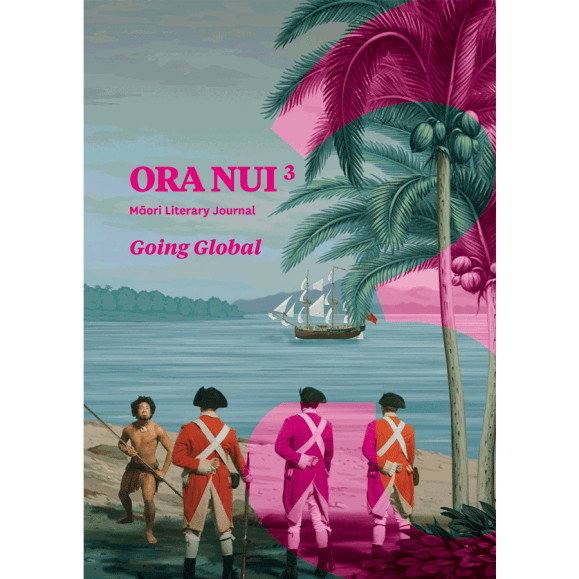
The cover showcases an image from from Lisa Reihana’s astonishing art installation, Pursuit of Venus (she has assured me we will get to see this again in New Zealand). I have propped the journal on a shelf so I can fall back into her mesmerising work. The image is the perfect gateway into writing that navigates questions of identity and belonging from multiple vantage points.


What I love about this journal though is the utter feast of voices and sumptuous artworks –  I cannot think of anything that has challenged, inspired or awed me in such diverse and distinctive ways. The poetry is symphonic in its reach and shifting keys. Here is a small sample of some of the poetry treats – I am till reading! I have just flicked to the back and got hooked on the lines of Robert Sullivan’s fruit poem, Reihana Robinson, Apirana Taylor, Briar Wood …. and then still sipping breakfast coffee, back to the dazzling currents of Reihana (especially ‘What is a nation?’).  I just bought a book of Reihana’s poetry – I am so hoping there is more in the pipeline.


Jacqueline Carter‘s  poetry often tenders a political edge. The poems included here underline her ability to get you rethinking things. These poems dig deep and resonate on so many levels.


‘The paepae

of the city’s children


is littered

with waewae tapu


people

who haven’t


been welcomed  on


people

in fact


who aren’t welcome at all’


from ‘Aotea Square’ (you just have to read the whole poem!!)


Rangi Faith pays homage to Janet Frame as he imagines the seat she sits in on a train; I have never read a portrait of Janet quite like this, and I love it.


‘When I was six years old

& running around the backyard

of our brick house in King Street,

a train steamed across the old airport

between us and the sea

carrying Janet Frame the poet.’


from ‘Janet Frame Passes through Saltwater Creek’


Rangi moves further south to pull Hone Tuwhare into a luminous rendering of place.


‘this place was always good for a waiata

to sing softly, or loudly if you preferred,

andto drum your tokotoko in time

to the incoming tide

on the earth’s Jurassic skin.’


from ‘To Hone at Kaka Point Seven Years On’


This is my first encounter with Teoti Jardine‘s poetry and I am struck by its clarity, its fluidity, its striking images.


.My Great Great Grandmother

wove her korowai with clouds.

and braided bull kelp lines

to hold the tide.’


from ‘Kuihi’


Kiri Piahana-Wong ‘s lyrical poetry holds the personal close, with both movement and stillness, little pockets of thought. I was drawn to her recounting Hinerangi’s broken heart and death.


‘On the day I died

it rained. Not just any rain,

but rain accompanied by

a sapping, brutal wind

from the southwest, the

kind that wrenches doors

from their hinges,

breaks down trees

and fences.’


from ‘On the day I died’


Two essays really struck a chord with me:

Dr. Carla Houkamau’s  ‘Māori identity and personal perspective’

Paula Morris’s ‘Of All Places: A Polemic on “International Book Prizes”‘


This is a substantial journal, a necessary journal, a must-read issue, and I have still so much left to savour. Bravo, Anton Blank for getting  this writing and this artmaking out where we can see it. I wish I could linger and share my engagement with every piece but must get back to writing my big book. I now have some new women to bring into my writing house. Thank you.


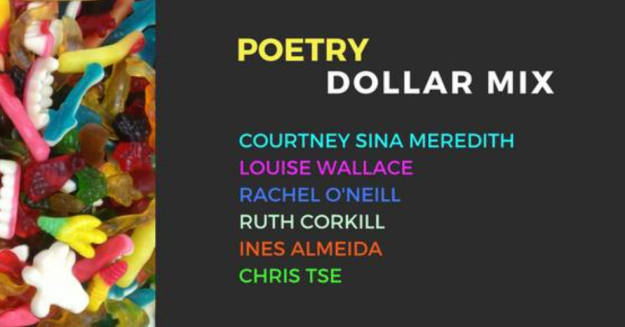
Poetry Dollar Mix – A Wellington Reading


Screen Shot 2017-10-03 at 9.18.06 AM.png


Screen Shot 2017-10-03 at 9.18.19 AM.png

Poetry Shelf reviews Mimicry 3 – a cracking good mix


Mimicy 3 is edited by Carolyn DeCarlo and Jackson Nieuwland, is published by Holly Hunter and features a cracking good mix of poetry, prose and images.

Find Mimicry at Unity Auckland, Time Out, University Bookshop Auckland, Unity Wellington, Vic Books, Volume (Nelson), Scorpio Books (Christchurch) and University Bookshop Otago, or order online with dirt-cheap NZ postage.

I love the way you can’t pin the mix of voices, sometimes young, sometimes a tad older, sometimes familiar, sometimes not, sometimes widely published, sometimes just emerging, sometimes lyrical, sometimes not, into a singular style.

As usual I read my way through the poems before slipping elsewhere (bar the arresting red pages ‘Tear sheet – Red’).


I am simply going to give you a taste of the poetry static that this suite of poems generates by quoting you the first lines of the poems (you can track the prose and images yourself).

This is the kind of journal that just makes you want to write.


A very fine first-line sampler from Mimicry 3


Stacy Teague from ‘ko au te awa, ko te awa ko au / i am the river, the river is me’

you could love wide-open / against the natural framework  / of this forever


Ruby Mae Hinepunui Solly from ‘Custard’

When I was smaller than the family dog


Aimee Smith from  ‘This is where first-year friendships come to die’

Aro Valley is haunted by ghosts,


Holly Childs from ‘Closing websites’

She said I said, ‘I can’t store energy inside me, can’t retain it, so it makes sense I’


Rachel O’Neill from ‘The good bastard’

I hope Mother and Father buzz around me till Kingdom Come.


Chris Stewart from ‘fluff’

I used to lick damp fluff


Nina Powles from ‘Dialectal’

this dialect has no written form / only hands feeling for the sound / only wings


Nina Powles from ‘Yellow notebook fragments’

#5c85d2 | smoke blue made of melting clouds


Annelyse Gelman from ‘Excerpts from Heck Land, a series of centos culled from William Burroughs’s Naked Lunch [note it’s cut and paste]

I can feel the heat closing in And I luuuuuuuuve it !


Courtney Sina Meredith from ‘eye’

drove to your house            parked across the road        ‘m n town


Courtney Sina Meredith from ‘the night sky is an immigrant coming from somewhere unknown’

half the group went into the past


Joan Fleming from ‘The optimism of our generation’

Dear X. Ruin porn


Eleanor Rose King Merton from ‘narcissus’

on a beach which is the edge of another planet


Eleanor Rose King Merton from ‘this is also how ownership is indicated’

why not just welt me up and vacate the area with a pillar of salt in each of my corners


Helen Rickerby from ‘Time and I’

The thing is, I have problems with time. Time and I, we just


Maria McMillan from ‘Snow, the reflective properties of’

You grow up, the city you grew up in and left,


Briana Jamieson from ‘Light’

Sun seeped into the van


Amy Leigh Wicks from ‘Log no. 1’

There is no blanket of fog. I am running through the woods today. Last night,


Anna Jackson from ‘Surprising news about your hairstyle’

Is it possible to sail through the air out


Anna Jackson from ‘Hurricane lamp’

Erin invites me to supper (thank you) and the heat


Caroline Shepherd from ‘fog girl’s diary’

how to tell my mother that yes, I did say that I could that thing and


Caroline Shepherd from ‘love lies’

my friends all had grand ambitions of love filling


Freya Daly Sadgrove and Hera Lindsay Bird from ‘Big time talk show with Freya and Hera’

Life is like a sad bucket, old men

Poetry Shelf reviews Nina Powles’s Luminescent – Every poem is a jewel of a thing


luminescent-cover-low-res_1_orig.jpg

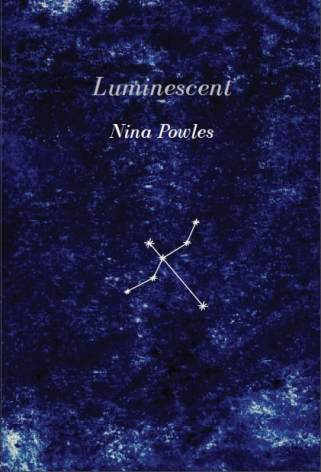
Luminescent, Nina Powles, Seraph Press, 2017


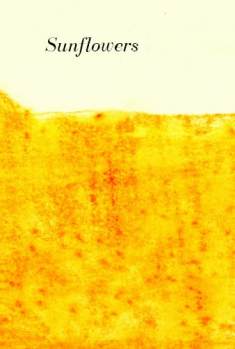
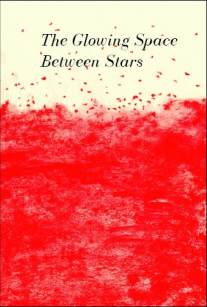
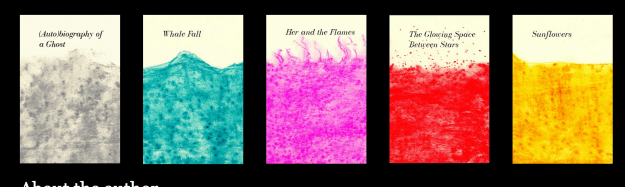
Nina Powles’s debut poetry collection, Luminescent, is a set of five slender chapbooks in a night-sky sleeve. Each book is like a constellation, with a particular woman, its luminosity. (Auto)biography of Ghost catches a ghost who was said to haunted Queen Margaret College’s bell tower where she fell to her death; Sunflowers becomes a conversation and an homage to Katherine Mansfield; Whale Fall imagines the world of Betty Guard, perhaps the first Pākehā woman to have lived in the South Island; Her and the Flames draws upon Phyllis Porter who died at 19 when her costume caught alight in a theatrical performance; The Glowing Space Between the Stars turns to Beatrice Tinsley, a New Zealand cosmologist. There are notes in the back of each booklet that background each woman.


I love the way the poems talk to each other within each booklet and between booklets.


The poetry extends itself in imaginings, yet grounds itself in the light of an autobiographical presence and research. Motifs such as dust, moths, ghosts and dreams are like connecting lacework that render a sense of ethereal wholeness to the set. The poems accumulate exquisitely textured voice; confident and idiosyncratic, searching and still, melodic and spare, intricate and warm. Every poem is a jewel of a thing.
 

katherine-low-res_1_orig.jpg


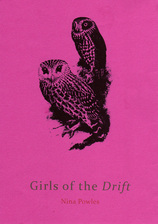
Sunflowers takes several Mansfield experiences as starting points for poems: she burnt all her letters and journals when she was in her early turbulent twenties; she wrote about a writing epiphany after seeing a Van Gogh painting for the first time; she recorded a dream after her brother’s death. In an early chapbook, Girls of the Drift, Nina put New Zealand poets, Jessie Mackay and Blanch Baughan together in poetry. The poems offered surprising pathways into our first women poets in print alongside a young contemporary poet forging her own poetic trails. With the Mansfield poems, I feel like I am sitting in a room in the South of France, and each poem resembles an aperture in the wall that pulls me into a Mansfield dreaming.

‘Fever dream’ is without punctuation, a slim short-lined poem that sizzles with ‘s’ alliterations that cut into the feverish night. In the midst of the hissing heat (stinging scorching nerves skin simmers inside struck bones sky she rising), two words cut into the fevered skin (teeth cracking). The poem is visually alert with its storm inflected sky. What stamps the poem indelibly is the final image:


bones cracking under

a New Zealand sky

and she is the wave

rising to meet it


‘She’ is Mansfield, and in that wave of fevered self, I am hooked into Mansfield musings.

The poems tap nostalgia, calling upon the senses to electrify the page. ‘Silver dream’ is set in a London garden in 1915, where Katherine bites into the pear her brother hands her:

It tastes like jam sandwiches

and sunshine on her mother’s hair.


After physical details that light the scene, the poem shifts to dream again, to the ghost-like vein that runs through all the poems, and it’s a surprising nudge. The pear leads us to ‘where everything is silver/ and he is alive again’, and the idyllic setting shifts. We are also lead to the collection’s title, as the whole poem glows with ache and loss in subtle overlaps:


Later she plants a pear tree

in one of her stories,


makes it glow in the window,

makes it touch the moon.


Several booklets feature erasure poems, where blocks of ghostly grey enable certain words to shine out as a poem. That we can see the journal entry in ‘Lucid dream’, through the grey veil, adds to the dream-like state of shiver and float. I pictured the whole journal translated into grey-veil poems. The lines that lift up feel so apt: ‘Time/ was shaken/ out of me.’ The final word, ‘violet’, pulls back to sweet-scented earth, to that nostalgic hunt for elsewhere places and elsewhere memories.


I love this set of poetry booklets, because we still need light shining on the shadows to recover the women who did extraordinary things, or everyday things, so they form a constellation, a suite of coordinates that might shift our contemporary means of navigation.
 

beatrice-low-res_1_orig.jpg


The Glowing Space Between Stars again links to the collection’s title, and underlines the idea that poetry can light up things, experiences, relations, ideas, feelings, memory. Beatrice, the cosmologist, shows how the space between things is the domain of curiosity. And for me, that feeds back into the way poetry is also curious about the gaps between. When you enter the poem gap, you enter a luminous field that so often surprises or delights or upturns.

Nina lists things in Beatrice’s childhood room; out of these things grew the adult curiosity (did anyone do this for Einstein or Newton?). She imagines the girl at 16:


then rushing home immediately

to write down what she’s seen,

noting especially

the glowing space between stars,

how it seems to have changed

since the night before.


Nina is making poems and she is making biographies, the one coming out of the other, and it is as though she is not tied to the rules of one or the rules of the other but can imagine and detour and intrude. In ‘Minutes’, the poet moves behind the galaxy facts, and the ongoing discoveries, to reveal the hiding narratives, the domestic underlay:


The light emitted by distant galaxies

takes billions of years to reach us.

It comes from a far younger universe,

somewhere where no one ever worried

about ironing their husband’s shirts

or arranging after-school childcare

because there were no ironing boards

and no children and no husbands


Five glowing booklets of poems that shine beyond the individual poems to gather a necessary and inventive, a lyrical and seismic, view of five very different women. I love this collection with its feminist energy, its poetic agility and its warm heart.


This, too, was the perfect time

to measure things in infinities.


from ‘Red (ii)’


Nina Powles, half Malasian-Chinese and half Pākehā, is from Wellington where she graduated with an MA in Creative Writing from Victoria University. There, she won the 2015 Biggs Family Prize for Poetry for Luminescent’s first draft. She writes poetry, non-fiction and makes poetry zines. Her chapbook, Girls of the Drift, was published by Seraph Press in 2014.


Seraph Press page

Nina Powles web page
Screen Shot 2017-09-30 at 12.56.14 PM.png


8854932.jpg


Given Words poetry competition for National Poetry Day 2017 – the winners


Screen shot 2017-07-29 at 5.32.03 PM.png


Given Words is delighted to announce the winners of the ‘Given Words’ poetry competition for National Poetry Day 2017.

The winner of Best Poem is Elizabeth Brooke-Carr for her poem All this and the winner of the Under-16 category is Hannah Earl for her poem A Magical Visit.

They will receive a copy of the New Zealand Poetry Yearbook 2017, courtesy of Massey University Press, and Lonesome When You Go by Saradha Koirala, courtesy of Mākaro Press, respectively, and their poems have been translated into Spanish and published on Palabras Prestadas. They will also be included in the forthcoming collection ‘Palabras Prestadas 6’ to be published in Spain.

In the run up to the competition we asked Kiwis to send us words via video and from these we chose the five words: exhilarated, static, finish, kaitiakitanga and biscuitchip. You can see the video of the five words here. All New Zealanders and NZ residents then had until National Poetry Day 25 August to write a poem that included these five words. The competition was judged by New Zealand poet and artist, Charles Olsen, who commented on the entries:

“I have enjoyed many of the images created such as a couple (I assume) who ‘huddled into curiosity’ as they contemplated a find on the beach; the sea – Hinemoana – ‘daggered with a cracked splinter of ice’ bringing a different take on climate change as does another poem pointing out ‘this earth is not our mother/fond and ever-forgetting’; the topical reflection on the elections with ‘media static posing as fact’; a reflection on life and death as ‘paua eyes weep tears of rain’. Kaitiakitanga was not an easy word to fit into a poem and I liked the originality of ‘the kaitiakitanga of your days… slips from you’, in The Finishing Time, and the delightful ‘kitchen floor act’ in Our Dog Pleads for Food. The poem All this stood out for me because it tells a simple story full of wonderful details. A conversation with a gull on a windswept beach introduces the concept of kaitiakitanga and we move on towards a second conversation and unanswered questions…

“I was also impressed by the creativity of our younger poets and was particularly drawn to the opening imagery of Songbird where the unexpected phrasing has something of the otherworldliness of birdsong. In the end I have settled on A Magical Visit with its vivid imaginary world – the way poetry can open thought spaces – and the particularly creative way the five words have all found a place within the story.”

We invite you to read the winning poems along with the other poems received.


Finalists for the Ronald Hugh Morrieson Writing Awards

Energy, action and quirky plots as finalists announced

The wait is over! Finalists for the Ronald Hugh Morrieson Writing Awards, Taranaki’s premiere literary competition, have been announced.

The bumper 237 entries have kept this year’s judges busy since the competition closed in August.

There are five categories in the Awards; The Secondary School Poetry and Short Story categories, the Open section Poetry and Short Story categories and the Secondary School Research Article category.

Research Article judge, Matt Rilkoff, says this year’s entries demonstrate how many fascinating people live among us.

“It is a courageous thing to allow someone into your trust to tell such a personal story as that of your life. Just as it is a daunting responsibility for the writer to attempt to sum up a lifetime of experience and character in a handful of words,” he says. “You all deserve a round of applause.”

Short Story judge, Rachel Stedman, says there was a lot of energy, and in general, action seemed to be central to many entrant’s plots.

“I was really impressed at how the high school entrants managed to write from such diverse perspectives, and I really enjoyed the quirky plots of some of the school entries,” she says. “In the open section, I enjoyed the vernacular used – very rural kiwi, very RHM!”

Poetry judge, Apirana Taylor, congratulated every entrant.

“Poetry reaches beyond the mere bread and butter of our existence. It casts the poignant light of insight onto the human condition. It seeks to and raises our consciousness,” he says.

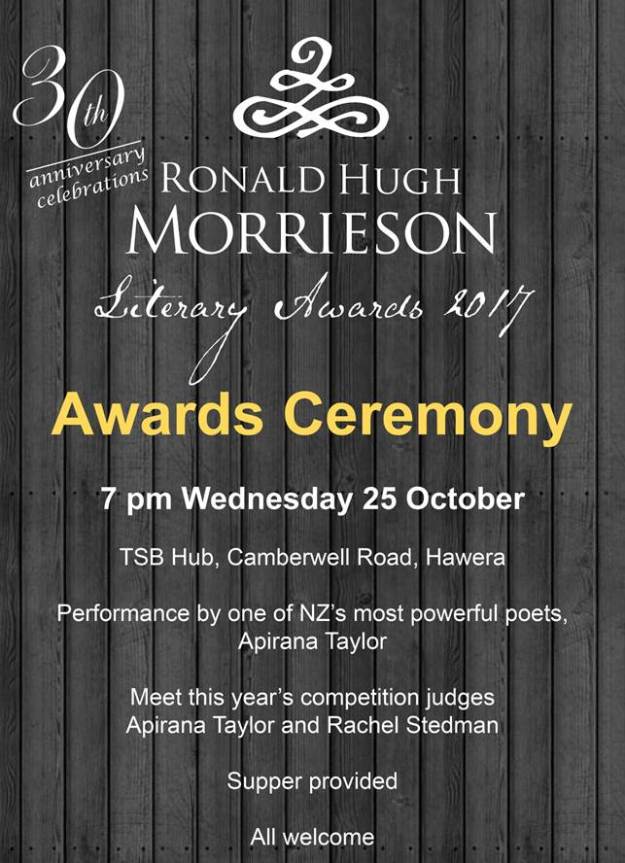
The Awards ceremony is being held at the TSB Hub in Hawera on 25 October from 7pm. All are welcome to attend to find out the winners and listen to a performance by Apirana Taylor, this year’s Poetry judge.

Secondary School finalists (all categories)
Denzal Adlam – Patea Area School
Hope Baker – St Mary’s Diocesan School
Nell Brown – Sacred Heart Girls’ College
Niall Clancy – Hawera High School
Maddison Cossey – Hawera High School
Puaawai Meihana Eiffe – Opunake High School
Sasha Finer – Hawera High School
Ashley Harrop – Opunake High School
Courtney Hatcher – St Mary’s Diocesan
Noah Hunt – Hawera High School
Megan Jackson – St Mary’s Diocesan School
Stevee-Jai Kelly – Opunake High School
Myah Kemsley – New Plymouth Girls’ High
Heather Phillips – Hawera High School
Yani Remoto – Hawera High School
Georgia Sparks – Hawera High School

Open Finalists (all categories)
Elizabeth Bridgeman – New Plymouth
Nell Brown – Sacred Heart Girls’ College
Emma Collins – Stratford
Maria Cunningham – Hawera
Anya Darling – Sacred Heart Girls’ College
Bruce Finer – Hawera
Stuart Greenhill – Stratford
Pip Harrison – Hawera
Janet Hunt – Inglewood

The Awards, sponsored by the Lysaght Watt Trust, honour the work of one of New Zealand’s most preeminent authors, Ronald Hugh Morrieson (1922 – 1972). Morrieson wrote four novels: a coming of age tale The Scarecrow (1963), Came a Hot Friday (1964), Predicament (published in 1975) and his only contemporary novel Pallet on the Floor (1976). All have been adapted for the cinema, the only New Zealand writer to have acquired this achievement. Two short stories were published posthumously, in 1974; ‘Cross My Heart’ and ‘Cut My Throat and The Chimney’.

Louise Wallace’s Bad Things – There is a freshness and a daring at work here

DAx7e6VUQAAZPoh.jpg


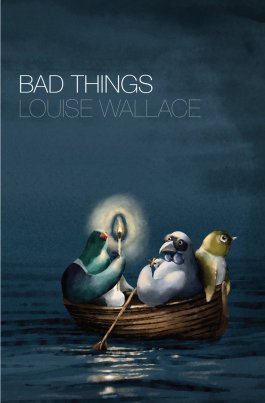
Bad Things, Louise Wallace, Victoria University Press, 2017

Some poetry collections depend upon a thread of similarity; connective subject matter, recurring motifs, a cohesion of form, tone and voice. Other collections resemble mosaics made of infinitely varied pieces that come together in surprising and satisfying ways. Louise Wallace’s new book, Bad Taste, exemplifies the latter. Turn the page and you have no idea what to expect – yet everything fits in the same animated package. There is a freshness and a daring at work here, because the poetry seems beholden only to its own choreography. I love that. I can’t think of another book quite like it. The cover, with the little patch of flame in the dark, and the boat waiting with its strange mix of birds, is the perfect entry into the poems.

Sometimes the poems relate little stories; condensed in prose paragraphs or strung with slashes to read in a single outbreath. Certain poems stop you in your tracks when you get to the last line and then tip you off the tracks of reading. ‘The hunt’ begins with a woman needing silence, yet it’s impossible to find when her voice rings out ‘like bells in the library’. She needs ‘to go church to pray’, but the poem does the twist and tilt and the ending becomes uneasy:


and without the silence she can’t pray / and if she doesn’t pray she will starve


Images also keep you on your reading toes: they might be strange, brightly-lit, smudged. There is, for example, a depiction of terrible things, ‘bad things’, that might fill a head:


They grow there—

a forest of tiny umbrellas.

They flourish—

a crown of terrible heads.


from ‘Bad things’


Or the sight and sound of a woman in a dump shop; ‘I’m amazed, she says’ over and over (‘Trash Palace’).

Or the sight and sound of a woman packing her husband and various assorted characters, including ‘the owner of the local chip shop’, into a row boat:


though it was extremely cramped

and they rowed

out to the open ocean

and sat quiet

and waited.


from ‘The body began to balance itself’


One poem may be densely packed and prose-like, while the next might offer short snappy lines that extend a poetic spine down the page:


resting shoulder

touching elbow


fingers to forehead

hand to cheek


from ‘Arrivals’


Strange poems, that may be hyper-real or surreal, hook with the element of surprise crouching somewhere:


7. You cannot take off the backpack.

8. You cannot just take off either.

9. You try to escape your own skin.


from ‘Right of return’


Sometimes it is a matter of taking three or four things (a man in a bus, the downhill, the light and the safety) and seeing what happens:


the light bounces

off the hill blindingly

bright and he’s saying

to himself

safety first

safety first

and he’s right, and all

through the bus

there is light.


from ‘Safety first’


Politics hue the mosaic pieces and slip in different directions, whether gender or ecological. Famous people glint the surface because their very presence is out-of-the-ordinary in the day-to-day ordinariness of what goes on. I especially like Meryl Streep, (but you also get Robert Redford and Reese Witherspoon): ‘Meryl Streep went nuts at me in the breakfast room, because I’d taken her table by mistake.’ I also like the arrival of Reeese, in ‘There are lots of ladies who have survived the desert’. The protagonist is walking in the desert, parched and desperate, when she hears wailing: ‘Reese Witherspoon emerges from behind a shrub, holding a plastic bowl full of oats and water.’ She cannot get her primus to work. Again Louise delivers the twist and tilt at the end of the poem, as though a shadow voice whispers to us to find perspective when we read of her neighbour: ‘Janet’s husband came home drunk one night and smashed a chair across her back.’


To understand the ability of the collection to travel and arc and shuffle, you need to juxtapose the offbeat with the achingly real. ‘Helping my father remember’ is the white hot searing heart of the collection. Communication is impaired: ‘Except something’s/ gone wrong with the wiring/ and he didn’t teach me/ how to fix it.’ The poem delivers such an emotional hit because of the way it lays little details alongside each other; the fact that the daughter is most like her father and his mother, and that sound might reactivate memory or that she is following him ‘through/ tall grasses, as high/ as my head.’  This time the ending is not a strange tilt but a poignant dive deeper below the poem’s surface:


We’re heading

to the river.

You find Nana,

and I’ll find you.

We won’t be lost

if we’re together.


If Louise’s new collection pulls you into a mosaic of dream, confession, anecdote or troublesome issues, it does so with a deft and darting accumulation of line. The overall effect works upon your ear, eye, heart and mind. There is stillness and movement, gaps and prickling images. I couldn’t ask for more – it’s a terrific read.


Louise Wallace is a poet and the founder and editor of The Starling, a literary journal for young NZ writers. She has published two previous collections: Since June (2009) and Enough(2013) . She was the 2015 Robert Burns Literary Fellow at Otago University.


Victoria University page

‘Reminders for December’ plus author note posted on Poetry Shelf

Louise in conversation with Pip Adam on Bad Things at Better Off Read

The Starling an online literary journal for young NZ writers