Read it here at Communion Arts Journal

Lifesaving
They don’t do it anymore,
breathe into the mouth to save.
We had learnt it reluctantly,
lined up beside a recumbent dummy,
waiting to take our turn to kneel at that mouth.
The simplest things disturb –
at night when the fluoros shut off and the cover is pulled,
the tiles swabbed – there it lies open,
not even a ventriloquist’s dummy
is so exposed.
©Wes Lee ‘Lifesaving’ won second place in The London Magazine‘s 2015 Poetry Competition
A conversation:
If you were to map your poetry reading history, what books would act as key co-ordinates?
I have always admired truth-tellers: Anne Sexton (The Awful Rowing Toward God), Raymond Carver (All of Us), Denis Johnson (The Throne of the Third Heaven of the Nations Millennium General Assembly), Dorothea Lasky (Thunderbird), Sharon Olds (Satan Says), Rachel Wetzsteon (Sakura Park), Claudia Rankine (Don’t Let Me Be Lonely), Douglas Wright (Laughing Mirror), Alice Anderson (Human Nature). To name a few.
One of my favourite poets at the moment is a Lovelock Paiute writer from Nevada, Adrian C. Louis (Ceremonies of the Damned), who blows my hair back, and makes me laugh out loud! He speaks such truths, I am in awe of him.
I also recently loved Michel Faber’s first book of poems on the subject of his late wife’s struggle with cancer: ‘Undying’. Brilliant book.
I am waiting to receive (through the mail) the Collected Poems of Jane Kenyon.
What do you want your poems to do?
Sharon Olds has said that she wants her poems to do something useful. I agree with that.
I want my poems to be brave, to connect, to surprise. I want to trust my voice, to resist self-censorship; to learn something each day about my own drama, as I learn each day from other poets. A journey of surprise and discovery.
Which poem in your selection particularly falls into place. Why?
I suppose a poem like: ‘Mania Come Back!’ which goes against the grain of the prevailing idea that the stable world is the desired world. It’s a poem that grinds against the flat plane of balance.
There is no blueprint for writing poems. What might act as a poem trigger for you?
I read poetry every day, and often other people’s writing is a trigger. Not only poetry but articles, essays, interviews, world news, movies, etc. And of course lines come up from “nowhere” and set the thing off.
If you were reviewing your entry poems, what three words would characterise their allure?
Resilient.
Ordnance.
Sly.
You are going to read together at the Auckland Writers Festival. If you could pick a dream team of poets to read – who would we see?
Probably poets I would like to meet, reading from the following collections:
Julian Stannard (The Parrots of Villa Gruber Discover Lapis Lazuli)
Michel Faber (Undying)
Vicki Feaver (The Book of Blood)
Elspeth Smith (Dangerous Cakes)
John Burnside (Black Cat Bone)
Martin Figura (Whistle)
Wes Lee is the author of Body, Remember (Eyewear Publishing, 2017), Shooting Gallery (Steele Roberts, 2016), and Cowboy Genes (Grist Books, University of Huddersfield Press, 2014). Her work has appeared in the Poetry New Zealand Yearbook 2018, New Writing Scotland, Westerly, The London Magazine, Landfall, Cordite, Poetry London, Irises: The University of Canberra Vice-Chancellor’s Poetry Prize Anthology 2017, and many other journals and anthologies. She has won a number of awards for her writing including the BNZ Katherine Mansfield Literary Award; The Short FICTION Writing Prize (University of Plymouth Press); The Bronwyn Tate Memorial Award. She is currently working on her third poetry collection, By the Lapels.
The four finalists will read from their work at the Sarah Broom Poetry Prize event at the Auckland Writers Festival on Sunday 20 May, 3.15-4.15pm. Guest judge Eileen Myles will introduce the finalists and announce the winner.
Sarah Broom Poetry Prize page.
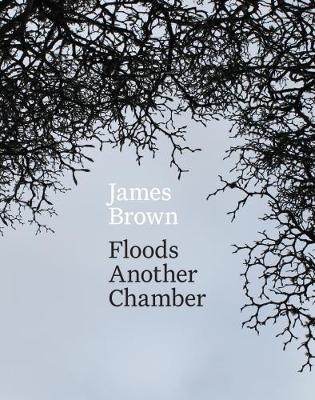
James Brown’s latest poetry book is Floods Another Chamber (VUP, 2017). You can find ‘Soft Returns’ in this collection.
Victoria University Press page
Yes! What a breath of outstandingly fresh air. I love Selina’s approach to picking the poems – you need to read the whole piece here
And it is a crackingly good selection. I can’t wait to read and listen. Some of my favourite reads from 2017 included. Content’s page here
From the intro:
‘I dedicate this last 12 months of choosing the ‘best’, to my friend and mentor, the late Associate Professor Teresia Teaiwa, whose Memorial Scholarship Fund continues to help give Pasifika peoples a choice.
Everybody loves free books (excluding my sons). I accepted this invitation to judge 2017’s batch of newly published poems because frankly, I wanted the books. I wanted to be able to map the latest constellation of Aotearoa’s poetry stars and navigate the various poetic journeys being offered from a particular time and place. I wanted to be inspired. After reading what seemed like, say, 3000 plus poems, I got what I wanted.
But I soon discovered that this was not an easy task. It wasn’t just a matter of reading a few poems and picking the ones I liked ‘best’. The sheer variety of form, tone, subject matter and lyricism soon problematised what I had thought was the ‘best’. Many a judge before me has acknowledged the impossibility of the task ahead. Most point to the bright sticky pink bubble gum of subjectivity that clicks and pops in the mouth whilst reading: ‘click, I like this one; pop, don’t like this one. Blow, I’m in my own bubble anyway.’ Presumably, this lets one off the hook. But I soon discovered that what I liked was too small a cage in which to read these free-range poems—just to further mix my metaphors in the post-euphoria of having climbed the Mt Everest of 2017’s poetic metaphors. Note to self: stop with the tongue in cheek stuff and get on with the serious business of writing this Introduction! (Aah, but whose tongue and in whose cheek?)
As a Pasifika Poet-Scholar, I wanted a more egalitarian way to ‘judge’ the ‘best’. I wanted to do something different, more collaborative, more epistemologically Pasifika—recalling Sia Figiel’s famously poetic passage nestled in the middle of her novel, Where We Once Belonged:
there is no ‘I’
only ‘we’
So, I decided to seek out the opinions, responses, reactions of the ‘we’ for a select numbers of poems that I hadn’t liked enough to include in my measly top 25. I gave out books and I gave out poems (with the payment that they could keep what they liked). My readers? Fellow Waiheke Trail Tribe runners, real estate agents, book club members, students, teachers, family members, people at the bus stop I saw often enough to bug. I asked them to give me 1-3 poems they liked and why.’
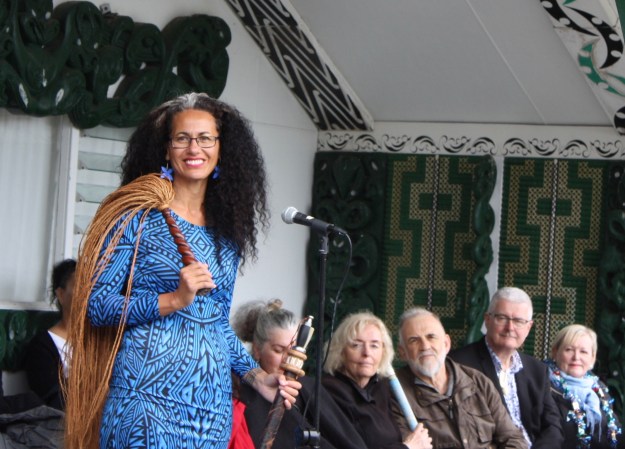
Selina at the Tokotoko Laureate event. Photo credit: Fiona Lam Sheung
‘Wherever there is a need for translation there is discomfort – a chasm that must be scaffolded, or connected by branch, bond or bridge. There is almost a desperation in the need to both enlighten and to be understood. In te reo Māori (the Māori language) the concept of te wheiao represents this liminal or transitional space. It is a term that has appeared in our incantations of mythology from the beginning of memory. It is a phrase that acknowledges a place between places, a third space, a chamber of waiting and uncertainty and one that has no set time, nor prescribed gestation period. It is also a place that is unavoidable and through which we must travel in order to gain full understanding. It is after darkness, but before light. It is the birth of all ideas. It can be the site of great discovery, or rampant anxiety, but regardless, it is a necessary place. There is no other way to reach te ao marama (the world of light). And it is in no way associated with shame.’
This is essential reading and you can read it here
Wild
Measure my wild. Down to my last leaf,
my furled, my desiccated. This deciduousness,
this bloom. Calculate my xylem levels.
My spore count, fungal, scarlet
in a bluebell glade. Whoosh,
where the foliage closes on a great cat.
Test me: how many tigers in my jungle,
how many lions at roam? Map my rivers,
deltas, estuaries. Mollusc, whelk, worm.
Monitor my silt. Do I have spoonbills,
high-stepping and watchful over the darting fish?
Rainfall on pines. Dappled sunlight
in my dells. Under moss, the fallen log, under
the log the hibernating hedgehog. Late my dates,
or soon? Return of the albatross, godwits
gathering. What clouds me, shifts,
but: indigo thunder-stack, pink wisp. Count the mice.
What will survive me, O my cockroaches, O my lice?
Scaffold me with metal, cage me in glass, tube me,
needle me, fill me, flush me. Saline solution:
the ocean. Oxygen therapy: the sky.
Mineral deficiency: socks off. Soil. Dark
rot, eye-less wriggle, while the roots seek, seek.
Un-diagnosable, that ticklish insect.
Mountain peak speak only snow, and thus
I am diminished; thus I rest in my pulse. Sweet
heart. Monitor my yearn, and treat it with trees.
Un-pane me. Wilden my outlook.
Membrane animal, skin mammal under the osmosis moon.
Allow my tides. All this to say, in love we nest, and on Earth.
©Sue Wootton from The Yield
Sue Wootton lives in Dunedin where she writes fiction and poetry and, as a PhD candidate at the University of Otago, is researching the importance of literature to health and wellbeing. Her debut novel, Strip (Mākaro Press), was longlisted for the fiction prize in the 2017 Ockham NZ Book Awards, and her most recent publication, The Yield (Otago University Press) is shortlisted in the 2018 poetry category of the awards. She is the selecting editor for the Otago Daily Times Weekend Poem column and edits the weekly Health Humanities blog Corpus: Conversations about Medicine and Life, found at corpus.nz
The poem “Wild” was awarded 2nd place in the International Hippocrates Prize for Poetry and Medicine in 2013. Sue’s website is suewootton.com
from a sonnet sequence called Fancy Dancing
vii.
Drowning is painless, or so they say, when we die
we’ll look as though we’re sleeping. How many thousands
and thousands are sleeping now in the swollen waters
of the Mediterranean? It’s enough to break your heart.
Maggie dropped in for a drink after work
the other day. Tears in the street. I’ve given her
our mother’s lovely little blue Limoges plate.
We talked about the grandfather we’d never met,
Alexander, thrown out of the family for some reason
we are left to imagine. I found him earlier this year,
lying all on his own in an unmarked grave in Ashburton.
You can drown in loneliness, it seems, just like in water.
We’ll put up a stone with his name on it, such a small gesture.
©Bernadette Hall
Bernadette Hall lives in a renovated bach at Amberley Beach in the Hurunui, North Canterbury. She has published ten collections of poetry, the most recent being Life & Customs (VUP 2013) and Maukatere, floating mountain (Seraph Press 2016). In 2015 shereceived the Prime Minister’s Award for Literary Achievement in Poetry. In 2016 she was invested as a Member of the New Zealand Order of Merit for services to literature. In 2017 she joined with three other Christchurch writers to inaugurate He Kōrero Pukapuka, a book club which meets weekly at the Christchurch Men’s Prison.
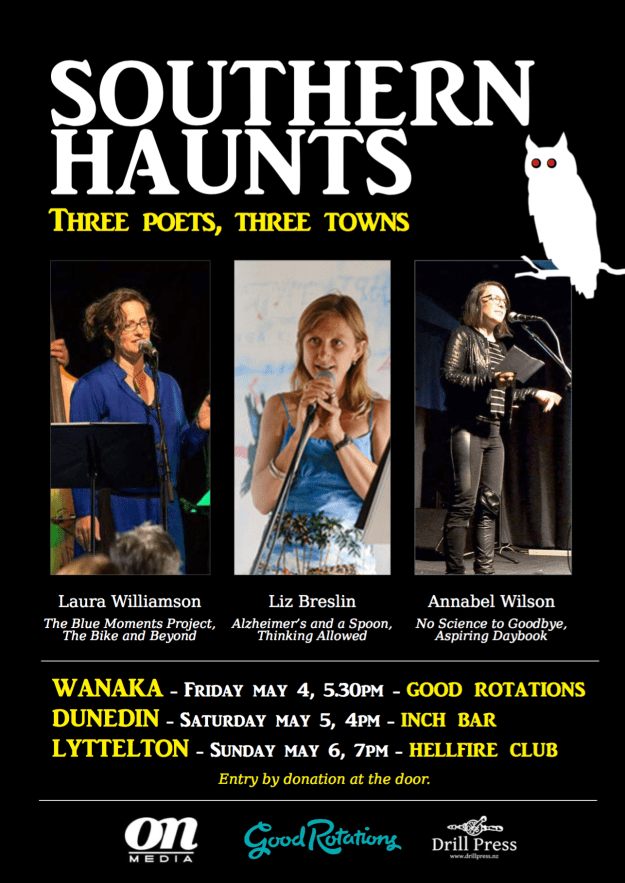
My mother read aloud a lot of AA Milne, Beatrix Potter to me and my sister when we were small; I loved the Narnia books; and one novel that still stands out for me was a copy of The Last of the Great Whangdoodles, by Julie Andrews Edwards – it was a book bought for the plane flight to America when I was 8. There was something momentous about it being a hardback, being written by the person I thought of as Mary Poppins, and its imaginative fantasy world, with moments of ludicrous word play (the sweet tooth – a tooth with a tiny flower tattooed on it) totally transported me.
Full article here
‘While New Zealand is most famous for its astounding natural beauty, friendly people and now legendary cinematic prowess, it has also been called home by some truly exceptional poets. Here’s a top 10 of New Zealanders who’ve graced the world with their poetry.’
Go here for the ten poets.
This on Janet Frame whose poetry keeps pulling me back, year after year:
Janet Frame was probably one of – if not the – greatest writers that New Zealand has ever produced. More than that, she was one of the most thought provoking and powerful writers of recent times. So much so that she was frequently spoken of as a Nobel Prize candidate for literature. She was more prolifically a writer of fiction – and that was what she will be chiefly remembered for – but she also published a single book of poetry.
If you’ve never read Frame’s work then you really should. She spent about a decade in mental hospitals after being incorrectly diagnosed with schizophrenia. Of this time she wrote: “I inhabited a territory of loneliness which … resembles the place where the dying spend their time before death, and from where those who do return, living, to the world bring, inevitably, a unique point of view that is a nightmare, a treasure, and a lifelong possession …” Her poetry collection is called The Pocket Mirror.
This is a tip-of-the-iceberg kind of list! Iceberg is not exactly the best trope though.
 NZ Poetry Shelf