Category Archives: NZ author

For women who signed the petition and the women who step forward


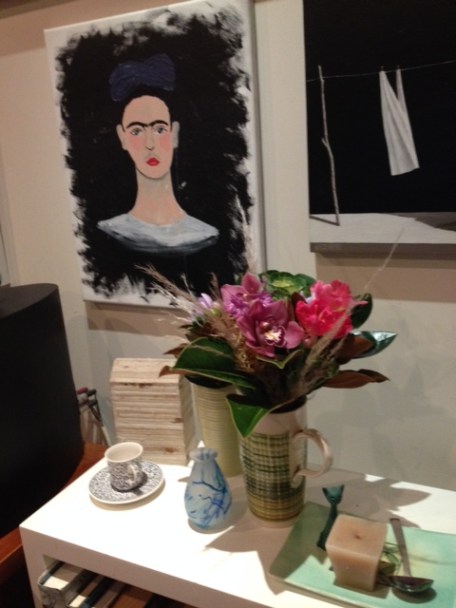
IMG_4390.JPG

Frida Kahlo by my daughter, Estelle Hight


125 years ago today many but not all New Zealand women got the vote.

I have waited until today to let this sink in and react

I am sitting here at my kitchen table with the grey clouds and a bite

in the air thinking of our early women poets who held hands with

the English suffragettes and risked their words to shape a better

future for all women by writing and speaking out and imagining

an equal life for women without violence and without poverty

and without being spoken over or patronised or ignored

on the grounds women were not men’s equal. I am thinking

this and the way I have a support crew of women who have held

my hand over the past year through difficulty and celebration

and I am wondering how we are risking words to shape

a better future for all women by writing and speaking out

and imagining lives without violence or poverty or denigration

or erasure or inequity and I am thinking of Selina Tusitala Marsh

and Tusiata Avia who have held my hand in this tough year

and who stand tall and proud for all women but especially

Pasifika women and speak out about abuse be it physical

or emotional and who then stand even taller and show

how words can sing and who get young Pasifika

women singing and I can feel the chain of hands stretching

back through a line of women writing to Blanche Baughan

and Jessie Mackay and I can feel the hand of Airini Beautrais

who is brave in her writing and Dinah Hawken who showed

me the tug of war between men and women and the way they

let the rope go and the way Fiona Farrell gave voice to her

broken city and we could hear the small stories of living

and here I am taking stock and giving thanks to the women

who came before me and giving thanks for my vote

and my freedom to choose education and motherhood

but thinking then of my notfreedom within medical systems

that know best and education systems that let children down

and clamp the Arts and the way even now our voices might

be trampled upon when we don’t sing in harmony. I am thinking

we bake bread and we buy bread and we get married and we don’t get married

and we live with women and we live with men and we hang out washing

and soothe the troubled child and we change gender and we go to work

and fold the clothes and get bruised and make the money stretch and make dreams

and try to keep warm and run away and chop the wood and get degrees

and we hold hands and we keep holding hands because there is strength in difference.

This year has almost wiped me out or so it feels but to sit here at the kitchen table and

reflect back on those brave early women who never gave up and who embraced shrill

and loud and forceful puts me back with the wind blowing through the manuka

back to that moment when I wrote a poem for Neve and her parents

and the world felt full of hope because kindness is just as important as strength.


Written in one breath by Paula Green, 19th September 2018, Bethells Valley, Waitakere


IMG_4405.JPG


Two speeches: Elizabeth Knox and Paula Green launch Anna Jackson’s award-winning novella


41946219_888009048075281_8779317979461451776_n.jpg

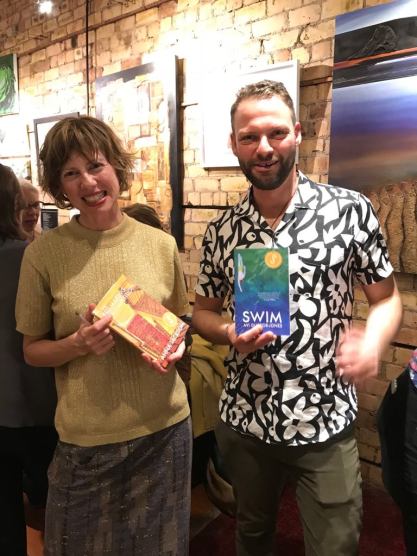
Anna Jackson with co-winner Avi Duckor-Jones at Time Out Bookstore


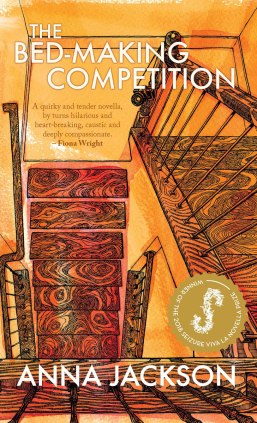
Anna Jackson recently won the 2018 Viva La Novella Prize with The Bed-Making Competition. The competition is open to Australasian writers but this is the first year a New Zealander has won – in fact two did. Avi Duckor-Jones also won with Swim. Both books were published by Australia’s Seizure Press and were recently launched in Wellington (by Elizabeth Knox) and in Auckland (by me).

I adore this book so it gives me great pleasure to share our launch speeches.


from Elizabeth Knox at Unity Books, Wellington:

Tena Kotou katoa

I am delighted to be launching Anna’s prize-winning novella The Bed Making Competition.  I’m a fan of novellas, a lovely, free, slippery form, partly because no one has yet decided what a well-made novella is supposed to look like, whereas there are plenty of confident and confidently expressed opinions about novels and short stories.  Like novels, a novella tells a sustained story, but in a way that somehow makes it more permissible to leave things out.  The Bed Making Competition gives us five chapters in the lives of two sisters, Brigid and Hillary.  Each chapter is a point of shared or solitary personal crises—solitary in the case of Hillary’s Goldilocks episode at a flat in Christchurch. The longest chapter is the duration of a pregnancy, the shortest a single day and a little run of events that consolidates a character, a relationship, a world view. Years intervene between each of the episodes—for instance Brigid is pregnant with a first child in the central one, then has two growing children in the next. Over and over I had the pleasure of surprise in coming back to the small configuration of sister, friends, parents, partner, children and seeing the changed circumstances, and changed selves, and the work of an almost Elizabethan sense of fortune in their lives—fickle fortune, an artist of whimsy and unease.  I kept wanting to know more, and having to intuit much, and being rewarded by the book’s feeling for the mysteriousness of what happens to people over the course of a lifetime.  These characters make their beds and have to lie in them; they move their beds around to make room for more beds; they climb into bed with a beloved sister and are as happy as a puppy in a basket; or they find themselves in the wrong bed in the wrong house, or bedless at bedtime and sitting on a suitcase.

This is a book about a sibling relationship. All sibling relationships entail some degree of competition.  Hillary and Brigid for the most part aren’t competing for anyone else’s attention—maybe a little for Brigid’s best friend Julia, and Brigid is ever ready to cede even a best friend for a sister’s needs—but never for their parent’s attention—and always for each other’s.  I could say that the novella charts a power relationship between sisters, except “power relationship” doesn’t quite describe the oscillations in their orbits of each other as the gravity of one becomes greater than the gravity of the other, and then swaps back again—back and forth over half a lifetime. The Bed-Making Competition is essentially about this dance, Hillary and Brigid circling each other, taking turns at being the heavier gravitational body. The younger sister waits for the older to come out of her bedroom and listen to her story, waits to have mysterious things explained to her, or for a lead in how behave with their parents, how to feel about being left by mother and father, and with father’s credit card.  Later each waits for the return of remembered moment of glorious closeness.  The novella gets that sense of loving too much, or of not being loved enough, that rises and falls in relationships between sisters.  It gets the necessity of wooing a sister.  Of all other relationships changing at the sudden presence of sister who has been absent too long. It gets being asked to be responsible, to manage a sister’s crisis for the happiness of helpless and aging parents, to manage it as if there’s some managerial magic in just being a sister. What the book doesn’t do is resentment, or disavowal—”I am not my brother’s keeper.”—only the helplessness of being able to do only so much.

This is a book very much about the changing nature of strong relationships.  And it’s serious about those things, but serious with lightness, and an appreciation of mess, mayhem, oddity.  The characters in this book never complain, they’re observant, rueful, they have notions about how to improve their lot – often peculiar and experimental notions.

The story is book-ended by abandonment and death—a mother runs away, followed by a father trying to retrieve her—and then then, in time, that mother is on her deathbed.  The meaningful deathbed exchange the mother and daughter have isn’t about the past, but a conversation conducted as if both of them have a present and future.  The scene is so true to the book’s understanding of people, and true to life, I found it really moving.  This book is moving, and also productive of anxiety. I really worried about the characters at various points.  Books that make me worry about their characters are my favourite kind of books.  The Bed Making Competition is a fine example one of those, a book that mostly caresses its readers and smooths their fur and sometimes startles them into electrified wakefulness by brushing their fur up the wrong way. So, welcome everyone to this caressing and startling book. And thank you Anna.


Elizabeth Knox
 

Bedmaking-front-cover-sml.jpg


from Paula Green at Time Out Bookstore, Auckland:

Kia ora koutou katoa

Last night I had a poet anxiety dream about launching this book. I am extremely glad I am not standing on this stepladder in a crumpled cotton dress and muddy gumboots. And I have a little speech written on this piece of paper that I haven’t left it at home.

Auckland University Press launched Anna’s terrific Pasture and Flock: New and Selected Poems earlier this year – a book that reveals a poetic curiosity in the world, lilting lines that absorb sumptuous detail, intimate attachments to people, places and ideas, an enviable ability to make words and thus poems move and surprise. I loved it.

What a treat to share Anna’s award-winning novella with you this evening when it delivers such similar joys. This is a book of two sisters, Hillary and Bridgid, two shifting voices that we follow through chronological and geographical jumps. The narrative exposes fragility, envy, attachment, yearnings, detachment along with various internal aches and hungers when life throws you off kilter or keeps you on some kind of vital track of living. As teenagers for example the two sisters get inebriated, drink champagne on swings, thrash the credit card, when the father goes in pursuit of the mother who has walked out. They get to eat pizza without salad.

There is so much to love about this book, this small package that is rich in effect.

I adore the way voice pulls you through Anna’s textured writing: it builds character, scene incident, development, and most importantly sister relations.

The details are both sensual and sumptuous: whether of food clothes people or setting. They establish an architecture of the domestic, of family, that is both intimate and revealing.

Little scenes stand out: such as in the art gallery where the prices and titles of Bridgid’s work get mixed up in her small corner of the gallery. Her partner gets most space.

Larger scenes stand out such as when Hillary goes to stay with Bridgid in London. Or the Goldilocks scene in the flat in Christchurch. But you have to read these for yourself!

I was hungry for this book as I read it. I am reminded of reading the honeyed fluency of Katherine Mansfield or Virginia Woolf. The way the novella resembles stream of consciousness but it is ever so beautifully and distinctively crafted. You get caught up in the writing currents and you don’t want to stop reading. It gives me great pleasure to declare this gorgeous book launched and to invite you to read it yourself. Congratulations on the award Anna and on this immensely satisfying read that startles and surprises as much as it draws you into points of recognition.

Paula Green


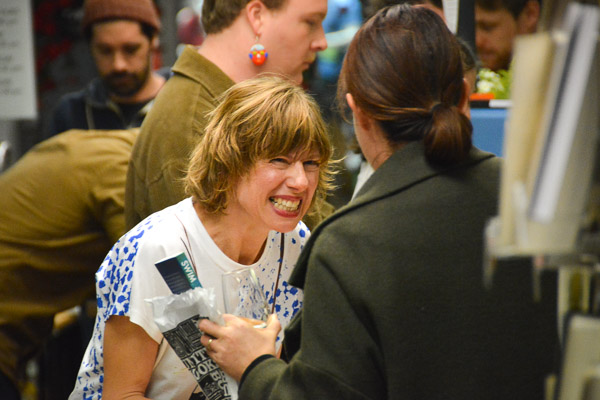
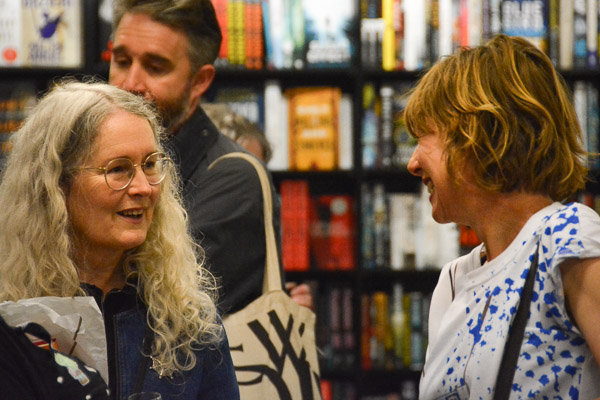
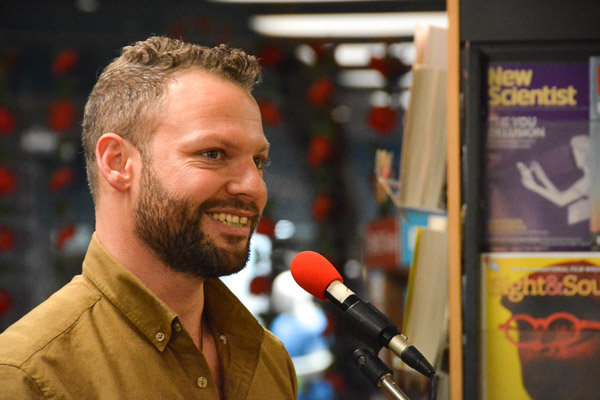
Some photos from the Unity Book launch
DSC_1168-3.JPG

DSC_1208-9.JPG

DSC_1239-13.JPG

DSC_1198-7.JPG


Poetry Shelf Monday Poem: Lynn Davidson’s ‘Leaving Bass Rock gannet colony ‘


Leaving Bass Rock gannet colony


After skypointing to show

it’s ready


after one last dive, shorting the sea

(the crack, the pressured current fizzing)


after one last moment of great aloneness: a fleck

in oceans


after the last fish in its gut –

the fin and skin and bone of it – tears apart


it takes a final flight, blowing

Bass Rock into the feathery pieces   we call


aura or

atoms    we called


father or

Adam


©Lynn Davidson


This poem was was published in New Writing Scotland 35. Bass Rock is a rock/island in the Firth of Forth. It’s a huge gannet colony and has a long and interesting history of human habitation too.

Lynn Davidson writes poetry, fiction and essays. Her latest poetry collection Islander will be published by Shearsman Books and Victoria University Press in 2019. Lynn currently lives in Edinburgh.


Dunedin writer Sue Wootton is the recipient of the NZSA Peter & Dianne Beatson Fellowship 2018

Sue_Wootton-300dpiBW-546x600.jpg


Sue Wootton will use the fellowship to work on an historical novel. She says: ‘I’m proud and delighted to be the recipient of the 2018 Peter and Dianne Beatson Fellowship. It’s really invigorating to receive this vote of confidence in my project, and wonderful to know that I can now dedicate a sustained stretch of time to work on my second novel, which begins during the 1948 polio epidemic and explores the effects of this on one NZ family’.

Sue Wootton’s poetry, fiction and essays are widely published in New Zealand and internationally, and her work has been recognised in a number of awards and competitions, including the International Hippocrates Prize for Poetry and Medicine, the Caselberg Poetry Prize, the Gwen Harwood Poetry Prize, the University of Canberra Vice Chancellor’s Prize, the BNZ Katherine Mansfield Short Story Competition and the NZ Poetry Society International Competition. Her debut novel, Strip (Mākaro Press), was longlisted for the fiction prize in the 2017 Ockham NZ Book Awards, and her fifth poetry collection, The Yield (Otago University Press) was a finalist in the 2018 poetry category of these prestigious national awards.

Selection panel convener David Hill commented: ‘Sue Wootton is a versatile and much-admired writer, with a growing track record in both poetry and prose. Her sample of work is distinguished by writing that is both adventurous and accessible.’


Full details here


Poetry Shelf audio spot: Rebecca Hawkes reads ‘Sighting’


Screen Shot 2018-07-23 at 11.04.47 AM.png


Photo credit: Mitchell Botting 


‘Sighting’ was originally published in Starling 5


Rebecca Hawkes is a poet and painter who has traded the tussock-clad hills of the Canterbury high country for the suburban slopes of Wellington. More of her work can be found in Landfall, Mimicry, Sport, and elsewhere via her website.


image.png


image.png


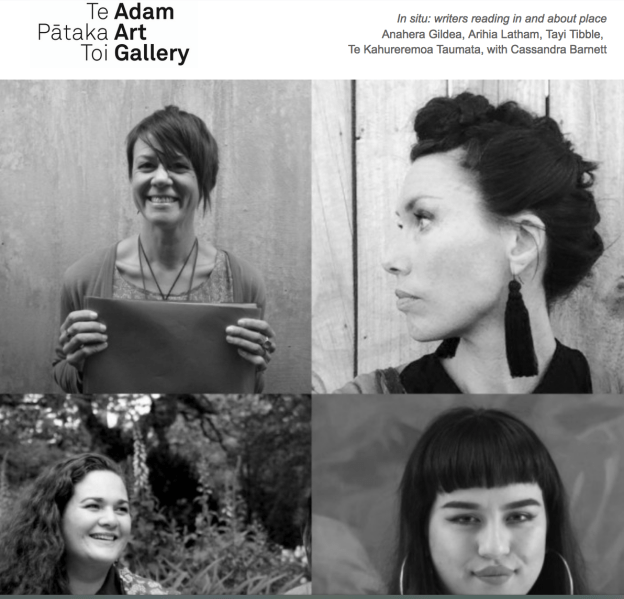
Four highly talented wāhine at Adam Art Gallery Te Pātaka Toi

Screen Shot 2018-09-11 at 6.14.23 PM.png

Adam Art Gallery Te Pātaka Toi
Victoria University of Wellington
Gate 3, Kelburn Parade
Tel: 04 463 6835
Email: adamartgallery@vuw.ac.nz
www.adamartgallery.org.nzClockwise from top left: Anahera Gildea, Arihia Latham, Tayi Tibble, Te Kahureremoa Taumata

In situ: writers reading in and about place
Friday 14 September, 6pm
Adam Art Gallery
Refreshments provided
Please join us for an evening of live readings generously organised by writer and art theorist Cassandra Barnett, who will moderate the evening. This series of readings uses the occasion of the exhibition The earth looks upon us / Ko Papatūānuku te matua o te tangata as an opportunity to hear from four highly talented wāhine.

We are pleased to host Wellington-based writer Anahera Gildea (Ngāti Raukawa-ki-Te-Tonga, Kāi Tahu, Te Āti Awa, Ngāti Toa, Ngāi Te Rangi), author of Poroporoaki to the Lord My God: Weaving the Via Dolorosa (Seraph Press, 2016); poet and short story author Arihia Latham (Ngāi Tahu, Kāi Tahu); singer, songwriter and storyteller Te Kahureremoa Taumata (Ngāti Kahungungu, Ngāti Tuwharetoa); and Tayi Tibble (Te Whānau-ā-Apanui/Ngāti Porou), who recently published her first collection of verse titled Poūkahangatus though Victoria University Press.

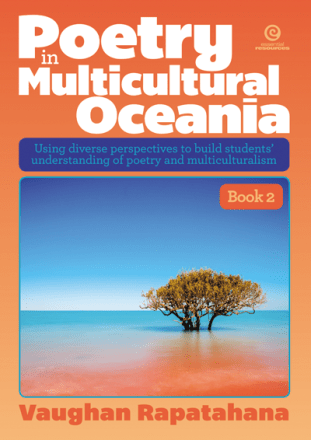
Poetry in Multicultural Oceania 2 – a teaching resource for Years 6 to 9


909ff650-8574-440e-954e-5c6548f874da.png

Poetry in Multicultural Oceania Book 2

edited by Vaughan Rapatahana, Essential Resource, 2018


‘mountains once roamed/ this land’  Apirana Taylor


Vaughan Rapatahana has edited a second collection of poems with associated activities to encourage the reading and writing of poetry and to further develop a student’s multicultural awareness. Vaughan is committed to drawing upon diverse poetry voices: Māori, Pākehā, Pasifika, Aboriginal Australian, Asian.

This issue includes: Mere Taito, Renee Liang, Apirana Taylor, Gregory Kan, Alan Jeffries, Simone Kaho, Paula Green, Michelle Cahill, Reihana Robinson, Alison Wong, Serie Barford, Michele Leggott, Selina Tusitala Marsh, Iain Britton, Makyla Curtis, Lionel Fogarty, Shasha Ali.

Each section includes the poem, a warm-up, focus on vocabulary, tips on reading aloud, consideration of the language and layout, questions to explore understandings and evaluations, followup suggestions.

The subjects are wide ranging but generally attached to identity issues.


I love the way this book will expose new and familiar poets to students and teachers and offer accessible and stimulating entries into poems. Bravo Vaughan for continuing to celebrate local poetry. This is an essential resource.


‘I am told that the wai of who/ is the water of our veins’  Makyla Curtis


Vaughan Rapatahana commutes between Hong Kong SAR, the Philippines and Aotearoa New Zealand. He is widely published in several genres in Māori, English and other languages.  His latest poetry collection is ternion (erbacce-press, Liverpool, England). Vaughan has a PhD in existential philosophy from the University of Auckland. Vaughan has written commentaries for Jacket2 (University of Pennsylvania), including a 2015–2016 series and a new series currently in progress.


Essential Resource page


Ka Mate Ka Ora: A New Zealand journal of poetry and poetics Issue # 16 now live

Screen Shot 2018-09-11 at 7.30.40 AM.png

Ka Mate Ka Ora live

Featuring:
Hannah Lees on Vaughan Rapatahana
Owen Bullock on Michele Leggott
Susannah Whaley on Janet Frame
Erena Shingade sends a Letter from Mumbai
Ian Wedde remembers John Dickson
Peter Bland remembers Gordon Challis
Aorewa McLeod remembers Heather McPherson
and Murray Edmond ponders Closure with a Wrecking Ball


I was really delighted to read Aorewa’s memories of Heather and her poetry.

I loved Erena’s letter with its poem inserts.

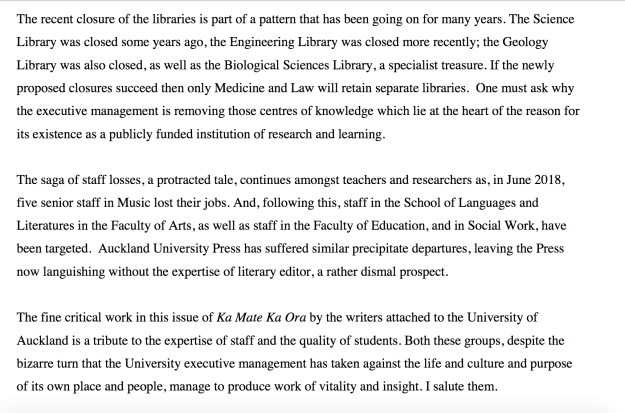
Reading Murray’s editorial on The University of Auckland decisions to shrink The Arts along with sites of book culture and knowledge is essential reading. Heartbreaking to read as a graduate. What can we do?


An extract:

Screen Shot 2018-09-11 at 7.44.21 AM.png

Now back to the rest of the issue!


A Poetry Reading: The Kink Poetroversy


image001.jpg


This year’s Winter Readings will belatedly
be held in the month of September in
Paekakariki, continuing a popular event
at the City Gallery in Wellington
2003-2008. Each event featured a tribute to an
album or group. This year’s readings form
a tribute to the Kinks.

Sunday, 23 September 2018
Poets: Iain Sharp and Joy MacKenzie (Nelson),
Michael O’Leary and Damian Ruth (Paekakariki),
Mark Pirie, Mary Campbell and Wyeth Chalmers
(Wellington) and Bill Dacker (Otago).
MC: Rob Hack

Venue: St Peter’s Hall, Beach Rd, Paekakariki.
Time: 12-2pm.

Admission to the reading is by koha. Books for
sale from 12.00pm.

Earl of Seacliff Art Workshop (ESAW) will publish
an anthology of poems (free with koha) by the
readers featured to celebrate the event.

Winter Readings are presented by:

HeadworX Publishers

Paekakariki Community Trust

Poetry Archive Trust

Earl of Seacliff Art Workshop