I know that I look the same / but I have manifested a lion
ripe & pumping giddily
I know that I look the same / but I have manifested a lion
present & unasked & ready
I know that I look the same / but I have manifested a lion
precise as mathematics
I know that I look the same / but I have manifested a lion
shoulders up against the wind
I know that I look the same / but I have manifested a lion
peace be upon the lion
I know that I look the same / but I have manifested a lion
& everyone always says how glamorous
I know that I look the same / but I have manifested a lion
as a prize
I know that I look the same / but I have manifested a lion
& how is this manifestation distinguished from all the other animals?
I know that I look the same / but I have manifested a lion
I said how is this lion distinguished from all the other animals?
I know that I look the same / but I have manifested a lion
a toll, a shimmer, a serious cloud, valuable, brief
I know that I look the same / but I have manifested a lion
behold, my lion
I know that I look the same / but I have manifested a lion
l’chayim l’chayim
I know that I look the same / but I have manifested a lion
it is beloved
I know that I look the same / but I have manifested a lion
in the kitchen
I know that I look the same / but I have manifested a lion
ah thunder!
I know that I look the same / but I have manifested a lion
& the urge for daylight is real
I know that I look the same / but I have manifested a lion
& a stag rutting in a meadow
I know that I look the same / but I have manifested a lion
a rare nocturnal lion
I know that I look the same / but I have manifested a lion
ta for noting how this lion is distinguished from the other animals
I have popped it into a segmented tray
I have left it to set at optimal temp
*
& bloody etcetera!
gawd
I owe Cath a letter
she wrote in April & now
it’s almost September
I should phone Pam too
phone Pam write to Cath
tell them I’m moving
to latch back onto the hopeless dresses of
Sde Boker with my goy ex, or
to Whanganui, maybe
What is the time?
Sam Duckor-Jones
Sam is an artist and writer from Wellington. His first poetry collection People From The Pit Stand Up was published in 2018 (VUP) and his second Party Legend will be published in June 2021 (VUP). He has exhibited widely and is represented by Bowen Galleries. In 2020 he bought a church near Greymouth that he is turning into a sculpture.
CONGRATULATIONS to all the poets. This is the best longlist I have seen in years. I have loved all these books to a sublime degree. I am also delighted to see a mix of university presses and smaller publishers, and those inbetween. I plan to review Hinemoana and Karlo’s books over the coming weeks (Goddess Muscle, Karlo Mila, Huia Press and Funkhaus, Hinemoana Baker, Victoria University Press).
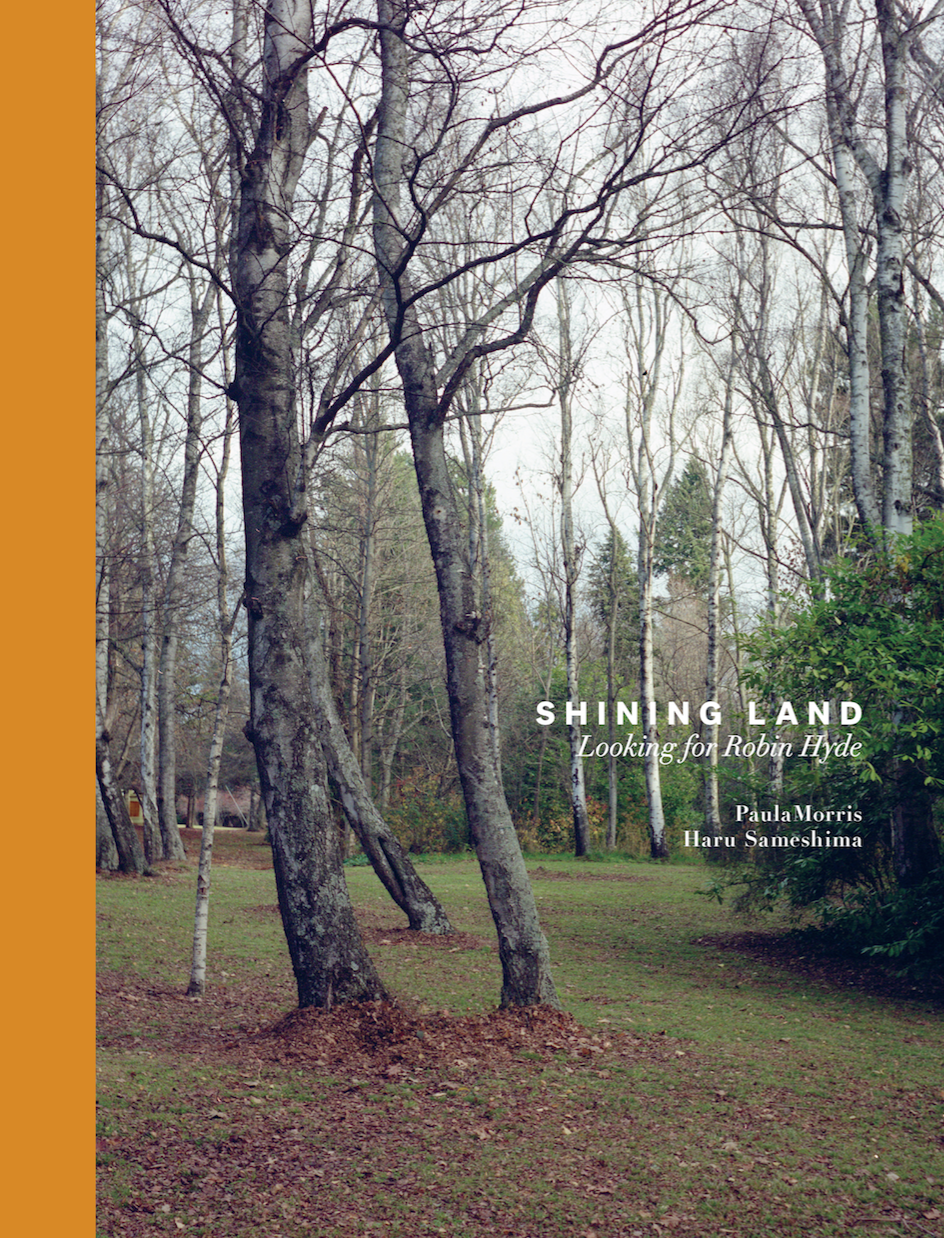
Shining Land: Looking for Robin Hyde, Paula Morris and Haru Sameshima,
Massey University Press, 2020
In 2020 Massey University Press initiated the kōrero project, a collaboration between ‘two different kinds of artistic intelligence to work at a shared topic’. As I underlined in my review, the first book – High Wire, by Lloyd Jones and Euan Macleod – was stunning. The kōrero project seems necessarily open with no prescriptive views on how each collaboration ought to proceed. I like that. The second book, Shining Land: Looking for Robin Hyde by writer Paula Morris and photographer Haru Sameshima, offers a different approach and is equally satisfying. Both hardbacks are gorgeously produced by Massey University Press.
Perhaps I am drawn to Shining Land because it returned me to my own search for women poets in the archives and their poetry as I wrote Wild Honey. Paula and Haru went looking for Robin Hyde in her books and in the archives, but equally significantly in the physical places where she had lived in Aotearoa. Individual ‘storm chasers’ who met and planned and then took to their own roads of creating. The photographs and the text offer separate narrative threads, but also establish electric connections between image and word, between what is imagined and what is read, the elusive past and a personal present. I see this ground-breaking book as an invigoration of genre. It is memoir, biography, artwork, road trip, narrative, collaboration. It does not contextualise a subject in academic theory or adhere to biography paradigms or offer sustained close readings. If the authors are in search of their subject so too are the readers. I like that. In fact I love peering between the lines and the shadows, so to speak.
Consider this book as you might consider a poem where the poet offers stepping stones without filling in the whole river scene. It is over to us to choose how we navigate the electric currents, cross the bridges, absorb the biographical details, the self exposures of author and photographer. We can track Robin’s difficult life: her incessant pain after a knee injury, numerous lovers but no long term attachments, the death of a lover overseas, a stillborn baby, a secret baby placed in foster care, the scorn of men including local literary power brokers, the censure of family, the mental fragility, breakdowns even, the prolonged time in ‘mental hospitals’. The incessant need to earn money to pay for the care of her son, Derek Challis. The departure from New Zealand, with her fraught stopover in war-torn China and Japan. Her premature and tragic death in London. The books published in her lifetime; the articles, the fiction, the poetry written. Such layers of challenge when unendurable pain (eased by morphine) was spiked by the pain of losing her babies, her lover, her family’s respect, a place to call home, to be home.
In the Alexander Turnbull Library I held a sticker scrapbook that Robin had made for Derek, little stickers pasted alongside little stories she wrote for him. The stories petered out, and then the stickers petered out, and I felt the pain of the loss deeply. I carried a phantom presence as a throbbing ache back to my hotel room.
As I try to write about Shining Land my words keep breaking its incandescent magic (shining), its accumulating moods. The photographs are uncanny, eerie, both empty and full, empty of human presence because Robin is missing and missed. The storm chasers outside the frame. I keep imagining Robin entering the scene. I like that. When I look at the shot of Rangitoto ki te Tonga D’Urville Island and Te Aumiti French Pass from French Pass Road with gloomy skies and greys I become grey state. I like this so much. How can I speak? This is where pregnant Robin posed as a married woman, before moving to Picton and then back to Wellington with her secret baby and and her secret heartache. I am on the pass looking down at the grey isolation. I will never know Robin, I will never be in Robin’s shoes, but I feel. And that is what Paula and Haru do. They feel Robin in the depths of their looking and their making. It is contagious.
For Paula, it has much to do with feeling home and unhome and being on the move. Nomadic. Paula has lived in many cities, both in Aotearoa and overseas. Robin too was always on the move, from this house to that, to psychiatric institutions, from her city of birth to a city in the provinces to a city offshore, far removed from loved ones. Haru’s photographs offer footbridges to states of minds and to author phantoms. Transcendental. Movement rich. Still. So too does Paula’s writing. Together Paula and Haru visited the Grey Lodge that is now part of Unitec Institute of Technology, but was part of Avondale Mental Hospital. Robin admitted herself after a nervous breakdown. Unlike other guests she had a private room in the lodge and patch of garden, a table and a typewriter, and took up her doctor’s suggestion to write a memoir. The photographs are eerie, thick with mood and absence that translates into an uncanny and heart-beating-faster presence. Paula’s paragraph sets my hairs on end. Place becomes heartbeat.
The door to the attic is green, tattooed with graffiti, and Haru warns me about the steps: they’re alarmingly narrow and tall, and must have been difficult for Hyde to negotiate with her limp. The attic view now is of tree tops and the city, with glimpses of the harbour. The room is dusty and bare, humming with a central air unit. Something about the attic excites us both: it seems alive with Hyde, or perhaps we feel close to her in this plain space; the shape would have been familiar to her, the quiet.
After I edge back down, my feet too big for the steps, I leave Haru alone in the house – apart from the ghosts – waiting for the light to turn.
Shining Land makes me feel closer to Robin, perhaps more than any other book has done, apart from her poetry. Paula and Haru have built a space for her, a plain space, with pathways and rooms and gaps between the lines. And so more than before, I am feeling the pain of losing babies, of needing to write, of translating experience into prose and poetry, of persisting on through crippling pain. Of not saying everything out loud, so the rooms of a life fill, so we may eavesdrop all this time later.
Paula offers felicitous quotations, along with nuanced comments. Empathetic. Insightful. Spare. For example: The building where Robin roomed in Whanganui – after she had fostered Derek out – now houses a children’s clothing shop: ‘I’m glad she never had to look at those tiny rompers and bonnets.’
On one page, one sentence only: ‘Gwen Metcalfe, her closest friend: “It is a lot to happen to a girl before she is twenty.”’
When I was writing Wild Honey, I mourned the way some writers of the past and the present have rendered our early women poets missing, lost in the service of academic theory, in the privileged views and yardsticks of men. I wanted to hold these fierce and insistent women close, and feel their poetry, feel their circumstances and their ideas, their refusal to vanish. Shining Land is a form of embrace. It offers significant facts, personal connections, an astute selection of Robin’s words, and from friends and enemies. The book is restrained and vulnerable and probing. On this occasion and in this way, it holds Robin. In the gaps, the empty rooms, the medicine bottles, the window views. It makes me want to pick up my favourite Hyde collection Houses by the Sea and catch glimpses of an elsewhere time and place, a woman finding life so heartbreakingly difficult. I feel Shining Land to my core.
Paula Morris MNZM, Ngāti Wai, Ngāti Manuhiri, Ngāti Whātua, is an award-winning novelist, short-story writer and essayist. A frequent book reviewer, interviewer and festival chair, she is an Associate Professor at the University of Auckland, where she convenes the Master in Creative Writing programme, and is the founder of the Academy of New Zealand Literature.
Haru Sameshima was born in Shizuoka City, Japan, and immigrated to New Zealand in 1973. He completed an MFA (1995) at Elam School of Fine Arts, University of Auckland. Sameshima has exhibited and published widely in New Zealand, and his images illustrate some of New Zealand’s most significant art and craft publications. He has his own publishing imprint, Rim Books, and runs his Auckland studio, Studio La Gonda, in partnership with Mark Adams.
Nouns, verbs, etc. Fiona Farrell, Otago University Press, 2020
Once upon a time there was
a story.
It lived in the mouth of an
old woman.
It was a bad-tempered story
that kicked the door in and
threw plates. It did not behave
itself.
But she gave it shelter.
She had made it herself.
She had fed it with her own
blood. She had spat her own
stomach into its straining
beak. She knew why it cried.
from ‘The old woman’s story’
Fiona Farrell, much loved poet, novelist and nonfiction author, began writing poems in childhood, at times in ‘wonky capitals’ with the delicious ‘thump’ of end rhyme. She discusses her evolution as poet in the terrific preface to her selected poems published last year. There were comic poems that made her class laugh, the earnest poems of high school with elevated expectations of what a poem ought to be, and the kick in the gut when, at 19, a young man laughed at the poem she showed him. She stopped writing.
It’s so difficult in 2020 to convey just how it felt to be in this world where men, past and present, stood about booming to one another like so many kākāpō on a steep hillside.
from ‘Preface’
So many other women in the 1960s through to the 1970s were writing on scraps of paper in scraps of time getting scraps of attention and rarely making it onto the hallowed ground of men, their journals, their university course material, their poetry gigs.
Today I’ve embroidered relativity
polished the Acropolis
knitted Ulysses
and baked two trayloads of cantatas
for the kindy.
Now, if the baby sleeps another hour
I’ll just about have time
to whip up some of that
Instant Immortality.
from ‘Preface’
Fiona’s ‘Preface’ echoes so many women’s voices I read in my Wild Honey travels. I think of how long it took me, along with other women, to move from hidden notebooks to going public and getting published. For Fiona it was the death of her father, and his complicated presence in her life, that started her poetry pen moving again: ‘The way the simple act of choosing words can give the illusion, however temporary, of control when emotion threatens to overwhelm’ (‘Preface’). She showed the poem to someone she shared a teacher’s college office with and took up the suggestion to get it published.
Fiona’s Nouns, verbs, etc. (selected poems) includes extracts from her four collections: Cutting Out (1987), The Inhabited Initial (1999), The Pop-Up Book of Invasions (2007) and The Broken Book (2011). Interspersed between the extracts are clusters of uncollected poems and, at the end, my favourite endnotes ever, a suite of fascinations that complement the joys of reading the poems, unexpectedly, beautifully. Fiona said she heeded the positive response to the endnotes in The PopUp Book of Invasions.
Nouns, verbs, etc. is a Poetry Treasure House. Across decades of writing, the poems are guided by inquisitiveness, linguistic nimbleness, a freshness of voice that survives over time, an exposed heart, the presence of I and we, political undercurrents. There are human and humane attachments because the recurring revelation is that this poet cares. Poetry stands as a means of care: for self, for loved ones, for the world, for the present and the past, for the stretch and possibilities of languages. In particular Fiona has cared about women; in their daily lives, in a history of writing, in genealogies, in other places and other times, in the need to resist subjugation and erasure.
She sits in the dark
on the rough side of
Sunday. The wood is
bare down here, torn
from a tree. She gets
her woolly hat. The
table is saw scrawl
screw and scratch.
She brings a cushion
and some crackers.
The table is a bare
bivvy. Brace and
bruised knuckle.
She flings a sheet
over. She will
live here
for ever.
from ‘The table’ – The Broken Book
The poem Fiona wrote upon the death of her father signalled the way poetry can be a necessary part of our lives as both readers and writers. I know through the extraordinary number of letters and poetry I received during our various lockdowns how vital poems were, whether we were writing or reading.
Each of Fiona’s books, both poetry or prose, has been necessary reading for me, right from the goosebump discovery of The Skinny Louie Book in 1992 to a suite of books responding to the earthquakes in Christchurch. The Broken Book transmuted from a book of walking essays to an earthquake book where the essays were interrupted by poems like quake jolts. It was written because of the Christchurch quake, and it makes the everyday voices away-from-the-cameras visible, the living with damage and daily fear and little blessings palpable. Again poetry becomes necessary.
The PopUp Book of Invasions was prompted by Fiona’s writing residency in Donoughmore, Ireland, the manuscripts her book borrows its title from, and the layering of contemporary invasions along with those in her whakapapa and Aotearoa. She wrote: ‘It was a strange feeling, being there. I wrote to express that’ (from ‘Endnotes’). Again the book becomes necessary reading.
I love the insertion of the unpublished poems in thematic clusters. There are a handful of love poems – so you get to enter a poetry love glade and imbibe the heat and shimmer and connectivity of love. I have no idea when the poems were written, but they feel so vital and fresh. Original. I want to quote from all of them but here is a taster:
They tied the knot.
It was a knot of their
own devising. They
went over and under,
over and under many
times, and it held. So
they could fly, tied
to earth by the knots
around their ties.
So they could always
find their way home.
from ‘Knot-tying for beginners’
Another cluster centres upon travel, upon home and not home, upon hills and mountains, lakes and harbours that anchor you into the guts and grit of the land, and then sets you drifting through place to people and back to the way place shapes and nourishes us. I especially love ‘Our trip to Tākaka’. I want to hear this poem read aloud, to hear the mood ripple through the understated repetitions and motion, the effect travel has upon us, the surprises that become part of our luggage, as we move along, and as we arrive back home.
Some poems carry whiffs of fable – I am picturing the poet blowing on the white page as though it were glass, with a fable presence making its subtle mark. There is always the everyday commonplace experience, relationships or objects in Fiona’s poetry, but there is also the way the poem transcends the realism and makes the ordinary glow.
The fathers swayed beneath us
walking like mountains on
their big legs. We looked
about, seeing the way ahead.
The fathers said hang on!
They held us by the ankles
lest we fall. And sometimes,
they flung us out into empty
air, and we were lost. We
squealed, flailed, knowing
already the pain of solid
ground. But the fathers
caught us on the downward
flight. Gathered us to the
knotting of old jerseys
smelling of fish and vege
gardens and Best Bets and
the whole wide place we’d
glimpsed from their tops.
from ‘The fathers’
Fiona Farrell’s poetry sparks language into dynamic combinations because, as the title of the book suggests, words have mattered to her – from the origins of words, to ancient languages, to codes and punctuation. In The Inhabited Initial endnotes – a collection that celebrates the organic states of words and languages – I discover the origin of the question mark and the punctuation mark. The original exclamation mark was a word that monastic monks inserted to denote moments of joy. I love this! Little glades of joy in the flow of a text. Nowadays the exclamation mark can be a form of shout and exhibitionism. Equally fascinating: Roman scribes used full stops to mark rest bays for breath in the flow of a text. I am thinking poets have a more open relationship with punctuation and how it adds to the reading of poetry.
Nouns, Verbs etc is a reading delight. It offers distinctive travel itineraries that set you drifting in unfamiliar skies, lingering in some poems as though you stall in the familiar rooms of your house, daydreaming between the lines, wondering at the power of nouns and verbs to provoke such intense feelings and connections. Let me raise my poetry glass and toast this glorious book (and loving Otago University Press production). Thank you Fiona, this necessary book is a gift.
FIONA FARRELL has published poetry, fiction, drama and non-fiction. Uniquely among New Zealand writers, she has received awards in all genres. Her poetry has been shortlisted for the New Zealand Book Awards and has been widely anthologised. Her first novel, The Skinny Louie Book, won the New Zealand Book Award for Fiction. Three later novels have been shortlisted for that award, and five have been longlisted for the prestigious International Dublin IMPAC Award. In 2013 she received the Michael King Award to write twinned books prompted by the Christchurch earthquakes and the city’s reconstruction. The non-fiction work, The Villa at the Edge of the Empire, was shortlisted for the 2017 Ockham NZ Book Awards. In 2018 she edited Best New Zealand Poems for the International Institute of Modern Letters. Farrell has received numerous awards, including the Prime Minister’s Award for Fiction and the ONZM for Services to Literature. She made Dunedin home in 2018.
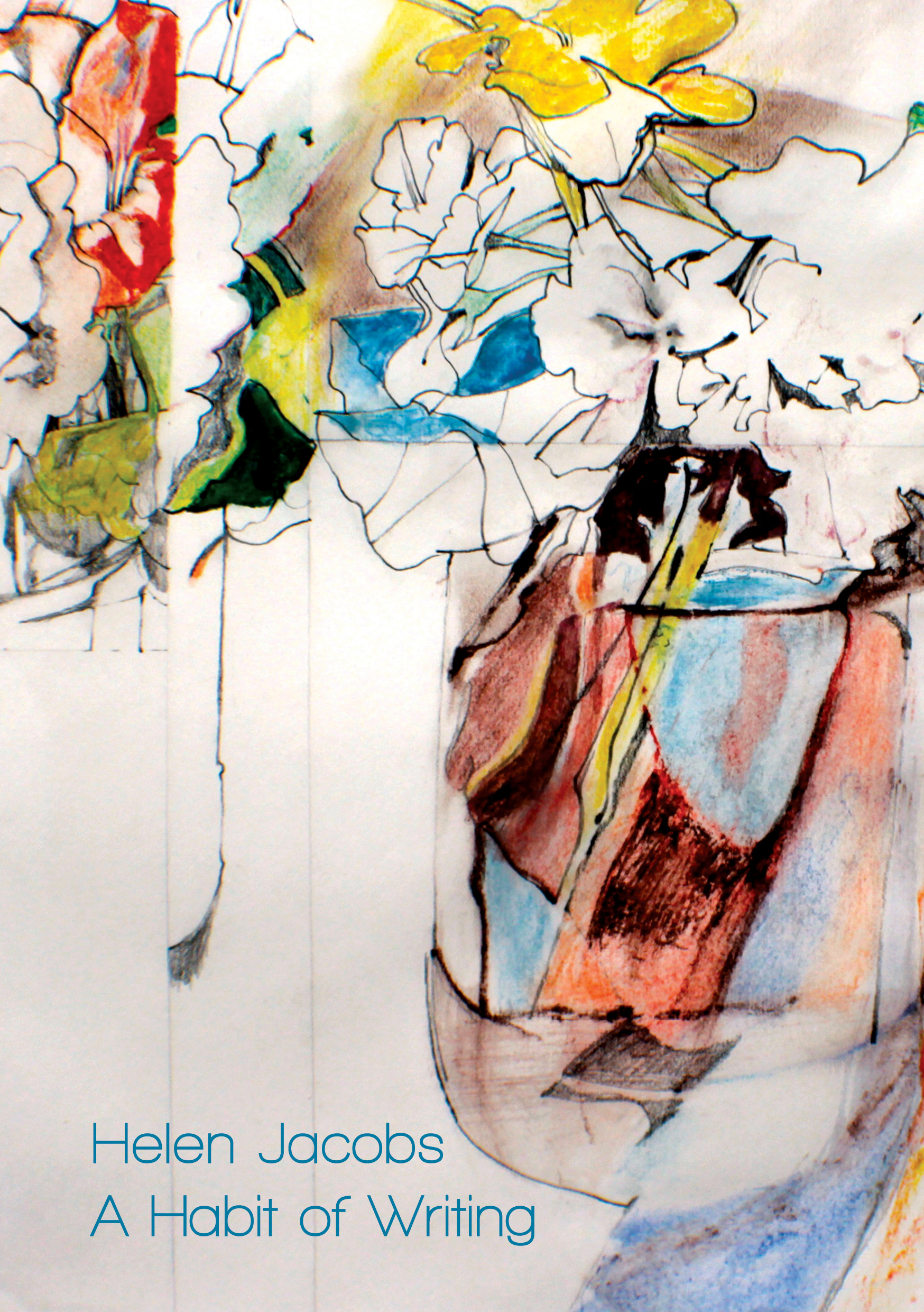
Helen Jacobs, A Habit of Writing The Cuba Press, 2020
Flying
I am being ordinary
and flying on a word
as the mist of the morning
unfolds.
I am being ordinary
in a community
where all are old and ordinary
and I am flying on a word
to meet the sun.
Helen Jacobs
Helen Jacobs (the pen name of Elaine Jakobssen) was born in Pātea, Taranaki in 1929. She has published eight poetry collections, and contributed to numerous journals both in Aotearoa and offshore. During her time as Mayor of Eastbourne, Helen advocated for the local environment and local writers and artists. She worked at the Women’s Electoral Body and was appointed to the Planning Tribunal. Since her time in Christchurch she has been a longtime member of the Canterbury Poets Collective. Aged 91, she lives in a retirement village and is still writing.
Helen’s new collection A Habit of Writing is a delight. Here is a poet writing in old age, absorbing things, often small, but sometimes large, always captivating: an object, walking, a flower uncurling, the hills, the wind, a pot of utensils. Each poem slowly and exquisitely unfolds its subject with rivered fluency, with enviable economy.
These are poems to place on your tongue, one at a time, where they will slowly dissolve leaving vibrant aftertastes that last all day. I read the poems before I went to sleep and I got straight back when I woke up. Perhaps I am drawn to the state-of-being of a woman in her nineties, where relations with life and death shift a tad. Where age is a close companion. Words matter a lot. She reaches out for words. She writes. She celebrates.
Fluency
Fluency traipsed off with the years,
shuffled out imagery.
I look at the pots on the balcony
the plants static, consonants and vowels
straight up.
They do not speak in the wind.
Look to the hills. I do,
as the low cloud ends wisp
across the ridges.
This is a collection of miniature pieces that form a larger mosaic, a wider picture that holds up the poet’s lived-in world. I am acutely drawn into an experience of age that makes me see things a little differently. And that is good. When Helen was ‘young’ and in her sixties she would see the ‘oldies’ out on a bus excursion, and now when she is out on the retirement-village bus she sees the young go by on bicycles. Her steps might be slow. She might slowly examine a geranium leaf as she waters her pots. She might repeat her mother’s ritual and drink a glass of port wine at Christmas. A sonnet would never suit ‘the bowls we play’; free verse is the ticket. It is the ‘small things / as my time grows old’ she observes, that ‘remark the larger world.’
Here I am, a young one on Helen’s time scale, but I am drawn to the slow step, to the measured pace, the prolonged look, to the way a single object or activity can be both rich and comforting in reward. The poem ‘Thinking of lemons’ reminds me how we skate over the surface of things, places, people, experiences. How every person we brush against in the street has a story, a sequence of dreams and mishaps. How every view is on the move, and like a good book, or a good poem, reveals further lights and shadows.
Reading A Habit of Writing offers the utmost joy and comfort. This is a book to savour and to give away. Glorious.
when asked to explain the lines that lead to now, you describe /
the shape of your body as it hits water / the shape of cold water
shocking muscle / the shape of fleshy chambers forced to loosen
and acquiesce / the shape of your grandparents in their coffins /
the shape of coffins that are too small to contain entire lifetimes /
the soft and hard moments we can’t forget no matter how often we
turn our backs to the light / [you write this poem out of love / but
even love can be a blindfold] / the shape of you and your parents
standing in your grandparents’ driveway / after being kicked out
for talking to your aunty’s white boyfriend / your hand reaching
out to someone you don’t recognise in a dream / their silhouette
branded upon your brain / [you’ve tried to swallow the night and
all its inhabitants / but they weren’t designed for consumption] / the
night standing in for doubt / as you argue with your own memory /
waking up to the smell of 皮蛋瘦肉粥 / the shape of a bowl designed
to hold love / love that is never spoken of because to do so would
silence it / the shape of silence when you tell your parents you’ve
fallen in love with a white boy / the shape of that white boy pressed
against your body / both your hearts / shaped like hungry mouths /
the shape of your mouth biting into the world’s biggest egg / the
shape of years spent running before walking / your knees shredded
and bloody / even after you grew the thick skin they said you would
need in this lifetime / the years pass like a watched pot / but you imagine
steam rising from its wide open body / flashbacks to the shape of air
being forced into a lifeless body / some incisions are made to clean
blood, others to fast-forward a certain end / when your grandparents
spoke of life it was whatever came their way / no one back then had
time to hide behind the sky / to pull strings / to taste control / the shape
of control does not fit with the shape of effort / a grounded bird tries
to climb an invisible ladder to heaven / to correct a path the world
wouldn’t let it look upon / in case it traced a line too close to comfort /
we all fear the shape of comfort when it belongs to someone else /
forgetting that we all look the same buried six feet under / both your
grandparents appear before you on the night you learn how to take off
your blindfold / when you finally recognise the shape of acceptance /
and how it might fit among the ruins of your rejections / it goes like this: /
the fights, the kisses, the direct hits / unfolding yourself into a shape
the world doesn’t know how to contain / what doesn’t fit / what doesn’t
hold true / the shape of your name / the shape of a bowl that never
empties / all of these things fit together if you turn them the right way up /
you run your finger along the lip of the bowl and remember / what it
means to be laced in time and not know how to use your hands to feed
yourself / you count the years / you feel their shape flooding your
throat / making a noise / making a space for what’s to come
Chris Tse
Chris Tse is the author of the poetry collections How to be Dead in a Year of Snakes and HE’S SO MASC. He and Emma Barnes are co-editing an anthology of LGBTQIA+ and Takatāpui writers to be published by Auckland University Press in 2021. He also edits The Spinoff’s Friday Poem.
鸣 (míng), the cry of animals and insects, rhymes with tooth, which rhymes with precipice, which rhymes with the first part of my Chinese name.
I am full of nouns and verbs; I don’t know how to live any other way. I am a tooth-like thing. I am half sun half moon, and the scissors used to cut away the steamed lotus leaves. I am honey strokes spreading over the tiles.
Certain languages contain more kinds of rain than others, and I have eaten them all.
from ‘Fieldnotes on a downpour’
I have been a fan of Nina Mingya Powles’s poetry since her chapbook Girls of the Drift (2014) through to her glorious poetry boxset Luminescent (2017). The poems are probing, lyrical, self-inquisitive, with women placed centre stage. Her new collection Magnolia 木蘭was also published in the UK (Nine Arches Press) and was shortlisted for the 2020 Forward Prize for Best First Collection. In 2018 she was one of three winners of the inaugural Poetry Prize, and won the Nan Shepherd Prize for Nature Writing the following year.
Currently living in London, Nina is a poet, zine-maker and nonfiction writer of Malaysian-Chinese and Pākehā descent. I have long been fascinated with the idea that poetry is way of writing home, whether home is physical, on the move, a state of mind, ancestral connections, familial relations, an anchor, an epiphany. And if poetry is a way of writing home it is also a way of writing to / for / with / by / underneath / inside / from (home). Magnolia is an organic version of this as it shifts languages on the tongue, layers sensual detail, raises identity questions, and moves from London to Shanghai to Aotearoa. Smells and tastes of elsewhere bring elsewhere closer to the point the paper is imbued with scent and living matter, and your reading taste buds pop.
there are only dream mountains high above the cloudline
I come from a place full of mountains and volcanoes
I often say when people ask about home
from ‘Night train to Anyang’
Senses are on alert as you read a Nina Powles poem, and I love the physical sensation as you read:
After Mulan saves China / fireworks rain down in waves of multi-coloured
stars
from ‘Girl warrior, or: watching Mulan (1998) / in Englsih with subtitles
Food is an exquisite presence, often connecting you to place, a particular memory or event, love, home. But sometimes Nina lingers on food for the sheer pleasure of food itself: it’s tofu for the love and sake of tofu, lotus leaves and sticky rice ‘sucked clean’. I have felt a similar addictive tastebud reaction reading the poetry of Ian Wedde, particularly The Commonplace Odes.
for the morning after a downpour
Layers of silken tofu float in the shape of a lotus slowly
opening under swirls of soy sauce. Each mouthful of dòufu
huā, literally tofu flower, slips down in one swallow. The
texture reminds me of last night’s rain: how it came down
fast and washed the city clean.
from ‘Breakfast in Shanghai’
Colour is equally vital, sometimes the hue of the land is evoked but, at other times, the tone of a particular painting is foregrounded. It makes a difference that I have stood in the Tate Gallery in London and felt the astonishing hum of Rothko’s colour palate, and have imbibed the colour in Agnes Martin’s equally heavenly paintings. I am curious that Nina’s poems, so active with colour, affect me as much as the artworks. It is as though the poem and the artwork are placed on my wrist like perfume and I feel the colour-pulse streaming through. Really the whole experience is both words and greater than words. Really it is as though a poem has the ability to hum inside us. Like colour.
#fee10c | saffron: pigment in medieval manuscripts
If I could step inside any Rothko painting it would be Saffron
(1957), which is different from his other yellows because of the thin
bright line that divides the colour fields, not colour shapes or colour
squares or colour blocks, none of which are wide enough to contain
the light. A line dividing two yellow atmospheres glows along the
edges, an electric current. If you stare long enough it seems to get
bigger, slowly opening at one end until it forms a bright gap that
you could just fit through by putting each one of your limbs inside,
one by one, until you are swallowed by light and your skin is the
colour of sunflower petals right before they die and you are either
floating or drowning or both at the same time.
from ‘Colour fragments’
Reading Nina’s collection, I keep fine-tuning what a poem can do. One moment it is the origami bud unfolding in my palm to expose surprising petals of feeling. The next moment she retraces her steps though a city she once lived in; walking and writing through the city and subsequently the miniature poem version. We choose how we move through the poem as miniature city, me on tiptoe, slowly, slowly. This experience is deeply affecting in ‘Falling city’, where the poet lived when young, where she is falling in love, where things have changed and things have remained constant. Nina is seeing and imagining and writing Shanghai by walking; and by reading Shanghai writer Eileen Chang / Zhāng Àilíng, by reading Robin Hyde, by reading maps (‘each person has their own secret map’), visiting ramen bars, musing on ‘New Woman’.
18. What was Chang herself like? I don’t know, but I think she
understood this moment when the dream and the real begin to blur.
She understood how the sky in Shanghai contains many different
colours at once: “At the horizon the morning colours were a layer of
green, a layer of yellow, and a layer of red like a watermelon cut open.”
19. When reading her stories in translation it’s like trying to see
her from a great distance. Or through a thick pane of glass. I am
standing outside, peering into rooms where her ghost has been.
20. As autumn deepened I expected to see your face on the street
or in the subway station. After you left I thought I might feel sad
that this possibility could no longer exist. Instead after a while the
outlines of trees looked sharper, like a fog had lifted.
from ‘Falling city’
The shortish middle sequence, ‘Field notes on a downpour’, is a favourite. There is a hunger for words that fit, for Mandarin fluency, for her mother whose name means rain and language, together meaning ‘cloud tints’. In its intimacy, small details, flâneur pace, mother closeness, disappearances, its repeating motifs, particularly clouds and rain, its naming and its confessions, its love yearnings, this sequence is succulent poetry. And I keep musing on why I am so attracted to the making of poetry, whether writing it reading it, and that it maybe comes down to poems that move into and from the heart of the matter. I don’t mean it has to be full of feeling. I don’t mean it has to fit the facts or perceived realities. I mean it navigates poetic truths: that on certain occasions, in certain places, for a particular person, radiating multiple lights and nuances, this is how it is. In this crumpled and self-challenging world – poetry flicks on the human switch. I am musing this because Nina’s incandescent poetry navigates a bundle of vital questions on who and how and where she is. On what being a particular human in a particular place means to her. On when being asked where you come from digs deep. On needing to eat words. On feeling the rain in all its colours. On being in love.
In order to make learning Mandarin easier, I started to see the
characters as objects I could collect and keep close to me.
魔 (mó), spoken like a murmur, an evil spirit or demon.
One night you said my name in the dark and it came out like a ghost
鬼 from between two trees 林. A ghost that rhymes with a path
between rice fields which rhymes with a piece of steamed bread which
rhymes with paralysis of one side of the body which rhymes with thin
blood vessels.
In June the cicadas were so loud we thought the trees would swallow
us whole.
from ‘Field notes on a downpour’
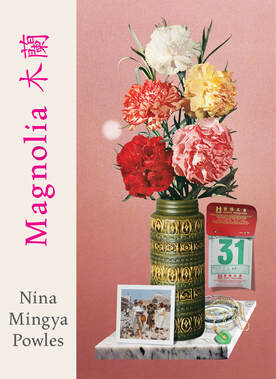
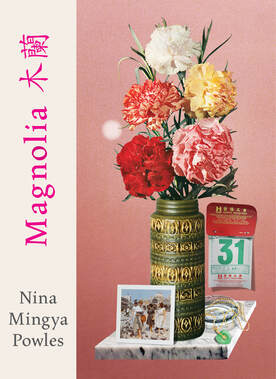
I turn to the blurb on the back of the book and see so many of the words that have guided my reading: hunger, longing, home, mixed-race, languages, women, colour, rain. Magnolia 木蘭 is origami poetry – it will unfold in your body as you read. It is miniature-city poetry that will reinstate multiple existences of home. It is rain poetry that will fall as gleaming light and stomach nourishment and tattoo your skin. It is love poetry and disappearance poetry. It is heart poetry and human poetry that, in this extraordinary year, will get you contemplating your own downpours and magnolias, and in those musings discover poetry solace. Oh, and it has my favourite cover of the year: an image by Kerry Ann Lee (Allora, 2017), and it is lovingly produced by Helen Rickerby and Seraph Press.Glorious!
I want to know the names of the trees in all other languages too so
that I find out what they taste like to other people. But my mouth
can only hold so much.
from ‘Magnolia, jade orchard, she-wolf’
Nina Mingya Powles is a poet, zinemaker and non-fiction writer of Malaysian-Chinese and Pākehā heritage, currently living in London. She is the author of a food memoir, Tiny Moons: A Year of Eating in Shanghai (The Emma Press, 2020), poetry box-set Luminescent (Seraph Press, 2017), and several poetry chapbooks and zines, including Girls of the Drift (Seraph Press, 2014). In 2018 she was one of three winners of the inaugural Women Poets’ Prize, and in 2019 won the Nan Shepherd Prize for Nature Writing. Magnolia 木蘭 was shortlisted for the 2020 Forward Prize for Best First Collection. Nina has an MA in creative writing from Victoria University of Wellington and won the 2015 Biggs Family Prize for Poetry. She is the founding editor of Bitter Melon 苦瓜, a risograph press that publishes limited-edition poetry pamphlets by Asian writers. Her collection of essays, Small Bodies of Water, is forthcoming from Canongate Books in 2021.
This poem is in response to NZQA using a poem by white supremacist and murderer Lionel Terry in a Level 2 History exam. Terry’s poem was part of a source which included testimonials from people who had received treatment at Seacliff asylum, which I feel disregarded his actions as ‘madness’, and extended sympathy to him. I also feel that the source didn’t properly contextualise Terry as a person, which downplayed the seriousness of his actions and views. Many other members of the Chinese New Zealander community also feel the same, and have lodged complaints against NZQA.
Shadows / shades
White: the colour of truth
the colour of enlightenment
the colour of the religion Lionel Terry
thought that he had found
in guns and Chows and murder.
The colour of purity
the colour of the purest skin
the colour of Terry’s hair
stripped bare with age
the colour of his chasteness
painted in portraits with white light
shining behind him, like a painting
of a god.
The truth: on September 24th, 1905
Lionel Terry shot Chinese man
Joe Kum Yung on Haining Street;
a cold, unremarkable Wellington night
(a Chinaman bleeding to death)
a man walking down the street
(a killer escaping his crime).
White, the colour of the starched
computer room, white screens
flickering with exam codes, white
clock on the ticking wall, time
sliding like a body to the ground.
White pages, neatly printed
with a poem by Lionel
Terry.
He pleads on the page
from Seacliff Asylum
for his case to be considered
that he is not insane
that murder is not always insanity.
The exam question asks me
for two different perspectives
on asylums.
I ask myself why I should have to
write about a murderer’s
perspective
a white supremacist’s
perspective
why I should have to slip myself
into such rotting, fetid
shoes.
All the exam says about him
is he was ‘known for his views on immigration
and racial segregation’.
Across the room, I catch eyes
with my friend
she gives me a loaded look
the whites of her eyes
wide
the edges of her white teeth
flickering on a grimace.
Red: thought to be the colour of blood
but that’s a little cliche
it’s more the colour of heat
the colour flickering behind
calculating eyes
searching for a Chinaman
the colour of fingers
closing in on a trigger
blood vessels beamed together.
Red, the colour of the pen
that grades work
the colour of a failed paper
the colour that means stop
or fail
or end.
The lucky colour in China
the colour of red envelopes
and paper lanterns
and prosperity and joy
and good things.
The colour of the borders
on the NZQA website
each letter rimmed in crimson.
I find the full poem online
the frothing frenzy of
Crowds of Russian Jews and Chows
that invade your peaceful land
and spread a few diseases of
an extra special brand.
I find it strange that this part
had been cropped out of the exam
and by strange, I mean
all too predictable
and by all too predictable
I mean so, so tiring.
Black: The colour of yesterday’s blood
the colour Joe Kum Yung
would have left on the streets
for lonely citizens to clean up
the colour of the ink on the page
the colour of a shadow: Terry’s
manifesto was called The Shadow
about the dark and lecherous men
with black hair and eyes
taking over the country
ruining it
burning it
shouldn’t be allowed in
(should be killed).
The colour of the scribble
my friend made under Terry’s poem
I HATE U in bold teenage chicken-scratch
the dark stains of the numbers
on the clock
ticking away
the bloated body of the fly
beating against the window.
My father’s hair is black
his eyes are black
mine are too
our mouths rounded in
the Kiwi accent
yet people still ask us
where we’re from.
He scrolls through Terry’s Wikipedia page
face screwed up
a contortion of black lines.
He was a real piece of shit,
this Lionel guy, he says. What were they
thinking, putting him in the exam?
His thick fingers pause on the photos
the charming headshot
or the one of him playing cricket
or the portrait where he’s bearded
and anointed, imposing
on my father’s eyes, and I think,
here’s another Chinese man
who has the taste of Lionel Terry
in his mouth
and here I am, another Chinese person
with my name now linked
to his.
Yellow, the yellow peril, yellow fever
yellow on the outside
white on the inside
yellow, the colour of piss
the smell of the streets
yellow, the supposed colour
of cowardice
the colour Joe Kum Yung
was killed for
the colour I am trying to bear
with pride.
The colour of the sun
shining when I left the exam room
the colour of something
on the horizon
the colour of the sunset
the promise of a new day’s kiss
a hope that something better
will come
from all of these shadows and shades
of bruises
Cadence Chung
Cadence Chung is a student at Wellington High School, who is tentatively trying to be a poet. She first started writing poetry during a particularly boring Maths lesson when she was nine. Outside of poetry, she enjoys singing, songwriting, reading old books, and perusing antique stores.
The poem is from the sequence ‘Attempting to Land’, runner up in the 2020 Kathleen Grattan Prize for a Sequence of Poetry. Judge Siobhan Harvey’s words re the sequence: ‘Stunning. A beautifully crafted ode to migration.’
For end-of-year Poetry Shelf wraps, I have usually invited a swag of writers to pick books they have loved. It has always turned into a mammoth reading celebration, mostly of poetry, but with a little of everything else. This year I decided to invite a handful of poets, whose new books I have loved in 2020, to make a few poetry picks.
My review and interview output has been compromised this year. I still have perhaps 20 poetry books published in Aotearoa I have not yet reviewed, and I do hope to write about some of these over summer.
The 8 Poets
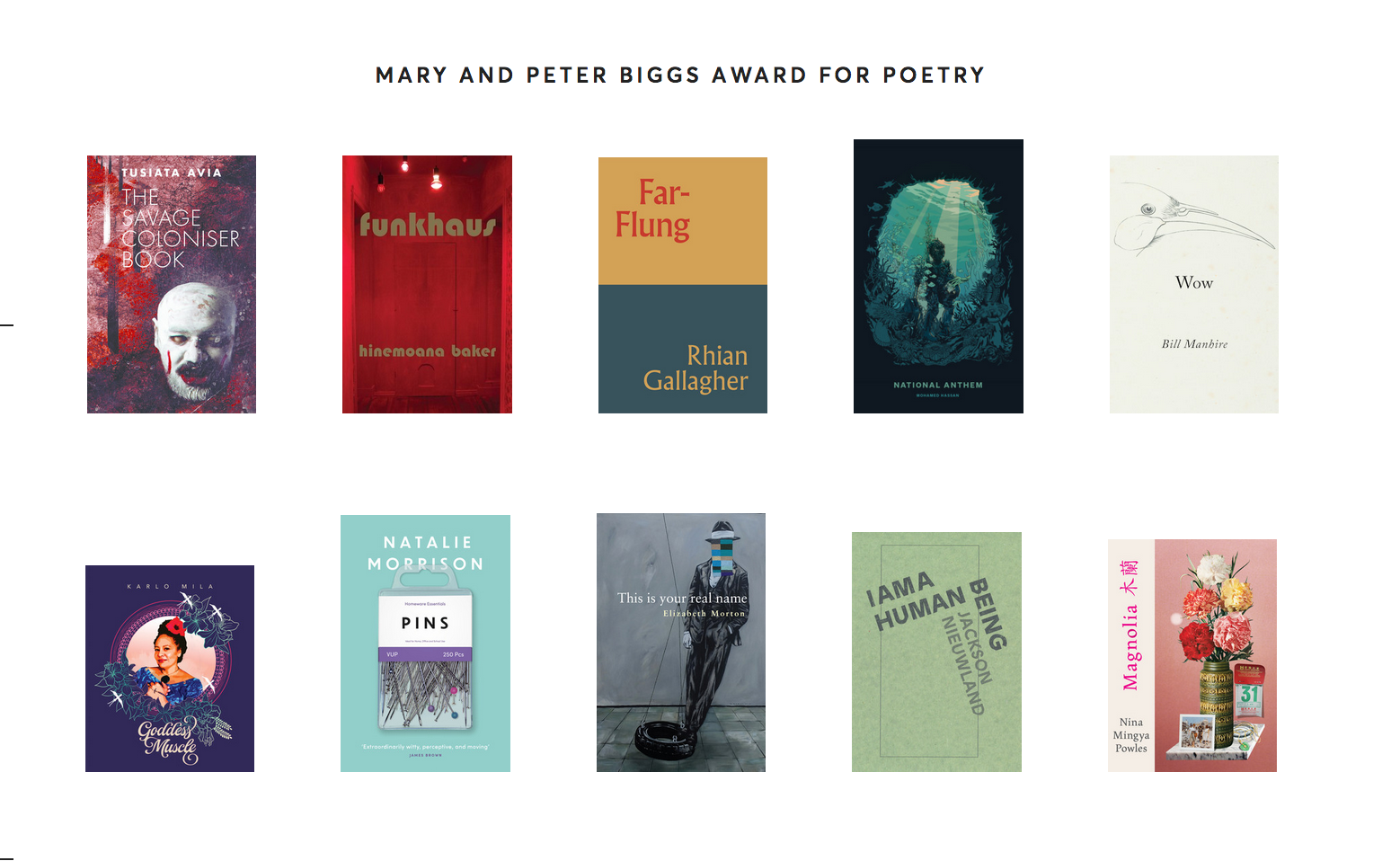
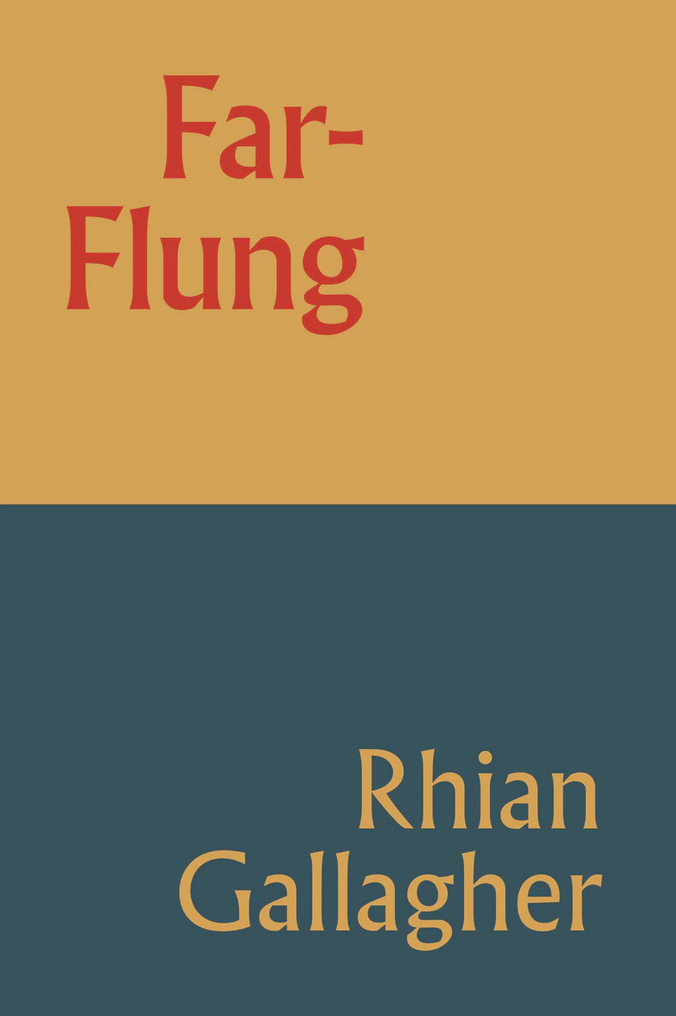
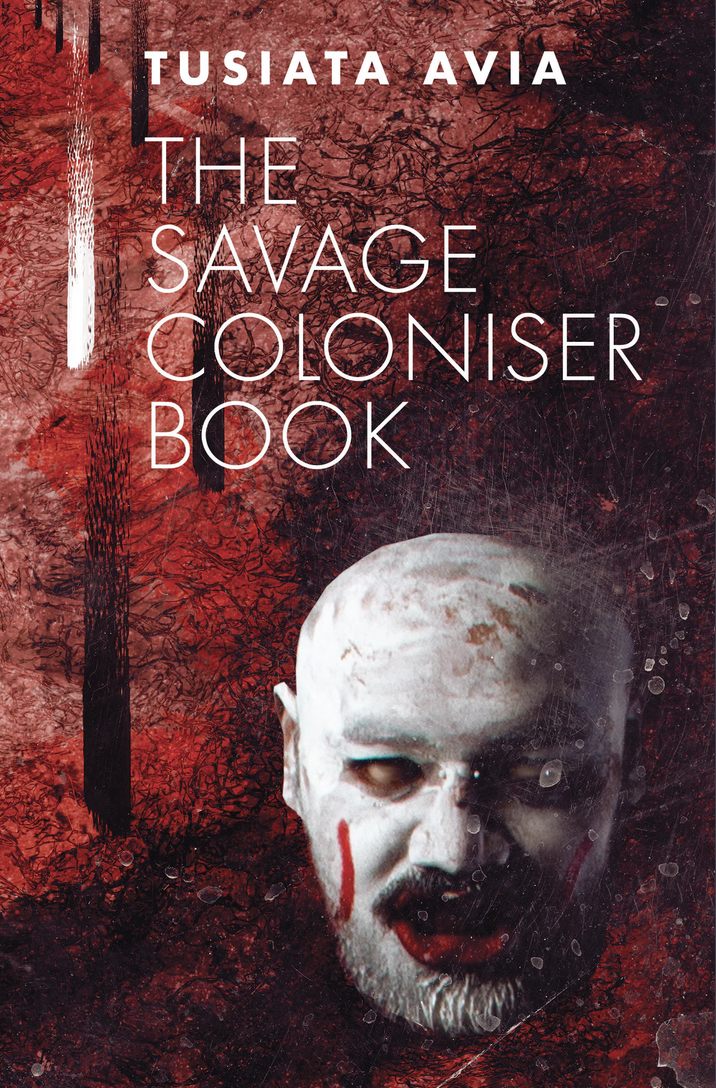
Among a number of other terrific poetry reads (Oscar Upperton’s New Transgender Blockbusters for example), here are eight books that struck me deep this year (with my review links). Tusiata Avia’s The Savager Coloniser (VUP) is the kind of book that tears you apart and you feel so utterly glad to have read it. Tusiata has put herself, her rage, experience, memories, loves, prayers, dreads into poems that face racism, terrorism, Covid, inequity, colonialism, being a mother and a daughter, being human. An extraordinary book. Rhian Gallagher’s Far-Flung (AUP) is a sumptuous arrival, a book of exquisite returns that slowly unfold across months. Her poetic craft includes the lyrical, the political, the personal and the contemplative in poems that reflect upon the land, experiences, relationships.
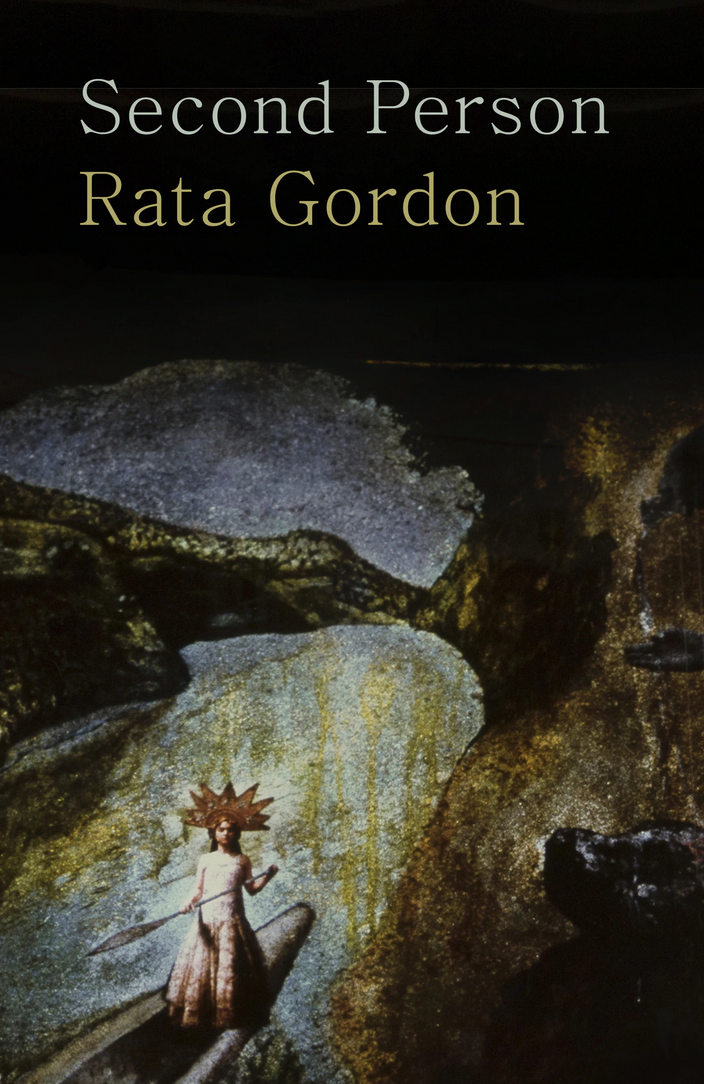
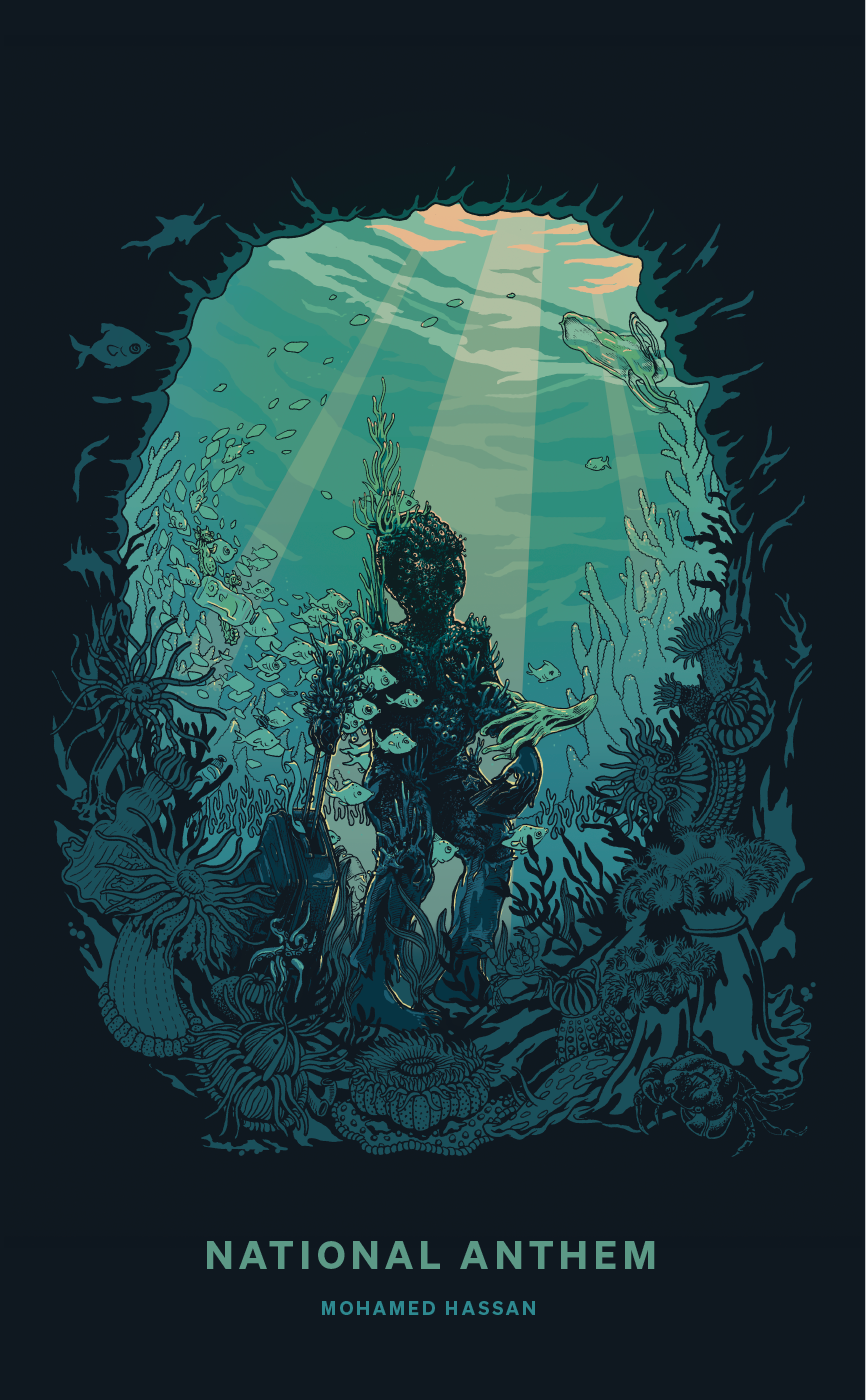
Rata Gordon‘s Second Person (VUP) is fresh, layered and utterly captivating. This is a book of birth, babies, death, the universe, love, motherhood, water, sky, wildlife. It is a book that celebrates the present tense, the way we can inhabit the now of being. Reading Mohamed Hassan’s new collection, National Anthem (Dead Bird Books), opens up what poetry can do. It widens your heart. It makes you feel. It makes you think. It gets you listening. It makes you think about things that matter. Humanity. Family. Soil. Ahh!
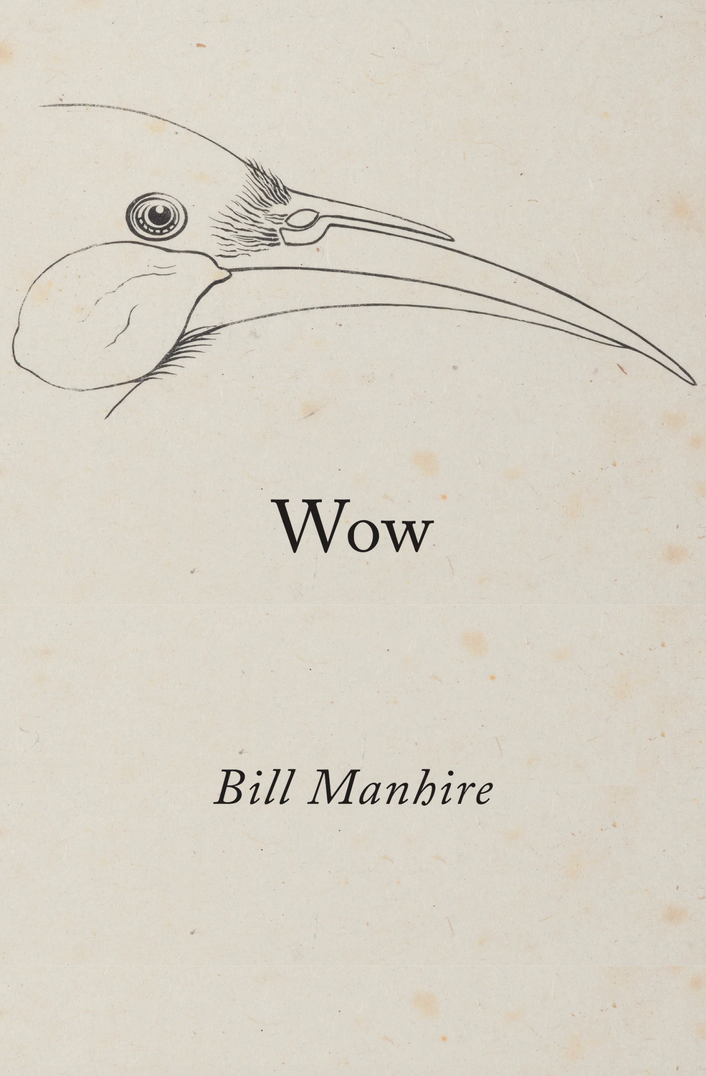
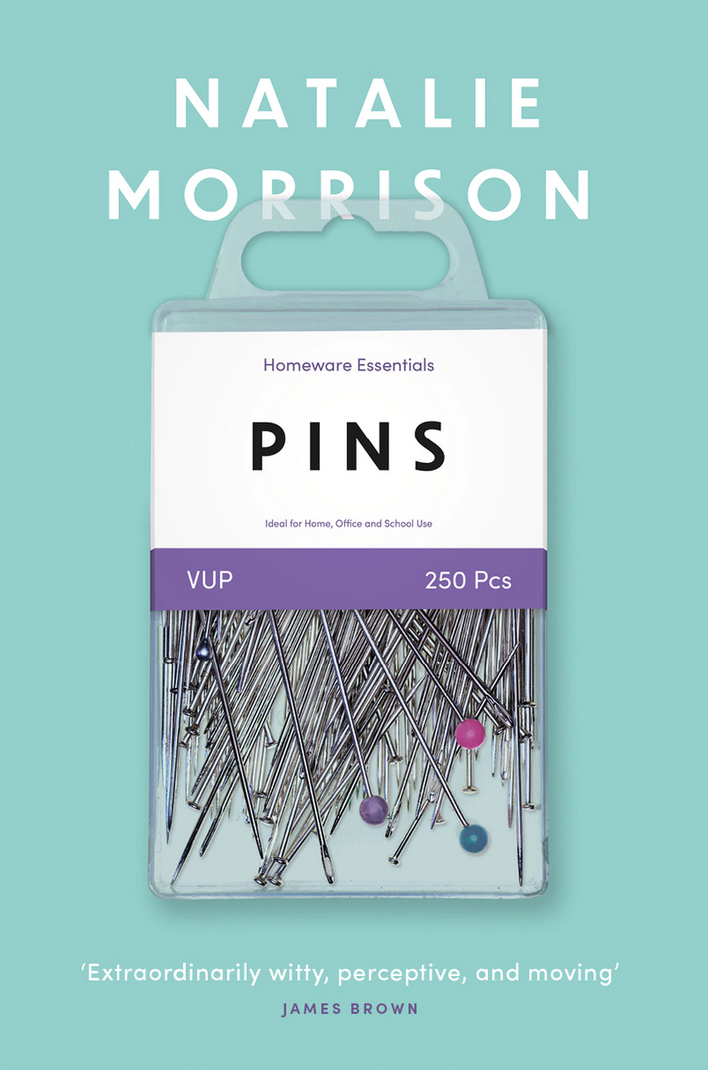
Bill Manhire‘s Wow (VUP) will haunt you – so many of these poems have joined my list of memorable poetry encounters. The baby in the title poem says ‘wow’ while the big brother says ‘also’. This new collection sparks both the ‘wow’ moments and the ‘also’ moments. Get lost in its glorious thickets and then find your way out to take stock of the ordinary (and out-of-the-ordinary) world about you. Like Rhian’s collection this is a book of poetry astonishments. Natalie Morrison‘s (VUP) debut collection Pins is exquisite, both melodious and tactile, economical and rich. There is both a quirkiness and a crafted musicality, resonant white space, yet perhaps a key link is that of narrative. I filled with joy as I read this book.
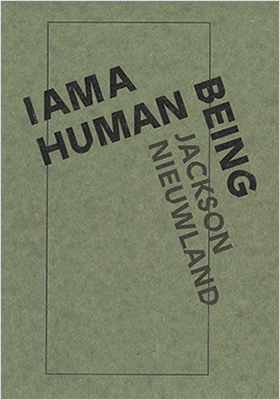
Jackson Nieuwland‘s I am a Human Being (Compound Press), so long in the making, lovingly crafted with the loving support of friends, with both doubt and with grace (think poise, fluency, adroitness), this book, in its lists and its expansions, moves beyond the need for a single self-defining word. I knew within a page or two, this book was a slow-speed read to savour with joy. Nina Powles‘s Magnolia (Seraph Press) is the book I am currently reading. I have long been a fan, from Girls of the Drift to the glorious Luminscent). Nina’s new book is so immensely satisfying as it navigates home and not-home, identity, history, myth, the lives of women – with characteristic nimbleness, heavenly phrasing, open-heart revelations, the senses on alert, the presence of food, multiple languages. Reading bliss!
The poets and their picks
Tusiata Avia
I’m a terrible book buyer. I tend to read books given to me (because I’m cheap like that) and the shopping-bag full of books my cousin, playwright, Victor Rodger, lends to me on the regular. He has the best taste! I should probably be a better reader of New Zealand poetry in particular, but I reckon I’ve got enough things to feel guilty about.
The top three on my list of books I have read this year and love:
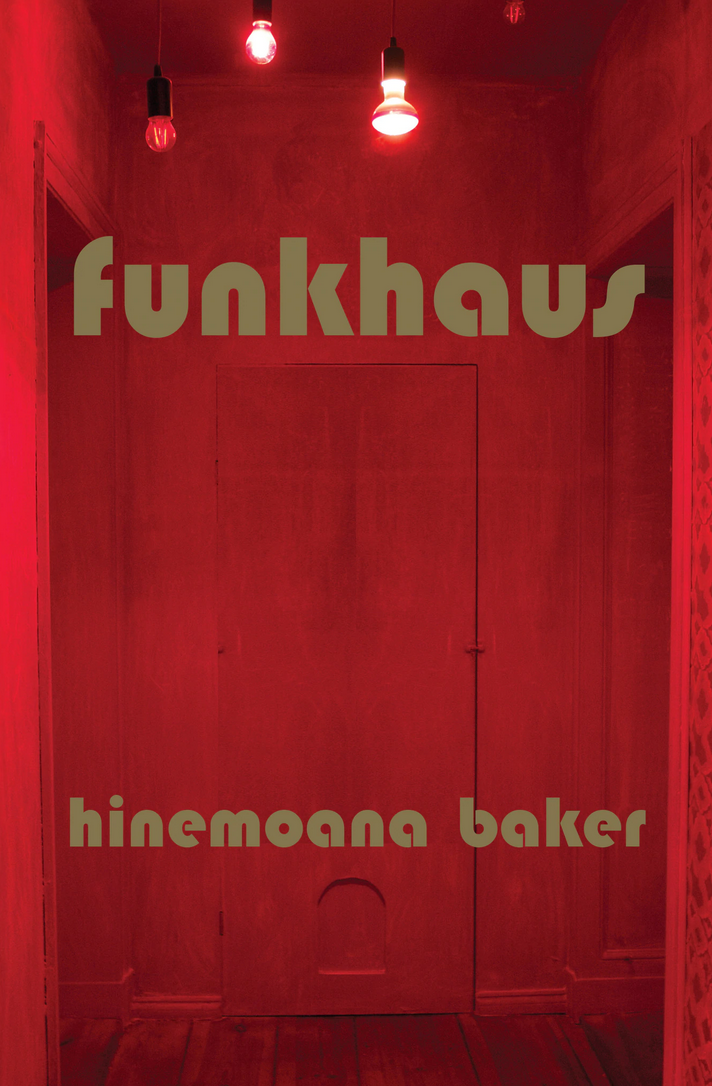
Funkhaus by Hinemoana Baker (Victoria University Press)
I love the way Hinemoana uses language to make the ethereal and the mysterious. I’m happy to not immediately be able to pin down meaning; her language allows me to be suspended between what it does to me and what it means. Poems like the incantatory Aunties and Mother – which I think of as more ‘rooted’ – make me want to sit down immediately and write a poem. In fact that is exactly what I did do when I read this book. I love a book that makes me write.
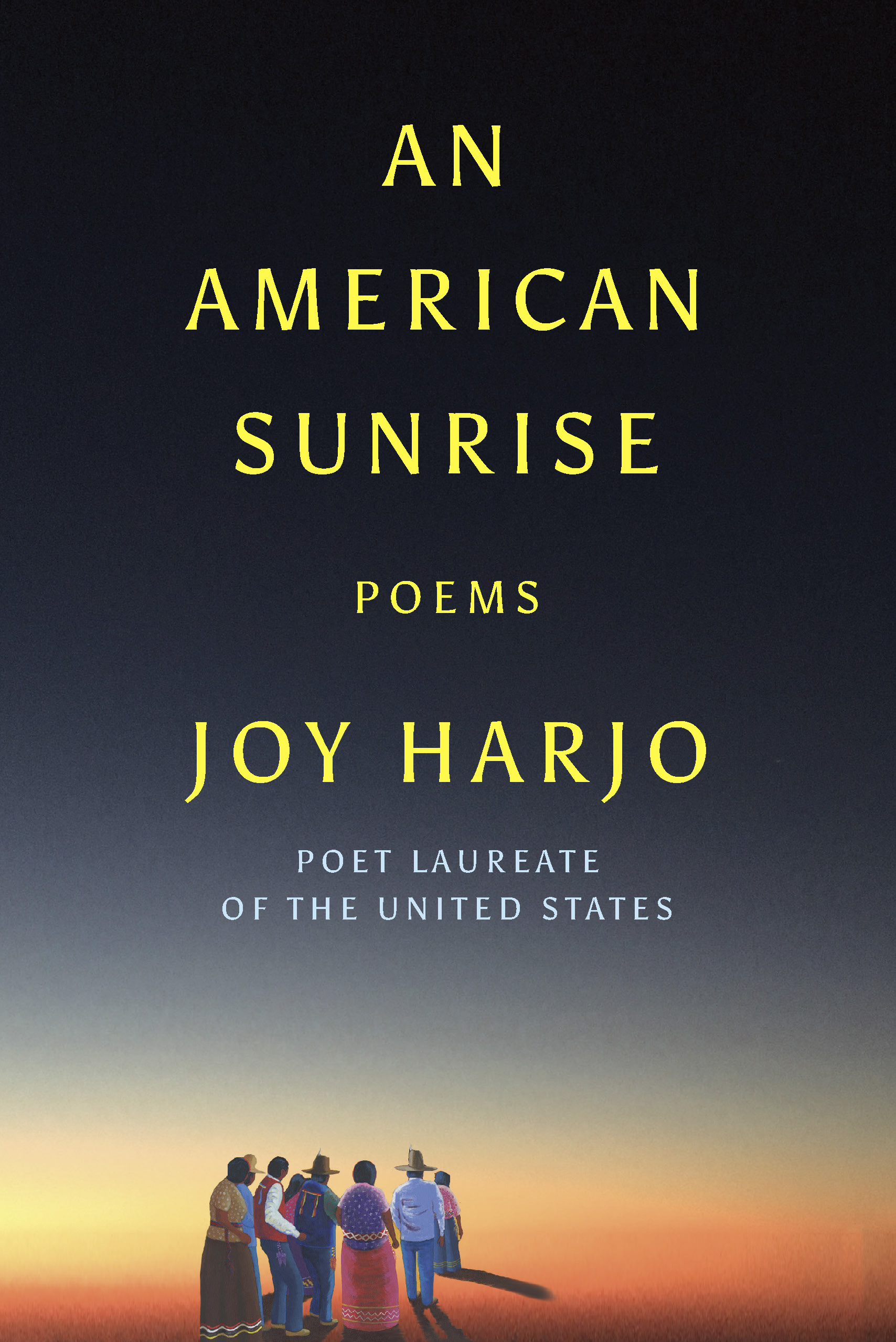
An American Sunrise Joy Harjo (WW Norton & Co)
An American Sunrise is Joy Harjo’s most recent book of poetry. Joy is Poet Laureate of the United States. I love everything Joy Harjo has written. And I mean everything. She Had Some Horses (from an early book of the same name) is one of favourite poems of all time. Elise Paschen says of her, “ Joy Harjo is visionary and a truth sayer, and her expansive imagination sweeps time, interpolating history into the present.”. I would add to that she is taulaaitu, mouth-piece for the ancestors, gods and spirits. While you’re reading Joy Harjo’s poetry, read Crazy Brave, her wonderful autobiography. It will stay with you forever.
National Anthem by Mohamed Hassan (Dead Bird Books)
When I was looking for favourite lines in this book, I couldn’t decide, sooo many – like small poems in themselves. Mohamed speaks with an iron fist in a velvet glove. His poetry is elegant and beautiful and it tells the damn truth. Someone needs to tell the damn truth – about March 15, about being Muslim in New Zealand (and in the entire western world), about the things that happen so close to us – and inside us – that are easy (and more comfy) to avert our eyes from.
Some favourite lines from White Supremacy is a song we all know the words to but never sing out loud: ‘Please come and talk on our show tomorrow/ no don’t bring that up/…
‘This isn’t about race/ this is a time for mourning/ this is about us/ isn’t she amazing/ aren’t we all’…
‘Let us hold you and cry/ our grief into your hijabs’…
Who can tell these stories in this way but a good poet with fire in his fingers, love and pain in equal measure in his heart and feet on the battleground?
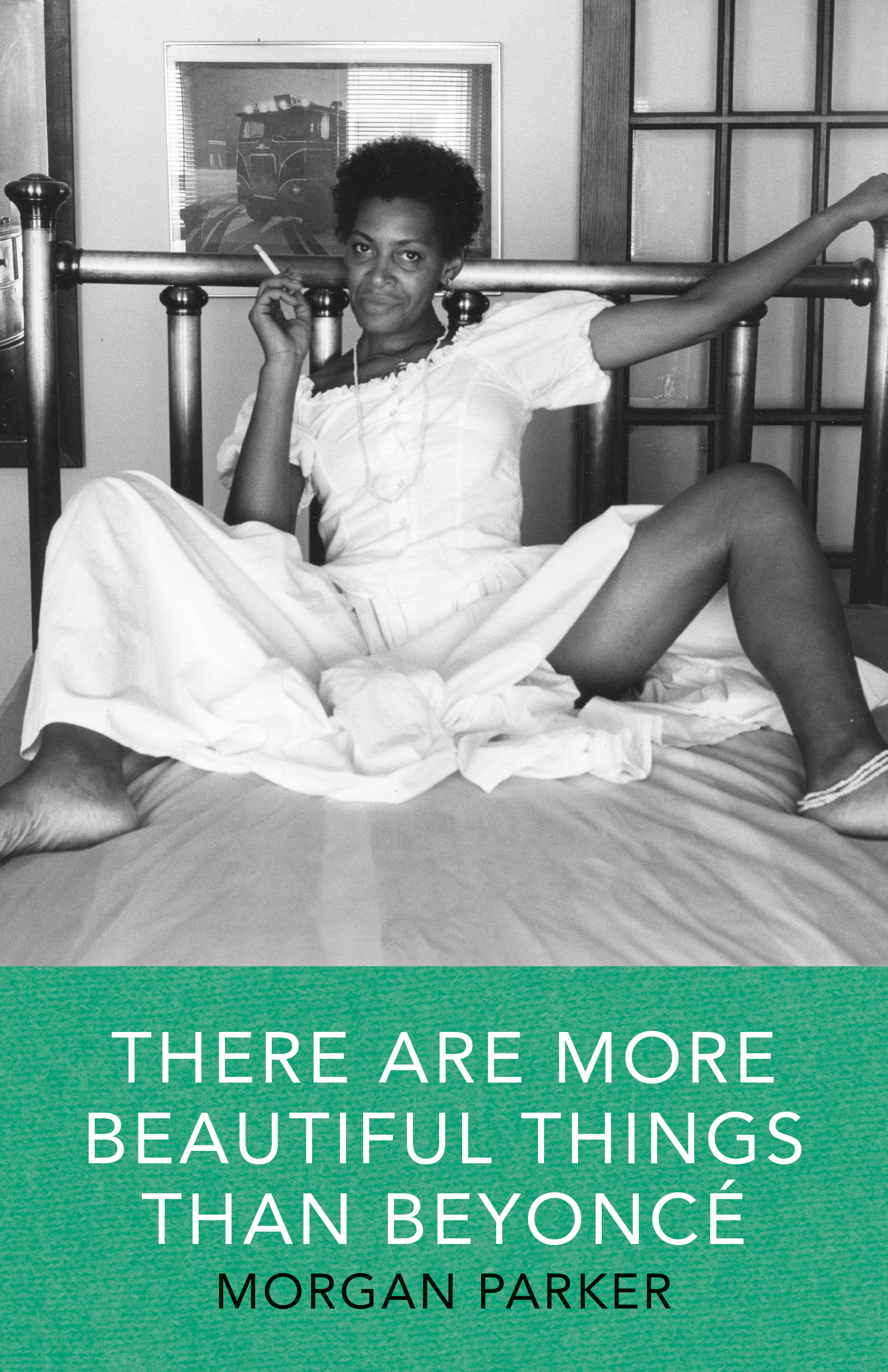
There are More Beautiful Things Than Beyonce Morgan Parker (Tin House)
I have to add, There are More Beautiful Things Than Beyonce by Morgan Parker to every list I write forever. In my opinion, no reader of poetry should miss this. If it doesn’t grab you by the shoulders, the heart, the brain, the belly – you might be dead. From the epigraph: ‘The president is black/ she black’ (Kendrick Lamar). Morgan Parker is PRESIDENT.
Rhian Gallagher
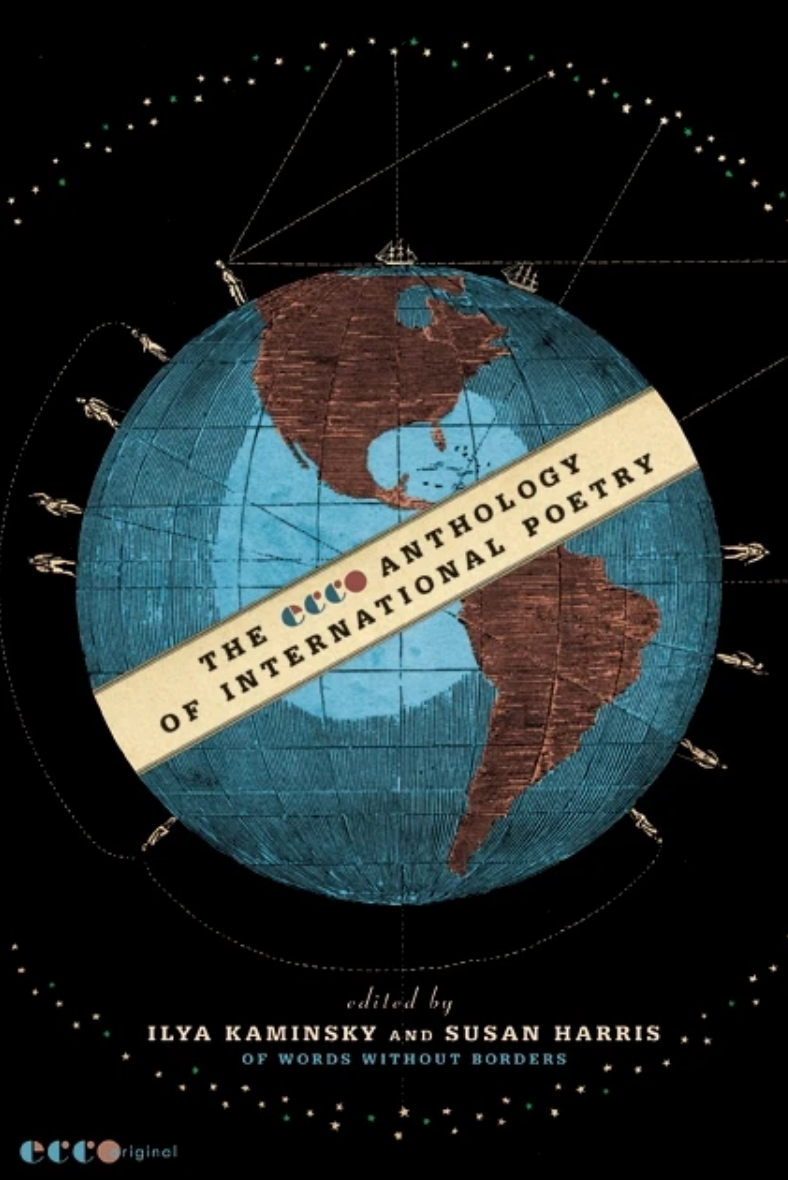
The Ecco Anthology of International Poetry (HarperCollins) edited by Ilya Kaminsky and Susan Harris features translations of 20th century poets from around the world and is packed with surprises.
Amidst all the books I have enjoyed during 2020, this is the one that I have read and re-read and continue to come back to. It was first published in 2010. I have been slow in coming to the book.
When a poem in another language is re-cast into English, through the empathy and skill of a translator, it seems to unsettle notions of line, rhythmn, word choice and form. Translation pushes and tugs at the boundaries of the ‘rules’ and introduces a kind of strangeness. This strangeness I experience as an opening; a feeling of potential, slippery as a an eel to articulate. It recalibrates predetermined notions and generates excitement about what a poem can do or be.
There are well-known names here: Cavafy, Lorca, Akhmatova, Ritsos, Milosz, Symborska among others. There are also many poets previously unknown to me, and many whose work is either out of print or difficult to source. It’s a diverse, inspiring array of poetic voices and, as Kaminsky says in the introduction, puts us ‘in conversation with a global poetic tradition’.
Making discoveries is one of the great pleasures of anthologies. I now have a brand new ‘to read’ list.
Rata Gordon
When I’m reading something that inspires me, I have the urge to inhabit it somehow. I find that entering into a creative process by writing with, and around, another’s words helps me to absorb them into my internal landscape. This poem was created with snippets of some of the poetry I have met recently.
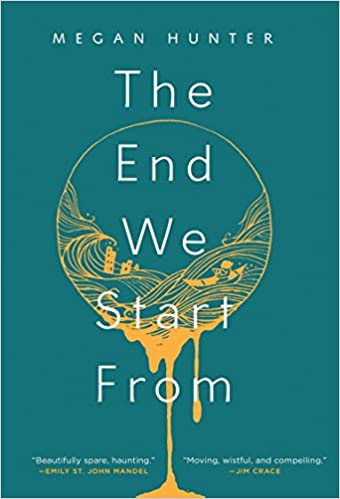
Soon, we are night sailing (Hunter, p. 71)
This is the closest you can get to it:
the void, the nothing,
the black lapping mouth of the sea
and the black arching back of the sky. (Hunter, p. 71)
One still maintains a little glimmer of hope
Deep down inside
A tiny light
About the size of a speck
Like a distant star
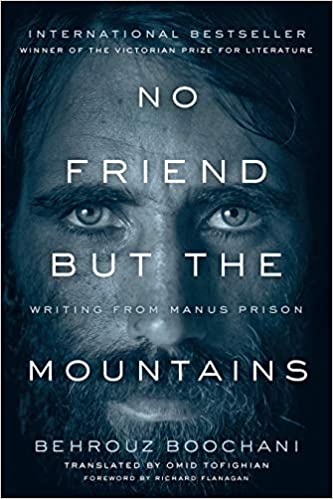
Is spotted on the horizon this dark night (Boochani, p. 26)
Swish swish swish
as quiet as a fish. (Ranger, p. 13)
… holy women
await you
on the shore –
long having practiced the art
of replacing hearts
with God
and song (Walker, p. 7)
Today you are tumbling towards her like the ocean.
… you are becoming nearer and nearer to someone other
than yourself. (Hawken, p. 49)
I have … imagined my life ending,
or simply evaporating,
by being subsumed into a tribe of blue people. (Nelson, p. 54)
The End We Start From by Megan Hunter (2017, Picador). (Not strictly poetry, but the book feels so much like a long poem to me). Line breaks added by me.
No Friend but the Mountains by Behrouz Boochani (2020, Picador).
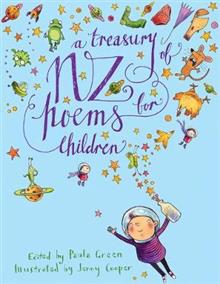
‘Autumn Leaves’ by Laura Ranger. In A Treasury of NZ Poems for Children edited by Paula Green (2014, Random House).
Good Night, Willie Lee, I’ll See You in the Morning by Alice Walker (1975, The Women’s Press).
Small Stories of Devotion by Dinah Hawken (1991, Victoria University Press).
Bluets by Maggie Nelson (2009, Jonathan Cape). Line breaks added by me.
Mohamed Hassan
Tusiata Avia’s The Savage Coloniser Book (Victoria University Press)
A few weeks ago, I sat in the audience at a WORD Christchurch event and watched our former poet laureate Selina Tusitala Marsh read a poem from Tusiata Avia’s new collection. It began as such:
Hey James,
yeah, you
in the white wig
in that big Endeavour
sailing the blue, blue water
like a big arsehole
FUCK YOU, BITCH.
The hall fell pin silent and a heavy fog of discomfort descended from the ceiling, and I sat in the corner brimming with mischievous glee. It was a perfect moment, watching two of the country’s most celebrated poets jointly trash the country’s so-called ‘founder’ in the most spiteful way imaginable. The audience squirmed and squirmed and I grinned and grinned.
This is how Avia’s book begins, and it never lets up. As the title subtly implies with a hammer, Avia has things she wants to say, and doesn’t care how people feel about them. She delights in the spiteful, burrows down into the uncomfortable and the impolite and pulls out nuggets of painful truths with her bare hands. They are all truths that must be said bluntly and Avia drills them home.
In Massacre, Avia reflects on her youth fighting the demons of Christchurch, and asks us if our ‘this is not us’ mantra is divorced from the history carried in the land, haunted instead by the white spirits that rose to claim lives on March 15.
The book crescendos with How to be in a room full of white people, a dizzying poem that traps us in a single moment in time and forces us to witness and squirm and eventually, hopefully, understand what it is like to be the only brown body in a foreign space, in all its literal and metaphorical significance.
This has been my most cherished book this year, bringing together Tusiata Avia’s firecracker wit and her uncanny gift of conjuring worlds that feel vivid in their weight and poignancy. Abandoning all diplomacies, this is a blazing manifesto for honest and confrontational poetry that speaks with an urgency that puts me as a writer to shame, and demands more of me at once.
Bill Manhire
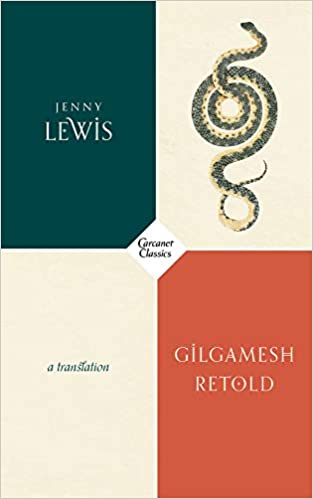
Jenny Lewis, Gilgamesh Retold, (Carcanet)
I love the way poetry re-visions the past, especially the deep past. I’m thinking of books like Matthew Francis’s reworking of the Welsh epic The Mabinogi and Alice Oswald’s Memorial, a book that abandons the main storyline of Homer’s Iliad in favour of narrating the death scenes of minor characters, accompanied by extra helpings of extended simile. I’d always known about the Epic of Gilgamesh, which I have owned for about 40 years in a yellow 1960 Penguin paperback. I’ve hardly opened it, but it’s one of some nine translations of the poem that Jenny Lewis has consulted for Gilgamesh Retold, published by Carcanet some four thousand years after the stories first circulated in oral form. (Her publisher at Carcanet, Michael Schmidt, has himself written a much admired book about the poem’s origins and afterlife)
Locally Dinah Hawken has worked with this ancient material, particularly writing about Inanna, the goddess of beauty and fertility and, sometimes, war, who is one of the major figures in the Gilgamesh cycle. Dinah’s feminist sense of the ancient stories accords with Jenny Lewis’s decision, as the blurb says, to relocate the poem “to its earlier oral roots in a Sumerian society where men and women were more equal, … [where] only women were allowed to brew beer and keep taverns, and women had their own language – emesal.”
It’s as well Inanna has such a significant role in Gilgamesh, for otherwise it would be a tale about male adventuring and bonding (Gilgamesh and Enkidu) and the discovery that even the greatest heroes can never overcome death. The world of Gilgamesh also gives us a Flood, which matches and in some ways outdoes the Old Testament. I love the way Jenny Lewis has retold these stories. She doesn’t try to pad them out to produce the sorts of coherence and pacing that contemporary readers and movie-goers find comfortable, while her phrasings have an unreductive clarity and a genuinely lyrical grace. The most audacious thing she has done, and has carried off brilliantly, is to use different metrical forms to reflect the ways in which a range of different custodians/retellers have voiced and revoiced the story. You admire the 21st-century poet’s craft even as she inducts you into a baffling and unfamiliar world. All stories, Gilgamesh Retold tells us, are made by many voices, and the best of them will journey on through many more.
And now I must try and summon up the courage to give the latest version of Beowulf a go!
Natalie Morrison
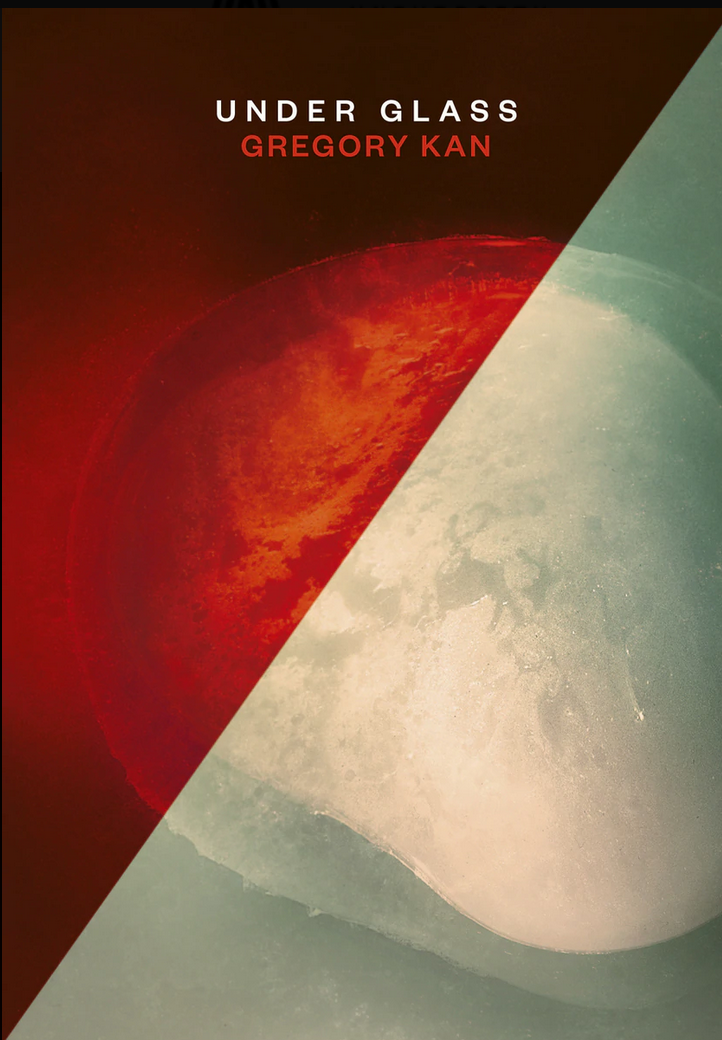
Gregory Kan, Under Glass(Auckland University Press)
My esteemed colleague, with one hand around his Friday swill-bottle: ‘I hate poetry – no one cares, no one reads it anymore.’
Gregory Kan, with two suns infiltrating the long ride on the train to Paekākāriki, illustrates otherwise: Under Glass lulls like a really disquieting guided meditation.
After lockdown, it is the first book I read outside our ‘bubble’. Threading through an internal landscape, somehow a place I recognise. ‘Here, there are two suns. The ordinary sun is in the sky overhead. The other sun is eating its way out from inside me.’
Certain lines, with their mystical insistence, snag on me and come back again from time to time: ‘Everything that surrounds the second sun is not part of it but nonetheless makes it what it is.’ It’s as if some lines have been dreaming of themselves. The book invites a gentle inspection. A glass bead held right up against the eye. A shutter flipped open over a stark interior.
‘When you move a look moves inside me and eats there what I eat.’
Once, a kind individual in Paekākāriki, their hands busy with a teapot, told me: ‘Those who know what it is, fall on it like starving people.’
When Litcrawl comes, we make our way to some of the events. The room has sucked a crowd in. Spells for 2020, with Rebecca Hawkes, Rata Gordon, Stacey Teague, Arihia Latham, Rachel McAlpine and Miriama Gemmell (thank you for your entrancing words), reminds me of how poetry is still something people might come in search of. Visitations of bees, airline heights and morphing walls. There is a sense of relief.
A crowd still feels like a dream, and a dream still feels like the sea. Gregory writes that ‘the sea is a house made of anything. The sea is a story about anything, told by someone unfit for storytelling. More than what I can know, and much more than I can understand.’
Under Glass, which wasn’t exactly written for this year (no ordinary year), seems to slot into it.
My steamed colleague, with one hand steadying the banister: ‘I guess Bob Dylan is okay, though.’
Note: I asked my colleague’s permission for quoting him. He said he was fine with it, as long as a mob of angry poets didn’t come knocking.
Jackson Nieuwland
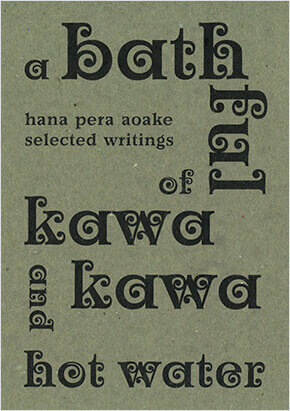
2020 was the year we finally got a book from Hana Pera Aoake (A bathful of kawakawa and hot water Compound Press). I had been waiting for this for so so long. It’s a taonga that I am incredibly grateful for. Ever since I first read Hana’s work they have been one of my favourite writers. Their writing is both clever and wise, of the moment and timeless, pop culture and fine art, Aotearoa and international.
This is a book I will be returning to over and over again for inspiration, electrification, nourishment, and comfort. I would recommend it to anyone.
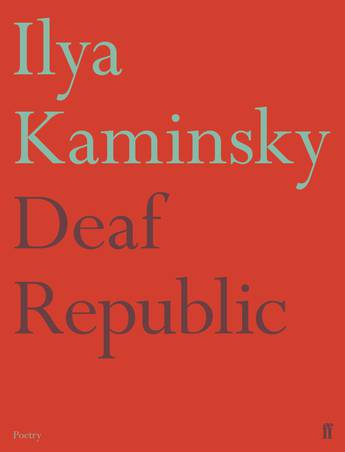
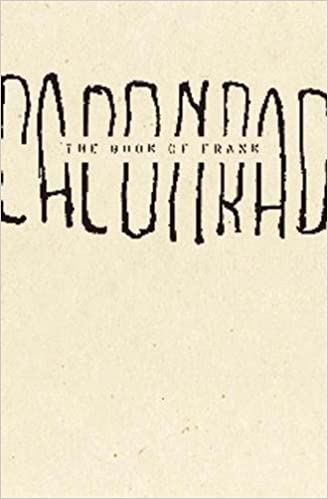
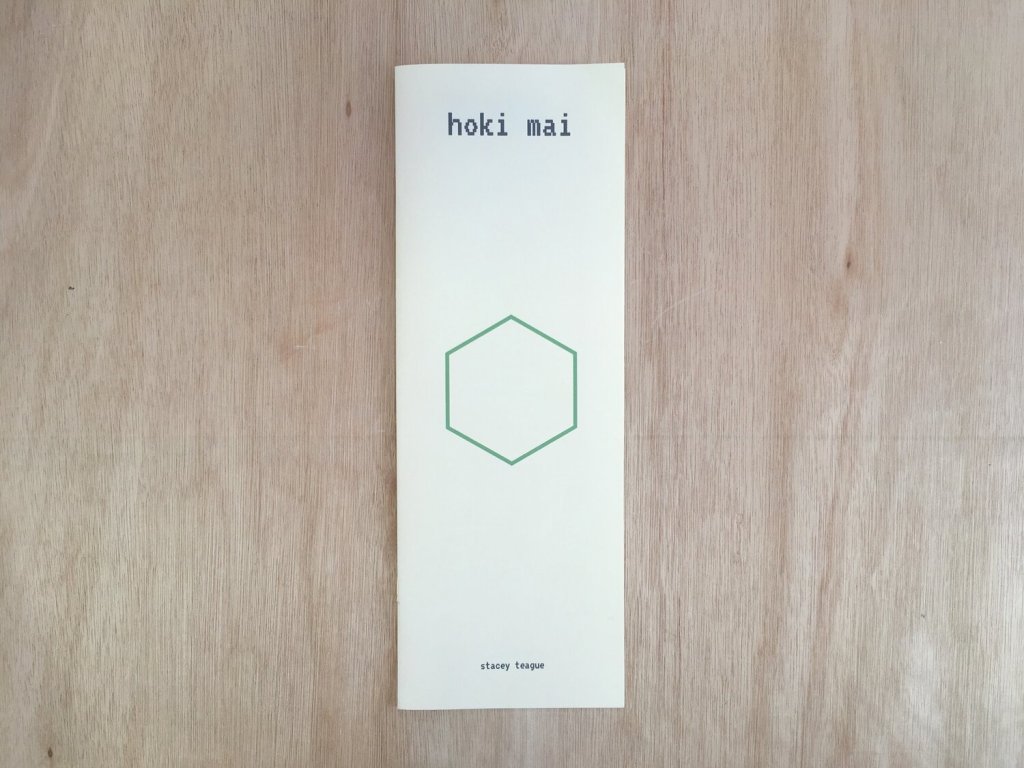
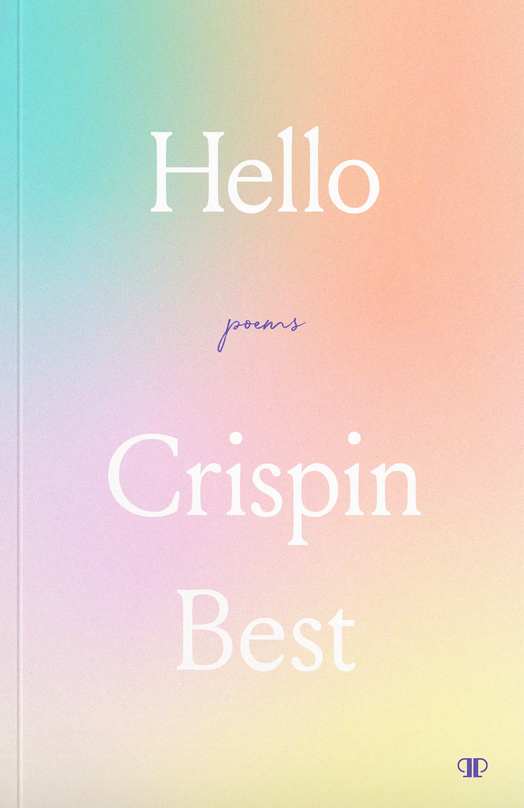
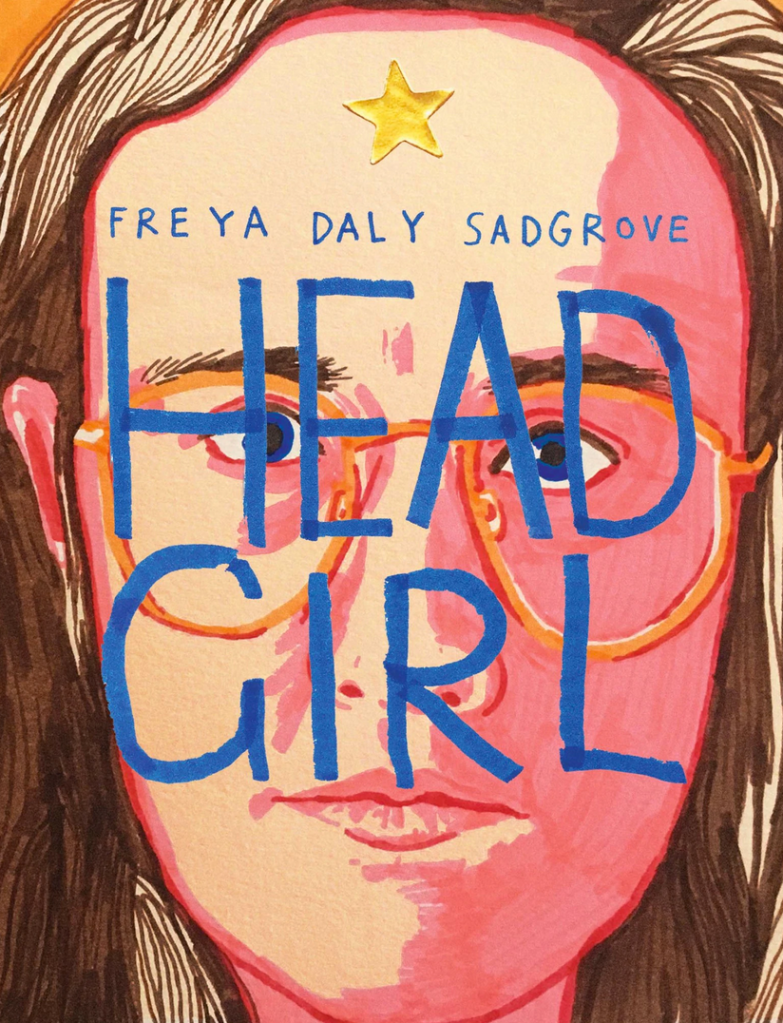
Other poetry books I read and loved this year: Deaf Republic by Ilya Kaminsky, The Book of Frank by CA Conrad, hoki mai by Stacey Teague, Hello by Crispin Best, and Head Girl by Freya Daly Sadgrove.
Nina Mingya Powles
For most of this year I could only read things in fragments. I could only hold on to small parts of poems, essays, short stories in my head before they floated away. This year I sought out poetry by Indigenous writers. Of these two books, the first I read slowly, dipping in and out like testing the surface of cool water. The other I read hungrily all at once.
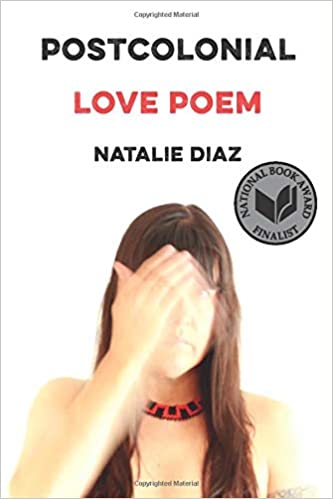
Postcolonial Love Poem by Natalie Diaz (Graywold Press) reminded me why I write poetry, at a time when writing anything at all felt impossible. Diaz’s heavy, melodic love poems circled around my head for days: “My lover comes to me like darkfall – long, / and through my open window.” But it is her writing about water and the body that changed me. In this book, water is always in motion, a current that passes through time, memory and history. Her long poem “The First Water of the Body” is a history of the Colorado River, a sacred river: “I mean river as a verb. A happening. It is moving with me right now.”
A bathful of kawakawa and hot water by Hana Pera Aoake (Compound Press) came to me when I needed it most, nourishing me and warming me. I haven’t yet held a copy of the book, but I read it on my laptop over two days and have carried parts of it around in my body ever since: “I speak broken French and Português into the broken yellow gloaming.” A bathful of kawakawa and hot water is a searing, lyrical work of poetry, memoir, and political and cultural commentary. Like the title suggests, it was a balm for me, but also a reminder of the ongoing fight for our collective dream of a better world, and most importantly, that “racism is not just a product of psychological malice, but a product of capitalism.”


 NZ Poetry Shelf