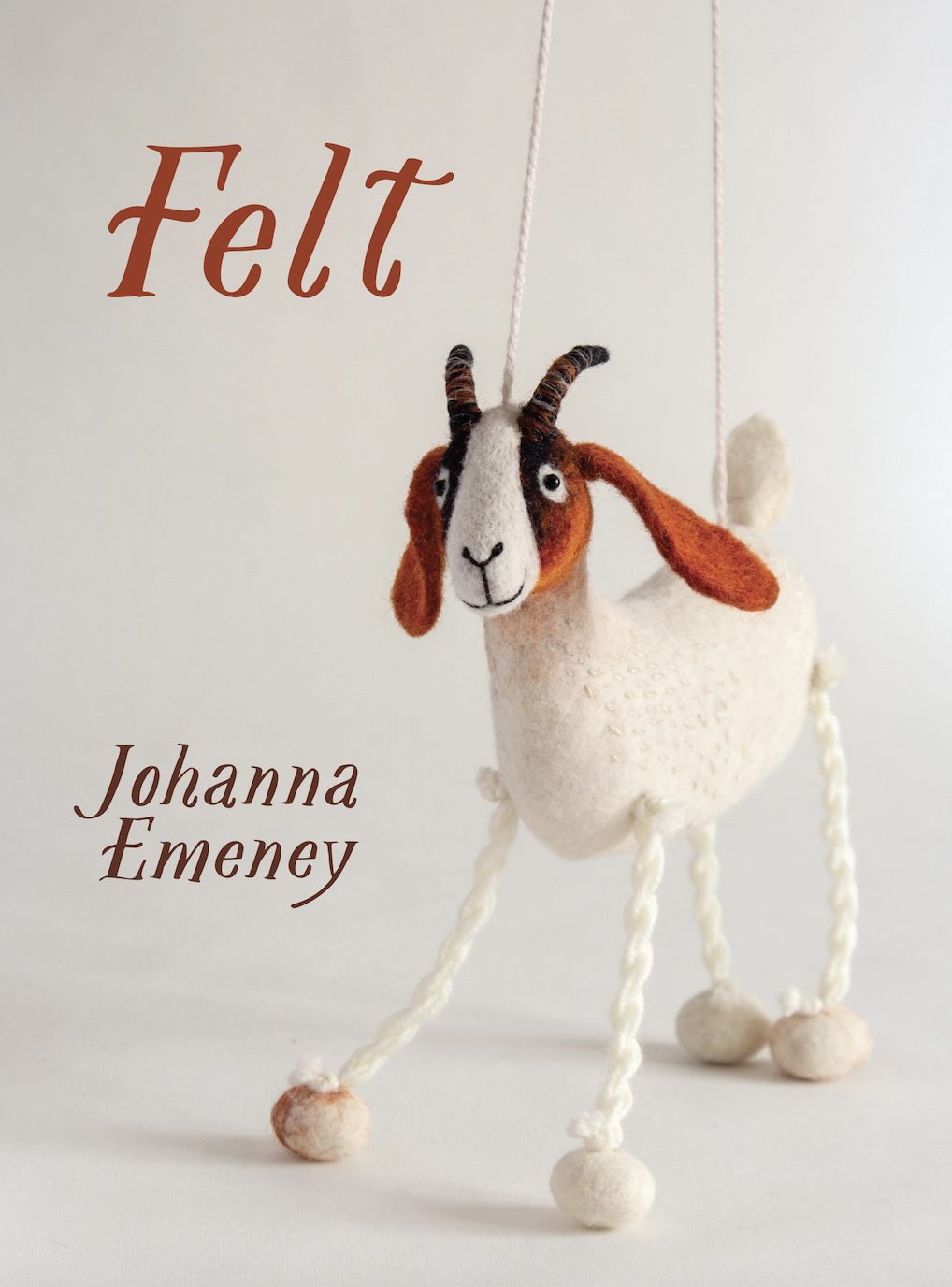
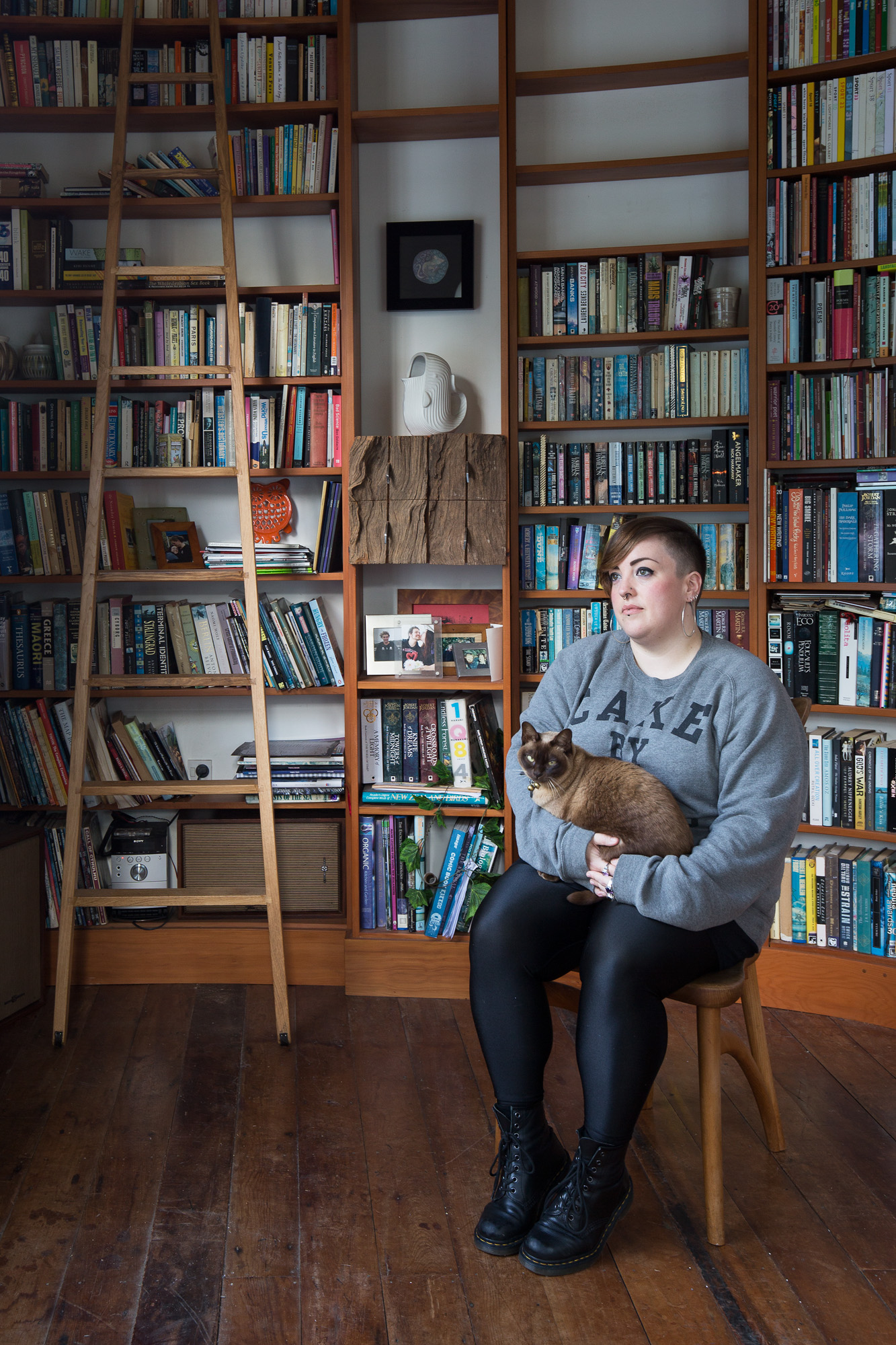
Felt(Massey University Press, 2021) is Johanna Emeney’s third poetry collection, following Apple & Tree (Cape Catley, 2011) and Family History (Mākaro Press, 2017). Her nonfiction writing focuses on poetry and the medical humanities, and poetry and disability. Jo has a background in English Literature, Japanese and Education. She is a senior tutor at Massey University, Auckland. Jo and her husband David share a few acres with their cats, goats and ponies.
Kay McKenzie Cooke’s fourth poetry collection was published by The Cuba Press in June 2020 and is titled Upturned. She lives and writes in Ootepoti / Dunedin.
A while ago the world seemed unbearably bleak and dark, and whenever the world seems bleak and dark, an idea unexpectedly falls into my head like rescue remedy. I had bought a bundle of UK poem booklets that came with an envelopes from the wonderful McLeods Bookshop in Palmerston North on my Wild Honey tour. Each featured ten poems on a theme and I loved the idea of sending one to someone just when they needed a poem boost (The Women’s Bookshop in Auckland stocks them I see). My rescue remedy was to host a season of themes over autumn and winter – with me picking poems but also inviting some poets to send poems and suggestions. The response has been overwhelming. Rescue remedy de luxe!
I wanted the presence of the theme to range from subtle to loud so I struggled over the preposition in the title. It might be a poem after or towards or with or from or by or under or hinting at a theme. Not necessarily about! It might simply be a single word resonating. A cameo appearance. I had 15 themes, but Alison Wong suggested ‘Light’, and Hinemoana Baker suggested ‘Land’, so 17 poetry themes will be appearing over the coming months.
If this had been for a print anthology, I would have spent several years reading and selecting, going to libraries, bookshops, agonising, agonising, agonising. But my rescue-remedy plan meant staying at home and returning to my vast New Zealand poetry collection which as you can imagine after Wild Honey is rich in women’s books. I felt like I wanted to do a whole book on each theme so many poems sung out.
Thank you to everyone who has contributed to my rescue remedy. It means a lot. You cannot imagine what a delight it has been to return to books I have loved over the past decades and to savour new poems sent me. To feel poetry work its magic.
Ten poems about clouds
The Sky
The sky thinks it is a flock of birds.
Then it thinks it is a cloud.
It also thinks it is widespread words.
Sometimes it looks up at the stars,
imagining other skies,
and sometimes down at the water
where it thinks it sees more stars.
At such times it believes itself to be a god.
But no such luck, poor sky! Soon enough
it is saying hello sir and madam
what a nice day it’s turning out to be
and can you perhaps spare a dollar,
thank you, thank you kindly. The sky
can still hold a small cloud in its hands.
Today it does so, and it rains.
It held our old home that way, too,
awkward and vertical and cold –
the snow caught fire as each day died.
But yes, it is safer here on the flat.
A man comes by with coal in a wheelbarrow,
muttering, muttering. He wants
to sell us warmth, his feet don’t leave the ground.
We think that we will always miss the sky.
It says look up whenever we look down.
Bill Manhire
from Wow, Victoria University Press, 2020
The Sky as a Metaphor for Everything
We can’t tell if the sky is clinging
to night or happy to welcome this new morning—
everything in this existence wrapped up and encapsulated
in the changing colours and how we constantly remark on clouds’
silly, ever-shifting shapes, how fast they travel, and so on.
Truthfully, we hate how light always wins
in the sky, in rooms, in movies where it’s a stand-in
for goodness— but never in our real lives.
Though our eyes do adjust eventually, and we get by—
like the sun rising in the morning in the sky.
Jane Arthur
from Craven Victoria University Press
Clouds
roll
south of the volcanoes.
You cut mushroom gills
soft as moth wings
that fluttering in the belly.
Bread rising on the water tank,
look out to patchy light
on the hills — moving.
Try to forget the names
of everything and call
them out new like rain
dropping on lava.
Steam born and gone
in the same instant.
A thought of one
you still look up to see
isn’t there.
Morgan Bach
in JAAM 33, 2015
Long White Clouds
all anyone ever does around here is / grow weed and stare / into burnt-
out houses / into the rabbit hole / into the cards / into the skin /
and roll their cars / their eyes / their r’s / their cigarettes / and kick
snow / kick rugby balls / kick each other / kick bad habits / only to
find another / like an eel / in the creek / in the backyard / in the
dark / in winter / and try to kill it on the rocks / chase the girls /
in a shed / a bathtub / a bed / with wet fingers / eyes / tongues /
and T-shirts / from spilled beer / spilled cum / spilled blood / spilled
secrets / bad boys / with bad skin / bad tattoos / and bad reputations /
because here / all anyone ever does is / swear / across their hearts /
at referees / at other drivers / taking to the road / cos all anyone
ever wants around here is / out / of home / of the closet / of the
relationship / of the sixth-storey window / open it / to the cold / to
the clouds / to the sky / cos all anyone ever does around here is / dive /
Tayi Tibble
from Poūkahangatus, Victoria University Press, 2018, picked by Amy Brown
Spelling Out Goodbye
“This doesn’t seem to be working,” he said quietly, “Perhaps we should try it another way. “Like this!” He split his shoes, laughed all the way to the top of the roof. “The plane will be coming soon,” he said, “Before that, would you help me out and make me a cheese sandwich?”
“Cheese,” said she, “Of course.” She clattered off like a train carriage. When she returned he was snuggled up on the nearest cloud with his breath spelling out hello goodbye. He left his pocketknife in his pocket, stuffed stars by hand into black-eyed plastic bags. He said catch as he floated them down to her.
Johanna Aitchison
in Miss Dust, Seraph Press, 2015
Couple
(after Magritte)
The couple with clouds in their heads
are just outlines cut into a wall
so what you’re seeing is what’s behind
on cloudy days it’s clouds
on rainy days water.
Tusiata Avia
in Wild Dogs under My Skirt, Victoria University Press, 2004
I had never seen you so open
Crumpled on the couch saying
seventh of the seventh
you seemed to be between
trying to get up and sinking further.
A soft redness about you
and a kind of shift somewhere,
to dreams, or clouds,
not things we usually have been
to each other.
Later, you folded the card sent from the office
inside his cap that served
on the deck of a warship in Korea.
Kept it beside you for weeks
until one day it was gone.
Wes Lee
appeared in The New Zealand Poetry Society Anthology 2020
Weather
Winter rain beats on the windows;
there is cloud-hidden snow
on the hills.
In our space, built for the elderly,
warm air encloses thoughts
of long ago:
the coal range, pots of soup
and rain.
Helen Jacobs
from A Habit of Writing, The Cuba Press, 2020
Reflections (clouds)
dawn the sky is splattered
by my juicy mandarin,
the sea a mirror
of tears soon to fall.
watching —
we capture the skyline,
grey lines folding like pursed lips.
wrapped in thick ash and two woven wings,
the sun sets a foot on our city
one eye blending
across an open sea.
E Wen Wong
Baba Yaga
Lyall Bay is often the scene
of tempests, everything pelted
with salt water, rust spreading
like ill humour. The police
are often patrolling in Lyall Bay.
When the cumulonimbus sit like fat
white cauldrons steaming with cirrus,
look our for brush strokes-
someone’s been sweeping the sky
clean as linoleum after an accident.
Amy Brown
from The Propaganda Poster Girl, Victoria University Press, 2008
Johanna Aitchison has published three collections of poems, Miss Dust (2015), a long girl ago (2007), and Oh My God I’m Flying (199). She was the 2019 Mark Strand Scholar at the Sewanee Writers’ Conference (Tennessee) in 2019; and her poetry has been published in New Zealand, the U.S., and Japan. Her poem “Miss Dust in a Motel Room” is forthcoming in Landfall 241.
Jane Arthur lives in Wellington, where she is the co-owner and manager of a small independent bookshop. Her debut poetry collection, Craven, won the Jessie Mackay Award (Best First Book) at the 2020 Ockham NZ Book Awards.
Tusiata Avia is an internationally acclaimed poet, performer and children’s author. She has published 4 collections of poetry, 3 children’s books and her play ‘Wild Dogs Under My Skirt’ had its off-Broadway debut in NYC, where it took out The Fringe Encore Series 2019 Outstanding Production of the Year. Most recently Tusiata was awarded a 2020 Arts Foundation Laureate and a Member of the New Zealand Order of Merit for services to poetry and the arts.
Morgan Bach is a poet recently returned to her home town of Wellington, where she also works as a bookseller.
Amy Brown is a writer and teacher from Hawkes Bay. She has taught Creative Writing at the University of Melbourne (where she gained her PhD), and Literature and Philosophy at the Mac.Robertson Girls’ High School. She has also published a series of four children’s novels, and three poetry collections. Her latest book, Neon Daze, a verse journal of early motherhood, was included in The Saturday Paper’s Best Books of 2019. She is currently taking leave from teaching to write a novel.
Helen Jacobs, aged 92, was born in Pātea and wrote her first poem nearly fifty years ago in response to a TV programme on nuclear war, publishing her first collection of poetry in 1984 and becoming actively involved with the poetry community in Christchurch for many years. She adopted the name Helen Jacobs to keep her writing separate from her life as local body politician, environmental activist and art advocate Elaine Jakobsson. Helen lives in a retirement village with the art she has collected over the years and a balcony of pot plants, delighted the world continues to offer her things to write about.
Wes Lee lives in Paekakariki. Her latest poetry collection, By the Lapels, was launched in Wellington (Steele Roberts Aotearoa, 2019). Her work has appeared in Best New Zealand Poems, Poetry London, Turbine, Poetry New Zealand, Westerly, The Stinging Fly, Landfall, The New Zealand Listener, Australian Poetry Journal, among others. She has won a number of awards for her writing, including, The BNZ Katherine Mansfield Literary Award. Most recently she was awarded the Poetry New Zealand Prize 2019 by Massey University Press, and shortlisted for The Inaugural NZSA Laura Solomon Cuba Press Prize 2021.
Bill Manhire founded the creative writing programme at Victoria University of Wellington, which a little over 20 years ago became the International Institute of Modern Letters. His new book Wow is published by Victoria University Press in New Zealand and Carcanet in the UK.
Tayi Tibble (Te Whānau ā Apanui/Ngāti Porou) was born in 1995 and lives in Wellington. Her first book Poūkahangatus won the Jessie Mackay Award for Best First Book of Poetry in 2019. Her new collection Rangikura will be published in June by Victoria University Press.
E Wen Wong is a first-year Law and Science student at the University of Canterbury. She was the winner of the 2020 National Schools Poetry Award.
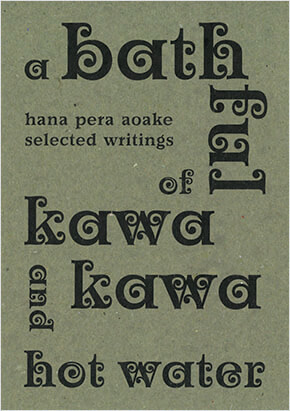
A bathful of kawakawa and hot water, Hana Pera Aoake, Compound Press, 2020 (reprinted 2021)
The opening poem, ‘Perhaps we should have stayed’, in Hana Pera Aoake’s collection of poetry and prose is like a chant, like a manifesto for self, like a list to pin to a fridge or a heart, to keep you moving and remembering, and thinking and feeling, and the title keeps repeating like an insistent beat, and it is political and it is personal, and it is sideways and direct, and it is searing and it is balm, and I can’t stop reading it, and I have read it five times in a bath with mānuka leaves that drift in on the wind.
PERHAPS WE SHOULD HAVE STAYED.
SOMETIMES THE LONGING MIGHT KILL YOU.
OTHER TIMES IT MIGHT BE THE EXHAUSTION.
IT’S GOOD TO BE YEARNING.
MAYBE YOU YEARN FOR SOMEONE OR MAYBE YOU
JUST YEARN FOR SOMETHING BETTER.
WATCHING BODIES FROM VERY FAR AWAY
THROUGH A SCREEN DOES NOT GIVE YOU A SENSE
OF WHO SOMEONE REALLY IS.
PERHAPS WE SHOULD HAVE STAYED.
THE IDEA OF HAPPINESS IS JUST CAPITALISM.
Hana is writing this book from Lisboa, from that far away point, where writing becomes the connective bridge to the land that they hold dear, and as you read you move across the memory bridge, from the waterfront there to the water here, from the Portuguese river to the line of police removing Ihumaato protestors. The prose piece is rich in direction, building in momentum like the Pacific ocean flowing and the voices of the protestors, never ever losing sight of the sea, and it is an umbilical chord and it is a cry, an insistent poetic cry to do better.
Elsewhere there is a yoga teacher that reminds the writer of a vegan flatmate ‘who didn’t clean and was really racist and ate all my food, and had a trust fund’. There is puking and there are drugs. There is a cameo in Sex and the City. There is a Lisboa square where the Jewish were once slaughtered. There are emails to write and fliers to be designed. There is an empty womb. There is all this and there is so much more. Hana’s language is the most super-charged gloriously exhilarating uplift of words you can hope to meet, that draw in Te Reo Maaori and Portuguese, and pay attention to rhythm, so that you are itching to hear it read aloud, because this is prose and this is poetry, and yes this is song. Song from the heart, from the whole body, moving and yearning and finding a way to be.
Yet if this collection is song, it is also an incisive and vital probe, drawing on reading, ideas, history, the present and the future, challenging Western discourse, asking questions, musing on what ‘constitutes a common’, on the co-option of Maaori concepts by Paakeha, on the inseparability of body and mauri, on the damaged world, on the power of myth.
As a Maaori I feel death all around; not just because fantails follow me most days, but because I carry dead bodies inside me. I name them as I name myself, my rivers and my mountains. I ache at night thinking of my grandmother dying alone in a rest home during this pandemic.
from ‘We were like stones like weeds in the road’
Chris Holdaway (Compound Press) has produced an exquisite book, using mid-20th Century typefaces designed by Samoan New Zealander Joseph Churchward. Hana has produced a collection of writings that within 83 pages take you out of yourself into a state of wider contemplation and deeper mourning and intricate learning and necessary action. This book I hold to my heart.
Hana Pera Aoake (Ngaati Mahuta, Tainui/Waikato, Ngaati Hinerangi) is an artist and writer based in Waikouaiti on stolen Kai Tahu, Kati Mamoe and Waitaha lands. They are keen to restart the land wars and love eating kaimoana and defacing colonial property.
there was kickback from the rifle aimed at cans of spaghetti
which set my last good ear reluctantly ringing, but organs
grumbled on, oblivious, dedicated to their business
then, a bowstring chipped along a forearm, the obvious
smarting blush of focus lost – that’s all – just a rash
to impress upon oneself the importance of accuracy
how about the satisfaction of bowling
straight and spinning, after three wides?
even the llamas seemed to sense that
otherwise, catching the hawk
making hot circles in the haze before braking hard
in the macrocarpa – the host will copy her later and almost
clip a concrete wall, prompting a brief vision of a herniated
ute smoking in the darkness – but we kept
to our seats and let him turn up his dust – no, hey, I know
the sheep started to seem familiar – pumping
panic, split up, sorted, all of us
watching the same pink pair of shorts
thinking the shade had lost its cool and comfort
wondering how high one would jump
and if the gate could be cleared
Claudia Jardine
Claudia Jardine is a poet and musician who has recently returned to Ōtautahi. A selection of her poetry was published in AUP’s New Poets 7 alongside the work of Rhys Feeney and Ria Masae. More of her work can be found in Starling, Sport, Stasis and on her bandcamp webpage.
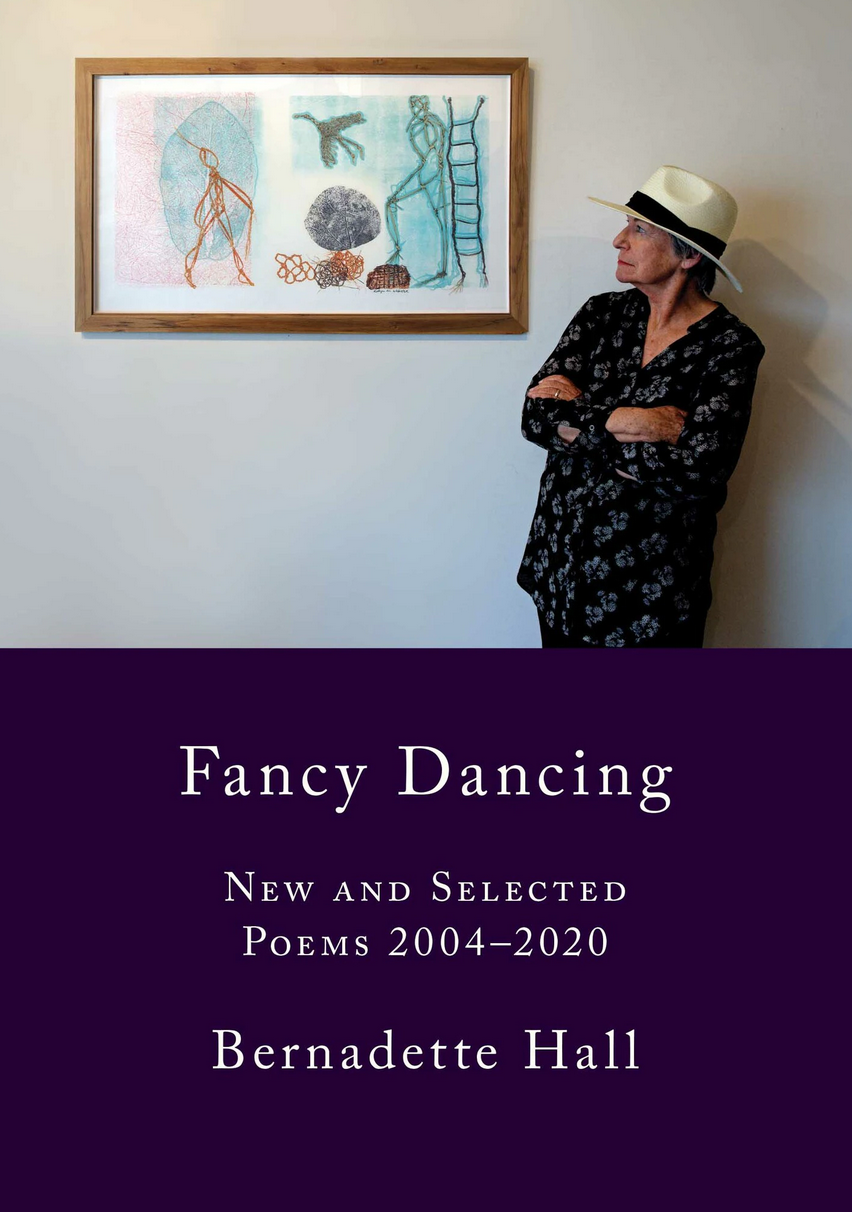
Bernadette Hall, Fancy Dancing: New and Selected Poems 2004 -2020, Victoria University Press, 2020
Campfires flicker in the night, ice masks the harbour.
I’ve made up my mind at last. I’m going to walk across
to see the others. We can sit down then
and talk about poetry, the way ‘water’ chimes
with ‘daughter’ and is there any news of her yet.
from ‘Wai-te-ta’
2020 was a year rich in New Zealand poetry and I am still dipping into my wee stack for treasures. I have long been a fan of Bernadette Hall’s poetry with its sumptuous sound and visual effects, its wide roving subject matter, and its agile engagement with ideas, experience and feeling, it’s humour.
Interestingly, picking up Fancy Dancing set me on a slightly different response to the poetry, because I stalled on Robyn Webster’s artwork before I read the poems. Robyn’s works are enticing. They appear like a fusion of needlework, embroidery and painting with maybe a whiff of printmaking. I haven’t seen them in real life so am only connecting with them as illustrations in a book and have no idea of the media. I am struck by the allure of threads, branches and tributaries, by a colour palette that shifts between soothing harmonies and piquant contrasts. There is both simplicity and intricacy.
Here I am stalling on the artworks and I see them as shadow maps of the poetry. To think of Bernadette’s poetry as rich in tributaries, branches and threads is rewarding. One thread takes you along Irish roads into experience and ancestors, another into ice and snow and the Antarctic. Gardens and friends, weather and the sea, the mountain and the angels are stitched exquisitely along the lines. There is the close-at-hand and there is the wider world. There is the warmth in harmonies and the edge in contrasts. It was so satisfying to read my way through samples from the collections I am familiar with (The Ponies (2007), The Lustre Jug (2009), Life & Customs (2013) and Maukatere, floating mountain (2016).
The final section is devoted to new poems, including an exquisite sonnet sequence that is akin to brocade it is so rich in effect. Bernadette’s included author bio is revelatory: “And as for the wilful sonnets that explode in the final pages of this book, she wonders where on earth they came from. ‘It was such fun writing them,’ she says, ‘as if I‘d kicked down the stable doors and taken to the hills.’”
If I continue making analogies with the artwork, I see the 25 sonnets as embroidery at its most intricate and dazzling. Classical threads are stitched into a contemporary context, the personal is threaded with the fictional, the imagined with the recalled. Both Phaedra and the poet are shadowy presences, their back narratives bubbling beneath the surface. The poet speaks:
Now it’s time to expand the narrative. So come
with me into a dimly lit corridor in the Mayflower
Student Hostel beside the Mississippi River
in Iowa. (…)
from ‘v.’
Think of brocade that glints and gleams and offers pocket narratives and pinches of the surreal. Guests make appearances: friends, family, writers, artists, goddesses. You will hear rain and footsteps, but you will also hear the sumptuous audio effects that are a trademark of Bernadette’s writing. Such an ear for the resounding line. I keep wanting to quote lines to you, whole sonnets.
In sonnet xix, the ‘crazy lady, how she strides down Cuba Mall in full combat gear’ declares the area is under control. The poem culminates in the poet/speaker imagining how she would behave kindly if it were a movie: she would approach the woman in combat gear saying, ‘Thank you, / I feel so much safer in this crazy world with you around.’
I am repeatedly drawn to sonnet xxiv, a sonnet dedicated to grandchildren, a sonnet that sways between past and present, between Italian marble and four children harbour swimming, ‘their arms / like triangle roof-lines’. The image is potent, the shiver between past and present fertile, and the ending so very moving:
(…) How long it took to see
the eating, drinking, gulping, feasting of the water
body, the spasmodic sun, the specific shade.
Beautiful children, you are forever and thereafter
swimming me to shore. I could not love you more.
The final sonnet is a form of counting blessings as it gives thanks. It becomes a rich celebratory brocade, luminous and heartfelt, a gift for ear and eye. I will pin this sonnet to my study wall as I continue to give thanks to poetry, to the things near me, to what gives me courage and furnishes each precious day.
Let us give thanks for the cranesbill geranium
and the mouse eared myositis,
for the ranunculus (little frog mouth, little friend),
for the feathered nival zone, for the bug moss
in the tarn, for all that is and all that
has been and all that is to come. It is for us
to keep our courage firm, to nurse our appointed
pain, to await ‘that which springs ablaze of itself’.
from sonnet xxv
Fancy Dancing showcases the work of one of our most treasured poets. The poems will dance in your ear and on your tongue, in your limbs and in your heart. Take a read. Pick a favourite and pin it to the wall. Take heart from this gift of poetry.
Bernadette Hall is Otago born and bred. Following a long and much enjoyed career as a high school teacher in Dunedin and Christchurch, she has for the last eighteen years lived in a renovated bach at Amberley Beach in the Hurunui, North Canterbury, where she has built up a beautiful garden. Fancy Dancing is her eleventh collection of poetry. ‘It’s as close as I’ll ever get to writing an autobiography,’ she says, laughing. And as for the wilful sonnets that explode in the final pages of this book, she wonders where on earth they came from. ‘It was such fun writing them,’ she says, ‘as if I‘d kicked down the stable doors and taken to the hills.’ In 2015 she collaborated with Robyn Webster on Matakaea, Shag Point, an art /text installation exhibited at the Ashburton Art Gallery. In the same year she was awarded the Prime Minister’s Award for literary achievement in poetry. In 2017 she was made a Member of the New Zealand Order of Merit for services to literature in Aotearoa New Zealand.
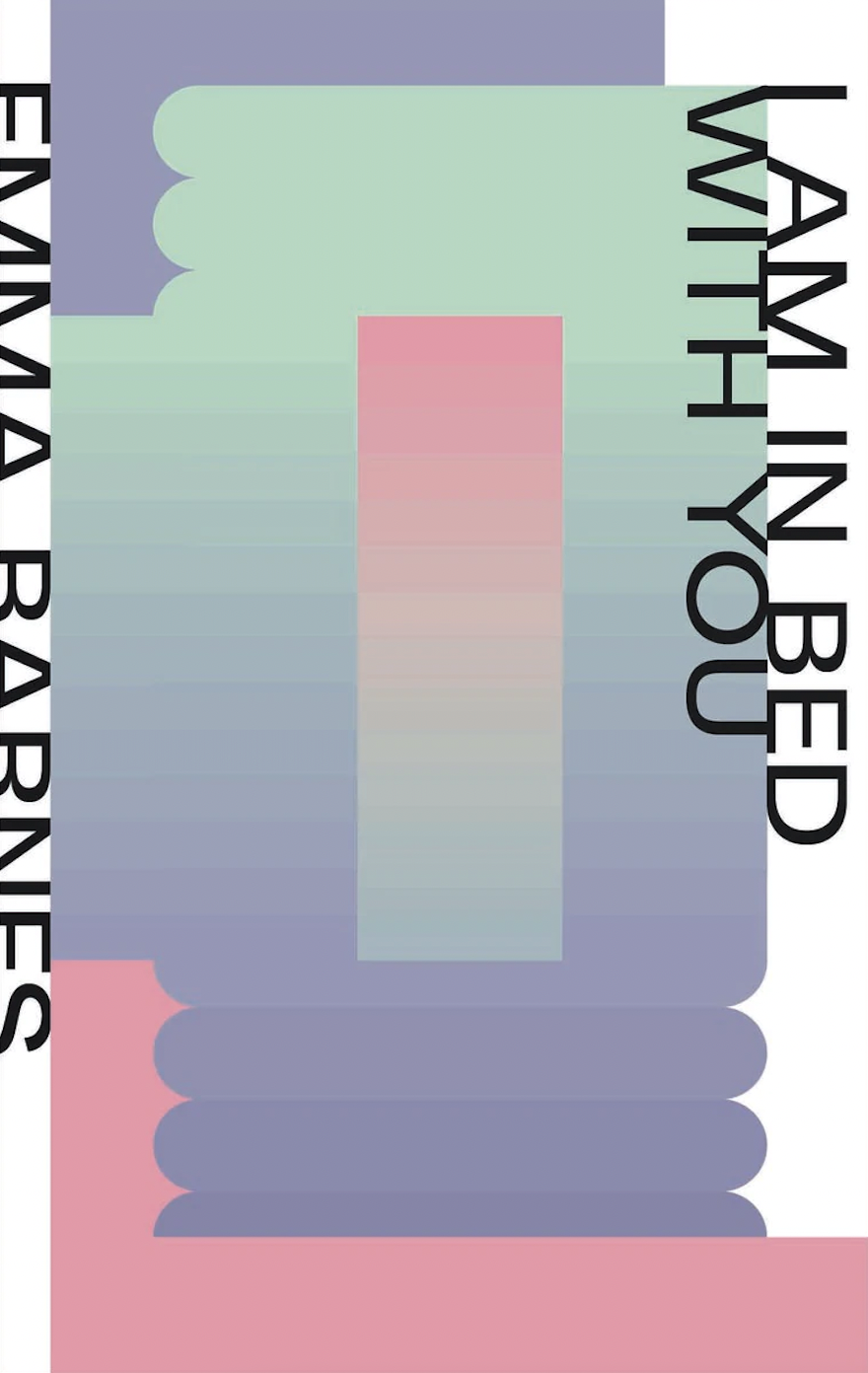
Emma Barnes reads four poems from I Am in Bed with You, Auckland University Press, 2021
‘Maiden Mother Crone’
‘Ohio’
‘Low boughs’
‘Completely dry riverbed’
Emma Barnes lives and writes in Pōneke / Wellington. They have just released their first book I Am In Bed With You. For the last two years they’ve been working with Chris Tse on an anthology of LGBTQIA+ and Takatāpui writing to be released this year by Auckland University Press. They work in Tech and spend a lot of time picking heavy things up and putting them back down again.
What is left are the tailings, the shit heap the pile
Naked mole rats shuffle and eat all our bile
Ant pathways like accordions filter the dirt
We feel nothing at all, not even hurt
Reihana Robinson
Reihana Robinson: Starting out near year end of 2019 there was the beautiful volume Ko Aotearoa Tatou/We are New Zealand (An anthology) I had the fortune to join. Next up was Nga kupu Waikato Kotahitanga online, video and exhibition with creator Vaughan Rapatahana at the helm.
Love in the Time of Covid Chronicle of a Pandemic through the good graces of Michelle and Witi brought me to the surface of writing after a spell of painting. Astonishing art and inspirational writing from around the world.
The year of 2020 was a year of editing both a new volume of poetry and a collection of poems for young voices. The new volume is woven, not like tukutuku or taniko (no absolute pattern). There are beginnings and a few endings that bleed, come together and come apart. Poems stitched with threads of rural misenchantment, misplaced desire and simmering memories that hover just over the horizon. Characters fledge their wings and some fly, some die. Language both gentle and brutal.
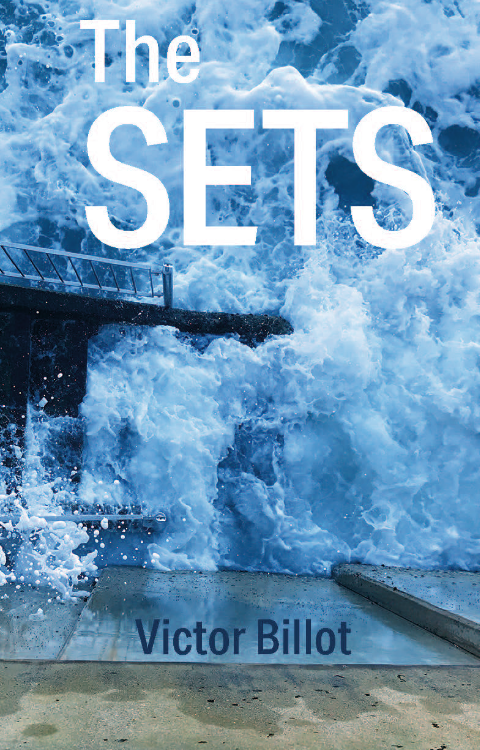
The Sets, Victor Billot, Otago University Press, 2021
Victor Billot reads ‘The Sets’ from his collection plus two new poems: ‘An Award Winning Campaign’ and ‘The Youngest One’.
Victor Billot was born in Dunedin, New Zealand in 1972. He has worked in communications, publishing and the maritime industry. His collection The Sets was published by Otago University Press in February 2021.
In 2020 he was commissioned by the Newsroom website to write a series of political satires in verse and is now embarking on a new series. His poems have been displayed in the Reykjavik City Hall and in Antarctica.
This is one of my favourite sessions I have chaired ever!
Paula Green, poet, anthologist, reviewer and children’s author, with her newly minted honours and awards, shares the stage in a charming conversation with poet, short story writer and academic Bill Manhire, and jazz composer and performer Norman Meehan, as they disclose the alchemy of setting poetic text as song. They discuss their latest collaboration, the riddle project, Tell Me My Name, and along the way Bill Manhire reads two of his poems Frolic and I am quiet when I call.
This session took place the day after Manhire, Meehan and friends delivered a captivating opening night performance, Small Holes in the Silence for the Going West audience.


 NZ Poetry Shelf