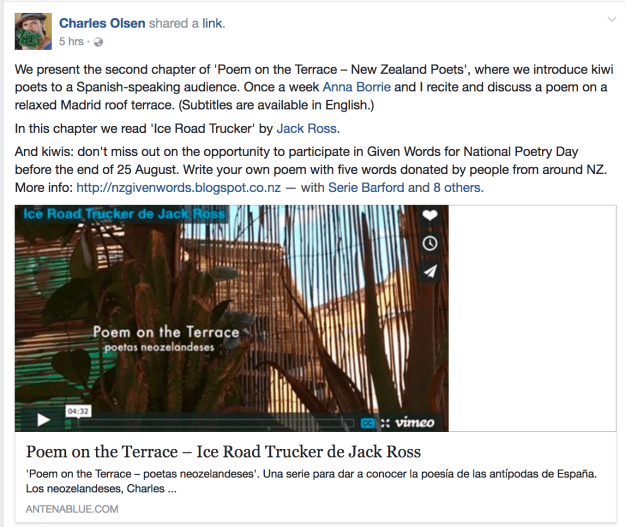
You can hear the poem in both English and Spanish with the conversation here.

We’re thrilled to announce the winners of the 2017 WriteNow poetry competition. This annual competition for Dunedin secondary school students was judged this year by Lynley Edmeades. First place in the senior section went to Molly Crighton (Year 12, Columba College), for her poem “Headlights”, and the winner in the junior section is Mia Parsons (Year 9, Otago Girls High School), for “Morning”. Full results, winning poems, judge’s report and prizegiving details are here: http://writenow.nz/
From Lynley Edmeades’ judges report:
I was really intrigued to read what teenagers are writing about today. Whichever direction the poems took, I found myself being invited into the minds of these young people and was often impressed with the treatment of the subject matter. I don’t know what it is like being a teenager today, but I do know that the modern world is, for many of us, a difficult place to understand at the best of times. Some of these poems remind me that poetry offers us navigational skills for the complexities of life. That these young minds are turning to poetry in times like these gives me solace and optimism: solace that they are looking to the written word as a medium of expression, and optimism for a future that has the humanities at its core.
Headlights
We travel parallel to a queue of cars –
That sting-bright shine of a string of pearls
Around anonymity’s urban neck.
Waiting tastes like suet
And rush hour a fatty feast
For clogged one-ways
And no-exits like the fence at a football game.
In between each bracket of streetlight the stars open and close
As though they are some bioluminescent tropical flower
Releasing headlight spores
To scatter white hot and sting-bright
On the bone-stark road below.
Molly Crighton: First place, senior section, 2017 WriteNow poetry competition
The WriteNow prize ceremony will be held on Friday 25 August as part of the National Poetry Day public event:
When: 25 August 2017, 5:30pm-8:00pm
Where: Dunningham Suite, Dunedin City Library
Price: Tickets $5 (bookable in person, at your local library)
Special thanks to WriteNow sponsors: University Book Shop; University of Otago Department of English and Linguistics; Otago University Press.
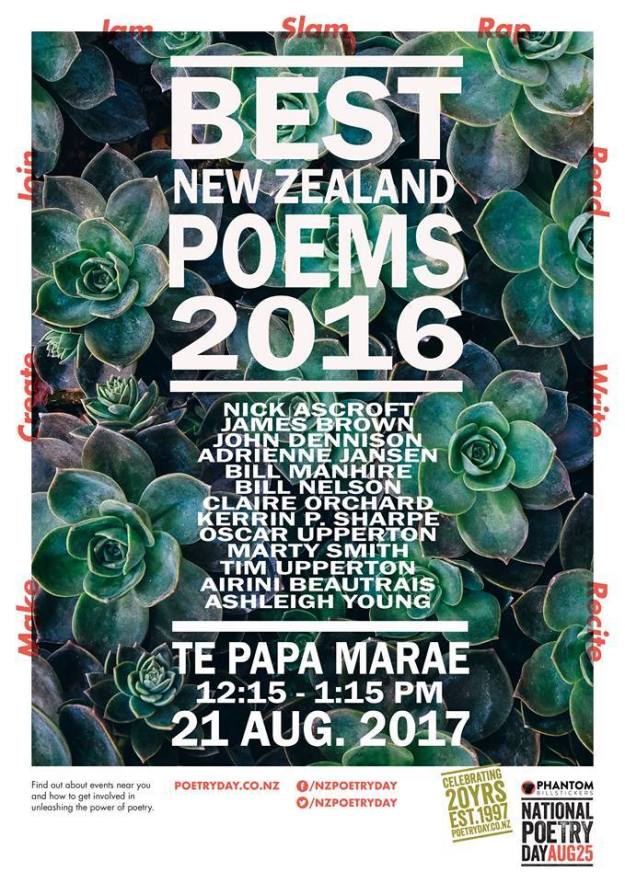
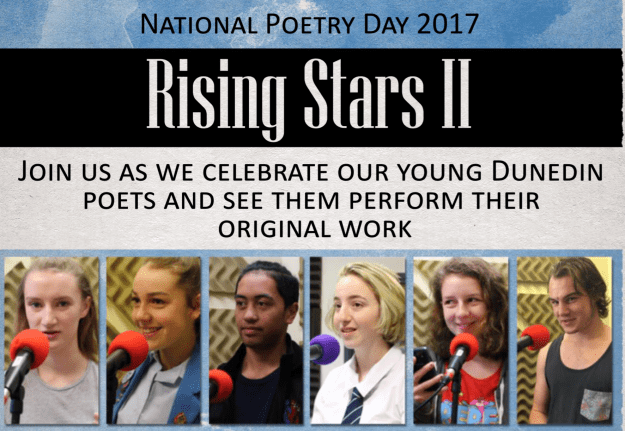

On National Poetry Day (August 25th) young Dunedin poets will perform their original work to a live audience.
Rising Stars II runs alongside the ‘Profile of 20 Young Poets’ radio series and podcast airing on Otago Access Radio, where young Dunedin artists talk about their writing and inspiration.
You can hear full episodes from this series here
Join us on the ground floor of the Dunedin Public Library to celebrate these young Dunedin poets!
25th August 2017 – 4:30pm
Gig City Cube, Ground Floor, Dunedin Public Library
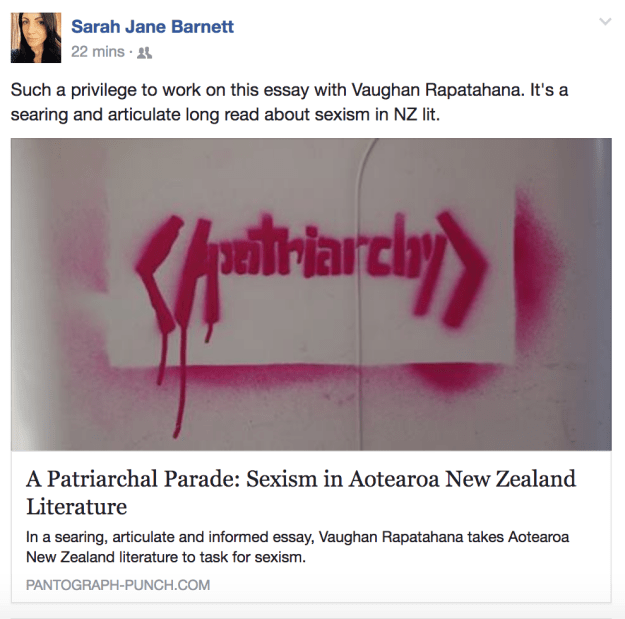
As you can imagine this article hits home sharply, especially as I am writing a book on New Zealand women’s poetry. My book aims to open multiple pathways into what was, at one point, viewed as a foreign country: women’s poems.
We have come so far, especially in view of Pākehā women – unbearably less so if you are not white-skinned – but I still find examples of gender bias and blindness, alongside the dynamic, fertile and eclectic visibility of women writing, critiquing, publishing, winning, speaking out, showcasing, connecting.
Thanks Vaughan, Sarah Jane Barnett and Pantograph Punch for provoking us to think and rethink.
Read the piece here.
A taste:
In a searing and articulate essay, Vaughan Rapatahana takes Aotearoa New Zealand literature to task for locker room schoolgirl-grooming, women-baiting, and sexism that arises from a violent and suppressed masculinity.
You, being a modern poet
Must write real he-man stuff
So you will take slabs of prose
And cuts it into chunks like this;
There need be no rhyme nor reason in it …
No top-notch New Zealand poet any longer
Writes ballads like Jessie Mackay
Or bird-songs like Eileen Duggan
Or lyricisms like Helena Henderson
Or tree-poems like Nellie Macleod …
And anyway they‘re only women
(‘Without Malice’ by Alien in O’Leary 179-180).
Yes, I have read all the books, all the pertinent material pertaining. New Zealand has always been a sexist society, a patriarchal panoply of male power, controlling and suppressing female prowess – as so well exemplified in its literary structures. Sexism in literature is a reflection of a wider societal sexism whereby a deliberately constructed literary masculinity ruled up until the 1970s or at least the 80s. Historian Jock Phillips pronounced in 1987 that ‘the traditional male stereotype is now weakening in New Zealand’ (289), while academic Kai Jensen pronounced, ‘…the mid 1960s…was the end of a thirty-year sequence of growth, dominance and decline in what we may call “high masculinism”’ (107). While the latter admitted to some continued sexism in New Zealand Letters from male writers after this time, it was now, ‘a tenuous residual presence’ (157).
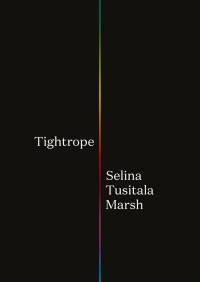
This is the one event I am not going to miss on NZ Poetry Day!
From Selina:
‘Talofa Maori and Pasifika Writers – I’m using the launch to get teachers and writers kanohi-ki-te-kanohi, at least with your books! If you’re coming, please email Carole at the Women’s Bookshop to make sure they have your book in stock to sell on the night! books@womensbookshop.co.nz. If you’re not coming, but would like your book available on the night, please still email them! Let’s get Reading Brown on National Poetry Day!’
Launch details of Selina’s Tightrope
August 25th: 4.30 to 6 pm
Venue: Fale Pasifika
Location: Fale Pasifika, University of Auckland, Auckland, 1010
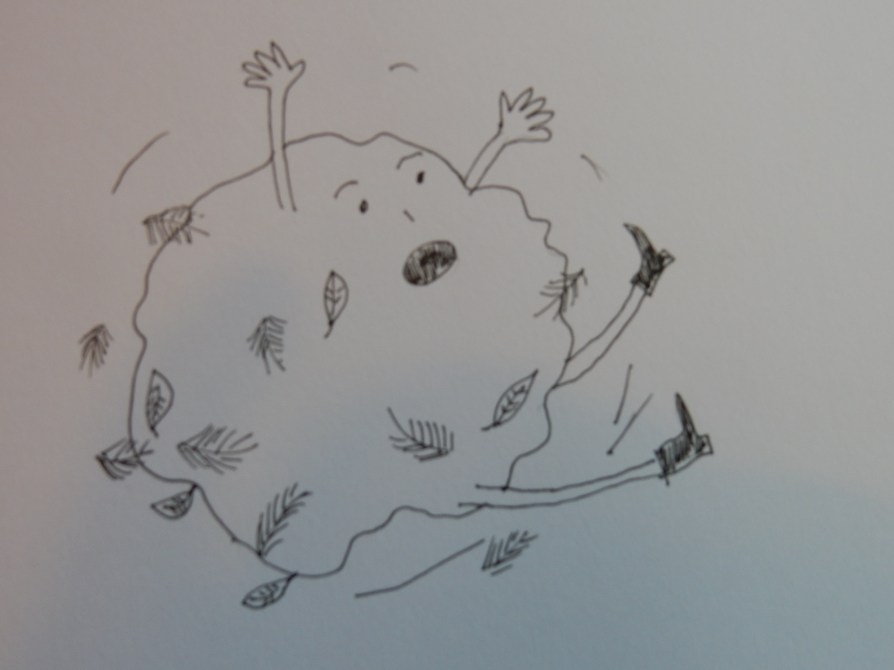
from Groovy Fish
It was such a pleasure having this chat with Lynn in the studio before my memorable taxi ride.
I can’t believe I forgot my all-time favourite New Zealand children’s poet, Margaret Mahy whose word play and leaping imagination astonishes me more than that of anyone else. I was full to the brim with award-day nerves but still …. a thousand apologies.
The Sapling will post an A to Z of my favourite children’s poetry books on Poetry Day.
Listen here.
11 August 2017
A little diary, my award speech and a photo gallery
A little diary
The Prime Minister’s Awards for Literary Achievement are an occasion to reflect upon why we write, read and circulate stories and poems that matter. For me, as the recipient this year for poetry, this was particularly so. I felt honoured to share a small pocket of public light with two other writers whom I admire greatly, Witi Ihimaera (for fiction) and Peter Simpson (for non-fiction). I got thinking about why I write, why I step out in public on the printed page and how I am in debt to a necessary and much loved support crew.
Books are transformative experiences for both reader and writer whether our ears, hearts and minds are engaged, whether imagination or scholarship takes precedence, whether we speak out in order to challenge injustice, or weave paths both within and beyond the contours of our familiar world.
When I discovered I had to make a short speech at the award ceremony, I knew I wanted to acknowledge some of the people who had got me to where I was, and also make reference to the complicated pleasures of writing. With a four-minute limit, I knew I would be leaving out the rows and rows of poetry books on my shelves that I have loved, from both past and present, not to mention people, friends, family and experience. Like many authors, the prospect of a significant public occasion induces sleepless nights, before, during and afterwards. This was no exception.
≈
I am wide awake, writing this at 3 am, back home after two wonderful days in Wellington, but I can’t stop reflecting back on my initial questions. I am thinking of the children who send poems to Poetry Box, the teachers who understand the power of poetry to do good things (like Ros Ali), the schools that have inspire me as much as I have inspire them. I am thinking of the effervescent conversation I had with Kathryn Ryan on Radio NZ National about children’s poetry; those I have had with book enthusiast Lynn Freeman where I forget I’m on radio because we get so caught up in the pleasure of ideas; dear friends Ruth Todd and Morrin Rout who celebrate poetry on Christchurch’s Plains FM.
I am also thinking of Sarah Ross and how we worked together with Michael Gleissner to get the Sarah Broom Poetry Award off the ground.
I am thinking, too, of New Zealand fiction writers who have made a difference to my writing. Several years of monthly lunches with Emily Perkins, talking books, ideas, secrets. There are little surprises like a getting a package of poetry books from Laurence Fearnley because she couldn’t bear to see them languishing in a second-hand book shop, and how she went back to get the rest for me. Fiona Farrell—like Laurence and Emily, fiction writer extraordinaire— offered to buy me a dress when my luggage went missing at the Wellington Writers Festival.
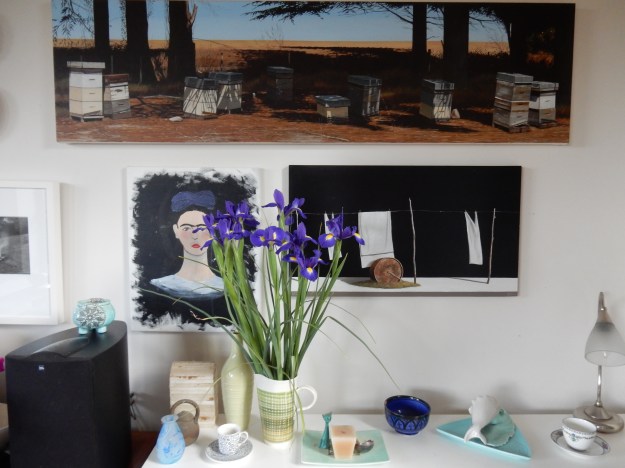
Last Thursday, when the awards were announced, I got so many lovely emails, I felt overwhelmed. I abandoned my initial impulse to answer each one straight away and went to the supermarket. I forgot dog food and broccoli and other crucial things; I stood in the middle of the vegetable aisle, with the whole writing community whirling about me, like some kind of marvellous winter wrap, and came home with several bunches of blue irises.
≈
Michael and I flew down to Wellington on Tuesday evening, jumped into a taxi, got out in the wintry wet at the National Library because I wanted to be part of Karl Stead’s Poet Laureate book launch. Along with Greg O’Brien and Chris Price, I had been part of Karl’s celebratory weekend at Matahiwi marae two years ago, and it was a memorable occasion that befitted a writer who has delivered so many literary riches. Again it came back to notions of a writing community and celebrating connections and the power of words. Karl’s laureate book, In the Mirror and Dancing, is a thing of beauty, produced by printer and bookmaker, Brendan O’Brien and Fernbank Studio with illustrations by Douglas MacDiamid. Karl read a suite of tiny Christchurch poems that showcased the sheen of his writing perfectly.
I was invited to read because the book contains a poem dedicated to me on the occasion of my 60th birthday. It is 3.30 am now, and I am thinking back to the morning, when Anna Jackson sent me an email saying HAPPY BIRTHDAY Paula Green in the subject line. I was not sure whether the link was healthy so left it awhile. But when I threw caution to the wind and clicked, I was taken to the online Poetry Shelf for Paula Green. A bunch of poets had written a poem or picked a poem and written a wee note to go into it. I burst into tears at the generosity of it all.
Karl’s gorgeous poem for me, ‘Long Range Forecast’, begins in August and the ‘purple irises are/ out under the vine’. I was transported back to the blue irises in my lounge as I read, lifted back to the warmth of Matahiwi, and then returned to the clarity of image and a tremolo of inference in the poem. I had raced over to buy a limited edition copy and felt the second serendipitous link when I saw I had purchased copy number 60.
≈
The thought of the award ceremony had kept me awake for several nights, squirming with self-embarrassment, yet the actual occasion was a joy. I am taking politics right out of this – Prime Minister Bill English made a speech that came from the heart of a reader, he underlined so clearly the importance of a book culture, of the exchange of stories, and that diverse and distinctive writing is important for all ages. I am proud of any politician, let alone leader of a nation, who can walk up to me and say he has read my book, and discuss it with me, with warmth and intelligence, outside the fact that this election year and I will be voting and responding to serious issues. It felt like a form of respect. When the Michael King recipient, Philip Norman, was making the audience laugh with his witty speech, and I was wondering how on earth I could follow that – Bill English gave me a look and a smile as if to say, you can do it!
I am thinking too of the kindnesses from everyone at Creative New Zealand, especially Malcolm and Jasmyne. Thank you.
≈
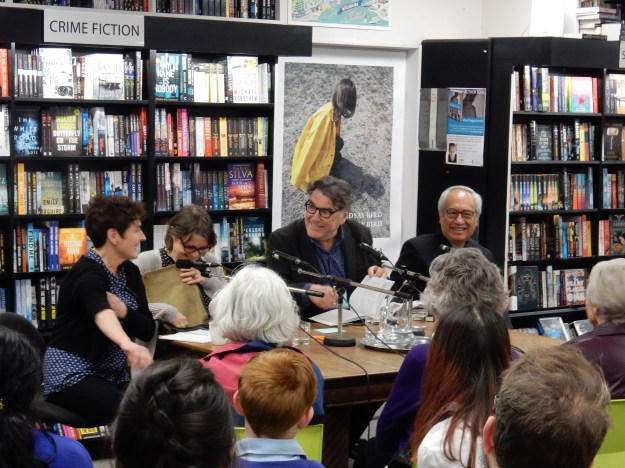
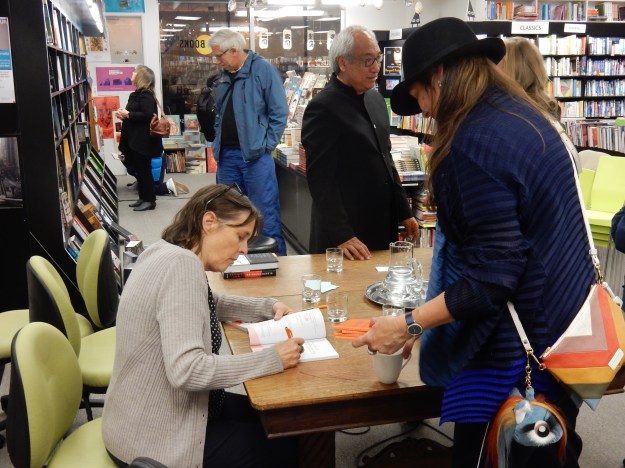
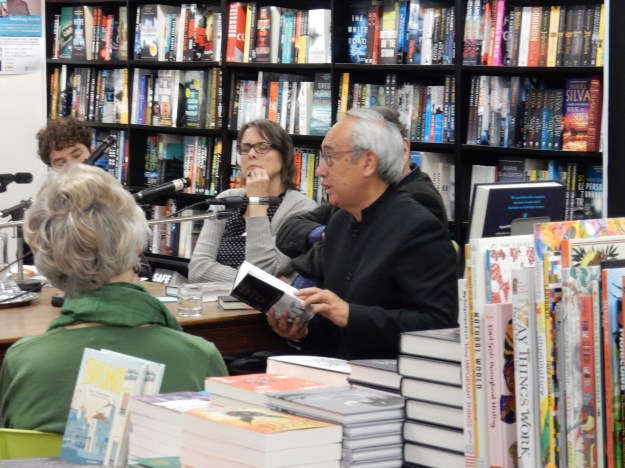
It is now 4 am and I am still awake, going back through the reading event at Unity Books chaired by national treasure, Kate De Goldi. You could hear a pin drop when Witi read his story from the brand new and utterly essential volume, Black Marks on the White Page. Check out the photo below with my eyes shut listening. I adored it.
I was tired, running on empty, wondering whether what flowed out of my mouth would make sense or need subtitles, but when I spoke directly to the secondary-school students, on how to visit a poem, and saw the look on their faces change, everything else faded.
≈
It is 5 am and I am replaying in my head one of my top five poetry experiences: hearing Bill Manhire read ‘Hotel Emergencies’ at Going West. Somehow I got to have coffee with Bill and Norman Meehan on Wednesday and talk music and words in preparation for our session at the festival this year.
That afternoon, I got a taxi back from my prerecorded interview with Lynn Freeman (once again I got caught up in the pleasure of talking books and poetry with her and even found myself talking about my new manuscripts! It’s on air this Sunday). I had the most astonishing taxi ride ever. A third serendipitous thing.
The taxi driver asked me what I did. I am a poet, I said. Well you must tell me a poem, he said. I loved hearing poems when I was a little boy, and I haven’t heard one since then. I can’t, I can’t, I kept insisting. You must, you must, he said, and it must be a lovely poem. I want to hear lovely poetry. So I pulled out my brand new children’s poems and my copy of New York Pocket Book, and read to him until we got to the hotel. He parked the car, lifted both hands from the steering wheel and clapped. It was my once-in-a-lifetime private poetry reading in a taxi. I didn’t tell him I was getting an award that night, and I didn’t have time to ask him his story, to take me back to the little boy listening with such devotion to poetry somewhere else in the world. I felt sad about that. I feel like ringing Combined Taxis, so on my next ride in Wellington, it is his turn to talk.
My award speech
Kia ora tatou. Thank you for the mihi nui. Thank you Rt Hon. Prime Minister Bill English, Rt. Hon. Minister of Arts, Culture and heritage, Maggie Barry, and CNZ. I am greatly honoured. A big hug for Philip, Witi and Peter.
I want to draw a line from the young girl-me half way up the stairs reading AA Milne to the 60 plus me standing here with butterflies and shaking legs, and pin on the line the day James K Baxter stood on our school stage with scruffy beard and bare feet. I went home and wrote pale Baxter poems. Seven days later he died, I drew his portrait in blue, wrrote more pale Baxter poems, walked into the school library, and discovered Hone Tuwhare’s gorgeous elasticity of words.
I pin my travels, meeting Michael in London, discovering we could inhabit our own creative spaces, build a life together with our daughters, our extended family.
I pin the day I met the poetry of Michele Leggott at the University of Auckland when I was doing my Italian degrees, because her enthusiasms were such a boost.
I pin the day Elizabeth Caffin, friend and mentor, with her resolute inspired dedication to local poetry welcomed me into the AUP family, published my first books including Flamingo Bendalingo, running with my madcap desire to have 50 co-poets who were children. To later working with Sam Elworthy.
I pin my second poetry family, the then Random House, the way Jenny Hellen sent my children’s poems sailing, and risked my poetry story book, Aunt Concertina, with Michael’s sumptuous oil paintings. I won’t forget the days we poured over poem picks for the Treasury.
I pin the year of tremendous discoveries-and-challenges that dear publisher and friend Harriet Allen and I shared as we worked with Harry Ricketts to produce and write 99 Ways into NZ Poetry.
I bring the sheer pleasure of finding 150 NZ Love Poems with Nicola Legat to the line.
I pin fun to the line because of The Letterbox Cat with Scholastic, and I pin the tremendous pleasures of working with Libby Limbrick and Storylines.
My third poetry family is really just one woman: the fabulous Helen Rickerby who published my last two adult collections with Seraph Press. On the line is the way she crafts books of beauty.
I pin the book I am writing now on NZ women’s poetry and the way Rachel Scott from Otago University Press is offers a new poetry family.
I pin booksellers, like Carole Beu, Marion Castree, librarians like dear friend, Elizabeth Jones at National Library, poetry supporter Peter Ireland, the difference research libraries make, devoted poetry publishers big and small, such as Fergus Barrowman Kiri Piahana Wong, working with Catriona Ferguson at the New Zealand Book Council.
I pin contemporary poetry books I’ve loved including Manhire Hall Bush Hawken O’Brien Neale Wedde Wallace Avia Tusitala Marsh Tse Price Mettner Bird Barnett Kan McQueen Eggleton Smither current Laureate CK Stead. Oh and Bethell. [and another 50 if I had had time, so many other loves, forgive me]
I pin writer friendships that get me over humps and hurdles and inspire: dear Anna Jackson, Angela Andrews, Anne Kennedy, Tusiata Avia, Jenny Bornholdt, Sue Orr.
So why do I love poetry? What difference does it make in a world affected by hunger, greed, homelessness, hatred, an intolerance of difference?
For me it comes down to JOY. As unofficial ambassador for children’s poetry, I want to fire up poems in children, and make sure that rarefied beast, a New Zealand children’s poetry book, continues to be published.
Adult poetry here, in contrast, is like an orchard abundant with fruit.
Last week Bernadette Hall told me this award is like a warm embrace from the writing community. I agree; we’re one big expansive community made up of many small distinctive families and while there are glaring and troubling lacks, we need more Māori, Pasifika and Asian poets in print, we can celebrate nourishing connections. We show and continue to show that books matter from 0 to 100. I’m filled with a warm community glow. Thank you.
A photo gallery
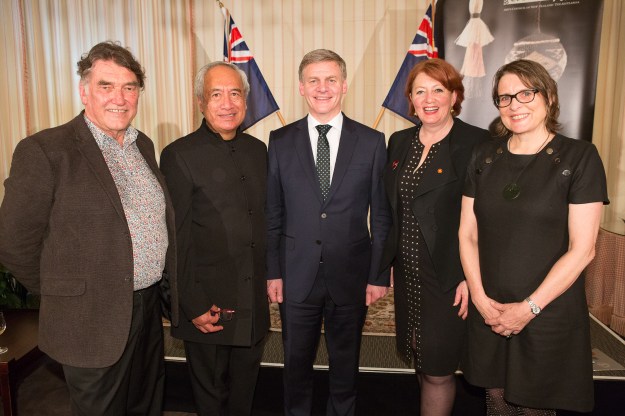
Photo credit: Creative New Zealand. Photographer: Neil Mackenzie.
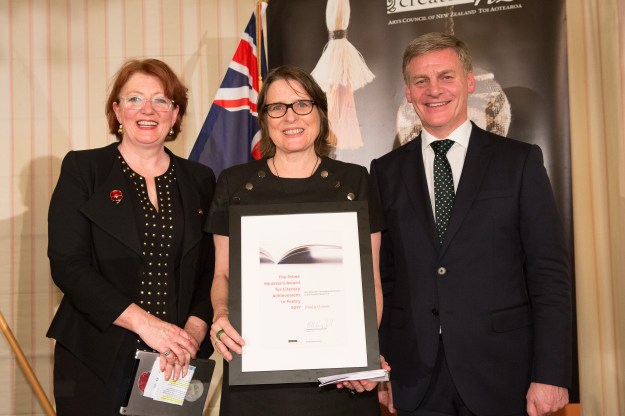
Photo credit: Creative New Zealand. Photographer: Neil Mackenzie.
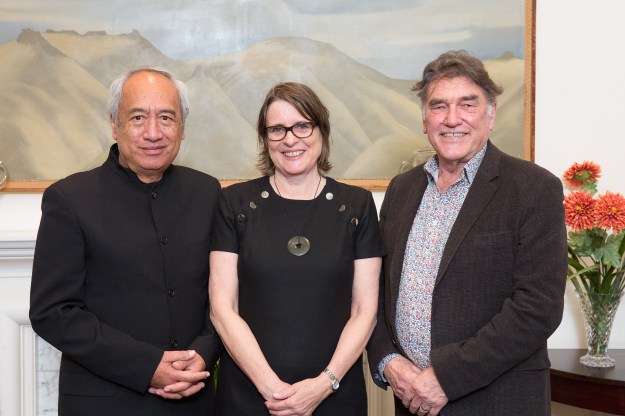
Photo credit: Creative New Zealand. Photographer: Neil Mackenzie.
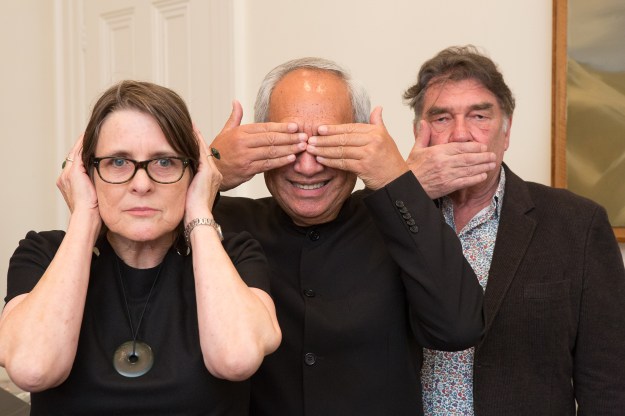
Photo credit: Creative New Zealand. Photographer: Neil Mackenzie.
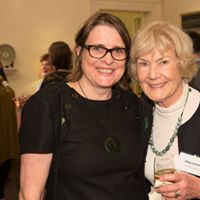
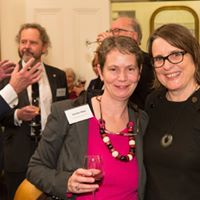
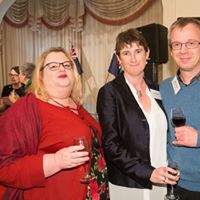
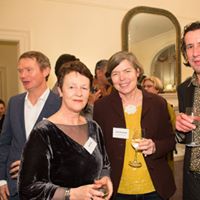
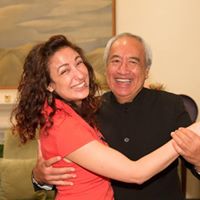
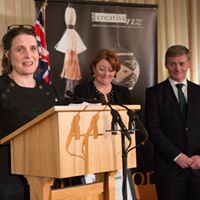
Photo credit: Creative New Zealand. Photographer: Neil Mackenzie.
Some informal phone shots:
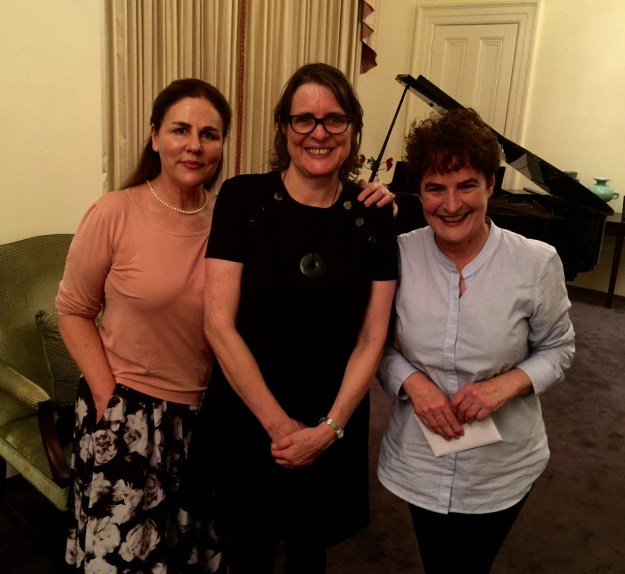
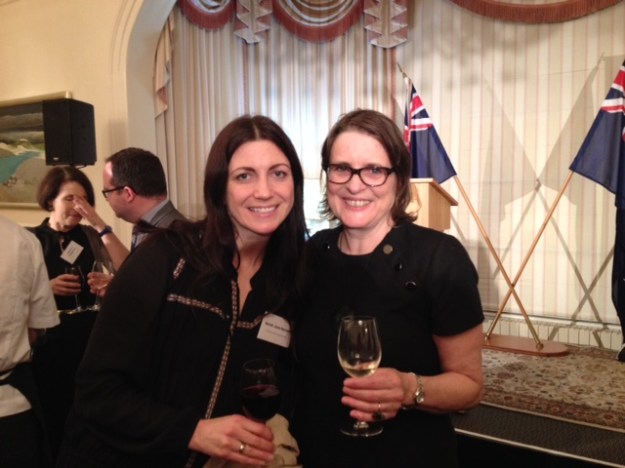
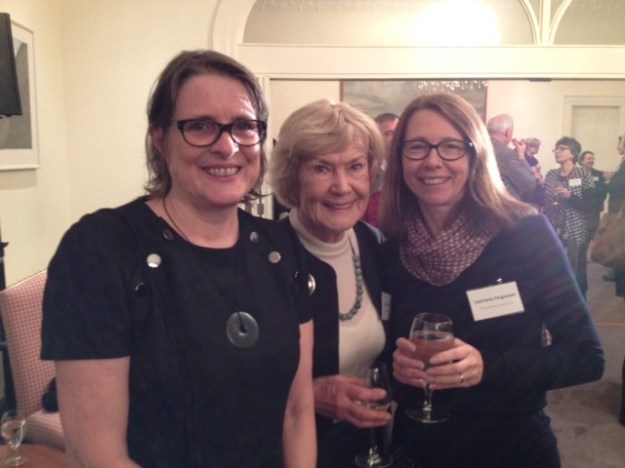
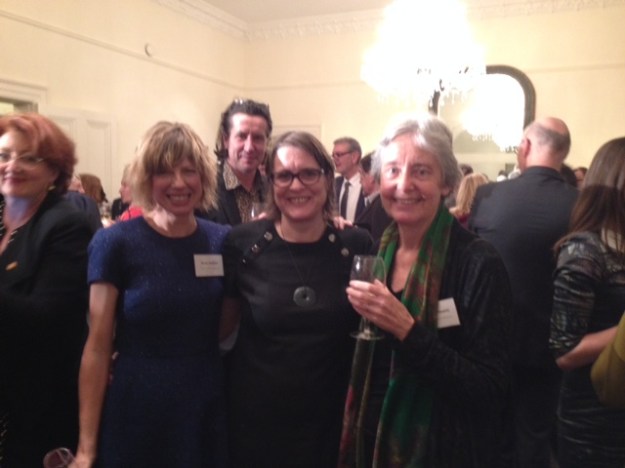
Unity Books event with HLB as a perfect backdrop: