Author Archives: Paula Green

I talk children’s poetry with Lynn Freeman


DSCN9150.jpg

from Groovy Fish

It was such a pleasure having this chat with Lynn in the studio before my memorable taxi ride.

I can’t believe I forgot my all-time favourite New Zealand children’s poet, Margaret Mahy whose word play and leaping imagination astonishes me more than that of anyone else. I was full to the brim with award-day nerves but still ….  a thousand apologies.

The Sapling will post an A to Z of my favourite children’s poetry books on Poetry Day.

Listen here.

On getting the Prime Minister’s Literary Award for Poetry


DSCN9166.JPG


11 August 2017


A little diary, my award speech and a photo gallery


A little diary


The Prime Minister’s Awards for Literary Achievement are an occasion to reflect upon why we write, read and circulate stories and poems that matter. For me, as the recipient this year for poetry, this was particularly so. I felt honoured to share a small pocket of public light with two other writers whom I admire greatly, Witi Ihimaera (for fiction) and Peter Simpson (for non-fiction). I got thinking about why I write, why I step out in public on the printed page and how I am in debt to a necessary and much loved support crew.

Books are transformative experiences for both reader and writer whether our ears, hearts and minds are engaged, whether imagination or scholarship takes precedence, whether we speak out in order to challenge injustice, or weave paths both within and beyond the contours of our familiar world.

When I discovered I had to make a short speech at the award ceremony, I knew I wanted to acknowledge some of the people who had got me to where I was, and also make reference to the complicated pleasures of writing. With a four-minute limit, I knew I would be leaving out the rows and rows of poetry books on my shelves that I have loved, from both past and present, not to mention people, friends, family and experience. Like many authors, the prospect of a significant public occasion induces sleepless nights, before, during and afterwards. This was no exception.

≈

I am wide awake, writing this at 3 am, back home after two wonderful days in Wellington, but I can’t stop reflecting back on my initial questions. I am thinking of the children who send poems to Poetry Box, the teachers who understand the power of poetry to do good things (like Ros Ali), the schools that have inspire me as much as I have inspire them. I am thinking of the effervescent conversation I had with Kathryn Ryan on Radio NZ National about children’s poetry; those I have had with book enthusiast Lynn Freeman where I forget I’m on radio because we get so caught up in the pleasure of ideas; dear friends Ruth Todd and Morrin Rout who celebrate poetry on Christchurch’s Plains FM.

I am also thinking of Sarah Ross and how we worked together with Michael Gleissner to get the Sarah Broom Poetry Award off the ground.

I am thinking, too, of New Zealand fiction writers who have made a difference to my writing. Several years of monthly lunches with Emily Perkins, talking books, ideas, secrets. There are little surprises like a getting a package of poetry books from Laurence Fearnley because she couldn’t bear to see them languishing in a second-hand book shop, and how she went back to get the rest for me. Fiona Farrell—like Laurence and Emily, fiction writer extraordinaire— offered to buy me a dress when my luggage went missing at the Wellington Writers Festival.

Last Thursday, when the awards were announced, I got so many lovely emails, I felt overwhelmed. I abandoned my initial impulse to answer each one straight away and went to the supermarket. I forgot dog food and broccoli and other crucial things; I stood in the middle of the vegetable aisle, with the whole writing community whirling about me, like some kind of marvellous winter wrap, and came home with several bunches of blue irises.

≈

Michael and I flew down to Wellington on Tuesday evening, jumped into a taxi, got out in the wintry wet at the National Library because I wanted to be part of Karl Stead’s Poet Laureate book launch.  Along with Greg O’Brien and Chris Price, I had been part of Karl’s celebratory weekend at Matahiwi marae two years ago, and it was a memorable occasion that befitted a writer who has delivered so many literary riches. Again it came back to notions of a writing community and celebrating connections and the power of words. Karl’s laureate book, In the Mirror and Dancing, is a thing of beauty, produced by printer and bookmaker, Brendan O’Brien and Fernbank Studio with illustrations by Douglas MacDiamid. Karl read a suite of tiny Christchurch poems that showcased the sheen of his writing perfectly.

I was invited to read because the book contains a poem dedicated to me on the occasion of my 60th birthday. It is 3.30 am now, and I am thinking back to the morning, when Anna Jackson sent me an email saying HAPPY BIRTHDAY Paula Green in the subject line. I was not sure whether the link was healthy so left it awhile. But when I threw caution to the wind and clicked, I was taken to the online Poetry Shelf for Paula Green. A bunch of poets had written a poem or picked a poem and written a wee note to go into it. I burst into tears at the generosity of it all.

Karl’s gorgeous poem for me, ‘Long Range Forecast’, begins in August and the ‘purple irises are/ out under the vine’. I was transported back to the blue irises in my lounge as I read, lifted back to the warmth of Matahiwi, and then returned to the clarity of image and a tremolo of inference in the poem. I had raced over to buy a limited edition copy and felt the second serendipitous link when I saw I had purchased copy number 60.

≈

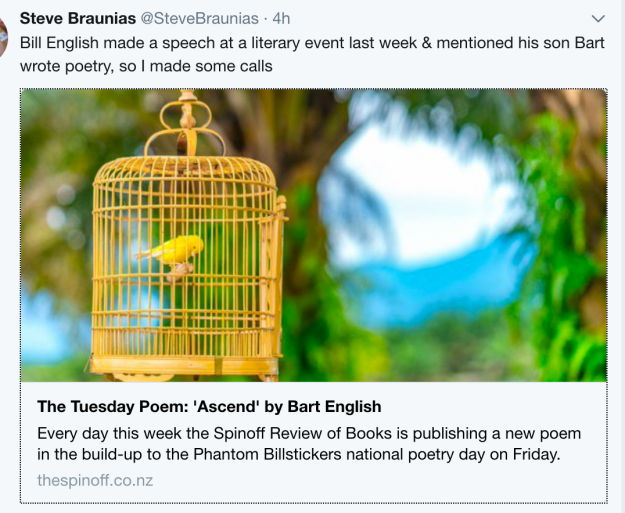
The thought of the award ceremony had kept me awake for several nights, squirming with self-embarrassment, yet the actual occasion was a joy. I am taking politics right out of this – Prime Minister Bill English made a speech that came from the heart of a reader, he underlined so clearly the importance of a book culture, of the exchange of stories, and that diverse and distinctive writing is important for all ages. I am proud of any politician, let alone leader of a nation, who can walk up to me and say he has read my book, and discuss it with me, with warmth and intelligence, outside the fact that this election year and I will be voting and responding to serious issues. It felt like a form of respect. When the Michael King recipient, Philip Norman, was making the audience laugh with his witty speech, and I was wondering how on earth I could follow that – Bill English gave me a look and a smile as if to say, you can do it!

I am thinking too of the kindnesses from everyone at Creative New Zealand, especially Malcolm and Jasmyne. Thank you.

≈

It is now 4 am and I am still awake, going back through the reading event at Unity Books chaired by national treasure, Kate De Goldi.  You could hear a pin drop when Witi read his story from the brand new and utterly essential volume, Black Marks on the White Page. Check out the photo below with my eyes shut listening. I adored it.

I was tired, running on empty, wondering whether what flowed out of my mouth would make sense or need subtitles, but when I spoke directly to the secondary-school students, on how to visit a poem, and saw the look on their faces change, everything else faded.

≈

It is 5 am and I am replaying in my head one of my top five poetry experiences: hearing Bill Manhire read ‘Hotel Emergencies’ at Going West. Somehow I got to have coffee with Bill and Norman Meehan on Wednesday and talk music and words in preparation for our session at the festival this year.


That afternoon, I got a taxi back from my prerecorded interview with Lynn Freeman (once again I got caught up in the pleasure of talking books and poetry with her and even found myself talking about my new manuscripts! It’s on air this Sunday). I had the most astonishing taxi ride ever. A third serendipitous thing.

The taxi driver asked me what I did. I am a poet, I said. Well you must tell me a poem, he said. I loved hearing poems when I was a little boy, and I haven’t heard one since then. I can’t, I can’t, I kept insisting. You must, you must, he said, and it must be a lovely poem. I want to hear lovely poetry. So I pulled out my brand new children’s poems and my copy of New York Pocket Book, and read to him until we got to the hotel. He parked the car, lifted both hands from the steering wheel and clapped. It was my once-in-a-lifetime private poetry reading in a taxi. I didn’t tell him I was getting an award that night, and I didn’t have time to ask him his story, to take me back to the little boy listening with such devotion to poetry somewhere else in the world. I felt sad about that. I feel like ringing Combined Taxis, so on my next ride in Wellington, it is his turn to talk.


My award speech

Kia ora tatou. Thank you for the mihi nui. Thank you Rt Hon. Prime Minister Bill English, Rt. Hon. Minister of Arts, Culture and heritage, Maggie Barry, and CNZ. I am greatly honoured. A big hug for Philip, Witi and Peter.


I want to draw a line from the young girl-me half way up the stairs reading AA Milne to the 60 plus me standing here with butterflies and shaking legs, and pin on the line the day James K Baxter stood on our school stage with scruffy beard and bare feet. I went home and wrote pale Baxter poems. Seven days later he died, I drew his portrait in blue, wrrote more pale Baxter poems, walked into the school library, and discovered Hone Tuwhare’s gorgeous elasticity of words.

I pin my travels, meeting Michael in London, discovering we could inhabit our own creative spaces, build a life together with our daughters, our extended family.

I pin the day I met the poetry of Michele Leggott at the University of Auckland when I was doing my Italian degrees, because her enthusiasms were such a boost.

I pin the day Elizabeth Caffin, friend and mentor, with her resolute inspired dedication to local poetry welcomed me into the AUP family, published my first books including Flamingo Bendalingo, running with my madcap desire to have 50 co-poets who were children. To later working with Sam Elworthy.

I pin my second poetry family, the then Random House, the way Jenny Hellen sent my children’s poems sailing, and risked my poetry story book, Aunt Concertina, with Michael’s sumptuous oil paintings. I won’t forget the days we poured over poem picks for the Treasury.

I pin the year of tremendous discoveries-and-challenges that dear publisher and friend Harriet Allen and I shared as we worked with Harry Ricketts to produce and write 99 Ways into NZ Poetry. 

I bring the sheer pleasure of finding 150 NZ Love Poems with Nicola Legat to the line.

I pin fun to the line because of The Letterbox Cat with Scholastic, and I pin the tremendous pleasures of working with Libby Limbrick and Storylines.

My third poetry family is really just one woman: the fabulous Helen Rickerby who published my last two adult collections with Seraph Press. On the line is the way she crafts books of beauty.

I pin the book I am writing now on NZ women’s poetry and the way Rachel Scott from Otago University Press is offers a new poetry family.

I pin booksellers, like Carole Beu, Marion Castree, librarians like dear friend, Elizabeth Jones at National Library, poetry supporter Peter Ireland, the difference research libraries make, devoted poetry publishers big and small, such as Fergus Barrowman Kiri Piahana Wong, working with Catriona Ferguson at the New Zealand Book Council.

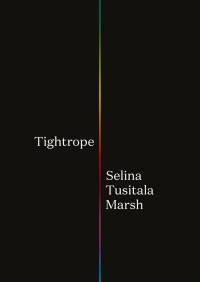
I pin contemporary poetry books I’ve loved including Manhire Hall Bush Hawken O’Brien Neale Wedde Wallace Avia Tusitala Marsh Tse Price Mettner Bird Barnett Kan McQueen Eggleton Smither current Laureate CK Stead. Oh and Bethell. [and another 50 if I had had time, so many other loves, forgive me]

I pin writer friendships that get me over humps and hurdles and inspire: dear Anna Jackson, Angela Andrews, Anne Kennedy, Tusiata Avia, Jenny Bornholdt, Sue Orr.

So why do I love poetry? What difference does it make in a world affected by hunger, greed, homelessness, hatred, an intolerance of difference?

For me it comes down to JOY. As unofficial ambassador for children’s poetry, I want to fire up poems in children, and make sure that rarefied beast, a New Zealand children’s poetry book, continues to be published.

Adult poetry here, in contrast, is like an orchard abundant with fruit.

Last week Bernadette Hall told me this award is like a warm embrace from the writing community. I agree; we’re one big expansive community made up of many small distinctive families and while there are glaring and troubling lacks, we need more Māori, Pasifika and Asian poets in print, we can celebrate nourishing connections. We show and continue to show that books matter from 0 to 100. I’m filled with a warm community glow. Thank you.


A photo gallery


0110  PM Awards2017.jpg

Photo credit: Creative New Zealand. Photographer: Neil Mackenzie.


0093  PM Awards2017.jpg

Photo credit: Creative New Zealand. Photographer: Neil Mackenzie.

0015  PM Awards2017.jpg

Photo credit: Creative New Zealand. Photographer: Neil Mackenzie.

0017  PM Awards2017.jpg

Photo credit: Creative New Zealand. Photographer: Neil Mackenzie.

20638357_1282930708485602_921999310744568246_n.jpg20664187_1282931578485515_9096593005272884518_n.jpg20664704_1282932735152066_5496175332867705663_n.jpg20708383_1282930631818943_6210317526497215081_n.jpg20638887_1282931061818900_7587207147376092690_n.jpg20664389_1282930718485601_4182290173787815846_n.jpg

Photo credit: Creative New Zealand. Photographer: Neil Mackenzie.

Some informal phone shots:

FullSizeRender.jpg


IMG_4438.JPG


IMG_4434.JPG


IMG_4439.JPG


Unity Books event with HLB as a perfect backdrop:

DSCN9167.JPG


DSCN9186.JPG

DSCN9183.JPG


Poetry Shelf Winter Season: C. K. Stead off-piste


Ten to midnight


She was, she tells me

the one without a partner

until I came

with a bottle of bubbly and two plastic cups

and a small box of rose petals.


‘You realize my age?’ I ask

(uncertain what it is).

‘Of course,’ she says.

‘This was half a century ago.’


So we danced and danced

until just before midnight

when I walked out

into the Bavarian dark.

‘I’ve never forgiven you,’ she says.

‘Where did you go? Where have you been?’


And here I am again

dinner jacket, bow tie

with the bottle, the plastic cups,

the rose petals.


Where is the dark side to this,

its sinister underbelly?


I cannot find it, am blind

and happy as we dance

in the town square,

surprised we move so freely

so gracefully over the cobbles

under a Munich moon

and a town hall clock telling me

it is ten to midnight.


© C. K. Stead


Author’s note: There are a number of points where my poems have taken a new turn but by now each one has become part of my armoury (so to speak) so it wouldn’t look as new or surprising as it felt at the time. But there’s a group of poems written recently which have a new feel about them – maybe a change of direction without being an about-face. I’m calling them collectively Nocturnes.

C. K. Stead is New Zealand’s current Poet Laureate. His most recent books include The Name on the Door is Not Mine, a collection of revised and previously unpublished short stories, and Shelf Life. His latest collection of poems, In the mirror, and dancing, will be published in August as a limited edition hand-printed by Brendan O’Brien.


To celebrate his new collection, Stead will participate in a reading/ conversation at the National Library:

A reading/conversation to mark the conclusion of C. K. Stead’s tenure as New Zealand Poet Laureate and to celebrate the publication of his In the mirror, and dancing, with illustrations by Douglas MacDiarmid.

Karl will read from the new book and discuss poetry, art, youth, the creative life and related matters with Douglas MacDiarmid’s niece and biographer Anna Cahill. They will be joined by hand-press printer Brendan O’Brien, who produced the book, with poet Gregory O’Brien in the chair.

National Library of New Zealand
Molesworth Street, Wellington
Ground floor, 12.10-1.10pm
Wednesday 9 August 2017

Free admission,
No RSVP’s so be seated early.


From Paula: For Poetry Shelf’s Winter Season, I invited 12 poets to pick one of their own poems that marks a shift in direction, that is outside the usual tracks of their poetry, that moves out of character, that nudges comfort zones of writing. It might be subject matter, style, form, approach, tone, effect, motivation, borrowings, revelation, invention, experimentation, exclusions, inclusions, melody …. anything!

With our current Poet Laureate, this is a winter-season wrap.

Thanks poets, and thanks readers.


Poetry Shelf Winter Season: Louise Wallace off-piste


Reminders for December


cut


dig


gather


heel in


lift


protect


Author’s note: The words and title of this poem were taken from a tatty book I bought from a second hand fair called The Vegetable Garden Displayed, published in 1949. I like the instructional quality of the words when re-applying them from gardening to something like loss or heartbreak – as though it can be that simple to recover! The off-piste quality for me is the amount of blank space. The poem appears in my new book Bad Things, where each word stands alone on a separate page, which is a little dramatic – I’m grateful to have an understanding publisher who will go along with my vision! I liked how all that space cushioning each word, isolates and intensifies the emotions they may contain.

Louise Wallace‘s third collection of poems, Bad Things, will be published in August by Victoria University Press. In 2015 she was the Robert Burns Fellow at the University of Otago, Dunedin. In 2016 she represented New Zealand at the Mexico City Poetry Festival. She is the founder and editor of Starling, an online journal publishing the work of young New Zealand writers.

Louise’s new book will be launched on Thursday 10th August. Details here plus details for Writers on Mondays this Monday because Louise is with Hannah Mettner, Maria McMillan & Airini Beautrais. Unmissable!


From Paula: For Poetry Shelf’s Winter Season, I invited 12 poets to pick one of their own poems that marks a shift in direction, that is outside the usual tracks of their poetry, that moves out of character, that nudges comfort zones of writing. It might be subject matter, style, form, approach, tone, effect, motivation, borrowings, revelation, invention, experimentation, exclusions, inclusions, melody …. anything!


Louise Wallace launches Bad Things and is at an excellent Writers on Mondays – on Monday!

2b24930c-5c1d-4335-a63e-423fb8cf9569.jpg


Victoria University Press warmly invites you to the launch of

Bad Things
by Louise Wallace

With readings from Lynley Edmeades, Bill Manhire, Tayi Tibble and Chris Tse. All welcome.

6pm–7.30pm on Thursday 10 August,
at Vic Books, Rutherford House, Pipitea
27 Lambton Quay, Wellington

Books by all authors available for purchase on the night, along with prints of the cover illustration by Kimberly Andrews.

 
WRITERS ON MONDAYS

Poetry Quartet: Louise Wallace, Hannah Mettner, Maria McMillan & Airini Beautrais

These poets write works of boldness and acute observation. Louise Wallace’s Bad Things, Hannah Mettner’s Fully Clothed and So Forgetful, Maria McMillan’s The Ski Flier and Flow by Airini Beautrais are diverse and exciting books of poetry. Each writer engages with language in innovative ways to explore and reimagine history, commerce, science, love and the things people do. Come and hear the latest New Zealand poetry in a reading and discussion chaired by poet and novelist Anna Smaill.

DATE: Monday 7 August
TIME: 12.15-1.15pm
VENUE: Te Papa Marae

Poetry Shelf Winter Season: Emma Neale off-piste


Fourteen Daydreams through Spanish Translation


The wind rotates in the sky’s blue socket.

I wish Ryan would love me.

Okay, notice me. Look at me, even.

But not when I’m smiling with my braces showing.


‘Turn over your tests. You may start.’


Ode to Sunday.


Oh yellow sun, lonely armadillo,

cancel your gut’s groans

with a spade

under the sober trucks

a zap of cheese.


What? Starving. Skipped breakfast. Want cheekbones though.

My sandwiches cat-nap in my lunch box

all fat white stomachy with family love

big and bricky as awful school shoes.


In the cities

the dearness, the world,

agonise us, peg us

in the egg yolks

of the pulverised chicken.


That can’t be right

but the clock’s got hysterics, the minutes

are spilling down its face, gotta crack on with it …


We are suddenly gulping gold

accusing ourselves

with piety pie

and cactus spines

with hot stones

and the mouth

sulphurates


Rotorua. Smelly eggy air. We went there.

Dad was relaxed for once. Funny that it stunk.


More than all the gifts:

it has salt, the throat, the teeth,

the lips and the language


Ryan hardly speaks, but I’ve seen the soft hairs

on his upper lip and I haven’t minded them at all,

so do I smile too wide? Feelings coated all over me

in oily sheen? Do I clip my hair too tight?

Is it my ugly yellow school bag that cries out, gormless?

I know it is. I’m so ashamed. And of how near my breasts

the gap between my shirt-buttons pouches

on plump skin white as baby scorpions.

But Ryan, he’s café au lait calm,

he’s a cool bronze casting

of himself.


We want to drink cataracts

the blue night, the poles

and then, crucifying the sky,

the coldest of all the planets,

the round, the supreme,

the heavenly sanity.


Oh what? Change the title, quick! ‘Ode to Sanity’?


It is the fruit of the tree of salt.

It is the ballerina of green truth.


The ballerina of green truth!

Ryan — sanity is the ballerina of green truth.

Do you like that, would you agree?

I’ve heard your mother is very strict

she hasn’t been well, people say she isn’t coping

and I don’t really know what that means.

Could I help, like, somehow? With the dishes?

Is it hard to be so much older than your brother?

You shouldn’t be embarrassed; it makes you seem wiser,

the way you walk him in his carriage, your face so I don’t know,

iron of jawbone, so soccer-practice-serious,

looking like science somehow,

upright, serious science. But your baby brother:

that you have to be another father to him,

and your mother doesn’t like you to be with girls…


If I were thinner, if I were a dancer,

would you fall at my feet so I could laugh,

flick back my hair like some Follyfoot filly,

(‘Grow, grow the Lightening tree …’)

then say, Ryan, no! Stand up! Please don’t!

So you could say, ‘You are even worth asphalt scrape-holes

on my school uniform knees…’


It is the dry universe

all of a sudden stained

by this fresh heaven


Yes, yes, yes, Ryan when I see you,

it is the dry universe

all of a sudden stained

by this fresh heaven


Quiet water coffin

queen

of the fruit stall


(What? That’s a compliment?

I thought they said this poet was romantic.

If only Ryan would say,

my golden colt, my blazing girl,

my ballerina of the heart, my zap of cheese

it doesn’t matter that you are fat,

you are not fat to me ….)


earthly bistro of depth, moon.

Oh pure one

in your abundance

of undressed rubies.


Well that’s just rude.

blah, skip, skip, skip.


If I could see his soul … pink, glowy,

like when the sun shone through his ears

yesterday at the bus stop

and it wasn’t even geeky somehow, it was ….


We divide you in the soft salt

like a mini mountain

of splendid food


Oh crap, is this about FOOD?


Skip skip skip

blah blah blah

we haven’t even been given half this vocabulary

this test SUCKS.


Oh hell, the bell! I can’t revise, that was way too fast.


‘Papers to the front. Pack your bags.’


Oh my GOD my skirt’s side zip’s undone. Please don’t tell me Ryan saw that today. Shit-shit. He would have. It’s been undone all day. You can see the gap between where my shirt tucks in and — God my school regulation underwear. I hate my parents for buying them. I am going to pass out from shame. That’s why he looked away and hardly spoke. Thinks he’s so superior. I’m giving up boys forever. My big fat watermelon hips. My big fat watermelon belly. I’m skipping lunch. I’m throwing myself into my schoolwork from now on. Oh yellow sun. Oh lonely armadillo.ª


ª Fourteen is struggling with ‘Oda a la Sandía’ (‘Ode to the Watermelon’) by Chilean poet Pablo Neruda. The version set for the test (‘No dictionaries allowed. You have forty-five minutes, starting from now’) is reprinted in The FSG Book of Twentieth Century Latin American Poetry, edited by Ilan Stavans. The translation here is entirely her own.


© Emma Neale


Author note: I’ve been working and reworking this adolesecent girl’s monologue for a couple of years. I’ve submitted it elsewhere once or twice, immediately sticking my fingers in my ears as if waiting for an explosion (of distaste or mockery, etc.). As the two modes it uses are quite far apart – the teenager speaker’s bad translation, and her internal thoughts – it stretches the container of the poem so far it might split. Perhaps that feeling of excess is okay, though, for an adolescent voice. Young people can be so receptive, sensitive, energetic, inventive, critical, vulnerable, wise and yet also wildly unknowing, there’s a symphonic orchestra of emotions competing on any ordinary day during these years, it seems to me. And each emotion is such an intensely coloured version of itself, what single poem could contain them all, even if it limited itself to one class test, on one day?


Emma Neale‘s most recent poetry collection, Tender Machines, was long-listed in the Ockham New Zealand Book Awards 2016 and her latest novel, Billy Bird, was short-listed for the Acorn Prize at the same awards in 2017. She works as a freelance editor.


From Paula: For Poetry Shelf’s Winter Season, I invited 12 poets to pick one of their own poems that marks a shift in direction, that is outside the usual tracks of their poetry, that moves out of character, that nudges comfort zones of writing. It might be subject matter, style, form, approach, tone, effect, motivation, borrowings, revelation, invention, experimentation, exclusions, inclusions, melody …. anything!

From Claire O’Loughlin: Writers on Mondays with Marianne Boruch


It is midday on Monday 31 July, and I am one of around a hundred people who have gathered in Te Marae at Te Papa to hear visiting American writer Marianne Boruch in discussion with Chris Price. On the way in I meet up with my friend and fellow IIML student Mia. We’re both elated and windswept from our brisk bicycle rides through the city to get here. Outside the wind is ferocious, making a high-pitched whistling sound against the building and pushing clouds out of the sky, letting multi-coloured sunlight to pour in through the stained-glass windows in the marae. After an introduction from Chris, Marianne steps up to the lectern and says she thinks the whistling is a good spirit. Te Marae is peaceful, warm and light. It does feel full of good spirits.

Opening with an acknowledgement of spirits is appropriate at a marae, and even if Marianne doesn’t know that, I feel immediately that she is, for all her international success, an utterly humble writer. She wants first and foremost to let us know that even though it seems we are here to talk about her, she is putting herself aside.

Today’s talk is called The Little Death of Self, which is the title of her new collection of essays published by The University of Michigan Press earlier this year. But this notion, the death of the self, relates to all her writing, and today she continually comes back to the idea of removing the self/the writer/the personality from the writing, and allowing its own life, or spirit, to come through.

She talks about her poetry collection, Cadaver, Speak, in which the poems are in the voice of a cadaver. In 2008, as part of a faculty fellowship at Purdue University in Indiana where she is Professor of English, Marianne took an anatomy class in the medical school studying corpses. She was drawn to one cadaver in particular, the body of a 99-year old woman. The result of her study was the collection of poetry, published in 2014 by Copper Canyon Press.

At first, she tells us, she struggled with voice in the Cadaver poems, which were all in third person pronoun. It felt wrong, she said, like she the writer was speaking for someone, rather than letting them to speak for themselves. She wanted a ‘self’ there, but it was the wrong one. A simple but profound switch solved the problem: she changed the poems to first-person pronoun. Suddenly it was like the real cadaver’s voice coming out, and the poems seemed to live on their own.

She reads us three poems from Cadaver, Speak; an essay on audibility; and a hilarious section from her memoir The Glimpse Traveller (Indiana University Press 2011), in which a high school nun gives her and her friends dating advice for keeping boys “at bay.” The advice that is so absurdly unique it is almost surreal, such as carrying around a little bag of stones to drop in any puddles one has to step over, in order to break the reflection.

She tells us that her memoir is really a “we-oir,” because it’s not just her story, it’s the story of a generation in 1970s America. Here again she’s putting the ‘me’ aside. She talks about the idea of intention as almost worthless in writing – intention can get you started, she says, but the work has to be allowed to be what it wants to be. Get the self out of the way. Let the spirit of it out.

It strikes me that this idea of intention as inherently selfish, and the idea removing the self, are both about allowing for empathy. They are both about putting yourself, whether you are the reader or writer, through feeling and imagination, into another’s shoes.

I am one of this year’s Masters students at Victoria’s IIML. My background is all in theatre, which I’ve studied and worked in for the past decade, and this year I suddenly find myself trying to be a non-fiction writer. At first it felt alien, but more and more I’m struck by the core values that cover all art forms. For me, theatre is also all about empathy. Marianne is a poet, essayist and memoirist, all seemly different forms. I’m beginning to see that you can switch between forms and mediums and be effective in them, but only if in every instance, you get rid of the ego and let the self die.

The wind is still whistling when we finish, blowing in from the harbour. I hop on my bicycle and the gusts push me all the way home, back to my desk and the spirits waiting there.


Claire O’Loughlin, August 2017