

I have a swag of poetry books from 2017 that I have not yet got to – but over the next months I am flagging them through a suite of Summer Postcards.
How important is it that our poetry books get reviewed?
Poetry books get so little attention in the media these days. NZ Books still offers a handful of poetry reviews. Not sure about Takahe. There is Landfall-on-line steered by poet Emma Neale and the occasional attention in print media (Siobhan Harvey in The Herald). For members there is the quarterly NZ Poetry Society Review. There are a few reviews at The Spin Off or in The Listener. Poetry (USA) recently did a NZ cluster and you find some in the Poetry New Zealand Annual. Pantograph Punch has supported poetry, but until they can pay reviewers a decent amount, they are no longer doing reviews.
From The Pantograph Editors:
The Hardest Call
Because of these changes, we’ve made the difficult decision to hit pause on publishing reviews. It’s been one of the toughest decisions we’ve made.
During the existential crisis of 2017 (refer above) we came to the somewhat crushing realisation that in underpaying our writers (sometimes as low as $50 a review), we were contributing to a structure that systematically devalues those writers and privileges voices who can afford to write for low pay. In trying to support critical culture, we were simultaneously contributing to its decay.
It’s one of the hardest decisions because it feels so contradictory: we’re stopping doing one of the exact things we believe in the most.
We strongly believe in critical dialogue, and one of our areas of focus for 2018 is finding a way to bring reviewing back. We’re committed to creating a sustainable pathway for future critics, so one of the things we’ll be doing is creating a fund which will be dedicated to commissioning reviews. Our commitment is to be able to pay reviewers a minimum of $300 per review, and if you feel as strongly about this as we do, we invite you to donate to that fund here.
Pantograph Punch
You can read the full piece and contribute to the funding call here. They favour posting less (one a week) and building a climate of critical dialogue. This is exciting news. Bravo PP!
We are hungry for critical forums. Joan Fleming recently started a vital discussion on reviewing with her Facebook friends:
The Question of Claws
As I step into a new role at Cordite Poetry Review – that of NZ Commissioning Editor – I have been troubling my head about how critical to be of New Zealand poetry books that strike me as undeveloped. Particularly when I’ve admired a writer’s poems in journals, and am frustrated by their book; or am struck by the first few stunning poems of a collection, which then disappointingly levels out. It is tough to be honest in a poetry culture that is so intimately small. Often in our poetry reviewing, there is gentleness where I want rigour, and there is faint praise where I want productive disagreement. We are overly careful because we are reviewing friends and colleagues. We don’t want to offend. It is tricky. Do aesthetic battles push writers to better writing, or ought we to only support and encourage each other, trusting that we are all already pushing ourselves?
On the one hand, the stakes are so low: there is no money, there is no fame (except for the occasional meteoric anomaly!), and poetry is hardly a career. On the other hand, the stakes are painfully high. We are talking about our raw-edged souls on the page here. In a Facebook thread, I asked the question (provocatively worded, I suppose): “Should we be showing our claws more often?” For claws, read: Do I dare to write a thoughtful yet unfavourable review? I hope to think there is nothing in me that wants to tear down other writers because of agendas, grudges, or jealousies – but we all have our lenses and leanings, our sometimes-unconscious preferences and biases.
I, myself, am trying to thicken up my own dreadfully thin skin. A solution to this bind (and this is not an original thought – I think Ellie Catton suggested this way back) is to foster more trans-Tasman reviewing: New Zealand poets reviewing Australians, and Australians reviewing New Zealand books. At Cordite, we’re doing a little of this. We have lots of NZ books on our review list. I wonder if a New Zealand publication might take up this challenge? (Pantograph Punch: I’m looking at you!)
Joan Fleming
Last week I posted a piece on my Poetry-Shelf aims to see if it was worth keeping up the blog. Is it relevant? Does it matter that I do this? I want to post poems and do reviews, interviews, news, events, musings on local and international poetry. And at times involve other people (as I have done), but in the current drive for decent payment, how can this possibly work?
I strongly believe we need a go-to-place for NZ poetry that crosses borders of all kinds. I like the idea of a mix of reviews (long and short) so that a decent number of published books catch your attention. Ha! so there is a new James Brown out! Or Joan Fleming is reading from a new book at TimeOut (if only!).
To have a long review of your book where the reviewer has paid utmost attention is ideal. But to have no reviews and feel like your book has drifted into the ether is heartbreaking.
I posted this on Joan’s Facebook feed:
I review books on my blog that I love. My life is too short to absorb the toxic fallout of writing about books that I don’t love. I aim to celebrate and explore what a book of poetry might do.
I so often read negative reviews that incense me because the writers seems straitjacketed by a narrow reading and clear bias (I don’t like experimental poetry but here I am reviewing it kinda thing!). Or poets and reviewers who insist there are certain things a poem must do, and if it doesn’t, then it is a failure.
I am not afraid to put my claws out when an important book warrants it – as with the AUP literary omnibus. That attracted utter venom towards me on social media and affected me in all kinds of other ways – but I would still do it. My doctoral thesis (Italian) challenged the way the academy is driven to deconstruct and tear apart, rather than forge connections and produce different intellectual models of thought.
That said, in a world that continues to privilege the status of white men, we still need claws to unpick the ideas that shape us and that we so easily become immune to and accept.
Ellie Catton once used the word kindness in talking to students about writing. Our PM has used the word in view of governing a nation. I want to review out of kindness. That doesn’t mean I will say things I don’t mean when I talk about your poetry. It doesn’t mean I only say good things. It means I pay attention to the fact a human being has written it. It means I work hard to find path ways through a book that might present itself with shuttered windows on foreign pathways on a first reading.
Sometimes the bridge between the reader and a book fails. When I can’t cross that bridge, I am going to share a book where I can.
I believe we can have critical discussions and write out of state of kindness.
This may not be the majority point of view, but it is my view. I have almost finished a book that rescues some of the women from the past who have been misread, unread, muted and sidelined by men with their claws out because in their view the women were not writing poetry.
We, as women poets, have come a long way since our banishment to the shadows, but things are still not ideal. So I will continue to be part of the small (and it is SO very small) group of writers who go public on what they love (outside institutions, financial reward and so on, so beholden to nobody) because I want you (in the widest reach a pronoun is capable of) to fall in love with poetry and what a poem can do.
As I said at the Poetry & Essay conference in Wellington in December this is a matter of JOY!
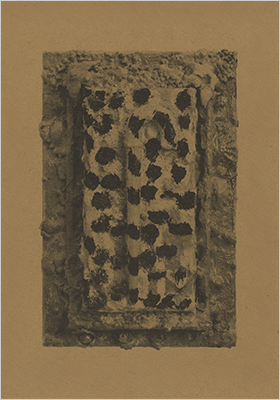
This slim adorably-produced poetry journal is a treat to read and hold (my favourite looking NZ volume – who wouldn’t want a poem in here!). It is rich in voice and edges.
The editor:
Zarah Butcher-McGunnigle has brought min-a-rets to life after a three-year hiatus. She states the original aim was to champion ‘openness & intensity in poetry, with a focus on NZ, but also including a few international writers each time’. She has stuck to the same poetic impulse and she has included some Melbourne poets – she is currently based there.
The poets:
Hana Pera Aoake, Eden Bradfield, Owen Connors, Anna Crews, Craig Foltz, Rebecca Nash, Rachel O’Neill, Ursula Robinson Shaw
The poems:
I open upon Rachel’s title, ‘The sky is a wide, unmoving chest’, and then fall into a poem that is wide but full of movement, strange and supple. Three poems from Eden catch air in their double spacing, floating talk, the everyday adrift. Ursula’s ‘2 Poems’ also float on the page, but here the talk static intensifies. The fragments startle first as little pieces, and then achieve a stuttering breathfilled momentum.
Voice – the speaking surge and spurt – marks Owen’s ‘4 untitled fragments’. This is not disembodied writing but is flush with sex and disenchantment and living.
Highly recommend this. Check out the journal here
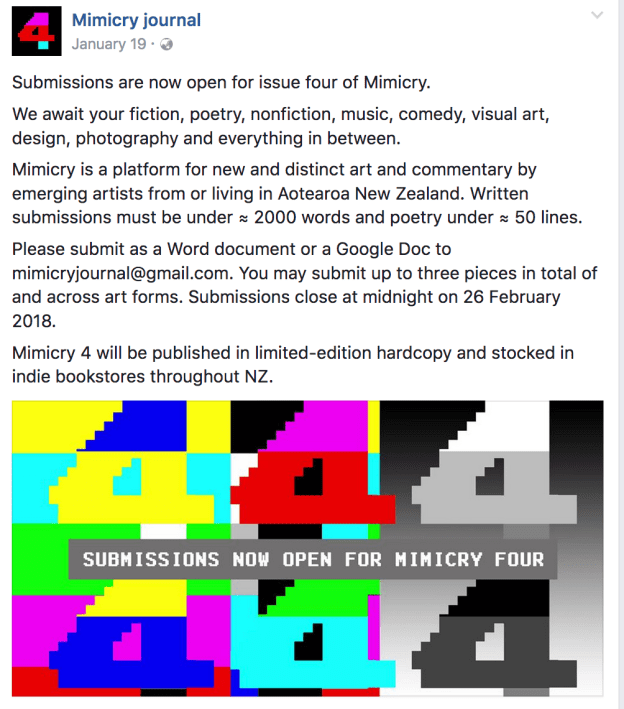
Submissions closed for the next issue at the end of January – so look forward to that!
Exciting news! Will be in the queue for this festival session that’s for sure.

SARAH BROOM POETRY PRIZE
The Sarah Broom Poetry Prize is one of New Zealand’s most valuable poetry prizes and aims to recognise and financially support new work from an emerging or established New Zealand poet. In 2018, the prize is an award of $5,000.
The prize was established in 2013 in honour of the New Zealand poet Sarah Broom (1972-2013), the author of Tigers at Awhitu (2010) and Gleam (2013).
Entries open on 19 February and close on 11 March 2018
Now in its fifth year, we are pleased to again showcase and celebrate New Zealand poetry during Auckland Writers Festival week in May 2018. Shortlisted poets will read from their work at a dedicated poetry event hosted by the Sarah Broom Poetry Trust where the winner will be announced.

For more information about the prize and Sarah Broom visit http://www.sarahbroom.co.nz
For more information about the Auckland Writers Festival, which will be held from 15 – 20 May 2018, visit here
HOW TO ENTER
The prize is awarded on the basis of an original collection of poems by a New Zealand resident or citizen. Entries will be accepted from from 19 February 2018 until 11 March 2018.
Poets are required to submit six to eight poems, of which at least five must be unpublished. The recipient of the prize will be announced in May 2018 during Auckland Writers Festival week. Shortlisted poets will be invited to attend a dedicated event and read from their work.
Entries should be emailed to poetryprize@sarahbroom.co.nz
Any queries should be emailed to enquiries@sarahbroom.co.nz
CONDITIONS OF ENTRY
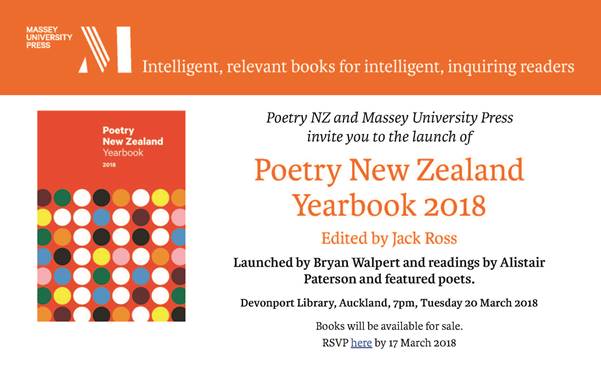

Kia ora koutou
Don’t miss your opportunity to nominate your pick of our finest writers for the 2018 Prime Minister’s Awards for Literary Achievement.
Every year New Zealanders are invited to nominate writers who have made a notable contribution to New Zealand literature in the categories of non-fiction, poetry or fiction. $60,000 is awarded in each genre.
New Zealand writers are also able to nominate themselves for the awards.
The nominations (submitted by email to pmawards@creativenz.govt.nz ) are assessed by an expert literary panel and recommendations forwarded to the Arts Council of Creative New Zealand for approval, with the awards presented in a formal ceremony.
In 2017, Witi Ihimaera received the award for Fiction, Paula Green for Poetry and Peter Simpson for Non-Fiction.
Nominations close on Friday, 6 April at 5pm.
Well this looks good!
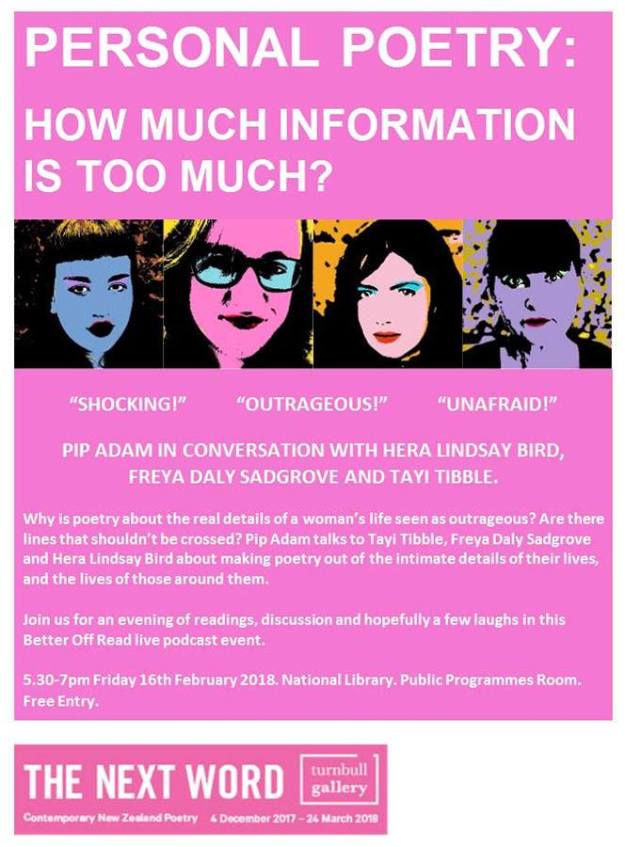
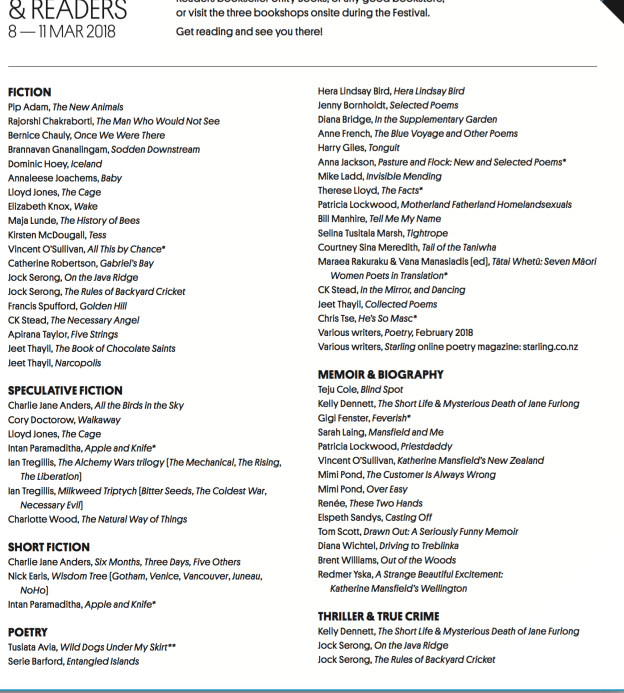
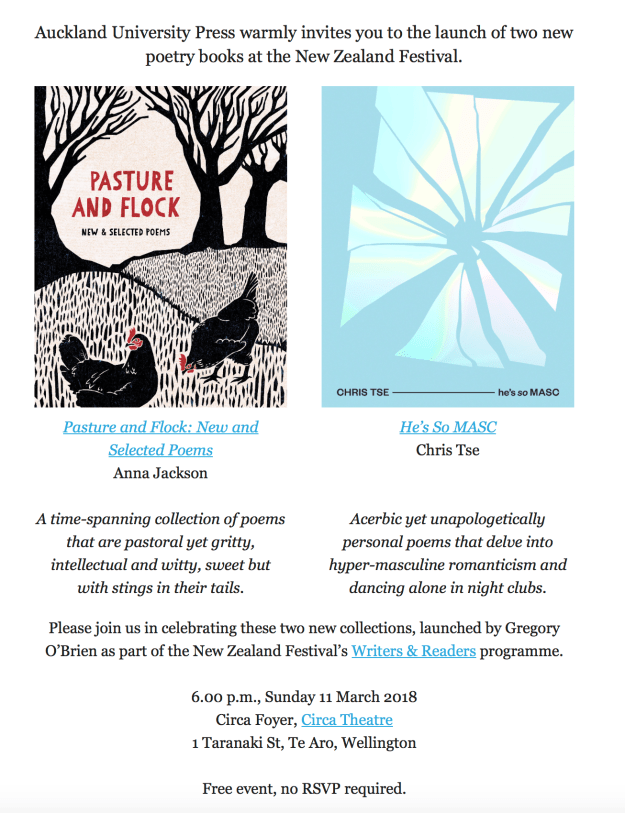
Go here for the programme. I am delighted to be reading at and chairing Selina Tusitala Marsh’s Call Me Royal event at the National Library as well as chairing Bill Manhire and Mike Ladd in conversation. I will be on the bus to Poetry at the Prison event, dashing to hear The Starling Poets, celebrating the launch of new books by Chris Tse and Anna Jackson and the new Seraph Press translation book, and hearing a cluster of poetry from offshore. Way more poetry here than last time – and a decent local presence! Always a treat to catch Hera Lindsay Bird read. And of course Tusiata Avia is a must. Check out the poetry reading list above to get in the mood.
 NZ Poetry Shelf