
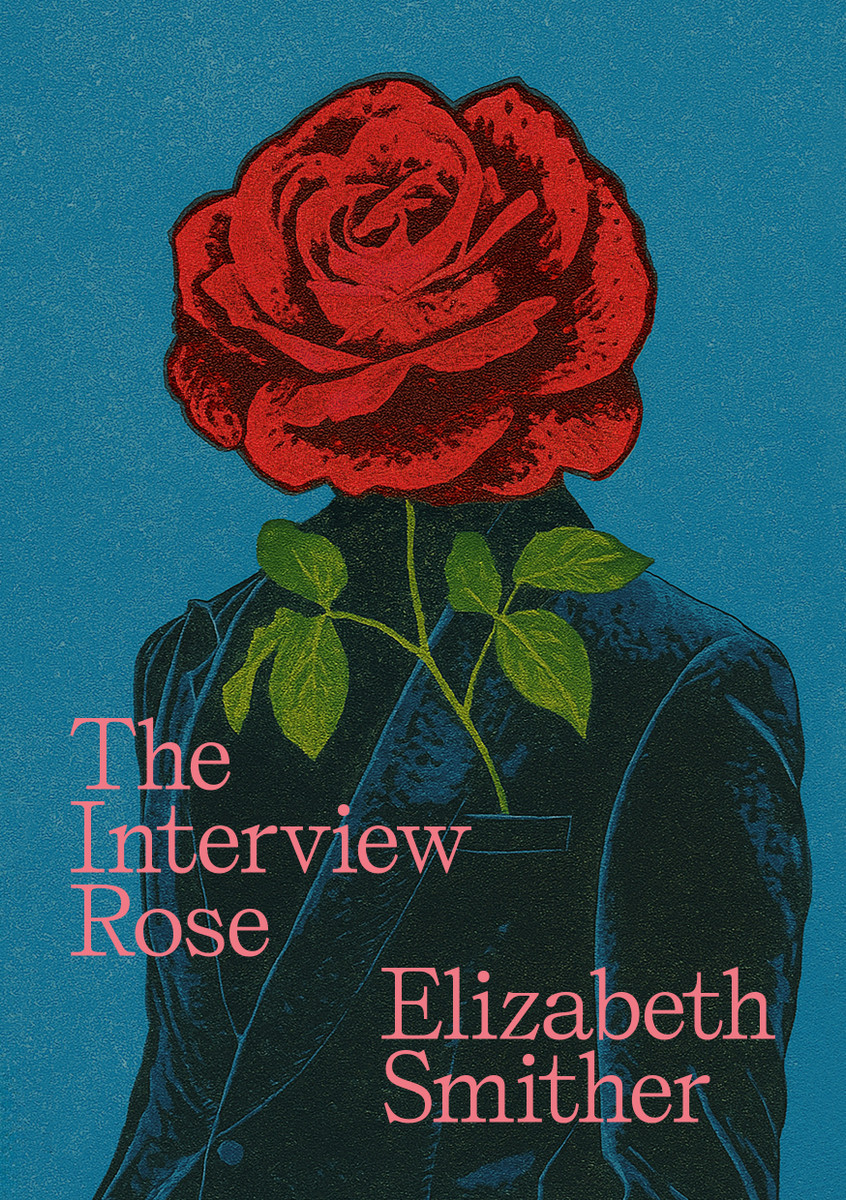
The Interview Rose, Elizabeth Smither
Auckland University Press, 2026
I have been a long fan of the poetry of Elizabeth Smither. Her new collection, The Interview Rose, is a work of beauty and heart nourishment. It is a book of unfoldings, it’s prismatic multilayered poetry offering lily launchpads to moments of awe and surprise. I found myself reading and rereading particular lines. Embracing deeply the music of the everyday alongside the music of the imagined and the witnessed. Family matters. Other writers matter. Reading matters. The domestic matters. The sheer inspirational delight in how words nestle together in a line of poetry matters.
To celebrate Elizabeth’s new book is a vital uplift.
Mark Doty: a footnote
Walking between venues in Aldeburgh
to attend the next reading or panel
a boy kicks a football in Mark Doty’s path.
Just a poet walking, one of those
removed from the world, a floater,
but look he has scooped up the ball
on the curve of his foot, cradles it
like a bird fallen from a tree,
rolls it up to chest height
then over his shoulder, his other foot
hooks to kick it back to
two astonished boys. A poet
who could play for Chelsea or Real Madrid,
earn a fee greater than any poet,
but greatest of all the way
he goes on chatting to the other poets,
=his head lowered, as modestly
he sets the world back in place.
Elizabeth Smither
from The Interview Rose
A conversation
Magic in our collaboration.
Woman and frog, a distant pond
reached by plodding and breathing
and by companionableness.
from ‘The frog’
Paula: The opening poem, ‘The frog’, epitomises the experience of reading your beautiful new collection of poems. As the frog hops from steps to pond, on each step he pauses. As I read, I too am propelled by stillness and movement. Pause and contemplation. Slow reading steps and discoveries. I also love the rhythm of the arrangement of poems. Tell me about your rhythms of writing.
Elizabeth: What a dear creature: a very large frog and my big feet treading on each step as he exits. A feeling of privilege; I didn’t think he was frightened of me and I noticed his skin was kept damp by a drizzling rain. Boldness on his side, rhythm and timing on mine, in case I stepped too soon. Eventually the steps ended and he was on the grass and heading towards a pond. The lovely order is the work of Elizabeth Caffin; I can see the internal order while I write; she knows to put the frog first.
Paula: Your observation of the physical world is another delight, an uplift, a snapshot of the beauty of the moment. Is there in your daily movement, as if there in your writing?
Elizabeth: I’ve always taken to heart Colette’s last words as she was turning the pages of a book of butterfly images: ‘Regarde, regarde’ (in a rolling Burgundian accent). To look is everything. The idea of a subject is very unfashionable but I agree with Carol Ann Duffy: ‘the subject of a poem is what the poet sees, hears, thinks about, is moved by’. She also said ‘I regard poetry as a vocation. Any other work – freelance or bank manager – simply supports the person writing it’.
Paula: I also love the sway between the said and the unsaid. How important is silence and the unspoken as you write?
Elizabeth: Recently I’ve been writing a kind of journal based on quotations. One of them comes from May Sarton’s ‘The Single Hound’. Tout lasse, toutcasse, tout passe. Everything passes, everything breaks, everything tires. It’s lovely when you speak it. There is an ending, not quoted so much: et tout se remplace. And everything is replaced. It’s not a defeat but an allowance of decline and fall, the said and the unsaid, rather like an incoming and outgoing tide. Or it could be like a poetry reading: the preparation, the stumbling over a word, or going too fast, and later conducting a critical analysis of the event. And then lasse, casse, passe come in and reason is restored.
Paula: I love that! The incoming and outgoing tide of both reading and writing. Some poetry collections are steeped in pain and darkness but for me your collection is a trove of pleasure. Take ‘De-stringing beans’ for example. This sublime poem carries me from the contentment of peeling beans for her sons to clambering, underrated garden beans to the contentment of art viewing, the woman pouring from a jug in particular. Was writing it a source of pleasure for you?
Elizabeth: I think it was a sense of speed, though contemplation can lie at the heart of it. I’m always trying to get something down. In the case of the beans perhaps I am imagining a formidable Italian nonna whose life skill is making tortellini for her family. Like the nonna my mind wanders as the mountain of beans goes down and I am thinking how shall I allot them and what is the calming image inside the chore?
Paula: I adore the exquisite startle moments, little arrivals of surprise. For example ‘Mark Doty; a footnote’, where the poet deftly hooks a football back to the young boys in the street while he chats to the other poets, “his head lowered, as modestly he sets the world back in place”. Do you surprise yourself as you write and read?
Elizabeth: I feel really proud of Mark Doty. I think the key word is ‘a floater’ which is meant to be contemptuous, a negative view of poets. But here he is playing like Cristiano Ronaldo but doing it with nonchalance, talking and walking and returning the ball but first having a little dialogue, a demonstration with it; it wraps itself around him like a scarf. I imagined the boy saying ‘Shit!’ not realising Mark Doty is a poet and a deservedly famous one. I am the one who is surprised and thrilled. A poet ambassador.
Paula: A number of poems are dedicated to writer friends. Various writers make an appearance. Other companions make appearances. The frog in the opening poem! The cat sitting on Wittgenstein quotes. Jane Austen’s Emma. It got me musing on how writing is for me an act of connection. Does that idea work for you?
Elizabeth: Yes, I love the idea of companionship, for writers dead or alive. I loved in the Emma poem that mentions Robert Gottleib that he hated semi-colons and would squash any he encountered; that he would read mss late into the night, sympathising with authors who would be on tenterhooks. And friends. I have decided to keep all their names in my address book since they still seem alive in my mind.
Paula: Can you pick a handful of words that epitomise how writing poetry matters to you? That are the key in the creation of a poem?
Elizabeth: I think if I were put in a cell I would pretend I hated books in the hope that a jailer would bring armfuls for me to read. And I would write childishly as if I had never been to school. But if I were unsupervised I would write like a speeding angel and hide the pages under a mattress.
The words: quick (the opposite of dead) and bright (Keats’s ‘Bright Star) merry (unless some dreaded seriousness is required). There’s a cardinal called Merry del Val whom I like very much.
Paula: And can you choose a poem that is particularly significant for you?
Elizabeth: I’d choose Wallace Stevens, ‘Final Soliloquy of the Interior Paramour’ with its lovely last stanza:
‘Out of this same light, out of the central mind,
We make a dwelling in the evening air.
In which being together is enough’.
Paula: Writing has been such a vital part of your time, a gift for us as readers. What else offers uplift and nourishment? I do think readers will discover answers to this across this charismatic collection.
Elizabeth: I think work, even of the slogging kind, should not be underestimated. And thinking, turning things over for new angles and insights, being active and sometimes being fallow like one of those marvellous 18th century fallow fields.
Paula: What a pleasure Elizabeth to spend time with your collection, to reflect upon how reading and writing poetry matters so very much. How angles and insights can refresh the contours of our days. I feel poem enriched. Thank you.
Elizabeth Smither has written six novels, six collections of short stories and nineteen poetry collections. She has twice won the major award for New Zealand poetry and was the 2001–2003 Te Mata Poet Laureate. In 2004, she was awarded an honorary LittD from the University of Auckland, Waipapa Taumata Rau for her contribution to literature and was made a Member of the New Zealand Order of Merit. She received the Prime Minister’s Award for Literary Achievement in 2008. Her book, Night Horse (Auckland University Press, 2017), won the 2018 Ockham New Zealand Book Award for Poetry.
Auckland University Press page


Pingback: Poetry Shelf weekend reading | NZ Poetry Shelf