
I hear birds and thought that although I am only hearing them,
and I am not having a thought, it still feels like a thought, almost
like a thought of my own, or a conversation I am having, or
perhaps it is more like reading a poem, where the words, or the
movement of the thought, the song of the thought, is given to
you rather than coming from you, but still moves through you.
from ‘Summer: Terrier, worrier’
I thought, it tells us something about poetry that when we
need to talk to ourselves about something we don’t know
we know, we tell it to ourselves when we are asleep, in images
we struggle to remember when we are awake, and often take
more than one reading to fully understand.
from ‘Summer: Terrier, worrier’
I wondered if anyone wrote a diary anymore. For writers like
Virginia Woolf this was a daily necessity, a form of expression
so compulsive that a day without writing in the diary felt for
Woolf like ‘a tap left running’, with it being not the writing
she imagined as a running tap but the day itself, as if writing
somehow stemmed from the flow of time. Could the diary really have
become so important to so many writers just because the paper was
cheap, and ready-made exercise books were sold in stationery
shops? Did the diary not answer a need for secret self-reflection
but create the need?
from ‘Autumn: Lounge scale’
I thought, even if the mind is a construction of activity of the
brain it makes no more real sense to think of thoughts as being
located in the head than it does to think of them as located in
the heart. They aren’t material things that can be there behind
the eyes, and why behind the eyes except that I look at the
world through the eyes and so can locate myself there?
from ‘Autumn: Lounge scale’
She came upstairs looking more like a cloud than a silver lining.
from ‘Winter: Hilbert spaces’
I thought, perhaps it isn’t that people high on mushrooms are
accessing some transcendent truth through the unlocking of
their own minds, perhaps it is that they are experiencing life the
way fungi experience it, with a consciousness without individual
identity, dispersed and without borders.
from ‘Winter: Hilbert spaces’
Agnes asked if meaning drains out of life as you get older, and
almost everyone said no, except for me. I answered emotionally,
not logically, and even as I was answering yes I was thinking,
but is a novel drained of meaning in its last few chapters? is a
sonnet drained of meaning after the volta?
from ‘Spring: Matchbox beetles’
I thought, we take it as axiomatic that happiness is the
highest good, but for the Romans it was justice, for the Greek
philosophers it was knowledge. For me, I think is beauty.
from ‘Spring: Matchbox beetles’
Lying on the carpet in our living room, Simon cooking in the
other room, I had the most profound sense of contentment.
I realised I was in the position I spent much of my childhood
in, lying on a carpet, able to play the most complicated
imaginary games in front of everyone, with whatever props
were to hand, knowing that even with the outer workings of
my inner life on display I was completely private because no
one was remotely interested.
from ‘Summer: Memory palace’
Anna Jackson
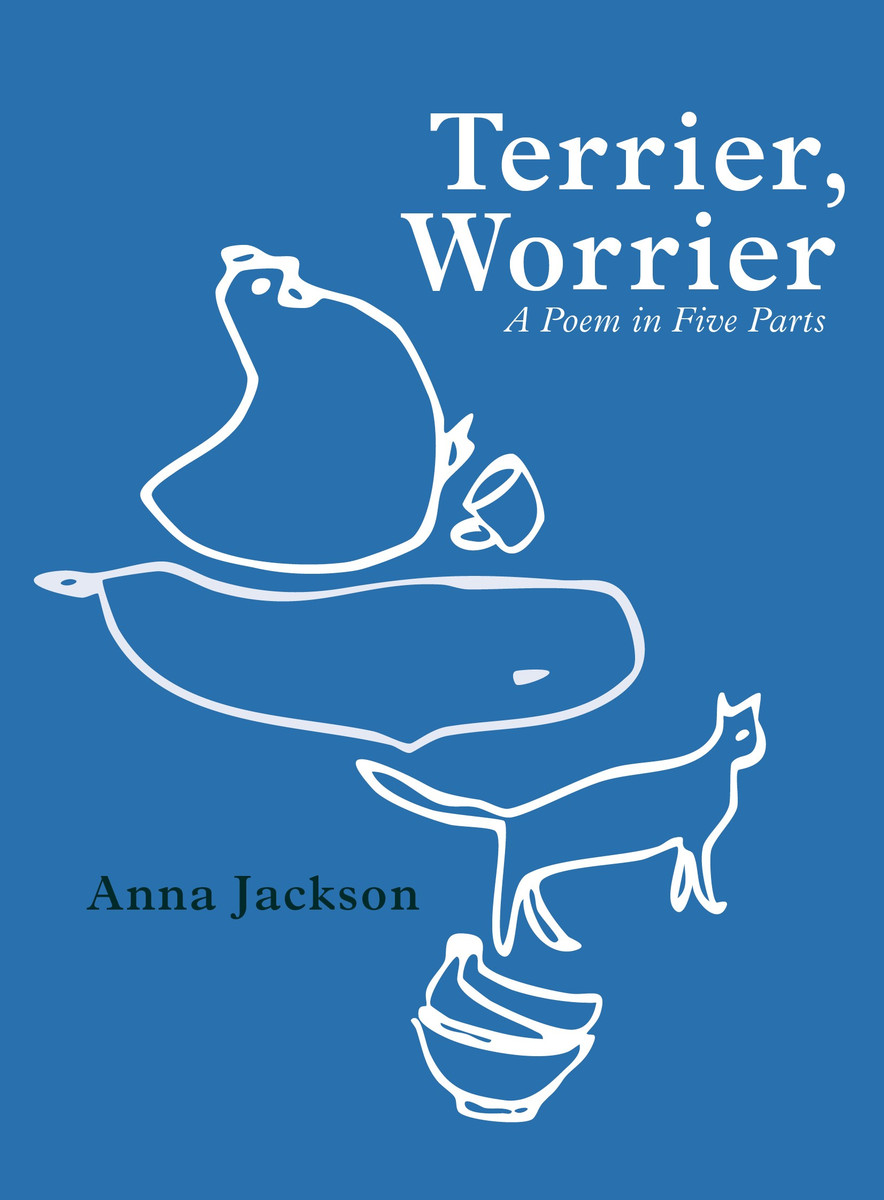
from Terrier, Worrier, Auckland University Press, 2025
Terrier Worriers is a long poetic sequence divided into five parts, into five season loop: summer autumn winter spring summer. These nine pieces are lifted from the extended sequence.
Inspired by The New York Times invitation to take ten minutes and slowly absorb the artwork they post each Monday, I created an ongoing series, the Poetry Shelf Breathing Room. Here, I invite you to breathe in a poem slowly for ten minutes. I love choosing the poem, I love slowing down to a restorative snail’s pace, to see what is experienced when we unfold a poem slowly.
As I move Poetry Shelf slowly and gently back online, I have spent this week lingering in the Breathing Room. On Tuesday, I was set to pick a poem from Bill Manhire’s Lyrical Ballads (THWUP, 2026) but stayed with the whole collection for several glorious hours. Yesterday it was a painting from Michael Hight’s exhibition, and wrote a poem in response. Today I spent several hours reading Anna Jackson’s glorious Terrier, Worrier again. I am curious to see what happens when I return to books I have loved so much, and to write down my engagements, as I also did with Bill’s new book. On both occasions, the books shifted to reveal new delights and wonders.
Anna’s book is an extraordinary sailing ship, a deep simmer-pot of thinking and exploration: porous moving full of song, with questions puzzles ideas worries that tremble and quiver and navigate as they set sail upon the page. There’s Anna’s recurring dream terrier pulling us into digging up and over and under things, the lyrical lines that carry us with wit and agility. It feels like I am are drawn into the waiting room, a poetry room that’s maybe cerebral physical recalled experienced imagined. An utterly intimate space of poetic and self exploration, where beloved hens cats Simon son and daughter mother and father are seated or standing close, where writing becomes thinking and thinking becomes writing, and everything is steeped in a slow braise of feeling and being and tenterhooks and life, yes above all life. To read this precious book, in my three-day Breathing-Room retreat is utterly precious.
Anna Jackson is a poet and Professor of English literature at Te Herenga Waka/Victoria University of Wellington, whose latest book Terrier, Worrier came out with Auckland University Press in 2025. She is the author of seven collections of poetry as well as Diary Poetics: Form and Style in Writers’ Diaries 1915–1962 (Routledge, 2010) and Actions & Travels: How Poetry Works (Auckland University Press, 2022).
Auckland University Press page


Pingback: Poetry Shelf weekend reading and listening and looking | NZ Poetry Shelf