Monthly Archives: May 2018

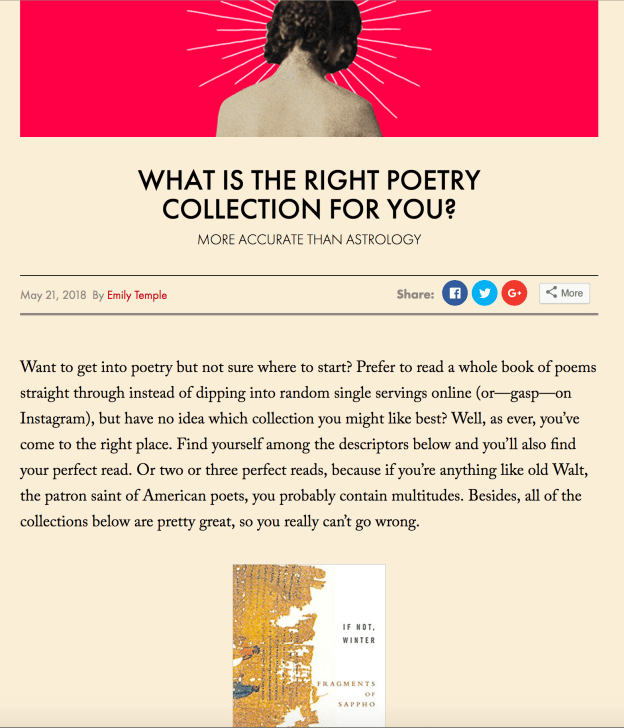
Emily Temple at Lit Hub asks: What is the right poetry collection for you?

This is a great list! It reminds me that this year I want to share overseas poetry collections I have loved with you. If you are like me you want poetry to take you in myriad directions with myriad effects and not settle down in a particular club. Lists like this keep you on your reading toes.

Check Emily’s list out here


Screen Shot 2018-05-27 at 11.47.22 AM.png


2 excellent poetry interviews @RNZ: Kim and Harry, Jesse and Jane


DSCN9476.jpg


Good to see poetry getting attention on Radio NZ. These two interviews, both warm and scintillating, are really worth listening to, especially on a cold rainy Sunday.


Jesse Mulligan and Jane Arthur talk about winning the Sarah Broom Poetry Prize 2018, writing poetry and founding a literary website for children. Jane blew my socks with her speech and poems at the award event at AWF – I posted both a few days ago.


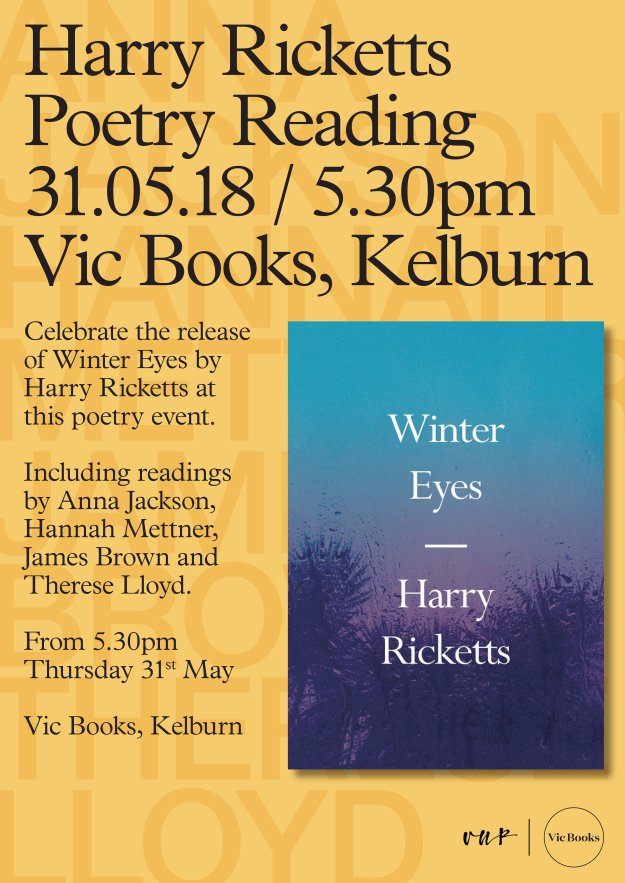
Kim Hill and Harry Ricketts talk about his new book Winter Eyes – a book I think is his best yet. Harry and I are in the midst of a slowly unfolding email conversation that I will post soon.


Thank you!


Poetry Shelf in conversation with Helen Heath


Helen Heath by Victoria Birkinshaw 2018.jpg

Photo Credit: Victoria Birkinshaw


Helen Heath’s debut collection, Graft, won the NZSA Jessie Mackay Best First Book for Poetry Award. It was also shortlisted for the Royal Society of New Zealand Science Book Prize (the first poetry or fiction shortlisted). Helen has a PhD in Creative Writing from Victoria University of Wellington’s IIML. Her new collection, Are Friends Electric, is a poetic smorgasbord that offers diverse and satisfying engagements. To celebrate the new book, Helen and I embarked on an unfolding email conversation.
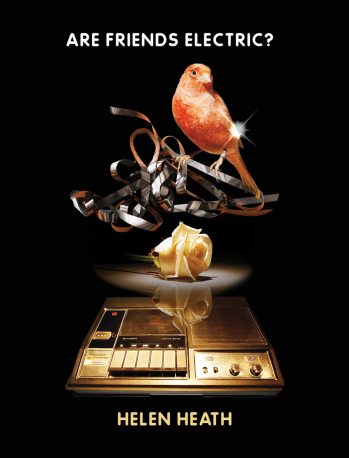
 

Are-Friends-Electric__83457.1522198652.jpg


The large electric that is you

is like the help that is you and

the mouth and the associated

kiss. The source is kind, simply

loved. Turning, my bird, turning

to view a scratched course.


from ‘Greg and the bird’


A slowly unfolding email  conversation


Paula:  The first poem, ‘Reproach’, starts with the word ‘you’. It is like an open invitation to enter the book. The next word jump cuts to ‘poet’ and from there to a reading hunger:


You. Poet. You’re hungry to be read


It is the best opening, the most audacious opening, to a book I have read in ages. Then as the poem curves and folds you end up at the footnote and the origins of the poem’s found text. I am reminded of the unreliability of language to represent reality. Tell me about the challenges you lay in the opening line and your experiences with Plato’s Phaedrus.


Helen: Thank you, I’m so glad you think so. The opening line is a response to the feeling of despondency I sometimes get when writing: ‘What’s the point?! Who even reads this?! This will all get lost and forgotten in time!!’ There is a famous passage in Plato’s dialogue Phaedrus where Plato recounts Socrates rejecting the invention of writing, believing it will strip our ability to remember and thereby an essential part of our humanity. Of course, the irony is that we know this because Plato wrote it down. Writing was an early technology and a similar argument is often put forward against various kinds of modern technology, such as smartphones or the internet, claiming they harm the development of memory or social skills.

Nicholas Carr wrote a now famous article in The Atlantic in 2008: ‘Is Google Making Us Stupid? What the Internet is doing to our brains’, which he developed into his book The Shallows. Giovanni Tiso wrote a thoughtful response to it on his blog. Technology can’t be separated from culture, it’s a cultural artifact, like language. “We shape our tools and, thereafter, our tools shape us.” — John Culkin (1967). This all circles back to the anxieties of the opening line and, as you rightly point out, the unreliability of language to represent reality. The poem attempts to wrap up anxieties surrounding the fallibility of language and writing with central themes of the collection.


Paula: Fascinating. The act of writing is itself a way of remembering and negotiating what is hard, elusive, necessary, puzzling. The list could go on! There are a number of found poems in the collection that stage you as first reader then writer. What attracts you to them?

Helen: It became impossible to separate the research from the writing in this collection. This book can almost be seen as a journal of reading and cultural responses. I was writing my way through some big ideas, trying to come to some kind of personal understanding. ‘Thought in motion’ is a phrase that comes to mind.

The other aspect of the found poems is the concept of literary and cultural intertextuality and how that can be seen as an analogue translation of hypertext and the internet as form. I am interested in poems that weave connected and reoccurring themes and ideas through their collections. In this book the poems reference other texts, popular culture, and each other, and (I hope) build up the reader’s understanding of the collection’s thesis incrementally.


Paula:


I am a woman and

this is a bridge,

despite our vast differences

we are very much in love.

One of the most difficult

parts of being in love

with a public object

is that he and I can never


be truly intimate.


from ‘The objects of her desire’


Movement can be such a strength in a poem. A poem as ideas in motion is in such contrast to personal poetry. Yet what I love in your poems is the shifting voice, the conversational tones. Do the found poems also stage forms of ventriloquism?

Helen:  Yes, definitely. I went to a Masterclass with Kei Miller when he visited Wellington in 2014, many of his poems are based on research and I asked him what techniques he used to keep his poetry from getting bogged down in facts and getting stale. He said he tries to focus on voice in his work. I started experimenting with persona poems and found this shape-shifting quite addictive.

I see myself working in a feminist tradition ­­­– the use of persona and alternative memories plays an important role in feminist revisionist mythology. In addition, a modern, post-positivist, scientific approach acknowledges the difficulty, if not the impossibility, of removing the personal from narratives of knowledge; it acknowledges the importance of multiple voices and experiences. I wanted to reflect that in my work.


Paula:


(..) The city is constantly

under construction, so many empty spaces,

so many car parks, you can get lost

in your home town without familiar landmarks.

My google glass app returns the lost buildings

but they jiggle on my hand-held screen.


from ‘Run rabbit’


I also see a common thread of seeing, strolling, collecting, as though this is poet as bricoleur, as though the book is a cabinet of curious things? How does that resonate with you?

Helen:  Yes, I think that is a good description, especially of the first half of the collection. Although, I hope this ‘cabinet of curiosities’ builds into a narrative for the whole book.


Paula:

I ask if you would like a body.

You say, ‘No I’m beyond bodies now,

I’m ready to be fluid, spilling out all over.

I’m ready to spread myself so thin that I’m

a membrane over the world.’ I’m not ready.

I take off my socks and shoes and walk

over a patch of grass very slowly.


from ‘Spilling out all over’


You move into poems that link grief with the effect of technology upon our bodies. Again there is a carousel of voices that may or may not be invented or borrowed but they make you feel something. What was driving you as you wrote these poems?

Helen:  My brother-in-law was dying of cancer while I wrote the collection and that had a profound impact on my work. I was watching my sister and her children go through this devastating loss while I was researching new technologies. The voices aren’t their voices directly, they are invented, but they are deeply influenced by this experience.


Paula: That’s interesting. The way writing can absorb things so it is there hiding in the ink. Were you bringing yourself in close as you wrote or keeping at a little more distance?

 Helen:  The first half of the collection is probably more curious and observational. The second half, while still observed (yet invented) is definitely more personal to me. The collection attempts to zoom in from observer to participant as you read through it.

Paula:  Yes I got that shift. And in a way the second half reflects and refracts back on the first. Did you need a particular place to write the poems?

Helen: I guess it was a particular headspace rather than a physical space. I was deeply immersed in the research and the writing, it was all consuming. Physically, I wrote wherever I could: at home, at varsity, on retreat, on the train, in bed…

Paula: The book is so complex, and satisfies so many layers for the reader, what did it do for you as writer?

 Helen: Haha, it completely did my head in!


Paula: Were there any poetry books you read as you were writing this that tilted things for you? Or simply filled you were awe or admiration?

Helen: I was reading everything I could of Jo Shapcott, Jorie Graham and Deryn Rees-Jones. Jo Shapcott doesn’t write about technology but she is what I would describe as a science poet who creates poems as thought experiments and deeply considers embodiment. I stumbled across Fleur Adcock’s 1971 speculative poem ‘Gas’ for the first time while writing this book, I found it disturbing and exciting. Similarly I was thrilled by Welsh poet Deryn Rees-Jones’ book length poem Quiver (2004) – a speculative murder mystery involving a clone – it’s fantastic.


Paula: Is there a poem that particularly works for you?

Helen:  I’m going to cheat and name three for different reasons. The poem that is the most personal is ‘A rise of starlings’, which is for my sister. I feel my heart crack open when I read it. ‘The Anthropocene’ is a poem, or lyric essay, which I think works because of the way it circles around a subject, attempting and failing to nail it neatly. Finally, I kind of love ‘Greg and the bird’ because it is the whole book scrambled then distilled into one poem that is meaningful and meaningless at the same time.

Paula: Yes, and all three are quite different.  Perhaps the connective tissue is what I might call a humane fluency.  ‘A rise of starlings’, for example, is mesmerising – both still yet full of movement. It is a poem that catches in your throat as you read.


Orion loosens his belt

in our own night sky. You

have drawn new maps

across the darkness, through

wild celestial fields, tracing

messages to me in particles

of dust and light.


from ‘A rise of starlings’


This was such a pleasure Helen, talking poetry, thank you.


Victoria University Press page

Helen Heath website

New Zealand Book Council author page


In the hammock: Reading Landfall 235

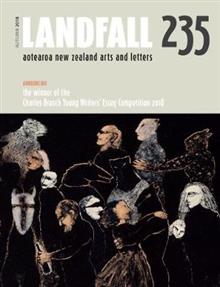
9781988531243.jpg


Landfall 235 launches Emma Neale as the new editor. The cover aptly features ‘The House Party’; Kathryn Madill’s monoprint is strange and seductive with sunken black space and textured skin. It is like a poem that tempts and then holds you in an intricate grip. There is a Madill sequence inside that is equally sumptuous, surprising, lyrical.

This is an addictive issue – think of it as a musical composition that carries you through diverse and distinctive reading effects across an arc from first poem to final story. I do hope more Pasifika, Māori and Asian poets send in submissions for the next issue to increase the diversity of voice.

The two visual sequences (by Madill and photogapher Russ Flatt) are stunning. Flatt’s photographs reconstruct memories from the ‘subconscious grief’ and experience of growing up gay in Auckland in 1970s and 1980s. Wow. This is the power of art to take you some place that transcends ideas and feeling but that is ideas and feeling.

Landfall 235 also includes the winner of the Charles Brasch Young Writers’ Competition,  Aimee-Jane Anderson-O’Connor, fiction (including a keenly observed piece by Airini Beautrais) and reviews. It welcomes established elders such as Elizabeth Smither and Bernadette Hall and barely published authors such as Sarah Scott and James Tremlett.


Here are a few poetry highlights:

Tracey Slaughter has turned from her dark, edgy must-read fiction to poetry. She was recently shortlisted for the 2018 Peter Porter Poetry Prize and I can see why. Her poem, ‘the mine wife’, with short-line fluidity, fictional momentum building, spiky detail, gritty feeling, is all about voice. A vulnerable, risking, space clearing, ‘self’ admitting voice:


the hand is a useless

surface for showing

the love it takes

to clear a path. Under

layers you wait for me to sift

your face from its mask.


from ‘the mine wife’


Lynley Edmeades‘ list poem, ‘The Age of Reason’, kicks off from Jean Paul Sartre’s title to move from ‘longing’ to ‘baby’, scooping up Simone de Beauvoir on the way, and all the staccato thoughts that propel a micro portrait: because why because how because who. I adore this!


Because fear of death

Because a dog might do

Because antidepressants

Because déjà vu

Because the trees

Because the population

Because plastic


from ‘The Age of Reason’


‘A Love Letter to My Mother: A work in progress’ by Wen-Juenn Lee is layered and probing and direct. I am wanting to read the whole work:


She takes astronomy classes at night.

I do not ask her why she stargazes

what she looks for              in the oily darkness

we go to a poetry reading on migrant women

I do not tell her

I remember her crying on the plane


from ‘A Love Letter to My Mother: A work in progress’


Nick Ascroft’s playful word shenanigans in ‘A Writer Wrongs’ are a delicious shift in key as rhyme binds  writer, hater and waiter:


So my fish is pallid.

So there’s a little pebble in my freekeh salad.

Is it necessary a balladeer batters

out a ballad?


from ‘A Writer Wrongs’


I haven’t encountered Rachel Connor‘s poetry before. She is a medievalist and a  postgraduate student in Otago University’s Department of English. I want to read more of her poetry! Her poem, ‘Home’, captivates with its quirky tropes and agile pivots upon ‘swan’:


A swan like a carved radish kickstarts its way across the water.

It should be easier

to temper my words and make iron gates of them,

to remember the names picked out in gold

that echo a memorial garden.


from ‘Home’


Tim Vosper offers my favourite ending in ‘The False Way to the Real’


When it comes time to kill the lamp

the leaf will turn into a shade.


from ‘The False Way to the Real’


I am fan of Sugar Magnolia Wilson’s poetry and have fingers crossed she gets a book out soon. ‘Betty as a Boy’ is lush with detail and movement:


And you, outside the upmarket  grocer’s, camouflaged top, khaki pants

slashed with a silk of red, a backpack strung with things that clink,

disappearing into your androgyny— the inverse of a newly minted drag queen,

appearing like a flaming comet, burning to be noticed.


from ‘Betty as a Boy’


Here is another unfamiliar poet I want to see a collection from. Susan Wardell’s poem pulsates with glorious surprising life. I will quote a piece but I urge you to read the whole thing: place rich, lithely troped, visually sparking, enigmatic, humane.  I am drawn to the voice, to the word hunger, to the portrait built.


They say

when meaning is gone, all that is left

is the grain

of the voice.


Well, hers sweeps the room like salt-flecked taffeta.


from ‘Grain of her Voice’


Writing journals, literary journals open up new avenues of reading and engagement. Landfall 235 is no exception. I have not finished, I have not yet read the reviews and all the fiction, but congratulations Emma Neale, you have taken the literary torch from David Eggleton, and the boost he gave, and turned your astute editorial eye to our advantage. I have new poets I am keen to track  down. I have seen familiar poets with fresh eyes. Kind of like a poetry house party in my head.


Landfall page

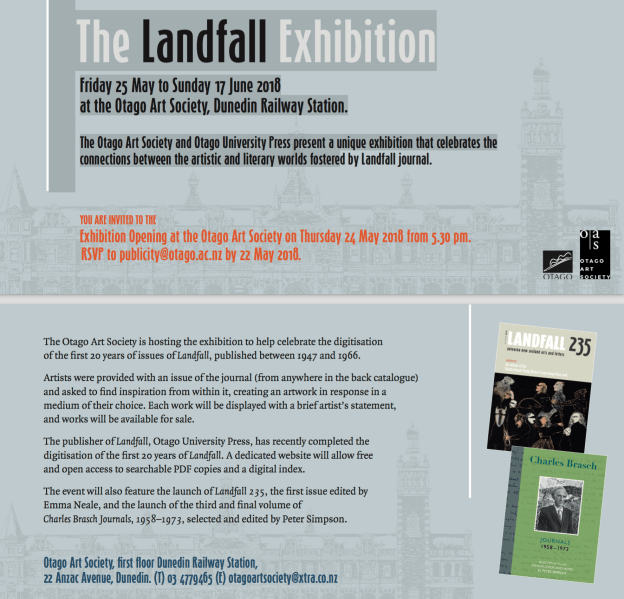
You can also go to the Landfall Exhibition if you live in Dunedin. Opening is Thursday May 25 at 5.30 pm.

Screen Shot 2018-05-24 at 2.23.52 PM.png


Poetry Shelf audio spot: award winner Hannah Mettner reads ‘Cat Chakra Alignments’


fullsizerender


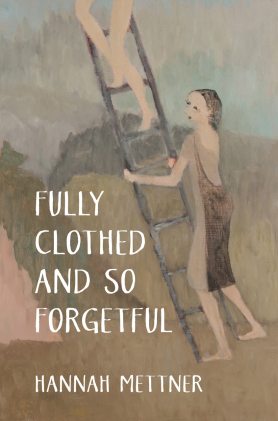
Hannah Mettner, ‘Cat Chakra Alignments’, Fully Clothed and So Forgetful, Victoria University Press, 2017 


Hannah Mettner is a poet, librarian and mum in Wellington. She co-edits Sweet Mammalian, an online poetry journal, with Morgan Bach and Sugar Magnolia Wilson. Her first collection, Fully Clothed and So Forgetful was published by Victoria University Press in 2017, and won the Jessie Mackay award for the best first book in poetry.


Victoria University Press page


Fully_Clothed_and_So_Forgetful__32303.1486956777


The Shanghai Literary Review seeks submissions

Go here for submission details


Screen Shot 2018-05-24 at 8.42.13 AM.png


Submission Categories

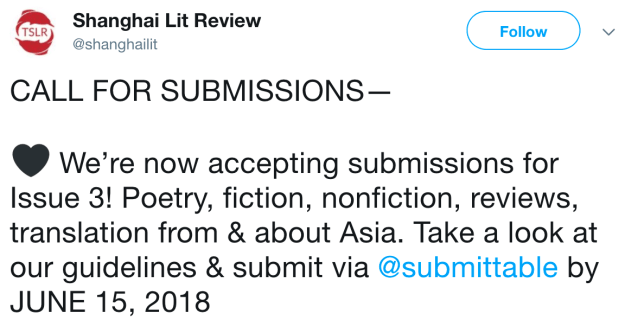
The Shanghai Literary Review accepts submissions for web and print on a rolling basis. Our deadline to submit for Issue 4 is June 15, 2018. We only accept submissions via our online submission manager. There is no fee for submitting your work to TSLR.

We are interested in art and criticism about urbanism, globalism, identity, and transnationalism, though by no means should submissions be limited to those topics. We’ll publish a good story about cats in Africa if it floors us. Selected works will be published in print, and with a delay, also online. We strongly urge submitters to check out our TSLR Online section on this site or view back issues of the magazine to get a sense of what we are looking for.

We publish:

  • Fiction – less than 5,000 words
  • Poetry – 2 poems submission limit per person
  • Nonfiction & Essay – less than 5,000 words
  • Flash Fiction or Nonfiction – less than 500 words
  • Visual Art – photography, video, photo essay, collage, painting, sketch, etc.
  • Translation – translation into English of any poetry, essay or short fiction from Asia, or vice versa, along with the original text
  • Book Review – pitch book review ideas to us, on fiction or non-fiction from or about Asia

In the hammock: Reading Min-a-rets (8)


Minarets8Autumn2018_webcover.png


Min-a-rets issue 8 autumn 2018


edited by Erena Shingade

published by Compound Press

drawings by Harry Moritz

poems by:

Victor Billot

Freya Daly Sadgrove

Lee Thomson

Zack Anderson

Murray Edmond

Courtney Sina Meredith

Manon Revuelta

Naomi Scully


This is multi-note poetry – each poem a sharp turn to different effect but the poetry co-exists so sweetly.  There is not a dud note.

Today I am in the mood for surprise.

Zack Anderson’s ‘Vapor Wake’ is a lush string of words, a momentum of startling image and sound. A taste:


shadow the streaming track

the wormy spoor

the hex print

the luminous index

data streaming from me

like a wedding dress

a mantle, a mantis

a veil


Murray Edmond goes ‘Camping in the existential forest’ with tercets that wryly build a miniature narrative, strange, theatrical and evocative:


III

Someone coming in

gumboots. Tramp tramp tramp. Beat

of own tell-tale heart.


Courtney Sina Meredith hooks me with an off-kilter memoir-like cluster of little pieces, definitely luminous. From ‘Pony’:


Baths

Unless my memory is playing tricks on me. The rats

were white with blazing red eyes.


I’m translating myself from a time when I was sure.


I recently did an email conversation with Manon Revuelta where I enthused about her debut collection, Girl Teeth. This new poem, ‘Prayer’, shows the subtle along with the degrees of surprise and lyricism Manon is capable of. A taste:


Look at this busy dance I do with my hand

When I’m talking to people

Shredding paper in the darkness of my pocket

It is the quiet work of saying things


Min-a-ret 8 is a treat to be read on multiple occasions like a good album that needs multiple listenings.


Min-a-rets page

Erena Shingade is a poet and arts writer from Auckland, New Zealand. Her work has been published by platforms such as The Spinoff, Landfall, Mimicry, Blackmail Press, Atlanta Review, Ka Mate Ka Ora, & the New Zealand Electronic Poetry Centre. After completing an MA thesis on the Zen Buddhist poetry of Richard von Sturmer in 2017, she continues to research the intersection of the poetic and the religious. During the day she works as a publicist for Allen & Unwin.

Celebrating the Sarah Broom Poetry Prize winner 2018: Jane Arthur


jane_arthur_SarahBroomPrize_KEL.jpg

Photo credit: Kelley Eady Loveridge

It was with great pleasure I announced Jane Arthur as the winner of the Sarah Broom Poetry Prize 2018. I had not heard Jane read before, had read a few of her poems here and there, but her reading just blew my socks off. Poems have first life on the page but poems also have infectious life in the air. So I cheekily asked her to record two of the poems she had read. Jane is a poet on my poetry radar – I can’t wait to hold her first book and review it on the blog. Warm congratulations!


Jane’s acceptance speech:

When I found out I was shortlisted for this prize, I said to my partner, “This is the flashest thing that’s ever happened to me.” And he looked at me and at our baby and back at me, and raised his eyebrows. I mean, it’s a close call, though. Sarah Broom and Eileen Myles? This is definitely the coolest I’ve ever been.

In 2010, a year after I’d moved from Auckland to Wellington, my friend Harriet sent me a gift in the mail, with a note along the lines of “This is essential reading”. It was a copy of the newly released Tigers at Awhitu. I’ve read it a number of times since then, and Gleam, too – and they’ve meant different things to me each time. I’ve read them for pleasure, and I’ve examined their craft. Most recently was this month, and it’s the first time I’ve read them since becoming a parent – it was harder this time. But they’re so brave, and kind and clear-eyed. I’m thrilled to have my name associated with Sarah Broom.

The poems I submitted for this competition were mostly ones I wrote when I did my MA in creative writing at Vic in 2015. Since then, I’ve had a couple of jobs, moved house twice, got a second dog, launched a website, had a baby – and lost entirely my confidence in my writing. It’s always been tenuous, but I had quietly come to the realisation that I’m not a writer. Definitely not a poet. Not good enough. Not proper-writer enough. I’d stopped writing. I was embarrassed at myself for entering this competition.

Then I got a phone call. And I spent a few days feeling like I’d had too much coffee. And then I wrote a poem.

The way this competition runs means the poems are judged blind – the judge doesn’t know who wrote them, how famous or accomplished or awarded the poet is. They simply read the poems. And the judge is different each year. This is a wonderful way to even the playing field and let different tastes and styles rise to the surface. I mean, here I am. Eileen freaking Myles read my poems. 

The prize means – I can barely believe this – I join the likes of Hera Lindsay Bird, who I did a Unity Books stocktake with once, and Elizabeth Smither, who’s from NP like I am. Once it’s sunk in, this prize will seriously up my confidence and give me ammunition to fire back at my imposter syndrome, and it will help me write a book.

Thanks again to the trustees, and the judge. And to the other finalists whose work I’ve really enjoyed discovering. But mostly thanks to Grisham – you are pretty flash.


Two poems from Jane’s reading at the festival:


“To check up on the state of your heart you must lie back”


“Keanu is afraid (a triolet)”


From our conversation on Poetry Shelf:

Paula: Which poem in your selection particularly falls into place. Why?

Jane: To check up on the state of your heart you must lie back” is one of those rare poems that burst out of me in one sitting (having been rolled around my brain for a day or so) and didn’t change significantly after that. An earlier version was published in Ika and two years later only a few words have changed. I wish I knew why some poems come out easily, it’s much more efficient. I am typically the world’s most painfully slow and fussy writer … more of a deleter.


Jane Arthur was born in New Plymouth and lives in Wellington with her partner, baby and dogs. She has worked in the book industry for over 15 years as a bookseller and editor, and is a founder of the New Zealand children’s literature website The Sapling. She has a Master’s in Creative Writing from the IIML at Victoria University, where her supervisor was Cliff Fell, a 2017 Sarah Broom Poetry Prize finalist. She also has a Diploma in Publishing from Whitireia Polytech and a Master’s in English Literature from Auckland University. Her poems have appeared in journals including SportTurbineIka, and Sweet Mammalian.


jane_arthur_SarahBroomPrize2_KEL.jpg

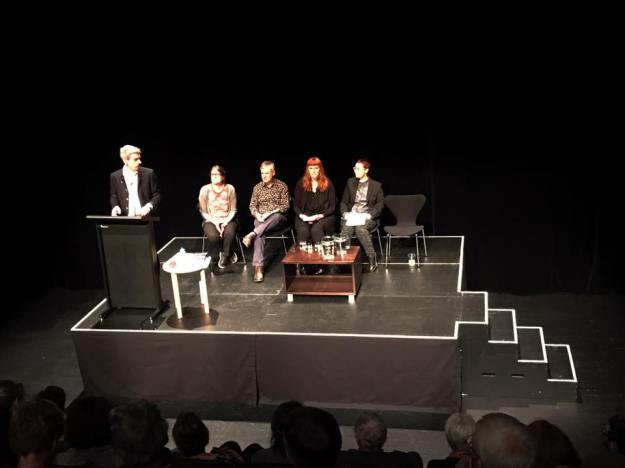
Photo credit: Kelley Eady Loveridge (Michael Gleissner with Paula Green, Stuart Airey, Jane Arthur and Robyn Maree Pickens)

Monday Poem: Nina Powle’s Styrofoam Love Poem


STYROFOAM LOVE POEM


my skin gets its shine from maggi noodle seasoning packets / golden fairy dust that glows when touching water / fluorescent lines around the edge of / a girlhood seen through sheets of rainbow plastic / chemical green authentic ramen flavour / special purple packaged pho / mama’s instant hokkien mee / dollar fifty flaming hearts / hands in the shape of a bowl to carry this cup / of burning liquid salt and foam / mouthful of a yellow winter morning / you shouldn’t eat this shit it gives you cancer / melts your stomach lining / 99% of all this plastic comes from China / if we consume it all maybe we’ll never die / never break down / and I’ll never be your low-carb paleo queen / I’ll spike your drink with MSG / find me floating in a sea of dehydrated stars / on the surface of my steam shine dream / my plastic Chinese dream / lips swollen with the taste of us


©Nina Powles

Nina Powles is a poet and zinemaker from Wellington, currently living in London. Her debut poetry collection, Luminescent, was published by Seraph Press in 2017. She is poetry editor of the Shanghai Literary Review and was the 2018 winner of the Jane Martin Poetry Prize.