Tag Archives: Gregory O’Brien

A Little Poetry Shelf Diary: A weekend at Matahiwi Marae to launch our new Poet Laureate, CK Stead


IMG_3281.JPG


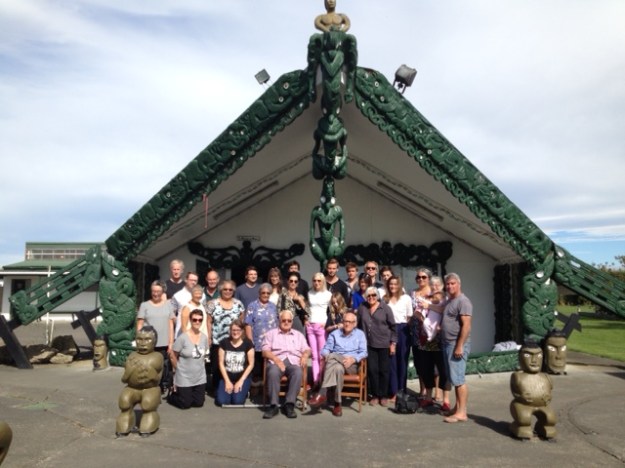
This weekend friends, family and poets gathered to join CK Stead celebrate his Poet Laureateship and the presentation of the tokotoko. It was a marvelous occasion that will stand in my memory for a long time. The weekend featured two key events. The formal and informal proceedings at Matahiwi Marae on the Saturday morning and a Poets’ Night Out in the evening.

With exemplary dedication to New Zealand poetry, Te Mata Estate’s Peter Buck and poet Bill Manhire established the award twenty years ago. In 2007, The National Library took over the administration, although the Buck family still remain involved, and donates a stipend of wine to the Laureates. Unlike most of the visitors, I got called onto the marae on the Friday evening with Chris Szekely and Peter Ireland from the National Library, and a number of their colleagues, including Oliver Stead and his son Isaac. Peter was the driving force behind detail of the weekend, and Ian Wedde’s moving tribute to him at The Circle of Laureates hit the mark. Thoughtful, attentive, committed to making a celebration fit for a Laureate. His back-up team are pretty special too (Joan, Cellia Joe, Lynette, Jason and Oliver).

Kaumatua Tom Mulligan and other members of the marae welcomed us with much aroha.

Joan, Cellia, Jason and I practiced some waiata back in the whare nui. CJ on ukulele.We crack up when CJ says all her family knows she can’t sing and she just fakes it. We are all fooled and I wonder what I can’t do but could fake and get away with.

On Friday night we hived off to Havelock North (one poet, five librarians) for dinner at Maine where the food was divine. We fell greedily into the comfort of the best hot chips ever and with that salty comfort digging deep into our bones were ready for whatever the weekend delivered. One plate of salmon with the best Niçoise salad and I was ready for a weekend of poetry and celebration.


Saturday morning

I got up early to walk in the near rain and saw a black cat stock still on a fence post eyeballing my lack of sleep. Not budging an inch until a car came down the gravel road and sent the cat sliding down like a snake into the golden corn. I had no idea what it meant. But it glowed with options.


CK Stead was called onto the marae with his whanau (around 20), poets Gregory O’Brien and Chris Price, her partner Robbie Duncan, and other guests. To have such family support felt very special. He is poetry but he is most definitely family. His daughter had travelled from London with her children.

After the formal speeches and the waiata exchanges, the tokotoko was presented to Karl by a kuia. She had such presence. Jacob Scott, who carves the tokotoko for each Poet Laureate said he had wanted to make a tokotoko for a gentleman and a scholar that could be used on a daily basis if needed. He had gained inspiration from Karl’s poem, ‘Scoria.’

Karl responded with a speech that mixed graciousness, humbleness, love. He said he was not only honoured by the role but honoured by the marae: ‘by being here, by your presence, by your aroha.’

Before he read a few poems, Karl talked about place, about the importance of one’s childhood occupation of place, and the way that place becomes one of return. He grew up with three maunga facing him whichever way he turned. He also underlined the primacy of poetry for him since his teenage days and the way he has ‘always come back to poems.’ With much humbleness, he added,’that’s why it is extraordinary at this late stage in my career as a writer to be honoured as Poet Laureate.’

Karl paused in his korero and then said; ‘I am getting advice from the tokotoko. We have to get used to one another.’

At that we all paused.

I am delighted that the Poet-Laureate role honours our elders, our writing taonga. It felt good to be part of the protocol. The talking. The listening. The exchange.


MC-ed by Marty Smith, the informal part of the morning was like a miniature poetry reading. As his invited poets, Chris, Gregory and I read a couple of poems and Chris sang a Bill Manhire song with her partner Robbie. What made this section special were the performances from local secondary students. One student used the analogy of a bird to explore the Poet Laureate’s original function to write poems on dictated subjects. She was keen to let a Laureate fly free! A student played a solo violin piece, one sang a Māori version of ‘Hallelujah,’ while another wrapped up the morning with Van Morrison’s ‘Moondance.’ Wonderful! I pictured us all dancing slow motion with the wind in our hair. Instead the wind whipped the music sheet up and away.

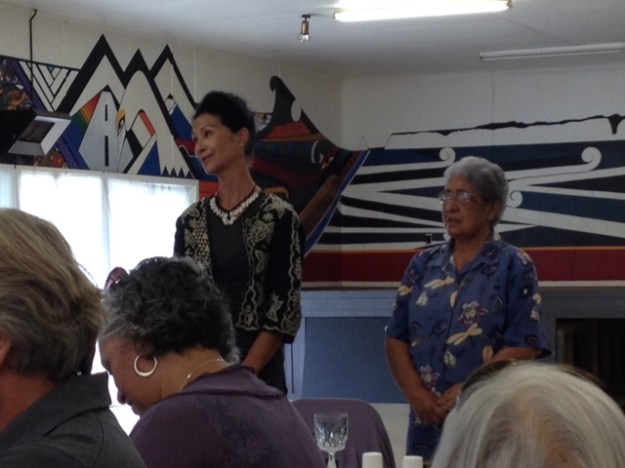
It was a morning of korero, waiata, music and poetry and it felt good to inhale both words and song. Nourishing. We moved to the whare kai where a tremendous lunch of fresh local produce matched the hubbub of conversation. You don’t get to experience many days like this in your lifetime. Such warmth, and connections.


Saturday night

Marty Smith was the MC extraordinaire in a poetry reading of two halves. It’s ages since I have heard Chris and Greg read, but to hear them read in this context was something special with poems handpicked for the Laureate occasion. Greg read a terrific poem now showcased in the selection of Best NZ Poems from 2015, while Chris confirmed that her new book is her best to date (we have an interview in the pipeline!). Three young opera singers from Project Prima Volta wowed us with two arias. The room befitted the occasion: white cloths on tables, astonishing flower/plant arrangements, platters of food, Te Mata wine. Karl started and ended the night and showed very clearly why he is Laureate. He read across his range and his last set gave me goosebumps. The clarity of voice, the poetic strata, the acute detail that makes you want to pick up your pen and write.


Sunday morning

Breakfast and poroporoaki for everyone on the marae. The goodbyes. At breakfast Karl and I talked about the weekend and how we both spent chunks of the night wide awake as though we had to rehearse the next day and analyse the day before. I probably had about two or three hours sleep a night and it seemed like a state of wakefulness that kept me on high alert. What had happened, what was about to happen. I had brought seven books to match most moods (everyone laughed at my big bag of duvet and books) but I only got to read snatches of The Lie Tree. The gap between YA fantasy and the marae was unbridgeable. I got up early and walked my way into wakefulness before Emma Scott, Jacob’s sister, took me out to the river mouth and then coffee at her brother’s house. To see the meeting waters, where river meets ocean, to soak up the gleam of sun on waves and estuary, felt like a poem on the surface of the world. We talked and we looked. Emma is a stone mason. We talked about poetry and we talked about stone. We talked about what holds things together. It matters that we hold up our treasured poets. Give them a place to stand and speak.

There was much korero after breakfast, and song. Chris and Robbie sang a mesmerising Bob Dylan number, almost lullabying me into necessary slumber.

Peter Ireland, running on empty after little sleep, spoke with characteristic thought and thanked everyone personally. It felt like a garland of words to wear out into the world of planes and trains and motorways. Or for me, a place of solitude and bush.

Jacob said it beautifully. He said that the Poet Laureate was significant for the marae. That it spread the hapu’s power and influence. That this is now Karl’s place as well. The undercurrent is that poetry matters. Jacob said it is significant ‘that the Poet Laureate can articulate the thoughts and expressions of who we are. Of what we can do. Of what we have got. And what we could do.’ Like a bird.

We all felt in debt to Tom Mulligan and his drawing together of this poetry clan. With much aroha and generosity of place, stories and a willing ear.

Our heads are full of days we cannot remember, but for many of us, this weekend will not be one of them.

Thank you. Especially Karl, The National Library and Matahiwi Marae.


The performances.


A quick trip into Havelock North to drink the best coffee and eat the best lemon tart in a cafe on the brink of closing for the day. Peter was a very good guide.


The writers, friends and family ate at Pipi Cafe, a cafe renowned for its love of poetry and its excellent pizzas in Havelock North.

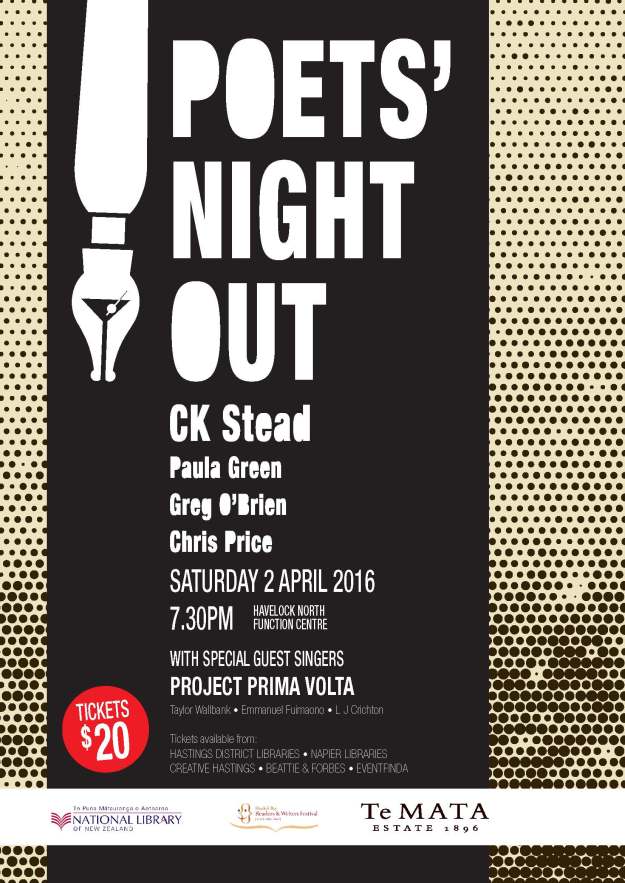
Poets’ Night Out


IMG_3258

IMG_3276

The last morning.

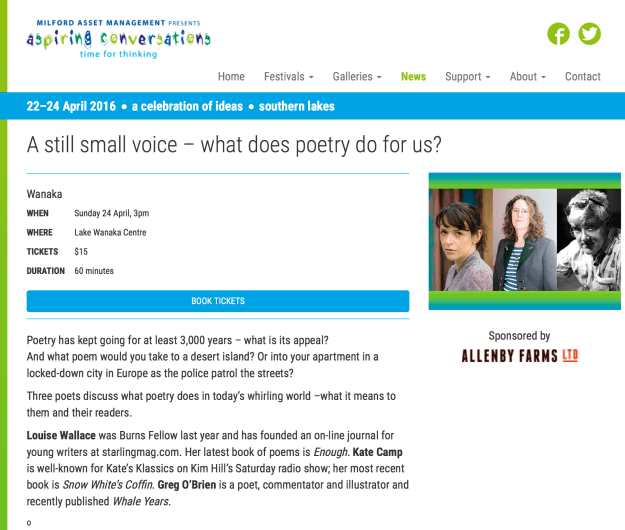
Wanaka Poetry event: ‘A still small voice – what does poetry do for us?

Screen Shot 2016-04-04 at 12.40.22 PM.png


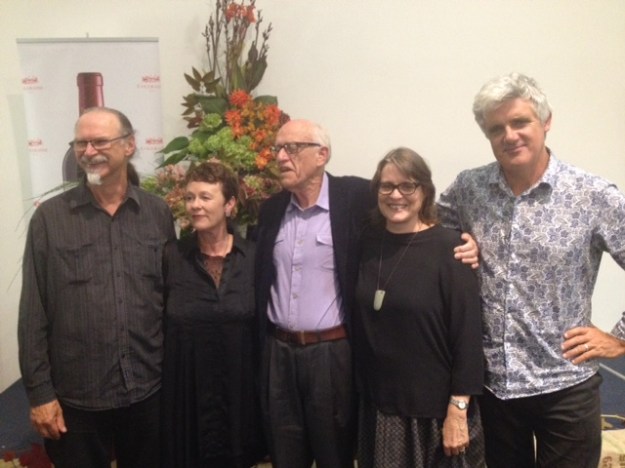
Poets’ Night Out in Havelock North with CK Stead, Paula Green, Gregory O’Brien and Chris Price

For Eventfinda tickets go here

The Poet Laureate Celebrations includes this event! Looking forward to my trip south.

HDL_poets-night-out_poster_A4_V3_PRINT

Poetry Shelf, Poet’s Choice: David Eggleton makes some picks


684a89cf-1c7b-4ee7-a686-f3e03271a543    1426649662558


Some of my most intense local poetry reading experiences this year have been as a literary editor, working my way through hundreds of poems and finding something wonderful in many of them, and then cherry-picking from these for Landfall 229 and Landfall 230; but beyond that the stack of new slim volumes looms, and I’ve elected to mention four poetry collections I enjoyed musing over.

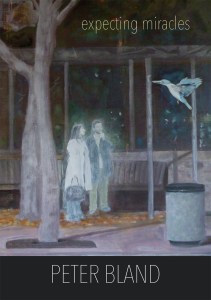
‘No, not Bali or Samarkand. Take/ me down to the Dominion Road . . .’ Peter Bland commands in his collection Expecting Miracles (Steele Roberts), drawing you in immediately with his canon-echoing rhythms and decluttered simplicity. His poems have a casual, conversational tone that belies their craft, bolstered by an oldster’s genial humour and air of wry bemusement at the oddity of the quotidian: he’s a metropolitan in a provincial culture.

  Gregory O’Brien‘s Whale Years (Auckland University Press) navigates its way around the South Pacific as if following the drift of ocean currents. In this collection, he’s a beachcomber pointing to curious flotsam and jetsam. His poems are mantras, notations, journal jottings, gatherings-together of cadenced imagery, and compelling in the way they combine astrological zodiacs, weather balloons, shipwrecks, islands. Collectively, the sense is of a star-trek odyssey, recapitulating ecological markers of the anthropocene era, Notably, too, the exoticism of travel helps generate a semi-arcane vocabulary, serving to align his verses with the baroque wing of New Zealand poetry: there where Kendrick Smithyman sculls in the sunset.

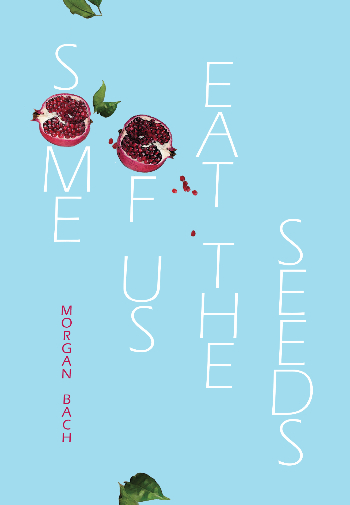
I was also very taken by the skewed reminiscences in Morgan Bach‘s first collection Some of us eat the seeds (Victoria University Press). Spiky, terse, yet also lyrical and tonally subtle, they recount a sense of adolescent awkwardness and estrangement, almost as if at times she’s ogling the outside world and its emotional coldness from her own private igloo, growing up in small town provincial New Zealand and longing to be elsewhere. But if she offers a return to childhood as a rejection of the sugar puff Disneyland of a commodified Nineties environment, she does this by crafting a version of Banksy’s subversive Dismaland: ironic, comic, sharply observant about the advertised ‘great expectations’ we have been led to expect from the product called ‘Life’.

Her poetic intuitions result in a cleverly-written-up sequence of what might be termed out-of-body experiences: the feeling of towering over shuffling Japanese passers-by in Tokyo; watching her screen-actor father die successively in movie after movie; and then ultimately a kind of ecstatic insight that turns her collection full circle: ‘the way you felt swimming/ in the rain that hammered/ when you put your head above water to see/ lightning flash in the pitch of the sky’ (‘The swimming pool’).

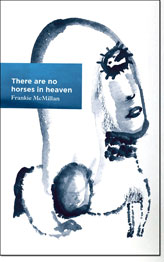
Frankie McMillan‘s There are no horses in heaven (Canterbury University Press) contains a multitude of poems rife with the storyteller’s art, proving her a kind of fabulist, distilling states of enchantment and sometimes states of disenchantment into a few lines ever so lightly and delicately, so that her shortish poems seem to musically chime with one another. And it’s as if you can carry them with you wherever you go. As she puts it: ‘What I want to say is something small/ enough to hold within the crook of my arm/ and that is not the half of it’.

And then there’s her poem ‘Observing the ankles of a stranger’, about a tourist being startled out of her wits when Ruaumoko’s seismic fists of fury pummeled central Christchurch almost into the ground on February 22nd, 2011. Here enchantment— or metamorphosis — takes the form of feeling lost in a familiar habitat as the dust settles. We need more such terrific poems.

David Eggleton

Expecting-Miracles-cover-web    nohorses_catalogue


Poetry Shelf interviews Gregory O’Brien — The poem has to dive down into and surface from some essential state of being

Screen shot 2015-03-14 at 9.52.32 AM

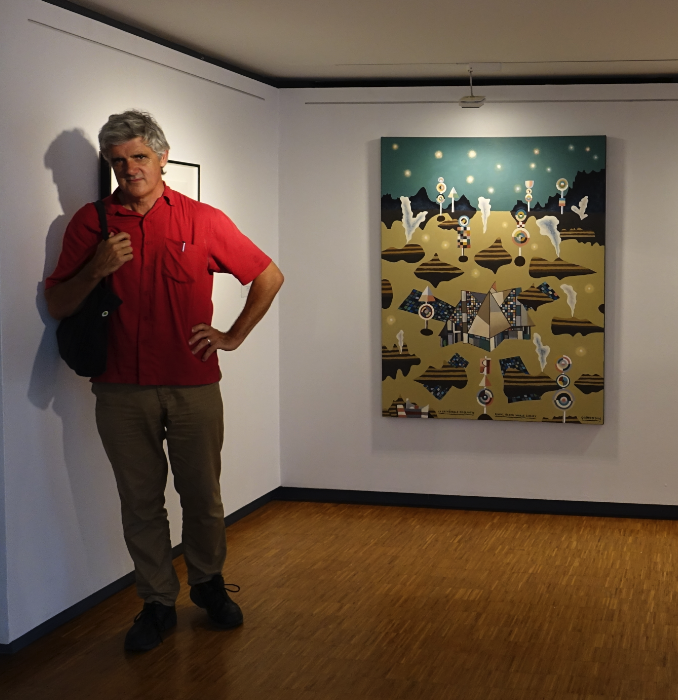
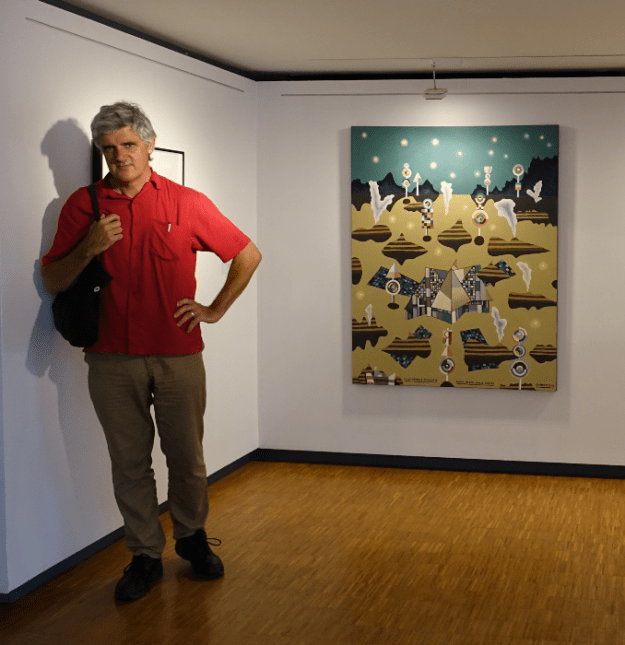
Gregory O’Brien at Tjibaou Cultural Centre, Noumea, March 2015

Photo Credit: Elizabeth Thomson


Gregory O’Brien is the  2015 Stout Memorial Fellow at the Stout Research Centre, Victoria University, where he is currently working on a book about poetry, painting and the environment. His new collection of poems is Whale Years (Auckland University Press). He has published numerous books of fiction, non-fiction and poetry. Since 2011 he has contributed to the ongoing Kermadec art project, works from which are on show at the Tjibaou Cultural Centre, New Caledonia, until July.


The interview


‘Ocean sound, what is it

you listen for?’


Did your childhood shape you as a poet? What did you like to read? Did you write as a child?

As far as I can recall, I drew more than I painted. And I always gravitated towards illustrated books—Tove Jansson’s ‘Moomin’ books stand out, and I remember The Lord of the Rings, as much for its illuminated maps as for the words. I went through a phase of reading comics—Whizzer & Chips rather than Batman. I date my interest in the interplay of words and visual images to those early encounters.

I doodled at every available opportunity and I remember being hauled out of class and punished for drawing, rather well, a crouching deer on the inside cover of my maths book. I usually captioned my drawings—so maybe those captions could be thought of as my first writings. Occasionally I filled in speech- or thought-balloons above various life-forms.


When you started writing poems as a young adult, were there any poets in particular that you were drawn to (poems/poets as surrogate mentors)?

I can trace this pretty exactly, I think. Aged 14: Bob Dylan’s ‘Writings & Drawings’. Aged 15: Dylan Thomas. Aged 16: James K. Baxter and Flann O’Brien (I liked to pretend Flann was an actual relative. I even screen-printed his book-title AT SWIM-TWO-BIRDS on a singlet—an item I still have in my wee box of treasures.) Aged 17: John Cage (Silence, and A Year from Monday). By the age of 18, I was living in Dargaville, and it was as if everybody suddenly jumped on board the NZ Road Services bus or bandwagon—I was reading Kenneth Patchen, William Blake, Edith Sitwell, T. S. Eliot, Ezra Pound, e e cummings; also Allen Curnow, Janet Frame, Sam Hunt… I had known about Eileen Duggan for some years, because she was a relative, on my mother’s side. More than anything else, however, it was discovering Robin Dudding’s journal ISLANDS that turned my world around, that brought the whole business home…. Therein I discovered Ian Wedde, Bill Manhire, Elizabeth Smither, CK Stead…


Did university life transform your poetry writing? Theoretical impulses, research discoveries, peers?

I was six years out of school by the time I finished my BA, so my university life was mixed in, very much, with everything else that was going on: with 15 months in Dargaville, a year or so in Sydney… At university, I certainly wasn’t drawn to theory except in so far as I thought it was a grand imaginative game that might, periodically, yield unpredictable and outlandish results. I enjoyed the pottiness of Ezra Pound’s literary (rather than his political) theorising… An ABC of Reading is a great book. Probably the Zen-inclined John Cage and the Trappist Thomas Merton were the two non-fiction writers I held closest to me.


Reading your poetry makes me want to write. I love the way your poems delve deep into the world, surprisingly, thoughtfully yet never let go of the music of the line. Words overlap and loop and echo. There is an infectious joy of language at work. What are key things for you when you write a poem?

I listen to a lot of music. I want the poems to have something of the music that I love. I spend a lot of my time looking at art. And I want my poems to have something of the art that I love. There are aspects of composition, tone, rhythm and character which span all these different creative modes. Those are the key factors for me when I write… At a certain point, an appropriate form makes itself known…. The poem has to dive down into and surface from some essential state of being… There is certainly a joy in doing the things that you love; so there’s joy in the making and, preceding that, in the state of being that leads to the making….


Do you see yourself as a philosophical poet? Almost Zen-like at times?

My concept of philosophy is broad and shambolic enough to accommodate what I do as a writer. I’ve never read extensively in the field of Zen (apart from the books of John Cage and the writing of my friend Richard von Sturmer). I’ve read a little, and somewhat randomly, in the field of non-conformist Catholic thought: Simone Weill, Meister Eckhart, Merton, Baxter… These peregrinations may have affected me more than I realise or am prepared to say.


Do you think your writing has changed over time?

I guess writing has to evolve – otherwise it will become predictable and a total drag. I’m as entranced as I ever was with the process, the business, the labour of it. At the same time, I remain devoted to the finished form of it: The printed book, with its covers and half-title and title-page; and the shapes of words on the page and maybe illustrations. Poetry is an art that, if it’s working, is constantly reinventing itself.

I look back at my early poems and find fault. I find myself blaming an over-voracious intake of French Surrealism; too much Kenneth Patchen one year, too much Stevie Smith the next… Too much John Berryman! And, next year, not enough John Berryman! But the ship sails on, and finds new oceans to ply.


You write in a variety of genres (poetry, non-fiction, critical writing). Do they seep into each other? Your critical writing offers the reader a freshness of vision and appraisal – not just at the level of ideas but the way you present those ideas, lucidly, almost poetically. Does one genre have a particular grip on you as a writer?

I’m only starting to realise the inter-relatedness of these different genres. A few years back I started to explore poetry’s potential to carry information, also to elaborate upon a thought in a more detailed kind of way, ie. to have an almost essayistic function. So quite a few of my longer poems (some of the odes and, particularly, ‘Memory of a fish’ in my new book) are laden with facts, figures and reasonably clearly articulated information.

Needless to say poetry infuses the writing I produce in relation to the visual arts. I find looking at art exciting; it appeals to my poetic self. I don’t really have a critical self. I hope my non-fiction writing has a cadence, a music and a subconscious (rather than a conscious) purposefulness. Pondering my recent writings on artists such as Pat Hanly, Barry Brickell and Michael Hight, I remember in each case hearing a note—a song, almost—in my ear, and I was beholden to it.


Do you think we have a history of thinking and writing about the process of poetry? Any examples that sparked you?

James K. Baxter wrote wonderfully about writing poetry. Bill Manhire’s Doubtful Sounds is an immensely useful and energising book. 99 Ways Into New Zealand Poetry is terrific too. I refer back to my set of the journal ISLANDS and, yes, it seems to me we New Zealanders have been writing about the process as well as the product. Janet Frame’s oeuvre might be our greatest, most enduring instance of writing about writing, thinking about writing, writing about thinking, and thinking about thinking.


Your poetry discussions with Kim Hill are terrific. The entries points into a book are paramount; the way you delight in what a poem can do. What is important for you when you review a book?

I think a book has to become part of your life to really make an impression. It’s the same with music or visual arts. It can’t be a purely intellectual thing, it has to take you over, to some degree. It has to be disarming. Accordingly I tend not to discuss books that don’t ‘do it’ for me. Life’s too short. Fortunately, I have catholic tastes. There are things I enjoy very much in Kevin Ireland, as there are things I enjoy in Michele Leggott. I guess this makes me a lucky guy.


I agree wholeheartedly. I am not interesting in reviewing books on Poetry Shelf unless they have caught me, stalled me (for good reasons!).

What poets have mattered to you over the past year? Some may have mattered as a reader and others may have been crucial in your development as a writer?

Two years ago I went to Paris and met up with one of my all-time heroes, the French poet and art-writer Yves Bonnefoy. He turned 90 last year (Joyeux anniversaire, Yves!) During my recent travels around the Pacific (from New Caledonia to Chile), I’ve taken bilingual editions of Yves with me everywhere. I am interested in the way he has turned the creative conundrum of being an Art Writer and a Poet into something unified and compelling (channelling earlier French poet-art-writers from Baudelaire to Apollinaire, with a nod to Yves’s near-contemporaries, that wondrous group of wanna-be French-art-poets, John Ashbery and the New Yorkers). I also took the poems of Neruda and Borges with me everywhere I went.


What New Zealand poets are you drawn to now?

New Zealand poetry is interesting at the moment. It’s all over the place. As it should be. There are plenty of people I read voraciously. As well as the poets mentioned already: Anna Jackson, Vince O’Sullivan, you Paula, Lynn Davidson, Kate Camp, Geoff Cochrane… Last year I edited a weekly column for the Best American Poets website—that was a good chance to ‘play favourites’, as Kim Hill would say. (All those posts are archived here: http://blog.bestamericanpoetry.com/the_best_american_poetry/new-zealand/) There are some great first books appearing at the moment: Leilani Tamu’s The Art of Excavation; John Dennison’s Otherwise. This bodes very well indeed.


Name three NZ poetry books that you have loved recently.

I was rereading Riemke Ensing’s Topographies (with Nigel Brown’s illustrations) the other day; I found that book very inspiring when it appeared way back in 1984. Lately I’ve also been reading Bob Orr’s crystalline Odysseus in Woolloomooloo and Peter Bland’s Collected Poems… I could go on.


Your new collection, Whale Years, satisfies on so many levels. These new poems offer a glorious tribute to the sea; to the South Pacific routes you have travelled. What discoveries did you make about poetry as you wrote? The world? Interior or external?

The Kermadec voyage, and subsequent travels—most recently to New Caledonia—opened up a huge areas of subjective experience as well as of human and natural history. How do you write about that kind of space, that energy, that life-force? Wherever you travel, the air is different; the ‘night’ has a different character; the smells and textures of the vast Pacific vary from place to place. And people move differently wherever you go – they claim a different kind of space within the environment. My recent travels have been like a door opened on a new world. The last three years of my poetry-writing have been the most intense since I was in my early twenties.


That shows in this book Greg. I am looking forward to reviewing it because it touched a chord in so many ways. I love the idea that poems become little acts of homage. What difficulties did you have as traveller transforming ‘elsewhere’ into poetry? To what degree do you navigate poetry/other place as trespasser, tourist, interloper?

The artist Robin White likes to point out that there is only one ocean on earth. All our oceans are joined together—it’s the same body of water. So, if you take the sea to be your home (which, as Oceanians, believe it or not, we should do), then as long as you’re at sea you’re still, to some degree, in your home environment.

As a poet entering a new environment, I bring with me my responses, my eye, my mind and various kinds of baggage. I’m a curious person by nature so I always want to find new things—things I don’t know anything about. I like it when my preconceptions fall apart. I love being wrong about things; I enjoy the subsidence of the known world. I quote the great post-colonialist writer Wilson Harris in Whale Years: ‘If you can tilt the field then you will dislodge certain objects in the field and your own prepossessions may be dislodged as well.’

I feel that, as a poet, I am most in my element when I am sitting on the ground and learning new things. When the field of the known has been tilted. And filling my notebooks with various tracings of that new knowledge or sensation.


This is a good way to look poetry that takes hold of you; it ‘tilts’ you. I also loved the elasticity of your language – the way a single word ripples throughout a poem gleaning new connections and possibilities. Or the way words backtrack and loop. At times I felt a whiff of Bill Manhire, at others Gertrude Stein. Yet a poem by Gregory O’Brien is idiosyncratic. Are there poets you feel in debt to in terms of the use of language?

Strangely, I can’t read Gertrude Stein anymore. She is one of a very few writers I have been in love with and then the relationship has waned. Maybe, early on, she loosened up my use of language, the extent to which the rational mind is left to run things. There was a music I found in Stein, for sure. But this was something—increasingly—I found in more conventional writers like Wallace Stevens, Robert Creeley and, most recently, in Herman Melville. Moby Dick is a piece of great, symphonic, oceanic music. The novel (for want of a better term) is an incredible noise, a racket of spoken and sung sounds. Melville’s style reminds me of all the depth-finders, radars, monitors and gauges on the bridge of HMNZ Otago as we sailed north to Raoul Island in May 2011. All that information pinging and popping…


Is there a single poem or two in the collection that particularly resonates with you?

The long poem, ‘Memory of a fish’, is the piece that connects various experiences from the three year period in which the book was written, and brings them together—in an essayistic fashion, almost. I enjoy the ebb and flow of the triplets, and the world’s details tripping along them, like things washing ashore on Oneraki Beach… When I was writing that poem I felt I was living inside it, totally. And I haven’t quite climbed out of it yet, to be honest.


The book also demonstrates that eclectic field you plunge into as a reader with its preface quotes. What areas are you drawn into at the moment? Any astonishing finds?

The quotations at the beginning of the three sections of the book are constellations in the night sky above the poetry-ground. They mark points of reference, further co-ordinates, which have guided the writing: W. S. Graham’s ‘The stones roll out to shelter in the sea.’ The Flemish proverb: ‘Don’t let the herring swim over your head.’ Those are verbal artefacts I have carried around with me, much as you would pick up a shell or a colourful leaf. They were/are talismans. So I have stored them inside the book as well. Cherished things.


‘Constellation’ is perfect. I was thinking underground roots that nourish. Or one of any number of maps you can lay over the poems (the map of domestic intrusion, the map of childhood, the map of objects, the map of reading). But yes the process of writing has its constellation-guides as you venture into and from both dark and light.

Poetry finds its way into a number of your paintings (as it does with John Pule). There are a number of drawings included in the book that add a delicious visual layer. How do you negotiate the relationship between painting and poetry? Does one matter more? Do they feed off each other?

My notebooks contain a thick broth of visual and verbal ingredients. These materials arrive in my journal simultaneously. When writing or painting, I separate the words from the visual images and work on them more-or-less separately. When it comes to putting together a book, like Whale Years, these two disparate activities are reunited again. I’ve always loved illustrated books. (I think immediately of Bill Manhire’s The Elaboration, with pictures by Ralph Hotere; Blaise Cendrars’ long Trans-Siberian poem, illustrated by Sonia Delaunay; William Blake illustrating himself, and so on)


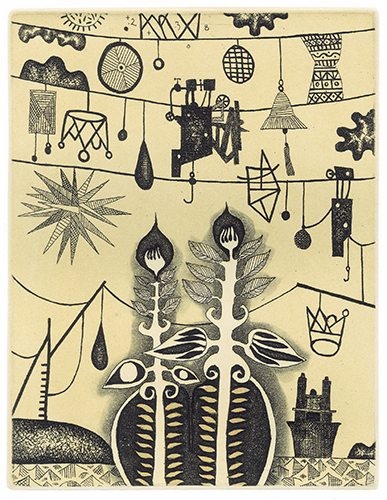
notes-on-the-raising-of-the-bones-of-pablo-neruda-at-isla-negra-gregory-obrien-and-john-reynolds-etching-2014

NOTES ON THE RAISING OF THE BONES OF PABLO NERUDA AT ISLA NEGRA by John Reynolds & Gregory O’Brien, etching, 2014

You have collaborated with a number of other artists and writers. What have been the joys and pitfalls of collaboration?

There are no pitfalls, as far as I can see. Somehow, I’ve found my way into a few collaborative circumstances and very much enjoyed the results. In the past year I’ve made etchings with my two painter-friends John Reynolds and John Pule. Like Charles Baudelaire and Frank O’Hara before me, I seem to have been lucky enough to fall in with a good crowd of painters (and also photographers—but that’s another story).


sailing-to-raoul-gregory-o_brien-and-john-pule-etching-aquatint-with-colour-roll-2011

SAILING TO RAOUL by John Pule & Gregory O’Brien, etching, 2012 (John titled this work, riffing off Yeats’s ‘Sailing to Byzantium’)


The constant mantra to be a better writer is to write, write, write and read read read. You also need to live! What activities enrich your writing life?

Certainly my recent travels around the Pacific have been hugely enriching. I’m not a proper swimmer, but since I was a child I have had a great passion for floating in, or being upon salt water. (My book News of the Swimmer Reaches Shore grew out of that propensity.) The everydayness of existence is the most enriching thing—as the poems of Horace and Neruda and Wedde keep reminding me. What a great and pleasant swarm of information and sensation we find ourselves amidst, every day of our lives.


Finally if you were to be trapped for hours (in a waiting room, on a mountain, inside on a rainy day) what poetry book would you read?

I keep coming back to the Collected Poems of James K. Baxter. Not because it’s the best book ever written but because of the simple fact that it occupies a huge and resonant place in my life.


Auckland University Press page

New Zealand Book  Council page

Arts Foundation page

The Kermadecs page

National Radio page (discussing poetry highlights of 2014 with Kim Hill)


Gregory O’Brien: Geography and the Imagination: A conversation between two poets and two geographers

Calling all Wellington friends! Greg O’Brien is hosting a seminar next week entitled:

Geography and the Imagination: A conversation between two poets and two geographers

Date: Friday 20 March 2015
Time: 11.00am to 12.15pm
Venue: Stout Seminar Room, 12 Waiteata Road, Kelburn

All Welcome!

Just fabulous! Gregory O’Brien on Peter Olds and Geoff Cochrane with Kim Hill

Poetry with Gregory O’Brien: Peter Olds and Geoff Cochrane

Originally aired on Saturday Morning, Saturday 7 March 2015

Painter, poet, curator and writer Gregory O’Brien discusses You Fit the Description: the Poetry of Peter Olds and a new collection by Geoff Cochrane, Wonky Optics.

Listen here

Gregory O’Brien on poetry in 2014 with Kim Hill — looks unmissable with such a tremendous list of books to discuss

11:35 Poetry 2014 with Gregory O’Brien

Gregory O’Brien is a painter, poet, curator and writer, and his exhibition of paintings, Whale Years, is showing at Tauranga Art Gallery to 8 February 2015. He will discuss New Zealand poetry in 2014, with reference to the following books:

Young Country by Karry Hines (AUP, ISBN: 978-1-86940-823-7); The Night We Ate the Baby by Tim Upperton (HauNui Press, ISBN: 978-0-473-28839-6); You Fit the Descripton: the Selected Poems of Peter Olds (Cold Hub Press, ISBN: 978-0-473-29803-6); Sweeping the Courtyard: the Selected Poems of Michael Harlow (Cold Hub Press, ISBN: 978-0-473-27420-7); Si No Te Hubieras Ido / If Only You Hadn’t Gone, by Rogelio Geudea, translated by Roger Hickin (Cold Hub Press, ISBN 978-473-28658-3); Otari by Louise Wrightson (Otari Press, ISBN: 978-0-473-28879-2); Halcyon Ghosts by Sam Sampson (AUP, ISBN: 978-1-869-40816-9); Autobiog of A Marguerite by Zarah Butcher-McGunnigle (Hue & Cry Press, ISBN: 978-0-473-28412-1); Tree Space by Maria Macmillan (VUP, ISBN: 978-0-86473-928-5); Gathering Evidence by Caoilinn Hughes (VUP, ISBN: 978-0-86473-926-1); Horse with Hat by Marty Smith (VUP, ISBN: 978-0-86473-927-8) Sleeping on Horseback by Frances Samuel (VUP, ISBN: 978-0-864-73972-8); The Art of Excavation by Leilani Tamu (Anahera Press, ISBN: 978-0-473-29004-7); How Does it Hurt? by Stephanie de Montalk (VUP, ISBN: 978-0-864-73969-8 Dirty Politics by Nicky Hager (Craig Potton Press, ISBN: 978-1-927-21336-0).

December On the Shelf: Poetry Picks by Kerry Hines, Richard Langston, Gregory O’Brien

Kerry Hines:

The collection I’ve read most recently is Tom Pow’s A Wild Adventure (Polygon, 2014), a ‘speculative verse biography’ of Thomas Watling, who was transported to New South Wales for forgery in 1791 and put to work painting its natural environment and indigenous inhabitants. The poems weave together elements of imagined material, the official record, Watling’s letters and paintings, and some of Pow’s experiences from his research.

The book I’m about to read next will actually be a re-reading of Kate McLoughlin’s Plums (Flipped Eye Publishing, 2011), which offers 58 ‘variations’ on William Carlos Williams’ “This Is Just To Say”. The variations reply and respond to the poem, sometimes incorporating words from it and sometimes not, drawing additionally on Pablo Picasso’s Las Meninas (a series of 58 works made in response to Velázquez’s painting of the same title). It’s witty and acute, and on first reading, I found myself thinking of how an incident might trigger simultaneous and contradictory impulses and responses, and how themes, questions and provocations can recur in (or haunt) a relationship over time (including a writer’s relationship with someone else’s work).

Kerry Hines’s first collection, Young Country – poems, with photographs by William Williams – has just been published by Auckland University Press. Her website is http://kerryhines.net.


Richard Langston:

I’m reading new stuff – Gerald Stern’s In Beauty Bright and Frederick Seidel’s Nice Weather – but I constantly return to favourites including these three

The Faber Book of Twentieth-Century Scottish Poetry edited by Douglas Dunn

Growing up in Dunedin probably gave me something of an affinity for the Scots. Burns wasn’t the first Scottish poet I read, Douglas Dunn was – his precise and remembered poems about the early death of his wife, Elegies (Faber, 1985). But I was delighted to find this anthology in an Auckland second-hand bookstore as it contains the work of a poet whose work is hard to find in print, George Mackay Brown. He lived on Orkney and was soaked in its history and salt-spray. He writes about island life, its closeness, and the smell and rhythms of the sea – something a New Zealander would naturally respond to. His poems are thrifty and intense – in the 25 lines of my favourite, ‘Hamnavoe Market,’ he evokes the lives of five idlers, Folster, Johnston, Grieve, Heddle, Garson and Flett, and ends with typical pungency: ‘They drove home from the market under the stars/Except for Johnston/Who lay in a ditch, his mouth full of dying fires’. Brown was himself partial to a drink. There are ten of his poems in this book which runs from the 19th century to the present-day, and includes the work of Don Paterson, Kathleen Jamie, Carol Anne Duffy, John Burnside, and Ivor Cutler. There’s unexpected treats: Elma Mitchell’s deadpan riposte to male assumption, ‘Thoughts after Ruskin’, and one of the few poems that’s made me roar with laughter, Alastair Reid’s skewering of Scottish pessimism called aptly enough, ‘Scotland’. Anyone who’s endured the wild fluctuations of Dunedin’s character-forming weather couldn’t but love it.


Emergency Kit – Poems for Strange Times Edited by Jo Shapcott and Matthew Sweeney, Faber and Faber

This is a terrific collection – I’ve been travelling with it on and off for ten years or so, and I keep making discoveries (it is also the place where I first read Brown’s ‘Hamnavoe Market’ –it’s the first poem in the book). It contains many of the big names of 20th Century western poetry with the emphasis on poems the editors say ‘can crack the world open and put it together in new and convincing ways’. It delivers.


Poems New and Collected  Wistawa Szymborska, Harvest

This Polish poet won the Nobel Prize in 1996. There is seriousness but there’s also levity. You can tell she enjoyed being alive and grappling with the mysteries. She says life constantly astonished her. Even when she writes about dark things such as in ‘The Suicide’s Room’ she has a surprising lightness of touch. She pokes fun at herself – she writes a poem in praise of her sister who doesn’t bother writing poems. We can only be grateful Szymborska did – I’m not sure if there’s a poem that states the case against war more simply, plainly and effectively than ‘The End and the Beginning’. It’s a poem of exasperation at human cruelty and indifference, but the images and language beguile as the much as the subject appalls.

Richard Langston is a poet and freelance journalist who has worked in television, radio and print media.


Gregory O’Brien:

Writing poems about history is like placing a dehumidifier out in the open air, maybe beside a harbour or stretch of coastline, and watching it fill up; then seeing, afterwards, how much of the harbour or ocean is left and trying to believe that you’ve captured something, anything at all. But you go home with your container of water and you feel the weight of it, and get to know it, and maybe you make something of it.

A recent book which samples layers of human history and makes much of them is Voyage Around a River; The Hokianga by the late Peter Shadbolt (brother of novelist Maurice), which is being launched this week by Steele Roberts. I had something to do with the evolution of this book as Peter was one of my writing students at Victoria University back in the 1990s. His book-length ‘documentary poem’ dates from that time. It is a compendious work of verbal bricolage—alert to the nuances and deep character of Rawene and environs–to which his widow Mary and publisher Roger Steele have added a layer of Hokianga-related visual materials. Historical photographs, watercolours and documents, gathered in the Turnbull Library and elsewhere, offer a further unpacking of, and elaboration upon, the themes and mood of the poem.

Another book marrying poetry and visual material is Kerry Hines’s Young Country (AUP). As elegant as a kauri cabinet filled with immaculate silver gelatin prints, Hines’s poetry is accompanied here by a suite of over 70 historical photographs by William Williams (1858-1949). Young Country is not only an overdue recovery of a lost Old Master of New Zealand photography, it is also an example of creative history-writing at its most evocative, distilled and plaintive—and offers a prismatic account of a nascent population growing into its relationship with the ‘new place’:

He stood on the step, admiring next door’s cabbages.

The life in the soil, he thought, proud of it.

In Cilla McQueen’s mad-excellent collection of eight small volumes of prose-poetry, Edwin’s Egg (Otago University Press), her words, like a sky filled with rapturous birds, gather around gloriously anarchic sets of photos. As exquisite as it is unhinged, Edwin’s Egg is the perfect antidote to systematic archival digging. It is a heady, endlessly evasive zone to get lost in–a rest area for the rational mind and a Mallarme-esque trip into the unknown familiar, the familiar unknown.

Among other recent poetry/visual art outings are Sam Sampson’s high-octane  Halcyon Ghosts (AUP), with its arrangements of words mimicking the arrangement of birds in the sky (or the other way around); Elizabeth Smither’s collection Ruby Duby Du (from the truly remarkable and noteworthy Cold Hub Press) with wafting, waterish illustrations by the indispensable Kathryn Madill. Finally, Andrew Johnston and artist Sarah Maxey have brought out a second edition of their small-press collaboration, a seasonal song-book, of sorts, for eye and ear: Do You Read Me?

 Gregory O’Brien has a new collection of poems due to be published by Auckland University Press in March, 2015. The Tauranga Art Gallery is currently showing Whale Years: Paintings by Gregory O’Brien (17 October – 8 February 2015).


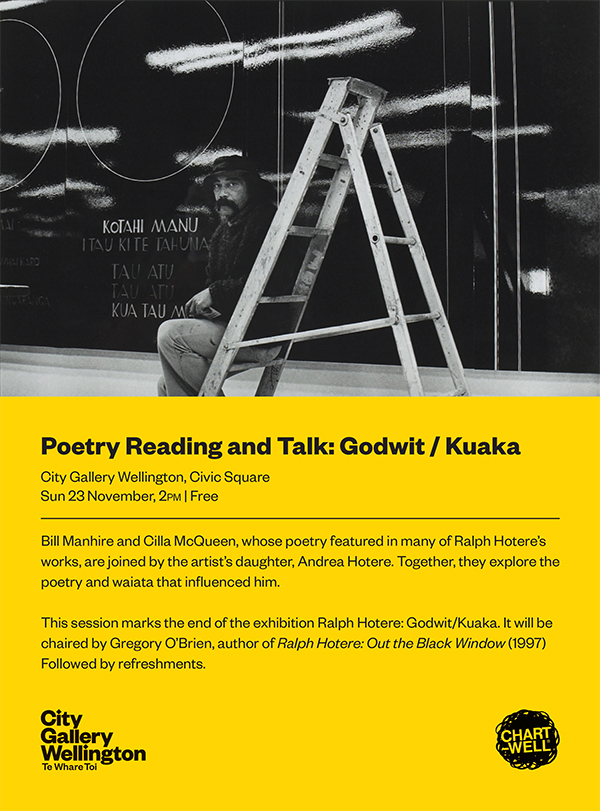
Poetry Reading and talk with Gregory O’Brien, Bill Manhire, Andrea Hotere and Cilla McQueen at City Gallery: Celebration of Ralph Hotere

1114-Poetry Godwit Kuaka-Flyer