Tag Archives: David Eggleton

Poetry Shelf Protest series: ‘Reading Poetry to Rare Lizards’ – Poetry in Defence of the Environment

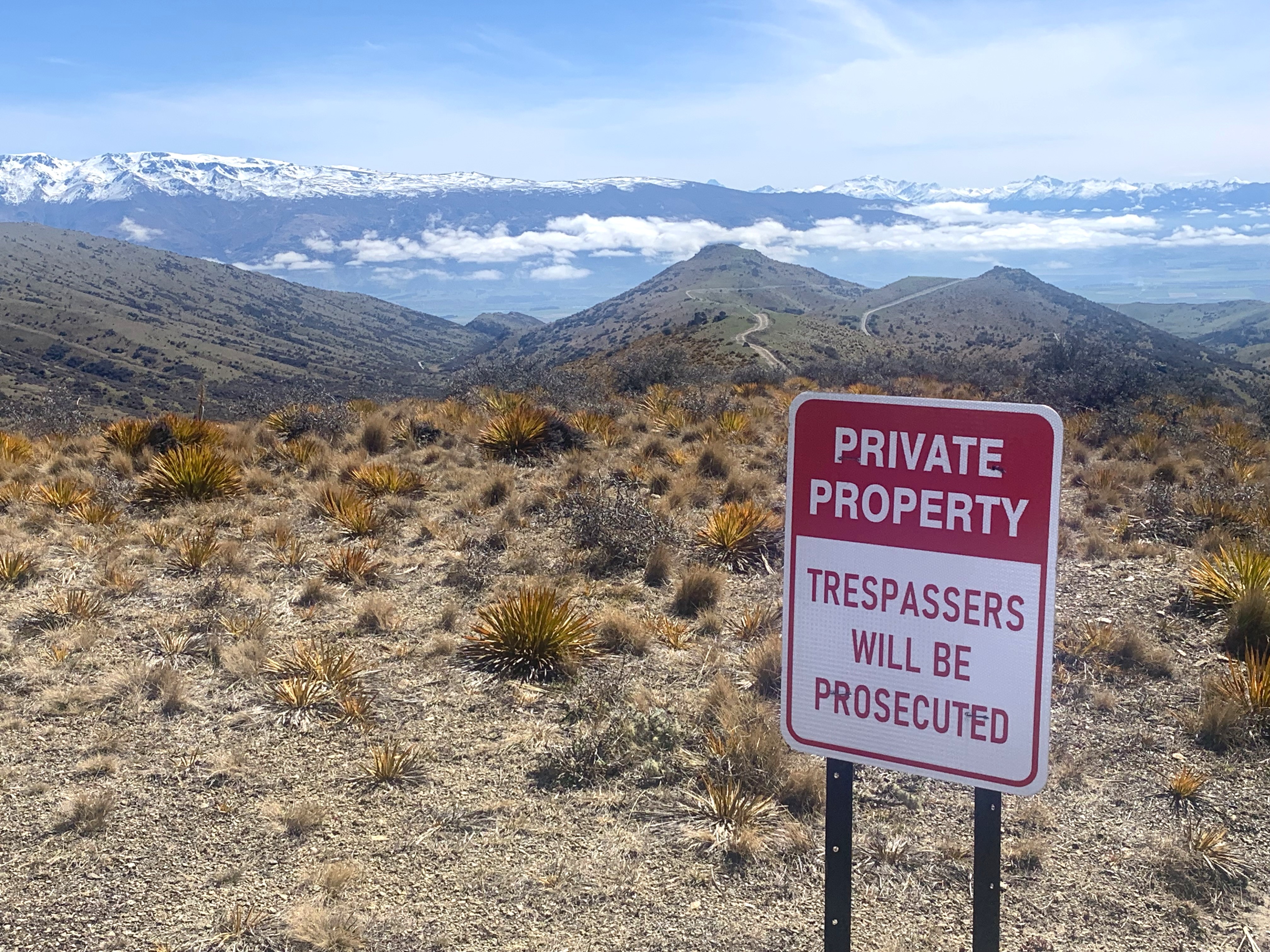
Summit, Thomson Gorge Road (looking towards Mount Aspiring).
Photo: Gregory O’Brien, October 2025

Backcountry

Now and ever
the mountain river.

A fantail flits.
Moss over branch,
the trees hurry.

Undying stone
continues the rhyme:
there is no time.


Richard Reeve
from Generation Kitchen (Otago University Press, 2015)

At the end of September, Gregory O’Brien sent me the media release for an online fundraising art show he was curating.

Nine well-established New Zealand artists have gifted works to raise funds in opposition to the proposed Bendigo-Ophir gold mine in Central Otago. The artists – all strongly opposed to the open pit mine – have come together under the banner “No-Go-Bendigo”, and are offering 100% of the funds raised towards fighting the fast tracked mine. All have been deeply affected by the majesty and singular character of the region—as the statements on the exhibition website underline. They all wanted to make a strong stand.
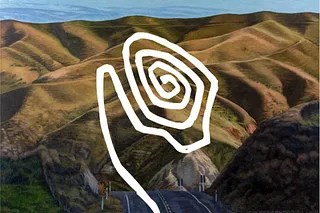
Dick Frizzell, Enough Gold Already, 2025,
limited edition of 12 screenprints, 610 x 860mm,

The artists who have contributed are Bruce Foster, Dick Frizzell, Elizabeth Thomson, Eric Schusser, Euan Macleod, Grahame Sydney, Gregory O’Brien, Jenna Packer and Nigel Brown. The works they have gifted for sale can be seen here

Exhibition organiser Gregory O’Brien, said that the group of artists from all over the country was highly motivated to help. “The proposed desecration of a heritage area for purely monetary gain is an outrage to all of us, as it is to the citizens of Central Otago and to all New Zealanders.” He said that the initial group of nine artists have already heard from other artists enthusiastic to help “during the next round”. “Painters, photographers, writers, film-makers, choreographers and other arts practitioners from within Central Otago and further afield are incensed at the churlishness of both the mining consortium and the Government’s ruinous ‘Fast Track’ (aka ‘Highway to Hell’) legislation. The environmental cost of such a cold-blooded, extractive exercise is simply too high, as is the social impact and down-stream legacy.”

When Gregory said that this was just the beginning, at the end of the exhibition media release, I knew Poetry Shelf had to become involved. My new Poetry Protest series was the perfect opportunity – knowing that poetry speaks out and for and because of issues in myriad ways. Gregory, Richard Reeve and I invited a number of poets based in the area (and beyond) to contribute a poem. Jenny Powell’s poem catches sight of the Dunstan Range, David Kārena-Holmes has penned an aching lament, Emma Neale writes of her local blue swallows that can also be found near Benigo. And then there are poets with miners in the family history such as Jeffrey Paparoa Holman and Diane Brown. Twenty three poets have gathered on this occasion but there are so many poets in Aotearoa singing out in defence of the land. Some poets chose poems from collections, while others wrote poems on the spot, often out of anger and frustration.

Richard Reeve, who is organising an anti-mining poetry reading in Alexandra in November (see poster), has written an introduction for the post. He sent me a suite of poems, both new and old, that touch multiple cords of beauty and outrage. I have included an older poem to head the post, and a longer new poem after his introduction. I have also included an extract from a recent media release by Sam Neill.

An enormous thank you to Gregory and Richard for co-curating this post, to all the poets who contributed, and to everyone who continues to read and write poetry. Today is a day of significant strikes by nurses, doctors and teachers in Aotearoa, a day with a major weather event still unfolding and widespread power outages, and the continuing heartslamming news from overseas.

To be able to connect with readers and writers who care, matters so very much, as I sit here weeping with a strange mix of sadness and gladness, beauty and outrage.

Thank you.
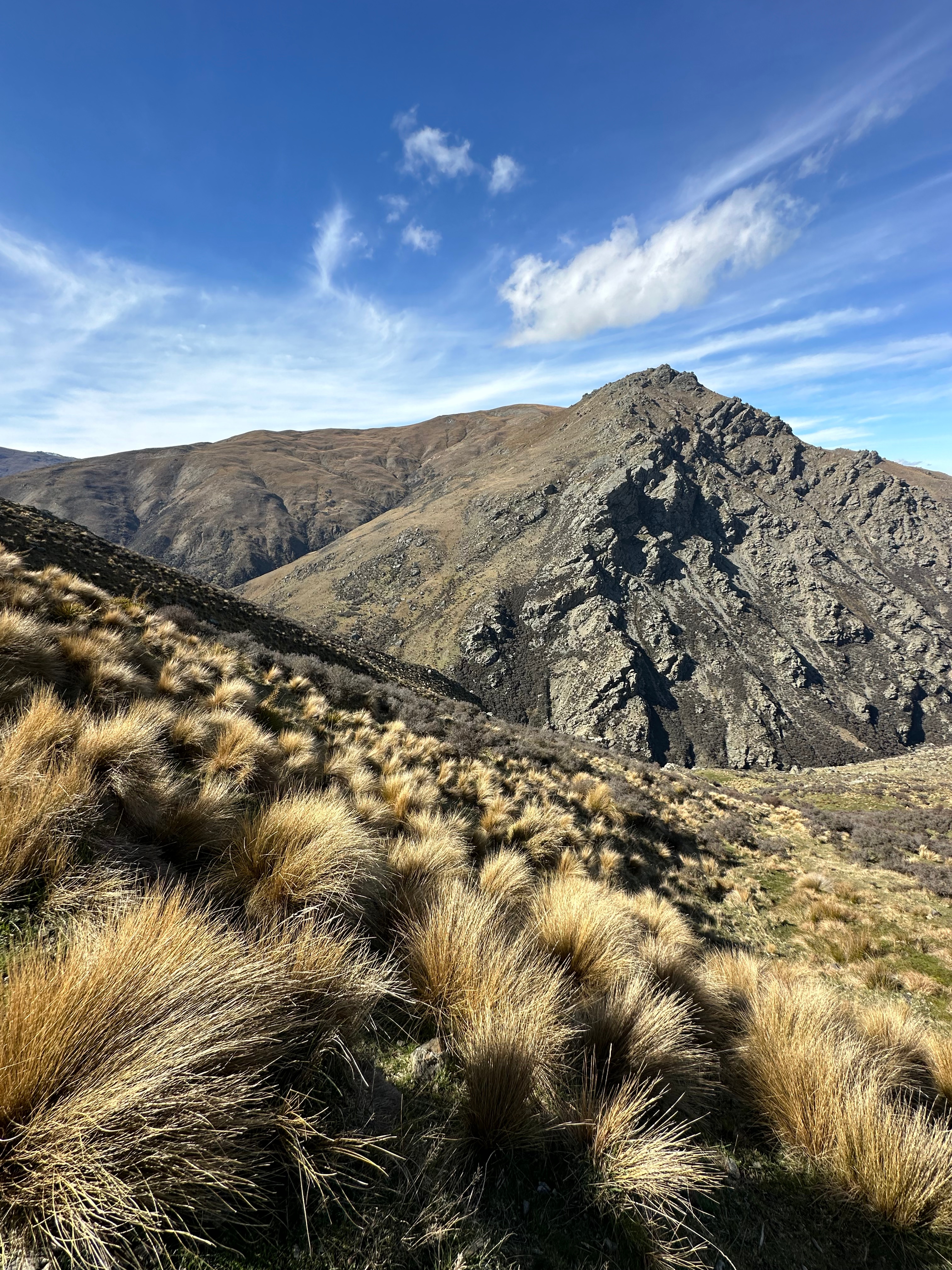
Thomson Gorge Road
Photo: Richard Harvey, October 2025
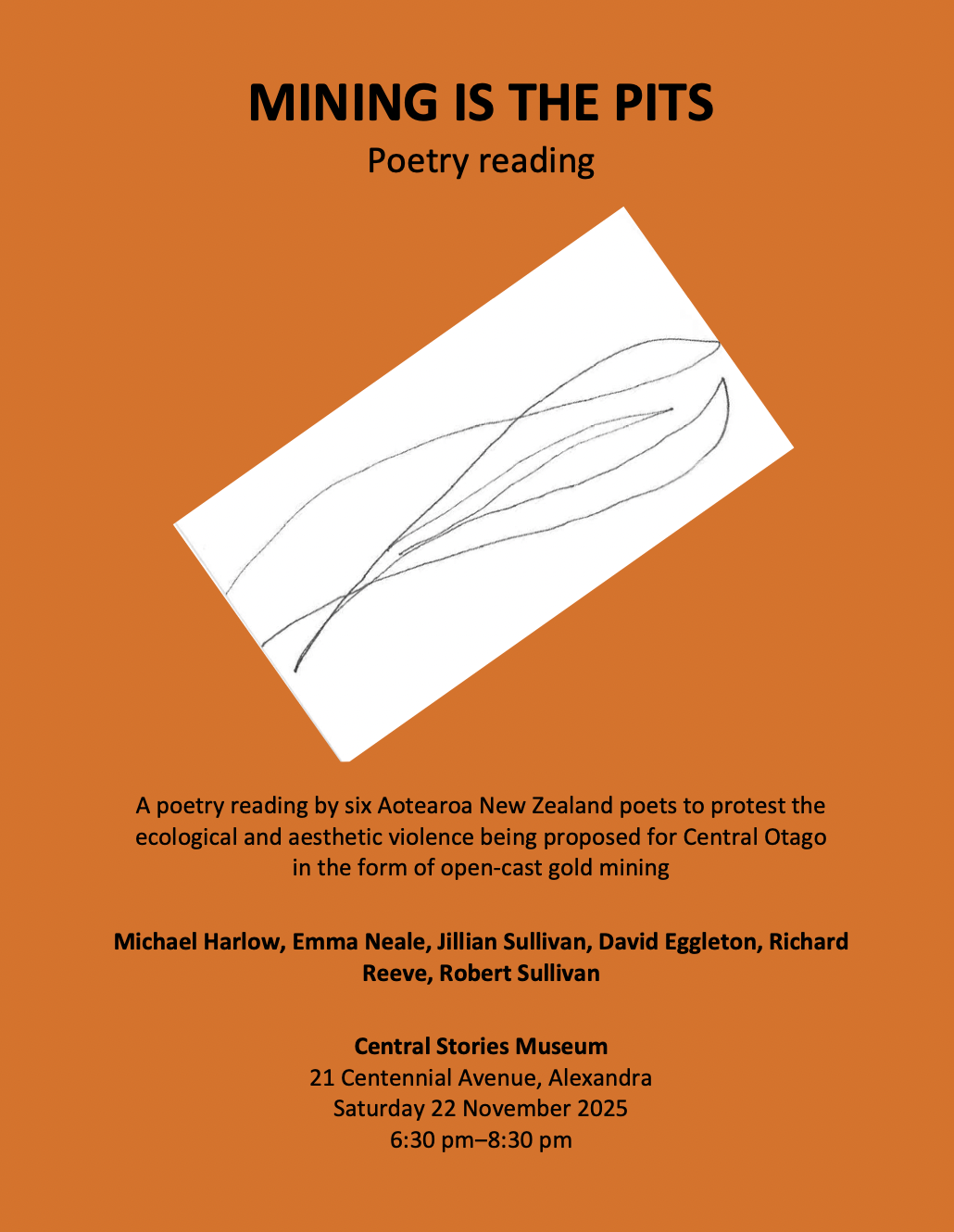
For Freddy – Ora pro nobis

A little while ago now, Lord Byron in his book-length poem The Prophecy of Dante mused, “Many are poets who have never penned / Their inspiration, and perchance the best”. By this he meant that even non-literary types can have poetic experiences. That of course begs the question, What do we mean when we talk about poetry? Is poetry, as some sceptics would suggest, purely prose with line-breaks, or does the concept embrace something more than words on a page to encompass the wider spectrum of lived experience?

Thomson Gorge Road in Central Otago is a place many would say has its own poetry, whether the subject of poems or not. A backcountry dirt road stretching from Matakanui near Omakau in the east to Bendigo near Tarras in the west, it cuts through a pass in the Dunstan Mountains that divides the Manuherikia Valley from the Upper Clutha Basin. Thomson Gorge Road is hawk country. Tussock country. The road is notorious for the sheer number of gates one has to open when using it as an alternative to the highway that skirts the base of the mountain range south to Alexandra and the Cromwell Gorge. The gates, livestock, steep winding track, stream crossings and mud mean Thomson Gorge Road is certainly not the fastest route from Omakau to Wanaka, even though more direct than the highway. Nevertheless, people travel it regularly enough.

Indeed, those who travel the road are off on an adventure. Punctuated with heritage sites associated with the colonial period (mine-shafts, abandoned huts, battery sites and so on), and before that significant to Southern Māori travelling the pounamu routes west to east, the passage exemplifies the interconnected complex of geophysical frontiers, native-vegetation-clad landforms and cultural touchstones that makes Central Otago uniquely important in our national psyche. The scenery is magnificent, encompassing in the course of the journey expansive views of two of the three great basins of Central Otago. Just as with the Hawkdun Mountains to the north or the Clutha-Mata-au River and Old Man Range to the south, Thomson Gorge Road is an essential component of wild Central Otago’s fabric, part of our collective heritage as a nation.

Despite this, flagged on by Minister of Resources Shane Jones and his “fast-track” legislative reforms, an Australian gold mining company – Santana Minerals – is now seeking permission to establish a giant open-cast gold mine not far from the crest of Thomsons Saddle, in an area situated within an officially designated Outstanding Natural Landscape and already subject to a conservation covenant. If consented, the base of the mine where huge volumes of tailings and toxic waste are to be stored will be only 6-7 kilometres from the Clutha-Mata-au River. In light of Minister Jones’ fast-track legislation, the general public have no right of input on the outcome of the proposal even though the open-cast mine is widely regarded as offensive, a public health risk and indeed a brutal and crass affront to the values of the region.

Those protesting the mine include not only poets and artists but also people who have no great interest per se in the literary arts or perhaps even the fine arts. Some have limited exposure to literature. Others likely know very little at all about Byron or indeed Cilla McQueen, Jillian Sullivan, Liz Breslin, Michael Harlow and others who have contributed poems to this edition of Poetry Shelf. Like the poets, they nevertheless understand intuitively and deeply that no amount of trumpeting by Santana or Minister Jones of the alleged financial value of the gold deposit will annul the violence being proposed to the fine poem – or fine wine, or fine painting, or good day on a bike – that is wild Central.

In this issue, Gregory O’Brien uses as an epigraph to his contribution, ‘Thomson Gorge Road Song’, Minister Jones’ now infamous comments to the effect that the days of deifying New Zealand wilderness are over:

We are not going to sit around and read poetry to rare lizards, whilst our current account deficit goes down the gurgler … If there is a mining opportunity and it’s impeded by a blind frog, goodbye Freddy.

Au contraire, Minister. In this issue we proudly dedicate poems to skinks, hawks, backcountry streams, tussocks, snow melt. We wilfully and without reservation pledge our heart and soul to Freddy. For, as Annabel Wilson asks in her poem ‘Gorge’, What would the real Santana – St Anna, mother of Mary – say? “Sancta Ana, ora pro nobis.” Pray for us, St Anna. God help us if we cannot as a people do better than this.

Richard Reeve – 20.10.25

Clutha Gold

People! Keep an eye on the prize before you. Emerging nugget,
the stuff “Black Peter” knew about, Bombay gentleman

who struck gold in 1857 at Tuapeka, scooping glinting gravel
from the riverbed with his cup years before Gabriel Read

saw flecks “shining like the stars in Orion on a frosty night”,
gold confirmed in Otago, a decade after New South Wales,

the glory – not to say reward – bestowed on the well-dressed candidate
(not the half-caste from Bombay whose honesty gave rise to no reward).

People! Keep an eye on the prize. Yes. The cycle trail we journey
in a meditative state, pausing to assess, for instance,

the scarification of the land above Beaumont Gorge,
native scrub scraped off just wherever possible given the steepness,

elsewhere, feral trees spilling out of the radiata along the tops,
sprouting under cliffs that once were waymarks to Māori

travelling up river from the coast along mahika kai routes.
If we are honest with ourselves, it is carnage. Chaos, plunder:

we ogle the fate of our kind who would move mountains
not far from here, nevermind scrub, in pursuit of the shiny stuff,

at so-called “Bendigo” in the Dunstan Mountains, Kura-matakitaki,
where men and women with geology degrees feverishly

calculate potential returns from the sparkling core samples
extracted under permit from the mountainback,

their CEO crowing future profits in the billions, regional growth,
speculation to accelerate the pulse of offshore investors.

Without cash, their fabled open-cast mine may not proceed.
Or it may. Certainly, the carnage we see from the riverbank

tells a story the trail people wouldn’t want us to focus on,
namely, the irrepressibility of our activity, humans in time

destined to be extracted from the view just like the mountains,
the land sliced up by farming, forestry, mining, infrastructure,

enterprise that in the end failed to save us from ourselves.
Those, at least, are the signs. What happens remains to be seen,

and we are getting ahead of ourselves. The end isn’t quite yet.
There is still sunlight and shadow, glitter of today’s fine day.

The prize is this deep blue vein of the motu, Clutha, Mata-au,
river that gave a pseudonym to Janet, a colour to Marilynn,

incrementally digging out its passage through culture,
resolving its way to the sea. We cycle from name to name,

past livestock, old gardens unravelling with age like memories,
derelict barns at the edge of paddocks, willow clusters;

the prize presumably is us, steering our contraptions
along the edge of a signature, at Beaumont saying goodbye

to the river, the trail now mostly following the highway,
gold country but no longer river country, dead Black Peter

ghosting the great disenfranchisements evident from the trail
as we ride through a converted landscape, sheep country

at Bowler’s Creek, pine plantations on the hills above Lawrence,
wholly transformed land, just riparian planting in the valleys

to give any indication of a time before now. The age of birds,
rivers, podocarps, sunlight, snow-melt, flax. Winking boulders

in which the ore retained its secret, faithful to the long moment
before our century of hard-hatted Ministers of Resources

tapping rocks and denouncing the catastrophe of the economy
(no mention of the slow-motion catastrophe of the land,

what is obvious all around us yet routinely overlooked
by those in rapid transit from name to name, place to place).

People! Anyway. Yes. Keep an eye on the prize before you,
we get that. And riding into Lawrence is certainly gold,

the sun setting on our handlebars, sheep laughing as we pass,
the fields outside town home to sun-drunk ducks, goats, horses,

good sorts in the only environment they have ever known,
lifestyle blocks, drained, fenced paddocks, previously bog

that before the man-driven fire was once primaeval forest.
Hard to believe, the gaudy general store on the main drag

now also extinct; also extinct the ironmongers, breweries, lions
that roamed the township, in its origins displaced by mining creep

to the present location. Not yet extinct the beauty of the town.
Rusted colonial rooftops pepper the view, seasoned by exotic trees.

Truth is, nature was always ahead of us. To the bitter end.
Whatever control any of us dreamed we had was an illusion.

Night colonises the shadows. Worn out, we pull up at the car.
We are the gift that keeps on giving, despite the prognosis.

Clutha Gold was awesome, we say. At the Night ‘n Day, we gorge.
And it is a fact, we are happy. Good work people! Keep it up!

Richard Reeve

TOXIC

It’s unbelievable, really. Unbelievable. Why would you visit this kind of environmental catastrophe onto a region that is thriving, that is in the midst of what many of us think of as a renaissance? The future of Central Otago lies in its bike trails, vineyards, cafes, in good farming practice, and a diverse and growing population of people, young and old, who genuinely care about the future of where we live.

All aspects of life in the province will be permanently affected by the toxic presence of a mine at Thomson Gorge. The initial mining proposal (and it will only get bigger, you can be sure of that) includes four mining pits, one of which will be a kilometre long and two or three hundred metres deep. All fouling our water, risking arsenic and cyanide pollution among other poisons. Don’t even mention the mad noise, the carbon, the ruin of our rivers, land and air pollution, the road traffic, the dust… the incalculable environmental cost.

Of one thing you can be certain: If the Thomson Gorge Mine goes ahead, there will be further mining proposals to follow. Watch out, Bannockburn. Watch out, Central. Remember this – ‘fast track’ can mean hasty and fatal mistakes.

Coming in here with their bogus claims, their invented figures (’95 per cent of the locals support the mine’– come off it!), these people should be ashamed. Those of us who love Central Otago are going to fight this. Because, make no mistake, this mine would be the ruin of our region, and importantly its future.

Sam Neill – 22nd October 2025
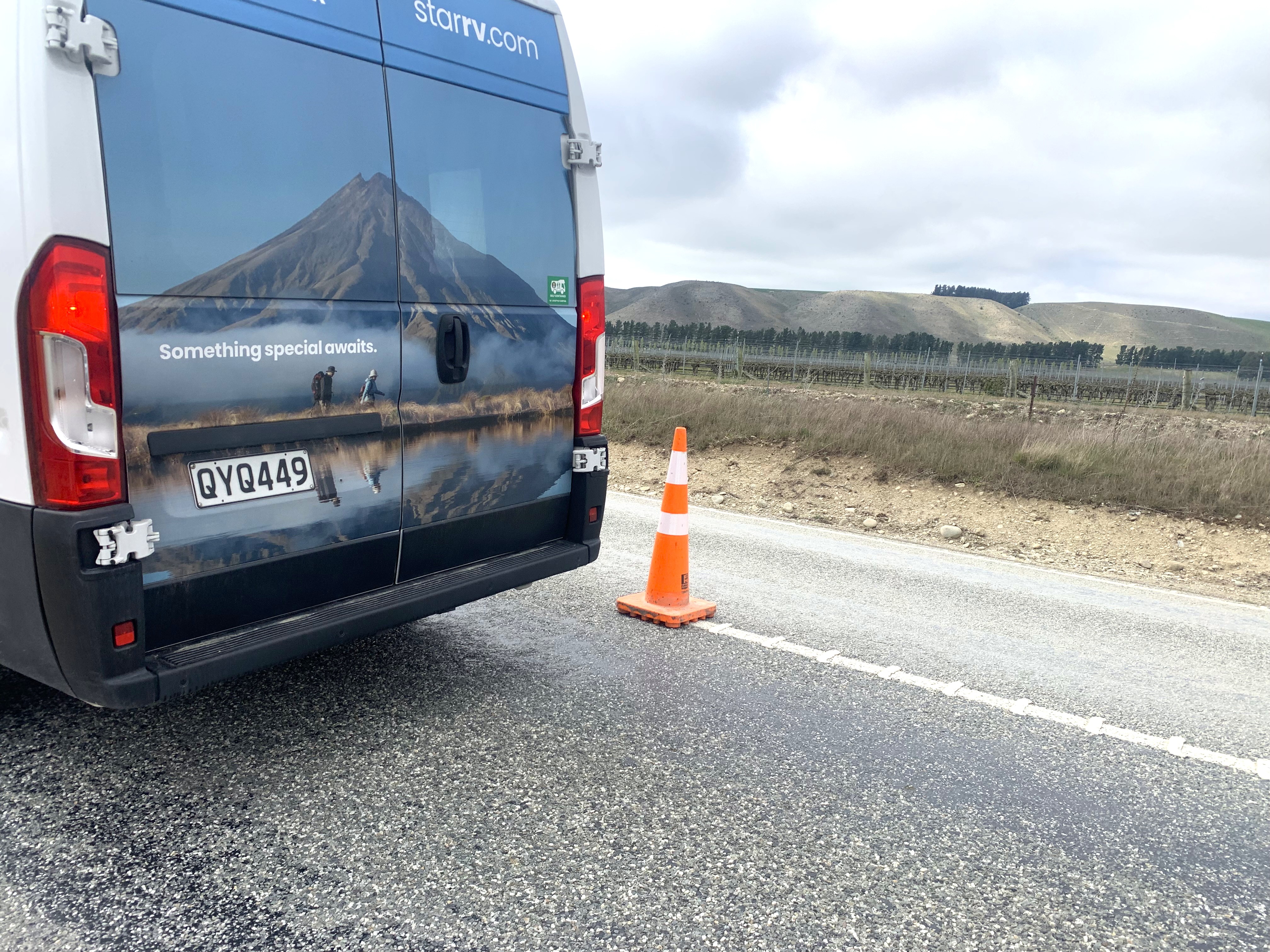
Near turn-off to Thomson Gorge Road, Tarras
Photo: Gregory O’Brien, October 2025

Reading Poetry to Rare Lizards

SONG FOR THE TUSSOCK RANGE
           ‘I will up my eyes unto the hills …’
                                                 – Psalm 121

Deep Stream, Lee Stream, Taieri River
   and their tributary waters –
   all your lovely water-daughters,
   Lammerlaw and Lammermoor –
   dear to me and ever dearer,
   Lammerlaw and Lammermoor!

Deep Stream. Lee Stream, Taieri river –
   where I wandered in my childhood
   with a fishing bag and flyrod –
   Lammerlaw and Lammermoor,
   dear to me and ever dearer,
   Lammerlaw and Lammermoor!

Deep Stream, Lee Stream, Taieri River –
   let no profiteers deface these
   windswept, wild, beloved places –
   Lammerlaw and Lammermoor,
   dear to me and ever dearer,
   Lammerlaw and Lammermoor!

David Kārena-Holmes

AT WEST ARM, LAKE MANAPOURI

Tourists on tourist buses enter
‘The Earth’s Arsehole’* (blasted, grouted,
|as though the Earth itself were buggered)
to view the powerhouse in the bowels,
where all the weight of thunderous water
that once was the glorious Waiau river,
flowing freely South to the sea,
is prisoned now in pipes and turbines
 to serve the mercilessness of man.

And so, it seems, the mythic grief
of Moturau and Koronae
(whose tears, in legend, filled this lake)
is vented in a cry transformed,
exhaled as an electric current
from generators underground,
to howl through cables strung on pylons,
gallows-grim, from here to Bluff.

Are we who turn on lights at evening,
or use the smelted aluminium,
exploiters of anguish, buggerers of the Earth?

David Kārena-Holmes
*The site of this power project was, in the construction period, known to the workers (as is, no doubt, commonly the case in such environments) as ‘The arsehole of the Earth’.   Most, or all, of the the power has gone to supply an aluminium smelter at Bluff.

Swoon

Skylark ripples the edge of silence,
icy hollows mirror its hover,
lines of dry grass quiver.

Winter’s travelling light transforms
the field of shaded frost
to shallow melt, and then, again.

Mountains drift into distance,
curve in whiteness. On either side,
hills and sky swoon at vision’s end.

Jenny Powell

Leave the arthropod alone

I saw a centipede in the crack of a rock
flipped the grey shape to view the earth underneath, watched
tiny legs scurry to safety, skittering from my unwanted gaze

I found a story in the hem of my coat
picked it apart, ripping the seam stitch by stitch
till the torn fabric, this undoing, was all I could see

I peered through a telescope at the southern sky’s gems
winced at the big-man voice next to me, joking about ladies who covet
– if only we could own them, if a man would get them for us, we’d be happy

I light the quiet fire of this poem: a resilient critter, a seam
that holds, the sparkling truth lightyears from man’s reach – these things
shining in the untouched crux

Michelle Elvy

A Faustian Bargain

Can I speak as a descendent
of Cornish tin miners?
Hunger led them to flee
to Australia and Kawau Island,
where they survived and profited
in minor ways, digging up gold and copper.
None owned a mine, some died
of the dust, and in 1867
my great-great grandfather
died in a mine collapse
in Bendigo, Victoria
leaving a widow, and nine children,
one unborn. Is the tiny opal
in my wedding ring
handed down from him?

Can I speak, knowing nothing
of this heritage before I shifted south
and my husband took me
to the old schoolhouse site
in Bendigo, Central
where we camped on the hard dryland.
Born in Tamaki Makaurau,
in view of the Waitemata
I took time to love this new land,
the forbidding mountains, cold lakes
and rivers, shimmering tussocks,
and now vineyards and tourists
annoying as they may be
bringing a more benign form of riches.

Can I speak, knowing my ancestors
left their toxic tailings,
their dams of arsenic and lead
still poisoning the water
150 years later?
Too late for apologies or compensation,
the best I can do is speak up,
say, beware these salesmen
with their promises of jobs,
and millions to be made.
Once the land is raped,
its gold stored safely in a vault
for nothing more than speculation,  
the money men will walk away
leaving land that feeds no one,

water that will slake no thirst.

Diane Brown

An Anti-Ode to Mining in Central Otago

There’s Lord Open Cast, pompous in yellow smog.
Corporate blokes raise another hair of the dog,
and pump more pollution for the water-table.
Dirty dairying brings bloody algal bloom;
so much cow urine until nitrogen’s poison,
that the arse has dropped out of the rivers.

Yes, the day looks perfect with road tar heat;
gorsebush fires flame above the lakeside beach.
Spot mad scrambles of rabbits gone to ground,
as orchards totter and grape-vine soils erode;
while every avenue is twisting itself around,
looking for the fastest way out of town.

Roadside lupins in Ophir echo purple sunsets.
Bendigo’s carbon offerings are burnt by nightfall.
A hundred per cent pure express their distance,
when smell of decayed possum chokes the air.
Don’t let land’s dirge be your billy-can of stew,
the petrol reek of your tail-finned septic tank.

Tailings will anchor environs turned unstable.
Once hymns were sung to hum of the tuning fork,
as the ruru called out, Morepork, morepork;
now drills hit post-lapsarian pay-dirt,
just where Rūaumoko rocks an iron cradle,
and the raft of Kupe fades to a roof of stars.

They would mine hills hollow because earth shines gold.
Clouds packed in sacks, a bale-hook making way.
Hear creeks burble and croon in violin tones,
over lost honey-thunder of long-gone bees.
Join the boom and bust of prize pie in the sky;
chase lizards of rain running down bulldozed trees.

David Eggleton

The Underside

Under the house the dust is dry
as an archaeologist’s brush, stippled
by the motionless rain of those particulars
that make our bodies, my body
groping, stooped and short-sighted,
under the loom of joists and time.

In this lumber room of mothlight
and clotted webs are countless lives
burrowing down and flitting between.

There is a workbench, joyously scarred.
There are bedsprings for sleeping bones.
There are scaffolding planks, rusty bricks,
the cheek of the hill that holds us up.
There is fire and there are stars
beneath this upturned palm
on which the piles of our home tremble.

And beyond, the astringent glory
of brindled hills that calls me to dwell
on the underside: this drowning-fear
that has us scrabbling up the ladder
of never enough, forgetting the ground
it foots upon. This lapse in listening to
the depositions of the earth.

Megan Kitching

nothing to do with you

For a cup of coffee,
you would strike the heart

with an axe, mine stone
for its marrow.

Maim
what rolls on into sky. Screw

metal poles into quiet land,
warp and crush

its offer
of light and air.

*

For greed,
on whenua

nothing to do with with you,
you would trammel

quilted, southern ground, leave
a trail of stains,

thrust twisted iron
nto its soft belly.

*

Rocks the wind or sun
cannot move, sleep on.

Tussock-backed
they carry soft gold

sound
we can hear for miles.

From somewhere,
a farmer

calls his dogs. Somewhere
the blaring throats

of young bulls
we cannot see.

Under our feet the gravel
coughs. Fallen apples

form a wild carpet
below a crooked tree.

*

The mist freezes
where it wafts, solid

lace. Cold, bloodless
and beautiful. Still for days

on end, the sun a smear
across the sky’s white mouth.

Bulrushes stuck fast
in frozen ponds. 

Willows and poplars
as wan as horse-hair.

*

In summer, the grasshopper
screams. In summer

the road floats
grey. Purple lupins

and orange poppies
dribble paint.

When we stop the car
we hear overhead

a pair of paradise ducks,
their alternating cries

the unfenced sound
of a mountain tarn.

*

Seized by the sun,
valleys do not resist

the line and fall
of riverbeds and trees.

On whenua
nothing to do with you, somewhere

the sound of a tiny bird.
Somewhere, lovely light,

the sound of nothing, of no one,
of the air.

*

Kay McKenzie Cooke
This poem, ‘nothing to do with you’, differs slightly from the original published in the book Made For Weather (Otago University Press, 2007).

Burn

It’s Brian Turner rolling around in the bed 
of a dry burn. Ghost poet 
Brian Turner galloping the fence line, hunched over a hockey stick.
Brian Turner, order of merit, 
spectral at a precipice,
rubbing scree in his beard.
Brian Turner opens his mouth and out comes the roar of the sun.
The broom fries.
The hawks microwave.
Ghost poet Brian Turner teleports up and
kicks at the plateau with a heel.
To the living, the clouds are invisible.
But, squirting over stones, the skinks have
Brian Turner’s tiny eyes.
Tussock have his hands, the wind
his keys.
The hilltops had hoped to be rid of him.
And they are.

Nick Ascroft

Otago: A Ballad (golden version)

Another golden Aussie
in his big golden truck,
crossing the water
to try his golden luck.

Rips up the golden tussock.
Digs a golden hole.
Finds a lot of rock
and a bit of golden gold.

While Shane and all his buddies
stand around and cheer
in a land called Desolation.  
No vision. No idea.

But they take their golden pennies,
buy a house, a car, a yacht.
And they sail away
on a plastic sea,
to nowhere you
would want to be.

On this barren rock
they’ve scraped blood red,
trashed and burned
and left for dead. 

Leaving us nowhere to run.
Circling round and round the sun.

Ripped out our heart.
our breathing space.

This golden land
that was our place. 

Fiona Farrell

Mine
i.m. Pike River miners 19 November 2010

Son, there was a time when you were mine
Brother, when the shining day was ours
Friend, there was an hour when all went well
Darling, for a moment we were love
Father, you were always close at hand
Human, we were people of the light.

And now, the mountain says ‘he’s mine’‚
And now, the rivers say ‘he’s ours’‚
And now, the darkness says ‘my friend’‚
And now, the silence says ‘my love’‚
And now, the coal says ‘father time’‚
And now, we wait for the day to dawn.

Jeffrey Paparoa Holman
from Blood Ties, Selected Poems (Canterbury University Press, 2017)

This is something of a raw topic for me, given my background as a miner’s son, growing up in a mining town. I’ve just looked in my copy of Blood Ties, Selected Poems, from 2017, and there is a section there with twenty poems related to mining and miners, much of it related to my growing up in Blackball. There are three poems there that speak to Pike River, a sore wound at the moment, with the film’s premiere in Greymouth last night.  I have a family member who could not face going. Her father died in the Strongman Mine explosion in 1967, when nineteen miners lost their lives. JPH

The Blue Language

In our local park, five welcome-swallows
swoop and dart for midges, their red chests
swell as they sing their high, sky dialect;
the thin vowels in their lyric glint as if rung
from glass bells blown in South Pacific blue.

The quintet shifts, leans in the italics of speed:
moves now like mobile acrostics,
now a faithful, swaying congregation
every bone adoring air

until an unseasonal despotic wind
flings them out of sight  —
scatters twigs, dirt, smashed tail-light, laundry, leaves and newspapers
like those that reported how, across Greece,

thousands of migratory swallows dropped
on streets, balconies, islands and a lake,
small hearts inert
as ripped sheet music.

In our throats, the wild losses dilate,
squat like rock salt
in a browning rose

a grief clot, untranslatable.

Emma Neale

Note: There is a shadow of the phrase ‘the green language’ here; also known as la langue verte; in Jewish mysticism, Renaissance magic, and alchemy, this was a name for the language of birds; often thought to attain perfection and offer revelation. Also see ‘High winds kill thousands of migratory birds in disaster over Greece’, Guardian, April 2020.

E hoa mā, please buy No Other Place to Stand: An Anthology of Climate Change Poetry from Aotearoa New Zealand Edited by Jordan Hamel, Rebecca Hawkes, Erik Kennedy and Essa Ranapiri (Auckland University Press, 2022)

Mining Lament

I went to see the golden hill
but it had all been mined away
all that’s left is an empty bowl
of yellow gorse and rutted clay

But it had all been mined away
except a clay bluff topped with stone
in yellow gorse and rutted clay
one stubborn relic stands alone

Only a clay bluff tipped with stone
remains of the hill the painter saw
one stubborn relic stands alone
of a rounded hill of golden ore

Remains of the hill the painter saw
rutted clay and a stumbling stream
a rounded hill of golden ore
sluiced away with a sluicing gun

Rutted clay and a stumbling stream
all that’s left is an empty bowl
sluiced away with a sluicing gun
I went to see the golden hill

(after a painting by Christopher Aubrey, c. 1870 of Round Hill, Aparima, Southland)

Cilla McQueen
from The Radio Room (Otago University Press, 2010)
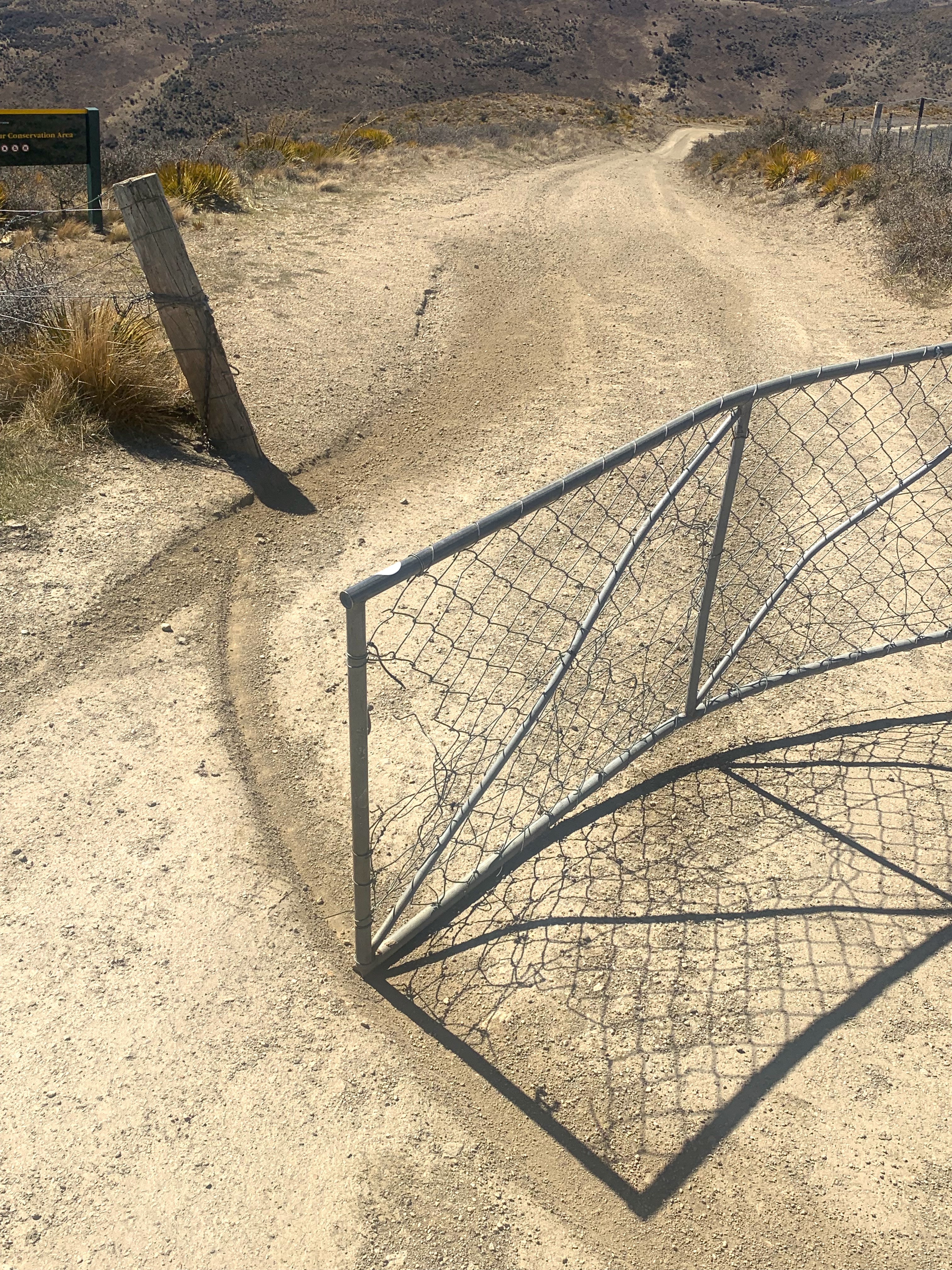
Thomson Gorge, Gregory O’Brien, Oct 2025

Old Prayer

Hawk, as you
lift and flare
above the river’s
slide, take us not
in thy talons. Take us not
from the bank
or branch or wrench us
from the earth, lifted by
calamitous wings.
Fix us not with your eye.
Take us not up
the way you raise the sparrow
and the finch. Leave us
as the covey of quail
in the willow.
Leave us be.

Jenny Bornholdt
from Lost and Somewhere Else (Victoria University Press, 2019)

Gorge


Somewhere

   in deep time, this collection of

      chemical / isotopic / insoluble

         composition signatures rises 

            and falls —

               and falls —

                  falls —

                     rises


                  No one still, silent surface

               along this space

           in this intense South,

         Gwondwana: floods, grey-washed

      avalanches, rumbling glaciers,                 slips 

hot water rushing through cracks

   engorging crystalline schist

      with veins of quartz

         layers of platy mineral grains

             { graphite, pyrite, arsenopyrite }


                Variations roaring through endless seasons

                    myriad     manifolds        must   melt

                         surfaces             scrape

                                                gales    salve

                        escarpment      creep

                  alps            keen,    pine,    take

             Glaciers loose from time 

      Ice must, is

   grey,  weathering

heat, rousing           

  Mata Au quickening

      Give, heave, cleave, groan


         water milky blue, rock particles

             scattering sunlight beginning and beginning and


Fast track to hammer / / Fast track to tamper \ \ Fast track to “explore”, drill,  dredge, bore / / Fast track to gorge gorge gorge  \ \  Fast track to contamination / / Fast track to hollowed out  \ \  Fast track to haunted  / / Fast track to dust  \ \ Fast track to coarse-veined lies / / Fast track to nowhere \ \  Fast track to what would the real Santana, St Anna, say?  / / / Sancta Ana, ora pro nobis.


Annabel Wilson


a suitable machine for the millions
for/after Hannah Hayes

forge and smithy
durability before cheapness
do the work of a dozen men

colonise
settle, spin the wheel
first cost, last cost, stop

the machine
if necessary check
up press and guard before

you start up
all cut, all shaped
all mannered the same two

tubes snug
one turns another
turns one turns a way

to make
it work invention
is the mother on two

wheels
and everything
is material or it is

immaterial
floating, dust
between us

Liz Breslin
from show you’re working out, (Dead Bird Books, 2025)

Stone

After all, stones remember
the opening and closing of oceans
the thrust of volcanoes; they remember,
in their sediments, ancient creatures and trees,
rivers, lakes and glaciations.
After all
stone is the firmness
in the world. It offers landfall,
a hand-hold, reception. It is
a founding father with a mother-tongue.
You can hear it in the gravity
of your body. You can hear it
with the bones of your body.
You can hardly hear it.
See that line of coast…
See the ranges ranging…
they seem to be
saying
after you,
after you,
after all…

Dinah Hawken
from Ocean and Stone (Victoria University Press, 2015)

Māori Point Road, Tarras

You and not I, notice the change in light at this time. On my side, it’s all busted
rough-chewed grass, stink of silage, black bulls in drenched paddocks. Rusted
mailboxes punctuate the long gravel line. Drenched sheep. We are haunted
by the chortle of a trapped magpie, the Judas bird made to betray. The black glove comes down once a day.

On your side, twilight bathes paddocks Steinlager green, all the way to those
wedding cake Buchanans, the white crown in the distance. The human need to
see shapes in things: a rock that looks like a wing. We carry on, not speaking.
We carry on not speaking. You know I want to ask you something.

Annabel Wilson

Substratum

We are so vulnerable here.
Our time on earth a time of
how to keep warm and how to be
fed and how to quell our most
anxious thoughts which come back
and back to connection.

How do we stay here on this earth
which is right below our feet?
Soil, clay, substrates of rock,
magma, lava, water, oil, gas;
the things we want to bring up and use,
the things we want to use up.

If all we ever wanted was to know
we would be warm and fed and listened to,
would we be kinder?
Would we in turn listen? Would we understand
the importance of those close to us
and the importance of what is under us?

We have the far sight. And we are what
the shamans warned against.

Jillian Sullivan
Previously published in Poems4Peace, Printable Reality

Deserts, for Instance

The loveliest places of all
are those that look as if
there’s nothing there
to those still learning to look

Brian Turner
from Just This (Victoria University Press, 2009)

Ōpawaho Heathcote River

As a child we fished and swam the Ōpawaho
Now Ōpawaho is muddy full of silt 
unswimmable unfishable for days after rain

as cars leach poisons, some factories spill metals,
subdivisions and farms without 20 metre wide riparian plantings spread, 
as shallow rooting pine forests get blown and burn
Opawaho’s waters grow thick with mud sediment and poisons

For our tamariki to swim and play safely in our river
we want 20 metre wide riparian plantings on each side of any stream or creek flowing into the awa
where the awa flows muddy we can plant raupo  

build flax weirs to stop sediment with holes to let fish through
lay oyster shells on the river floor 
Any other ideas let us know 

Ōpawaho pollution is our mamae pain
Her harikoa joy brings smiles to the faces of our people
Her rongoa healing restores our wetland home

Kathleen Gallagher

Great Men
(after Brecht)

‘Great Men say dumb things.’

   And then they do them.
When that plumped-up someone
   is trying to talk to you about themselves
and they are using ‘fat word’ you can be
   sure they are as spindle-shanked in heart
as anyone can be. ’The dumbness of their
   third-rate ideas’ not even a tattered wonder.
And you know that whenever they are
   smooth-talking about peace, they are preparing
the war-machine. Just to show you how dumb
  they really are, they keep talking to each other
about how they are going to live forever. 


Michael Harlow
from Landfall 243, 2022

Poet’s note: Bertolt Brecht was a Poet, Playwright, and Theatre Director. He was renowned for  The Three Penny Opera, and his most famous plays Mother Courage and Children, and The Caucasian Chalk Circle. His most famous quotation: ’Terrible is the Temptation to be Good’. As a Marxist and Poet he was noted for his social and political criticism.

Thomson Gorge Road Song

“Those people who have sought to deify our wilderness … those days are over. We are not going to sit around and read poetry to rare lizards, whilst our current account deficit goes down the gurgler… If there is a mining opportunity and it’s impeded by a blind frog, goodbye Freddy”. (Shane Jones, Minister of Resources, May 2025)

Stand me a while
in this warming stream then
stay me with flagons, apples—

the sustainable industries
of each numbered morning.  Or bury me
in arsenic, in heavy metals,

blanket me in blackened earth
and scatter my ashes
beside the Mata-Au,

in the bright orange of its contaminated
flow. Bury but do not forget me
under what was once

a greenwood, then lay that ailing tree
to rest beside me. Steady
and sustain me, streets

of the noble town
of Alexandra, strike up
your municipal band and

bring on the blossom princesses
of early spring. Forget if you can
this season’s toxic bloom.

Bury me in sodium cyanide,
then set me adrift
as toxic dust, carry me high above

your ruined waters, your tailings.
Bury me
in spurious claims, the cheery sighing

of cash registers, volatile stocks
and the non-refundable deposits of a town
that goes boom. Lay me down

in bedrock and slurry,
in overburden and paydirt,
fast-track me to the next life.

Bury me
under the freshly laid asphalt
of Thomson Gorge Road

in gravel and aggregate—bury me there,
beneath your highway
to hell, but please don’t take me

all the way with you, Minister Jones.
Play instead this song on every stringed instrument
of the province: on the wiring of

O’Connell’s Bridge, each note
strung out on vineyard wiring
and well-tempered,

rabbit-proof fencing. Sing me this
open-cast, sky-high song
above Rise & Shine Valley,

bury me in the company of
the last native frog of Dunstan,
the last attentive lizard,

lay me to rest, this once quiet road
my pillow, sing me this song
but do not wake me.

Gregory O’Brien

Poetry Shelf review: A Shell-Print of Waves – Aramoana poems ed David Eggleton and Michelle Elvy

A Shell-Print of Waves – Aramoana Poems
eds David Eggleton and Michelle Elvy
At the Bay | I Te Kokoru, 2025

A Shell-Print of Waves – Aramoana Poems is like a poem travel guide that draws a particular place into view with a rich stitching of visual detail. The chapbook presents poems that came out of sessions run by David Eggleton, Michelle Elvy and Madeleine Child in Aramoana in April 2024 and April 2025. The venture was run in association with Wild Dunedin while the chapbook was supported by Ōtepoti Dunedin UNESCO City of Literature.

Twenty-two poets step off from a place, Aramoana, to reflect and absorb: perhaps a writing exercise where you translate what is physically present through an array of senses, memory prompts, thought trails, word delights. A pocket guide book, and it feels like I have spent the weekend in a place unfamiliar to me. There are recurring motifs (how could there not be?): calm, storm, movement, constant change, sunlight, sky, birds, waves sand, sea. Every now and then, the presence of the writing circle filters through, exposing a process of seeing and doing.

I borrowed a few verbs from Michelle Elvy’s poem, ‘Waterways 2: our stories are wild weather’, to underline the way it’s a collection of shifting rhythms, as the poems burn grab ripple rumble puff weave carry nudge rainwash cloudswim swell pull dip.

Here’s a sample from Diane Brown’s ‘Not a matter of calm’, a poem that shifts and twists:

( . . .) We have come

to expect no day here the same.
Sometimes a flat sea and sun
to bathe in. Sometimes

we come face to face with wildness,
sea lions, leopard seals, or our shadowy
selves shifting course.

In ‘Between Aramoana Spit and Taiaroa Head’, David Eggleton amplifies both sound and image on the line, embedding the reader in a shadowy-rich scene. Here is the final stanza:

There’s a salty savour to the air; brine bubbles;
the tide’s sheen glides up over the wet, flat sand.
Shadows stretch estranged from what they shadow:
the shadow of a flounder, the shadow of an albatross,
shadow of macrocarpa, shadow of a channel marker,
shadow of a cargo ship bearing logs into chasms of the night.

Gilbert May, as the cover shows, has produced the perfect line drawings and design for the subject matter. This gorgeous wee chapbook is a perfect treat to tuck into pockets for a dose of weekend travel. Maybe I’ll pick up a pen, look about me, reflect a moment, and start writing: the flat and the wild, the shadows and the cargo.

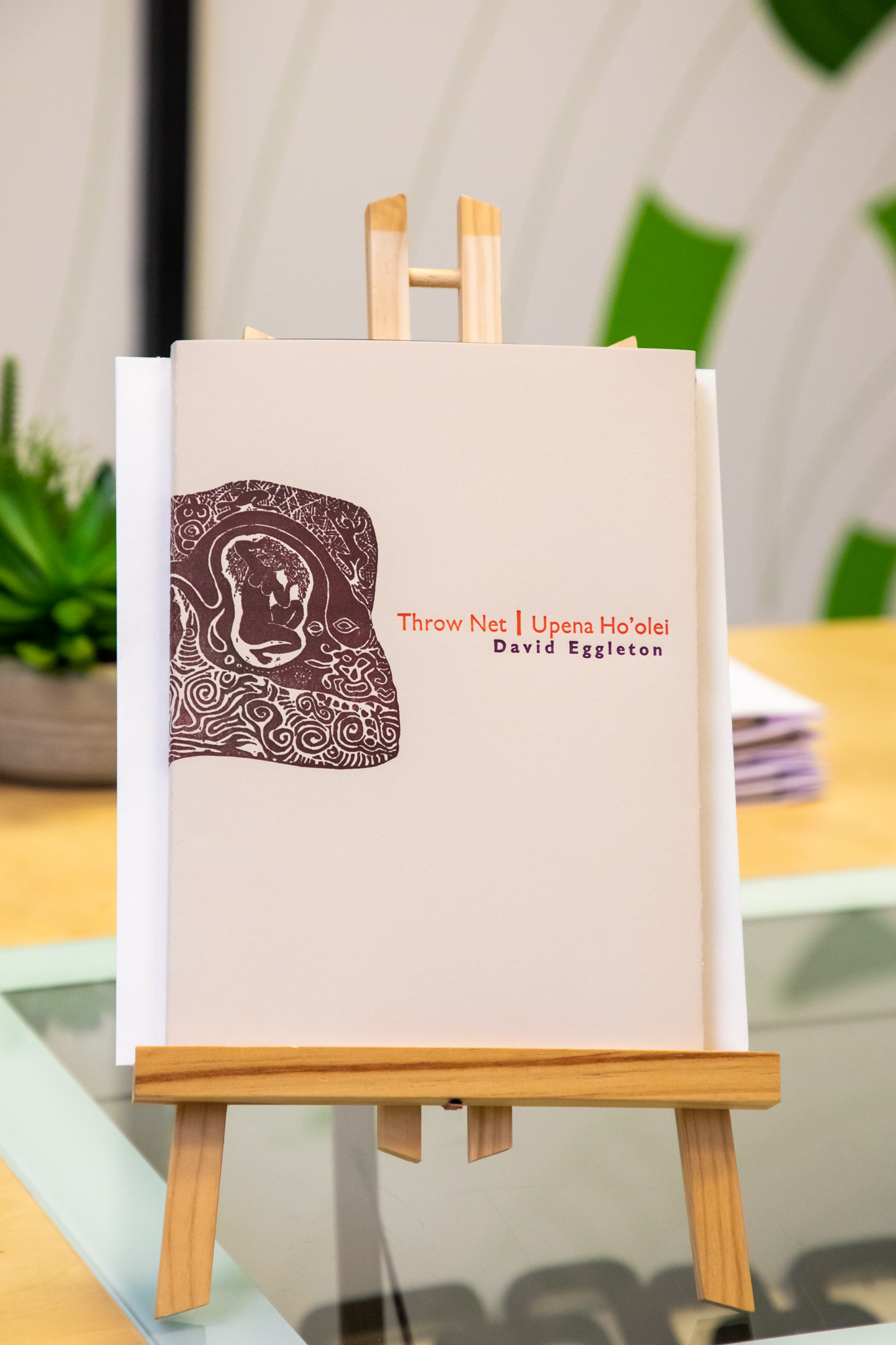
Poetry Shelf review: David Eggleton’s Throw Net | Upena Ho’olei

Throw Net | Upena Ho’olei, David Eggleton, artwork by Tonu Shane Eggleton, National Library / Fernbank Studios, 2021


I’m mesmerised by the sunshine’s sheen,
and every minute particular feels mine.

The sea disgorges its catalogue of shells
on the white page of sand for no-one.

On my hotel bed, I dream and sail.


from ‘Tourist Island’

Our current Poet Laureate, David Eggleton, has published a handset, hand-bound collection of poetry with artwork (woodblock prints) by his brother Tonu Shane Eggleton. Brendan O’Brien, beautiful-book craftsman extraordinaire, has produced an edition of 100 at his Fernbank Studios. The book is exquisite. I run my hand over the rough edged paper (Kerkall, plus Stonehenge for the covers). It is book joy. Holding this book. Holding this beauty. The artwork is an evocative sheen on the page.

The National Library, which has administered the New Zealand Poet Laureate Award since 2007, published the book. The award was established by Bill Manhire and winemaker John Buck as the Te Mata Poet Laureate Award n 1996. Throw Net | Upena Ho’olei is fittingly dedicated to John.

In 2018 David spent three months at the University of Hawai’i’s Moana Campus, as the Fulbright-Creative New Zealand Pacific Writer Resident. The poems began in notebooks while he was there, and were completed upon his return.

Throw Net | Upena Ho’olei, with nine poems and a scattering of artworks, is the perfect place to sojourn.

This is poetry that celebrates the moment. It feels like the poet is inhabiting a particular place, at a particular time, and slowly breathes in the experience. The poem establishes a heightened relationship with place, a translation of experience within measure poetic form. The treasured details offer sound and visual explosions to the point I am imbibing a poetry feast, a delectable banquet. I am unashamedly drawn to food metaphors because poetry is a form of nourishment on the tongue, in the heart, in the lungs. This is poetry that is so very nourishing.

There is quietness, there is melody, there are shifting keys and multiple forms. I am breathing in salt and ocean, and undulating voyage. I am lingering over vignette and anecdote. In this time of limited travel and strict local borders, poetry is a travel plan, an itinerary of respite and joy. You might swim with turtles and hear the church bells ring out. There is ‘the chop of waves’ and ‘ukelele strums’. Expect mountains and lava and sun, much much sun. I am feeling skin glazed as I spend a whole Saturday drifting in and out of these poems. Pleasure crafts. Such honeyed vessels.

I love this lovingly crafted chapbook. Such economy, such fluidity, such reach. I dream and I set sail.


The snores of a sleeper on a beach towel
recite genealogy under volcano’s glow.
A sunken raft of manta rays stirs after dark.

Hands hula-hula, shaping sandwiches
into islands; mechanically, a shark
takes a bite out of the moonlight.

Someone slings a hammock between trees.
Each wave is a line; each line is breaking;
and even the mountains are setting sail.


from ‘Throw Net’

David Eggleton NZ Poet Laureate blog

You can order a copy at the Library Store at $70 per copy. email: natlib-retail@dia.govt.nz

NZ Poetry Shelf interview

Otago University Press page

NZEPC page with poems

Poetry Shelf Theme Season: Thirteen poems about song

Music is the first poetry attraction for me. I am drawn to poems that sing. Poems sing in multiple keys with affecting and shifting chords, rhythms, harmonies, counterpoints, pitch, cadence, codas, crescendo. Tune your ear into the poetry of Karlo Mila, Emma Neale, Sue Wootton, Bill Manhire, Hinemoana Baker, Michele Leggott, Nina Mingya Powles, Lily Holloway, Alison Wong, Chris Tse, Mohamed Hassan, Gregory Kan, Anna Jackson, David Eggleton and you will hear music before you enter heart, mystery, experience, startle. Take a listen to Bernadette Hall or Dinah Hawken or Anne Kennedy. Anuja Mitra. Louise Wallace. How about Grace Iwashita Taylor? Ian Wedde. Tusiata Avia. Tayi Tibble. Rebecca Hawkes. Helen Rickerby. Selina Tusitala Marsh. Murray Edmond. Apirana Taylor. Iona Winter. Rose Peoples. Sam Duckor Jones. Vincent O’Sullivan. Kiri Pianhana-Wong. Jackson Nieuwland. Serie Barford. Listening in is of the greatest body comfort and you won’t be able to stop leaning your ear in closer. I think of one poet and then another, to the point I could curate an anthology of musical poets. I can name 100 without moving from the kitchen chair. Ah. Bliss.

But for this theme I went in search of poems that speak of song. The poems I have selected are not so much about song but have a song presence that leads in multiple directions. And yes they sing. Once again I am grateful to publishers and poets who are supporting my season of themes. Two more themes to go.

The poems

poem to Hone Tuwhare 08

the master

adroit composer of

‘No Ordinary Sun’

has gone

and still

the music grows flows
grumbles and laughs

from his pen

only the old house has fallen
to the wind and storm

death shakes the tree
but the bird lives on

Apirana Taylor

from A Canoe in Midstream: Poems new and old, Canterbury University Press, 2009 (2019)

Between Speech and Song

I’m sorry, you said.

What for, I said. And then

you said it again.

The house was cooling.

The pillowcases had blown

across the lawn.

We felt the usual shortcomings

of abstractions. I hope,

you said. Me too, I said.

The distance between our minds

is like the space

between speech and song.

Lynley Edmeades

from As the Verb Tenses, Otago University Press, 2016

Dust House

my sister is humming

through wallpaper

the front door is shutting

and opening like lungs

to kauri trees

leaping upwards through air

my lungs are pressed

between walls

grey warblers sing like

dust moving through air

the sunflower is opening

and shutting like lungs

my lungs are shifting

the air

Rata Gordon

from Second Person, Victoria University Press, 2020

Lullaby

The woman next door sings so slowly someone must have died. She practices her sorry aria through the walls. When we bump on the steps she is neighbourly, maybe, with her purpled eyes. She tries for lightness. The radio tells me it is snowing somewhere south. Drifts fall down for days. The presenter uses the word ghastly far too often. In the ghastly snow, he says, animals dig for their calves. When we meet on the path my own voice is chestnut and dumb. ‘It’s a ghastly thing,’ I say. ‘It was a ghastly mistake.’ In the dark the woman’s voice touches a sweet, high place. It’s a small cupboard where her children once hid when she’d tried to explain ­­– which you never really can – why the animals must paw in the cold, brown slush. Where are the young? Who hears their low, fallow voices?

Sarah Jane  Barnett 

from Bonsai – Best small stories from Aotearoa New Zealand, edited by Michelle Elvy, Frankie McMillan and James Norcliffe, Canterbury University Press, 2018

Song

i

The song feels like singing,

looks out the window:

clouds glued to the sky,

harbour slate-grey,

hills like collapsed elephants.

There’s food stuck to the highchair,

a plastic spoon on the floor.

The cat stares up in awe at the fridge.

The song opens its mouth,

but seems to have forgotten the words.

ii

The song wakes up.

It’s dark.

Someone is crying.

The morepork in the ngaio

shakes out its slow spondee:

more pork more pork more pork.

Back in the dream a line

of faces passes the window.

Each face smiles, lifts

its lips to show large teeth.

iii

The song sits at the window, humming

ever so softly, tapping

a rhythm on the table-edge, watching

the harbour slowly losing

colour. At the very far end

of the harbour slightly up to the right,

a zip of lights marks the hill

over to Wainuiomata. If that zip

could be unzipped, thinks the song,

the whole world might change.

iv

The song strokes the past

like a boa, like some fur muff

or woollen shawl,

but the past is not soft at all;

it’s rough to the touch,

sharp as broken glass.

v

The song longs to sing in tune.

The song longs to be in tune.

The black dog comes whenever

the song whistles, wagging its tail.

The black dog waits for the song’s whistle.

The black dog wants a long walk.

vi

The song croons “Here Comes the Night”

very quietly. Meanwhile the baby

spoons its porridge into a moon.

The black dog leads the song

down long, unlovely streets.

The night is slowly eating the moon.

Harry Ricketts

from Winter Eyes, Victoria University Press, 2018

The Crowd

The crowd is seaweed and there’s always one man too tall at least or one man dancing too much or one woman touching too much. We form short bonds with each other. The man next to me we briefly worry is a fascist. But him and I set a rhythm of touches with each other as we’re together and apart from the music and the bodies. When the bassline and the drums are inside my entire body they always shake up grief like sediment in water so that I am the sediment and my tears become water. And I am the water and the seaweed at the same time and I hover in the thick of the sound experiencing myself experiencing sound and feeling and my body as one piece of a larger thing. I want to be part of a larger thing as often as I can. So many days there isn’t enough music to pull us together. We shred each other, other days. A little rip. A tiny tear. A deep cut. We curl backwards into ourselves to do the damage. I follow the line. I rise into it because it is the sea and the only thing to do is to rise. I am bread and I am fire. I am the line of the horizon as it is reflected back to you. We make our own beds and lie in them. You will have said something. To me. Later, as I think it through I remember us neck to neck, clutching.

Emma Barnes

from Sweet Mammalian 7

singing in the wire

The song is a clutch of mailboxes

at the end of an undulating road,

an unsteady stack of bee-hives

beside poplars.

The song is the whine from a transformer,

crickets, waist-high roadside grass,

a summer that just will not let up.

The song is a power pole’s pale-brown

ceramic cup receiving a direct hit

from a clod flung by my brother.

It is looped bars laid

against the white paper of a gravel road.

Released the year and month my father died,

‘Wichita Lineman’ can still bring me the valley

where we lived,

still bring me grief, the sound

of wind through wire, the loneliness

of country verges; but does not bring

my father back. You can ask

too much of a song.

Kay McKenzie Cooke

from Born To A Red-Headed Woman, Otago University Press 2014

thursday quartet 9:15

The stairwell grew and rolled

with slackened half-night. Quite clearly

she saw how her words had become her.

When she sang she remembered; her breath was deep

letters unnudged. The stairwell hummed. Everything

smelt of other people’s hands.

One, two, three. Another life had trained her ready.

She knew these breaths. It had been a day

of near misses, daredevil secret creatures

who followed her home, a line of sight

and the road, misadventured art deco.

Had she been good enough?  

At night her window smithied day.

She could see the boats as they came.

The stairwell rose and then uprising

the first notes.

Pippi Jean

Trigger


When Johnny Cash
was sad he’d call
Willie Nelson and
ask for a joke.

Willie knew a
dirty joke – good
or bad – was the
secret to happiness.

Some people haven’t
yet realised that Willie
Nelson is one of the
greatest singers, guitarists

and songwriters. But
there’s time. There’s always
time. Despite it being
funny how it always seems

to just slip away. Still,
to add to the legends of
Willie smoking pot
on the roof of the White House

and blowing out interviewers
so that they couldn’t remember
where they parked their car or
where they lived or worked,

we can now thank Willie not
only for his 70 albums and for
writing the greatest jukebox
weepie of all time…

But, also, on some level, he
helped keep Johnny Cash alive
for as long as he lasted. Johnny
battled his depression

with a dirty joke from Willie
Nelson. I’m not saying it works
for everyone but it served
The Man in Black.

Simon Sweetman

from off the tracks website

Sunday’s Song

A tin kettle whistles to the ranges;

dry stalks rustle in quiet field prayer;

bracken spores seed dusk’s brown study;

the river pinwheels over its boulders;

stove twigs crackle and race to blaze;

the flame of leaves curls up trembling.

Church bells clang, and sea foam frays;

there’s distant stammers of revving engines,

a procession of cars throaty in a cutting,

melody soughing in the windbreak trees,

sheep wandering tracks, bleating alone.

Sunday sings for the soft summer tar;

sings for camellias, fullness of grapes;

sings for geometries of farming fence lines;

sings for the dead in monumental stone;

sings for cloud kites reddened by dusk —

and evening’s a hymn, sweet as, sweet as,

carrying its song to streets and to suburbs,

carrying its song to pebbles and hay bales,

carrying its song to crushed metal, smashed glass,

and fading in echoes of the old folks’ choir.

David Eggleton

from The Conch Trumpet, Otago University Press, 2015

Ephemera

My brother says that he doesn’t

understand poetry. He hears the words

but they all intersperse into a polyphonic

whirl of voices; no meaning to them

beyond the formation and execution

of sounds upon lips, pressing together

and coming apart. I cannot touch or feel

words, but I see them ‒ the word ‘simile’

is a grimacing man, poised on the edge

of polite discomfort and anguish. ‘Dazzled’ is

a 1920s flapper with broad, black eyes

and lank black hair around the edges of

her face. A boy in my music class hears

colours ‒ well, not hearing as such, he says,

but images in his mind’s eye. People play

tunes and ask him what colour it is, but

they play all at once, and he says that it is

the indistinguishable brown of all colours

combined. I think of a boy I used to know

called Orlando, and how this word conjures

the sight of a weathered advert for a tropical holiday

in my mind ‒ a forgotten promise, just ephemera

and not to be mentioned. The History room at school smells

like strange, zesty lemons, like the smell when you

peel a mandarin and its pores disperse their

sebum into the air, or when you squeeze the juice

from a lemon into your hands, and feel it dissolve

the soapy first layer of skin. I always think of

a certain someone when I smell this, even though

they wear a different perfume, and when I listen

to soft guitar ballads I think of them too, even though

I know they wouldn’t have heard them. All

of the sounds and smells and thoughts blend

into ephemera, scorched postcards of violets and

swallows, etched with the perfect handwriting of

old, consigned to antique stores that smell of

smoke. Things of the past with no value, no

substance, just air filled with citrus mist. I collect

each word and strain of what was once fresh in

my mind, in a forgotten jacket pocket, to be discovered

on some rainy day, years later. I’ll pull out the

postcard and think of the way I always look twice

when I see someone with curly hair; the word ‘longing’

is a blue wisp that creeps between the cracks

in my fingers. That wisp hides in these things,

tucked away, like the 1930s train tickets I found

in an old book. I wonder if their owner ever made it

to their destination. I wonder who they were.

Cadence Chung

first appeared in Milly’s Magazine

Love songs we haven’t written

Within the warm wreckage of me,

I’d never dare to ask you, but

in that moment when pain finds it plowing rhythm,

would you want me dead?

It’s a startling thought.

So round and whole and ordinary.

But you can’t know these things until

you’re sunk deep in the geometry of them. Of course,

the bed I lie on would be lily white and threatening levitation.

I would imagine the emptiness I leave and

you would think of all the ways to fill it.

That is the grotesque version.

It should of course be the other way around.

I don’t need misery to write poetry.

For me words come only after precarity passes

and there is safety in sitting still for long stretches.

Words, eventually, have the thickness of matter

left out too long in the sun. My love,

If we had a daughter, I’d be more dangerous.

She’d lick words whole     out of the air.

I would recognize her tiny anthem.

Like you, she’d need two anchors, and only one mast.

Like me, she’d be immovable, a miniature old woman

by seven years old.

Catherine Trundle

thursday’s choir

my singing teacher says yawning during lessons is good

it means the soft palate is raised and air circulates the bulb of your skull

to be pulled out between front teeth like a strand of taut hair 

gum skin or yesterday’s nectarine fibre

in empty classrooms my body is a pear, grounded but reaching

the piano is out of tune, its chords now elevator doors

a shrieking melody that says: relish the peeling off

floss til you bleed and watch through the bannisters

voices merge like a zip ripped over fingers

reeling backwards and thrown to the wall

are all the arcades, rubber children

midnight sirens and birds sounding off one by one

the sopranos cry out offering forged banknotes

while the altos bring the alleyways

you crash through the windscreen, thumbs deep in pie

laundromat coins with that rhythm

Lily Holloway

Emma Barnes lives and writes in Te Whanganui-ā-Tara. She’s working on an anthology of Takatāpui and LGBTQIA+ writing with co-conspirator Chris Tse. It’s to be published by AUP in 2021. In her spare time she lifts heavy things up and puts them back down again.

Sarah Jane Barnett is a writer and editor from Te Whanganui-a-Tara. Her poetry, essays and reviews have been published widely in Aotearoa. Her debut poetry collection A Man Runs into a Woman (Hue + Cry Press) was a finalist in the 2013 New Zealand Post Book Awards. Her secondcollection Work (Hue + Cry Press) was published in 2015. Sarah is currently writing a book on womanhood and midlife.

Kay McKenzie Cooke’s fourth poetry collection was published by The Cuba Press in June 2020 and is titled Upturned. She lives and writes in Ootepoti / Dunedin.

Cadence Chung is a student from Wellington High School. She started writing poetry during a particularly boring maths lesson when she was nine. Outside of poetry, she enjoys singing, reading old books, and perusing antique stores.

Lynley Edmeades is the author of two poetry collections, most recently Listening In (Otago Uni Press, 2019). She lives in Dunedin and teaches poetry and creative writing at the University of Otago.

David Eggleton is the Aotearoa New Zealand Poet Laureate 2019 – 2022. His most recent book is The Wilder Years: Selected Poems, published by Otago University Press.

Rata Gordon is a poet, embodiment teacher and arts therapist. Her first book of poetry Second Person was published in 2020 by Victoria University Press. Through her kitchen window, she sees Mount Karioi. www.ratagordon.com 

Lily Holloway is a queer nacho-enthusiast. She is forthcoming in AUP New Poets 8 and you can find her work on lilyholloway.co.nz.

Pippi Jean is eighteen and just moved to Wellington for her first year at Victoria University. Her most recent works can be found in Landfall, Starling, Takahe, Mayhem, and Poetry New Zealand Yearbook among others.

Harry Ricketts teaches English literature and creative writing at Victoria University of Wellington Te Herenga Waka. His Selected Poems appeared in June, Victoria University Press.

Simon Sweetman is a writer and broadcaster. His debut book of poems, “The Death of Music Journalism” was published last year via The Cuba Press. He is the host of the weekly Sweetman Podcast and he writes about movies, books and music for a Substack newsletter called “Sounds Good!” (simonsweetman.substack.com to sign up). He blogs at Off The Tracks and sometimes has a wee chat about music on RNZ. He lives in Wellington with Katy and Oscar, the loves of his life. They share their house with Sylvie the cat and Bowie the dog. 


Apirana Taylor, Ngati Porou, Te Whanau a Apanui, Ngati Ruanui, Te Ati Awa, is a nationally and internationally published poet, playwright, short story writer, novelist, actor, painter and musician. He has been Writer in Residence at Canterbury and Massey Universities. He frequently tours nationally and internationally visiting schools, tertiary institutions and prisons reading his poetry, storytelling and taking creative writing workshops. He has written six collections of poetry, a book of plays, three collections of short stories, and two novels. His work has been included in many national and international anthologies.

Catherine Trundle is a poet and anthropologist, with recent works published in Landfall, Takahē, Poetry New Zealand Yearbook, Not Very Quiet, and Plumwood Mountain.

Ten poems about clouds

Twelve poems about ice

Ten poems about dreaming

Eleven poems about the moon

Twelve poems about knitting

Ten poems about water

Twelve poems about faraway

Fourteen poems about walking

Twelve poems about food

Thirteen poems about home

Ten poems about edge

Eleven poems about breakfast

Twelve poems about kindness

Thirteen poems about light

Poetry Shelf noticeboard: Vaughan Rapatahana on David Eggleton at Jacket 2

Vaughan Rapatahana offers a commentary on his old schoolmate David Eggleton, along with a close look at David’s recent poem, ‘Are Friends Electric’. Terrific piece which you can read in full at Jacket 2. Here is a taster:

‘I have known David ever since we both went to the same South Auckland, New Zealand, schools waaaaay back in the 1960s. Indeed, we were in the same classes at Aorere College, Mangere, where David had a definite proclivity for compiling vocabulary. I recall once presenting him with the triad “copious, abundant, plethora,” which he noted was good, nodding enthusiastically.

Eggleton loves words, most especially esoteric, arcane, and interesting lexis, which he crafts into his cadenced poetry with considerable care. His poems are vital verbal extravaganza and this — along with his indomitable delivery style, itself rhythmically syncopated — are hallmarks of his work as a poet, given that he is also a writer across several other genres such as art criticism, literary reviews, and editing, and holds other roles, such as a recording artist. His poems abound with layers of colourful imagery, often adumbated, so that their overall patina is distinctive: one can often recognise his distinctive work even if his name does not appear on the page.’

.

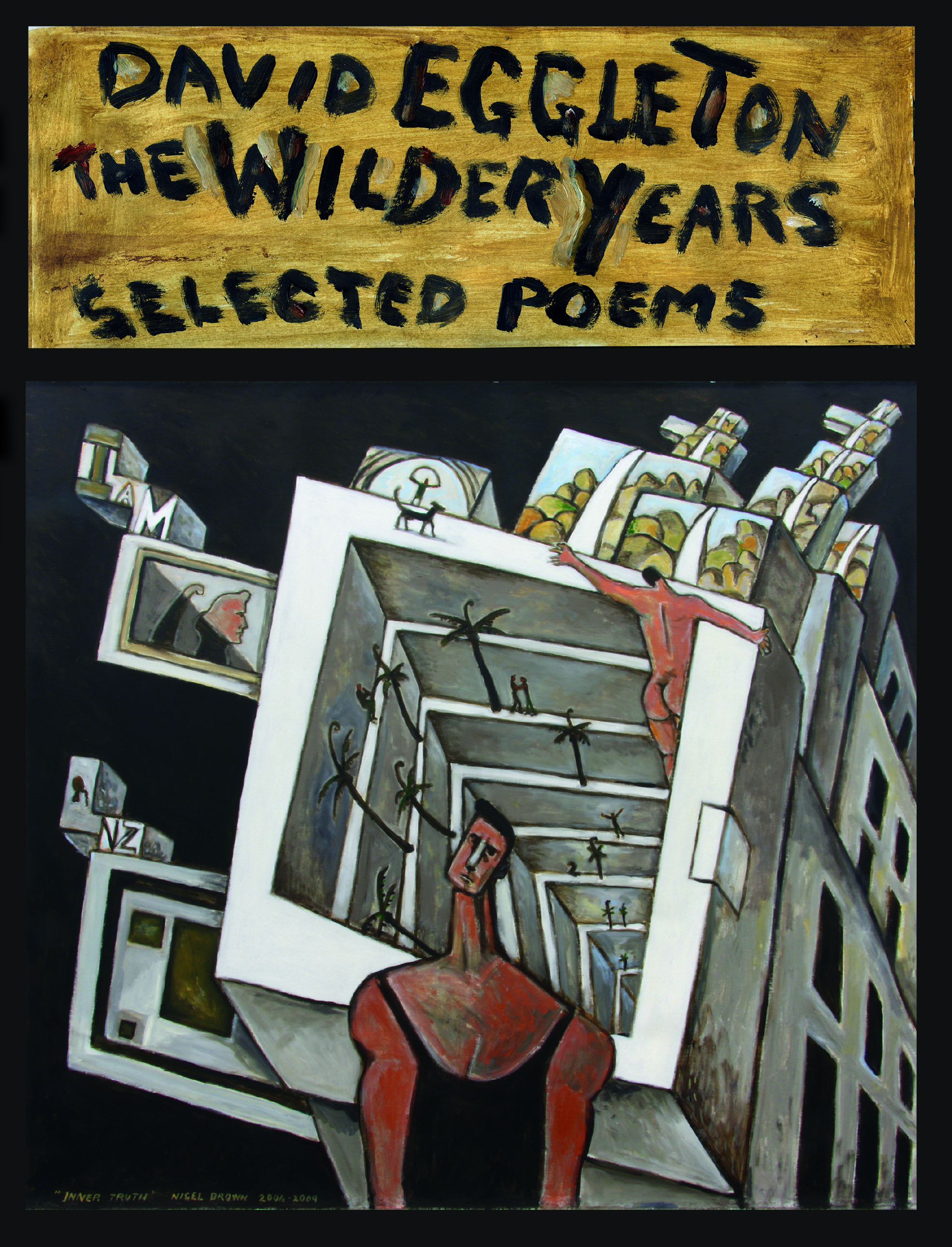
Poetry Shelf celebrates new books: David Eggleton reads from The Wilder Years: Selected Poems

David Eggleton reads ‘The Burning Cathedral’

The Wilder Years: Selected Poems, Otago University Press, 2021

David Eggleton is a poet and writer of Palagi, Rotuman and Tongan descent based in Dunedin. He has published a number of poetry collections, and has also released a number of recordings with his poetry set to music by a variety of musicians and composers. He is the former Editor of Landfall and Landfall Review Online as well as the Phantom Billstickers Cafe Reader. His book The Conch Trumpet won the 2016 Ockham New Zealand Book Award for Poetry. In 2016, he received the Prime Minister’s Award for Literary Achievement in Poetry. His most recent poetry collection is The Wilder Years: Selected Poems, published by Otago University Press in May 2021. He is the Aotearoa New Zealand Poet Laureate for 2019 – 2022.

Otago University Press page

Michael Steven review at Kete Books

Standing Room Only interview RNZ National

Poetry Shelf Theme Season: Ten poems about dreaming

Not many younger poets sent me poems about ice but there were loads of dreaming poems. I have always loved poems that dream because poetry is a close relation with its slants, mists, hallucinations, and deep personal cores. I sometimes think that to dream is to write. To enter the opaque, to reclaim the obvious, to have no idea where you will end up or how you will get there. To astonish yourself.

I am so very grateful to the poets and publishers who have backed my themed poetry season with such loving support.

Ten poems about dreaming

the dream is real

the moon is an open eye

high in the sky or winking

at the world below

the wind is the sea’s breath

rustling the leaves in the trees

night is a dark river

flowing through the day

a bird is a song

the dream is real

clouds are ghosts

flight is a wing

Apirana Taylor

from a canoe in midstream, Canterbury University Press, 2009

Insomnia

it is a black night

I lie perfectly still

mine is the long

awake adult body

two small boys

flickering at either side

night sweats

bad dreams

fluttering in and

out of sheets

I lie black

in between

head

thorax, abdomen

trembling children

my wings

Karlo Mila

from A Well Written Body, Huia Press, 2008

My Father Dreams of His Father

My father dreams of his father

walking in the garden of the old family homestead

on Kawaha Point.

I have not been back since he passed away.

As decrepit dogs wander off under trees

to sniff out their final resting places,

elderly men wait in the wings

rehearsing exit lines.

I’m sure my grandfather never envied his dog more

than during those last days.

I’m sure, given the choice, he would have preferred

to slip away under the magnolias.

The garden is tended by different hands now.

My grandmother still walks by the lake,

her little dog in tow. The current man of the house

is more interested in the chasing of swans

than the cultivating of camellias.

My father dreams of his father

walking in the garden of the old family homestead

on Kawaha Point.

I have not been back since he passed away.

Claudia Jardine

from AUP New Poets 7, ed. Anna Jackson, Auckland University Press, 2020

Sentries

I’m frantically chasing my mother who weaves in and out of the aisles throwing down craft supplies. I trip over scissors and quick unpicks

not seeing her face, only clean ponytail and collar poking out over plum cardigan. We run between shelves of antique vases but lose contact with the linoleum

and float out. In this world we drive couches like cars. I’m picking one up from the junkyard with a blue shag cushion for reference. Bumper stickers are glinting

while the couches lie gridlike. We scramble through the drivers’ seats running fingers through the upholstery. In the winter gardens there are fish tanks

nestled between succulents. One has a tangle of thin eels within it. Boys tap on the home of a solitary neon tetra until it shatters. I hold the fragments together

and try to keep the fish swimming in a handful of glass and water. They put me in the newspaper. I run out to catch you in the ocean, my mother

but you keep dipping under. As I look around I notice, embedded in rock formations are those white plastic fans, not rotating anymore just facing the horizon.

Lily Holloway

originally published at The Spin Off, October, 2020

interventionalist god

in my dream nick cave had a long, thick black mane.

it swung around his hips, kissed

with a bright white streak

snaking its length.

he served noodle soup at the concert

full of moving mushrooms, blooming

into elegant dancing technicolour spores;

tasted like purple.

the show was very red, like the blood

of his falling son. my mother

was falling too,

drunkenly, over crimson seats,

hurting her back and lying down with the room spinning.

pissing off the man in the toupee, and toupee’s wife.

nick drawled, don’t worry,

sung a song sad and it broke us,

spun around inside a steel cage,

spray-painted KINGS on our leather jackets

so we could get into his next stadium show free.

afterwards, we matched up our snails in the foyer.

nick was smoking through tears out back,

about to catch a flight, saying,

i think i’ve met someone with your name,

and it was you already.

Hebe Kearney

Lake Wakatipu

A jade lizard bends in a circle,

chasing its tail;

straightens, and darts for a crevice.

Mist swathes in grey silk the lake:

flat-stomached, calm, slow-pulsed,

a seamless bulk.

Vapours spiral,

pushing up to a cloud-piercer,

where snow has been sprinkled

like powder from a talc can at height.

Grandeur stands muffled.

The Earnslaw headbutts shorewards.

After lying prone for years,

rocks shift downwards

at speed, eager to wheel

through air, crash in a gully,

and not move.

The lake buttons up to dive deep,

leaving a perfectly blank black space,

through which you might fall forever.

David Eggleton

from Edgeland and other poems, Otago University Press, 2018

Daisy

This town is just one great big farm. The main road runs alongside these power poles tilted over green green paddocks, the lines all sagging, the poles on the piss. You hit it at forty k and slug down the main street, past the Strand, the Top Pub, the Nott. Past blue election billboards and wooden fences painted red with Water Gouging and Inheritance Tax. The arterial line is just panel beaters, tractors, pots of pink flowers dripping from shop windows. She says they look like icing. And these cows. There are forty-two of them, all painted up to look cultural. Blue like an old tea cup, pearls and roses dribbling over the rim. One unzipped at the side, with muscle and guts peeking out like baked beans and salmon. One flower power cow, real LSD yellow and orange, like it sorta wandered over from Woodstock and got lost for years and years. Little kids run across the road just to touch them. Name their favourites after their pet cats. Rusty, Mittens, Boots. They’re bolted to the pavement so at night they just haunt the main street, all washed out and hollow. But the worst is that giant one right at the start of town. Two stories high, with black splotches like flames of tar. I have these dreams that the paddocks are on fire and the ground is opening up and all you can hear is mooing. The Mega Cow watching over his herd like some great milky God. The trains rattle past at dawn and wake me up. The cows hardly blink.

Aimee-Jane Anderson-O’Connor

from Ngā Kupu Waikato: an anthology of Waikato Poetry, ed. Vaughan Rapatahana, Self Published, 2019

Tilting

The woman on the bus said

I’ve never been on a bus before

as she lifted her bag

a miniature suitcase

black and shiny as a beetle.

Next time you’ll know what to do

said the driver as he stood on the brakes

pointed to the building on the left and said

The lift’ll take you to The Terrace.

There were no ledges on The Terrace

just buildings tilting and leaning

and the wind to push against.

That night, unpacked and tired

the woman climbed on her black beetle bag

and flew across the harbour

soaring above its flat cool face

staring deep into its mouth

and wondering about earthquakes.

The next morning the bus driver couldn’t shake

the woman from his mind.

As he left the depot

his bus pshishing and grinding through peak hour flow

he checked his mirror

but she wasn’t there

instead he saw the edges of his bus converting

row by row, slice by slice

into a huge loaf of bread.

The aroma filled the aisles

stirring the appetites of even

his sleepiest passengers

and when he neared the end of Lambton Quay

all that was left of the bus, was the crust.

Some like the crust, some don’t, he thought

as he chewed and chomped

until the last crumb fell

into the gutter, into the drain

into the harbour, and out to sea.

What now? he said

peering skywards, catching a glint.

Trish Harris

published under the title ‘Openings’ in New Zealand Poetry Society Anthology 2015/2016

bone / tired

I am tired to my bones

this exhaustion

has wrapped around my ribs

sunk into my jaw

slunk

down

each vertebrae

I take deep slow breaths

each exhale

rattles the cage of ribs

I don’t sleep anymore

I just rattle around the house

the rooms empty of the wakeful

I touch each wall

like a talisman

like an averter of the evil eye

to avert whichever evil

might choose us tonight

I keep vigil

I don’t sleep anymore

rattle the bones

of the sleeping

I am rattled

to my bones

I don’t sleep anymore

the bones of my shoulders

have permanently rolled inward

they hunch

waiting for a fight

for a blow

I have never been in a fight

just in anticipation

of the fight, the flight

there are 27 bones in the human hand

I count them all

in lieu of sleeping

I am tired to my bones

I don’t sleep anymore

Rose Peoples

Pasture and flock

Staring up into the sky my feet

anchor me to the ground so hard

I’m almost drowning, drowning,

in air, my hair falling upwards

around my shoulders, I think I’ll hug

my coat closer. I’m standing

on hundreds of blades of grass, and

still there are so many more

untrodden on. Last night, in bed,

you said, ‘you are the sheet

of linen and I am the threads,’ and

I wanted to know what you meant

but you wouldn’t wake up to tell me

and in the morning you didn’t

remember, and I had forgotten

till now when I think, who is

the blades of grass, who is the pasture?

It is awfully cold, and my coat

smells of something unusual.

It almost seems as if it is the stars

smelling, as if there were

an electrical fault in the sky,

and though it is almost too dark

to see I can see the sheep

moving closer, and the stars

falling. I feel like we are all

going to plunge into the sky

at once, the sheep and I,

and I am the sheep and I am

the flock, and you are the pasture

I fall from, the stars and the sky.

Anna Jackson

from Pasture and Flock: New & Selected Poems, Auckland University Press, 2018

Aimee-Jane Anderson-O’Connor was awarded the 2018 Charles Brasch Young Writers’ Essay Competition, and the 2017 Monash Prize for Emerging Writers. Her work has appeared in Starling, Mayhem, Brief, Poetry New Zealand, Landfall, Turbine, Flash Frontier, Mimicry, Min-a-rets, Sweet Mammalian, Sport and Verge. She is Poetry New Zealand‘s 2021 Featured Poet. She writes thanks to the support of some of the best people on this great watery rock.

David Eggleton is the Aotearoa New Zealand Poet Laureate 2019 – 2022. His most recent book is The Wilder Years: Selected Poems, published by Otago University Press. 

Trish Harris has written two books – a poetry collection My wide white bed and a memoir The Walking Stick Tree. She teaches non-fiction on the Whitireia Creative Writing Programme, is co-founder of Crip the Lit and edited their 2019 pocketbook, ‘Here we are, read us: Women, disability and writing’. She says she’s a part-time crane operator…but maybe she’s dreaming?

Lily Holloway has a Teletubby tattoo and is forthcoming in AUP New Poets 8. You can find more of her work here

Anna Jackson lectures at Te Herenga Waka/Victoria University of Wellington, lives in Island Bay, edits AUP New Poets and has published seven collections of poetry, most recently Pasture and Flock: New and Selected Poems (AUP 2018). Thoughts on dreaming and on being dreamed about can be found here and here.

Claudia Jardine (she/her) is a poet and musician based in Ōtautahi/Christchurch. In 2020 she published her first chapbook, The Temple of Your Girl, with Auckland University Press in AUP New Poets 7 alongside Rhys Feeney and Ria Masae. Her work has also been published in Starling, Sport, Landfall and Stasis. For the winter of 2021, Jardine will be one of the Arts Four Creative Residents in The Arts Centre Te Matatiki Toi Ora, where she will be working on a collection of poems.

Hebe Kearney is a poet from Christchurch who now calls Auckland her home. Her work has appeared in The Three Lamps, Oscen, Starling, Forest and Bird, a fine line, and the Poetry New Zealand Yearbook 2021.

Dr Karlo Mila (MNZM) is a mother, writer, award-winning poet and leadership programme director. Of Tongan and Pākehā descent, her creative and professional career has focused upon Pasifika peoples in Aotearoa. Her book Dream Fish Floating won the best first book of poetry in the NZ literary awards in 2005. Karlo lives in Tāmaki Makaurau with her three sons. Her third poetry book Goddess Muscle was published by Huia in 2020.

Rose Peoples is from Te Awakairangi/Lower Hutt. She is a student at Victoria University and, having finished her law degree last year, decided that the logical next step was to embark upon a Masters in Literature. She is a bookseller at Good Books. Her work has previously appeared in Cordite, Mimicry and Starling.


Apirana Taylor, Ngati Porou, Te Whanau a Apanui, Ngati Ruanui, Te Ati Awa, is a nationally and internationally published poet, playwright, short story writer, novelist, actor, painter and musician. He has been Writer in Residence at Canterbury and Massey Universities. He frequently tours nationally and internationally visiting schools, tertiary institutions and prisons reading his poetry, storytelling and taking creative writing workshops. He has written six collections of poetry, a book of plays, three collections of short stories, and two novels. His work has been included in many national and international anthologies.

Ten poems about clouds

Twelve poems about ice

Poetry Shelf noticeboard: Best NZ Poems 2020 goes live

Poet Laureate David Eggleton has edited the latest edition of Best NZ Poems 2020. He concludes his introduction with these words:

I hope you will enjoy reading these poems as much I have on my year-long odyssey for which I didn’t have to leave home. I’m glad to have had the privilege of the journey and its discoveries. Discoveries rather than judgements because poems are essentially playful and deeply wilful and a law unto themselves and won’t be judged. As the American poet Archibald MacLeish put it in his brilliant formulation about the art of poetry: ‘A poem should not mean/ But be.’

I had already read most of the poems – but I loved revisiting them. Poems are like albums; you can put them on replay and they just get better.

Go here for poems, introduction and audios.

Poetry Shelf noticeboard: Poet Laureate David Eggleton picks two Peter Olds poems

The sky turned black as night,
sirens wailed, streetlights blinked
at stalled streets, the air streaked
like some New York modern painting:
Surreal, unreal, leaving high tide
marks of ice in the doorways of
mid-town shops

from ‘Hail & Water ‘ by Peter Olds

Two terrific poems by Peter Olds on The Poet Laureate site