Tag Archives: Claire Beynon

Poetry Shelf celebrates The Venetian Blind Poems with a collage conversation with nine poets

The Venetian Blind Poems, Paula Green
The Cuba Press, 2025

Later in the year I am planning a number of Poetry Shelf live events to celebrate poetry voices in Aotearoa. This month I have a new poetry collection out but my energy jar and immunity is not quite ready for book launches so I have invented three celebrations for the blog. On Publication Day (August 1st), I posted an email conversation I had with my dear friend Anna Jackson, a conversation that celebrates our shared love of writing and our two new books. Anna’s Terrier, Worrier (Auckland University Press) and my The Venetian Blind Poems (The Cuba Press).

For my second feature, I have created a collage conversation by inviting some of the poets whose books I have reviewed and loved over the past year to ask me a few questions. It gives me another chance to shine light on the extraordinary writing our poets are producing. I have kept the conversation overlaps as I find something new when I return to a similar idea or issue.

It is with grateful thanks to David Gregory, Mikaela Nyman, Cadence Chung, J. A. Vili, Rachel O’Neill, Kate Camp, Xiaole Zhan, Claire Beynon and Dinah Hawken, I offer this conversation in celebration of poetry. You can find links to the reviews below. The conversation has ended up being something rather special for me. I have never experienced anything quite like it! I loved the questions so much. Thank you. Because this is a book of love, I would like to gift signed copies to five readers, whether for themselves or a friend (paulajoygreen@gmail.com).

I also want to share a review Eileen Merriman posted on her blog after reading my book, because she is in the unique position to respond to it as another writer, a haematologist and a close friend. Some things she says struck me and I refer to them when I answer a question by Kate Camp.


I’ve just finished reading Paula Green’s recently published poetry collection, The Venetian Blind Poems in one sitting. This book was an oasis in the midst of a hectic time for me (when is life ever not?); it’s not very often I can be compelled to sit for more than half an hour currently. Yet I connected with this on so many levels: as a writer, as a doctor, as a patient, as a friend, as a human. Green details her experience on the Motutapu ward, the bone marrow transplant/haematology unit at Auckland Hospital, where she received a bone marrow transplant for a life threatening  blood disorder in June 2022.

As a haematologist, I know this is one of the most challenging treatments you can put a patient through, bringing someone to the brink of death to save a life. Recovery takes months, sometimes years. The acute phase can be akin to torture, one only the recipient could ever understand. But Paula holds us close, so that we can begin to understand: ‘I return to the pain box in Dune… I am using the box/for when my ulcerated mouth pain is unbearable/last night I held the box/as the mouth pain radiated but/I didn’t put my hand in/I decorated the box/ with seashells instead’. And then we are elevated from the abyss to the sublime, because this is how Green survives, by stacking poems along her windowsill and creating word pictures in her head: ‘Buttered toast and clover honey/marmalade brain and mandarin heart’. And then, time and time again, we are brought back to the world that Green sees, from the confines of her isolation room, peering through the Venetian blinds at the world that sustains her, one second, one minute, one day at a time.

This book had me captivated from the delicious first line ‘Liquorice strips of harbour’, throughout the rough seas, eddies, near-drownings and becalmed harbours of the stem cell transplant, and beyond, right through to that hopeful last line, ‘We will be able to see for miles’. Kia kaha, Paula Green, your inner strength knows no bounds.

Eileen Merriman
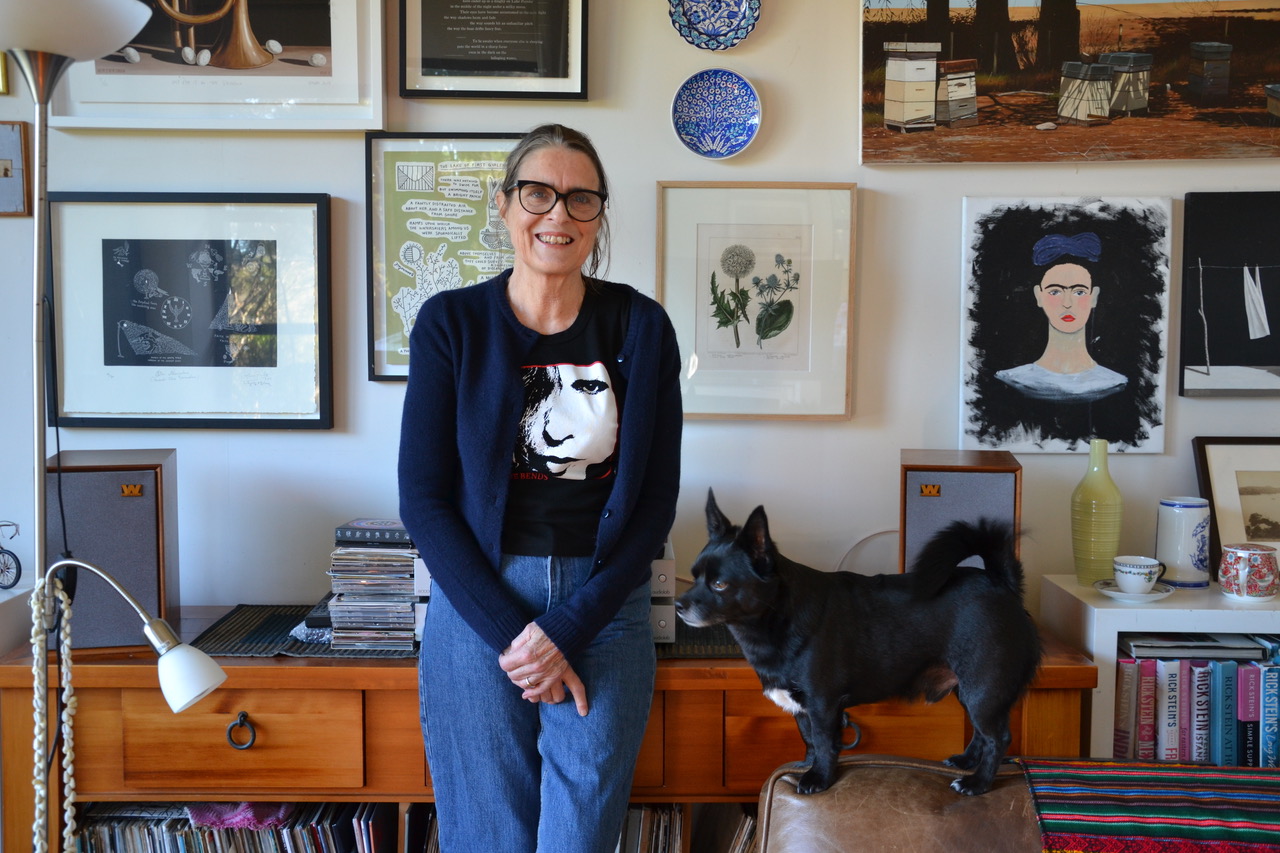
me with my daughter’s dog, Pablo

a collage conversation

Every morning I open an envelope and
read a poet’s choice inside a greeting card
I nestle into the joy
of Cilla McQueen’s kitchen table

David: Where do your ideas for your poetry come from?
Paula:  They fall into my head like surprise word showers, whether from what I see, hear, feel or read. From the world experienced, the world imagined, the world recalled.

David: How do you know when a poem is complete?
Paula: It’s a gut feeling. When it hits the right notes and catches a version of what I want to transmit. Poetry can be and do so many things, and I’m a strong advocate for poetry openness rather than limiting and conservative ideas on what a poem ought to be. Paul Stewart from The Cuba Press edited the book and he has a sublime ear for poetry and its range. You couldn’t ask for a better poetry editor.

In the middle of the night
the radio takes me to Science
in Action and I am listing
ways to save the planet
and the way dance liberates
cumbersome feet

Mikaela Nyman: These poems emerged out of a life temporarily reduced by severe illness. Yet they’re not limited by the medical circumstances, and not merely a comfort blanket, but seek to connect with the world outside. Did this happen straight away, or is it something you consciously pursued later in the writing process? 
Paula: I love this question – yes my life was limited physically, not only on the ward but on my long recovery road with a fragile immune system, daily challenges and minute energy jar. But I also saw it as an expansion of life. I focused and am focusing on what I can do, not what I can’t do. On the ward, the world was slipping in through the blinds as much as I was looking out. From the start my writing navigated both my health experience and the world beyond it.

Mikaela: Given the dire circumstances that compelled you to turn to poetry at this point in life – i.e. your personal health struggle as well as the state of the world – how important is it for you to retain hope and offer a sense of wonder in your poems?
Paula: I think it ‘s been ongoing, across decades, my impulse to write through dark and light. I think all my books have sources, whether overt or concealed, in patches of difficulty. I was writing 99 Ways into NZ Poetry with Harry Ricketts when I was first diagnosed and I never stopped writing. Maybe writing is my daily dose of vitamins. And that word wonder. Wonder is a talisman word – whether it’s the delight you might find in thought coupled with the delight you might find in awe. It is a crucial aid.

It’s the third day of the poetry season
Oh, everyone’s queueing up to read
a poem and count falling leaves

Cadence: Do you have a particular line/poem you’ve written that you think really encapsulates the collection?

I will meet you at the top of the hill
we will be able to see for miles

Cadence: What’s an experience you’ve had lately that has brought you joy?
Paula: Ah, such an important question. Every day is a patchwork quilt of joy. Take this day for example. Reading and reviewing a poetry book. Drinking coffee with a homemade muffin with sun-dried tomatoes and paprika. Making nourishing soup for lunch and sourdough with millet flour for a change. Watching the pīwakawaka dance in front of the wide kitchen window as though they are rehearsing for an special occasion. Replying to children who have sent me poems for Poetry Box. Cooking a Moroccan tagine with preserved pears and rose harissa paste for dinner and sharing with my family. Listening to Jimmy Cliff on repeat all day and imbibing the uplifting reggae beat and need to protest.

This morning I got up at 5 am to drive to an early appointment as the full-wow-moon shone in the dark, and streaks of bright colour ribbons hung over Rangitoto. It felt like my heart was bursting. I switched to Maria Callas singing ‘Casta Diva’ from Bellini’s Norma.

Today I feel happiness
as solid as a wooden
kitchen table with six chairs
and a bowl of ripe fruit

Cadence: How does a poem come to you? Quickly and all at once, or more measured and worked out?
Paula: Poems linger in my head -as they did on the ward – before I write them in a notebook. Often poem fragments arrive in the middle of the night, or when I am driving across country roads to Kumeū. But there is always a sense of flow not struggle. I love that.

I decide even stories are slatted
with missing bits, so I lie still and
fill in the gaps of my childhood

Jonah: How did your writing flow in the light and dark times, on the good
days and bad days of your recovery journey?
Paula: It flowed and flows in my head, most days, slowly, slowly. But sometimes, especially in the dark patches, I don’t have the energy to write on paper. I can’t function. Words falter. I compare it to the stream in the valley – sometimes it flows like honey, sometimes it struggles over rocks and debris. When it’s honey flow I write, when it’s not, I do something else. So I pull vegetables from the fridge of garden and make a nourishing meal to share with my loved ones. Or watch Tipping Point on TVNZ! Or listen to an audio book.


Jonah: How much did writing these poems during your personal struggle help in
your healing and recovery?
Paula: To a huge degree. And it still does. It was and is a crucial aid because it was and is a way of connecting with the world and people, of feeling love though my love of words. It’s a vital part of my self-care toolkit.

Jonah: Since this was such a personal journey for you, what was something new you discovered about yourself and life itself?
Paula: How in the toughest experience you can feel humanity at its best – for me the incredible care and patience of the doctors and nurses, no matter how tired or stretched they were (and underpaid). I loved my time on the ward. An anonymous donor gifted me life and that felt extraordinary to me. This miracle gift – it felt like I was seeing and experiencing the whole world for the first time and it was a wondrous thing. And still is (despite the heart slamming choices of certain leaders and Governments). It’s recognising what is important. Cooking and sharing nourishing food (especially Middle Eastern flavours). Watching football. Listening to music on repeat: reggae, Bach, opera, Reb Fountain, Boy Genius, Nadia Reid, The National, Marlon Williams, Lucinda Williams, Billy Bragg, Delgirl, Nina Simone,more reggae. I am hooked on Jimmy Cliff at the moment and the struggle he was singing about way back in the 1960s and 1970s: our half starved world, the Vietnam War, the broken planet, the ‘suffering in the land’. Well we are still singing and writing these same songs of heartbreak and protest.

In the basement of song
there are jars of pickled zucchini
worn shoes and well-thumbed novels

Rachel: Where does a poem generally begin for you, and has that changed at any point?
Paula: In my conversation with Anna, I talked about the way phrases drift into my head, surprise arrivals in my mental poetry room. I referred to these arrivals as gentle word showers. I have had these arrivals since I was a child. when I was in Year 8 (Form 2) my teacher, Frederick C. Parmee, was a poet! He was the only teacher who saw the potential in me as a writer and I flourished. By secondary school I was shut down as wayward and I failed school. Yet the words kept falling into my mind, and then into secret notebooks (like many women across the centuries), across my years of travelling, living in London, and finding a place in the Italian Department at the University of Auckland. Taking an MA poetry paper with Michele Leggott. Getting a poetry collection published with Auckland University Press. Extraordinary. And still the words drift and fall.

Rachel: Does your new collection speak to dynamics of patience and urgency? Along these lines, what has writing this collection made you appreciate more, or challenged you to move on from?
Paula: I think it has amplified my attraction to slowness, to patience, to writing and reading and blogging like a snail, into uncharted territory as much as into the familiar. When you run on slow dose energy, I think urgency is disastrous – I favour slow cooked braises and sourdough bread. Choosing the slow reading of poetry books, so much more is revealed. Yet urgency is both rewarding and necessary for other people, and produces breathtaking results, it just doesn’t work for me. That said, we need to unite with urgency to heal this damaged planet.

The second part of your question is crucial. In a nutshell, I appreciate life, I have had a transplant that has gifted me the miracle of life. Extraordinary. How can this not change the way I am in the world. What matters. Dr Clinton Lewis at Auckland Hospital has made an excellent video for bone marrow transplant patients. He talks about how many patients reassess what matters most. I have drafted a book, A Book of Care, it is not quite ready yet, but it is the manuscript I am most keen to be published. I offer it is as a self-travel guide, a tool kit, borrowing practical ideas that have helped me.

Rachel: In what ways do you think poetry helps us integrate and accept tension or discomfort as part of human experience and living a full life?
Paula: I love this question. I have been musing no matter what I am writing, the tough edges of the world, the daily wound of news bulletins find their way in. What difference does it make if we speak of Gaza and the abominable choices our Government is making? I just don’t know, but I do know silence is a form of consent, and that in the time of fascism in Italy, it was strengthening that some people spoke out. Every voice ringing out across the globe, in song or poem or article, every protest march and banner, is a human arm held out, a call to heal rather than destroy, to feed rather starve, to teach and guide the whole child rather than discriminatory parts.

My repugnance
at the devastation of Gaza
is not eased by the soft light
on the Waitākere Ranges
or a canny arrangement of summer nouns
or Boy Genius on the turntable
or even a bowl of chickpea tajine

 Kate: do you ever feel when you are writing about personal experiences – especially intimate ones of the body – that you are invading your own privacy? And once you have written about those experiences, do you find that the poem version overlays the “real” remembered version? Or if not overlays it, then how do they co-exist, how does the personal, private version of the experience alongside the version of the experience as captured in a poem? 
Paula: I love love this question Kate. Xiaole introduces their reading for a Poetry Shelf feature I am posting on Poetry Day, by talking about oversharing. I know this feeling so well. I feel like I am doing it in this collage conversation! To what extent do people want to hear about illness? About bumps in the road? I started sharing my health situation on the blog because I wanted people to know why I was operating on a tiny energy jar and couldn’t review quite so many books or answer emails so promptly. And most people have been unbelievably kind. I felt so bad when I hadn’t celebrated a book I had loved. And then I would think EEK! And wanted to delete my talk of cancer and transplant experiences and issues. But what I don’t do is go into dark detail. That stays private and personal. Will I have the courage to press ‘publish’ for this collage conversation! Scary.

I found it so illuminating to read Eileen’s review of the book. She writes from her experience as a writer, avid reader, haematologist and my friend. She says things I don’t have running through my head but are important! To read her words made feel so much better about how I am handling my recovery road and my own writing! I don’t use warrior language on my cancer road. I don’t wallow in what I can’t do. I have never said ‘why me?’. But I do have dark patches where I feel I physically can’t function. To hear doctors say a bone marrow transplant is an extremely tough experience is like getting a warm embrace. Recognition.

So yes, I love the idea of a private version and a shared public version – I am a writer that keeps most of my life private – my personal relationships, especially with my partner and our children. I think part of my impulse to write this experience was self-care, as I mentioned to Jonah. Liking drinking water. And how important it is for me to write out of aroha and wonder as much as difficulty. To write as you travel, in the present tense of experience. Once I had spent two years writing the sequence, I wanted to get to get the book published as a gift for doctors, nurses and other people ascending Mountains of Difficulty.

After a night of dream scavenging
I open my mouth
and out fly stars
a garden of leeks and carrots
a family of skylarks
a track to the wild ocean

Xiaole: I’ve been thinking a lot about this idea from e.e. cummings: ‘To know is to possess, & any fact is possessed by everyone who knows it, whereas those who feel the truth are possessed, not possessors.’ Did you have any experiences of not knowing or of ‘being possessed’ while working on/ living through your collection?
Paula: What fascinating traffic between knowing and feeling! Possessing the facts, being possessed. What slippery territory . . . truth yes, but even facts. Are they ever fixed or certain? Sometimes I think writing is a way of re-viewing an experience, of re-speaking it say, and it is for me an organic process. Never fixed. The versions I tell my consultant, the nurse, my psychologist, my close friends, my family, are tremble stories, never fixed, as I remember and forget and shift the focal lens, the distance finder, the colour filter. It is so very important. I almost feel like venturing to Zenlike thought by saying there is knowing in the unknowing, and unknowing in the knowing.

I lip read the cloud stories
and remember the comfort points

Claire:   I appreciated the absence of ‘explicit’ punctuation in your collection—all commas, colons, semi-colons, full stops are invisible/implicit. The rhythm and cadence of each word, line and stanza work quietly and diligently on their own, as if seeking connection and continuity. They neither ask for, nor require, anything extra in the way of emphasis or embellishment. Did you set out to write the collection this way? Or did you initially include ‘traditional’ punctuation and make a decision to remove it later/during your editing process? 
Paula: Punctuation is an aid for the poem – for me it is a key part of the musical effect – and it is a guide for the reader – where to take a breath or to pause. I have had many books published and worked with many editors and they have different, and at times, contradictory approaches. I wanted to keep faith with the first section of The Venetian Blind Poems as I gathered it in my head on the ward. Punctuation played more of a role in the second section which I wrote back home. A musical tool. A rhythm aid.

Claire: I wondered while reading The Venetian Blind Poems whether living with a painter—your partner, Michael Hight—influences your way of composing and structuring your poems? I mentioned in my FB post that something about the tone and shape of this collection reminds me of the work of artist Giorgio Morandi. I’ve long admired Michael’s paintings, too—their quiet, contemplative quality, compositional sophistication and attention to detail, the at-times unexpected juxtaposition of objects—and sense between them and your poems a kind of reciprocity or shared sensibility. 

Forgive me if I’m projecting here. I don’t mean to speak out of line or to make any assumptions… but, well, I found myself wondering about these things… how there seems to be something deeply simpatico between your work and Michael’s. And it moves me/strikes me as beautiful.
Paula: Michael and I are big fans of Morandi! We live very separate creative lives – he doesn’t enter the poetry room in my head and I very rarely walk up the hill to his studio – neither of us talk about work in process with anyone. But I have written about Michael’s work (read a review of his last Auckland show here). We have his art on our walls and it’s uplifting, a vital form of travel. I give him my manuscripts to read just before they go to a publisher! We have two creative daughters and we have shared love of books, movies, music and art. To be in New York together absorbing art, music, literature and food was incredibly special – and Ireland, Barcelona and Lisbon on another occasion – and of course Aotearoa.

Claire:  I realised when I reached the last page of your collection that I’d read the book as one long poem—a whole comprised of many parts, yes, but essentially ‘one poem’. I actively appreciated the fact that, aside from the titles at the start of each of the two sections, there are no titles to distract or interrupt the flow of the writing. This allows readers to fall into step with you and walk more closely alongside. On the last page, you seem to confirm this:

Most of this poem
is in 1000 pieces
in a box on the table

Do you see the collection as one poem?
Paula: Yes I do! One poem like a quilt made of many notes, light and dark patches. 

A poem might be an envelope 
to store things in for a later date:
old train tickets postcards buttons
a map of Rome a bookmark

Dinah: A few weeks ago I found myself asking myself what I most hoped my poems would do now that I’m in the last part of my writing life. My main hope is that a few readers will feel ‘be-friended’ by a poem of mine, in the way I have felt be-friended by the poems of others. Then, in reading your conversation with Anna (Jackson), I came across – with surprise – your idea of ‘poetry as friendship’ and Anna’s of poetry as ‘a short cut to intimacy.’ Do you have more to say about this?
Paula: Anna and I have been friends since my first collection Cookhouse was published in 1997, when I had just completed my Doctorate in Italian. Before our slow-paced email conversation, I had never thought of poetry as friendship, but the more I thought of it, the more it resonated as an idea and a practice. I realised my slow-tempo approach to poetry – to reading, writing, blogging and reviewing – is a way for forging connections, of holding things to the light to see from different angles, explore multiple points of view, experiences, hues and chords. Of listening. Our poetry communities in Aotearoa are so active and so strengthening. As this collage conversation underlines.

Dinah: And were you thinking of a particular kind of reader (say someone who had experienced serious illness) when you were writing The Venetian Blind Poems?
Paula: No, I wasn’t thinking of a reader at all. Of getting published. I write first out of my love of writing, as a form of nourishment, as a source of joy. So I guess that is selfishly writing for one’s self. Inhabiting the moment. But now that The Venetian Blinds Poems is out in the world, to be able to give copies to doctors, nurses and other people going through difficult health experiences matters so very much. And to other poets! Climbing a mountain can be hard but it can also be a source of beauty, and I am nothing, this book is nothing, without my support crew, particularly Anna Jackson, Harriet Allan, Eileen Merriman, Michele Leggott and all the fabulous doctors and nurses on Motutapu and the Day Stay Ward. All the readers and poets who contribute to Poetry Shelf as both readers and writers. And my dear family. Thank you. My dedication catches how I felt when I had finished writing the book:

for everyone
ascending the Mountains of Difficulty
and their support crews

David Gregory, Based on a True Story, Sudden Valley Press, 2024, review
Mikaela Nyman, The Anatomy of Sand, THWUP, 2025, review
Cadence Chung, Mad Diva, Otago University Press, 2025, my review
J. A. Vili, AUP New Poets 11: Xiaole Zhan, Margo Montes de Oca, J. A. Vili
editor Anne Kennedy, Auckland University Press, 2025, review
Rachel O’Neill, Symphony of Queer Errands, Tender Press, 2025, review
Kate Camp, Makeshift Seasons, THWUP, 2025, review
Xiaole Zhan, AUP New Poets 11: Xiaole Zhan, Margo Montes de Oca, J. A. Vili
editor Anne Kennedy, Auckland University Press, 2025, review
Claire Beynon, For when words fail us: a small book of changes,The Cuba Press, 2024, review
Dinah Hawken, Faces and Flowers Poems to Patricia France, THWUP, 2024, review

The Cuba Press page
Paula Green and Anna Jackson in conversation
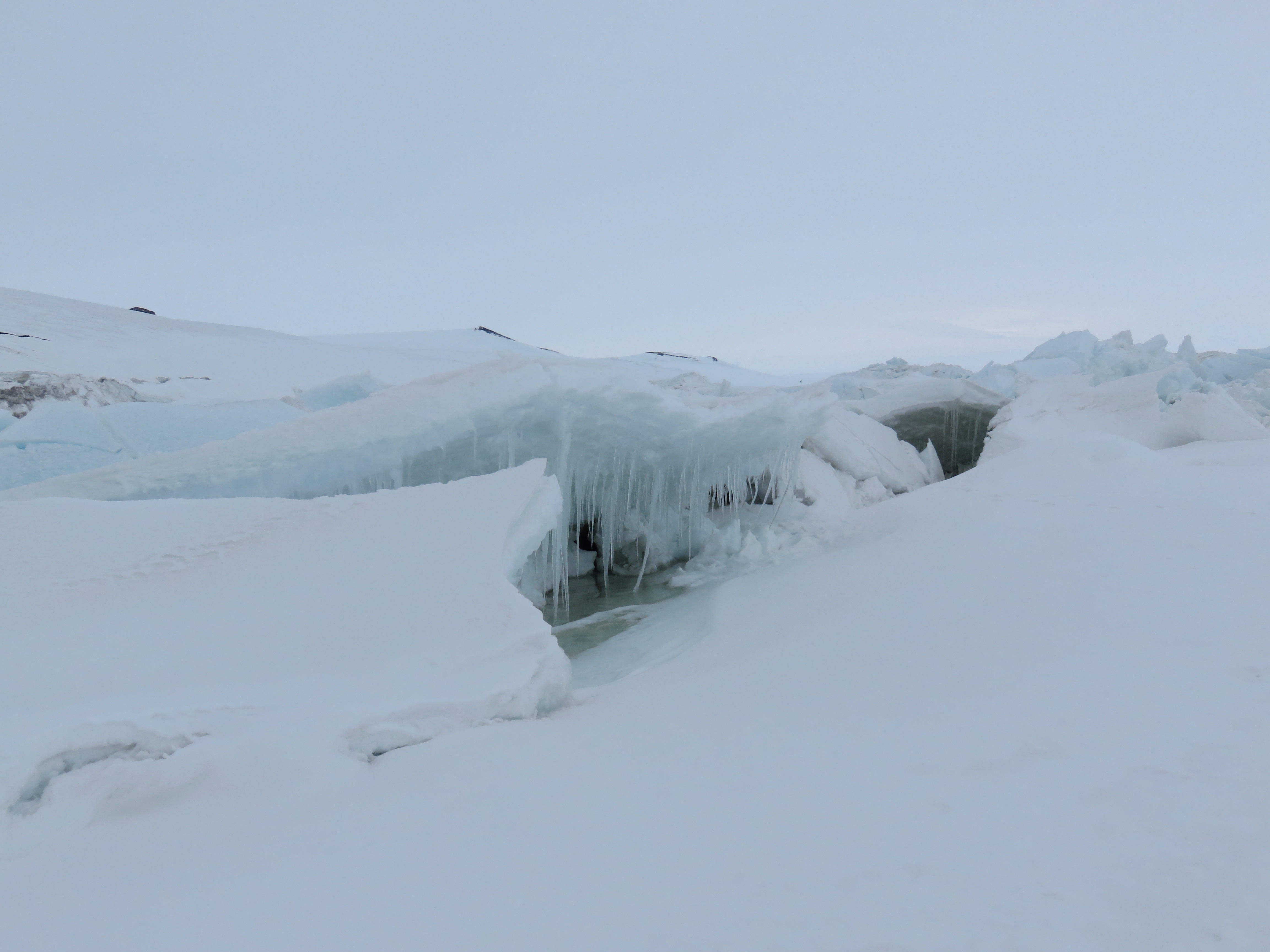
Poetry Shelf Theme Season: Twelve poems about ice

Photo credit: Alison Glenny

Some poetry books catch you on the first page and you get goosebumps and your breathing changes and you know this is a book for you. I felt like that when I first read Alison Glenny’s sublime The Farewell Tourist with its luminous connections to Antarctica. There is something about poetry that takes risks, that never loses touch with heart, is unafraid of ideas, and is able to sing on the line. You just want to camp up in the book for days, with a thermos of tea, and all your devices unplugged.

I felt the same way about Bill Manhire’s extraordinary poem ‘Erebus Voices’ (Lifted, Victoria University Press, 2005). You can read the poem at The Spin Off here and listen to Bill read the poem here. Thinking of Alison’s book and Bill’s poem, I knew ice had to be one of my themes.

Ice in poems: it might be a hint, a hurt, an underlying coldness, an icy image, a heart freeze, a trip to the snow-capped mountain, a melting ice-cream, an avalanche.

I am so grateful to all the poets who have supported my extended thematic poetry gatherings. Thank you.

The Poetry Shelf Theme Season runs every Friday until mid August.

In the morning the mountains beckon

Blue and clear like bells; glaciers feed upon

Light pouring from heaven brighter than ice-stone.

Ruth France (1913-1968), from No Traveller Returns: the selected poems of Ruth France, Cold Hub Press, 2020

Twelve poems about ice

Some afternoons a fog rolled down the hallway. On others, the staircase groaned with moisture. A finger laid carelessly on a bannister dislodged a ledge of rime. She lifted the hem of her dress to avoid the damp in the passageway, wore knitted gloves in the kitchen. She was lying in the bath when the glacier pushed through the wall. She sank deeper into the water to escape the chill that settled on her shoulders. Trying to ignore the white haze, to lose herself between the pages of her book.

Alison Glenny

from The Farewell Tourist, Otago University Press, 2018

He Manawa Maunga

We are dwarfed by a snow bank

that reaches beyond our eyes,

a single hole punctuating its white sheet.

Your hand covers my small eyes

and I feel you shielding me in the warmth of your jacket

as we move though.

I open them to a palace of ice and snow

meticulously carved by strangers

long gone down the mountain.

We sit together in silence,

deep in the mountain’s quiet heart.

Watching our breath melt away

the walls around us.

Ruby Solly

from Tōku Pāpa, Victoria University Press, 2021

Pencarrow Lighthouse

Mrs Mary Jane Bennet saw frost on the ground

circling the lighthouse where her children sleep.

At the cliff edge where wildflowers were,

gulls wash seafoam up the shore.

You, gulls, over hoofprints on the track,

over the dunes, over pearl beams ghosting

out from the lighthouse,

in your thousands over clean seashells.

The wind spins dead things in circles.

Collect up the wintertime, won’t you,

crack it on a rock,

drop it from a height.

But, you bird whose wing cuts the tops off waves,

shut your wings for the children

of Mrs Mary Jane Bennett.

Let loose a grey feather.

She will tuck it into the knot

of the blue satin ribbon

ion her eldest daughters hair, the one

who dreams of white things circling.

Nina Mingya Powles

from Girls of the Drift, Seraph Press, 2014

Wabi-sabi

I was thirty-three before I learned
people stuck in snow
can die from dehydration.
I would melt icicles
on my tongue for you, resist
the drinking down, drip it
into you. Then repeat, repeat
until my lips were raw.

Deep snow squeaks. We
stop on the Desert Road
because of the snow. You
throw snowballs at the
‘Warning: Army Training Area’ sign.
I take macro-photographs of
icicles on tussock.

When we drive up the Desert Road
we lost National Radio, we lose
cellphone reception, we lose
all hope. I was thirty-seven before
I considered not trying to always fix
things. I read an article in the New Yorker 
about wabi-sabi – the beauty in the
broken and the worn. The integrity
of the much-used utilitarian object.

But then there was another article
about a woman flying to Mexico
to be put into a coma
so she can wake up mended. It is 
like rebooting a computer, said the doctor.

Despite wabi-sabi, I want that.
To live in snow and not be thirsty.
I want good reception all the way
up the country. I want a shiny, clean
version of myself. Closedown,
hibernate, restart.

Helen Lehndorf

from The Comforter, Seraph Press, 2011

Girl Reading

She overhears the sound of things in hiding.

She bites an apple and imagines orchard starlight.

Each time she licks her thumb, its tip,

she tastes the icy branches,

she hears a sigh migrate from page to page.

Bill Manhire

from Zoetropes, Victoria University Press, 1981

Opa

They would ice-skate:

he worked the canals

with speed.

My grandparents,

between villages, on ice

above the level of the land.

*

Amsterdam in the fifties:

a row of white stone houses

on a paved street.

*

New Zealand’s blue sea

lapped at sloping shores,

knew its place

at the flank of land.

Wide stars, small shells,

the open span of sand.

*

A wooden villa 

changed you.

Housed you.

Those years of good

morning, goodnight,

pudding and bread,

climbing in

and climbing out of bed.

*

Your skates 

hang on the wall.

Blond varnished wood.

Braided laces.

Those blades, sweeping,

never shook off the ice.

Angela Andrews

from Echolocation, Victoria University Press, 2007

Island girl Tokoroa

ice-cream puddle licks bare feet

a sky so bright and blue

the sun rimming its yellow stain

make-believe it is summer

yet winter bites frozen fingers

gloves and scarves for some other child

in her hands she holds the key

a coin for lunch one Sally Lunn, miss

creamy pink-smothered bun

there is no word for luxury beyond

this daily walk in winter sun

she can almost taste it

morning flicks by chafing

children

head down she holds out her hand

winter may snow for all she cares

the skies can turn black

one Sally Lunn, miss

is heaven and blue

and forever

Reihana Robinson

from Her Limitless Her, Mākaero Press (Hoopla series), 2018

Ben Lomond  

Three people in the snow  

two linked by marriage  

memorising fault line  

                                         by fault line  


and every  now and again  the head of the summit  

tails in

     and out of sight  


three people with backpacks and knees in the snow  

threading the  mountains  with a silence   

that once broken   

would make you cry  


and every now and again  the head of the summit  

tails  in

     and out of sight  


like the early love of a  June morning  

first an accent  and  then the hearing  

and the sky is a blanket wishing it gone  


late  on  the  summit a sparrow  

whittling alone    

                              and away 

Modi Deng

from A Clear Dawn: New Asian Voices from Aotearoa New Zealand, eds Paula Morris & Alison Wong, Auckland University Press, 2021

Avalanche        

There was the war on TV,

the snow, the people lying on plastic

in the snow, death arriving

with his suitcase full of tools,

the delivery out of this world

offers such a dazzling

variety, and the snow, forever this

white tableau becomes forged

with the recollections of your last

oncology visit

and the people lying on the plastic

in the snow.

At the doctor’s I sat with

my tiny hands held in my lap the way

I’d been taught, two lovebirds,

but the flesh was as cold as sheet ice

I was up to my elbows

in frostbite and snow.

There were stories in the news

each day and in the morning paper,

death can happen overnight, may

be in your house if you don’t move

fast enough, in a trench, or

the dreadful football-stadium one,

under the trees in a dark

wood, against a hedge, or even lying

on plastic in the wan snow.

Such soft subdued footfalls,

but a goodly advance

over a long stretch of time.

Others shift their seats away from me

leaving a pencil

-thin cavity, a subtle margin,

but you and I are crouched

together in the snow reading the

avalanche instructions;

they are torn and dirty, tacked to

the cobwebbed wall of some

wild and woody alpine mountain hut:

Construct earthen fortifications

Behind your village. In the case

of serious exposure it is

best to wait for rescue dogs.

We must read the instructions

we must read the instructions

but there are no instructions

I believe there are no instructions.

Vivienne Plumb

from Avalanche, Pemmican Press, 2000

The Icicles

Every morning I congratulate

the icicles on their severity.

I think they have courage, backbone,

their hard hearts will never give way.

Then around ten or half past,

hearing the steady falling drops of water

I look up at the eaves. I see

the enactment of the same old winter story

– the icicles weeping away their inborn tears,

and if only they knew it, their identity.

Janet Frame

from The Goose Bath: Poems, eds. Pamela Gordon, Denis Harold, Bill Manhire, Vintage, Random House, 2006, picked Hebe Kearney

You can hear Janet Frame read ‘The Icicles’ here

At Home in Antarctica

In this place, silence has a voice
wide-ranging as the continent.
Some say it’s on the cusp
of madness, the way it hums
and stutters, mutters to itself
in quietest tones.

In this place, the universe brims.
Inside absence, presence.
Inside distance, dust
and our sleeping earth
dreaming beneath her thin blue
mask of ice.

In this place, the necessity
of memory, recollections
of a loved one’s face, shape
of laughter, weight of breath.

In this place, nostalgia
roams patient as slow
hands on skin transparent
as melt-water. Nights are light
and long. Shadows settle
on the shoulders of air.

Time steps out of line
here stops to thaw
the frozen hearts of icebergs.
Sleep isn’t always easy in this place
where the sun stays up all night
and silence has a voice.

Claire Beynon

from Open Book – Poetry & Images (Steele Roberts, 2007).

Suggested by Jenny Powell. The poem has also been a prompt for various musical compositions, including a piece Antarctikos by US composer, Jabez Co (2010) and The Journey Home (2012) for soprano, tenor, baritone, choir and orchestra by NZ composer John Drummond.

Visiting Rita at Sydney Street West

Wellington rains in a cross-hatch tantrum.

Wind blasts batter everyone backwards.

Lost in a volley of ‘after the hill second street right

follow your nose’ I have taken the wrong hill,

veering left with an eye on the clock.

Landmarks stream down my spectacles,

couplets of directions waterfall out of my head.

Lost in a valley of paper map ink-splash,

folds between us disintegrate. In the if-only world

my fingers wrap a hot cup of tea, my coat dries by your heater.

Sticks torn from moorings shoot down white-water gutters.

Wind race of paper packets eddies in high-speed gusts.

I am lost in solitary panic.

An onslaught of sleet freezes my face.

Jenny Powell

from Meeting Rita (forthcoming June, Cold Hub Press)

Angela Andrews lives in Auckland with her family. Her PhD in Creative Writing at Victoria University examined the relationship between medicine and poetry. She has previously worked as a doctor.

Claire Beynon is a Dunedin-based artist, writer and independent researcher. She works collaboratively on a diverse range of on- and off-line projects with fellow artists, writers, scientists and musicians in NZ and abroad. These group activities are buoyed and balanced by the contemplative rhythms of her solo practice. Websites here and here.

Modi Deng is a postgraduate candidate in piano performance at the Royal Academy of Music on scholarship. Currently based in London, Modi received a MMus (First Class Honours, Marsden research scholarship) and a BA from Auckland University. Her first chapbook-length collection of poetry will be part of AUP New Poets 8. Her poems have also appeared in A Clear Dawn (AUP), Starling, the Stay Home Zine (Bitter Melon Press), and on NZ Poetry Shelf for National Poetry Day. She cares deeply about literature (especially poetry, diaspora), music, psychology, and her family.

Janet Frame (1924 – 2004), born in Dunedin, was the author of thirteen novels, five story collections, two volumes of poetry, a children’s book and a three-volume autobiography. She won numerous awards including the New Zealand Book Award for poetry, fiction and non-fiction titles, and the New Zealand Scholarship in Letters. She received New Zealand’s highest civil honour in 1990 when she became a Member of the Order of New Zealand. She was awarded the Prime Minister’s Award for Literary Achievement in 2003 and was named an Arts Foundation Icon Artist in 2004.

Alison Glenny’s collection of prose poems The Farewell Tourist, was published by Otago University Press in 2018. A chapbook, Bird Collector, is being published by Compound Press in 2021. She lives on the Kāpiti Coast.

Helen Lehndorf’s book, The Comforter, made the New Zealand Listener’s ‘Best 100 Books of 2012′ list. Her second book, Write to the Centre, is a nonfiction book about the practice of keeping a journal. She writes poetry and non-fiction, and has been published in Sport, Landfall, JAAM, and many other publications and anthologies. Recently, she co-created an performance piece The 4410 to the 4412 for the Papaoiea Festival of the Arts with fellow Manawatū writers Maroly Krasner and Charlie Pearson. A conversation between the artists and Pip Adam can be heard on the Better Off Read podcast here

Bill Manhire founded the creative writing programme at Victoria University of Wellington, which a little over 20 years ago became the International Institute of Modern Letters. His new book Wow is published by Victoria University Press in New Zealand and Carcanet in the UK.

Vivienne Plumb writes poetry, short and long fiction, drama, and creative non-fiction. She held the Creative New Zealand Berlin Writing Residency in 2018, and has held several other writing residencies (both in N.Z. and overseas), and has been awarded the Hubert Church Prose Award and the Bruce Mason Playwriting Award, amongst others. Her work has been widely anthologised. A new chapbook of her poems will be released in July, 2021. 

Jenny Powell is a Dunedin poet and performer. Her work has been part of various journals and collaborations. Her next collection, Meeting Rita, is inspired by the artist Rita Angus, and is due from Cold Hub Press in June 2021.

Nina Mingya Powles is a poet and zinemaker from Wellington, currently living in London. She is the author of Magnolia 木蘭, (a finalist in the Ockham Book Awards and the RSL Ondaatje Prize 2021), a food memoir, Tiny Moons: A Year of Eating in Shanghai, and several poetry chapbooks and zines. Her debut essay collection, Small Bodies of Water, will be published in September 2021. 

Reihana Robinson is a writer, artist and farmer living in the wilderness of the Coromandel. She has written two collections, Aue Rona and Her Limitless Her, has had work published in Aotearoa, Australia, France and USA. She is a contributor to the Dante-themed anthology More Favourable Waters and the just published Ora Nui Māori Literary Journal New Zealand and Taiwan Special Edition.

Ruby Solly (Kāi Tahu, Waitaha, Kāti Māmoe) is a writer, musician and taonga pūoro practitioner living in Pōneke. She has been published in journals such as LandfallStarling and Sport, among others. In 2020 she released her debut album, Pōneke, which looks at the soundscapes of Wellington’s past, present and future through the use of taonga pūoro, cello, and environmental sounds. She is currently completing a PhD in public health, focusing on the use of taonga pūoro in hauora Māori. Tōku Pāpā, published in February 2021, is her first book.

Ten poems about clouds

A Poetry Shelf audio gathering: Dunedin poets celebrate Elizabeth Brooke-Carr (1940 – 2019)

Carolyn McCurdie introduces the reading

Carolyn McCurdie reads ‘When bright red was eclipsed by silver shoon’

Martha Morseth reads ‘On discovering your oncologist is a travel agent’

Jenny Powell reads ‘A spot on the map’

Maxine Alterio reads ‘The vein whisperer’

Claire Beynon reads ‘Poolburn’

Elizabeth Brooke-Carr (1940 – 2019) was a Dunedin poet, essayist, short story writer, teacher, counseller. Her writing appeared in newspapers, online journals and anthologies. She was awarded the New Zealand Society of Authors’ 75th Anniversary Competition and the Dunedin Public Libraries competition Changing Minds: Memories Lost and Found. She received a PhD from the University of Otago. Wanting to tell you everything was published by Caselberg Press in 2020.

Poetry Shelf review of Wanting to tell you everything

The readers

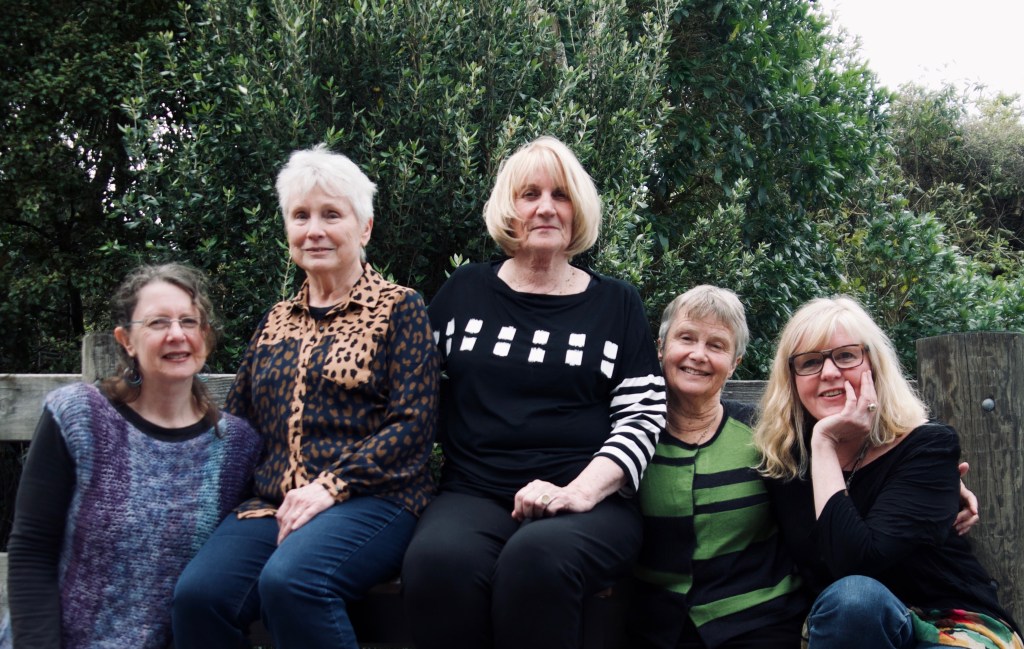
Jenny Powell, Martha Morseth, Maxine Alterio, Carolyn McCurdie, Claire Beynon

Maxine Alterio is a novelist, short story writer and academic mentor. She has published four works of fiction and co-authored a textbook about learning through reflective storytelling.

Claire Beynon lives in Broad Bay. An artist and writer, she works on a range of collaborative, interdisciplinary projects balancing group activities with the contemplative rhythms of her solo studio practice. She’s in the slow process of completing a second collection of poetry.

Carolyn McCurdie is a Dunedin writer of poetry and fiction, especially speculative fiction. Her poetry collection Bones in the Octagon was published by Makaro Press in 2015.

Martha Morseth has written articles for More Magazine and the NZ Woman’s Weekly since l982, and poems for The Listener, Landfall and other literary New Zealand magazines. She has published two collections of poetry, three collections of short stories and plays for high school English classrooms. She came to New Zealand in 1972 with her husband and two daughters.

Jenny Powell has published seven individual and two collaborative collections of poems. She is part of the touring poetry duo, J & K Rolling, and is the 2020 RAK Mason Writing Fellow.

Poetry Shelf review: Elizabeth Brooke-Carr’s Wanting to tell you everything

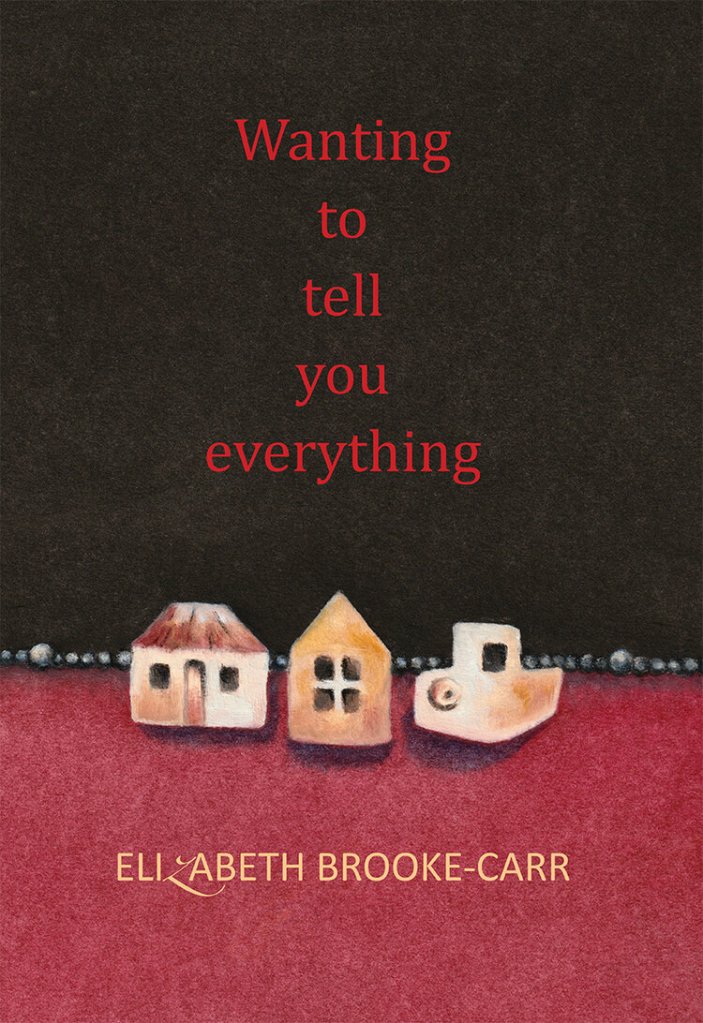
Wanting to tell you everything Elizabeth Brooke-Carr, Caselberg Press, 2020

Upright


Our kitchen table was perfect for a family of four with Protestant

leanings. Solid and square, legs sturdy as posts, set between window

and woodstove, it kept the faith, never moved, wore no adornments

except for a gingham cloth laid before a meal, on the diagonal,


triangles of polished wood showing bare at the corners like our

father’s elbows through the worn wool of his gardening jersey.

Afterwards the cloth was shaken out over the back lawn, and if

unspotted, folded away on the same crease lines for next time,


chairs slid in, chaste, ribs against the unyielding edge so they

scarcely dared breathe. But if you sat there alone at night with your

homework, undisciplined thoughts wandering through your verbs,

there might be a sudden creak, a sly shift in the air around the table,


a loosening of values as chair legs brushed against each other and

laughter scraped the linoleum. And if you shut your eyes you might

hear flakes of gossip peeling off the cracked cream paint, history

you thought forever sealed in grainy wood, being whispered low like


bedtime prayers destined to be heard in heaven; a pair of Edwardian

spindlebacks, gifted from a well-married aunt careful with vowels,

exchanging memories of refinement and silver service in a designated

dining room, a ladderback, in darker patois, telling tales of neglect


in the cellar of a second-hand shop, and the bentwood, rescued

from the tip, singing our father’s praises for the number eight wire

he’d twisted around its legs to keep them from growing crooked,

as sure as God’s grace and the metal brace on my teeth.


Elizabeth Brooke-Carr

Elizabeth Brooke-Carr (1940 – 2019) was a Dunedin poet, essayist, short story writer, teacher, counseller. Her writing appeared in newspapers, online journals and anthologies. She was awarded the New Zealand Society of Authors’ 75th Anniversary Cmpetition and the Dunedin Public Libraries competition Changing Minds: Memories Lost and Found. She received a PhD from the University of Otago.

Elizabeth’s posthumous debut collection has arrived in the world thanks to friends and her writing group,: Maxine Alterio, Claire Beynon, Martha Morseth, Carolyn McCurdie and Jenny Powell. The cover features Claire Beynon’s painting of Elizabeth’s favourite necklace. Mary McCallum provided editorial assistance, Paul McCallum production assistance. The book itself is published by the staunch supporter of poetry, Dunedin’s Caselberg Press. It is so heartwarming to see this group of poets and poetry fans bringing this book, and thus Elizabeth’s poetry, to our attention.

Last year, when I hosted my Wild Honey event in Dunedin, Elizabeth had just passed, and as much as the event was a celebration of women writing poetry in Aotearoa, it was the celebration of a particular woman. It felt both special and fitting. The more we shine the light on women writing, and the women who have written, the more we enrich our poetry communities, as both readers and writers.

The collection’s opening poem ‘Upright’ holds a kitchen table for our close attention. It is the place of family experience, a repository of history and anecdote, celebration and loss. The table is so present I want to reach out and stroke it. Maybe because the details are nostalgic; the gingham cloth set on the diagonal leaves wood patches reminiscent of ‘our / father’s elbows through the worn wool of his gardening jersey’. The table, like family history, is lacework in its prolific gaps. The speaker was once at the table with homework dreaming, and from that moment, I am carried across decades of secret musings that filled the writer holding the pen.

The joy in reading Elizabeth’s poetry is in part the way the poetry gifts you a joy in life: the joy you find in moments from the past, your kin, beloved places, friendship. More than anything her writing ink is fuelled with love. To read these poems, at this particular time, with such uncertainty and global loss, both global and local, is of the greatest comfort.

The poems are light-footed, with honey currents and patches of shade. I am reminded that close friends arranged the collection’s order. They have done a good job; we move from the kitchen-table hub through various scenes and connections to perhaps the last poems she wrote before she died. People and places are paramount: this is poetry that gathers together life, from the speckled past to the endangered present:

We arrived in the future, unpacked, folded the years

away into our own small histories. Now, my family

gone, I look back on the life-stained map


with the rusty pins that marked our meanderings,

my finger trails over mountaintop folds,

into valley creases, tracing the journey home


from ‘A spot on the map’

The movement that shapes the poems is so appealing; it builds mood, presence, absence, surprise. I find myself constantly moved as I read, drawn into the surprising notes that ring out in the endings. Moments are recovered and translated into poetry. I adore these. In ‘Out of the glare’, a couple go for a drive in the countryside and eat at the Wobbly Goat. The ending catches so exquisitely:

Dazzled by a low ray of sunshine on silver,

he slid the spoon sideways out of the glare,

laid it in the curve of hers.

Over the page a poem deposits me in the sensual shimmer of Bannockburn, and again it is the poem’s ending that grips:

At the base of the hill you leap from the stile

arms thrown wide like ropes tossed to my bollard.

Your mouth tastes of sunshine.

Your palms smell of bruised thyme.


from ‘Bannockburn sluicings’

Mood is such a potent ingredient – mood that is subtle and steady in growth. Poems reach towards beloved family and friends who have departed. Like a deep kernel, like an origami bud, this skillful handling of feeling is why I keep reading and why I will read this book again. The poem, ‘Gardening in the rain’, is a way of remembering, of recalling a goodbye kiss to a brow. In the opening lines the speaker is ‘digging deep / for the sound of your voice’, while in the last lines ‘My claggy spade / sticks to the soil’. So much unsaid. So much felt. The image of the claggy soil and the effort to dig so heart-breakingly sharp.

Love is equally significant in poetry that embraces both the economy and richness of everyday life, and why the personal can be so resonant. ‘Poolburn’ is written in old age (‘All the days of our youth are behind us / dust spiralling back along old roads traversed’) and again the couple is driving though beloved southern countryside. It is as though people don’t exist without place, and place is made vibrant and vital through the eyes of those in the scene. This is a love poem. A beautiful, slow pitched, breathtaking love poem. Again the layers, the scent, the texture is resonant. Like a piece of music, like a song perhaps by Nadia Reid or Reb Fountain you want on replay, this is a poem to read at intervals throughout the day. Here is the ending:

When the sun sinks and the light fades

purple shifts among the rocks, wild geese arc

in an amethyst sky, ruby veins line the face

of the lake. You come indoors, sit by the window.

Dusk has gathered you in.

The final section of poems were written from Elizabeth’s death bed. She is writing from terminal illness, nearby death, with her small revelations, her rage and her equilibrium. Perhaps writing is a way of living, of bearing treatment, a changing body, the changing future, a way of sharing what is difficult to decode. The final poem, ‘Wanting to tell you everything’, presents a phone call to a beloved, another moment, larger than life, urgent with feeling, subtle with the unsaid, using a moment of physical beauty (a rainbow stretching across the sky ’embracing everything that soars – light and sound and thistledown’) to summon so much more than the words on the page. The final lines – of the poem, of the book, of a life – unfold and refold, unfold and refold, and poetry is a way of breathing. Necessary. Exquisite. Blood boosting.

Your television in the background talks to itself.

While you turn the volume down, I wait.


Yes, I’m still here. I’m still here and wanting,

wanting to tell you everything.

Elizabeth’s poetry reminds me of the joy of reading Elizabeth Smither, Cilla McQueen, Ruth Dallas, Jenny Bornholdt, Bernadette Hall. I am drawing Elizabeth Brooke-Carr into the house of Wild Honey: she belongs there, with her honeyed currents, her uplifting translation of life into poetry, her wisdoms and her poetic finesse. Poetry can do so much. This book is a gift.

Caselberg page