
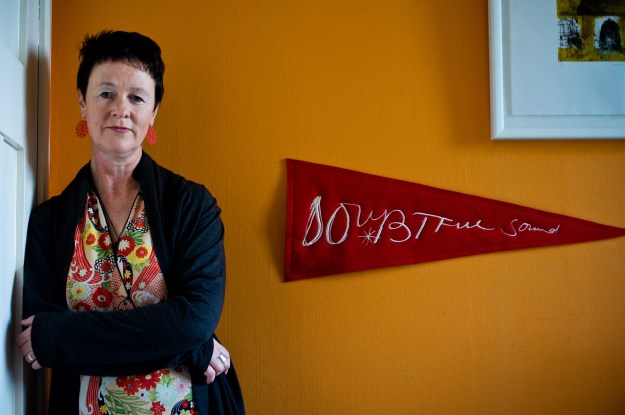
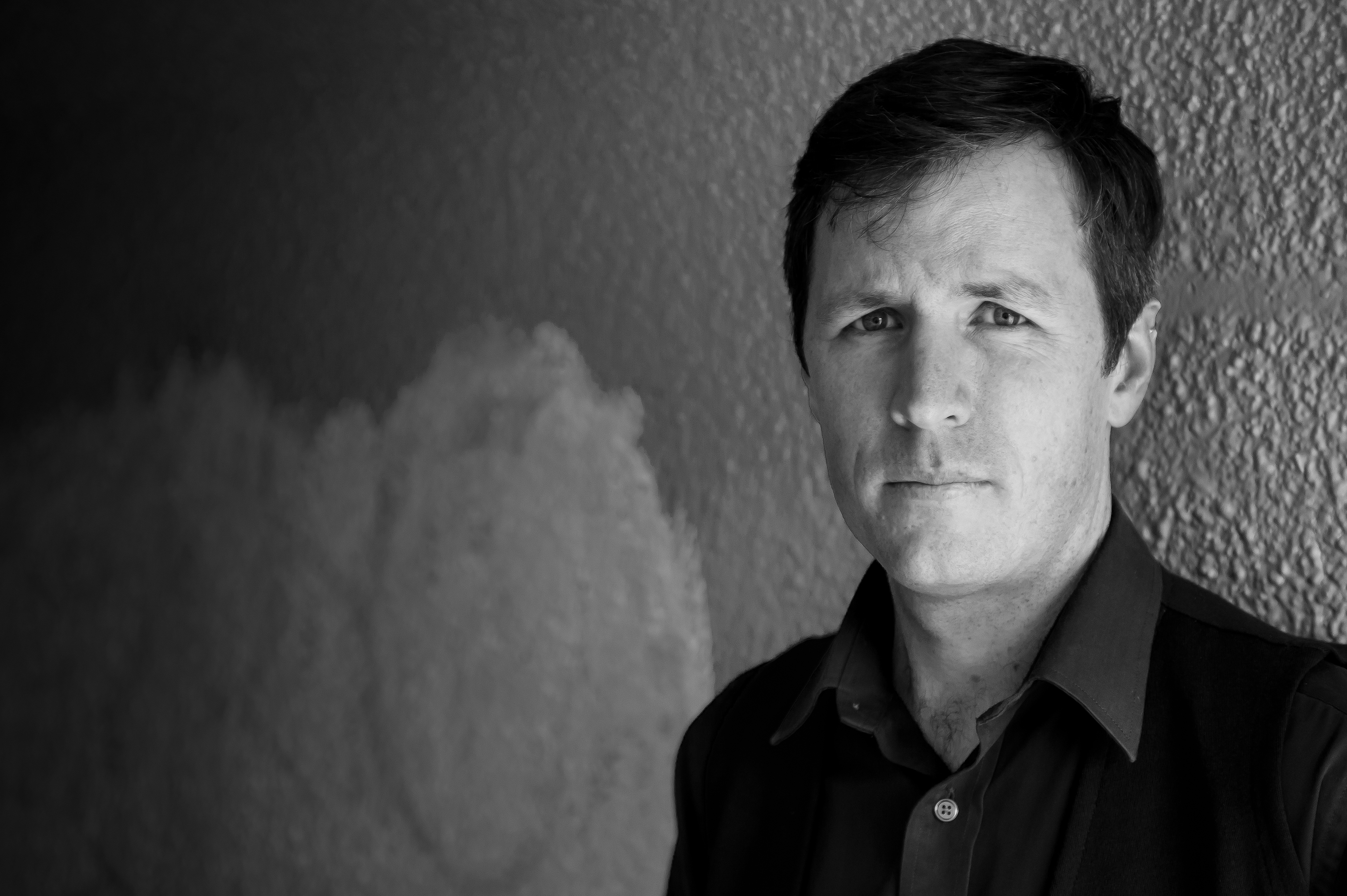
Photo credit: Robert Cross
How the song will wait
no matter how long,
how high the moon
or tower, however dry
the seed or flower —
the song will raise you.
from ‘Spell for a child to remember’
Chris Price is the author of two previous poetry collections (Husk, The Blind Singer) and a generically playful collection of biographical anecdotes ( Brief Lives). Her debut collection won the Jessie Mackay Award for Best First Book of Poetry (2002). She now teaches Creative Writing at the IIML at Victoria University. Previously, she had stints editing Landfall and coordinating The International Arts Festival’s Writers and Reader’s Week in Wellington. Her poetry pleasingly follows its own course, as though this poet is not beholden to passing trends. This originality cements her place as a unique and important voice in New Zealand poetry. I got to hear Chris read from her new collection, Beside Herself, at CK Stead’s recent Laureate events in Napier and I came away feeling these edgy poems that hit both shadows and light were her best yet. I could hear the audience appreciating the utterly satisfying pitch of the poems with their oohs and aahs.
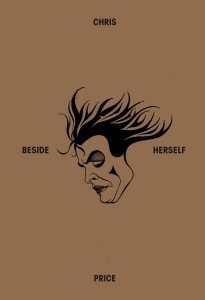
Beside Herself Chris Price Auckland University Press 2016
To coincide with the release of the new collection, Chris agreed to an interview with Poetry Shelf.
Did your childhood shape you as a poet? What did you like to read? Did you write as a child? What else did you like to do?
My family were great readers, and bedtime stories were big for me – eventually some of the stories were on LPs, which my parents would put on when I went to bed, to be summoned back with an imperious call of ‘Other side!’ when the LP needed to be turned over. The Count of Monte Cristo is one I remember. Because my brother and sisters were quite a bit older than me, I spent a lot of time as a kind of only child. When I had to go out with my parents on shopping trips or to visit their friends, I was always happy as long as I had a book. I wasn’t one of those who started writing early, though.
When you started writing poems as a young adult, were there any poets in particular that you were drawn to (poems/poets as surrogate mentors)?
I said my family were great readers, but that didn’t generally include poetry. I can remember two main strands that had a hold of me in my teenage years – one was Japanese and Chinese poetry, which I found in the public library, and the other was the poetry I was taught in school – Keats and Shakespeare, mainly. If we ever read New Zealand poems in the classroom, I don’t remember it – perhaps a bit of Denis Glover, which I didn’t really connect with at that age. But I did have a teacher in the fifth form who later published a book of poems himself – perhaps his enthusiasm was influential, although we also mocked his beard-stroking in the classroom. My sixth form teacher (Sandra Coney’s sister) encouraged me to enter a school poetry award judged by Lauris Edmond, in which I received a ‘highly commended’. Later, I read Lauris’s poem ‘The Pear Tree’ in the Listener, and wrote to her asking where I might find a copy of the book (that’s how clueless I was). She sent me a copy, which I still find quite extraordinary. Those small moments of encouragement or being taken seriously can be quite disproportionately important early on.
That is so lovely. My intermediate teacher was a poet who ended up in The Big Smoke anthology. They couldn’t trace him so I read his poem. It felt very spooky. He was like a little epiphany. Did university life transform your poetry writing? Discoveries, sidetracks, peers?
Oh, utterly. I hadn’t really encountered much contemporary poetry before university, so everything came as a revelation, and lectures on poems by Blake, Rilke, Stevens or Curnow or Rich must have taught me something about the intense pressure the best poets bring to bear on language. I do think everything you take in at that age becomes a kind of compost for your later writing life, so it’s important to take courses that involve direct encounters with great writing. I’m not a great believer in doing an undergraduate degree that consists of nothing but creative writing workshops. That said, having the peers and encouragement of a writing workshop (I was in the first writing workshop taught by Karl Stead) cemented the idea that poetry was something a person could do. It took quite some time, nonetheless, before I rediscovered the courage to give it a go after university. Somehow I hadn’t acquired enough belief in my capacity to do it well to keep going at the time, but the idea of writing hung around until it seemed necessary to put up or shut up.
The massive sidetrack of university life was music, but that’s another story.
Are there any theoretical or critical books on poetry that have sustained or shifted your approach to writing a poem?
On the whole, I am challenged, educated and sustained by great poems first, and criticism second. Theory and criticism can help move poetry along when it seems to be getting stuck or stale, but it can also generate flat writing. But I do find it exhilarating to watch a great reader unpack how a particular poem works. Poems thrive on a mix of conscious and unconscious knowledge and craft, I think.
What poets have mattered to you over the past year? Some may have mattered as a reader and others may have affected you as a writer.
Last year was prosaic. I forbade myself the pleasures of poetry in order to finish researching a book about a poet. So obedient was I to the ban that I didn’t write a single poem last year, and didn’t read a great deal of poetry either. It’s a pleasure to be return to reading it in 2016: it’s a great pleasure, for example, to have a new book from Andrew Johnston, and it’s looking like it will be a big year for NZ poetry.
What New Zealand poets have you been drawn to over time? What international poets?
I tend to admire poets and poems that have qualities I lack and envy: humour (James Tate, James Brown), surrealism and strangeness (Charles Simic, Greg O’Brien), or that sense of fundamental human decency that can’t be faked, and that emanates from poets such as Jenny Bornholdt and Rachel Bush. At various points in the past, Robert Hass, Anne Carson and Alice Oswald have been important to me. At the moment I am a little more interested in what I can learn from the poets in the generations after mine than those who come before, but Bill Manhire’s ability to leave room in his poems for the reader to roam around in offers a model I continually fall short of. I never quite get to the bottom of what they are doing.
Your poems always make delicious demands on the reader – the ideas borne along finely crafted lines, the well tended gaps, the dazzling sound. What are key things for you when you write a poem?
Listening for and being led by the music of the poem has always been central – to the extent that I now feel as if I may need to break the hold of that aspect of poetry to some degree, because it has begun to feel like my default setting. I started (affectionately) calling some of the poems in this book my ditties and jingles — meaning that they have had unabashed fun with quite strong rhyme or assonance. I don’t necessarily want to acquire the habit, though. I never went looking for rhymes, but it seems they came looking for me.
You spent 2011 in Menton as the Katherine Mansfield Fellow. Your new collection, Beside Myself, does not re-present physical traces of France to the degree I have spotted in some Mansfield Fellows. However, it does open out to the world, to the way the world is carried in one’s head. What difference did Menton make to your poetry, and to this book in particular?
Well, there is a whole journal of the time in Menton, written in poetry and short bursts of prose, that registers the physical traces experience in quite minute detail, as well as thinking about what I was reading there. It was my guilty pleasure to begin each day at the writing room – where I was working on the prose book I mentioned earlier – by warming up with some writing in this journal, which threatened to become a kind of pleasurable avoidance strategy, albeit one sanctioned by the terms of the Fellowship, or so I thought. But really I began it because I wanted to register the specialness of the experience on a granular level, and I knew that it would flee from me in future years if all I did was take photographs of where I was, while writing about elsewhere. In a way it’s the written equivalent of a photo album.
A number of the poems in Beside Herself are lifted from that journal. I spent a lot of time in the galleries up and down that coast that are the legacies of the Modernists who lived and painted there: Picasso, Matisse, Chagall, Bonnard, Cocteau. And in some of the galleries in Paris and Rome and Oxford, which I also visited on that trip. The sequence ‘Museum Pieces’ is a record of encounters with some of the artworks I saw that year. And the little poem ‘Appreciation’ emerged at the end of my morning walk to the writing room in the Villa Isola Bella, on which I would often listen to podcasts. In this case it was a Poetry Foundation podcast that gave me the opening line of the poem.
In a short review of your book (forthcoming for Fairfax), I suggested reading your new book was like entering a poetry thicket and that I wasn’t quite sure what would emerge from the light and dark. It felt like all manner of characters inhabited these woods. I loved this playfulness. What did character and shifting personae mean to you in these poems?
Persona here has often meant a chance to unleash aspects of personality that don’t see daylight otherwise – a little dash of crazy, a pinch of furious, and a dash of self-loathing on the one hand, and a bit of song and dance and delight on the other. And then there are a few figures I think of as marionettes, or Punch and Judy figures, larger than life rather than realistic. I wanted to write poems that avoid the pretence of wisdom.
I love the way you can refresh a well-worn subject, such as you do in ‘Abandoned Hamlet.’ Again character seems crucial. This is such a kaleidoscopic book of people. What kind of characters are you drawn to?
I suppose I have always been interested in monsters. Also the ‘damaged goods’ of humankind: very early in my writing life I began writing people who could be described as outsiders with redeeming characteristics, or magnificent failures. I don’t know where that comes from. Some of the characters in this new book seem to be irredeemable, though, which may have something to do with a pessimism about human nature that has increased as I’ve got older. Others are more vulnerable beneath the surface.
Language choices are vital, but as I read your characters, empathy is close at hand. What matters in the how of writing them?
My interest is in trying to inhabit and understand rather than judge. The first person is perhaps a more troubling but vivid way of doing this.
For a time when I was in my teens I thought I would like to be an actor, and it’s true that, like many actors, I like to hide in other people’s clothing. I just do my acting on the page. There’s a recent poem by Will Kemp that expresses this impulse quite neatly.
I especially loved the sequence that features Churl. The detail is sumptuous. He gets under your skin.
Churl remembers every
curse and kick that sent him
on his way to this outskirts hut
where even his damp fire
wants to smoke him out.
from ‘The Book of Churl’
Where did the starting point for this poem come from?
I wanted to write a sequence featuring a single character, like Hughes’s Crow or Berryman’s Henry. I covet the fierce energy of language and attitude in those sequences, but of course I am no Hughes (and a good thing too), so the character who arrived was a much gentler, if still flawed, anti-hero. The poem’s language world is influenced by the Anglo-Saxon alliterative tradition, which probably goes back to hearing Seamus Heaney reading his translation of Beowulf on the radio in the late 90s and being entranced. To me the Anglo-Saxon part of the English language is a bit like raw protein – it does the most basic work of being human. (Although readers will find that the poem is not absolutely rigorous about excluding Latinate language, I decided not to fight it if the poem seemed to need it.)
The experience of writing Churl was a bit like what certain fiction writers talk about when they refer to hearing a voice and simply writing it down. I wrote most of it over a period of ten days or so when found I could sit down each morning and simply re-enter the voice world of the poem as if it was there waiting for me to step into it each day. About two-thirds of it flowed out quite easily this way – the final third was harder. I am fond of Churl, who despite his poor manners and outsider status has a rough kind of virtue that I find attractive. One of my redeemable outsiders.
Indeed. I am fond of this character too. There are so many poems that elevate this collection into something special. I particularly liked the poem that tweaks the title of the book. Here the pronouns are particularly slippery, but the magnetic core is a simmering fusion of revelation and invention.
Step sideways.
Now look back
at whatever’s
left standing
in your shoes.
What looks
is reduced to the size
of a bird’s-eye
chilli, hot and salty
staring back at that bonesack
that functions as yourself.
from ‘Beside Yourself’
Are you cautious about self-exposure as a poet?
If poems emerge, as the American poet Peter Gizzi suggests, from a combination of one’s autobiography and one’s bibliography, then my writing has probably leaned more heavily on the bibliographical. It has been said of my previous work that I am, to a considerable degree, not present in it.
I began writing with a conviction that my life doesn’t make for interesting reading, a position that has both disabling and enabling aspects for a writer, as I have gradually come to realise. I am still a believer in following the demands the poem makes, and I don’t often sit down with a desire to write about something that has happened to me. Writing and revising a poem is an act of listening for the possibilities the language offers, rather than a transcription of pre-existing experience, so fictions arrive fairly quickly.
That being said, ‘Beside Yourself’ (not strictly speaking the title poem, as the pronoun takes a sideways step between one and the other) deliberately entertains the confessional, and sets out to lose some composure, both formally and personally. I also had in mind Jenny Bornholdt’s infinitely calmer and more measured poem ‘Confessional’ and its remark, about the world not having had much time for personal poetry lately, along with my own sense that the first person had become profoundly unfashionable, even embarrassing, in certain quarters of American poetry.
On one hand all writing is, in a sense, autobiographical. On the other, if a poem does deploy autobiographical information, it had better be in the service of something larger than oneself. I have a t-shirt from American musical duo The Books with the slogan ‘Freedom from expression’, which is a slogan I march under in life and in the workshop.
Which poem really worked for you?
Aside from Churl, whose creation seems a little bit magical, I am still pleased with ‘Tango with Mute Button’, at least half of which was written in my head while the scene at the gym it describes was actually happening, so that I had to keep repeating it to myself then run off to write it down asap! It might be the most autobiographical poem in the book. And ‘Spell for a Child to Remember’, which is a kind of verbal antidote to the darker currents of the book.
Leo Bensemann’s drawings fit the book perfectly. What sort of connections do you see between them and your poems?
I was initially drawn to the fierceness of the mask on the cover, which seemed to catch the tone of some of the book. But when I went back to Peter Simpson’s book about Bensemann, to make a copy of the mask to send to AUP, I realised that some of the other images in the Fantastica series also caught different aspects of the book – the rather combative relationships, the impotent fist-shaking of Churl at the powerful, the broken gallows and hangman’s noose that register the destructive or self-destructive aspects of ego, and the contrasting freshness, self-possession and charm (in the magical sense) of the Little Witch.
I also love the way little (or bigger) lists make their way into your writing. What is the allure of a list?
A list is elaboration
and incantation.
It calls up devils or angels,
constructs clockwork mice or pavlovas.
It can be funny, or furious,
insouciant or obsessive,
and sometimes both
at once. It can underline
or undermine itself.
List lives on
repetition
and variation.
The road of excess leads
to the palace of wisdom
except when it leads to A&E.
Tell me about the title. There are so many meanings. It suits the way you step into the poems and then step out of them to tilt everything. There is you, and then there is so much more. There is internal confusion, almost like a little fit, and then there is the holding at bay (alongside) of self.
The title points two ways. ‘Beside’ in the sense of ‘as well as’ or ‘in addition to’ celebrates the chance to be someone else on the page. But ‘beside herself’ in the more obvious sense of being out of control, and also conscious of that fact, which can be an almost out-of-body experience.
What irks you in poetry?
Lack of urgency. One question I have heard Fergus Barrowman ask of a poem sums it up: ‘Is your journey really necessary?’ Humourless experimentalism (as opposed to the playful kind, which I often love).
What delights you?
A poem that is like Dr Who’s Tardis – bigger on the inside than it appears from the outside, and likely to take me somewhere both strange and mysteriously familiar.
Some poets argue that there are no rules in poetry and all rules are to be broken. Do you agree? Do you have cardinal rules? Do you have rules you particularly like to break?
I am reminded of something the poet Frederick Seidel said in his Paris Review interview: ‘I like to hear the sound of form, and I like to hear the sound of it breaking.’ For any given rule there’s probably a successful piece of writing that breaks it. But that’s different from saying anything goes and sanctioning lack of control. It’s handy to try playing by a fair number of the rules at first, to figure out why the ‘rules’ have become the ‘rules’ before you experiment with breaking them. As time goes by, a cardinal rule your poems have lived by might just stop being useful to you for a time. Compression might come to seem cramped and narrow, expansiveness may become saggy and lacking in energy. Music might become cage rather than liberation.
Do you find social media an entertaining and useful tool or white noise?
Both.
The constant mantra to be a better writer is to write, write, write and read read read. You also need to live! What activities enrich your writing life?
Listening to music and making it, looking at paintings, photographs, modern dance: wordless art forms are the most enviable and the most soothing, but I also get poems out of the Film Festival. Conversations with people who are more psychologically acute, more generous and funnier than I am. Getting out into the natural world as a counterbalance to all that reading.
Finally if you were to be trapped for hours (in a waiting room, on a mountain, inside on a rainy day) what poetry book would you read?
That might be a good moment to fill in a gap in the classics. The list of things I ought to have read will always be too long, but Dante (who I’ve only read in part) would be near the top, despite the fact that I am a bit allergic to traditional religion. Or the epic of Gilgamesh, or the Icelandic sagas… So much to read, so little time.
Thank you Chris.
Auckland University Press page
My Fairfax review


 NZ Poetry Shelf