

Auckland University Press and The Women’s Bookshop
warmly invite you to the launch of Night Horse

Please join us in celebrating the launch of Elizabeth Smither’s new poetry collection, Night Horse.
6.00 pm, Tuesday 20 June 2017
The Women’s Bookshop
105 Ponsonby Road
Auckland
Please RSVP by 18 June.
Email books@womensbookshop.co.nz or phone (09) 3764399
Auckland University Press


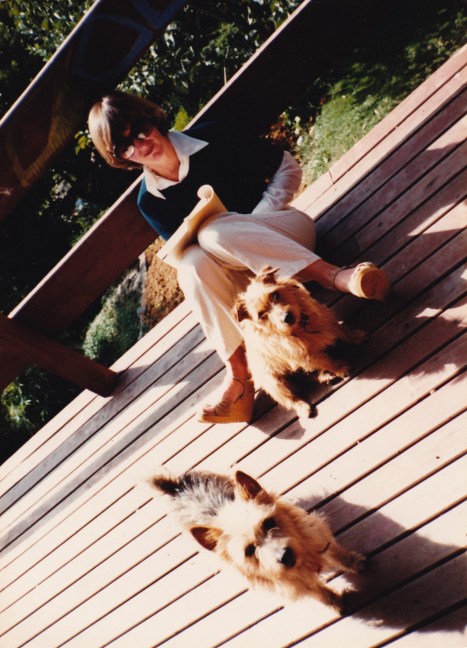
With Donna in Berlin, New Year 2013/14.
You have to start somewhere
in these morose times,
a clearing in a forest say,
filled with golden shafts of sunlight
and skirmishes. A little later
your itinerary will take you past
weathered churches on plains that stretch
as far as the eye can see.
from ‘The lifeguard’ in The Lifeguard (2013) and Selected Poems
To celebrate the arrival of Selected Poems (Auckland University Press, 2017), Ian Wedde agreed to talk about poetry with me.
Born in Blenheim (a twin of Dave) in October 1946, Ian has lived in Bangladesh, England, Jordan, France, Germany, now lives in Auckland with his wife Donna Malane, a screen-writer and novelist, they have five children and five grandchildren, has published seven novels and sixteen collections of poetry as well as books of essays and assorted art books and catalogues. Most recent book is Selected Poems (AUP, 2017) with marvellous art work by John Reynolds. New Zealand poet laureate 2011-12, Prime Minister’s Award for Literary Achievement (poetry) 2014.
Cover and internal art work: John Reynolds
The Interview
PG: Did poetry feature in your childhood? What activities delighted you as a young boy?
IW: There wasn’t a lot of poetry in my childhood, though my father chanting John Masefield’s ‘Cargoes’ as he rowed across Waikawa Bay in the Marlborough Sounds was memorable – the rhythm was right but the words were deeply weird to me, which was what I liked.
Quinquireme of Nineveh from distant Ophir,
Rowing home to haven in sunny Palestine,
With a cargo of ivory,
And apes and peacocks,
Sandalwood, cedarwood, and sweet white wine.
PG: What were some key influences when you first started writing?
IW: A link between the deeply lost-in-it world of reading stories and the hypnotic secret ecstasy of writing things, or trying to. Also the fascination of not understanding either what I was reading sometimes (I happened on Browning’s ‘Sordello’ by accident) or why writing was so mesmerising. Also Kipling, because of the poems associated with the Jungle Books, which I was addicted to.
PG: Or at university?
IW: At university I was obsessive about getting my hands on contemporary American poetry after or off the shoulder of the great modernists – post Pound-and-Eliot if you like. Post-Beats, for that matter. William Carlos Williams above all, though of course Spring and All and Kora in Hell were published in the 1920s – but those early books like Spring and All and Kora in Hell incorporated prose and poetry, they seemed to be experimental and interesting in ways that the accredited modernist masters were not. I loved Williams’ humanity and love of sparrows and weedstalks, but also the marvellous delicacy of thought that articulated his lines. Robert Creeley was important, his frugal counterpoint; Denise Levertov’s makeover of the exhausted lyric; Gary Snyder’s ecological ethic that made for a new kind of eclogue; Frank O’Hara’s urbane vernacular and before long Ted Berrigan, especially Berrigan’s Sonnets. John Ashbery’s ‘The Tennis Court Oath’ amazed me. Also French poets, but always sheeting back to Rimbaud. Pablo Neruda in bulk, his marvellous relish for the sensuous world and its political demands on our responsibilities. Elizabeth Bishop’s The Complete Poems. John Wieners because he broke so many rules without showing off.
I study my son’s face, to treasure it.
Each day (now, & now) it’s changed & I’ve lost
what I love, loved.
from ‘Paradiso Terrestre’ in Earthly Sonnets for Carlos (1975) and Selected Poems
PG: The birth of your first son prompted Earthly: Sonnets for Carlos. While some New Zealand men have written fatherhood poems (notably Graham Lindsay) I cannot think of another extended sequence such as yours. The prolonged contemplation allows greater complexity when facing what might at first seem unsayable – the miracle of a new-born baby. Did your son’s arrival throw your relationship with writing in the air?
IW: I usually threw my infant son in the air. It was a time of wonder. I also walked around with him quite a lot at night, those rhythms shaped how I thought and how the poems moved.
PG: What draws you to the longer sequence?
IW: A disinclination to get to the point in timely fashion or to admit there is one worth ending with. There are dear friends whose conversations and phonecalls I love because they do go on. Mostly I like giving in to the drifts and swerves of language that takes me to places I can’t get to by intention. A tendency rapidly to lose interest in the self-centred, anecdotal lyric in which a certain kind of modesty often strikes me as sham.
PG: Have other things elbowed your writing—refreshed, transformed, derailed, sent askew in good ways, sparking in new directions? A book or theory or idea or chance encounter or unexpected experience?
IW: Probably art more than anything, and music. The ways in which our perceptions of phenomena trigger thought I find fascinating and seductive. I’m an easy weeper – I’ve been known to sniffle during the opening credits of movies just because it’s so amazing that we can do this stuff. I love art in its many guises because at its best it can be so capable of subversion – of subverting representation as mimesis, subverting personal testament, or markers of class and taste – and because at its worst it can be all those things, and boring to boot, especially as cultural capital. Music perhaps because it’s just off the camber of what language does in poetry, unless of course we’re talking about poets as song-writers, that fabulous ancient lineage. During the time I spent in Jordan in 1969-70 the poetry of Mahmoud Darwish and others was a revelation – how it had a vast, loyal, politically disenfranchised radio audience of Palestinians and at the same time reached deeply into classical histories, reached the audiences of the Egyptian singer Oum Kalsoum and spoke to intellectuals such as Edward Said.
(..) If trees &
suchlike don’t tell on me I understand
my son will & soon, too. His new blue eyes
see everything. Soon he’ll learn to see
less. O the whole great foundation is sand.
But the drought has broken today, this rain!
pecks neat holes in the world’s salty fabu-
less diamond-backed carapace & doubt comes
out, a swampy stink of old terrapin.
What shall I say? ‘I hid nothing from you,
but from myself. that I dream, little one,
from ‘for Rose’ in Earthly Sonnets for Carlos (1975) and Selected Poems
PG: For me Sonnets for Carlos is a collection imbued with love deep within the roots of the line. Yet when I regard the expanse of your writing across the decades, love seems to be an active ingredient whether it is for the dead poet Horace, blistered peppers on the hot plate, the beauty of a city street, family or the wide stretch of home. Do you agree? What do you see as active ingredients that have endured?
Late autumn’s good up around
The neighbourhood mountain’s misty flank in the morning
When the piss-trail of the morning’s promenade’s fresh
And even an old dog can still feel
The sac of earth trembling under his running feet.
from ‘5.4 To Mount Victoria’ in The Commonplace Odes (2001) and Selected Poems
IW: ‘Love’ is an easy word to utter and an even easier one to claim. Looking at what’s in this new book of selected poems, what I think I see repeated quite often is a claim that I ‘love’ the commonplace world – William Carlos Williams’ world of sparrows and weedstalks, if you like. I love appetite and enjoyment and relish and so the preparation of meals and so forth. I love thought that has a vigorous appetite, that enjoys tasty discussion. But I think you have to love this kind of ‘love’ knowing it comes at a cost, that grief or anger are its stalkers. I think there’s quite a lot of anger and frustration in my poems.
PG: In your introduction, ‘Enjoyment,’ you talk about the joy of writing poetry. That feeling must be contagious because in my view your poetry is a joy to read. For some writers, writing is a dark and painful process while for others it is energising. Do you also have patches like these? Do you have writing patterns, routines or rituals?
IW: For me writing – or thinking about writing – poetry really is a tremendous pleasure, at once a kind of rapture or abeyance of self, and a complete deployment of the self’s capacities. I’d never describe it as painful, though it can be tough when the critical phase kicks in and you realise that your rapture has generated a steaming heap. But then there’s a certain pleasure in consigning the pile of shit to its bucket. Much of what I write starts with walking around with a little notebook, and in a sense nothing in the notebook is ever wasted, even if what happens to it ends up getting chucked.
PG: You refer to the pleasure generated when ‘a poem veers off, carried along by a momentum that’s not quite mine, towards a direction neither I, nor the poem’s reader, is anticipating.’ There is a sense of writing into the unknown, but could you conversely say you write into into the known in unpredictable ways?
IW: No, I’m really talking about how my let’s call it ‘overarching concept’ can be highjacked by language itself – I go along with that, in a sense, and try to keep a very light hand on the tiller (as in that mixed metaphor).
PG: I am thinking, for example, of The Commonplace Odes and Three Regrets and a Hymn to Beauty where home infuses the poems in searing physical detail along with home-nourished states of mind. I rate these two books in my handful of sublime New Zealand reading experiences ( I am thinking too of the way your books have been long-term, book mentors along with those of Michele Leggott, Bill Manhire, Bernadette Hall, Cilla McQueen). The language is pitch perfect but it is that glorious tension between the known and the unknown that elevates me—along with the roving intellect and the physical beacons. I am reminded of Kafka’s yearning to read books that, like an axe, cut through the frozen sea within us. Do you have a book in your oeuvre that has particularly worked for you?
IW: Do you mean books I’ve read? I think there have been lots of them, over time. Perhaps the one that keeps on being non-negotiable is Rimbaud’s Oeuvres complètes (Gallimard, 1972) and subsequent translations, including those by Samuel Beckett, John Ashbery and Jeremy Harding, among others. Rimbaud’s pronouncements in May 1871 at the age of seventeen in letters to Georges Izambard and Paul Demeny that ‘I is somebody else’ (Je est un autre) remains for me one of the most potent codes with which to approach the way in which the poet (at seventeen) can become a ‘drunken boat’ that morphs into the child the poet was ten years earlier, playing with his toy boat on a pond, and finally the ship that swims under the frightful gaze of the prison hulks that incarcerated the Communard prisoners of 1871 that were the seventeen year old Rimbaud’s heroes. But if you mean one of my own books that I think has come close to that kind of sorcery, then pass.
Beauty
you’re the trouble I’m in
because there’s a lot of sweetness in my life
with that rude kind of magnificence
as when they hung Le Bateau upside down,
unusually animated and sparkling.
Happy birthday Montgomery Clift:
where did I see this guy – in Red River
or From Here to Eternity?
Accept and you become whole
bend and you straighten.
from ‘A hymn to beauty: days of a year’ in Three Regrets and a Hymn to Beauty (2005) and Selected Poems
PG: The allure of language in its slippery elusive glory, its ability to make music and bear all manner of freight, is a potent force for the poet. When a poem succeeds for you, or comes close, what is language doing? Do you have a poem or two that continue to resonate at the level of language? For me, there is an ongoing musicality, an enviable musicality, that provides shifting keys harmonies and chords.
IW: I think any poem that’s worth reading ‘resonates at the level of language’, which is to say the language doesn’t just do what it’s told to, rather it subverts or distracts the task of making itself understood. ‘Musicality’ in the language of poems can be a distraction or, at worst, an indulgence, an invitation to the categorisation ‘poetic’. I like the idea of meaning-chords as riffs, vertical rather than linear.
(..) the lovely world has everything I need,
It has my kids, my sweetheart, my friends, it has a new book
With mouth-watering risotto recipes in it,
The kind of plump rice you might have relished,
Horace, in the Sabine noon, yellowed with saffron.
‘The zen poet’ is another of you, he wrote a poem
About making stew in the desert which changed my life.
A good cookbook is as good as a book of poems
Any day, because it can’t be any more pretentious
Than the produce you savour with friends as night falls.
from ‘1.2 To the cookbook’ in The Commonplace Odes (2005) and Selected Poems
PG: In ‘To the cookbook,’ we read that ‘A good cookbook is as good as a book of poems.’ Women have long been denigrated for domestic traces in their writing. I take issue with this on so many levels. Food, including the cooking of food, adds a sensual zest, like finely judged salt and pepper, to your poetry, and indeed opens fascinating windows upon relations between food, life and writing. How do these connections work for you? Are you offended if I describe some of your poems as mouth-watering?
IW: Not in the least offended. It’s a compliment, thank you. And then, Neruda’s ‘Ode to Tomatoes’ is one of the most slyly political poems ever written, as is Gary Snyder’s ‘How to Make Stew in the Pinacate Desert’.
PG: The word subversion crops up in your introduction. You relish subverting expectations of what language ought to or can do. Do you see other subversions at work?
IW: I try to subvert myself, not always with much success.
PG: The Selected Poems underlines how important your reading life is and how it has sustained and infiltrated your writing life. Name three books from any time or any place that have mattered deeply.
IW: Geoff Park’s Nga Uruora: The Groves of Life; May Gibbs, The Complete Adventures of Snugglepot and Cuddlepie; Ovid, Metamorphoses.
PG: Name three New Zealand poetry books that have resonated with you.
IW: Nga Moteatea (4 vols.); R.A.K. Mason, Collected Poems; take your pick of poets who are also song-writers, we have some great ones: Hinemoana Baker, Teremoana Rapley, Bill Manhire, Dominic Hoey known as Tourettes, the Dam Native crew, lots more in this country.
PG: Have you been attracted or influenced by any poetry movements? Or conversely repelled?
IW: Constantly.
If I wanted to translate
silence I would have to be
deaf, to remember silence
I would have to recognise
its opposite, for instance
singing, a miracle, not
too much to ask I hope, and
why wouldn’t I hope, why not?
from ‘Shadow stands up’ in The Lifeguard (2013) and Selected Poems
PG: In your introduction you suggest it is over to the reader to make sense of the way your writing has changed—over to us to decipher the recurring motifs and predilections, the side steps, the shifts in attention and concerns. Time and age are under the spotlight right from the start, in the first poem addressed to Matisse. Just one question then. Do you feel you have greater freedom at 70 when you pick up your writing pen?
IW: I have less compunction about putting the pen down and going for a walk. With or without my notebook.
Henri Emile Benoît Matisse je vous salue!
Let me tell you a secret.
Your work goes on.
I’d only seen your things in art books
bite sized. I dreamed there was a bright room
in my head somewhere
which you were making real stroke
by counterpointed stroke
& where I would some day retire
to an armchair in the corner:
the final element of a composition
that perfectly described itself.
from ‘Homage to Matisse’ in Homage to Matisse (1971) and Selected Poems
Auckland University Press page
Radio NZ review
Herald piece with Greg Fleming
Discussed in Anna Jackson’s essay on the Epistle Poem
Swordfish . . . Far Hotel
That’s me up there cast in plaster
above the wide window
of a coastal pub’s vista bar.
I am the trophy of some forgotten fisherman.
Cigarette smoke fogs my vision
but I still see that day the trophy of my life was taken.
Again I feel. I feel the hook deep within me catch
I feel my anger whip
I feel the tackle tighten
I feel my guts explode
I feel the rainbow strength of colours in me leap
I feel the sky like a mirror smashing
I feel the sun across my dorsal fin get torn
I feel the waves beneath me again and again split open
I feel the blood in the protein church of my heart begin to chant
I feel the hook in my brain burning
I feel the trace against my jawbone cut
I feel time tight as a nylon line almost breaking
I feel the great poem of my life and I know that it is ending.
©Bob Orr Valparaiso Auckland University Press, 2002.
I found myself hesitating between two very different poems I could choose, Janet Charman’s “pin unpin pin unpin pin,” which so vividly recalls the intensity of new motherhood, or Bob Orr’s Hemingwayesque fishing poem, “Swordfish…Far Hotel,” told from the point of view of the fish, now caught and cast in plaster. My reason for choosing the fishing poem is the experience I had of reading it out loud once at a National Poetry Day event at Te Papa, and feeling myself caught on the line of the poem just as it describes the fish caught on the fishing line. It is an extraordinarily taut and powerful poem and reading it was one of the great poetry experiences of my life. It can be found in Bob Orr’s 2002 collection Valparaiso, which is full of favourite poems of mine, including “Eternity” (“Eternity is the traffic lights at Huntly…”), “Remembering Akhmatova,” and “Friday Night…Alhambra Bar,” amongst others.
If we weren’t limited to New Zealand poems, I’d choose “Viewless Wings,” by Mark Ford, the poem which best captures the “lyric strangeness” that Alex Hollis and Simon Gennard have been talking about as what poetry is for, and what poetry needs. It is the poem I would most wish to have written myself, and now am looking for some way to write past.
Anna Jackson
Anna Jackson lives in Island Bay, Wellington, lectures at Victoria University, and has published six collections of poetry, most recently I, Clodia (AUP, 2014). With Helen Rickerby and Angelina Sbroma she quite often runs conferences and other events for talking and thinking about writing, this year a conference on Poetry and the Essay.


©Anne Kennedy, The Darling North, Anne Kennedy, Auckland University Press, 2012.
Bernadette Hall comments on the poem:

I first read these lines in 2012. Anne Kennedy’s book had just come out. I read the lines and I fell in love with them. I held onto the poem that held onto them as if it was a life-raft. Every time I read that poem, Hello Kitty, Goodbye Piccadilly, (and I read it often) I have the same feeling of home-coming. The thinking is within the same territory I’m fixated on: the tension between the dream places, the places of beginning, of origin, the places that arise from myth. And the materiality of here and now, the stuff that arises from star dust just as our world does and everything including us within it.
On the one hand there’s the ancient dreaming, the naming and the renaming of myth and ritual. Of religion and philosophy. The stuff of the mind, the soul and the imagination. The stuff of desire. And then there’s the solid ground beneath our feet. There’s a collision here surely. How are we to shape a language that it is capacious and mobile and courageous enough to handle collision and complexity?
It’s an ancient curiosity, this, to ask the existential questions : unde? whence? quo? whither? cur? why? Philosophers and theologians are the professionals. But so often their thinking has been disembodied. Maybe it was up to poets to explore the connective tissue between concrete and abstract, to make new alliances between thought and matter. The body, the mind, the heart, the soul. How serviceable the old language was. But how are we to reveal ourselves to ourselves today?
The framework of Hello KittyGoodbye Picadilly is the shift from New Zealand with its theatre of memories to Hawai’i. It’s a move north, away from the cold wind – ‘you wish you had gathered it up / and kept it in a suitcase’ – to a Pacific ‘Paradise’. The kind of place the French sailors with Marion du Fresne thought they’d found in Tahiti. But then they went on and found a Pacific ‘Hell’ when they landed in the Bay of Islands in 1772. (I’m fresh from reading Joanna Orwin’s marvellous novel ‘Collision’ that explores these things with spectacular success.)
What I love about the poem is that it arises out of uncertainty, out of questioning. Out of a sense of what’s missing.
There are those repeated lines, the repeated negatives : ‘I don’t have Hawai’iki’ ‘I don’t have Heaven’. Isn’t this the Socratic method, using negatives to slash away the debris and then see what’s left standing? ‘In Paradise you will sit for a long time / looking at everything as if for the first time / and you will understand.’ So we’re back to the very beginning, in need of language, in need of thinking. But then ‘You wonder in passing / about your body, its whereabouts’. And there’s the female body, the human body, the body, not as something corruptible but as an equal.
Maybe memory is the cache where everything holds together, where everything lasts:

Almost at the very end of the poem there’s a recounting of losses:

And my heart turns over. I guess these lines just get richer as I age. As the whole question of getting up and leaving the room becomes more present. How is this to be done?
There’s a scene in J. M Coetzee’s novel ‘ Elizabeth Costello’ where the aged academic finds herself at the gates of what we might call heaven. She has to face judges there, she has to answer difficult questions. Her life as a writer, a life spent of making up things, is under scrutiny.
‘Is childhood on the Dulgannon another of your stories, Mrs Costello? Along with the frogs and the rain from heaven?’
‘The river exists. The frogs exist. I exist. What more do you want?’
Indeed, what?
The final move in the poem is from loss to uplift. Once again it’s repetition that’s the key turning in the lock, multiplying the ways to enter the text:

.
I love this kind of thing. The depth and the nourishment I find here. The way Anne Kennedy’s writing, like that of Coetzee, opens up new rooms in my head and in my heart.
Bernadette Hall
Bernadette Hall lives at Amberley Beach in the Hurunui, North Canterbury. She has published 10 collections of poetry, the most recent being Life & Customs VUP 2013 and Maukatere, floating mountain, Seraph Press, 2016. The latter includes drawings by the Wellington artist, Rachel O’Neill. In 2015, Bernadette received the Prime Minister’s Award for Literary Achievement in Poetry. And in 2017, she was invested as a member of the New Zealand Order of Merit for her Services to Literature.
Rain
She’s been lying
on the jetty for weeks,
cheek flat on the wet
wood, mouth an inch
from a fishgut stain
knife at her elbow.
The rain just keeps
coming down.
She’s as naked
as a shucked scallop,
raw and white
on the splintered planks.
Her breath is as slight
as the sea’s sway
Up there in the bush
all the trees lean down
and inwards, longing
for the creek
which longs
for the sea.
And the grey ocean
nuzzles the sand,
its waves as gentle
as tiny licks of kisses,
their small collapse
an everytime surrender.
Don’t touch her.
Let it rain.
Let it rain.
©Sarah Broom, Tigers at Awhitui Auckland University Press, 2010.
I find this a terrifying poem, I feel it offers me hopelessness and acceptance intermingled. There is spiritual movement away from a body before the body is dead, an exquisitely rendered vulnerability, a painfully sensual strength.
The poem opens on a woman who has been lying on a jetty ‘for weeks’; stopped in the middle of gutting fish, to drop her knife and be still, her mouth close to the fouled wood, which has not been cleansed by the continuous rain.
Some violence has been done on her, she is naked, shucked from her clothes, her position of power – she is as a scallop, an image both sensual and visceral. She has swapped places with the sealife – someone/thing else now holds the knife.
The image of the scallop caught me, an icon of fine dining. It’s tender vulnerability is its delectability; I see the taut white quiver of her on the splintered wood.
In the next line we learn she is still alive, breathing, aware. Unable, then, to move – or unwilling. Is she being punished – is she being defiant?
The likening of her breath to the sea’s slight sway is a dizzying; she is at once barely alive, and conversely, a goddess; inexorable and elemental.
We move up and away into the bush with the curved yearning trees, and the sustaining creek – all longing for the sea, which is far away, with this woman.
The sea in the sixth stanza is like an animal or a lover:
‘its waves as gentle
as tiny licks or kisses,
their small collapse
an everytime surrender.’
This verse holds all the tension of lovemaking. The woman on the jetty is soothed by the sea, it surrounds her, supporting her breath – the elements are the only things that can reach her now.
This is confirmed for us in the next line where for the first time we are given instructions:
‘Don’t touch her.
Let it rain.
Let it rain.’
We are powerless like her. We must not touch her, we must allow nature.
I think of the rain. How we rush to be out of it because of its wetness and coldness. How I knew my cats were ready to die when they didn’t move out of the rain. Here, it replaces human touch, releasing, relentless.
This poem is spare; precisely descriptive and rhythmic. Small sways of lines like shallow breathing. It presents us injury, danger and paralysis – a helpless naked female, who has not lost her allure despite her diminishment, and her vulnerability – yet prevents us from helping or even empathising. Rather asks us to bear witness to her passage. Her transcendence into an elemental rhythm which we cannot take part in.
I feel this poem has helped me understand my father’s death from cancer more, and given me a glimpse into a pain beyond anything I have experienced or imagined.
Simone Kaho
Simone Kaho is an Auckland performance poet and a graduate of the International Institute of Modern Letters in Wellington. Lucky Punch, Simone’s first book, was launched November 2016. It bridges poetry and memoir as the narrator comes of age in New Zealand’s rich and confusing intersection of pacific and colonial culture. Simone has been interviewed on TV by Tagata Pasifika and will be featured in an upcoming Landfall.
The Sarah Broom Poetry Prize is now open for entries, closing March 2nd. Details here.
Mahmoud Darwish
from ‘The Andalusian Epilogue’
Because it’s our last evening on this earth we extract our days
From their leafy camouflage and count the coasts we’ll encounter
And those we’ll leave. There. On this our last evening
There’s nothing left to farewell and no time for fanfares.
This is how everything’s governed. How our dreams are renewed,
Our visitors. Suddenly irony’s beyond us
Because the place is set up to accommodate nothing.
Here, on the last evening
We moisten our eyes with mountains encircled by clouds.
Conquest and reconquest
And an earlier time that relinquishes our door-keys to the present.
Come into our houses, conquerors, and drink our wine
To the music of our mouwachah. Because we are the night’s midnight.
And no courier-dawn gallops to us from the last call to prayer.
Our green tea is hot, drink it, our pistachios are fresh, eat them,
The beds are of green cedar wood, yield to sleep
After this long siege, sleep on the duvet of our dreams.
The sheets are spread, perfumes placed at the doors
And by the many mirrors.
Go in there so we can leave, finally. Soon enough we’ll seek out
The ways our history wraps around yours in distant regions.
And at the end we’ll ask: Was Andalusia there
Or over there? On the earth . . . or in the poem?
(after the French translation by Elias Sanbar of Darwish’s poem in Arabic)
©Ian Wedde The Lifeguard: Poems 2008 – 2013 Auckland University Press, 2013.
The poem I have chosen, ‘Mahmoud Darwish’, is taken from Ian Wedde’s collection The Lifeguard: Poems 2008 – 2013 (Auckland University Press, 2013). This is a book mostly made up of sequences of interlocking poems. One of the sequences is called ‘Three Elegies’, and consists of three poems, titled, respectively: ‘Harry Martens’, ‘Mahmoud Darwish’ and ‘Oum Kalsoum’. These are connected through the life and work of the Palestinian poet Mahmoud Darwish (1941 – 2008). The elegy for Harry Martens remembers an exuberant traveller, linguist and poet, one Harry Martens, who translated Darwish, while the elegy for Oum Kalsoum celebrates a famous Egyptian singer and media star — acclaimed generally as the single most prominent Arab woman in twentieth-century history — who died in 1975. In this latter elegy, Wedde recalls hearing her in the early 1970s ‘singing Darwish in Cairo, /reprise after reprise’, a performance he watched at the time on a TV set in Amman, Jordan.
Of the central poem ‘Mahmoud Darwish’, it could be said rarely has a poem seemed more pertinent than this one right now, when, preening himself like an orange budgerigar, President Trump is obsessively chirping anti-Muslim, anti-Arab tweets on Twitter, intent on scapegoating and marginalising Arab citizens as the dangerous Other. Mahmoud Darwish (1941- 2008) was one of the most accomplished modern poets, not just of the Arab world, but internationally. Furthermore, he is one of the emblematic poets of loss of homeland and exile, of ‘destroyed identity’ — and the central literary figure in Palestinian culture.
The Israelis razed Darwish’s home village to the ground in 1948, when he was seven. He grew up in occupied Palestine. Emerging as a significant young writer in the 1960s, he was imprisoned for reciting his poems, harassed, banned, and eventually sent into exile by the Israeli authorities: a permanent refugee.
Ian Wedde, working with the Arabic scholar Fawwaz Tuqan, translated a number of Darwish’s poems into English in the early 1970s, and Carcanet Press in the UK published these as a Selected Poems in 1973. A copy of this slim volume in its now-faded yellow dust-jacket resides on my bookshelves.
‘Mahmoud Darwish’, however, is not a poem directly about the poet; instead it is a translation from an original poem by Darwish, filtered through a translation into French by Darwish’s friend and fellow Palestinian writer Elias Sanbar. One affinity between Darwish and Wedde is that they are both philosophical poets, ontological poets, concerned with exploring being-in-the-world through language. Another affinity is that they are both cosmopolitan poets, restlessly alert to contexts and cultural allusions. Many of the poems in The Lifeguard emphasise a kind of stream-of-consciousness effect, or are, in their reverie, even occasionally teasing reminiscent of Walter Benjamin on hashish.
‘Mahmoud Darwish’ picks up on the same phenomenological pressure, but then artfully opens out into a sort of liminal dream space. Its verbal music, at first acquaintance, seems to have an air of yearning, as it evokes what might be a mirage, an oasis, a sequestered courtyard. But gradually, reread, the poem becomes increasingly haunting, subtly plaintive, and the tone you might at first take for lassitude, world-weariness, melancholy, begins to resonate in a more complex way. Beneath the incantatory language and luscious imagery, the air of fatalistic resignation, is a smouldering anger and underlying bitterness.
Wedde has actually only selected the first of eleven poems in Darwish’s original ode sequence, titled by one translator ‘Eleven Stars Over Andalusia’, or as Wedde calls it ‘The Andalusian Epilogue’. All the poems in the original sequence are variants of classic Arabic verse forms, pushing and pulling and prescribed rhyme schemes and standard imagery.
Andalusia in southern Spain is a mythical homeland for the dispossessed Palestinians. It’s a region of medieval artistic accomplishments, where Muslims, Jews and Christians lived together in harmony for centuries until Muslim Spain — al-Andalus — was conquered by Christians from northern Spain in 1492. Darwish wrote this poem on the anniversary of the Fall in 1992, in part in response to Yassir Arafat’s peace negotiations with Israel at that time, which Darwish regarded — rightly, as it turned out — pessimistically. ‘Mahmoud Darwish’, then, is a poem about harsh realpolitik, only cast in sensual cadences; it’s a poem of disillusionment, affirming a lost cause. The tribal bard calls on his people’s collective memory to mark the ongoing occupation of the homeland and the intransigence of the conqueror — that conqueror’s policies of eradication, subjugation, apartheid — in language reminiscent of the Song of Solomon.
David Eggleton
David Eggleton lives in Dunedin, where he is a poet, writer, reviewer and editor. His first collection of poems was co-winner of the PEN New Zealand Best First Book of Poems Award in 1987. He was the Burns Fellow at Otago University in 1990. His most recent collection of poems, The Conch Trumpet, won the 2016 Ockham New Zealand Book Award for Poetry. He is the current Editor of Landfall, published by Otago University Press.
The Wash House
The turning on was slower done — the firebox stoked,
the wooden lid the copper had, gilded shine of its deep pan.
And side by side two great stone sinks
for suds and rinse, could hold a muddy child.
The place became a store — chook mash,
pig grits — housed a mat and dust of wares,
played host to mouse. Cat found a hide for bed
and laid her kittens there.
One small window choked with web,
light gave way across the floor; each step
softening to listen hard
though you could never say what for.
Warped tracks of tallboy teased, opened to a world of finds.
A jar of pennies turned to bank. Rust crept
along the blades of knives. And each oilskin coat, from its nail,
stiffened like a corpse impaled. The kittens ended in a sack.
The shedding held small lost endeavour, walls with cracks
poached by the weather, dissolved the meanest acts of time
where garden slept in seed sachets, the mewing
ghosts, the lynching strength of binder twine.
©Rhian Gallagher, Shift Auckland University Press, 2011.
Rhian Gallagher publishes beautiful poems, each one of them burnished to a sheen. Her first volume, Salt Water Creek, was published in the UK and shortlisted for the 2003 Forward Prize for best first collection. In 2012, her second collection, Shift (Auckland: AUP), won the NZ Book Award for Poetry.
How to choose a favourite poem from her oeuvre? I can’t, actually – there are many poems from her two collections that I love. So it’s been a deep pleasure these past few days to read both books again in search of one poem to talk about. At random, here are a few of the Gallagher lines that slay me: What did I ask of you, water of no-going…? (“Salt Water Creek”); Reaching for you was to hear the light expand (“A Winter’s Room”); Give us this day, cobbles worn to shine like water (“In the Old Town”); To walk off the edge of the green world (“Under the Pines”); It’s always been a wired country (“Paddocks”); Heat radiated from the schist, the air felt migrated (“The High Country”). The spirit animating these poems is open and alert; the writing is sensual and intelligent.
“The Wash House” is one fine example among many possible fine examples.
It’s a poem I simply cannot tire of. It casts its enchantment early through lulling lyricism, assonance, consonance and internal rhyme. I’m hooked before I know I’m hooked. Into this sound-cradle, Gallagher embeds concrete visual details: the firebox, the wooden lid of the deep and shiny copper, the stone sinks, a muddy child. Ah, you might think, how nostalgic. You would be wrong. As the poem progresses, its lyrical charm builds and intensifies. By the middle stanza, we’re hypnotised. Quietly and slowly, we step with the poet behind the “window choked with web”. We “listen hard”. Our eyes and ears adjust, and suddenly we’re in the “world of finds”, and what we find there is both brutally real and threaded through with the uncanny. Gallagher’s exquisite, multi-dimensional craftwork is invisible, but everywhere, in this poem (take the selection and placing of the last word, for one example). I recommend reading “The Wash House” aloud – I recommend learning it by heart.
Sue Wootton
Sue Wootton lives in Dunedin where she is a PhD student researching the affinity between medicine and literature. She is the selecting editor for the Otago Daily Times Weekend Poem column, and co-editor of the Health Humanities blog Corpus: Conversations about Medicine and Life. Her novel Strip (Makaro Press) is longlisted in the 2017 Okham NZ Book Awards. Her fifth poetry collection, The Yield, will be published in March by Otago University Press.
website here
corpus.nz
The clod of earth speaks
2004
I have come to Waitangi,
Said the leader of the opposition.
But I have always been here,
Said a clod of earth scooped from the ground.
We are for the leader of the opposition,
Sang the enclave of suits.
So am I,
Intoned the clod, mid-air.
2005
Although you didn’t recognise it at the time
I was your best idea
a thought bubble hovering just west
of your changeable complexion.
That, between the two of us, we might arrive at
some natural relation
between man and land, I was a hearing aid
that you might hear,
a handful of clay rubbed into your eyes
that you might see.
A year has passed, I am often asked
where the flying clod
finally came to rest. Up north
we have a saying:
the mud outlives
the man.
You never stood easily inside
your body – you needed
earth to steady you. That I offered.
Every gardener’s dream:
A good manuring. Time did not
stand still for me:
I was raised up, remembered
as ‘the high flying one’,
but also that most stationary of things,
the everything-returning earth.
©Gregory O’Brien Afternoon of an Evening Train Victoria University Press, 2005.
In 2004, Don Brash, then leader of the opposition, delivered a now infamous inflammatory speech at the Orewa Rotary club. Amongst other things he claimed that Māori were the recipients of unfair privilege, and described the Waitangi tribunal process as the ‘now entrenched Treaty grievance industry.’ The full text of Brash’s speech is available online.
The speech sent ripples of hurt throughout Aotearoa: amongst Māori, amongst non-Māori, amongst people working for reconciliation.
In 2004 I was 21, living in a flat with six staunchly political women and genderqueer people. Some of us were directly involved in working with treaty issues, particularly aiming to educate our wider communities about the history of the treaty and its importance in the contemporary world.
When Brash attended Waitangi Day celebrations in 2004, he was showered with mud and hit in the face with a clod of earth. It felt like the clod of earth was speaking for a lot of people. It was speaking for us.
Later, when Greg O’Brien’s poem ‘The clod of earth speaks’ appeared, I remember reading it and thinking ‘Yes.’
Responses to reading poems vary, even when poetry is one’s ‘thing.’ Sometimes I am quietly impressed. Other times I’m delighted by a poet’s technical skill. At times I’m ambivalent, at times I feel ‘that doesn’t work,’ and so on. The poems that have really stayed with me over the years have been the ones that reached me on an emotional level. Somehow these poems have said something I needed or wanted to hear; something that stops me in my tracks. ‘The clod of earth speaks’ is one of my favourite New Zealand poems for this reason. I remember being excited that O’Brien was willing to tackle this subject, one which might quickly be put in the ‘too hard’ basket by many writers. Few subjects in New Zealand have the potential to touch on so raw a nerve. For Pākehā poets it might be easy to say ‘That has nothing to do with me, I have no place writing about it, I’ll leave it for someone else.’ But it has everything to do with us. We live on this piece of earth.
I like the way this poem is divided into two sections, the first the symmetrical, call-and-response exchanges of Brash and the clod. I like the shift in tone in the second half, where the clod is given the last words, stating ‘I was your best idea . . . a hearing aid / that you might hear. . . .’ Ventriloquising through the clod, the poet asks a politician, but in fact all of us, to listen. The final line ‘the everything-returning earth’ is a call to humility: a reminder of our fallibility and mortality, and our responsibility to the land and to each other.
In the collection Afternoon of an Evening Train, this poem is included in a short section entitled ‘Two handfuls of earth’, alongside another political poem, ‘Dominion’. A number of other poems in the collection feature the story of Parihaka. There are strongly thematic concerns in the collection, various approaches to place being the most evident. ‘The clod of earth speaks’ marks an important moment in New Zealand history; Afternoon of an Evening Train is a significant waypoint in New Zealand poetry.
Airini Beautrais
Airini Beautrais is the author of three poetry collections. A fourth collection about the Whanganui river region is forthcoming later this year.