Tag Archives: Anna Jackson

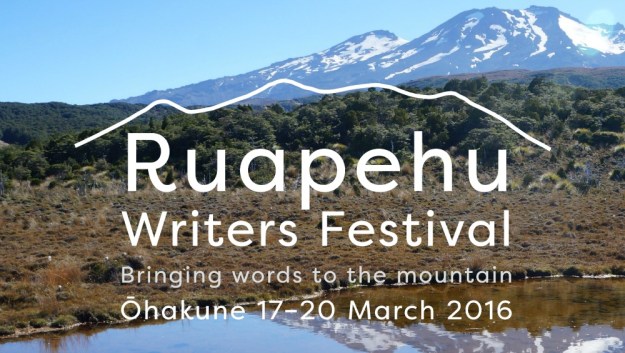
A new writers festival like no other: Ruapehu Writers Festival, Ōhakune, 17–20 March 2016


Ruapehu image with logo low-res


Tickets are on sale now for the country’s newest, and quirkiest, writers festival, to be held in Ōhakune in March. And even if you can’t make it, you can still be involved by donating to its crowdfunding campaign.


A pony ride with a popular children’s author, a literary waterfall walk, poets on bikes and a venue like something out of Twin Peaks: this doesn’t sound like the average writers festival. But then the first ever Ruapehu Writers Festival, which will be held in Ōhakune on 17–20 March, is not an average writers festival.

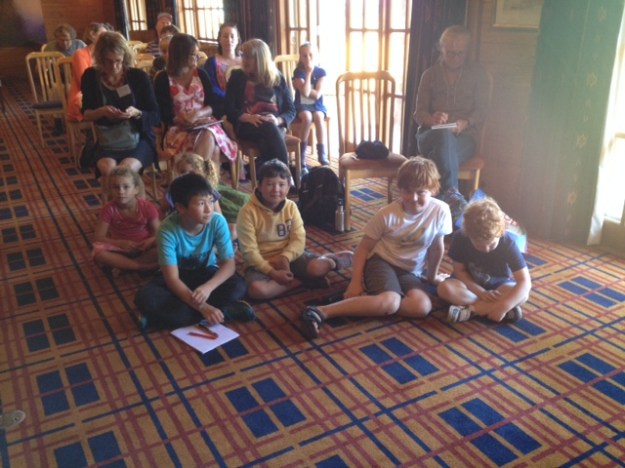
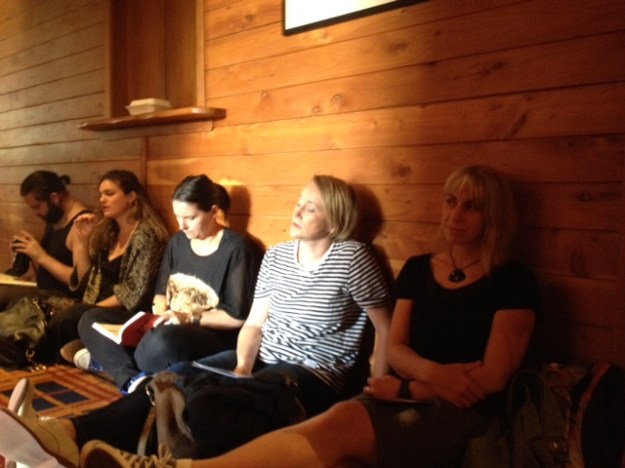
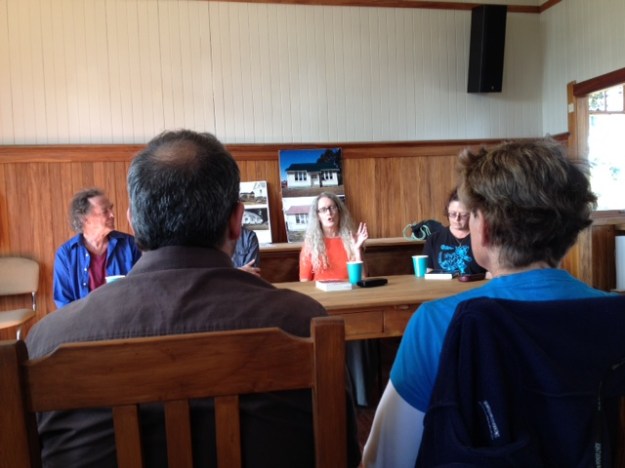
Locals and visitors alike will be able to enjoy a long weekend of events – including readings, panel discussions, workshops, sessions for children and a poetry slam – featuring 40 New Zealand writers, from the well-known to the up-and-coming. Tickets and season passes are on sale now, and a Boosted crowdfunding campaign to support the festival is running until the end of February.

Festival sessions include a Friday night lecture by award-winning novelist Elizabeth Knox, a fiction-writing workshop with Auckland writer Sue Orr and the pony ride with Stacy Gregg, the author of the popular Pony Club Secrets series. The setting will be acknowledged in a session about local history with leading non-fiction writer Martin Edmond, who grew up in Ōhakune, and local historian Merrilyn George, and another on the Desert Road.

Other well-known writers who can be heard at the festival include novelists Emily Perkins, Fiona Farrell, Nicky Pellegrino, Jenny Pattrick and Fiona Kidman and poets Paula Green, Harry Ricketts, Tusiata Avia and James Brown. Local writers are also being included, such as novelist and Taumarunui High School teacher Antony Millen, and editors from four of New Zealand’s literary presses will talk about what they look for in new writing. The complete programme is available on the festival website.


The festival is the brainchild of poet, lecturer in English literature at Victoria University, and 2016 Katherine Mansfield Fellow Anna Jackson . She and her husband Simon Edmonds, owner of Tuatua café, have a house at Rangataua, next door to Ōhakune. “We realised that Ōhakune, half way between Auckland and Wellington, is the perfect place to hold a writers festival. While many people visit during winter for skiing, it’s at its most beautiful in summer. And the local community has been so enthusiastic about having this event in their town.”

Joining Jackson and Edmonds on the organising committee is poet and Seraph Press publisher Helen Rickerby. She says, “This is going to be an informal and fun festival, and I think the fact that it’s being organised by writers has given it a different approach.” Jackson says she expects readers and writers involved to come out of the session still talking about some of the ideas and books discussed. Readers and writers will also have chances to meet each other and keep talking about ideas on the waterfall walk – free for anyone to come along.


The festival will be based at the Powderhorn Chateau, right next to the Ōkahune railway station. “It is a fantastic venue, with large spaces and two decks to relax on in between sessions. Being in an alpine forestry town, the hotel has log walls, which reminds me of the hotel in Twin Peaks – but less creepy,” Rickerby laughs.

Tickets are on sale now, with earlybird season passes at just $90 (until 6 February) and individual sessions at $14, with concessions also available.


Edmonds says, “It was important for us to keep prices low, so as many people as possible could afford to come. We have some funding from Creative NZ, but we hope people will support our crowdfunding campaign so we can pay for accommodation and travel for the guest writers, who are generously donating their time.” Because Boosted contributions are eligible for a tax credit, donors will get 33 cents back from every dollar they donate.


  • Donate to the Boosted crowdfunding campaign.
  • Find out more about the Ruapehu Writers Festival and buy tickets here.


Media:

  • For more information contact Chris Wilson on 04-463 9498, 021 0525 300 or chris.wilson@vuw.ac.nz, or Anna Jackson at anna.jackson@vuw.ac.nz.
  • To interview the organisers or any of the participating writers, email anna.jackson@vuw.ac.nz.
  • Profiles and photos of participating writers are available on the festival website.
  • A media kit, including downloadable logos and images, is available the festival website.

Poetry is off to Menton

SAM_0467 (2)

I am so delighted Anna Jackson is the 2016 Menton recipient. When a poet goes to Menton, poetry benefits (thinking of Bill Manhire and Jenny Bornholdt).

Last Friday, with no inkling of the news, I posted this poem by Anna. I can’t wait to see what she does in France.


Scenes from the photographer’s childhood: wardrobe


She kneels in the red light of her wardrobe, leaning

over one tub of chemicals to pull out the dripping

sheet from the one in the far corner, the space so

small, the smell so sharp, the image not that

of her mother, poking her amused face

around the bathroom door as she heaved

it open, pushing across the floor the barricade

set up to keep her out, nor of her own fury, still

sharp days later, but the shot she had taken

seconds earlier of her body, her legs

half shaven, still half dressed in foam.

Every night, without fail, whatever

time she takes her bath, within minutes

her mother suddenly just has to wash

her hands. It is this, even more than the

ruined image, that makes her scream

when her mother opens the wardrobe now,

an extended scream that the exhausted

mother next door, in her faded blue thrift

shop dress, covered in spilt milk, thinks will

never end, and so joins in, even though

it will wake the baby, which it does: and now

they are all screaming, the girl in B, the neighbour

in G, and the baby in F, a long, tense chord

of such helpless rage, almost a panic, it seems

it must rise up, it will ruin them all, there

can never be any release, their throats, all three,

scraped raw, the scream continuing, the

exhausted mother holding, perfectly, her note

of G, as the baby drops to E, the photographer

rising to C, holding for four beats and then

stopping, just as the baby stops, and so

the mother stops too and for the long moment

before the baby starts again, stands rapt

in the most perfect silence

she has ever known and will ever know

again, milk all through her dress, blue

jug in pieces on the floor,

exactly at the midpoint of her life.

© Anna Jackson 2015


Author bio: Anna is the Programme Director in the English Department at Victoria University. She has published five poetry collections, including Thicket, which was shortlisted for the New Zealand Post Book Awards in 2011. Her latest collection  I, Clodia, and Other Portraits was published by Auckland University Press in  2014 (my review here). Anna is currently organising a Ruapehu Writer’s Festival with Helen Rickerby to be held in Ohakune, March 2016 (Facebook page here).

Paula’s note: This surprising poem, holds narrative in its palm, a sharp moment that reverberates  with implication. I get to the end and I am pulled back to the beginning, again and again. The musical chord that holds the moment together (and thus the poem)  jars, unsettles — until that moment of silence and it feels like time has iced over. Within that silent beat, poetry blooms. Ha! I need to get to work but this poem keeps distracting me. I adore the power of poetry to do just that.


1415925155755    1415925155755


Auckland University page

New Zealand Book Council page

Anna Jackson’s poem, ‘Afraid of falls?’ on Poetry Shelf.

Anna Jackson’s interview on Poetry Shelf


Poem Friday: Anna Jackson’s ‘Scenes from the photographer’s childhood: wardrobe’ — Within that silent beat, poetry blooms


Scenes from the photographer’s childhood: wardrobe


She kneels in the red light of her wardrobe, leaning

over one tub of chemicals to pull out the dripping

sheet from the one in the far corner, the space so

small, the smell so sharp, the image not that

of her mother, poking her amused face

around the bathroom door as she heaved

it open, pushing across the floor the barricade

set up to keep her out, nor of her own fury, still

sharp days later, but the shot she had taken

seconds earlier of her body, her legs

half shaven, still half dressed in foam.

Every night, without fail, whatever

time she takes her bath, within minutes

her mother suddenly just has to wash

her hands. It is this, even more than the

ruined image, that makes her scream

when her mother opens the wardrobe now,

an extended scream that the exhausted

mother next door, in her faded blue thrift

shop dress, covered in spilt milk, thinks will

never end, and so joins in, even though

it will wake the baby, which it does: and now

they are all screaming, the girl in B, the neighbour

in G, and the baby in F, a long, tense chord

of such helpless rage, almost a panic, it seems

it must rise up, it will ruin them all, there

can never be any release, their throats, all three,

scraped raw, the scream continuing, the

exhausted mother holding, perfectly, her note

of G, as the baby drops to E, the photographer

rising to C, holding for four beats and then

stopping, just as the baby stops, and so

the mother stops too and for the long moment

before the baby starts again, stands rapt

in the most perfect silence

she has ever known and will ever know

again, milk all through her dress, blue

jug in pieces on the floor,

exactly at the midpoint of her life.

© Anna Jackson 2015


Author bio: Anna is the Programme Director in the English Department at Victoria University. She has published five poetry collections, including Thicket, which was shortlisted for the New Zealand Post Book Awards in 2011. Her latest collection  I, Clodia, and Other Portraits was published by Auckland University Press in  2014 (my review here). Anna is currently organising a Ruapehu Writer’s Festival with Helen Rickerby to be held in Ohakune, March 2016 (Facebook page here).

Paula’s note: This surprising poem, holds narrative in its palm, a sharp moment that reverberates  with implication. I get to the end and I am pulled back to the beginning, again and again. The musical chord that holds the moment together (and thus the poem)  jars, unsettles — until that moment of silence and it feels like time has iced over. Within that silent beat, poetry blooms. Ha! I need to get to work but this poem keeps distracting me. I adore the power of poetry to do just that.


1415925155755    1415925155755


Auckland University page

New Zealand Book Council page

Anna Jackson’s poem, ‘Afraid of falls?’ on Poetry Shelf.

Anna Jackson’s interview on Poetry Shelf


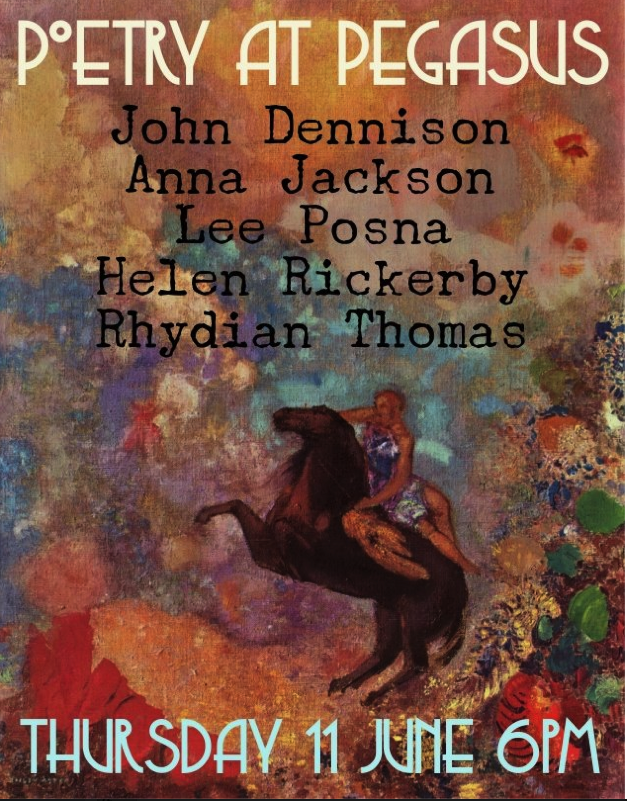
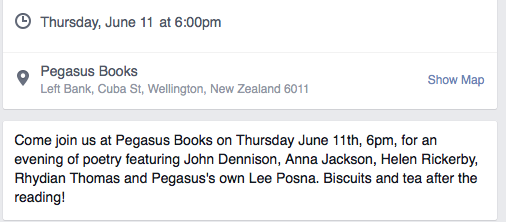
This looks very good! Poetry at Pegasus: Dennison, Jackson, Rickerby, Thomas, Posna

Screen shot 2015-05-31 at 1.05.19 PM

Screen shot 2015-05-31 at 1.08.02 PM

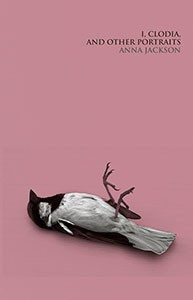
Anna Jackson’s I, Clodia and Other Portraits – A lightness that is fierce, a spareness that is complex

1415925155755  SAM_0467 (2)


I, Clodia and Other Portraits Anna Jackson, Auckland University Press, 2015

Anna Jackson has published five collections of poetry including Thicket (Auckland University Press, 2011) which was a finalist in the New Zealand Post Book Awards. She currently teaches English Literature at Victoria University.


Anna Jackson’s new collection contains two sequences that step up from everything she has previously written to a lightness that is fierce, a spareness that is complex. Poems become voice, voice becomes reaction to/against, reaction become autobiography, autobiography becomes invention. The pleasure that the poetry generates is multiple; from the exquisite loop of sound to the ideas that pierce, to the stories that accumulate, to the silent patches that are not in fact silent.

The first sequence, ‘I, Clodia,’ signals a return to Catullus, but now his muse, his beloved (Lesbia, Clodia), speaks. There has been a wide line in recent times of re-visioning, resiting, reclaiming, re-presenting women from the shadows of history; women who were spoken on behalf of, who were seemingly passive, are given voice. Anna’s version prompts thinking in myriad directions. The poems are laid across an underlay Catullus carpet. I followed Anna’s directive and read his poems in the order proscribed so that I might absorb the intriguing underlay as I read. In the end, it felt like Anna had given flesh to the bare bones of Catullus’s Lesbia (Clodia). Invented because Anna was working with the protruding bones of a skeletal figure, yet this sequence also gains fire and contextual zest through diligent research. The poems come to life within the context of the times hinted at — the events, relations, circumstances. The degree of research for such a slender sequence could have rendered the historical (the facts, the near-facts) cumbersome, but instead history becomes the lily pads of the poems. Drawing the eye close, moving ever so slightly on the drift of water, encouraging the mind to make little leaps.

What of the voice? No whimsical, petal-of-a-voice here. This is where the layers utterly captivate me. Draw me into a woman brought to sparking life, and all the issues and ideas that emanate. Clodia addresses his charges (‘but to counter them one by one in order’) and declares her love (‘Oh, I loved you, and being loved by me did/  you not take more than you could ever give me?’). She throws his questions back at him (‘Whom shall I love now?’ ‘Whom shall I permit to visit?’ ‘It seems we are occupied with the same questions’). She is fierce (‘You had better be leaving’) and in his moment of speechlessness, she replenishes her own stanzas (‘I’ll fill my/ stanzas up while you can be silent for once’).

We come hard up against the authority of the male poet on the page. His authorship legible, enduring. She, however, ephemeral. Catullus writes: ‘but a woman’s words to her eager lover/ should be written on running water, on the wind.’ Clodia counters (by way of Anna): ‘I can just see you/ scuttling about on the shore, peering/ suspiciously at the ocean and calling it/ a fickle thing’. Ha! He is desperate to read her, yet would not want her words set in concrete, with script and ink that lasts. In this sequence, Clodia exists beyond the contrary longings of Catullus; she exists beyond him in the wider world of political relations and within the intimate moments of her own reckoning.

Anna appeared with Daniel Mendelsohn at the Auckland Writers Festival this year in a standout session on translation. Anna suggested that she was ‘not translating words but ideas,’ and that she wanted to see ‘how far she could push her translated versions, her subversions.’ She had the advantage of translating ‘imaginary texts, non-existent poems.’ So for her, traversing the hiatus between Latin and a second language posed different challenges. The conventional translator faces the untransportable word, gendered endings, punning options, difficult rhymes, different rhythms, inappropriate cliches, time honoured truisms and cultural trapdoors. The list is endless. Anna, though, was traversing a different gap as she worked with English translations and sought to translate the hints, the shadows, the contradictions, the silences. She was after a way to give poetic flesh to longing, loss, love, not-love, circumstance, conflict and so on. Anna has stepped into the skin of a long-lost other and gifted us a mesmerising mouthpiece. The deftness of what is revealed and what is kept back renders the white space poignant, illuminating, fertile.

You need to go for a long walk or eat a bowl of soup before you move into the second sequence, ‘The pretty photographer.’ Now Anna steps into contemporary shoes in order to re-present portraits. The Diane Arbus quote at the start is the perfect entry point (‘A photograph is a secret about a secret’) because the poems are like miniature mise en abymes. You fall into elusive, intangible selves, the dry dust of story, as the autobiographical self is laid like a transparency over the invented or borrowed self. If these are photographs, at times it is like entering the photo negative, where things are dreamlike, with the melancholy of the dark room adhering, the upset of the negative image clinging. The past is caught in splices of looking, looking through and then looking through again (‘I’m going to look right through you/ furiously stapling my feelings together’). It is as much about the photographer as it is the subject.

So many standout poems that linger (‘ Diane, unexploded’ ‘Afraid of falls?’ ‘The photographer in the library’ ‘The photographer’s hallway’ the whole thing really!). So many lines and phrases in the collection as a whole to pin to the wall. Here are some that struck a chord:


‘silent and tethered’

‘a look of such lovely lamentation’

‘the sight of women’s arms/ lifting and rising in and out of the water/ black like black eels in a swarm/ curling and calling/ one to another’

‘She picks out her coldest onion,/ her tears tight on her face.’

‘We were always walking towards the day we’d be parted.’

‘The truth is, I have feelings for you/ in every substance – including/ a cathedral of sea.’

‘I had a dream I was a ghost/ and only one man could see me …’

‘I’ll return/ to the person I was drawing/ and the dawning of the night’.


My copy of I,Clodia is battered and worn as I have carried it out and about with me for months. Sometimes I think the right book finds the right reader, not because you will necessarily get what the poet is trying to do and say, but because that book strikes a deep internal chord — the chord of humanity, the exquisite chord of a solo violin partita, the chord of that which is missing and that which is missed, the chord of women emerging from the shade. This is a poetry collection that matters.


Auckland University page

New Zealand Book Council page

Anna Jackson’s poem, ‘Afraid of falls?’ on Poetry Shelf.

Anna Jackson’s interview on Poetry Shelf


AWF15 bouquets and brickbats

This morning I ran along the beach into the hit of the west-coast wind, and it felt like a hinge between four glorious days at the Auckland Writers Festival and getting back to work. As I ran, I pictured myself asking Murakami running questions. Where does he like to run? Is it in a wild space where you hardly see another soul as I do and your mind empties as the rhythm of the run takes over. You might see a puffed up dotterel out of the corner of an eye or a pied stilt wading. The rhythm of the run sends me into a pre-writing state but mostly it is is just me and breathtaking beauty.

This morning as I ran it took awhile to get into that equilibrium of silence as the festival keep drifting through. What I loved. What I loved a little less.


My bouquets in no particular order

1. To Anne O’Brien and her team for creating a dazzling programme that pulled me out of hermithood into the city for four full-to-the-brim, glorious days, that filled an auditorium over and over, that offered free sessions. This was one of the best festivals I have attended yet in terms of the range and quality of voices on offer. The audiences.

2. The new dedicated focus on children’s writing with the School Days, Family Day and sessions featuring a children’s author. I was coming out of a session and saw David Walliams at his signing table and was incredibly moved. He was looking with careful attention at a picture a young child had drawn for him, taken the time to pause and wonder, when his signing queue had stretched out into the square at the start of my session. It seems to me the festival has also become a gift for our emerging readers and writers, our thinkers and our scientists, our comics and our leaders. Thank you!

3. The amount of poetry this year. Sure I still love a line up of ten poets like a tapas tasting lunch that shows you the terrific width of our poetry communities. But I love the way poets now read along side international authors and local fiction writers in panels. This exposes our poets to a much wider audience. One stand out for me (sadly I missed some poets I had wanted to see due to clashes) was John Dennison. I have just reviewed his stunning debut collection on the blog but his poems lifted and became even more exquisite as I listened and shut my eyes. Two poets came to mind: Gregory O’Brien and Bill Manhire. I could hear a faint, appealing somethingness  of them in John’s intonations, the pauses, the repetitions, the stresses — the downright joyous musicality. If you don’t have John’s book, I highly recommend it. Maybe you can find him reading a poem or two on YouTube.

4. More poetry. The session with Anna Jackson and Daniel Mendelsohn on translation gymnastics was fascinating. I had Anna’s new book, I, Clodia, and a bilingual edition of Catallus in my bag all weekend as I am working on a review. I think I will save some of the gems from Anna until I do the review. But hearing the poems read aloud, we all leaned forward into the beauty of them. Gorgeous!

5. The Gala Night story tellers hit the mark. Sometimes I have been at previous ones counting how many to go. Not this time. The last one spoke, the time was up and I had stayed glued to every word.

6. Mrs Dalloway: I was in awe of Rebecca Vaughan maintaining those weaving voices for ninety minutes, pulling us into the shifting detail, moods, revelations.

7. Amy Bloom in conversation with Carole Beu. I had just read Lucky Us. Sparkling, scintillating, sent me straight to the book stall to buy the short stories.

8. Kim Thúy, a Vietnamese-Canadian novelist, in the panel session on Asian Histories. I didn’t know her at all but loved the little stories that ballooned out from a single word. Loved it when she said Vietnamese don’t show the feelings so much, and that her parents never asked her how she felt, but would ask her if she was hungry, then feed her mood. Dashed to the bookstall and bought Man. This writing is astonishing and I want to read everything she has written. I bumped into her when she was talking to her friend Anne Kennedy and so she inscribed my book. Ah the joy of lucky moments at festivals.

9. More poetry. Hearing Chris Tse reading a breathtaking selection from his debut collection How to Be Dead in the Year of Snakes.

10. Some favourite chairs: John Freeman, Carole Beu, Noelle McCarthy, Catherine Robertson, Christine O’Brien, Ruth Harley (many I missed sadly).

11. The privilege of sitting on stage with Edwin Thumboo to talk about poetry and Singapore was an utter highlight. He is, as I said in the session, like Margaret Mahy was, and Michele Leggott and Bill Manhire are: writers whose work fills you with endless admiration but who also occupy the world as writers in a way that is extraordinary. He is a Singaporean national taonga, so how good he read and spoke to a packed house. We barely scratched the surface of what we could have traversed, but to hear his poems hit the air/ear was such a treat. Preparing for the session sent me on new paths of thinking. I am so grateful to the festival for this opportunity.

12. David Mitchell in two sessions. In the first he was jet lagged and in the second, in a panel. Here are some of the gems I loved: He used to make his own Middle Earths with card and paper. He was a low maintenance kid! He stalled on a sip of tea then talked on the über novel, then cautioned new writers to be careful naming things as the name sticks. On character: A character moving into a new book brings a suitcase of credibility from previous ones. On discussing how to pronounce ‘archipelago’ with Catherine Robertson,  they both slide into an hilarious word jam. On links between books: there are doors wormholes tunnels from one book to next but not many. Ponders on how to make many different things coexist in one book: one way is to compartmentalise. He apologises for bringing his wife into the discussion (she was back stage!) on entering the female mind as a writer of his protagonist. He has five friends on earth, three of whom don’t read him! Question: Do you have an attic mind?  Mitchell: a junk shop mind. On names: high scrabble scores generally make useful names. They stick to the eyeball.  On the intensity of writing: You get through the intense immersion of the current novel underway ‘with little kisses of thinking about the next one.’ On fear: you should go outside your comfort zone. Have I bitten off more than I can chew? is important. He offered to read a Stephanie-Johnson draft when she said showing unfinished novels to others was an imposition. He said he wasn’t a novelist; he writes novellas with bridges and tunnels between. [I love this idea the connection can go through air or underground!].

13. Emily St. John Mandel on editing: Retype your entire draft, read the whole thing aloud to yourself, edit pages in random order.

14. Helen MacDonald. Now I have to read her book, H is for Hawk. Things I loved she said: We use nature to prove our concepts to us. On the joy of festivals: They let thoughts and words be said that aren’t normally available in everyday life.  There’s no past or present when you are flying a hawk. When you have a big loss: After a year of grief, I started to grow around the holes. It was all about love.

15. Carol Ann Duffy. Carol Ann Duffy. Carol Ann Duffy.  Carol Ann Duffy. Hearing her read. And loved this bit from John Campbell on the joy of reading her poems: (can’t quite remember exact words) but ‘drilling down into your particular way of knowing.’

16. The fabulous Tim Winton: I  think perhaps people are wired to hope.

17. Hearing Ashleigh Young read her remarkable new poems, especially the casino one and the road one. They felt like a glorious step up from her debut. Fresh, elastic, lyrical, effervescent, surprising. I am going to post one on the blog as soon as possible so I can talk about it. I do hope a new book is on the horizon line.

18. Anne Kennedy talking about Janet Frame’s Owls Do Cry, the Great Kiwi Classic this year. She was so lucid, so on the button, with what she said. Reading the book for her was like a sock between the eyes. She loved the way the vernacular had been transformed into the poetic, but that it was above all a triumph of kiwiness. Anne said Janet rescued kiwiana and polished it like a gem. For Courtney Sina Meredith reading it was like a rite of passage. She said she was terrified of it at university (if you can’t get into this, you can’t get into New Zealand literature) but then she became deeply connected. Wonderful! Damien Barr cried after he read it (hearing his autobiographical anecdote I am not surprised). Great session steered by Kate De Goldi, but more audience involvement would have been good. I think that is the intent of the NZ Book Council that it becomes a very interactive session.

19. The Honoured NZ Writer: CK Stead. Wonderful movement through his life and career. Loved the poems breaking into the conversation. Like the way he said Catallus gave him a persona where he could go to the edge of things that had sometimes happened to him, or that were an invention. It became an area of freedom when he was not mentally a confessional poet. He had returned to NZ because he wanted to be a NZ writer and turned down the option of a very different academic career in Britain. He doesn’t regret it but sometimes ponders the possibilities of that different track.

I have been especially drawn to Karl’s recent poetry collections, their reflectiveness, musicality, ability to matter and move. You saw that a bit in the conversation. On being a critic: I was too dogmatic, too excited, things could have been said more subtly. I discovered what it was like to be characterised by what was a small part of me. On rereading Death of the Body for this ‘ordeal’ decided it was so much cleverer than I am now. A terrific way to end the festival.

20. Hearing fabulous Irish poet, Vona Groarke read her own poems and talk so beautifully about the finalists in the Sarah Broom Poetry Awards. I am so tempted to get to Wellington to hear her talk and read for a whole hour!

21. Stepping into the shoes of Alice Miller to read her finalist poems at The Sarah Broom Poetry Awards. I was amazed at how reading the poems of another poet out loud in front of an audience drew me so much closer into the very heart of them. The poems were breathtakingly good. I should do this more often. Find a special place to stand and read aloud the poems of another.

22. Ah! Murakami. Ah what a tremendous session. Ah! Ah! My daughter gave me some of his novels to read over summer and I was hooked. How had I not read him before? The outright surprise, wonder and delight of where he leads you. So to find out he was coming to the festival was the absolute highlight. I loved the fact he wrote his first novel and cast it into the bin as dreadful. He then wrote it in English as he had a limited vocabulary and stock of phrases. He translated it back into Japanese and achieved the simplicity, the economy and clarity of writing that is now his trademark. He likes his writing to be unpredictable to himself, which it is why it is so gloriously unpredictable to the reader. He feels he can be anybody when he writes (not all writers feel this!). He enjoys reading his books that have been translated into English (a few years after the original) as it is like reading it afresh and he can’t remember what happens. He likes Japanese tofu and donuts! Maybe a tofu donut! The chair, John Freeman, was exceptional. What made this session so utterly special were the silences, the long pauses that became little pivots of contemplation for both speaker and audience. One writer said Murakami says more in his silences than some writers say with truckloads of words. The t shirt he was wearing:

Keep

calm

and

read

Murakami


23. The volunteers, the lovely stage crew, the festival team and of course all the readers and writers who filled the Aotea Centre with a buzz of ideas and response. Astonishing!

Thank you thank you thank you


The brickbats that aren’t really brickbats at all

I. I wish Anne O’Brien could get to see more than the odd session. To sit back and enjoy the fruits of her labour.

2. Missing out on a ticket to The World’s Wife. My fault. From all accounts it was fabulous.

3. I was a chair, so feel free to criticise me (like all chairs I walked away wondering how I could have done a better job!), but sometimes the research and commitment as chair takes over whereas it should take the back seat along with your own ego. It seems we now live in an age where audiences have no problems in letting a chair know when they are dominating the conversation. Fair enough maybe, as it keeps us on our toes. The other tricky thing is that the audience will be a clashing mix of expectation, and equally varied mix of experience of the subject and writing under the spotlight. We are all different kinds of readers searching for different things. The sessions where the writers opened out into a warm and and sparking conversation were gold.

4. Why didn’t I run to the free sessions to make sure I got a seat?! Missed out on a few gems.


On reading Sport 43

Sometimes a literary journal is just the ticket for rainy-day blues, diversion, or the need to put a finger on a literary pulse. Ha! The notion of a literary pulse is where debate ensues. Each finger will be sensitive to different nuances, different implications.  I strongly believe that national anthologies that claim to represent a wide group ( New Zealand, for example) must be challenged if gender, ethnicity, age or geographic-location biases fuel significant blind spots. For decades, women were the blind spot in anthologies and journals, and now, at times it seems there is token representation of  work by Māori, Pasifika and Asian authors. Literary journals, however, are often the bloodline of a place, a niche, a literary disposition, and nearly always reveal the predilections of the editor. Sport comes out of Wellington, and it is to a great degree of Wellington (not in subject matter, but in terms of authors selected). It is a celebration of the writing by both established and emerging writers that have some connection with the city, often through Victoria University or its Press.  I have no problem with this.  I most definitely have no problem with this when the work included catches my attention and sends me in directions both familiar and unfamiliar.

The latest issue worked a treat for my rainy-day blues.

Seven essays are sprinkled through the selection of poetry and fiction, and if this is a new feature, it is a feature I applaud in this climate of idea-sharing in creative and stimulating forms. Long may it continue.
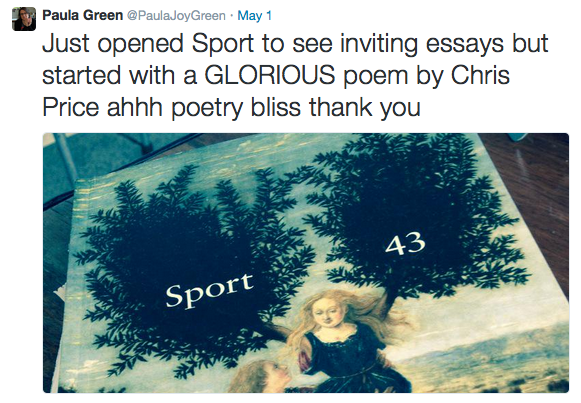
When I first picked up the book, I went straight to Chris Price (out of longing for a new collection perhaps) and immediately did a tweet review. Tucked away at the back of the book, it felt like the best had been saved for last with the playful, audacious flick and flash of words that catch your ear and send you flying to a nursery rhyme or Murphy’s Law or cheeky wit or the subtle twist and let’s-be-serious of the last word, ‘unspoken.’

Screen shot 2015-05-12 at 10.14.03 AM

This time I went to an unfamiliar name first, ‘Ruth Upperton,’ and what a discovery. Think I must have yearning for the comfort and absolute pleasure of poetic musicality (why I like the poems of Michele Leggott and Bill Manhire so much). Ruth has appeared in other journals, has just finished a law degree and lives in Palmerston North. Her five poems are different, the one from the other, but are linked by gorgeous rhyming (off, aslant, sliding), infectious repetitions, aural chords, sumptuous words. There is poetry out of sentences and there is poetry out of curiosity. You shift between comfort and strangeness.
 

from ‘The lonely crow’

Nothing sadder than a lonely river.

Nothing darker than a single crow.

Shiver at the strong’s surrender.

Play a tune on your June piano.


James Brown’s terrific poem, ‘Mercy,’ made me hungry for a new James Brown collection.

Anna Jackson’s three cooking-show poems suggest she is just getting better and better ( I am working my way through Catallus so I can review her new collection soon). I love the way the ingredients (excuse the pun) in these poems shift and flicker from one poem to the next, and in their new baking dishes taste a little different. The sort of poems that evoke a steady engagement at the level of sound and narrative.

Sarah Jane Barnett’s sequence of poems, Addis Ababa,’ caught me by surprise. They take me to an elsewhere, the elsewhere of  displacement, of otherness, of immigrants. The poems step up from everything Sarah has previously written, and then take another step into risk, empathy, inquiry, experience. What a combination.


Rachel Bush’s ‘Long and short,’ is a poem that moved me with its exquisite detail and revelation, a family story (true or false) that catches in the throat. The poetic glue: the baked bread.


So many things accumulate. They weigh us

off balance. We struggle to stay upright,

we lurch and are precarious. Our feet are flat

and sudden. It was easier when we had

a mum and dad. Easily we could blame them

when we were less than we desired.


Still most essays and fiction to read, but started here: Damien Wilkinson’s lecture/essay navigates a subset of the ‘ought’ and ‘ought not’ of narrative: the way it ought/ ought not represent some kind of personal change (character based). Fascinating following the thread of argument. Is this a requisite ingredient in poetry? That poems ought to navigate some kind of change? I raise this because, and I am shifting tack a little here, I am fond of poems that exhibit some kind of movement (and movement may be zen-like and hold change within its sameness and vice-versa). Poetic movement need not be on a grand, spectacular scale. It might be miniature shivers in the poem, sweet little movements that you catch out of the corner of your eye, or a flicker in your ear, or a faint tremble of your heart, or the tug of an idea that is itching to confound, challenge and pull you elsewhere. That is what I felt when I read, ‘She cannot work,’ Ashleigh Young’s foray into fiction. It is what I felt reading this issue of Sport, a catalogue of movements that displaced my state of fatigue.


Sport: miniature shivers in the writing, sweet little movements that you catch out of the corner of your eye, or a flicker in your ear, or a faint tremble of your heart, or the tug of an idea that is itching to confound, challenge and pull you elsewhere.


Friday Poem: Anna Jackson’s ‘Afraid of falls?’ — a pinhole in the dark expanse of memory to let the light of childhood through


SAM_0467 (2)  

Afraid of falls?

We spent our childhoods upright.  We rose asleep.
We rose silent, when our breaths were taken.
We sat on the mat, and were told to sit up.
There was so much to learn.
In the weekends, though, my brother
went into the bush behind the house
and he came back talking of the waterfalls.
Oh take me, take me to the waterfalls,
I promise not to fall.
Fruit fell.  Whole lawns were carpeted!
Fell, and rotted where it fell.
In the end, we rose apart.
But I remember the waterfalls,
and I remember how the world was so much with us.

© Anna Jackson I, Clodia, and Other Portraits Auckland University Press, 2014


Author’s bio:

Anna is the Programme Director in the English Department at Victoria University. She has published five poetry collections, including Thicket, which was shortlisted for the New Zealand Post Book Awards in 2011.

1415925155755   1415925155755

Author’s note:

When I was little I found it strange that you could “sit up” or “sit down” and the sitting would still be the same either way. I’ve also always loved Chris Price’s poem “Rose and Fell” and how its title makes such a strangeness of the phrase “rise and fall” by placing it in the past tense. So this is a meditation on rising and falling, and on childhood as a time before a fall, when instead of falling asleep you might rise asleep, and keep on rising.

We lived in Titirangi until I was seven, and my brother did go into the bush, and he did come back talking about the waterfalls.


Paula’s note:

This poem is like a little sonata pivoting upon the word, ‘fell.’ Then again, it is as though a word, ‘fall,’ is elbowing a pinhole in the dark expanse of memory to let the light of childhood through. Playfully. Childhood becomes a riff on falling (and rising), and there is a delicate, addictive humour in the overlaying words (‘oh take me, take me to the waterfalls,/ I promise not to fall’). The image of the childhood wonder is made more pungent by the carpet of rotting fruit, the stench of abundance and plenty (time, dreams, play).

The book that contains the poem, Anna’s latest, lifts from the previous collections. It is a book of portraits, and here, in this example, the portrait of a child(hood) might be invented, misremembered, once lived, fleetingly real, achingly so. It was no easy task picking a poem that stood out for me in this book (I am waiting to get a copy of Catallus so I can follow Anna’s reading map as I reread the poems to review). The lift and play of each line is glorious, the image equally so. I have donned the cotton dress of my younger self and the lift and fall moves beyond the gold nugget for ear and eye to that of elusive self. A little sonata that haunts and plays again.


Auckland University page

New Zealand Book Council page

Poetry Shelf interview


Poetry Shelf interviews Gregory O’Brien — The poem has to dive down into and surface from some essential state of being

Screen shot 2015-03-14 at 9.52.32 AM

Gregory O’Brien at Tjibaou Cultural Centre, Noumea, March 2015

Photo Credit: Elizabeth Thomson


Gregory O’Brien is the  2015 Stout Memorial Fellow at the Stout Research Centre, Victoria University, where he is currently working on a book about poetry, painting and the environment. His new collection of poems is Whale Years (Auckland University Press). He has published numerous books of fiction, non-fiction and poetry. Since 2011 he has contributed to the ongoing Kermadec art project, works from which are on show at the Tjibaou Cultural Centre, New Caledonia, until July.


The interview


‘Ocean sound, what is it

you listen for?’


Did your childhood shape you as a poet? What did you like to read? Did you write as a child?

As far as I can recall, I drew more than I painted. And I always gravitated towards illustrated books—Tove Jansson’s ‘Moomin’ books stand out, and I remember The Lord of the Rings, as much for its illuminated maps as for the words. I went through a phase of reading comics—Whizzer & Chips rather than Batman. I date my interest in the interplay of words and visual images to those early encounters.

I doodled at every available opportunity and I remember being hauled out of class and punished for drawing, rather well, a crouching deer on the inside cover of my maths book. I usually captioned my drawings—so maybe those captions could be thought of as my first writings. Occasionally I filled in speech- or thought-balloons above various life-forms.


When you started writing poems as a young adult, were there any poets in particular that you were drawn to (poems/poets as surrogate mentors)?

I can trace this pretty exactly, I think. Aged 14: Bob Dylan’s ‘Writings & Drawings’. Aged 15: Dylan Thomas. Aged 16: James K. Baxter and Flann O’Brien (I liked to pretend Flann was an actual relative. I even screen-printed his book-title AT SWIM-TWO-BIRDS on a singlet—an item I still have in my wee box of treasures.) Aged 17: John Cage (Silence, and A Year from Monday). By the age of 18, I was living in Dargaville, and it was as if everybody suddenly jumped on board the NZ Road Services bus or bandwagon—I was reading Kenneth Patchen, William Blake, Edith Sitwell, T. S. Eliot, Ezra Pound, e e cummings; also Allen Curnow, Janet Frame, Sam Hunt… I had known about Eileen Duggan for some years, because she was a relative, on my mother’s side. More than anything else, however, it was discovering Robin Dudding’s journal ISLANDS that turned my world around, that brought the whole business home…. Therein I discovered Ian Wedde, Bill Manhire, Elizabeth Smither, CK Stead…


Did university life transform your poetry writing? Theoretical impulses, research discoveries, peers?

I was six years out of school by the time I finished my BA, so my university life was mixed in, very much, with everything else that was going on: with 15 months in Dargaville, a year or so in Sydney… At university, I certainly wasn’t drawn to theory except in so far as I thought it was a grand imaginative game that might, periodically, yield unpredictable and outlandish results. I enjoyed the pottiness of Ezra Pound’s literary (rather than his political) theorising… An ABC of Reading is a great book. Probably the Zen-inclined John Cage and the Trappist Thomas Merton were the two non-fiction writers I held closest to me.


Reading your poetry makes me want to write. I love the way your poems delve deep into the world, surprisingly, thoughtfully yet never let go of the music of the line. Words overlap and loop and echo. There is an infectious joy of language at work. What are key things for you when you write a poem?

I listen to a lot of music. I want the poems to have something of the music that I love. I spend a lot of my time looking at art. And I want my poems to have something of the art that I love. There are aspects of composition, tone, rhythm and character which span all these different creative modes. Those are the key factors for me when I write… At a certain point, an appropriate form makes itself known…. The poem has to dive down into and surface from some essential state of being… There is certainly a joy in doing the things that you love; so there’s joy in the making and, preceding that, in the state of being that leads to the making….


Do you see yourself as a philosophical poet? Almost Zen-like at times?

My concept of philosophy is broad and shambolic enough to accommodate what I do as a writer. I’ve never read extensively in the field of Zen (apart from the books of John Cage and the writing of my friend Richard von Sturmer). I’ve read a little, and somewhat randomly, in the field of non-conformist Catholic thought: Simone Weill, Meister Eckhart, Merton, Baxter… These peregrinations may have affected me more than I realise or am prepared to say.


Do you think your writing has changed over time?

I guess writing has to evolve – otherwise it will become predictable and a total drag. I’m as entranced as I ever was with the process, the business, the labour of it. At the same time, I remain devoted to the finished form of it: The printed book, with its covers and half-title and title-page; and the shapes of words on the page and maybe illustrations. Poetry is an art that, if it’s working, is constantly reinventing itself.

I look back at my early poems and find fault. I find myself blaming an over-voracious intake of French Surrealism; too much Kenneth Patchen one year, too much Stevie Smith the next… Too much John Berryman! And, next year, not enough John Berryman! But the ship sails on, and finds new oceans to ply.


You write in a variety of genres (poetry, non-fiction, critical writing). Do they seep into each other? Your critical writing offers the reader a freshness of vision and appraisal – not just at the level of ideas but the way you present those ideas, lucidly, almost poetically. Does one genre have a particular grip on you as a writer?

I’m only starting to realise the inter-relatedness of these different genres. A few years back I started to explore poetry’s potential to carry information, also to elaborate upon a thought in a more detailed kind of way, ie. to have an almost essayistic function. So quite a few of my longer poems (some of the odes and, particularly, ‘Memory of a fish’ in my new book) are laden with facts, figures and reasonably clearly articulated information.

Needless to say poetry infuses the writing I produce in relation to the visual arts. I find looking at art exciting; it appeals to my poetic self. I don’t really have a critical self. I hope my non-fiction writing has a cadence, a music and a subconscious (rather than a conscious) purposefulness. Pondering my recent writings on artists such as Pat Hanly, Barry Brickell and Michael Hight, I remember in each case hearing a note—a song, almost—in my ear, and I was beholden to it.


Do you think we have a history of thinking and writing about the process of poetry? Any examples that sparked you?

James K. Baxter wrote wonderfully about writing poetry. Bill Manhire’s Doubtful Sounds is an immensely useful and energising book. 99 Ways Into New Zealand Poetry is terrific too. I refer back to my set of the journal ISLANDS and, yes, it seems to me we New Zealanders have been writing about the process as well as the product. Janet Frame’s oeuvre might be our greatest, most enduring instance of writing about writing, thinking about writing, writing about thinking, and thinking about thinking.


Your poetry discussions with Kim Hill are terrific. The entries points into a book are paramount; the way you delight in what a poem can do. What is important for you when you review a book?

I think a book has to become part of your life to really make an impression. It’s the same with music or visual arts. It can’t be a purely intellectual thing, it has to take you over, to some degree. It has to be disarming. Accordingly I tend not to discuss books that don’t ‘do it’ for me. Life’s too short. Fortunately, I have catholic tastes. There are things I enjoy very much in Kevin Ireland, as there are things I enjoy in Michele Leggott. I guess this makes me a lucky guy.


I agree wholeheartedly. I am not interesting in reviewing books on Poetry Shelf unless they have caught me, stalled me (for good reasons!).

What poets have mattered to you over the past year? Some may have mattered as a reader and others may have been crucial in your development as a writer?

Two years ago I went to Paris and met up with one of my all-time heroes, the French poet and art-writer Yves Bonnefoy. He turned 90 last year (Joyeux anniversaire, Yves!) During my recent travels around the Pacific (from New Caledonia to Chile), I’ve taken bilingual editions of Yves with me everywhere. I am interested in the way he has turned the creative conundrum of being an Art Writer and a Poet into something unified and compelling (channelling earlier French poet-art-writers from Baudelaire to Apollinaire, with a nod to Yves’s near-contemporaries, that wondrous group of wanna-be French-art-poets, John Ashbery and the New Yorkers). I also took the poems of Neruda and Borges with me everywhere I went.


What New Zealand poets are you drawn to now?

New Zealand poetry is interesting at the moment. It’s all over the place. As it should be. There are plenty of people I read voraciously. As well as the poets mentioned already: Anna Jackson, Vince O’Sullivan, you Paula, Lynn Davidson, Kate Camp, Geoff Cochrane… Last year I edited a weekly column for the Best American Poets website—that was a good chance to ‘play favourites’, as Kim Hill would say. (All those posts are archived here: http://blog.bestamericanpoetry.com/the_best_american_poetry/new-zealand/) There are some great first books appearing at the moment: Leilani Tamu’s The Art of Excavation; John Dennison’s Otherwise. This bodes very well indeed.


Name three NZ poetry books that you have loved recently.

I was rereading Riemke Ensing’s Topographies (with Nigel Brown’s illustrations) the other day; I found that book very inspiring when it appeared way back in 1984. Lately I’ve also been reading Bob Orr’s crystalline Odysseus in Woolloomooloo and Peter Bland’s Collected Poems… I could go on.


Your new collection, Whale Years, satisfies on so many levels. These new poems offer a glorious tribute to the sea; to the South Pacific routes you have travelled. What discoveries did you make about poetry as you wrote? The world? Interior or external?

The Kermadec voyage, and subsequent travels—most recently to New Caledonia—opened up a huge areas of subjective experience as well as of human and natural history. How do you write about that kind of space, that energy, that life-force? Wherever you travel, the air is different; the ‘night’ has a different character; the smells and textures of the vast Pacific vary from place to place. And people move differently wherever you go – they claim a different kind of space within the environment. My recent travels have been like a door opened on a new world. The last three years of my poetry-writing have been the most intense since I was in my early twenties.


That shows in this book Greg. I am looking forward to reviewing it because it touched a chord in so many ways. I love the idea that poems become little acts of homage. What difficulties did you have as traveller transforming ‘elsewhere’ into poetry? To what degree do you navigate poetry/other place as trespasser, tourist, interloper?

The artist Robin White likes to point out that there is only one ocean on earth. All our oceans are joined together—it’s the same body of water. So, if you take the sea to be your home (which, as Oceanians, believe it or not, we should do), then as long as you’re at sea you’re still, to some degree, in your home environment.

As a poet entering a new environment, I bring with me my responses, my eye, my mind and various kinds of baggage. I’m a curious person by nature so I always want to find new things—things I don’t know anything about. I like it when my preconceptions fall apart. I love being wrong about things; I enjoy the subsidence of the known world. I quote the great post-colonialist writer Wilson Harris in Whale Years: ‘If you can tilt the field then you will dislodge certain objects in the field and your own prepossessions may be dislodged as well.’

I feel that, as a poet, I am most in my element when I am sitting on the ground and learning new things. When the field of the known has been tilted. And filling my notebooks with various tracings of that new knowledge or sensation.


This is a good way to look poetry that takes hold of you; it ‘tilts’ you. I also loved the elasticity of your language – the way a single word ripples throughout a poem gleaning new connections and possibilities. Or the way words backtrack and loop. At times I felt a whiff of Bill Manhire, at others Gertrude Stein. Yet a poem by Gregory O’Brien is idiosyncratic. Are there poets you feel in debt to in terms of the use of language?

Strangely, I can’t read Gertrude Stein anymore. She is one of a very few writers I have been in love with and then the relationship has waned. Maybe, early on, she loosened up my use of language, the extent to which the rational mind is left to run things. There was a music I found in Stein, for sure. But this was something—increasingly—I found in more conventional writers like Wallace Stevens, Robert Creeley and, most recently, in Herman Melville. Moby Dick is a piece of great, symphonic, oceanic music. The novel (for want of a better term) is an incredible noise, a racket of spoken and sung sounds. Melville’s style reminds me of all the depth-finders, radars, monitors and gauges on the bridge of HMNZ Otago as we sailed north to Raoul Island in May 2011. All that information pinging and popping…


Is there a single poem or two in the collection that particularly resonates with you?

The long poem, ‘Memory of a fish’, is the piece that connects various experiences from the three year period in which the book was written, and brings them together—in an essayistic fashion, almost. I enjoy the ebb and flow of the triplets, and the world’s details tripping along them, like things washing ashore on Oneraki Beach… When I was writing that poem I felt I was living inside it, totally. And I haven’t quite climbed out of it yet, to be honest.


The book also demonstrates that eclectic field you plunge into as a reader with its preface quotes. What areas are you drawn into at the moment? Any astonishing finds?

The quotations at the beginning of the three sections of the book are constellations in the night sky above the poetry-ground. They mark points of reference, further co-ordinates, which have guided the writing: W. S. Graham’s ‘The stones roll out to shelter in the sea.’ The Flemish proverb: ‘Don’t let the herring swim over your head.’ Those are verbal artefacts I have carried around with me, much as you would pick up a shell or a colourful leaf. They were/are talismans. So I have stored them inside the book as well. Cherished things.


‘Constellation’ is perfect. I was thinking underground roots that nourish. Or one of any number of maps you can lay over the poems (the map of domestic intrusion, the map of childhood, the map of objects, the map of reading). But yes the process of writing has its constellation-guides as you venture into and from both dark and light.

Poetry finds its way into a number of your paintings (as it does with John Pule). There are a number of drawings included in the book that add a delicious visual layer. How do you negotiate the relationship between painting and poetry? Does one matter more? Do they feed off each other?

My notebooks contain a thick broth of visual and verbal ingredients. These materials arrive in my journal simultaneously. When writing or painting, I separate the words from the visual images and work on them more-or-less separately. When it comes to putting together a book, like Whale Years, these two disparate activities are reunited again. I’ve always loved illustrated books. (I think immediately of Bill Manhire’s The Elaboration, with pictures by Ralph Hotere; Blaise Cendrars’ long Trans-Siberian poem, illustrated by Sonia Delaunay; William Blake illustrating himself, and so on)


notes-on-the-raising-of-the-bones-of-pablo-neruda-at-isla-negra-gregory-obrien-and-john-reynolds-etching-2014

NOTES ON THE RAISING OF THE BONES OF PABLO NERUDA AT ISLA NEGRA by John Reynolds & Gregory O’Brien, etching, 2014

You have collaborated with a number of other artists and writers. What have been the joys and pitfalls of collaboration?

There are no pitfalls, as far as I can see. Somehow, I’ve found my way into a few collaborative circumstances and very much enjoyed the results. In the past year I’ve made etchings with my two painter-friends John Reynolds and John Pule. Like Charles Baudelaire and Frank O’Hara before me, I seem to have been lucky enough to fall in with a good crowd of painters (and also photographers—but that’s another story).


sailing-to-raoul-gregory-o_brien-and-john-pule-etching-aquatint-with-colour-roll-2011

SAILING TO RAOUL by John Pule & Gregory O’Brien, etching, 2012 (John titled this work, riffing off Yeats’s ‘Sailing to Byzantium’)


The constant mantra to be a better writer is to write, write, write and read read read. You also need to live! What activities enrich your writing life?

Certainly my recent travels around the Pacific have been hugely enriching. I’m not a proper swimmer, but since I was a child I have had a great passion for floating in, or being upon salt water. (My book News of the Swimmer Reaches Shore grew out of that propensity.) The everydayness of existence is the most enriching thing—as the poems of Horace and Neruda and Wedde keep reminding me. What a great and pleasant swarm of information and sensation we find ourselves amidst, every day of our lives.


Finally if you were to be trapped for hours (in a waiting room, on a mountain, inside on a rainy day) what poetry book would you read?

I keep coming back to the Collected Poems of James K. Baxter. Not because it’s the best book ever written but because of the simple fact that it occupies a huge and resonant place in my life.


Auckland University Press page

New Zealand Book  Council page

Arts Foundation page

The Kermadecs page

National Radio page (discussing poetry highlights of 2014 with Kim Hill)


Truth or Beauty: Poetry and Biography — a little chapbook of poems

truth-or-beauty-cover

In 2014, Helen Rickerby and Anna Jackson organised a conference at Victoria University entitled Truth or Beauty: Poetry and Biography. It drew poets and scholars from across New Zealand and Australia. Over three days the participants shared readings, papers, panels and informal discussions.

To celebrate the event, the organisers have released a gorgeous chapbook containing poems by the participants that highlight meeting points between poetry and biography, truth and/or beauty.

In the introduction, the editors (Anna and Helen are joined by Doctoral student, Angelina Shroma) suggest that  some of the poems ‘are more straightforward retellings of a life, but most take a poetic twist — are impressionistic, episodic, mythic, abstract or undermine the very idea of being able to know factual truth.’

Seeing the line-up of poets included gives some indication of the stretch and vitality of ideas exchanged along with poetry shared: Jordie Albiston, Airini Beautrais, Amy Brown, Geraldine Burrowes, Zarah Butcher – McGunnigle, Max L Chapnick, Majella Cullinane, Toby Davidson, Joan Fleming, Janis Freegard, Maureen Gibbbons, Helen Heath, Kerry Hines, Anna Jackson, Shari Kocher, Saradha Koirala, Bella Li, Vana Manasiadis, Karlo Mila, Robynanne Milford, Vivienne Plumb, Jenny Powell, Nina Powles, Chris Price, Helen Rickerby, Harry Ricketts, Jack Ross, Erin Scudder, Anna Smaill, Marty Smith, Robert Sullivan, Leilani Tamu, Chris Tse, Jessica Wilkinson, Karen Zelas.

Some of the poems took me back to books I have already loved (Autobiography of a Marguerite, Dear Neil Roberts, I, Clodia, and Other Portraits, Crumple, Girls of the Drift, My Iron Spine, Just Then, Horse with a Hat, How to be Dead in the Year of Snakes, Captain Cook in the Underworld) while previously unpublished poems were miniature temptations of new works to come (Joan Fleming’s ‘New Margins,’ Helen Heath’s ‘Radiant,’ Chris Price’s ‘A natural history of Richard’) and some poems and poets were new to me and are now on my radar now (Shari Kocher, Robynanne Milford). I haven’t read many poems by Erin Scudder but her deliciously inventive word play in ‘Hollywood Hills Woman’ catches at story, character, language, space and life. This was a gem.

This is a beautiful hand-bound book; I got to the end and just wished I had been able to attend the conference. This makes up for it slightly.


Web page here

Copies are available for purchase for NZ$20, plus NZ$5 for overseas postage. Email Helen.Rickerby@paradise.net.nz to order and arrange payment.


About the editors

Anna Jackson, associate professor at Victoria University of Wellington, has published six collections of poetry, most recently I, Clodia, and Other Portraits (Auckland University Press, 2014). The first half of this collection is based on the life of Clodia Metelli, the ‘Lesbia’ who was the subject of the most passionate poetry written by Catullus in late Republic Rome.

Helen Rickerby has published four books of poetry, most recently Cinema (2014), which includes biographical poems about film-makers and her friends. Her 2008 collection, My Iron Spine, features biographical poems about women, many of whom have been neglected by history. She is the managing editor of Seraph Press, a boutique poetry publisher, and is co-managing editor of JAAM literary magazine.

Angelina Sbroma is a doctoral student in English literature at Victoria University of Wellington. Her thesis focuses on children’s fantasy literature.