Tag Archives: Anna Jackson

Poetry Shelf 2025

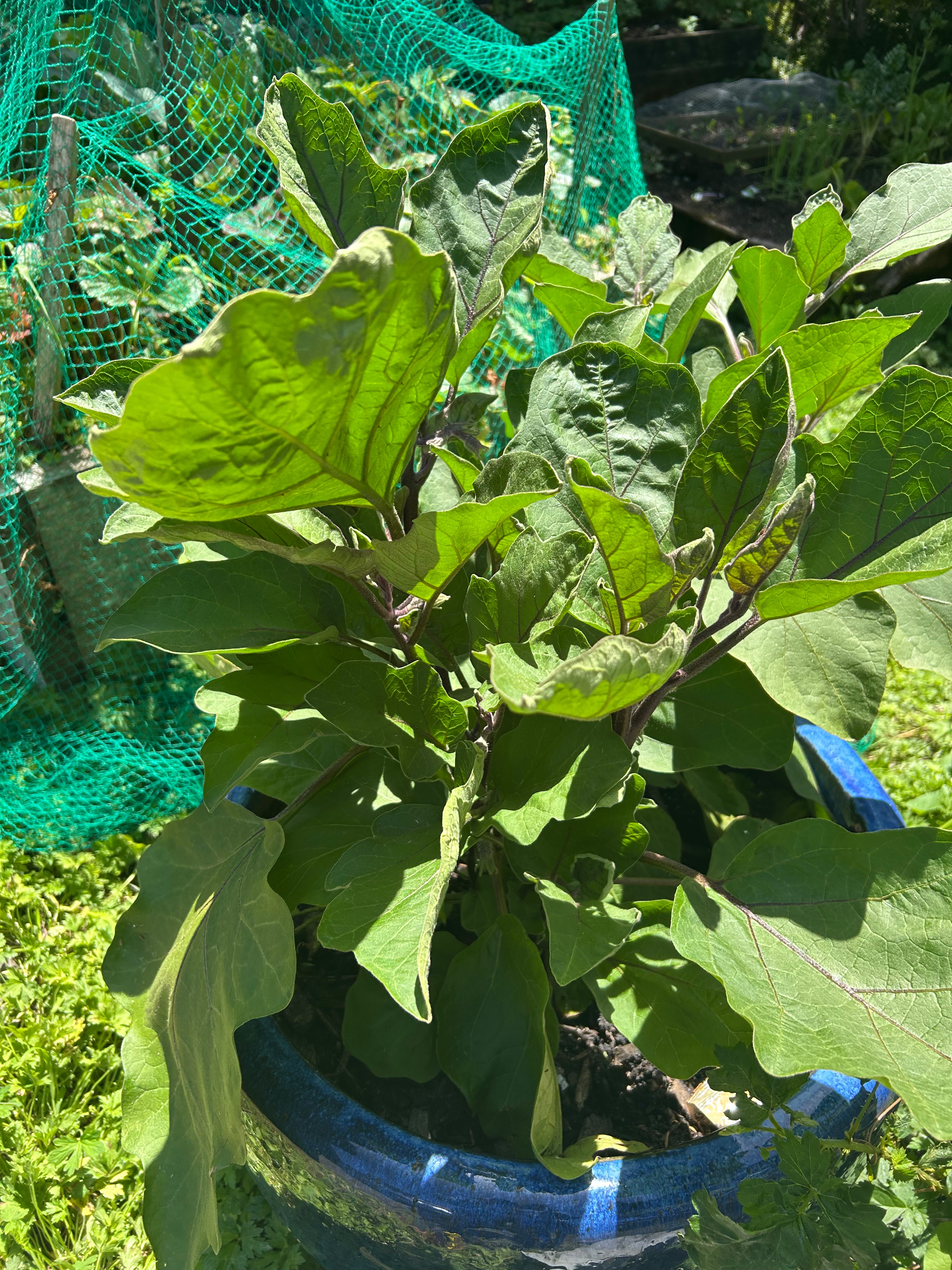
growing aubergine for the first time

Inside the city a house
Inside the house a room
Inside the room a cupboard
Inside the cupboard a drawer
Inside the drawer a box
Inside the box a necklace
Inside the necklace a story
Inside the story a city hope

Some years I invite you to share your favourite reads of the year, especially poetry, especially when poetry doesn’t get much attention in the end-of-year lists and book stacks that we are seeing across all forms of media. This year has sizzled and simmered and shone with local poetry: new collections along with live performances. So many collections document and explore tough stuff: illness, heartbreak, despair, suicidal thoughts, global wars and inhumanity, our government inflicting more and more damage on planet and people. And so many collections deliver love, a multi-stranded love and love in what words can do, whether exuberant or sweetly nuanced.

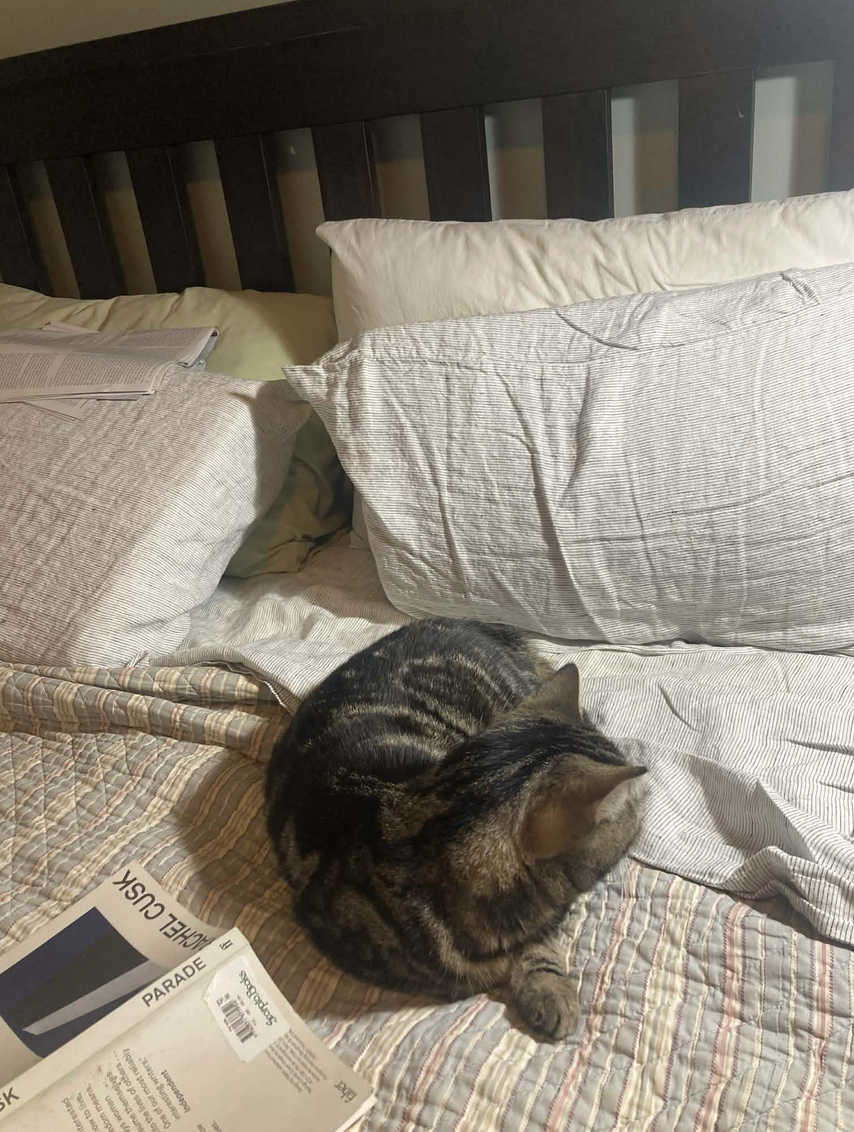
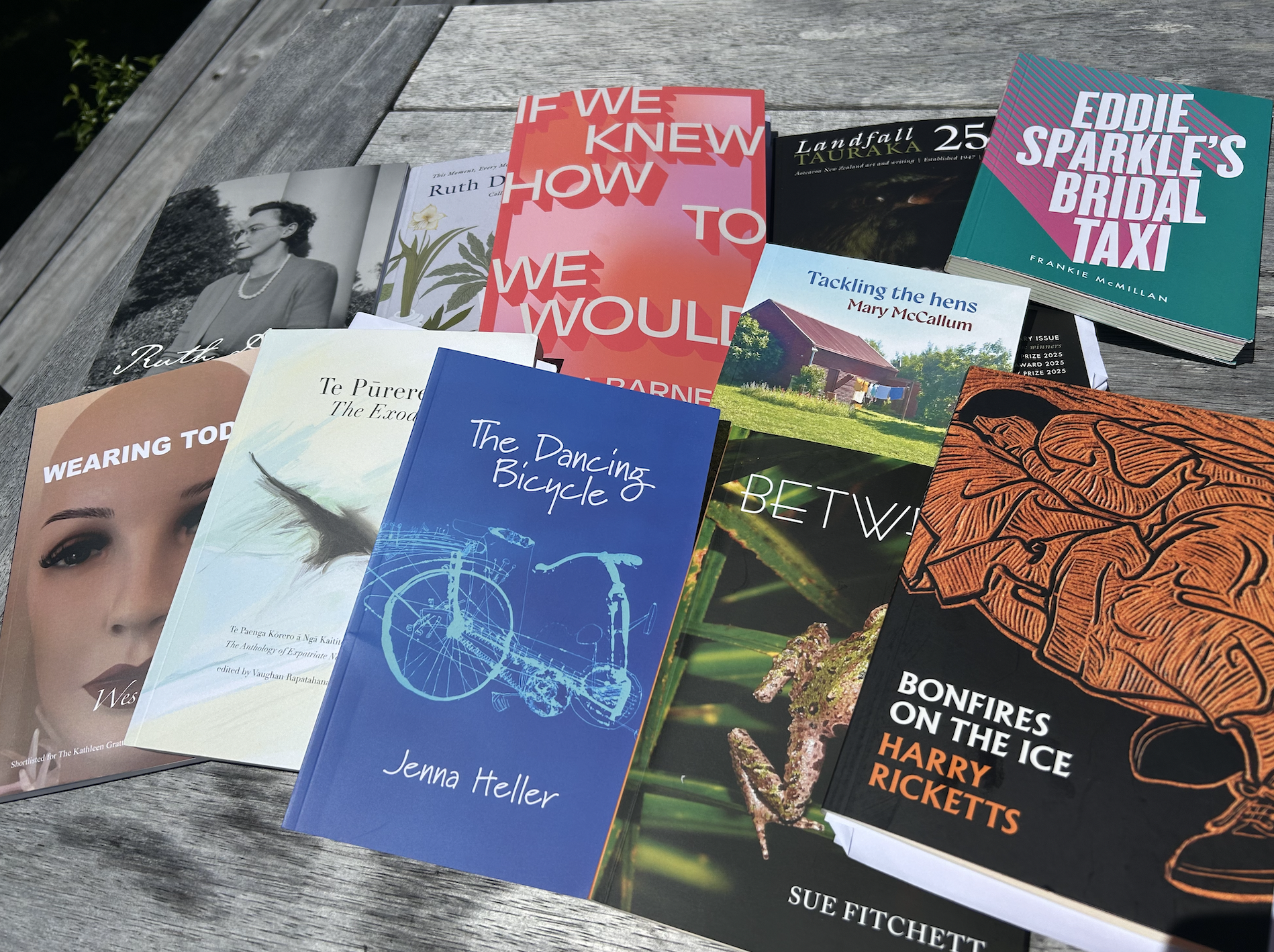
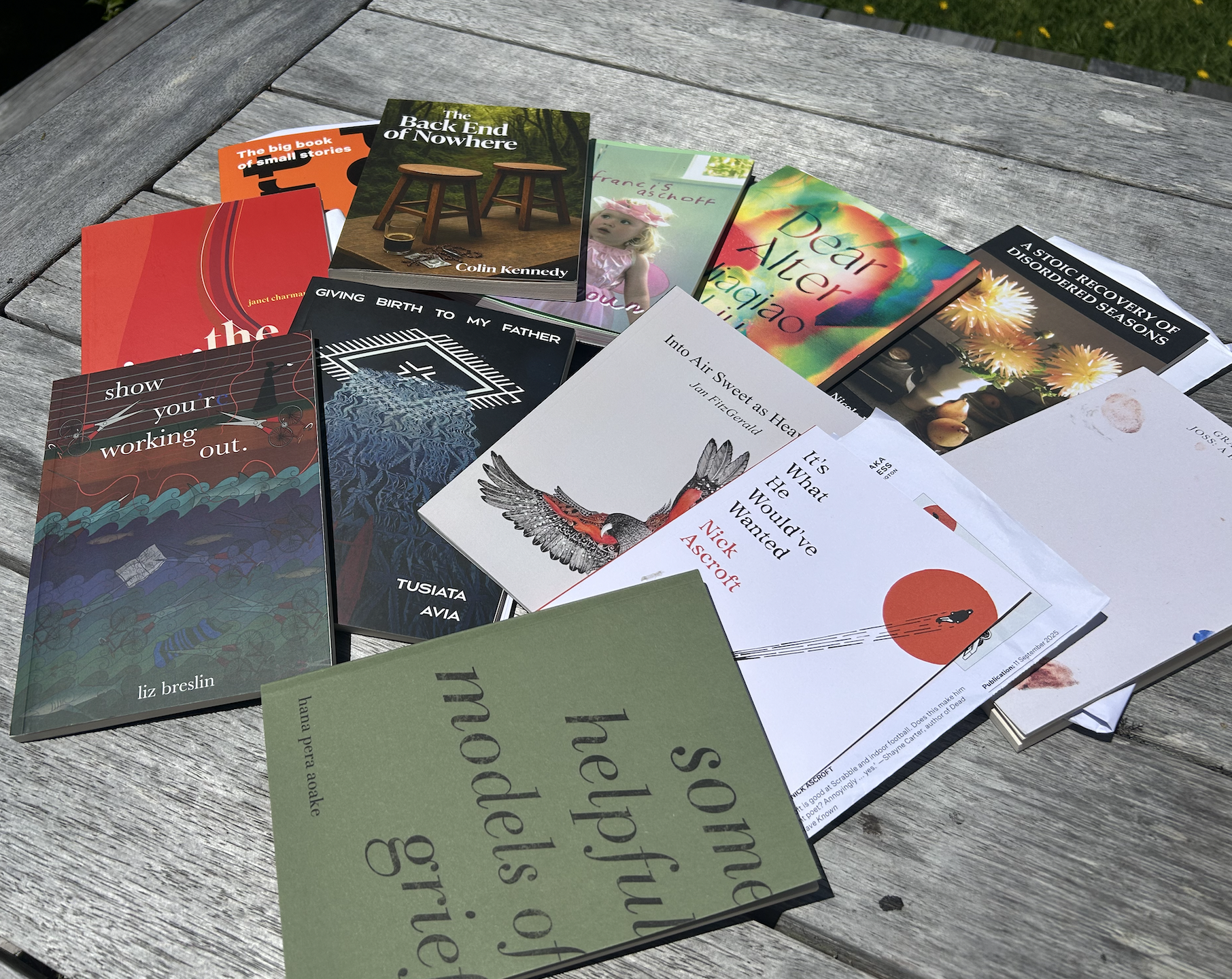
Every poetry book I have picked up, lingered over and reviewed (put review in the side bar and you will discover my reviews), I have utterly loved. Sadly for me, there is still a stack of books on my desk I’m itching to get to (see photos below), books by poets I love, books by poets new to me. This week I made the hard decision to return to reviewing these books after Poetry Shelf and I have rebooted, after we all get through the busy season where it is hard to read more than shopping lists.

I want to share a couple of highlights with you, but first a wee update. I am standing at a fairytale door, a threshold onto my new road. What specialists call my new normal, not the normal I enjoyed when I was travelling all over the country, visiting schools, doing events and author tours, reading and writing all day long. I have had a bone marrow transplant that has gifted me the miracle of life, thanks to an anonymous donor and an incredible medical team, but it comes with scars. Looks like I will always have to use my energy jar carefully, to manage my daily physical challenges with various aids. But I sure in heck find enjoyment and delight in every day.

Poetry Shelf has made such a difference in year that I have tagged both my worst and best. So many poets contributing, so many poetry fans reading and sharing. So many thoughtful caring emails, especially those responding to The Venetian Blind Poems, especially those responding to features and audio that have resonated with you. Poetry Shelf is nothing without you, without readers and writers connecting across generations, cultures, the length and the breadth of the country.

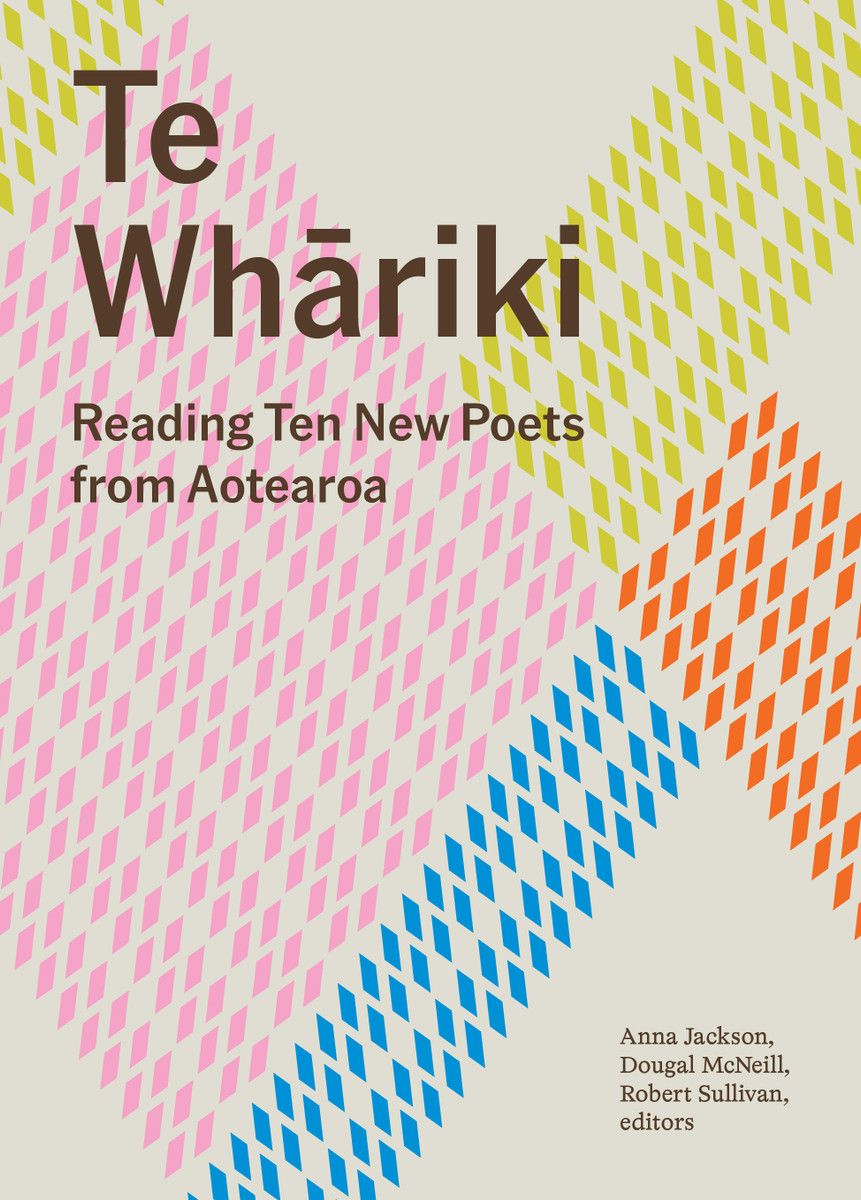
Creating three new series this year has been a special highlight for me. I have included links to one of them, Poetry Cafe Readings, because hearing these poets read has been such a gift. This will be back next year, along with the Speaking Out ( check out the Gaza poems) and Playing Favourites series (check out Jackson McCarthy), plus some new ideas. I have also included a link to the fabulous Te Whāriki anthology where some of the contributors selected a favourite poetry book of 2025.

Feature on Te Whāriki: Reading Ten New Poets from Aoteatoa, edited by Anna Jackson, Dougal McNeill and Robert Sullivan (Auckland University Press, 2025)

Poetry Shelf Cafe readings: Poets read and talk poetry for around twenty minutes

Richard von Sturmer reading
Jo McNeice reading
Anne Kennedy reading
Aruna Joy Bhakta reading
Harry Ricketts reading
Alexandra Cherian reading
Ethan Christensen reading
Sue Wootton reading

I often ask poets in interviews what words matter to them as they write – but today I am asking you what words matter as you live each day. I am thinking: kindness, self-care, connections, hope and joy. Over the next month or so I am going to read novels, watch movies, listen to music, tend the vegetable garden, and bake and cook.

Sending aroha to you all along with a huge bouquet of sweet and salty Te Henga ocean air.

Books on my must-read pile:

Poetry Shelf conversations: Paula Green and Anna Jackson

In 2022 I had a lifesaving bone marrow transplant and, since then, have been on a long and bumpy recovery road. To celebrate the arrival of my new collection, The Venetian Blind Poems (The Cuba Press) I am creating three features to post on the blog over the coming month, with the help of other fabulous poets. Thank you!

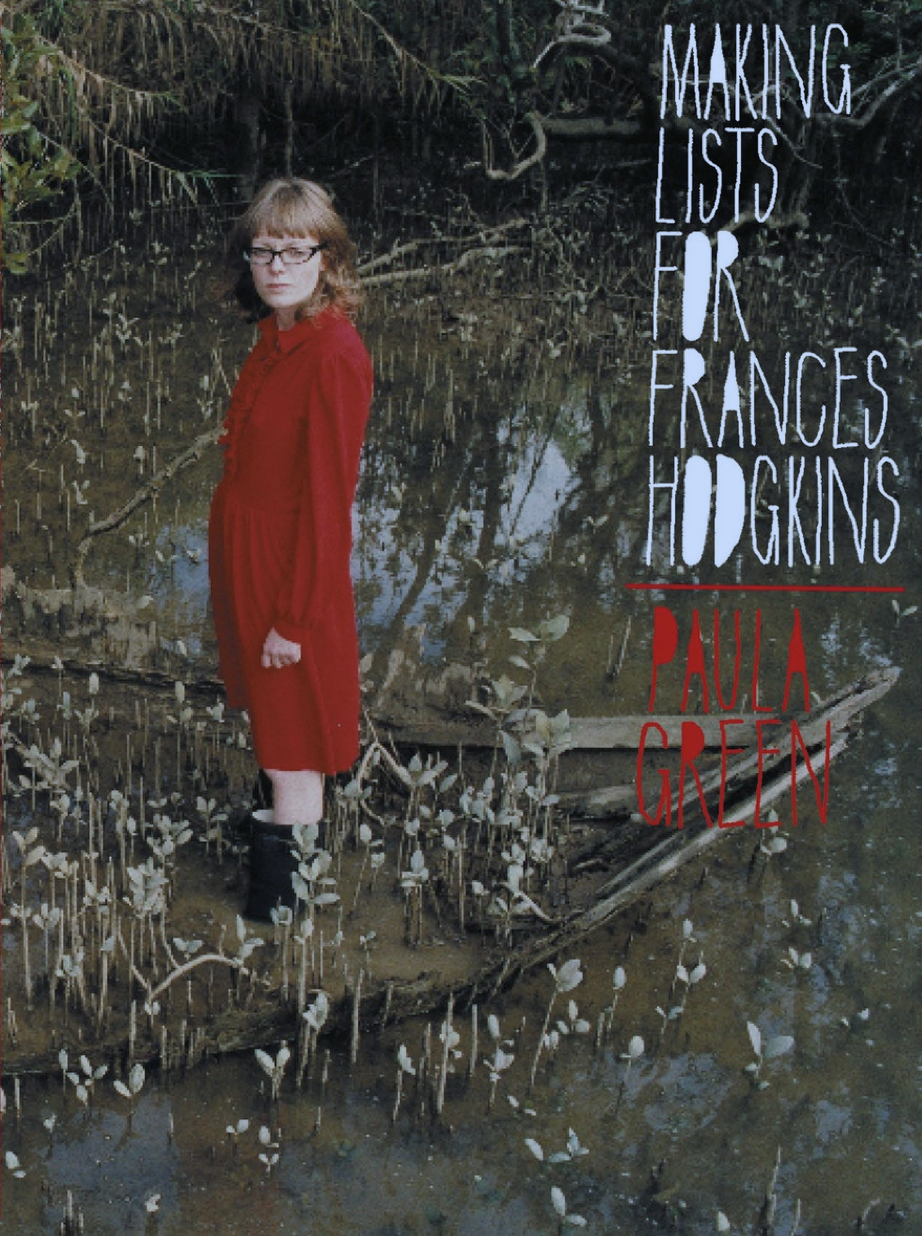
The Venetian Blind Poems, Paula Green, The Cuba Press
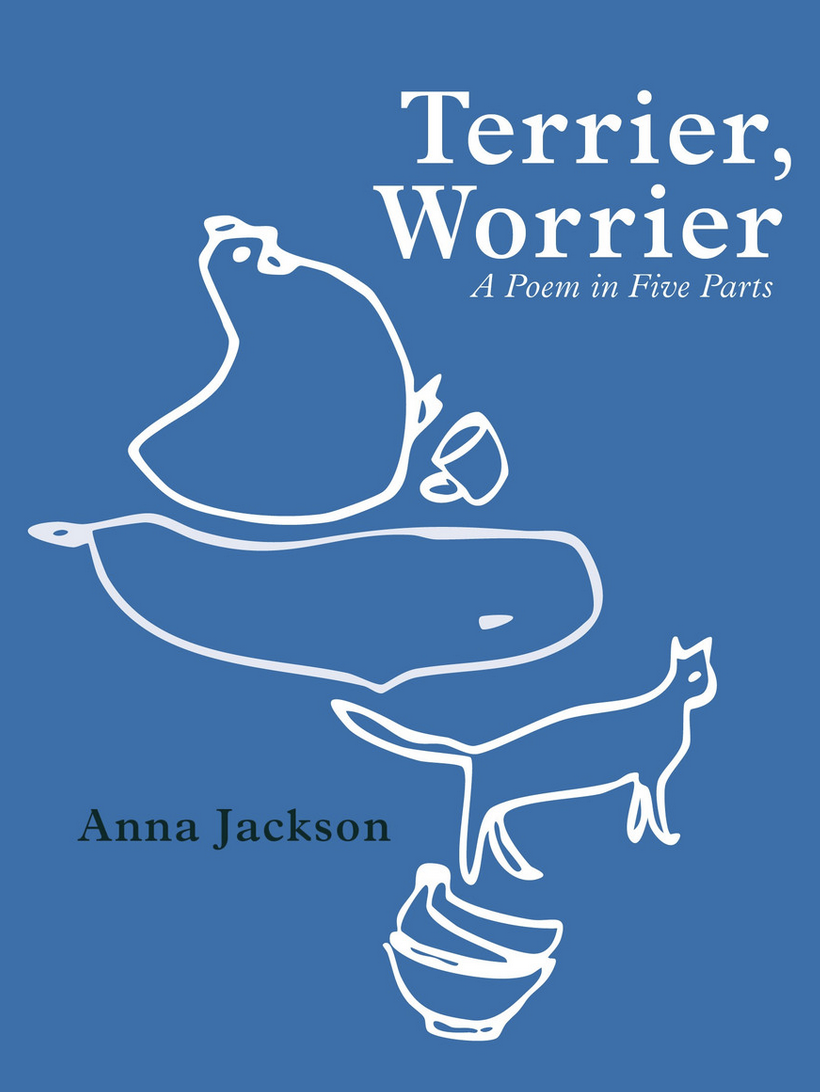
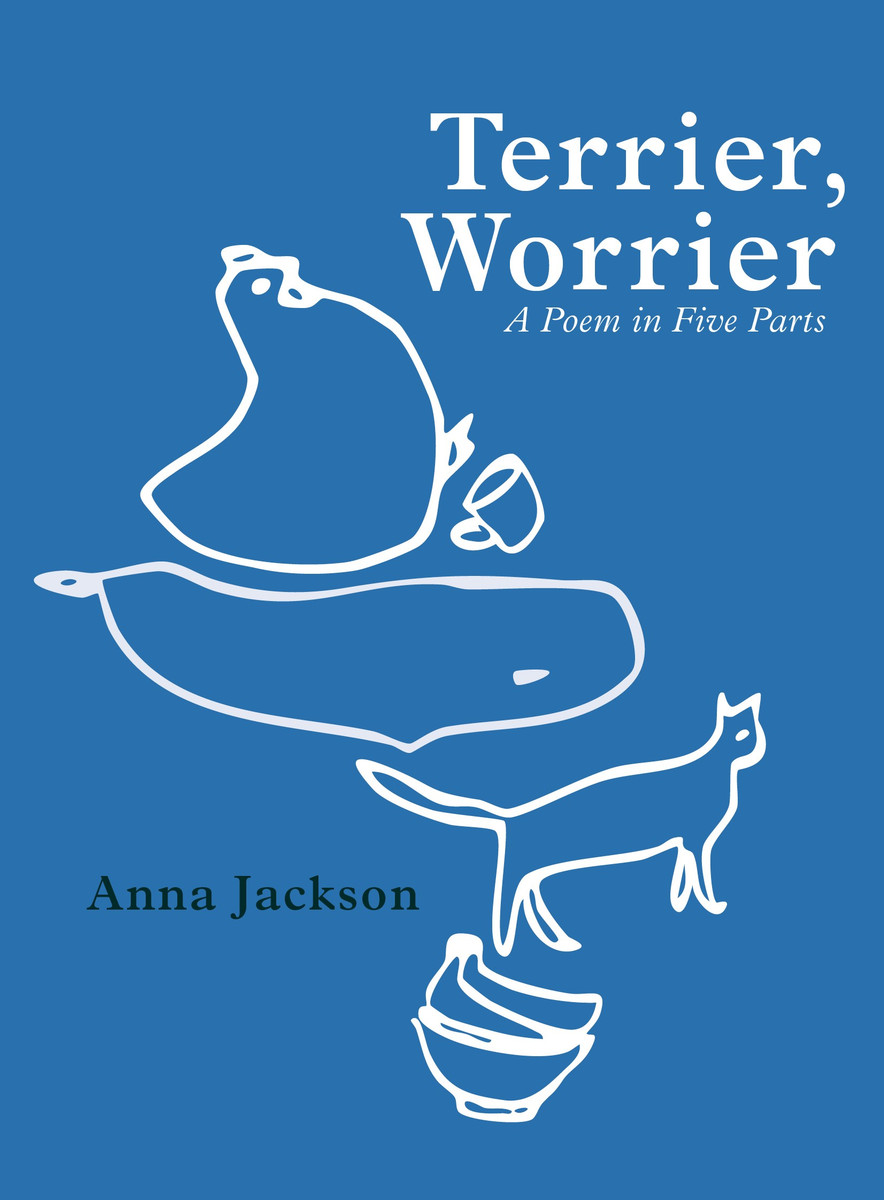
Terrier, Worrier, Anna Jackson, Auckland University Press

‘I thought, every body is a memory palace.’
Anna Jackson

‘I will try roaming drifting stalling sailing’
Paula Green

An email conversation: Anna Jackson  and Paula Green

Paula: We have known each other for a long time, drawn together by our mutual love of poetry. When my debut collection Cookhouse was published by Auckland University Press in 1997 you slipped a letter in my university pigeonhole inviting me to afternoon tea, and we have been friends ever since. Over the past couple of years, in my isolation period, we’ve had ‘café conversations’ on the phone, filled to the brim with talk of books and writing and poetry. And of course, life. These conversations have been so precious to me.  

We both have new poetry books out this year so I thought it would be wonderful to have an unfolding email conversation where we get to talk about reading and writing poetry, and most importantly, our two new books. Like a miniature road trip with no predetermined route or lookout points.    

Where to start? For the past few days various ideas fell on the page, but I kept returning to an insistent thought: why poetry matters to me. I guess I have simple answers and complex answers. I have written poems all my life because I love doing it. Writing poetry gives me strength and joy. It feeds my love of music, my intellect, my heart, it offers surprising pathways into the past, the present, into beauty and despair, into humanity. I love how poetry can be so open, so organic.  

Why does poetry matter to you?  

Anna: I loved your Cookhouse book and I think it is funny how literally I took it – it is full of imaginary afternoon teas with writers, and you were the writer I wanted to have my own afternoon tea with, so I just asked you.  I love the way poetry opens up possibilities, on the page and in the world.  I thought about answering your question about what poetry means to me in these terms, as an intimate kind of relationship between poet and reader, and as a way of opening up possibilities for actions in the world.  But trying to answer completely truthfully about what it is that has kept me reading and writing poetry for more than three decades now, it is really more as a form of art I engage with it, rather than as a form of conversation. 

I am endlessly interested in the effects of form, and in how to arrange ideas and imagery in ways that add resonance to meaning, that give rise to a kind of beauty.  I would really have liked I think to have been an artist, and to work to create a visual language and visual beauty that would also give rise to thought, but thoughts are my material, words are what I know how to work with, or have practiced working with, and I am no closer to reaching the limits of what I can do with them.    

I’m trying to think if this is true of me as a reader of poetry as well as a writer and I think so?  I do feel a little in love with poets as a reader, and so I do also  think about poetry as a kind of conversation, or as a kind of self-expression – I can fall in love with a voice and want to read anything written by, for instance, Frank O’Hara or Eileen Myles or Amy Marguerite.  And I love Raymond Carver’s poetry because I think of him writing it – even though I have never met him (or Frank O’Hara or Eileen Myles). And when I read Cookhouse, I wanted to know you as a friend.  So it isn’t just an interest in formal arrangements – and that must be true for me as a writer too.  I am not interested in arranging just anything, I am arranging ideas and experiences of my own.  But the arrangement matters.   

Paula: So much I want to say. I am thinking of poets whose books I have travelled with over decades – Bill Manhire, Bernadette Hall, Dinah Hawken, Elizabeth Smither, Michele Leggott, Anne Kennedy, Robert Sullivan, Selina Tusitala Marsh, Tusiata Avia, Emma Neale, Helen Rickerby – whose work I love so much and with whom I have had uplifting café poetry conversations. I am thinking of the incredible waves of new poets whose work both sustains and amazes me, and I feature this on Poetry Shelf.

I am also thinking of Terrier, Worrier, and how the book’s form, with its loops and patches, its intellectual and emotional rhythms, celebrates, yes celebrates, how poetry can open and re-view worlds, both internal and exterior. So yes, an arrangement that, like a Frances Hodgkin’s still life, offers expansive movement, and out of that movement, an intoxicating interplay of stillness and beauty. And it feels deeply personal. The poetry collections that depend upon, that navigate or have poetic bloodlines in the personal in myriad ways, these are the collections I want to keep reading and re-reading.   

Anna: I read The Venetian Blind Poems as your friend, and knowing something about what you had been through, and having had many conversations with you about the politics of the time we are living in, the atrocities we have witnessed, and so of course I didn’t read it just as a formal arrangement of ideas.  But I also do love it for its composition, for the way you balance the small, vivid details of a life – the sound of air conditioning, the day-break birds – with the concerns that extend beyond your own experience, your concern for other people, the way your own life is shaped by the news you hear on the radio and read on your phone.  And I love, too, the way so much of the imagery is imagined or remembered – you can think of a beach while lying in a hospital bed, you can climb over pain like a mountaineer.  Your whole life, in a way, is there in the room with you, even while it is so taken up with the routines of a hospital stay, the comings and goings of nurses, the way symptoms of illness and recovery shape the experience of time.  It must have been a challenge arranging all these different things into a collection that moves as beautifully as The Venetian Blinds Poems does.  Do you want to talk about this?  

Paula: For me it simply comes back to three words: joy, light and love. Writing along with cooking is way of nourishing the joy, light and love that shape each day. And for me, both involve sharing. The Venetian Blind Poems comes out of a tough experience, but perhaps it comes back to beauty. I imagined (and still do) I am climbing a mountain. Yes, it is tough and there are obstacles, but in hospital I would stop on the side of the mountain and pause to look at the beauty view.  And still do. My transplant was a gift, and even though I still face daily challenges, each day is a miracle.

I think I should add friendship to my list. I’m sitting here musing on the notion of poetry as friendship. I’m heartened by the acknowledgement pages in poetry books I have read this year, pages that situate the creation of a book within a matrix of friends, along with other writers and their work.  

Anna: Oh yes, I like reading the acknowledgement pages too, especially in books by poets who are not part of my own poetry community, when they reveal friendships between different poets I love that I didn’t know were friends.  I love to think of them reading each other’s work!  Reading poems by friends, or people you want to make friends with, is a brilliant short cut to intimacy, you get to know them not only through the autobiographical details they might draw on, but through the particular way they leap from one idea to the next, the kind of images they think up, what they find beautiful in the world.

Returning to the question of the relation between poetry and beauty, there is so much beauty in The Venetian Blind Poems, in images like the moon shining through the blinds in the hospital, or the sweet-talking light that the hens respond to when you are back home in Bethells, looking out at a view you say you could make sugar from!  And there is a beauty too in the arrangement of ideas and metaphor and in the movement through time that the collection gives us.  I know you were an artist yourself before you were a poet, and your partner is an artist, so I’d be interested in what you have to say about the relationship between poetry and visual art, and the importance of beauty to you as a poet.    

Paula: I love your drawings. I have one on the wall above my desk. You should do more! There is a long line of artists in my family. Colin McCahon once lived in a shed at the bottom of my mother’s garden. Toss Wollaston is in my family tree. I would stay with my artist uncle in Mapua, he would get out his paints for me, and I fell in love with painting. When Michael and I met in London we knew we wanted to be together, and that we wanted to write and paint no matter how poor we were, and we have done that. I get to walk up the hill to his studio and get an incredible uplift from his work. And I can go to exhibitions now.

When I initially view an exhibition or read a sublime poetry book, I move beyond words, into a state of intellectual and emotional uplift. A state that may move into narrative or ideas or memory or feeling. I felt that after reading Terrier, Worrier, it took me ages to find a way to review it, to find a form and an arrangement that opened the book for the reader.   

There were so many lines I wanted to quote from your book in my review – ideas that would expand as I moved through the day. For example:

I felt as if my own life were like that dream in which you climb some stairs in your house and discover a whole additional room, or a whole

series of rooms, you didn’t know was there.

I love this idea. I definitely have rooms in my head! It got me musing on connections between writing and space and discovery. Is this key for you too?  

Anna: I think that’s a common dream, finding you have more rooms in a house than you knew you had?  And I think it does represent an opening up of the self.  I think I even read that in a dream dictionary!  And I think poetry does build rooms that expand the sense of self and gives you more room in the world.  I think art does too.  I draw all the time, actually, or often, anyway, but I don’t usually keep my drawings and I wouldn’t want to exhibit them, they are just for me, something I like doing. To be an artist I think is more than drawing, or painting, or it would have to be for me to think of exhibiting – it would be more of a conversation with the world, perhaps, than my drawings are, I would have to think in terms of audience, and in relation to other art. 

I am secretive about playing the piano too, and singing – I have no interest in performing.  But I don’t know if I would write poetry if I didn’t think I would publish it, or if I did, it would be a different kind of activity.  How strange.  What is the relation for you between writing and publishing?  Does it change the nature of the work, do you think?  

Paula: Interesting question. I have so many secret manuscripts I have written over the past couple of years and every single one I wrote out of a love of writing. Some I might like to see in book form, some I might not, but I would never sacrifice my voice or vision in order to be published. Working with Harriet Allen on 99 Ways into NZ Poetry, and with Nicola Legat on Wild Honey: Reading NZ Women’s Poetry were special experiences. Working with Helen Rickerby for many years on poetry collections was equally special. The past three years I have experienced multiple forms of isolation, but my secret writings and my public blogs have been vital engagements with the world. They both matter to me far more than being published. I love talking about poetry books by other people, but talking about my new book takes me back to such an extraordinary time, both on the ward and on my recovery road, I am cautious. Illness is a tricky thing. How do we talk about it? How do we care about it? How do we listen? 

I was thinking about secret writing, and how poetry collections, especially sequences such as Terrier, Worrier, both mind and heart fluent, come into being. Did its arrival surprise you? Like opening different doors and windows onto the world and self? Like discovering different poetry trails? 

Anna: My secret writing is mostly just stories in my head.  I’ve been interested lately in books that include day-dreaming as part of the narrative – Rosalind Brown’s Practice, about a student who is trying to write an essay on Shakespeare’s sonnets, opens out into the most extraordinary day-dreaming sequence, so true to the experience of inhabiting an imaginary self, allowing a story world to come into a kind of reality overlaying the actual reality.  And Claire-Louise Bennett’s Checkout 19 also has a story of a story inside it, a kind of written day-dream.  Both of these narratives of day-dreaming feel astonishingly transgressive to me – so revealing of an interior self!  Which is odd because what else is poetry? 

Terrier, Worrier was a surprise to me, yes!  I wasn’t planning on writing it.  But I had recorded some thoughts, over about 3 or 4 years, including the lockdown years, as a blog on my website, that was semi-public – I had a link to the blog on the website but not many people ever read it.  So it didn’t feel published, exactly, but not quite secret either.  I considered going through the blog posts and turning them into sonnets, or giving them a rhyme scheme, and I also considered expanding the ideas and developing the logic of each thought, and perhaps developing a logic connecting them to each other.  Instead, I took out an image, or a fragment of thought, or a few connected points, from each of them (or, not all of them – maybe about half of them), and pieced these extracts together in the fragmentary way the book works now, letting the connections between different ideas resonate in a more open way, and adding in additional thoughts, observations and reading notes, thinking more about the rhythm of the text than the content.  I liked the thoughts much more when they were cut short and had some space around them. 

Tell me about the process of writing The Venetian Blind Poems – they are set in the time of your hospital stay but were written later.  Did you draw on written notes or just on memory?  Were you writing poetry in hospital, in your head or on the page, or just thinking poetry, or did the poetry come later?

Paula:  I love how fragmentation, space, openness and openings work together in Terrier, Worrier, so it is fascinating to hear their role in the process of writing it. I was ‘writing’ in my mind on the ward – in one of those secret head rooms – but I was on morphine for pain and every now and then things would spill out. I would create line fragments, reciting them like beauty echoes in my mind, especially when things were tough, to help me step outside physical challenges. I think I was assembling drifts of poetry in my head. Sometimes I jotted poetry drifts in my notebook along with blood results and the water sipped.

Back home, I wrote it in a big beautiful notebook. The first section, ‘The Venetian Blinds’, was a mix of memory fragments and notebook drifts. It’s why there’s a strange rhythm sometimes, with miniature snags, jarrings and arrivals, along with sweet currents. The second section, ‘Through the open window’, is one-hundred percent back home where the miracle world is an incredible mix of wonder and fragility. It felt like I was writing poetry with a miracle pen, in a world that filled me with despair as much as it filled me with wonder.

Somehow through this, I’ve also been reading and reviewing books for Poetry Shelf. Taking time to read and write slowly. To open the possibilities for poetry book reviews wider. My slow pace and personal approach means I don’t complete as many reviews as I would like. But I love doing it so much.

I have been thinking about how writing is both words and beyond words. When I write a poem, I’m taken beyond words to a state akin to listening to music or watching pīwakawaka dance beside the kitchen window. And it’s exactly the same when I read poetry collections that carry me beyond words before returning me to the exhilarating moment of writing a review. These are the books that stick to me regardless of form or style, voice or subject matter.  I often wonder how I’ll ever manage to review such books without shutting them down for potential readers, without placing limits on the possibilities of reading. I am currently reading Josiah Morgan’s breathtaking collection, i’m still growing and I’m at the point of being beyond words I love the poetry so much. I felt this with Terrier, Worrier and ended up writing a review loop in nine parts.

Do you find writing is both words and beyond words? Every book I review – I am stalling on the word review here and might write a piece on it for the blog – I discover something different about poetry writing as a process. Any thoughts on this?

Anna: I love the idea of poetry drifts, and the idea of creating beauty echoes in the mind, and I love your account of how the book was assembled out of notes and memories, out of poetry drifts and notebook accidents, and completed in that time of miracle and fragility.  I know what you mean about the beyond-words aspect of poetry – but I don’t know if I can find the words to talk about it!  Maggie Nelson writes in The Argonauts about Wittgenstein’s idea that “the inexpressible is contained – inexpressibly! – in the expressed,” and I find myself talking to poetry students about how a poem can “mean more than it means” – stopping by some woods on a snowy evening becomes about more than stopping by some woods on a snowy evening, without ever being precisely about anything else.  In my poetry class I call this “resonance” – the way a poem kind of thrums with meaning, through the ways different ideas, or images, or events, or objects are placed together in the same textual space.  But you have to use words to make the words mean more than the words do! 

In your work, you often use abstract words in a way that seems very concrete, while filling the poems, too, with material objects that seem to shimmer with meaning.  This is something I’ve always loved about your writing.  In Cookhouse, for instance, several of the poems have an item of food as the title, then a more abstract phrase or couplet to follow:

iced water

the perpetual sense of the little piece
Relishing stroke upon stroke


gelato

habits harbouring no conclusions
in my moment of heat 

I found these poems mysterious and compelling, I loved the way the iced water or gelato anchored the lines that followed into something I could picture, but I also loved thinking of the habits that harbour no conclusions, the perpetual sense of the little piece, and how these ideas might both attach to the objects that gave rise to them but also how they might float free from them, and I found that after reading Cookhouse all the objects around me became magnetised with the potential to attach meaning.

The Venetian Blinds poems work a little differently but the effect is still to layer meaning on meaning.  There is a lot of figurative imagery, which in itself seems to me to lean towards abstraction, in the sense that as soon as you compare one thing to another it becomes at once both things and neither thing.  But you are more often bringing different concrete, material things into relation with each other rather than relating an abstraction to something concrete.  So, you write for instance:

At dawn the air conditioning
is the sound of rain on a tin roof
and then water dripping in distant bush


Or, writing about the hospital food (I found this very funny):


It’s a solid square of inedible fish pie
slathered in Thai coconut sauce that reminds
me of cotton wool and saltless sea foam

And along with the details of hospital foods, nurses coming and going, the view from the window, changing light, changing sounds, there are memories of other views and objects and occasions, and daydreams of other places, thoughts of what is going on elsewhere, so everything is at once concrete and material but also often belonging to dream or memory or imagination.  And then you are also concerned with writing about pain, illness and fear in concrete terms, imagining pain as a box, or recovery as a mountain.  And poetry itself you think of in visual terms, you talk about driving a poem at low speed so you can enjoy the view through the window, and you even have an image for the relation between the expressed and the inexpressible:

Whenever I open a poem
there’s a curious river
between what I write
and what I don’t write

Paula: Driving a poem – whether as reader or writer! Writing and reading is a crucial form of travel for me. The word that comes to mind as I reread your book again, is movement, that sweet satisfying sensation I accrue as both reader and writer. I am thinking intellectual, emotional, mnemonic, self-nourishment, musical. When I reviewed your book, I created a loop review in nine parts, and movement was a vital ingredient in each section. That and thought.

I enter your poems and I am re-viewing thought, moving across a bridge between one idea and another, along currents of thinking that expand and condense. I read: ‘every body is an emergency room’ and then ‘every body is a memory palace’. I am crossing a bridge into self and then into poetry. Could I carry the emergency room and the memory palace over to the poem? Think of the poem as emergency room? As memory palace? I love this. It resonates so acutely with The Venetian Blind Poems.

Your title, Terrier, Worrier, with its foraging dog image and fretful thinker, offers multiple gateways into movement. You write:

I thought, a terrier is a good symbol for the work of digging up
something underground but still alive.

Again I lead an idea over a bridge to self and then to poetry. To the making and the reading of a poem. And as you indicate with my collection, there are the vital anchors in a physical world. Your thinking, for example, finds roots or starting points in your hens, the birds you observe, the floor tiles, the concrete slabs you photograph, as much what you read, experience, remember.

Thinking, I am surmising, is a relative of wonder, with its attraction to both questions and awe. On each occasion I read Terrier, Worrier, I am wondering. It’s like you are opening both the emergency room and the memory place for us as readers, to let us feel and think the looping ideas, the attachment to beauty and art, to empty space and infinity possibilities.

In this piece, for example, I grasp the need for similes as much intentions or plans, especially how the similes you include add taste and texture to your curling thoughts, as though you are sprinkling grated ginger or finely chopped curly parsley over the writing, the thinking:

I thought, I feel like we ought to acknowledge our feelings,
but I also feel like we ought to then present thoughts, and
claims, that can be challenged and which could be backed
up with evidence, and we ought to act on our claims and the
implications of them. And, I thought, I feel like the phrase
‘I feel like’ ought to introduce a simile at least as often as a
thought or an opinion or a plan. I wanted to feel like a leaf
but I felt like a sink of dirty dishes.

I am about to begin a sentence with ‘More than anything …’, but what follows keeps changing, because Terrier Worrier, offers so many rewards. But I think the word I return to is nourishment. More than anything, the collection nourishes me. The idea that thought, feelings and dreaming, along with poetic devices, form and tempo, are sustenance. Poetry is nourishment, and in this uncertain world, that matters. To that I am adding preparing meals, baking bread, keeping my two poetry blogs active, connecting and engaging with family, friends and other writers.

What matters in our days? What matters in these  catastrophic times is how we nourish ourselves, each other, our planet. And writing and reading poetry is one small but vital form of doing this.

Watch Anna Jackson in conversation with Amy Marguerite and John Geraets
Auckland University Press page
The Cuba Press

Poetry Shelf review: Terrier, Worrier A Poem in Five Parts by Anna Jackson

Terrier, Worrier A Poem in Five Parts, Anna Jackson
Auckland University Press, 2025

“She came upstairs looking more like a cloud than a silver lining.”

Loop: A Review in Nine Parts

LOOP

Anna Jackson’s glorious new collection, Terrier, Worrier A Poem in Five Parts, gets sunlight slipping through the loops of my thinking, reading, dreaming. The collection is offered as a seasonal loop as we move through summer, autumn, winter, spring, summer, and in this temporal movement, the loop regenerates, absorbing and delivering rhythms of living . . . mind and body . . . rhythms of writing . . . nouns, verbs, conjunctions . . . rhythms of thinking . . . and little by little . . . the compounding ideas, the feelings. It’s poetry as looptrack: overloop, underloop, throughloop.

I photographed a floor softly tiled in white and grey and
posted it with a quote from Emily Brontë’s diary: ‘Aunt has
come into the kitchen just now and said, “Where are your
feet Anne?” Anne answered, “On the floor Aunt.”‘

BREAKING THE FRAME

There is a long tradition of breaking the frame of poetry, or let’s say opening the frame, widening, nurturing, reinventing, rebooting, invigorating. And yes, there is sunlight drifting in through the gaps in these poetry weatherboards, lighting up what poems can do or be, both beyond the frame and within the frame. Subject, style, sensation. Anna writes:

Poetry can be a form of refusal as well as openness.

I am reading this poetry book at the kitchen table and it is a loop of ignition points. Anna also writes:

I thought, it tells us something about poetry that when we
need to talk to ourselves about something we don’t know
we know, we tell it to ourselves when we are sleep, in images
we struggle to remember when we awake, and often take
more than one reading to fully understand.

PRESENT TENSE

There’s a long black cloud streaking from the west coast to the backyard bush sprinkling salt and pepper rain. Terrier, Worrier is generally written in the past tense, with many stanzas beginning with ‘I thought’, yet for me, curiously, wonderfully, it carries the charismatic freight of the present tense, the sweet fluidity of the gerund, the present participle . . . where be-here-now fluency prevails regardless of gaps, rest-stops, hesitancy. Reading is to be embedded in the moment of the past as reader, so that what happened, and what was thought, becomes acutely present. Dive into the poetry currents in the collection, and along with the writer, you will might find yourself filtering, evaluating, experiencing, valuing, photographing, documenting, thinking. Savouring a moment.

I remember sitting in the car after work, not wanting to turn on the windscreen wipers because I felt like I needed rain on the windscreen to do the work of crying for me.

THOUGHT

Thinking. Yes Terrier Worrier is a poetic record of thought that offers anchors, the cerebral terrain of the philosopher say, an archaeology of ideas to dig for. Where testing the possibilities of what is matters along with what is not, along with everything in between. Poetry forms a thinking loop, a porous border between poem and idea, where meaning is organic, fertilised by nuance and shifting light. Sunlight say. Looping motifs and coiling thinking, like the surprise delight of letting thoughts carry you without planned itinerary. Where meaning ripples and slides. This is what happens as I read Terrier, Worrier.

Anna writes:

I thought, most of the time I, too, am a person not having thoughts but only having sensations, emotions, instincts, memories, anticipations.

Perhaps the poem becomes the vessel for ‘sensations, emotions, instincts, memories, anticipations’.

PRESENCE

Anna’s poetic record of thought (how ‘record’ resonates with the effects of tracks and music) is physically active. Thinking is anchored in a physical world, a yard of hens, a cat, partner, mother, father, daughter, son, friends. A tangible texture of dailiness that grounds the rhythm of thought in physicality. I love this.

Beside my bed there is a painting of a blue fish, floating high above a grey-blue sea, impaled on a grey-blue spike. On the back of the painting are written the words of the artist, my daughter, aged 3: ‘This is the fish. I painted it because it stuck in my mind.’

DREAMING

Dreaming becomes thinking becomes inventing becomes dreaming. Anna holds the idea of dreaming, like a prism on her palm, to question, revisit. Again I’m acutely aware how everything I have already said feeds into what I am saying here, and what I will say. How dreaming is the present tense, looping past and future, how the poet wonders her dream, with dream seeping into life and life into dream, into the threads of a poem in five parts. How do “sensations, emotions, instincts, memories, anticipations” slip into the dream texture, I wonder. Into the making of a poem.

When Amy told me she had dreamed about me, I felt as if my
own life were like that dream in which you climb some stairs
in your house and discover an additional room, or a whole
series of rooms, you didn’t know was there.

SPACE

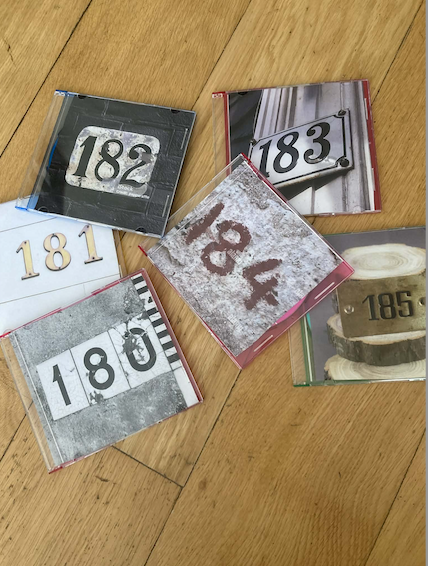
A word with myriad possibilities. There is space in the reading, in this nourishing process of reading that sends me looptracking and dawdling in a state of dream and wonder. Early in the sequence Anna is (and yes usually I am cautious about attributing the speaking voice to the author, but this book feels utterly personal so I think of the voice as Anna’s) – taking photographs of squares.

There is too the proximity of space and death, especially as both Anna’s parents and sister had had “a turn at death’s door”.

There are recurring motifs of rooms and buildings, and especially this thought:

I thought, every body is a memory palace.

And this:

I thought about the concept of ‘peripersonal space’, the idea
that your mental mapping of the self includes the immediate
space around you, and what you habitually keep about your
person, including for instance your bag, or your falcon.

READING LIST

Lately, I have been reading novels and poetry books that make a writer’s reading history visible. I love falling upon titles to be added to my must-read notebook, across genre, time, location, languages. Anna’s reading list at the back and the titles sprinkled throughout is incredible.

How may times do I return to Virginia Woolf! I must read Jan Morris’s thought-a-day diary, or Robert Wyatt’s irony of doing loads of minimalism, and how I too loved Susan Stewart’s magnificent On Longing: Narratives of the Miniature, The Gigantic, the Souvenir, Olivia Lang’s Crudo, Madison Hamill’s brilliant Specimen, Muriel Rukeyser’s poetry.

Worrier, Terrier is the kind of book you can’t put down. I keep giving myself another week to flow along its currents, neither to explain nor pigeonhole, but to embark upon the joys of reading poetry, of reading a book that feeds your mind, that sparks and startles your memory banks, that gets you revisiting your own secret feelings and thoughts. Because more than anything, I hold Terrier, Worrier as a book of self. This book of invigorating return, where you will find yourself expanding with both recognition and discovery. It feels like this is what Anna did as she wrote. Is the poetry a form of coping with the abysmal world, the drift thoughts and non-thoughts, the dailiness, the relationships?

I read another page. Then I reread this, a pulsating heartcore of the book:

Some feelings expand the self like a gas into the world and
some condense the self into the coldest matter.

And then this:

I wondered whether I could hear ‘terrier’ as a version of the
word ‘worrier’, a worrier being not someone who makes you
worry but someone who themselves worries, who worries away at things like a terrier might worry away at a sock. A terrier would be someone who allows themselves actually to indulge in the feeling of terror. I tell myself, ‘I am not okay, but I will be okay’, but maybe I need to stop saying that and release the terror, or maybe the terrier is not myself but represents someone else’s terror that needs to be heard.

Tomorrow I will pick up the book again, and find another gleam and thought spur. I want to sit in a cafe with you all, let our thoughts dream and drift and link, as we empty our coffee cups, pick up our pens, and catch both the dark and the sunlight slipping in . . . as we write through weeping, laughter, longing, with doors ajar and love strengthening. I utterly love this book of wonder.

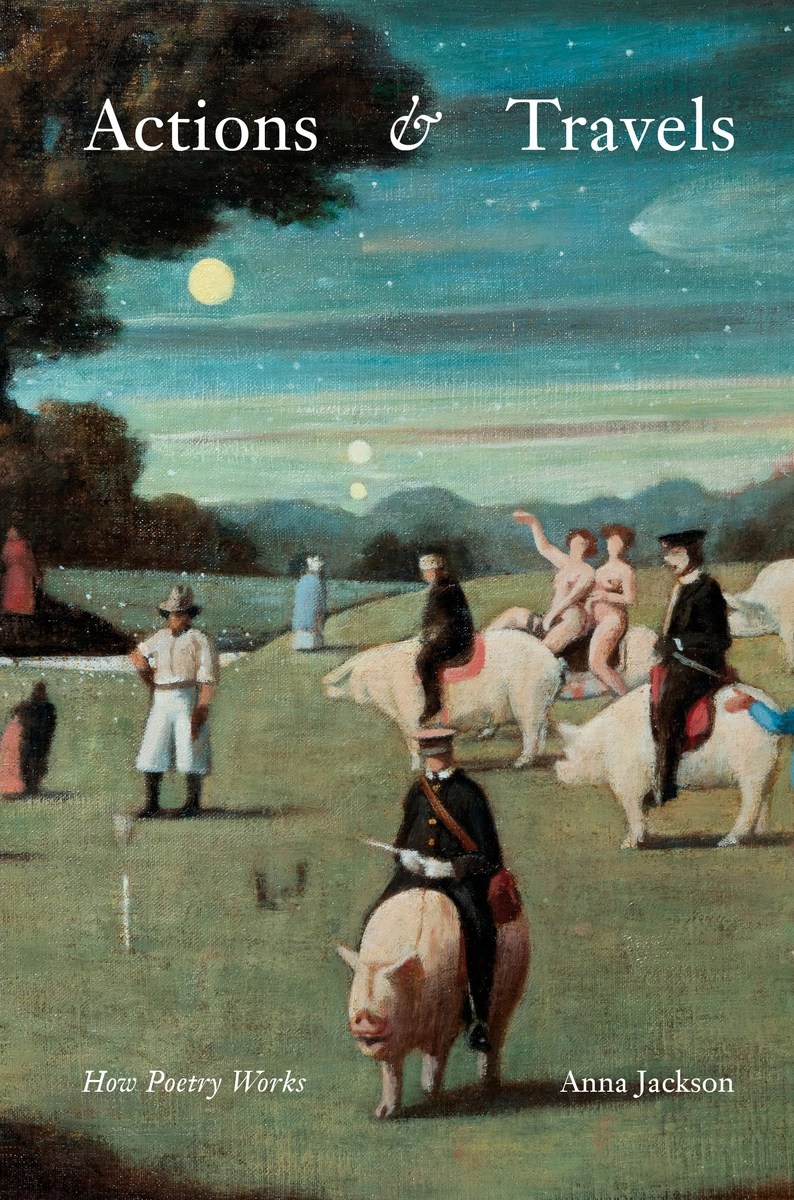
Anna Jackson is the author of seven collections of poetry as well as Diary Poetics: Form and Style in Writers’ Diaries 1915–1962 (Routledge, 2010) and Actions & Travels: How Poetry Works (Auckland University Press, 2022). She lives in Island Bay, Te Whanganui-a-Tara, and is associate professor in English literature at Te Herenga Waka  Victoria University of Wellington.

Anna Jackson’s website
Auckland University Press page
Poetry Shelf launch speech series: Helen Rickerby launches Anna Jackson

I decided it would be a great idea to share the occasional poetry launch speech. All kinds of things get in the way of attending book launches – distance, time, illness, work, double-bookings! So I thought it would be great to host a series of launch speeches and photos – if you go to a poetry launch and love the launch speech, well maybe the poet and the launcher will give permission to post on Poetry Shelf. Let me know!

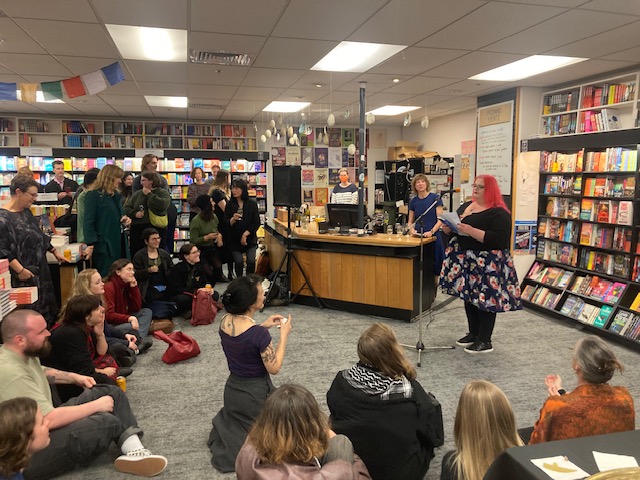
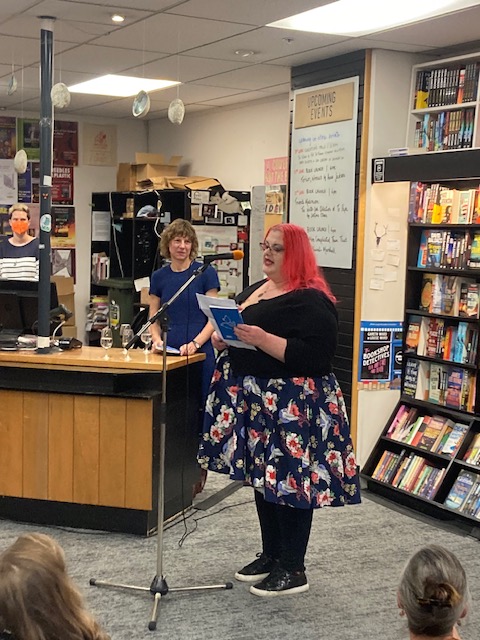
First up is Helen Rickerby launching Anna Jackson’s Terrier, Worrier A Poem in Five Parts (Auckland University Press) at Unity Books in Wellington.

Wellington launch speech for Terrier, Worrier

Kia ora kotou. Hi, I’m Helen Rickerby, and it’s an honour to be launching this new book by Anna Jackson – Terrier, Worrier. And lovely to see you all here to help celebrate.

I’ve been a big fan of Anna’s work since I first came across it, back sometime in the dark ages – the late 90s. She was living far away (Auckland) and submitted to a literary magazine I was editing. We got a lot of submissions, but Anna’s really stood out. I accepted it immediately, and that was the beginning of my friendship with Anna’s work.

I got to meet Anna herself not too much later, and then, conveniently, she got a job here in Wellington. She has become one of my dearest friends and her work and her self continue to be a big inspiration to me. She writes poetry that always makes me excited and inspired, which pushes me to be explorative and ambitious in my own poetry.

I know she’s been a great inspiration to many other people too, as a writer and teacher and as a person.

I’ve loved all of Anna’s books, so I don’t say this lightly – and I don’t really want the other books to hear me say this, I mean I don’t want to hurt their feelings and some of them are engraved on my heart – but I think Terrier, Worrier, is my favourite yet.

Auckland University Press, 2025 (page)

I got to see this book in various stages – when I read the first draft I remember thinking – and saying – that it was my favourite kind of thing to read. It’s sparky and fun and deep, it’s gorgeously written, with beautiful turns of phrase. It’s also quite educational – I learned a lot of things reading this. It’s like having a really really good conversation with Anna, and getting to watch her think in action.

This book is a thought diary in poem form – a hybrid prose poem form, which is my favourite.

Anna – or perhaps we should really say ‘the narrator’, because it is of course a composed and beautiful work of art; but while recognising that the voice of this poem is in fact a construct and not exactly or completely Anna herself, it also sounds so much like at least one version of Anna herself, that I am just going to call the narrator ‘Anna’. Anyway, Anna implies in the poem and the notes (I want to put in a plug for the notes – which are almost as rich, fun and conversational as the poem itself, and do feel to me like part of the poem itself): Anna says that she doesn’t think she has thoughts, or emotions. It is so clear to me that Anna is full of emotions, and full of thoughts – as proven by this book. I am someone who feels very full of both thoughts and feelings – when she began this project, I thought and felt that recording one’s thoughts would be quite overwhelming – I feel that I have a thought tumbling into another thought followed by another faster than I can even follow – I couldn’t comprehend how you could capture them all. But I’ve come to understand that one difference between Anna and myself is that she has higher standards of many things, including of what a thought is – and perhaps what a feeling is.

This is longish for a poem, but small for a book – however, in this small book there is just so much! A lot of thoughts and ideas per square inch. As well as her own thoughts, she argues with Ludwig Wittgenstein over language and beetles, questions Hannah Arendt over beauty, reads and considers scientific studies about time and perception – but despite all that dense deepness the experience of reading Terrier, Worrier, is easy, light, spacious, fun.

This is thanks to the beautiful, light, clever and funny way it is written.

And it isn’t just jumping from one profound thought to another – it circles back, revisits, reconsiders and sometimes disagrees with itself, makes connections with other thoughts and, aided by the fragmentary nature of this poem, there is space for us the readers to think and make connections too. For me it is the kind of writing that makes my brain spark.

This quote is from early on in the poem:

I heard birds and thought that although I am only hearing them,and I am not having a thought, it still feels like a thought, almost
like a thought of my own, or a conversation I am having, or
perhaps it is more like reading a poem, where the words, or the
movement of the thought, the song of the thought, is given to
you rather than coming from you, but still moves through you.

She begins by considering whether hearing is a thought, continues on to the nature of poetry and then you realise it’s doing exactly what it’s talking about – we’re following her thinking and the poem is making us feel like we’re doing the thinking, but then there is the space for us to actually think – if we want to – otherwise we can just go back to watching Anna’s brain.

One thing I love about Anna’s work, and actually about Anna herself, is her complete lack of concern with a hierarchy of culture. She mixes the high – classic and classical literature, philosophy etc – with the ordinary – the domestic space, family life, pets – but also treats both the ‘high’ and ‘low’ as much the same – or at least of equal importance. Or equal-ish – I think the pets might actually be more important than the philosophy.

And pets do make frequent appearances in Terrier, Worrier – mostly hens and also cats, as illustrated on the cover. There’s also a whale on the cover, and there are also whales in the book, but I don’t think even Anna could make a pet of a whale, though you never know.

While in some ways this poem is like a monologue, is really a conversation – as well as being in conversation with philosophers and scientists, she has conversations within the poem – or in fact arguments – such as with Simon about whether it would be better to leave doors open (apparently it is). And it also feels like a conversation with us.

I love how she says:

Whether including conversations
counted as cheating was another question. I decided it
probably was cheating, because it is almost impossible not
to have thoughts in conversation.

I have in fact had conversations where I have had trouble having thoughts, but never with Anna.

As I expect you have noticed, we are living in some pretty weird times. While this isn’t a book that engages directly in a political way, it is the kind of book I think we need in these times – the kind of book that stands in opposition to the values that are prominent right now among some of our so-called leaders.

This is a book that is full of curiosity, empathy with other humans and with animals. It is not interested in hierarchies of status, but in the beauty of all the things, big and small, that make an individual and collective life worth living. It values thinking deeply and is not content with the first knee-jerk idea or black and white solutions. It is a book that values connections and conversations, between ideas, between people and animals, and between people and people. These are the kinds of values that give me hope.

I don’t feel I’ve done this book justice – there are so many things that are wonderful about it, but I hope I’ve whet your appetite for it. And so now I declare Terrier, Worrier launched!

Helen Rickerby

Poetry Shelf in conversation with Anna Jackson

In 2022 I aim to have email conversations with poets whose work has inspired me over time. First up, Anna Jackson. Very apt, as Anna’s new book, Actions & Travels: How Poetry Works, is published by Auckland University Press today.
Right from the start Anna’s poetry has touched a chord with me. In the early poems, the litheness on the line, the measured wit, the roving curiosity captivate, as in AUP New Poets 1 and The Long Road to Teatime (2000). In The Gas Leak (2006) Anna steps into narrative, but family remains in acute focus. There is a humaneness at work, little wisdoms, a playful yet serious pushing at familial boundaries. When Pasture and Flock: New & selected poems arrived in 2018, I admired the new growth, myriad viewpoints, shelter and flight. We discussed poetry and the Selected Poems in a Poetry Shelf interview.

Paula: Not long after my debut poetry collection Cookhouse appeared (1997) you popped a note in my pigeon hole at the University of Auckland inviting me to afternoon tea. We meet up for the first time and have been sharing afternoon tea ever since, exchanging thoughts on poetry, what we read and write, the world at large and the world close at hand.

To celebrate the arrival of your book Actions & Travels: How Poetry Works, I thought a slowly unfolding email conversation as I read the book would be perfect.

I love the title because it underlines the way poetry is full of movement. I also like the open-spirited ‘how poetry works’. I started listing verbs under the umbrella word, ‘works’: sings, captivates, challenges, narrates, mystifies, dreams, soothes, astonishes, functions. Was it hard settling upon a title?

Anna: I still love Cookhouse, I used to carry around my copy of it so I could read an afternoon tea poem wherever I was in the day.  Yes, movement is exactly what I love in poetry, movement and pace.  The title comes from a quote I love by Anne Carson, from an interview with her, in which she calls a poem ‘an action of the mind captured on the page’, an action that the reader has to enter into, and move through – so that reading poetry is a form of travelling.  Actions and Travels was my working title for the book from the start, but I did try to come up with something that would be a bit less obscure.  Instead, the subtitle has had to make it clear that this is a book about poetry.  ‘Works’ is a very functional sort of word, less poetic than sings, or mystifies.  But when I’m writing poetry myself that is what I am looking for, whether the poem is working or not.   

After I’d finished the book, and was editing the final chapter for the last time, a chapter about the poet’s invisibility, and a poem’s flights, I thought Flight and Invisibility could have made a good title for the book.  But I like the more prosaic quality of Actions and Travels too.

Paula:  Before I move onto the book, is there a poetry book (or two) you have carried with you in the past few months or so?

Anna: Oh, there is, actually – Anne Kennedy’s The Sea Walks into a Wall (AUP).  It is a collection that fits different spaces of time, with some shorter poems and some longer poems, so I am quite often picking it up again, and the longer poems in particular I return to at different times.  They repay rereading and the collection as a whole also gains in substance and resonance with rereading.  It has been a good summer book, and a good counterweight to the Knausgaard novels that have been my other summer obsession.

Paula: I am fascinated how a poetry collection reaches us in different ways over a period of time. In the introduction to Actions and Travels, you discuss John Keats’ brilliant short poem and the hand reaching out: ‘I hold it towards you’.  This is poetry. I always think of the bridge I cross as I enter a book. So many ways of crossing, sometimes impossible, so many different bridges. I am thinking of the Bridge of Wonder. The Bridge of Knots. The Bridge of Song. Heaven forbid The Bridge of Dead Ends. What matters to you as you enter a poetry book?

Anna: Different things matter according to the book – I suppose it depends on what mattered to the poet. Wonder, knots and song – those are all things that might draw me in.  I was talking to artist/curator Nathan Pohio about the importance of grit in writing and thinking – it was what he was working to include in his own writing – and I thought this was such a good word, something that slows you down and maybe even hurts a little bit, something that makes you need to bring something of yourself to the experience.  Grit rather than a dead end – something that invites collaboration and involvement rather than shutting you out.  But not something too smooth, either – not something you are forgetting as you read it.

Paula: Collaboration seems important. Openings for the reader rather than closures. When you first came up with the idea for Actions and Travels, what sort of things did you hope it would do. From my early stage of reading, I am finding it a source of openings and inspiration. It prompts me to action as a writer and travels as a reader, and vice versa.

Anna: I hoped it would allow readers to take some time over some poems I love, some of which they might already know, some of which may be new discoveries for them.  A lot of people I talk to don’t read poetry but read novels or non-fiction, books they can be immersed in.  Part of what I love about poetry is what a quick reading hit it can give you, how you can come across it on social media, in magazines or on posters and be instantly transported.  And poetry is reaching more and more readers this way.  But Actions and Travels offers a slower reading experience for readers who want to follow my own responses to the poems I read.  I hope readers will also want to stop and think about their own responses to the poem and be interested in any differences there might be between their own initial responses and my own.  I hope slowing down the reading, and returning to some poems that might already be familiar, will also make space for the poems to resonate deeply, and maybe continue to haunt the reader after the book is finished.

Paula: I was thinking similar things when I wrote Wild Honey. I love the way poetry can fit in small moments, in a pocket, a bag, or while you drink morning coffee. Long poems are immensely pleasurable, but short poems equally so. Bill Manhire sent me a poem he recently had published in PNReview, and I haven’t stopped thinking about it. It’s musical, enigmatic, physical, a haunting Covid snapshot. Tell me a short poem you have read recently that has lingered in your mind.

Anna: Yes, I loved the way Wild Honey gave us time with each of the poems you discussed, and with the poets too – I loved the way it brought the poets into the picture with biographical details.  Actions and Travels doesn’t have the same scope but I hope it does open space up in a way that is a little bit similar.  As for a short poem, for brilliance with brevity my favourite poet would have to be Lydia Davis, and the short poem of hers I think of most often is ‘Improving my German’, which goes like this: 

All my life I have been trying to improve my German.
At last my German is better
—but now I am old and ill and don’t have long to live.
Soon I will be dead,
with better German.

And the poem I’ve been talking most about lately is Erin Scudder’s Jewel Box.  It is definitely the best poem about grit I can think of.  It can be found in Sweet Mammalian Issue 8.

Paula: I love ‘Jewel Box’. It has got me thinking of poems in this way. Yes as jewel boxes, but also the grit that rubs against you. There’s the ‘peach meat’ and there’s the grit. Glorious. As I said long poems are equally rewarding. I wrote long poems when I was doing my Doctorate and my daughters were young, as I felt I could fit something big in small moments. Your long-poem chapter is entitled ‘Sprawl’ and that is so fitting. I am thinking of the way your ‘I, Clodia’ sequence (can I call this a long poem?) both sprawls and concentrates on small poems. Clodia’s voice is the connective tissue. And I am also thinking of The Gas Leak. I see grit and peach meat in both these projects. What draws you to the long poem? Do you like writing them?

Anna: I think of ‘I, Clodia’ and ‘The Gas Leak’ in terms of sequence rather than sprawl, because of the concentration, as you say, in each of the small poems.  Every poem of those sequences I think of as quite tightly wound.  I did love having the space that the sequence gave to build narrative and to develop ideas over its course.  That is what sprawl offers too but I think of the sprawling poem as having more looseness and more fluidity to it, so it can be very relaxed, open and looping.  I don’t think I’ve ever really written a sprawling poem though I would like to try.  I love your ‘Letter to Anne Kennedy’ which I include as an example of sprawl for the way it unfolds so loosely and easily across the pages.  There are patterns too, an intricate architecture of departures and returns, repetitions and echoes, and shifts in perspective, but they are very unobtrusive.

Paula: ‘Tightly wound’ is apt – and it also resonates with wound/ injured. ‘Resonates’ is a word you explore in ‘Simplicity & resonance’. If the stars align in a poem for a reader, it resonates – as in the examples you navigate. I find I am reading the book at a snail’s pace because of the interior resonances. The way I stall on a poem, and then want to read more of Emily Brontë, Robert Frost, Bill Manhire, Rebecca Gayle Howell, Eileen Duggan, William Butler Yeats (or return to). Yet I am also compelled to keep reading – as I might with a detective novel -regardless of what else needs to be done. Did you find this book a challenge to write? It seems to be a book written out of deep love for the subject matter and that shows.

Anna: Resonance is interesting to think about because as you say it depends on the relation between the reader and the poem – what resonates for one reader may not be what resonates for another – but also on how the poem sets up the possibilities for resonance.  So it is both internal to the poem and external to it – the way the thought of a wound or injury is suggested by the word wound as in wound up, but is not actually present in the phrase tightly wound. I wondered at the time, actually, about writing “wound up” instead of tightly wound, because I didn’t particularly want the association with injury to come into play, but then I thought, tightly wound is better – it is how you might describe a person, a mood, whereas wound up suggests clockwork, something more mechanical, and something wound up in order to then do something else.  And I thought, after all, there is also some kind of injury or wound at the heart of each of those narratives. 

Language is complicated!  And part of the beauty of poetry is how the poet works with all those complications and manages the interplay of associations.  That is what I loved most about writing the book, the close attention it made me pay to all these sorts of details in the poems I was reading.  So yes, the writing was totally driven by my love of the poetry.

Paula: It shows. Your sentences are exquisitely crafted. There is a fluency about the book that invites the reader in. I like the way the footnotes are not evident until you see the notes at the back. This is a book of ideas but it resists academic jargon and theory speak. What were your thoughts on how you would write it?

Anna: I loved it when you said, earlier, that you were reading it like a detective novel!  It doesn’t have a lot of plot or suspense but I did want readers to be able to follow my thinking and my reading.  So yes, instead of footnotes there are notes at the back you only need to refer to if you want to know where a quote comes from.  For the same reason, I cut back on references to other critics, so that each chapter would just be shaped by my own thinking and observations.  There are times when another critic’s reading really helps me make a point of my own.  I give Edward Hirsh’s account of his childhood reading of the Emily Bronte poem because it is such a good example of how resonance can come both from inside and outside the poem – the experience he brought to it, the idea that his grandfather was talking to him through the poem, was his own experience, but the ways the poem allowed that sense of being haunted and the ways it conveyed the exact sense of loss he felt are very specific to the poem, with its stormy scenery, insistent rhythms and echoing rhymes.  So some critics are referenced but it is mostly just my own voice, talking my way through the poetry, as the discussion of one poem leads to the introduction of the next, to develop an idea about the political work a poem can do, for instance, or what is going on when poets translate or rework poetry from the past.

Paula: I love the way you weave in the voices of other critics. To me these appearances service connection and building rather than dismantling and disconnection. If as poets we write on the shoulders of the poems and ideas that have preceded us, we also write within the ‘fire’ of the present and the urgency of the future (as you explore). We reach out to the established poets and we listen intently to the new and younger voices. I found I had to leave things out of Wild Honey and it kept me awake at night (chapters, poets, poems). Did you have similar struggles and pain?

Anna: Yes, I did, although Actions and Travels is a very different book.  Wild Honey is so inclusive and so wide-ranging and comprehensive an account of women’s writing in New Zealand, you can include so many more poets than I had the space for, and write about their work in so much depth and detail, but even though the book is so inclusive I know how much you agonised over the limits even to so large a book.  In some ways it is harder, when a book is so inclusive, to leave any particular poet out.  Actions and Travels is so much smaller and it covers poetry from the US and UK as well as New Zealand, and goes back to the sixteenth century and even earlier, much earlier in the case of Sappho.  So there was no way I could include every poet who is important to me, or even all my most absolute favourite poems.  There are absolute touchstone poets I left out, like Stevie Smith, Anne Kennedy, Lydia Davis, Seamus Heaney, Robert Sullivan, to name just a few, and poems I often return to that are not in the book at all, or are mentioned briefly in passing, like Gerard Manly Hopkins’ ‘Oh, the mind, the mind has mountains’. 

I did begin with an idea of some of the poems I wanted to include, but I allowed the readings in each chapter to suggest connections between poems, and I wanted observations to be able to develop into arguments or extended thoughts on how poetry can sustain the particular qualities I was finding in it, so often the poems are chosen for how well they illustrate an idea I am exploring, or how well they fit in the chapter between two other poems.  It isn’t a canon-building or a curatorial exercise, just a free-flowing discussion of poetry and ideas.  Having said that, I do love every one of the poems that I have included, and I do think they make a beautiful collection together in the book. 

Paula: I love the addition of writing prompts linked to each chapter at the back. I really like: ‘Find the words that resonate with you – at a paint shop? In a fabric shop? In a knitting pattern? Put one or more of these words in the centre of a short poem.’ Have you tried any of your prompts?

Anna: The poetry prompts are meant to be taken lightly, tried out to see if anything comes of them.  They are a way of setting the writer on a different course of thought than they might have been on.  If you write with a loose grip on the instructions and let the writing go wherever it wants to, it will probably arrive at some concern or obsession of your own or draw on something of your own life, but coming at it from a different angle may lift your own story into something both stranger and perhaps more universal.  Some of the poetry prompts are based on how I wrote some of the poems I’ve written – describing a physical action in such detail it becomes metaphysical (‘Evelyn, after apple-picking’), adding the word ‘Dear’ to turn a poem into a letter (‘Dear Tombs’), adding rhyme to turn free verse into terza rima (‘Dear Tombs’ again, and ‘Eleanor at the beach’), adding in elements to the scenario in Sappho’s love triangle poem (‘Being a poet’), some of the others too.  But I haven’t actually started with any of my own prompts, to generate a new poem.  I really should try them out. 

Paula: I am particularly drawn to the ‘Poetry in a house on fire’ section as it seems apt for the difficult times we share – what with pandemic, protest, looming war, poverty, despair. Locally, globally. You turn to the poetry of younger writers such as Ash Davida Jane and Tayi Tibble (and yes, more established writers), and it excites me. I take heart from these younger poetry voices. I find poetry is so important at the moment. I want Poetry Shelf to be a place of connection and celebration. The edgy grit along with the soothe. What gives you solace at the moment? How does poetry fit into this ‘house on fire’? 

Anna: Yes I think poetry is particularly important in turbulent times, both as solace and as a kind of resistance.  Poets are writing more politically now I think than when I began publishing poetry, maybe because social media is already bringing together the personal and the political, maybe because these are such turbulent, politically charged times, though I also love, too, the way poets like Tayi Tibble and Ash Davida Jane are so funny even when they are at their most political.  The poems that I find most soothing when events in the world are most overwhelming are poems of quiet but implacable resistance or refusal, there’s a kind of humour but it is very astringent.  There was a time I wanted to read Robert Lax’s 1966 poem ‘The port was longing’ over and over again, as a kind of meditation,  not of acceptance but of refusal.  At the moment, Ilya Kaminsky’s ‘We lived happily during the war’ has a terrible resonance.  His reading of it is extraordinarily powerful.  It certainly isn’t soothing, it is terribly disquieting, raising such a difficult question of how to live in times of crisis.  Does happiness become immoral?  Poetry insists not only on an ethical but on an emotional response to such a question.  I don’t think we ever want to let go of feeling. 

Anna Jackson is a New Zealand poet who grew up in Auckland and now lives in Island Bay, Wellington. She has a DPhil from Oxford and is an associate professor in English literature at Victoria University of Wellington.

Anna made her poetry debut in AUP New Poets 1 before publishing six collections with Auckland University Press. Her most recent book, Pasture and Flock: New and Selected Poems, gathers work from her previous collections as well as twenty-five new poems. The book includes poems from Catullus for Children and I, Clodia, the two collections that engage with the work of Catullus, as well as poems about badminton, billiards, salty hair, takahē, head lice, indexing, proof-reading, hens, truth and beauty.

As a scholar, Anna Jackson is the author of Diary Poetics: Form and Style in Writers’ Diaries 1915–1962 (Routledge, 2010) and, with Charles Ferrall, Juvenile Literature and British Society, 1850–1950: The Age of Adolescence (Routledge, 2009).

Auckland University Press page

Anna Jackson website

Poetry Shelf noticebaord: Paula Green reviews AUP New Poets 8 at Kete Books

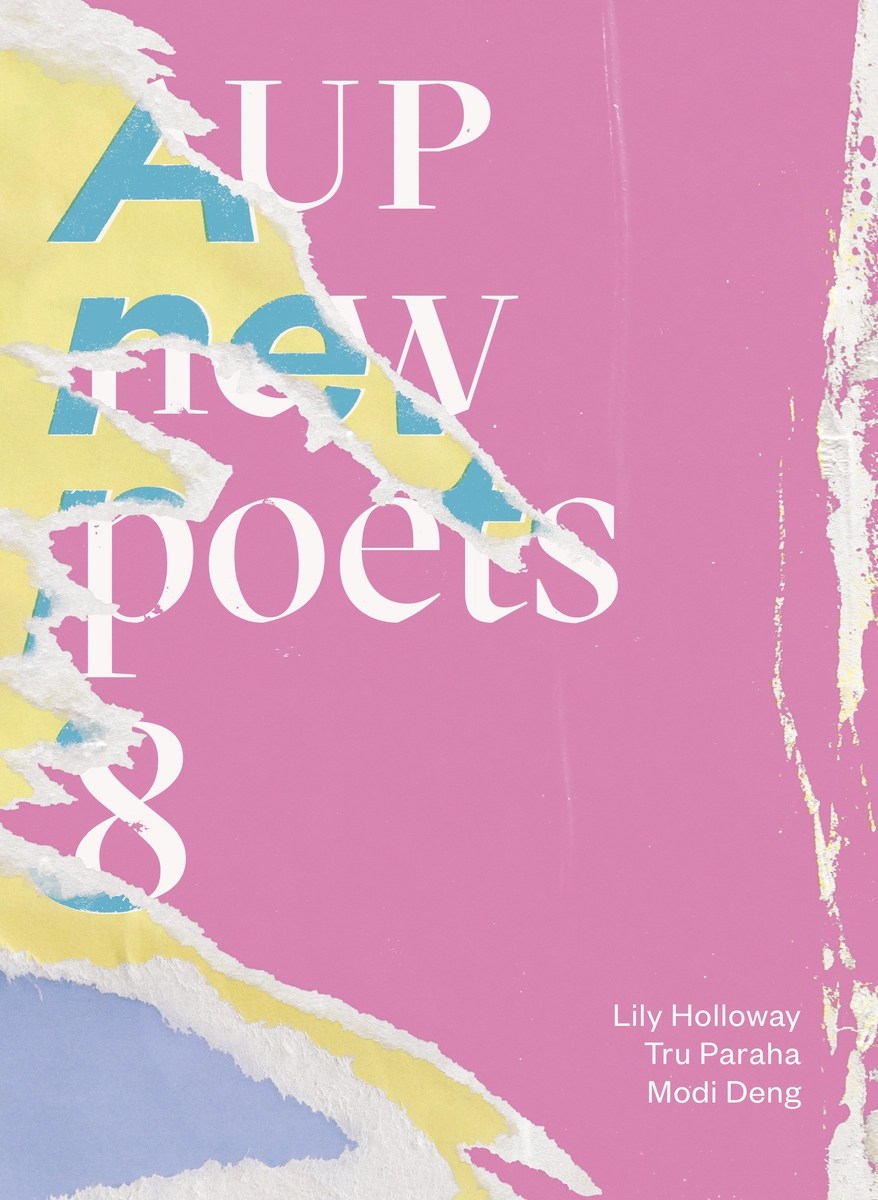
AUP New Poets 8: Lily Holloway, Tru Paraha, Modi Deng, Auckland University Press, 2021

Review extract:

Editor Anna Jackson has selected three distinctive poets for AUP New Poets 8 and has placed them in the perfect tonal order.

The title of Lily Holloway’s suite, a child in the alcove, reminds me of poetry’s alcove-like features. Poems can be miniature shelters, places of refuge, an interplay of dark and light, secret, mysterious, challenging, bulging with nooks and crannies. Reading the work is to read across myriad directions, to peer into captivating cubbyholes and, as Jackson writes in her terrific foreword, to read distance and depth.

Holloway is an award-winning writer and postgraduate student who has been published in numerous journals. I have long admired her poetry: her aural and linguistic deftness, the sweet measure of surprise, the variegated forms, the connecting undercurrents, the honey, the bitterness. Her poems run on the rewarding premise that poems don’t need the full explanation, that tactile detail and deft juxtapositions can unmask love, desire, razor edges, self-exposure. Pocket narratives are equally sublime.

Full review here

Listen to the three poets read

Auckland University Press page
Lily Holloway (born in 1998, she / they) is a queer writer and postgraduate English student. While she mostly writes poetry, she has also tried her hand at non-fiction, fiction and playwriting. You can find her work in places like Starling, Midway Journal, Scum, The Pantograph Punch and The Spinoff amongst various other literary nooks and crannies. In 2020 she was honoured to receive the Shimon Weinroth Prize in Poetry, the Kendrick Smithyman Scholarship in Poetry and second place in the Charles Brasch Young Writers’ Essay Competition. In her spare time she enjoys op-shopping, letter writing, visiting small towns and collecting vintage Teletubbies paraphernalia. She is passionate about survivor advocacy and taking up space. You can find a list of her writing at lilyholloway.co.nz.

Tru Paraha resides in Tāmaki Makaurau in the suburb of Tukituki Muka (aka Herne Bay). She works as a choreographer and director, having enjoyed an extensive career in experimental dance, theatre and audio-visual arts. She is currently in the final year of a postdoctoral research fellowship in the English and Drama department at the University of Auckland. Moving between choreography, philosophy and creative writing, Tru produces live performances, artists’ pages and poems drawing on materials from deep space. She is a member of the International Dark-Sky Association and advocate for the preservation of the night sky as a world cultural heritage.

Modi Deng is a pianist based in London, currently pursuing postgraduate performance studies on a scholarship at the Royal Academy of Music. Her Chinese name 默笛 means ‘silent flute’, which her father drew from a poem by Tagore. Performances with her ensemble, the Korimako Trio, have taken her throughout the UK and her concerts have been broadcast on BBC Radio 3 and RNZ Concert. After growing up in Dunedin, she went on to complete a Master of Music with First Class Honours on a Marsden research scholarship, while completing a Bachelor of English at the University of Auckland. Modi cares deeply about literature (diaspora and poetry), music, psychology and her family.
Poetry Shelf celebrates new books: AUP New Poets 8

AUP New Poets 8: Lily Holloway, Tru Paraha, Modi Deng, Auckland University Press, 2021

I am loving the AUP New Poets series under the astute editorship of Anna Jackson. Each volume draws new voices into compelling view, each volume sparks essential poetry conversations. How we write. Why we write. What we write. How we write ourselves and how we write the imagined.

This on AUP New Poets 8, from my Kete Books review appearing shortly: ‘Editor Anna Jackson has selected three distinctive poets for AUP New Poets 8 and has placed them in the perfect tonal order. The title of Lily Holloway’s suite, ‘a child in that alcove’, reminds me of poetry’s alcove-like features. Poems can be miniature shelters, places of refuge, an interplay of dark and light, secret, mysterious, challenging, bulging with nooks and crannies. Reading the work is to read across myriad directions, to peer into captivating cubbyholes and, as Anna writes in her terrific foreword, to read distance and depth.’

This is an arrival to celebrate – and how better than with a suite of readings – not as good as book launch for sure – but online readings offer a lounge of returns. Make a coffee, a cup of tea, pour a glass of wine, you choose, find a sweet spot and have a listen. I raise my glass to Anna, Lily, Tru, Modi and AUP. This is essential listening (and reading!).

The readings

Lily Holloway

Photo credit: Angela Zhang

Lily Holloway reads ‘Reverb or Aftermath’

Lily Holloway reads ‘return again’

Tru Paraha

Tru Paraha reads ‘Paradox’

Tru Paraha reads ‘Postcard from Israel’

Modi Deng

Photo credit: Mikayla Bollen

Modi Deng reads ‘field notes on Lewis Hyde’s ‘The Gift’’

Modi Deng reads ‘unrest • an wei’

Modi Deng reads ‘now and then things come in tandem’

The poets

Lily Holloway (born in 1998, she / they) is a queer writer and postgraduate English student. While she mostly writes poetry, she has also tried her hand at non-fiction, fiction and playwriting. You can find her work in places like Starling, Midway Journal, Scum, The Pantograph Punch and The Spinoff amongst various other literary nooks and crannies. In 2020 she was honoured to receive the Shimon Weinroth Prize in Poetry, the Kendrick Smithyman Scholarship in Poetry and second place in the Charles Brasch Young Writers’ Essay Competition. In her spare time she enjoys op-shopping, letter writing, visiting small towns and collecting vintage Teletubbies paraphernalia. She is passionate about survivor advocacy and taking up space. You can find a list of her writing at lilyholloway.co.nz.

Tru Paraha resides in Tāmaki Makaurau in the suburb of Tukituki Muka (aka Herne Bay). She works as a choreographer and director, having enjoyed an extensive career in experimental dance, theatre and audio-visual arts. She is currently in the final year of a postdoctoral research fellowship in the English and Drama department at the University of Auckland. Moving between choreography, philosophy and creative writing, Tru produces live performances, artists’ pages and poems drawing on materials from deep space. She is a member of the International Dark-Sky Association and advocate for the preservation of the night sky as a world cultural heritage.

Modi Deng is a pianist based in London, currently pursuing postgraduate performance studies on a scholarship at the Royal Academy of Music. Her Chinese name 默笛 means ‘silent flute’, which her father drew from a poem by Tagore. Performances with her ensemble, the Korimako Trio, have taken her throughout the UK and her concerts have been broadcast on BBC Radio 3 and RNZ Concert. After growing up in Dunedin, she went on to complete a Master of Music with First Class Honours on a Marsden research scholarship, while completing a Bachelor of English at the University of Auckland. Modi cares deeply about literature (diaspora and poetry), music, psychology and her family.

Auckland University Press page

Poetry Shelf Theme Season: Eleven poems about breakfast

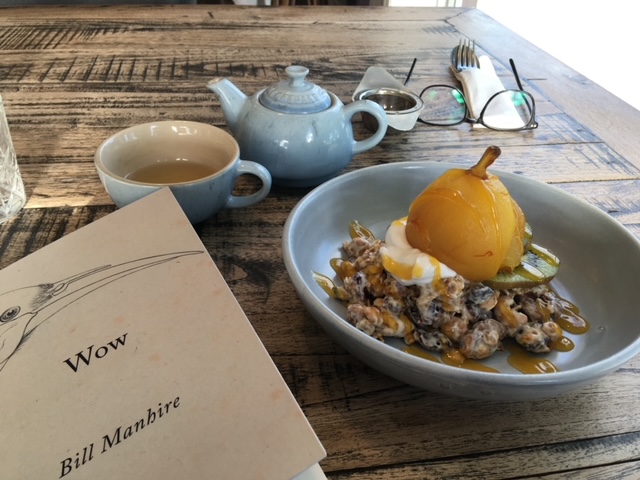
Breakfast is a lifelong ritual for me: the fruit, the cereal, the toast, the slowly-brewed tea, the short black. It is the reading, it is the silence, it is the companionship. It is finding the best breakfast when you are away at festivals or on tour, on holiday. This photograph was taken last year at Little Poms in Christchurch when I was at WORD. One of my favourite breakfast destinations. Breakfast is my gateway into the day ahead, it is food but it is more than food. It is the ideas simmering, the map unfolding, the poem making itself felt.

The poems I have selected are not so much about breakfast but have a breakfast presence that leads in multiple directions. Once again I am grateful to publishers and poets who are supporting my season of themes.

Unspoken, at breakfast

I dreamed last night that you were not you

but much younger, as young as our daughter

tuning out your instructions, her eyes not

looking at a thing around her, a fragrance

surrounding her probably from her

freshly washed hair, though

I like to think it is her dreams

still surrounding her

from her sleep. In my sleep last night

I dreamed you were much younger,

and I was younger too and had all the power –

I could say anything but needed to say

nothing, and you, lovely like our daughter,

worried you might be talking too much

about yourself. I stopped you

in my arms, pressed my face

up close to yours, whispered into

your ear, your curls

around my mouth, that you were

my favourite topic. That

was my dream, and that is still

my dream, that you were my favourite topic –

but in my dream you were

much younger, and you were not you.

Anna Jackson

from Pasture and Flock: New & Selected Poems, Auckland University Press, 2018

By Sunday

You refused the grapefruit

I carefully prepared

Serrated knife is best

less tearing, less waste

To sever the flesh from the sinew

the chambers where God grew this fruit

the home of the sun, that is

A delicate shimmer of sugar

and perfect grapefruit sized bowl

and you said, no, God, no

I deflated a little

and was surprised by that

What do we do when we serve?

Offer little things 

as stand-ins for ourselves

All of us here

women standing to attention

knives and love in our hands

Therese Lloyd

From The Facts, Victoria University Press, 2018

How time walks

I woke up and smelled the sun mummy

my son

a pattern of paradise

casting shadows before breakfast

he’s fascinated by mini beasts

how black widows transport time

a red hourglass

under their bellies

how centipedes and worms

curl at prodding fingers

he’s ice fair

almost translucent

sometimes when he sleeps

I lock the windows

to secure him in this world

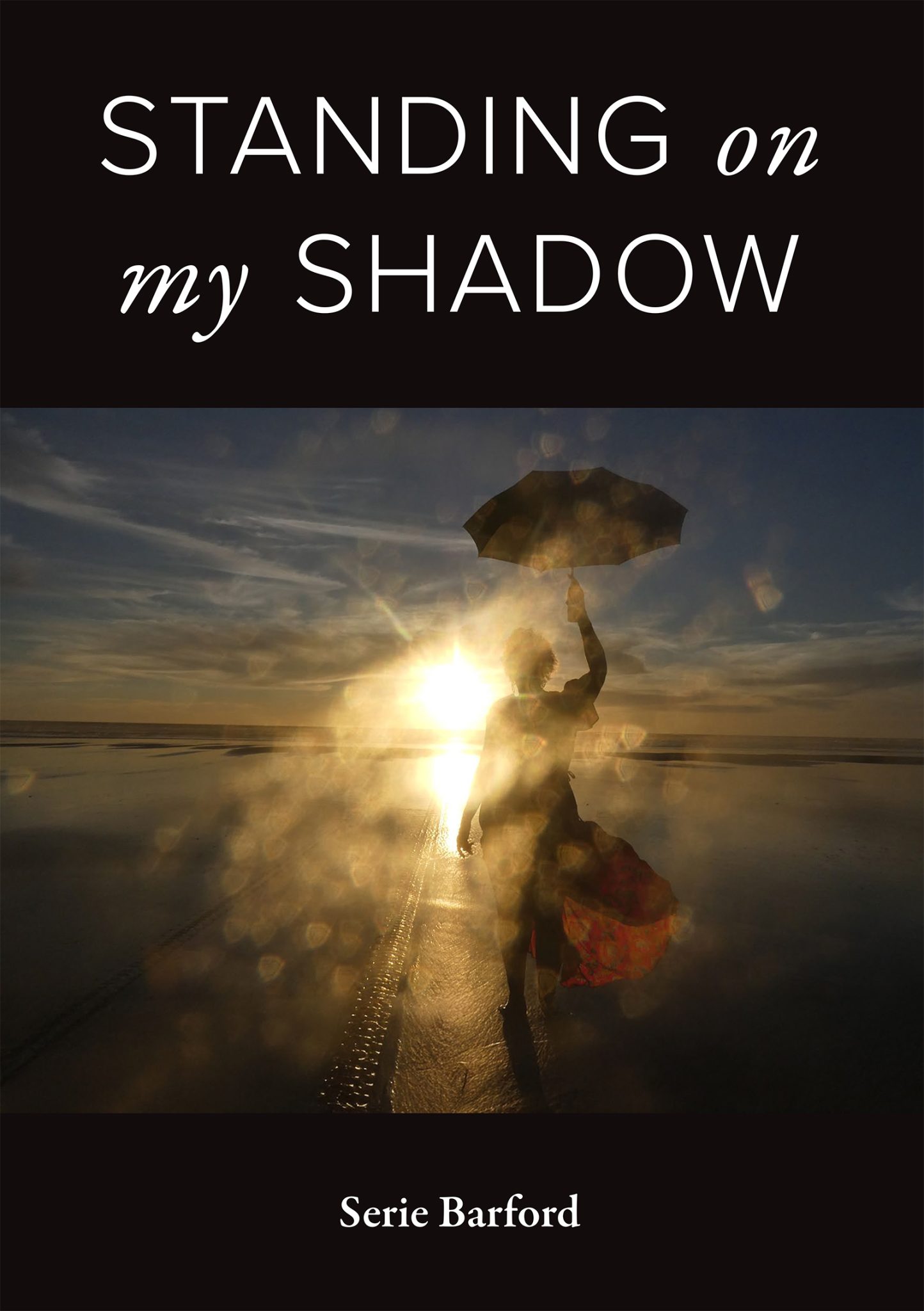
Serie Barford

from Entangled islands, Anahera Press, 2015

Woman at Breakfast

June 5, 2015

This yellow orange egg
full of goodness and
instructions.

Round end of the knife
against the yolk, the joy
which can only be known

as a kind of relief
for disappointed hopes and poached eggs
go hand in hand.

Clouds puff past the window
it takes a while to realise
they’re home made

our house is powered by steam
like the ferry that waits
by the rain-soaked wharf

I think I see the young Katherine Mansfield
boarding with her grandmother
with her duck-handled umbrella.

I am surprised to find
I am someone who cares
for the bygone days of the harbour.

The very best bread
is mostly holes
networks, archways and chambers

as most of us is empty space
around which our elements move
in their microscopic orbits.

Accepting all the sacrifices of the meal
the unmade feathers and the wild yeast
I think of you. Happy birthday.

Kate Camp

from The Internet of Things, Victoria University Press, 2017

How to live through this

We will make sure we get a good night’s sleep. We will eat a decent breakfast, probably involving eggs and bacon. We will make sure we drink enough water. We will go for a walk, preferably in the sunshine. We will gently inhale lungsful of air. We will try to not gulp in the lungsful of air. We will go to the sea. We will watch the waves. We will phone our mothers. We will phone our fathers. We will phone our friends. We will sit on the couch with our friends. We will hold hands with our friends while sitting on the couch. We will cry on the couch with our friends. We will watch movies without tension – comedies or concert movies – on the couch with our friends while holding hands and crying. We will think about running away and hiding. We will think about fighting, both metaphorically and actually. We will consider bricks. We will buy a sturdy padlock. We will lock the gate with the sturdy padlock, even though the gate isn’t really high enough. We will lock our doors. We will screen our calls. We will unlist our phone numbers. We will wait. We will make appointments with our doctors. We will make sure to eat our vegetables. We will read comforting books before bedtime. We will make sure our sheets are clean. We will make sure our room is aired. We will make plans. We will talk around it and talk through it and talk it out. We will try to be grateful. We will be grateful. We will make sure we get a good night’s sleep.

Helen Rickerby

from How to Live, Auckland University Press, 2019

Morning song

Your high bed held you like royalty.

I reached up and stroked your hair, you looked at me blearily,

forgetting for a moment to be angry.

By breakfast you’d remembered how we were all cruel

and the starry jacket I brought you was wrong.

Every room is painted the spectacular colour of your yelling.

I try and think of you as a puzzle

whose fat wooden pieces are every morning changed

and you must build again the irreproachable sun,

the sky, the glittering route of your day. How tired you are

and magnanimous. You tell me yes

you’d like new curtains because the old ones make you feel glim.

And those people can’t have been joking, because they seemed very solemn.

And what if I forget to sign you up for bike club.

The ways you’d break. The dizzy worlds wheeling on without you.

Maria McMillan

from The Ski Flier, Victoria University Press, 2017

14 August 2016

The day begins
early, fast broken
with paracetamol
ibuprofen, oxycodone,
a jug of iced water
too heavy to lift.
I want the toast and tea
a friend was given, but
it doesn’t come, so resort
to Apricot Delights
intended to sustain me
during yesterday’s labour.
Naked with a wad of something
wet between my legs, a token
gown draped across my stomach
and our son on my chest,
I admire him foraging
for sustenance and share
his brilliant hunger.
Kicking strong frog legs,
snuffling, maw wide and blunt,
nose swiping from side
to side, he senses the right
place to anchor himself and drives
forward with all the power
a minutes-old neck can possess,
as if the nipple and aureole were prey
about to escape, he catches his first
meal; the trap of his mouth closes,
sucks and we are both sated.

Amy Brown  

from Neon Daze, Victoria University Press, 2019

break/fast and mend/slowly


Tate Fountain

from Starling 11


Biologist abandoned

I lay in our bed all morning             

next to the half-glass of juice you brought me 

to sweeten your leaving

ochre sediments settled in the liquid

a thin dusty film formed on the meniscus

but eventually I drank it                 

siphoning pulp through my teeth 

like a baleen whale sifting krill from brine

for months after your departure I refused to look 

at the moon

where it loomed in the sky outside              

just some huge rude dinner plate you left unwashed

now ascendant                   

brilliant with bioluminescent mould

how dare you rhapsodize my loneliness into orbit

I laughed                 

enraged                       

to the thought of us   

halfway across the planet staring up

at some self-same moon & pining for each other

but now I long for a fixed point between us

because from here       

even the moon is different     

a broken bowl     

unlatched from its usual arc & butchered                

by grievous rainbows        

celestial ceramic irreparably splintered              

as though thrown there

and all you have left me with is          

this gift of white phosphorous

dissolving the body I knew you in    

beyond apology

to lunar dust     

Rebecca Hawkes

in New Poets 5, Auckland University Press, 2019, picked by Aimee-Jane Anderson-O’Connor

everything changing

I never meant to want you.

But somewhere

between

the laughter and the toast

the talking and the muffins

somewhere in our Tuesday mornings

together

I started falling for you.

Now I can’t go back

and I’m not sure if I want to.

Paula Harris

from woman, phenomenally

Breakfast in Shanghai

for a morning of coldest smog

A cup of black pǔ’ěr tea in my bedroom & two bāozi from the

lady at the bāozi shop who has red cheeks. I take off my gloves,

unpeel the square of thin paper from the bun’s round bottom.

I burn my fingers in the steam and breathe in.


for the morning after a downpour

Layers of silken tofu float in the shape of a lotus slowly

opening under swirls of soy sauce. Each mouthful of doufu

huā, literally tofu flower, slips down in one swallow. The

texture reminds me of last night’s rain: how it came down

fast and washed the city clean.


for homesickness

On the table, matching tiny blue ceramic pots of chilli oil,

vinegar and soy sauce. In front of me, the only thing that

warms: a plate of shuǐjiǎo filled with ginger, pork and cabbage.

I dip once in vinegar, twice in soy sauce and eat while the

woman rolls pieces of dough into small white moons that fit

inside her palm.


for a pink morning in late spring

I pierce skin with my knife and pull, splitting the fruit open.

I am addicted to the soft ripping sound of pink pomelo flesh

pulling away from its skin. I sit by the window and suck on the

rinds, then I cut into a fresh zongzi with scissors, opening the

lotus leaves to get at the sticky rice inside. Bright skins and leaves

sucked clean, my hands smelling tea-sweet. Something inside

me uncurling. A hunger that won’t go away.

NIna Mingya Powles

from Magnolia 木蘭, Seraph Press, 20020

Serie Barford was born in Aotearoa to a German-Samoan mother and a Palagi father. She was the recipient of a 2018 Pasifika Residency at the Michael King Writers’ Centre. Serie  promoted her collections Tapa Talk and Entangled Islands at the 2019 International Arsenal Book Festival in Kiev.  She collaborated with filmmaker Anna Marbrook to produce a short film, Te Ara Kanohi, for Going West 2021. Her latest poetry collection, Sleeping With Stones, will be launched during Matariki 2021.

Amy Brown is a writer and teacher from Hawkes Bay. She has taught Creative Writing at the University of Melbourne (where she gained her PhD), and Literature and Philosophy at the Mac.Robertson Girls’ High School. She has also published a series of four children’s novels, and three poetry collections. Her latest book, Neon Daze, a verse journal of early motherhood, was included in The Saturday Paper‘s Best Books of 2019. She is currently taking leave from teaching to write a novel.

Kate Camp’s most recent book is How to Be Happy Though Human: New and Selected Poems published by VUP in New Zealand, and House of Anansi Press in Canada.

Tate Fountain is a writer, performer, and academic based in Tāmaki Makaurau. She has recently been published in StuffStarling, and the Agenda, and her short fiction was highly commended in the Sunday Star-Times Short Story Competition (2020).

Paula Harris lives in Palmerston North, where she writes and sleeps in a lot, because that’s what depression makes you do. She won the 2018 Janet B. McCabe Poetry Prize and the 2017 Lilian Ida Smith Award. Her writing has been published in various journals, including The Sun, Hobart, Passages North, New Ohio Review and Aotearotica. She is extremely fond of dark chocolate, shoes and hoarding fabric. website: http://www.paulaharris.co.nz | Twitter: @paulaoffkilter | Instagram: @paulaharris_poet | Facebook: @paulaharrispoet

Rebecca Hawkes works, writes, and walks around in Wellington. This poem features some breakfast but mostly her wife (the moon), and was inspired by Alex Garland’s film adaptation of Jeff Vandermeer’s novel Annihilation.  You can find it, among others, in her chapbook-length collection Softcore coldsores in AUP New Poets 5. Rebecca is a co-editor for Sweet Mammalian  and a forthcoming collection of poetry on climate change, prances about with the Show Ponies, and otherwise maintains a vanity shrine at rebeccahawkesart.com

Anna Jackson lectures at Te Herenga Waka/Victoria University of Wellington, lives in Island Bay, edits AUP New Poets and has published seven collections of poetry, most recently Pasture and Flock: New and Selected Poems (AUP 2018).

Therese Lloyd is the author of two full-length poetry collections, Other Animals (VUP, 2013) and The Facts (VUP, 2018). In 2017 she completed a doctorate at Victoria University focusing on ekphrasis – poetry about or inspired by visual art. In 2018 she was the University of Waikato Writer in Residence and more recently she has been working (slowly) on an anthology of ekphrastic poetry in Aotearoa New Zealand, with funding by CNZ.

Maria McMillan is a poet who lives on the Kāpit Coast, originally from Ōtautahi, with mostly Scottish and English ancestors who settled in and around Ōtepoti and Murihiku. Her books are The Rope Walk (Seraph Press), Tree Space and The Ski Flier (both VUP) ‘Morning songtakes its title from Plath.

Nina Mingya Powles is a poet and zinemaker from Wellington, currently living in London. She is the author of Magnolia 木蘭, a finalist in the Ockham Book Awards, a food memoir, Tiny Moons: A Year of Eating in Shanghai, and several poetry chapbooks and zines. Her debut essay collection, Small Bodies of Water, will be published in September 2021.  

Helen Rickerby lives in a cliff-top tower in Aro Valley. She’s the author of four collections of poetry, most recently How to Live (Auckland University Press, 2019), which won the Mary and Peter Biggs Award for Poetry at the 2020 Ockham Book Awards. Since 2004 she has single-handedly run boutique publishing company Seraph Press, which mostly publishes poetry.

Poetry Shelf Theme Season: Ten poems about dreaming

Not many younger poets sent me poems about ice but there were loads of dreaming poems. I have always loved poems that dream because poetry is a close relation with its slants, mists, hallucinations, and deep personal cores. I sometimes think that to dream is to write. To enter the opaque, to reclaim the obvious, to have no idea where you will end up or how you will get there. To astonish yourself.

I am so very grateful to the poets and publishers who have backed my themed poetry season with such loving support.

Ten poems about dreaming

the dream is real

the moon is an open eye

high in the sky or winking

at the world below

the wind is the sea’s breath

rustling the leaves in the trees

night is a dark river

flowing through the day

a bird is a song

the dream is real

clouds are ghosts

flight is a wing

Apirana Taylor

from a canoe in midstream, Canterbury University Press, 2009

Insomnia

it is a black night

I lie perfectly still

mine is the long

awake adult body

two small boys

flickering at either side

night sweats

bad dreams

fluttering in and

out of sheets

I lie black

in between

head

thorax, abdomen

trembling children

my wings

Karlo Mila

from A Well Written Body, Huia Press, 2008

My Father Dreams of His Father

My father dreams of his father

walking in the garden of the old family homestead

on Kawaha Point.

I have not been back since he passed away.

As decrepit dogs wander off under trees

to sniff out their final resting places,

elderly men wait in the wings

rehearsing exit lines.

I’m sure my grandfather never envied his dog more

than during those last days.

I’m sure, given the choice, he would have preferred

to slip away under the magnolias.

The garden is tended by different hands now.

My grandmother still walks by the lake,

her little dog in tow. The current man of the house

is more interested in the chasing of swans

than the cultivating of camellias.

My father dreams of his father

walking in the garden of the old family homestead

on Kawaha Point.

I have not been back since he passed away.

Claudia Jardine

from AUP New Poets 7, ed. Anna Jackson, Auckland University Press, 2020

Sentries

I’m frantically chasing my mother who weaves in and out of the aisles throwing down craft supplies. I trip over scissors and quick unpicks

not seeing her face, only clean ponytail and collar poking out over plum cardigan. We run between shelves of antique vases but lose contact with the linoleum

and float out. In this world we drive couches like cars. I’m picking one up from the junkyard with a blue shag cushion for reference. Bumper stickers are glinting

while the couches lie gridlike. We scramble through the drivers’ seats running fingers through the upholstery. In the winter gardens there are fish tanks

nestled between succulents. One has a tangle of thin eels within it. Boys tap on the home of a solitary neon tetra until it shatters. I hold the fragments together

and try to keep the fish swimming in a handful of glass and water. They put me in the newspaper. I run out to catch you in the ocean, my mother

but you keep dipping under. As I look around I notice, embedded in rock formations are those white plastic fans, not rotating anymore just facing the horizon.

Lily Holloway

originally published at The Spin Off, October, 2020

interventionalist god

in my dream nick cave had a long, thick black mane.

it swung around his hips, kissed

with a bright white streak

snaking its length.

he served noodle soup at the concert

full of moving mushrooms, blooming

into elegant dancing technicolour spores;

tasted like purple.

the show was very red, like the blood

of his falling son. my mother

was falling too,

drunkenly, over crimson seats,

hurting her back and lying down with the room spinning.

pissing off the man in the toupee, and toupee’s wife.

nick drawled, don’t worry,

sung a song sad and it broke us,

spun around inside a steel cage,

spray-painted KINGS on our leather jackets

so we could get into his next stadium show free.

afterwards, we matched up our snails in the foyer.

nick was smoking through tears out back,

about to catch a flight, saying,

i think i’ve met someone with your name,

and it was you already.

Hebe Kearney

Lake Wakatipu

A jade lizard bends in a circle,

chasing its tail;

straightens, and darts for a crevice.

Mist swathes in grey silk the lake:

flat-stomached, calm, slow-pulsed,

a seamless bulk.

Vapours spiral,

pushing up to a cloud-piercer,

where snow has been sprinkled

like powder from a talc can at height.

Grandeur stands muffled.

The Earnslaw headbutts shorewards.

After lying prone for years,

rocks shift downwards

at speed, eager to wheel

through air, crash in a gully,

and not move.

The lake buttons up to dive deep,

leaving a perfectly blank black space,

through which you might fall forever.

David Eggleton

from Edgeland and other poems, Otago University Press, 2018

Daisy

This town is just one great big farm. The main road runs alongside these power poles tilted over green green paddocks, the lines all sagging, the poles on the piss. You hit it at forty k and slug down the main street, past the Strand, the Top Pub, the Nott. Past blue election billboards and wooden fences painted red with Water Gouging and Inheritance Tax. The arterial line is just panel beaters, tractors, pots of pink flowers dripping from shop windows. She says they look like icing. And these cows. There are forty-two of them, all painted up to look cultural. Blue like an old tea cup, pearls and roses dribbling over the rim. One unzipped at the side, with muscle and guts peeking out like baked beans and salmon. One flower power cow, real LSD yellow and orange, like it sorta wandered over from Woodstock and got lost for years and years. Little kids run across the road just to touch them. Name their favourites after their pet cats. Rusty, Mittens, Boots. They’re bolted to the pavement so at night they just haunt the main street, all washed out and hollow. But the worst is that giant one right at the start of town. Two stories high, with black splotches like flames of tar. I have these dreams that the paddocks are on fire and the ground is opening up and all you can hear is mooing. The Mega Cow watching over his herd like some great milky God. The trains rattle past at dawn and wake me up. The cows hardly blink.

Aimee-Jane Anderson-O’Connor

from Ngā Kupu Waikato: an anthology of Waikato Poetry, ed. Vaughan Rapatahana, Self Published, 2019

Tilting

The woman on the bus said

I’ve never been on a bus before

as she lifted her bag

a miniature suitcase

black and shiny as a beetle.

Next time you’ll know what to do

said the driver as he stood on the brakes

pointed to the building on the left and said

The lift’ll take you to The Terrace.

There were no ledges on The Terrace

just buildings tilting and leaning

and the wind to push against.

That night, unpacked and tired

the woman climbed on her black beetle bag

and flew across the harbour

soaring above its flat cool face

staring deep into its mouth

and wondering about earthquakes.

The next morning the bus driver couldn’t shake

the woman from his mind.

As he left the depot

his bus pshishing and grinding through peak hour flow

he checked his mirror

but she wasn’t there

instead he saw the edges of his bus converting

row by row, slice by slice

into a huge loaf of bread.

The aroma filled the aisles

stirring the appetites of even

his sleepiest passengers

and when he neared the end of Lambton Quay

all that was left of the bus, was the crust.

Some like the crust, some don’t, he thought

as he chewed and chomped

until the last crumb fell

into the gutter, into the drain

into the harbour, and out to sea.

What now? he said

peering skywards, catching a glint.

Trish Harris

published under the title ‘Openings’ in New Zealand Poetry Society Anthology 2015/2016

bone / tired

I am tired to my bones

this exhaustion

has wrapped around my ribs

sunk into my jaw

slunk

down

each vertebrae

I take deep slow breaths

each exhale

rattles the cage of ribs

I don’t sleep anymore

I just rattle around the house

the rooms empty of the wakeful

I touch each wall

like a talisman

like an averter of the evil eye

to avert whichever evil

might choose us tonight

I keep vigil

I don’t sleep anymore

rattle the bones

of the sleeping

I am rattled

to my bones

I don’t sleep anymore

the bones of my shoulders

have permanently rolled inward

they hunch

waiting for a fight

for a blow

I have never been in a fight

just in anticipation

of the fight, the flight

there are 27 bones in the human hand

I count them all

in lieu of sleeping

I am tired to my bones

I don’t sleep anymore

Rose Peoples

Pasture and flock

Staring up into the sky my feet

anchor me to the ground so hard

I’m almost drowning, drowning,

in air, my hair falling upwards

around my shoulders, I think I’ll hug

my coat closer. I’m standing

on hundreds of blades of grass, and

still there are so many more

untrodden on. Last night, in bed,

you said, ‘you are the sheet

of linen and I am the threads,’ and

I wanted to know what you meant

but you wouldn’t wake up to tell me

and in the morning you didn’t

remember, and I had forgotten

till now when I think, who is

the blades of grass, who is the pasture?

It is awfully cold, and my coat

smells of something unusual.

It almost seems as if it is the stars

smelling, as if there were

an electrical fault in the sky,

and though it is almost too dark

to see I can see the sheep

moving closer, and the stars

falling. I feel like we are all

going to plunge into the sky

at once, the sheep and I,

and I am the sheep and I am

the flock, and you are the pasture

I fall from, the stars and the sky.

Anna Jackson

from Pasture and Flock: New & Selected Poems, Auckland University Press, 2018

Aimee-Jane Anderson-O’Connor was awarded the 2018 Charles Brasch Young Writers’ Essay Competition, and the 2017 Monash Prize for Emerging Writers. Her work has appeared in Starling, Mayhem, Brief, Poetry New Zealand, Landfall, Turbine, Flash Frontier, Mimicry, Min-a-rets, Sweet Mammalian, Sport and Verge. She is Poetry New Zealand‘s 2021 Featured Poet. She writes thanks to the support of some of the best people on this great watery rock.

David Eggleton is the Aotearoa New Zealand Poet Laureate 2019 – 2022. His most recent book is The Wilder Years: Selected Poems, published by Otago University Press. 

Trish Harris has written two books – a poetry collection My wide white bed and a memoir The Walking Stick Tree. She teaches non-fiction on the Whitireia Creative Writing Programme, is co-founder of Crip the Lit and edited their 2019 pocketbook, ‘Here we are, read us: Women, disability and writing’. She says she’s a part-time crane operator…but maybe she’s dreaming?

Lily Holloway has a Teletubby tattoo and is forthcoming in AUP New Poets 8. You can find more of her work here

Anna Jackson lectures at Te Herenga Waka/Victoria University of Wellington, lives in Island Bay, edits AUP New Poets and has published seven collections of poetry, most recently Pasture and Flock: New and Selected Poems (AUP 2018). Thoughts on dreaming and on being dreamed about can be found here and here.

Claudia Jardine (she/her) is a poet and musician based in Ōtautahi/Christchurch. In 2020 she published her first chapbook, The Temple of Your Girl, with Auckland University Press in AUP New Poets 7 alongside Rhys Feeney and Ria Masae. Her work has also been published in Starling, Sport, Landfall and Stasis. For the winter of 2021, Jardine will be one of the Arts Four Creative Residents in The Arts Centre Te Matatiki Toi Ora, where she will be working on a collection of poems.

Hebe Kearney is a poet from Christchurch who now calls Auckland her home. Her work has appeared in The Three Lamps, Oscen, Starling, Forest and Bird, a fine line, and the Poetry New Zealand Yearbook 2021.

Dr Karlo Mila (MNZM) is a mother, writer, award-winning poet and leadership programme director. Of Tongan and Pākehā descent, her creative and professional career has focused upon Pasifika peoples in Aotearoa. Her book Dream Fish Floating won the best first book of poetry in the NZ literary awards in 2005. Karlo lives in Tāmaki Makaurau with her three sons. Her third poetry book Goddess Muscle was published by Huia in 2020.

Rose Peoples is from Te Awakairangi/Lower Hutt. She is a student at Victoria University and, having finished her law degree last year, decided that the logical next step was to embark upon a Masters in Literature. She is a bookseller at Good Books. Her work has previously appeared in Cordite, Mimicry and Starling.


Apirana Taylor, Ngati Porou, Te Whanau a Apanui, Ngati Ruanui, Te Ati Awa, is a nationally and internationally published poet, playwright, short story writer, novelist, actor, painter and musician. He has been Writer in Residence at Canterbury and Massey Universities. He frequently tours nationally and internationally visiting schools, tertiary institutions and prisons reading his poetry, storytelling and taking creative writing workshops. He has written six collections of poetry, a book of plays, three collections of short stories, and two novels. His work has been included in many national and international anthologies.

Ten poems about clouds

Twelve poems about ice

Poetry Shelf review: AUP New Poets 7

AUP New Poets 7 features the work of Rhys Feeney, Ria Masae and Claudia Jardine. The series is edited by Anna Jackson.

Editor Anna Jackson suggests the collection ‘presents three poets whose work is alert to contemporary anxieties, writing at a time when poetry is taking on an increasingly urgent as well as consolatory role role as it is shared on social media, read to friends and followers, and returned to again in print form’.

I agree. Poetry is an open house for us at the moment, a meeting ground, a comfort, a gift, an embrace. But poetry also holds fast to its ability to challenge, to provoke, to unsettle. In the past months I have read the spikiest of poems and have still found poetry solace.

AUP New Poets 7 came out in lockdown last year and missed out on a physical launch. To make up for that loss I posted a set of readings from the featured poets. One advantage with a virtual celebration is a poetry launch becomes a national gathering. I still find enormous pleasure in online readings – getting to hear terrific new voices along with old favourites.

Herein lies one of the joys of the AUP New Poets series: the discovery of new voices that so often have gone onto poetry brilliance (think Anna Jackson and Chris Tse).

Rhys Feeney is a high school teacher and voluntary health worker in Te Whanganui-a-Tara with a BA (Hons) in English Literature and a MTchLrn (Secondary). Ria Masae is an Auckland-based poet, writer and spoken-word artist. In 2018 she was the Going West Poetry Slam champion. Claudia Jardine is a Pākehā/ Maltese poet and musician with a BA in Classics with First Class Honours. The three poets have work in various print and online journals.

Rhys Feeney

I am thinking poetry is a way of holding the tracks of life as I read Rhys’s sequence of poems, ‘soy boy’. He is writing at the edge of living, of mental well being. There is the punch-gut effect of climate change and capitalism. There are crucial signals on how to keep moving, how to be.

The poems are written as though on one breath, like a train of thought that picks up a thousand curiosities along the way. As an audio track the poetry is exhilarating in its sheer honeyed fluency. Poems such as ‘the world is at least fifty percent terrible’ pulls in daily routine, chores, political barbs. The combination matters because the state of the world is always implicated in the personal and vice versa. The combination matters in how we choose to live our lives and how we choose to care for ourselves along with our planet.

waking up from a dream abt owning a house

for a moment i think i’m in utopia

      or maybe australia

           but then i see the little patches of mould on the ceiling

i roll over to check my phone

    but i forgot to put it on charge last night bc i was too tired

          why am i am so fucking tired all the time

i should find some better alternative to sugar

i should find some better alternative to lying there in the morning thinking

Artificial Intelligence is a Fundamental Risk to Human Civilisation

      or what i am going to have for breakfast

           how can i reduce my environmental footprint

                but increase the impact of my handshake


from ‘the world is at least fifty percent terrible’

I love the way Rhys plays with form, never settling on one shape or layout; the poems are restless, catching the performer’s breath, the daily hiccups, the unexpected syncopation. Words are abbreviated, lines broken, capitals abandoned as though the hegemony of grammar and self and state (power) must be wobbled. Yet I still see this as breath poetry. Survival poetry.

I am especially drawn to ‘overshoot’; a poem that lists things to do that get you through the day, get you living. The list is more than a set of bullet points though because you get poignant flashes into a shadow portrait, whether self or invented or borrowed.

     5) give yourself time to yourself

light fresh linen candles

       & cry in the bath

           call it self-care

6) eat a whole loaf of bread in the dark

7) start working again

           the topsoil of your tolerance is gone

you break in two days

      this is called a feedback loop

your coping strategies don’t work

           in this new atmosphere

Rhys’s affecting gathering of poems matches rawness with humour, anxiety about the world with anxiety about self. Yet in the bleakest moments humour cuts through, gloriously, like sweet respite, and then sweesh we are right back in the thick of global worry. How big is our footprint? What will we choose to put in our toasters? Have we ever truly experienced wilderness other than on a screen? This is an energetic and thought-provoking debut.

Ria Masae

What She Sees from Atop the Mauga opens with a wonderful grandmother poem: ‘Native Rivalry’. The poem exposes the undercurrents of living with two motherlands, Samoa and Aotearoa, of here and there, different roots and stars and languages, a sea that separates and a sea that connects. There is such an intense and intimate connection in this poem that goes beyond difference, and I am wondering if I am imagining this. It feels like I am eavesdropping on something infinitely precious.

i tilted my face up to the stars

that were more familiar to me

than the ones on Samoan thighs.

without turning to her, i answered

Leai fa‘afetai, Nana.’

i felt her stare at me for a long pause

before puffing on her rolled tobacco.

we sat there silently looking at the night sky

until we were tired and went to sleep

side by side on a falalili‘i in her fale.


from ‘Saipipi, Savai‘i, Samoa’ in ‘Native Rivalry’

Perhaps the lines that really strike are: ‘Mum was fa’a pālagi, out of necessity / i was pālagified by consequence / so, was i much different?’

I am so affected reading these poems on the page but I long to hear them sounding in the air because the harmonics are sweet sweet sweet. ‘Intersection’ is an urban poem and it is tough and cutting and despairing, but it is also stretching out across the Pacific Ocean and it is as though you can hear the lip lip lap of the sea along with the throb throb throb of urban heart.

She sits at her window

staring down at the city lights.

Her scared, her scarred, her marred wrists

hugging her carpet-burnt knees.

The waves in her hair

no longer carry the scent of her Pacific Ocean

but burn with the stink of

roll-your-own cigarettes.

Ah, enter these poems and you are standing alongside the lost, the dispossessed, the in-despair, you are pulled between a so often inhumane, concrete wilderness and the uplift and magnetic pull of a Pacific Island. I find these poems necessary reading because it makes me feel but it also makes me see things afresh. I know from decades with another language (Italian) some things do not have a corresponding word (for all kinds of reasons). ‘There is No Translation for Post-Natal Depression in the Samoan Language’ is illuminating. There is no word because of the Samoan way: ‘be back home that same evening / to multiple outstretched brown hands / welcoming the newborn baby into the extended alofa.‘ How many other English words are redundant in a Samoan setting, where ‘isolation’ and ‘individualism’ are alien concepts?

At this moment, in a time I am so grateful for poetry that changes my relationship with the world, with human experience, on the level of music and connections and heart. This is exactly what Ria’s collection does.

Claudia Jardine

Claudia Jardine’s studies in Ancient Greece and Rome, with a particular interest in women, have influenced her sequence, The Temple of Your Girl. I was reading the first poem, ‘A Gift to Their Daughters: A Poetic Essay on Loom Weights in Ancient Greece’, in a cafe and was so floored by the title I shut the book and wrote a poem.

The sequence opens and closes with the poems inspired by Ancient Greece and Rome, with a cluster of contemporary poems in the middle. Yet the contemporary settings and anecdotes, the current concerns, permeate. There is sway and slip between the contemporary and the ancient in the classical poems. History isn’t left jettisoned in the past – there are step bridges so you move to and fro, space for the reader to muse upon the then and the now. The opening poem, ‘A Gift to their Daughters’, focuses on the weaving girls/women of ancient Greece, and the threads (please excuse the delicious pun) carry you with startle and wit and barb. I am musing on the visibility of the work and art women have produced over time, in fact women’s lives, and the troublesome dismissal of craft and the domestic. Here is a sample from the poem which showcases the sublime slippage:

Weaving provided women with a means to socialise and help one

another, strengthening their own emotional associations to the oikos and

to textile manufacturer itself.

The school is filled with Berninas, Singers, Vikings and Behringers.

Our mums are making cat-convict costumes for the school musical,

a mash-up of plagerised Lloyd Webber and local gossip.

I already hate CATS – The Musical.

from ‘The Importance of Textile Manufacture for the relationship of Women’ in ‘A Gift to their Daughters’

These lines reverberate: ‘My dad is furious when I decide to take a textiles class in Year 10. My mother has a needle in her mouth during this conversation.’ The characters may be fictional or the poet’s parents but the contemporary kick hits its mark. How many of us know how to sew? How many of us were frowned upon for selecting domestic subjects at secondary school? So many threads. The speaker / poet muses on ‘all the queens on Drag Race who do not how to sew’.

At times the movement between then and now borders on laugh-out-loud surprise, but then you read the lines again, and absorb the more serious prods. I adore ‘Catullus Drops the Tab’. Here is the first of two verses (sorry to leave you hanging):

there were no bugs

crawling under his skin

where that Clodia

had dug her nails in

rather

The middle section gets personal (or fictional in a personal way) as the poems weave gardening and beaching and family. Having read these, I find they then move between the lines of the classical poems, a contemporary undercurrent that contextualises a contemporary woman scholar and poet with pen in hand. I particularly love ‘My Father Dreams of His Father’ with its various loops and lyricisms.

My father dreams of his father

walking in the garden of the old family homestead at Kawakawa Point

I have not been back since he passed away


As decrepit dogs wander off under trees

to sniff out their final resting places,

elderly men wait in the wings

rehearsing exit lines.


Claudia’s sequence hit a chord with me, and I am keen to see a whole book of her weavings and weft.

Anna Jackson’s lucid introduction ( I read after I had written down my own thoughts) opens up further pathways through the three sequences. I love the fit of the three poets together. They are distinctive in voice, form and subject matter, but there are vital connections. All three poets navigate light and dark, self exposures, political opinions, personal experience. They write at the edge, taking risks but never losing touch with what matters enormously to them, to humanity. I think that is why I have loved AUP New Poets 7 so much. This is poetry that matters. We are reading three poets who write from their own significant starting points and venture into the unknown, into the joys (and pains) of writing. Glorious.

Poetry Shelf launch feature: Claudia, Rhys and Ria talk and read poetry

Auckland University page

Review at ANZL by Lynley Edmeades

Review at Radio NZ National by Harry Ricketts