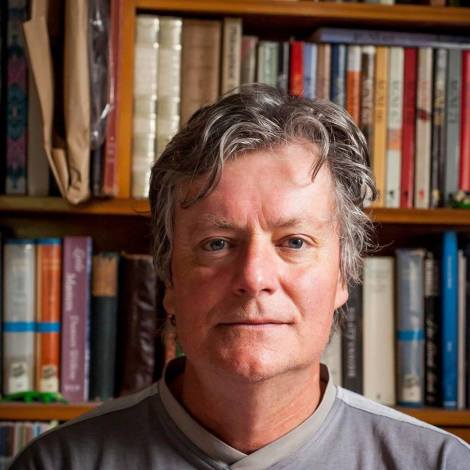
Majella Cullinane, originally from Ireland, has lived in New Zealand since 2008. She graduated with an MLitt in Creative Writing from St Andrew’s University in Scotland and her debut collection was published by Salmon Poetry in Ireland. She has received a number of awards including the Robert Burns Fellowship at Otago University and the 2017 Caselberg International Prize for Poetry. She is currently a PhD candidate at the Centre for Irish and Scottish Studies at Otago University. She lives in Port Chalmers.
Otago University Press has just released Majella’s second collection, Whisper of a Crow’s Wing. It is a terrific read that furnishes a sumptuous bridge between homes, contemplations and experience – with luminous detail, undercurrents and themes. To celebrate the book’s arrival, we embarked on a slowly unfolding email conversation.

The conversation
I too find myself in a bedroom now, the reflection of myself in the window,
only the line of my torso, my arms in a white woollen jumper.
Below me the neighbour’s house; behind that a tree stripped by winter.
I am neither idle nor riveted by my eyes, but at this moment
the letters race to catch each other across the space; the sound
in my ears is the piano keys and the slow stretch of bows against strings.
It is the day before the shortest day of the year.
The sky is grey; it has started to rain.
from ‘Winter Solstice’
Paula: The first line of the first poem, ‘Winter Solstice’, stalled me: ‘In the dark I cannot say what the day begins with.’ Is this how it is writing a poem at times? You are writing into the light from the dark? Or the exact opposite?
Majella: I think what I meant is more practical in that I hadn’t opened the curtains. The opening line of my poem is specifically a response or answer to Kinsella’s poem (epigraph) which begins:
The day dawns, with scent of must and rain… (Kinsella)
and I’m saying/opening with:
In the dark I cannot say what the day begins with…(Me)
Paula: Yes! I love the way you set up a conversation. The line is a perfect entrance into the poem itself but, as I stalled on it, I began to think about all the different ways to come to writing a poem. I love the way poetry can sidetrack you and then return you to the heart of a poem. My thinking got quite twisty because I was thinking I write into both dark and light when I begin a poem, always with jolts of surprise as the words hit the page. How is it for you when you write a poem?
Majella: How I come to write a poem varies widely. Generally I tend to let ideas and images simmer or gestate for quite a while first, or I might write a line or two and leave it and then return later. I’m a great believer in free-writing or writing down the page and letting words spill out unhindered, unedited. I suppose it’s my way of discovering what the poem is about and what it is I want to say. I need to write my way in. If something is not quite working I often like to move stanzas around. At some point I think there is, as you describe, a kind of jolt of surprise when you see that the poem is taking shape and you know what it’s trying to say. Rarely, and it’s like a beautiful gift, I will get a poem fully formed, one that doesn’t need too much tweaking. But this is very rare. It is the craft and close attention to each word that I really love about poetry, the way poetry has this magical way of making you stop and notice the seemingly small things in life. Also because I also write fiction I think poetry allows me to access the stiller, more reflective side of my personality.
III
I watch the slow tide one late February day,
stare into the grey whiteness of sky,
marvelling at the vagary of clouds.
If they could unshackle themselves,
I’d parcel them up with the mountains,
the inlets, the sea,
paint them on canvas,
carry them home under the nook of my arm.
from ‘Broad Bay’
Paula: Simmering and gestating are like the invisible threads of a poem. Stillness along with slow contemplation is such a captivating feature of your poetry. I am also drawn to the sumptuous detail in your poems: pungent, sharp, intriguing, scene building. I am always intrigued by the way details work and the various places it leads me as reader. What does detail do for you in your poems?
Majella: An attention to detail mostly helps me to reconnect with memory and place, and thereby conjure imagery associated with a particular time and place. It also enables me to explore language, and hopefully enrich the essence of a particular poem. The curiosity engendered by specificity or detail also allows me to discover new things. For example, I’m fascinated by NZ flora and fauna which is so specific and unique to this country, and am interested in connecting that uniqueness, which may be taken for granted if you grew up here, to my own experience of being an outsider/immigrant and to my sense of place in the world. Perhaps it is my attempt to root or anchor myself in familiar and unfamiliar landscapes, and for the present and past to coexist and play with or against each other.
Paula: Is there one poem where the detail particularly works for you?
We’re not there yet, but there are hints: in the pink-red clasp of sorrel,
the cicada easing a pitch lower, shedding its voice. The wind
changing direction like the act of entering a room and forgetting
what it is you came for. The sky tinged in blue-lavender,
spools of cloud whipping over the hills like wounds.
from ‘Finale to the Season’
Majella: I think most of my poems use detail to attempt what I discussed above. ‘Finale to the Season’ juxtaposes details from my past and present to explore the contrasting seasons – New Zealand’s early autumn, with the reference to the cicada and the grey warbler in the southern hemisphere and in the Northern hemisphere early spring with ‘crows stalking frozen trees’ and also the memory of my parent’s house where my sister and I shared ‘our own narrow bed’. The contrast of the first and third stanza, between the here and there is suspended for a moment, or at least hinted at when I write ‘the season’s murmurings are breached.’ Perhaps what I’m trying to achieve here, at least imaginatively, is that the past and present converge somehow and it is through imagery and connection with place that a momentary connection is possible.
The birch collar box lying in the centre of his suitcase the day he had left.
And you wondered about it, whether or not it had been returned;
if he had ever worn such a neat, rigid, clean thing, knee deep in rain and mud,
with the boom of the guns deafening, the smell of the kitchen,
the stove’s heart miles away.
from ‘Op Shop, 1985’
Paula: Yes – I was really struck by the way some of the poems arc between here and there, New Zealand and Ireland. I was quite moved by them. Another poem that struck me was ‘Op Shop, 1985’. Rather than place, this poem animates people. Do you ever feel poems are a way of anchoring place and people when you have attachments in both hemispheres? Poetry is a way of being at home?
Majella: Absolutely. I’ve lived in New Zealand since 2008 and to be honest it took me a while to settle in. Although there are many similarities between NZ and Ireland there are many differences, and not just with the flora and fauna, which is the most obvious thing but culturally too of course. I am now a dual citizen of Ireland and New Zealand and feel very much at ‘home’ in both countries. I think a big part of that settling-in period, and eventual ease with having a foot in each hemisphere so to speak, was achieved by exploring my feeling and experience through poetry, and the realisation that it’s not one place that necessarily makes a home but rather the people that, as you suggest, animate it whether they be living or dead.
Paula: Do you still touch base with Irish poetry?
Majella: Very much so. There’s a lot going on in Ireland in terms of poetry and fiction at the moment. Favourite Irish and Northern Irish poets include Vona Groarke, Michael Longley, Kerry Hardy, Sinead Morrissey, Eavan Boland just to name a few. But my reading is pretty wide. I also love Scottish and American poetry.
Paula: I got to hear Vona at AWF a few years ago. She is so good, and I have loved books by Sinead and Eavan. I also love the way Eavan writes about poetry. I will have to track down the other two! What about New Zealand poets? Are there any that you have really engaged with?
Majella: Rhian Gallagher, Emma Neale and Sue Wootton for their lyrical intensity, striking imagery and attention to form and craft.
Paula: Musicality is such a feature of their poetry, both on the page and when they perform. Do you write for the page or is reading aloud equally important? An early New Zealand poet, Eileen Duggan, with familial links back in Ireland, was shaped by Irish song. Not so much individual songs but the love of song, of women singing. Has Irish singing influenced your poems?
Majella: I read everything I write aloud, both poetry and fiction. Sound is so essential when writing poetry so that each draft I write I’m reading and re-reading it as I go. As for Irish song, I wouldn’t say I’m influenced by Irish singing but I do listen to music while I’m writing/drafting mainly classical music and I love soundtracks. Mind you having said that I do love Irish ballads: Siúil a Rún, She Moved Through the Fair, Raglan Road, etc. so maybe I’ve been influenced subliminally. I certainly used to sing a lot as a young child and had singing and piano lessons. I’ve often said if I didn’t write I probably would have gone into music.
You called just after eight. I could hear the longing in your voice
as raw as the air two days earlier when the hills were dusted with snow
and temperatures plummeted. We wrapped your grandson in layers
vest, long johns, hat and gloves. I stayed in and cleaned, found traces of myself
in drawers and cupboards, in scraps of paper and old notebooks, piled
laundry on the bed and folded it.
from ‘Compline’
Paula: For me the joy of your collection lies in the multiple subjects that depend upon musicality and contemplative movement. The poems engage so intricately with people and place, but there is an emotional undercurrent that also hooks me. I love ‘Compline’, the poem for your mother that catches the ache of distance. There are the tender mother observations in ‘You Say’ and ‘The Little Boy That Got Away’.
In some poems, grief is measured and utterly moving – as in ‘There But For’. I am drawn into the width and depth of being human in your poems. How important is it to write as both mother and daughter? To write the tough experience along with the jubilant and the wonder?
Majella: Well, when I first started writing I was a little hesitant to use the personal in poetry, which is why I wrote quite a few dramatic monologues, especially in the first collection. It is a form I still love as it allows me to explore another I and perhaps connect with the latent thespian in me. There’s quite a gap between the first and second collections. In a way that gap mirrors the experience of being both here and there, of becoming a mother in New Zealand, and consequently knowing what it is to be a mother, and how my own mother feels about distance, especially as I’ve been coming and going from Ireland since I was twenty and haven’t lived there since 2004.
Regarding writing about the tough, or difficult in life, well, the older I get I find I need to write about all aspects of being human as you suggest. Even in the most difficult situations I have encountered, there is, if I look hard enough, and slow enough, a little wonder and hope to be found. I’m reminded of that phrase, the darkest hour is just before dawn.
Paula: Can you pick one poem to post at the end? My collections often have poems that particular matter to me. Do you have one like this?
Majella: One poem that particularly matters to me would be Feather, inspired by Dickinson’s Hope Is The Thing With Feathers. The idea that until we ‘know’ we can always hope, and even when what is hoped for is not possible we can still feel it to be real somehow – through the power of the imagination.
Feather
If only everyday was as simple as listening to birds, their small voices
plucking the grey-blue morning, emboldened on this first day of spring.
We too might dare to hope that what has long been desired is not so far away.
Let’s suppose it is here already, as real as this room’s radiator
switching itself on and off; the thermostat of our longing unhindered
by a dial of hours. Rather it exists in a kind of elsewhere,
or takes form in the wanderer who crosses bridges and borders
without restraint. Better to loosen the tangle of our rough wishes,
of the could-have-beens and might-have-beens and know we had it all,
just for a moment. Beneath the clamour of sounds –
logging trucks rattle to and fro from the port, a dog barks at the passersby.
A friend writes a message, subvoce – imagine, imagine,
and the bird that sheds a feather without knowing,
is the one we might chance upon, pick up and carry home
©Majella Cullinane Whisper of a Crow’s Wing
Otago University Press page
\\