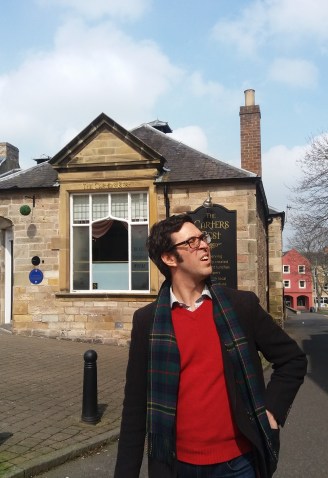
Erik Kennedy has followed his poetry chapbook, Twenty-Six Factions (Cold Hub Press, 2017) with his debut collection, There’s No Place Like the Internet in Springtime (Victoria University Press, 2018). He edits the online journal Queen Mob’s Teahouse. He lives in Christchurch. His first-full length collection sparks with multiple fascinations, experience, thought, wit, politics, optical delights and aural treats. It is a book of harmonics and elastic thinking, and is a pleasure to read.
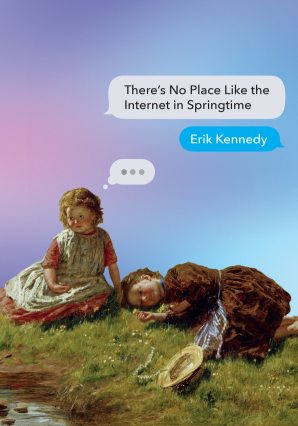
To celebrate the book Erik and I embarked on a slow-paced email conversation.
Paula: Did you read, write or hear poetry as a child? As a teenager?
Erik: I wouldn’t say that I grew up in a poetical household, but it was certainly a bookish one. My early touchstones were mostly fact-filled books: The Book of Lists, Jacques Cousteau, The Rand McNally Encyclopedia of Military Aircraft, atlases. We had that two-volume complete OED that comes with a magnifying glass, which I never used, and instead I liked to bring my eyes quite close to the tiny, tiny type on the huge pages. I was born in 1980, so I am part of the last cohort that had a childhood without the internet.
I came to poetry in my early teens. I was converted by my father’s old university poetry textbook, which was an early edition of An Introduction to Poetry by X. J. Kennedy (no relation). Then I realised that we had a lot more of this ‘poetry’ stuff in the house, and that even bookshops in suburban New Jersey would sell you poetry if you wanted it. I became obsessed with it. I was an only child with addictive tendencies. I started writing my own poems, and I liked it so much that I thought I should write hundreds of them. For a while I kept a chart of my productivity. For a while I thought six poems per day was a decent target.
Eventually I became saner and realised that reading was more important than writing, but the funny thing is, I wasn’t wrong about the benefits of writing tons of poems. At the time I thought I should do it because I assumed they were all brilliant and worth recording. Now I do it because I know that half of them will be rubbish.
Paula: Oh I love the image of the chart. I wonder if you will look through the rubbish pile one day and see some of the poems glow? I am intrigued by the way relationships change with a poem over time. I am also wondering with your enviable productivity if you write a poem quickly or it is agonisingly slow?
Erik: These days I’m more likely to abandon a poem than to revise it extensively, so I guess I go along at a fair clip. (If taking a week on a poem is writing ‘quickly’.) A couple of poems in the book – like ‘The Shame’, for instance – were written in one sitting. Poets reading this will be familiar with how amazing a feeling this is. Like bowling a perfect game on Christmas Eve, or finding a fifty dollar note in a seldom-worn coat.
I’m not very sentimental about particular poems. I tend to revisit certain subjects regularly – climate change, the atheist’s perspective on religion, inequality, mortality and the fear of death – so it’s unlikely that any given poem I write will be my last word on the matter. This takes off some of the pressure to get it perfect. This isn’t to say that I don’t like my poems or have particular favourites. But often it’s reader or audience reaction that earns a poem a place in my affections. I want my work to connect with people, and that connection is something that’s probably more important than my own super-subjective feelings about my work. This is one reason why I send my poems out so much and why I do as many readings as I can. Hopefully it all adds up to something in the end.
Paula: Writing is such a private thing – we send our work into the world and so often don’t eavesdrop on the reader. When an audience gasps after you read a poem it is gold!
There’s no place like the internet in springtime!
Everything foals a new thing like itself,
and old things are respectful in their pastures
and only argue over if it’s best
to let the snow melt or to make it melt.
from ‘There’s No Place Like the Internet in Springtime’
The order within disorder
is a spice-rack in a shipwreck,
an abacus in the corner
at the ruined abbey of Glenluce,
or hill-roads amid the scree
where earthquakes preside.
It is also a probe
in orbit around a comet,
a self-tightening noose,
a precise polypeptide
in a gummy primordial soup
from ‘I Can’t Even’
Your collection navigates eclectic subject matter but I was initially drawn to the interplay between a virtual world and a classical world. I began to muse on how poetry fits into movement between the arrival of the internet and a legacy of classical knowledge. Do both feed your curiosities as a poet? Does the internet make a difference to you as poet? I really love the lines in ‘I Can’t Even’:
The things we write we transform:
the far becomes the distant,
the distant becomes the invisible,
the invisible becomes the new
Erik: I sometimes (over-ambitiously!) describe the book as a collision between the digital and the pastoral – like responding to Marlowe’s ‘The Passionate Shepherd to His Love’ with an image macro. It seems to me that poetry is good at representing collisions like this, given that so much of the art as it’s practised now is about surprising juxtapositions and skewed perspectives. Even some of the famous ‘definitions’ of poetry get at this. Take one of Carl Sandburg’s hare-brained formulations: ‘Poetry is a puppet-show, where riders of skyrockets and divers of sea fathoms gossip about the sixth sense and the fourth dimension.’ This is barking, obviously, but it’s a way of saying, ‘Well, I add a and b together and I get x, and I’m not really sure why.’ And I understand that. That’s how it feels to me, too.
You’re right to sense that I care deeply about history. I’ve always cared as much about the seed drill as I have about @dril. It seems to me that on the c. 2018 internet all of history exists simultaneously. This was previously possible in the arts, but I don’t think that our daily lives were filled with the disorientating, mind-bending glory of it all until we had social media. I’m thinking of the @medievalpoc Twitter account, Daniel Mallory Ortberg’s legendary art/lit/textspeak mash-ups on The Toast (a few years old, but not forgotten), even Jim’ll Paint It (if old British telly counts as history). I could go on forever. We are blessed to live in these times.
But, in a way, I don’t think it is internet culture itself that has primarily affected my work, although I like Weird Twitter as much as the next idiot. I think instead the ability to plug into existing literary cultures has allowed my work to be broader than it would have been otherwise. This is part of the general, larger process of globalisation and cultural cross-pollination that we’re all living with and contributing to. I’m not the first person to say this, but I feel like I just know a lot more about the various poetries there are out there than I used to. And if I didn’t, I’d probably still be writing the same kinds of poems I wrote when I was twenty . . . and trust me, that would not be a good thing.
Paula: Engagement with diverse poetries seems so important and for me that involves reading outside my comfort zone, my poetry loves. I also love the idea of poetry reacting to collisions, intersections, juxtapositions. Interestingly when I was jotting down notes I wrote the words ‘detail’, ‘things’ and ‘juxtaposition’ but not just for the embedded ideas. Yes, the detail in the poems is striking in itself, but I was drawn to the ‘static’ or the ‘conversation’ or ‘kinetic energy’ between things as I read.
Two feet of snow at my parents’ place, in another season.
Here, the cicadas sing like Christian women’s choirs
in a disused cotton mill. Belief is a kind of weather.
I haven’t seen proper snow for three years.
from ‘Letter from the Estuary’
I can jump about this stanza for ages. How important are the connections or bridges (and perhaps disconnections) between things as you write? Is there a poem where it is particularly important?
Erik: Perhaps you already know that James Brown has (gently) mocked my thought processes in that stanza of ‘Letter from the Estuary’ in a poem called ‘Liking Similes’? From his poem:
When I hear cicadas, their singing always reminds me of
Christian women’s choirs in a disused cotton mill.
I picture the conductor’s arms bent in supplication
as she tries to draw forth the correct ‘cicadian’ rhythm
from the collective gasp of Christian women.
And it goes on in that vein for about 400 words! I recommend it enthusiastically. I’m a strong believer in trying to surprise readers. Maybe sometimes I try too hard. Maybe sometimes that effort borders on the absurd. But a certain amount of risk is necessary if you’re going to write either very good or very bad poems. I’d like to be remembered as someone who wrote both.
I think James has got my style down, though! Or at least he’s got the logic of it, if not the exact tone. I’m lucky enough to be in a great critgroup – four other poets I trust, with whom I meet once a month. I often get told that my poems operate in predictable ways because they argue more than they emote. I think that aspect of my writing is easy to parody, and I don’t mind that. What’s wrong with using poems to work out problems? One of the oldest, simplest, and most enjoyable poems in the book, called ‘Growing Fears That the Leadership Contest Has Been Hijacked by Far-Left Infiltrators’, is a series of propositions, which, if answered in the affirmative, all seem to say that the reader is a proper socialist. That’s the sort of connection that’s most important to me – connections that lead to a punch line rather than ones that merely establish a mood.
Paula: Well, heck, I love jumping about that stanza and indeed the whole collection. Do you have a favourite poem in the collection – where the poem just clicked into place and lifted?
Erik: When it comes to my poems, I’m like a parent. I’m like a parent who loves all his children equally. I’m like a parent who acknowledges his children’s limitations. I’m like a parent who hopes his next children will be better than the ones he already has are. I’m like a parent who thinks his children would have been better off if they had been born in another time and place, when children rhymed and scanned. Maybe this is a faulty simile from someone who hasn’t got any kids.
What I’m trying to say is that I have a lot of favourite poems, and they all do different things, and I’m not vain enough to think that they’re all perfect. In fact, I have frosty relations with some of my poems. I won’t renounce them, but I hope I can replace them with better ones in future.
So instead of a one-poem answer, I hope you’ll let me nominate a few poems that I think fulfil their ambitions pretty well:
Favourite love poem: ‘Love Poem with Seagull’
Favourite poem about aesthetics: ‘I Rank All the Beautiful Things There Are’ (which appears in a slightly different version in the book)
Favourite rambling philosophical poem: ‘The School of Naps’
Favourite ‘history poem’: ‘Public Power’
Favourite ‘New Zealand poem’: ‘Letter from the Estuary’
Favourite eco-poem: ‘I Am an Animal Benefiting from Climate Change’ (not online)
Favourite poem that isn’t online: ‘Double Saw Final at the Canterbury A&P Show’ (also not online)
Paula: Oh, how perfect. I have been thinking of running a series on my blog where I get a poet to recommend a favourite poem (and go through categories!). I was thinking of poems by other poets though. I love your list; it is a reminder that poetry does all kinds of things on all kinds of subject matter with all kinds of stylistic leanings and you enagge with them for different reasons.
I had a conversation with a writer who, like me, finds writing makes her happy. It can be a challenge, demanding much of/from you, but it makes me happy. I jotted down a couple of lines from three terrific poems near the end of your book that feature ‘happy’, ‘glad’, ‘contentment’. For some reasons these three poems gave me goosebumps.
From ‘The School of Naps’: When you’re happy you have a responsibility to those who are unhappy / to do your best with it.’
From ‘The Contentment Poem’: ‘I’ve got the garden just how I like it and that, obviously, / is just how I like it.’
From ‘Today’: ‘And I, alone and glad, have missed these things.’
Does writing make you happy or is it a painful part of your life as it is with some writers?
Erik: Are there really poets who cause themselves pain when they write? Of course I love writing. I’ll never be more alive – ever – than when I feel an unmistakably good line come into my head. To me, that’s what humanity is: the moment when you acknowledge yourself as a self-aware, clever being. (Knowing that you’ve written a good poem is like juggling in the mirror.) At the moment of my death I will probably say something like, ‘One more line, please.’ One line in Latin on one’s tombstone below one’s name: Magis. More.
Obviously, I hate the process of writing as much as everyone else does; 999 lines in a thousand are just craft, not art. But I will chase the feeling of that serendipitous line across all of time and space. I suppose it’s why I’m a poet rather than a novelist – I can capture that feeling more easily in ten choice words than in ten chapters. Poetry is a shortcut to pleasure, and none of us should ever apologise for taking that shortcut.
Paula: Bill Manhire quotes Randall Jarrell in his (Bill’s!) poem ‘The Victims of Lightning’ – good poets might get struck by lightning five or six times in a thunderstorm – a great poet maybe a dozen. Sometimes it feels like that – where did this poem come from? How on earth did it hit the page and sound like this!
I am really drawn to the lists in your poems – there is something that both surprises and comforts about list poems or poems that play with lists. What is the attraction?
Erik: A natural rage for order, I suppose! I hope I don’t write many ‘list poems’, though. I’m happy enough to write poems that contain lists, but when lists are the poem I’m not usually very happy. It’s the same with anaphora, parallel structure, whatever. Like any rhetorical gimmick, these devices make useful servants and oppressive masters. I was reading Clint Smith’s ‘the drone’ the other day and I was thinking that it is a good example of a poem that develops and emerges naturally from its confines to say something necessary. And the structure helped it say what it said; it wasn’t just there when it got said, hanging around or getting in the way.
So when I write things like this:
I rank all the beautiful things there are
starting with self-sacrifice, then supernovas,
the brain, love, virga, Korean pottery,
lemurs, cuckoo clocks, suits of armour for horses,
a child’s first words, mercy, bread, and so on.
from ‘I Rank All the Beautiful Things There Are’
Or this:
The human ingenuity I admire
is limited, implausible, post hoc,
folksy, unconsidered, overthought,
ecstatic, garden-shed, Corinthian,
exhausting, nebulous, and somehow sexy.
from ‘I’m Impressed’
I am indulging myself, yes, but I am also pointing to the richness and strangeness of experience, which is a subject that those two poems share. Lists are a nice way to establish breadth. As someone who (likes to think that he) writes on a broad range of subjects, many of them not personal ones, they help me show that I have considered things, that I aware of the possibilities and I love them. Maybe that’s why I like lists and deploy them.
Paula: I am reluctant to wrap our conversation up as it has been such fun, but can we finish with a list – around five New Zealand poems that have struck you for different reasons?
Erik: In no particular order, and with no comment: Nick Ascroft’s ‘Five Limericks on Grief’, Hera Lindsay Bird’s ‘The da Vinci Code’, Alistair Te Ariki Campbell’s ‘Waiting for the Pākehā’, Ashleigh Young’s ‘Ghost Bear’, and James K. Baxter’s ‘Elegy for My Father’s Father’. Thanks! This has been great!
Paula: Indeed! Poetry delight.
Erik reads ‘Tour Grandfather’s Stories’
Victoria University Press page
Erik’s website