
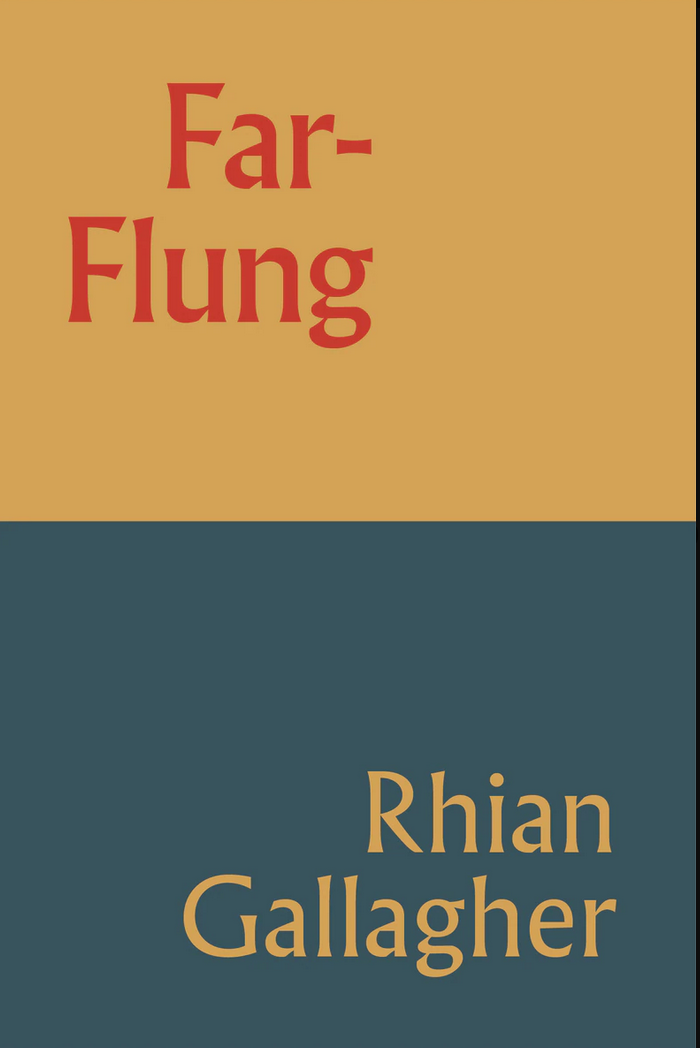
Rhian Gallagher reads from Far-Flung (Auckland University Press, 2020)
Rhian Gallagher‘s first poetry book Salt Water Creek (Enitharmon Press, 2003) was shortlisted for the Forward Prize for First Collection. In 2007 Gallagher won a Canterbury History Foundation Award, which led to the publication of her book Feeling for Daylight: The Photographs of Jack Adamson (South Canterbury Museum, 2010). She also received the 2008 Janet Frame Literary Trust Award. Gallagher’s Shift (AUP, 2011) won the 2012 New Zealand Post Book Award for Poetry. In 2018, she held the University of Otago Robert Burns Fellowship.
Auckland University Press page
Poetry Shelf review of Far-Flung

Greetings cards for Jackson Nieuwland
I light a candle and vines of blood
Run down in place of wax as if
The experience of transubstantiation
Were being drawn towards the grave
Centre of the earth by the weight of
Your own iron content. Ever found
Yourself on a throne whose arms
And legs are wired to crosses like
A marionette? You’re no puppet and
It’s all the universe in a pocketwatch
I’m afraid. My heart on fire under
A bell jar and that’s just how it’ll stay.
❤
Getting into keeping fish as a hobby
Hoping to use my own body as a tank
Until so filled with water I gain imm-
Unity to drowning and companionship
All at once. The deeper I go the more I
Feel as though falling from great heights.
My open palm broad enough to form
Plains on which tornadoes arise like
Spring clockwork before the lines turn
To river deltas so blue I can’t imagine
Ever having had veins in my hand.
❤
Amongst the sunflowers the scarecrow
Is king. I have the first successful mono
-culture fields of carnivorous plants
That eat every new seed right as you
Sow it. Knock off and pitch a ladder
Against the clouds to paint them like
A weatherboard house or chip away at
An ice sculpture. Lay down on the Gulf
Stream like Michelangelo on scaffolding
Painting the dogmatic ceiling. As if
The compass woven into paper maps
Could spring to life like a computer.
❤
I woke inside a lightbulb holding
A candle slowly consuming all the air
Like the sweetest dream of being a star
Calculating orbits in the different twists
Of screw and bayonet fittings the kind
Of knowledge that can never survive
A trip to the store. An alley so dark I
Instantly become an orphan and have
The shadow of a wolf in passing head
-lights. Fallen leaves and playing cards
And receipts curl into being on the wind
And take a hike into rolling hills.
Chris Holdayway
Chris Holdaway’s Compound Press was established in 2013. It publishes poetry, other writings along with Minarets, a journal of poetry and poetics. The books are printed and bound in their Auckland workshop. Jackson Niuewland’s I am a human being (2020) is longlisted in the Poetry Category of the Ockham New Zealand Book Awards. Last year they also published A bathful of kawakawa and hot water, a selection of writings by Hana Pera Aoake.
Inside the television the tiny people
are moving and talking. Some of them
are falling in love. Some of them are dying
in exciting ways. The cartoon people
who fall off a cliff or are hit by a train
get up again, scowling but unharmed.
There are also tiny animals.
They live in documentaries.
They hunt and fall in love and die.
They do not get up again.
At night the television is turned off
and all the people and all the animals
lie down and go to sleep.
The people sleep in tiny houses.
The animals sleep in and under tiny trees.
It is crowded inside the television,
but they are all used to it
and they make do, they settle down
under their tiny night sky,
with its tiny stars.
Who would not wish
to join them there?
A young woman with wet hair
climbs out of the television
into a living room,
her long hair and sodden dress
are dripping water on the floor,
and that is a horror movie.
But more and more of us
are going into the television,
and the young woman will soon
be alone in the world.
She wanders from empty house
to empty house, testing the abandoned
appliances. She picks up the remote
and switches the television on,
but then she is bored
and switches it off.
There is nothing to be afraid of
inside the television. It’s quite all right.
Good night, we tiny people
say to each other.
Good night, the tiny animals
growl and squeak and purr.
The television is dark now.
Good night.
Tim Upperton (an earlier version of this poe appeared in takahē 98)
Tim Upperton lives in Palmerston North. His second poetry collection, The Night We Ate The Baby, was an Ockham New Zealand Book Awards finalist in 2016, and he won the Caselberg International Poetry Prize in 2012, 2013 and 2020. His poems have been published in many magazines including Agni, Poetry, Shenandoah, Sport, Landfall and Takahē, and are anthologised in The Best of Best New Zealand Poems (2011), Villanelles (2012), Essential New Zealand Poems (2014), and Obsession: Sestinas in the Twenty-First Century (2014). His poem “The truth about Palmerston North” was recently recorded by Sam Neill here.
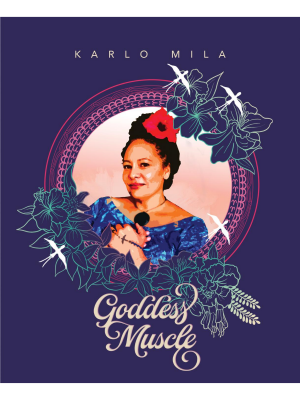
Karlo Mila, Goddess Muscle, Huia Publishers, 2020
Paintbrushes in our hands
drafting our dreams,
remembering the chants,
writing the poems,
relearning the language
composing the chants,
cooking the dinners,
carrying the children,
paying the bills,
fighting the fight,
with our tax-paying,
car-driving hands.
A collective of artists
narrating a story
we can bear to live in.
Creating an image
of ourselves
we can love
to look at:
from ‘Our Generation : ‘Āina Aloha’
Karlo Mila’s new poetry book is the most gorgeously produced collection I have held in ages. It feels good. It looks good. It is a pleasing shape. It has abandoned the reigning tradition of black ink upon white page in favour of a wider colour palette for both font and background. Sometimes I have to peer in close to read as though the physical act of reading is as important as cerebral connections and heart boosts. It continues to matter to me as addicted poetry reader at the moment: the effects a poetry collection has upon you as you read and as you move away. How satisfying when poetry uplifts heart and stimulates brain, soothes tired bodies and sets us swaying.
Several artists contributed work for the book and, as the acknowledgement page underlines, these vibrant works are personal: Delicia Samero’s portraits of Karlo, a collaborative mural Aloha ‘Āina and Naomi Maraea’s depiction of Hikule‘o.
I adored the 2021 poetry longlist for the Ockham New Zealand Book Awards having been so affected by the eight books I had read and reviewed. And now I can add a ninth sublime read: Karlo’s Goddess Muscle. The collection ignites every reading muscle: from heart to mind to breathing to memory to pulse. Karlo engages with light and dark, fragility and strength, relationships, family, sisterhoods, writing mentors, life mentors, political issues. Her words meet the line, create the lines like a movement of water, lap lapping in your ear, across your skin, with ebb and tide, the words in debt to water fluency as they flow gentle and honeyed, or hit sands, rocks, obstacles. Such sweet flowing lyrical currents. Always audible, always mesmerising. This is poetic craft at its most agile.
Dark, lovely cowrie-shell eyes,
who’d expect the lies,
unless you flipped that fragile shell over
to the serrated crack
of the backside,
where the sea slugs reside,
that weak pink flesh on the inside.
Everyone’s got a living surprise,
the part that they hide.
from ‘The Tale of Hine and Sinilau’
The book begins with a gathering, a gathering of lineage, ancestors, relations. This becomes place, somewhere to write from and to and because of. The gathering involves balance, re-orientation. The gathering (both noun and verb) becomes writing and this is what writing can do.
It is their
soft singing,
cellular love songs,
the chanting lyric of bloodlines,
accompanying you
all the way
through the lonely.
from ‘Your People Will Gather Around You: Love After Love’
The ocean is paramount, not just in the water fluency of the lines, but in the recurring motifs and the personal attachment. “Oceania’ is an ocean homage, image, self-defining: ‘I call on the memory of water’.
Karlo acknowledges writers and loved ones who have sustained her, who are the essential oils of writing. She lights a candle for Teresia Teaiwa in ‘For Teresia Teaiwa’. I am moved to tears as I read this loving tribute to poet who affected and inspired so many others.
I will light this candle.
The spendy kind,
cradled in glass,
that burns for days
smelling of coconut and vanilla
and I will say prayers for you
even though my prayers
are like bad poems
and are often wordless.
I hope,
at the least,
you will feel the
long-burning
flame of my intent,
warming the space
between us.
The tribute poem to JC Sturm cuts to the bone of reading, sidestepping Baxter and his sickening offences, Karlo taking a road trip to Jerusalem with her own broken heart and her mother, moving under his over-present lines to Jacquie. How I love this poem, this mihi: ‘But moving under all that surface skimming / was you.’ The poem to Hone Tuwhare is pure delight. The sonic torque (can I say that, think sounds spinning on word axes) is sensational.
You boilermaker,
fabricating lyrical weld
from blast furnace
of sun,
slowed,
stopped and
set
on white horizon
of page.
from ‘A Conversation with Hone Tuwhare’
Karlo’s love poems have always gripped me and I favoured them in Wild Honey’s ‘Love’ section. This collection faces broken love, longings, touch, loneliness, attachment with shifting intensities, hues, admissions. There is someone at the end of the poem, an addressee, a beloved, a lover lost, a lover found, and Karlo never forgets that. The poems are layered, intimate, deeply personal. I am still held in their grip.
Goddess Muscle is crafted like a symphony, an experience of shifting life seasons and subject matter, so as you read the effects are wide reaching. Karlo faces significant political issues: climate change, the Commonwealth, colonialism, racism, Ihumātao, ‘the daily politics of being a woman, partner and mother’. She faces these global and individual challenges without flinching. The resulting poems are essential reading, never losing touch with song and heart, always insisting in poetic form how we can do better. How we can be a better world, recharge humanity. I would like to see these poems read in secondary school. You can read ‘Moemoeā: (composed for poets for Ihumātao)’ here.
Goddess Muscle is a gift. I can barely account for how it will stretch your reading muscles, your beating heart, your enquiring mind, your compassion, your music cravings, your empathy. Karlo has extended her own poetic muscle and offered poetry that is wisdom, strength, refreshed humaneness. Thank you. Thank you.
If we were truly to reorient
to life as relatives,
commonwealth
would mean more
than what we might cling to
in the face of a dangerous
and uncertain future.
Let us not
use the word ‘commonwealth’
to try and insulate fate
with the soft fur of fine-feathered friends.
No,
let us spread our wings
to a much wider vision than that.
It may be the end of the world as we know it
but let us not fear
the remaking of another one.
To the young people I say,
there may be no jobs
but there is plenty of work to be done.
So let us harness our collective wisdoms:
divers, different and divergent.
Let us create an atmosphere
of kindness and love
for even the air we breathe,
fresh water, trees, people, ocean.
Let us create a dream house,
a great place to raise a family.
For therein lies the fate
of an extraordinary family of relatives.
Where what we have in common
is all of us.
from ‘Poem for the Commonwealth, 2018’
Dr Karlo Mila is a New Zealand-born poet of Tongan and Pākehā descent with ancestral connections to Samoa. She is currently Programme Director of Mana Moana, Leadership New Zealand. This leadership programme is based on her postdoctoral research on harnessing indigenous language and ancestral knowledge from the Pacific to use in contemporary leadership contexts. Karlo received an MNZM in 2019 for services to the Pacific community and as a poet, received a Creative New Zealand Contemporary Pacific Artist Award in 2016, and was selected for a Creative New Zealand Fulbright Pacific Writer’s Residency in Hawaii in 2015.
Goddess Muscle is Karlo’s third book of poetry and has been longlisted for the Ockham New Zealand Book Awards 2021. Her first, Dream Fish Floating, won NZSA Jessie Mackay Best First Book of Poetry Award at the Montana New Zealand Book Awards in 2006. In 2008, Karlo collaborated with German-born artist Delicia Sampero to produce A Well Written Body.
Huia Publishers author page
Poetry Shelf – poets on their own poems: Karlo Mila reads ‘For Tamir Rice with Love from Aotearoa’

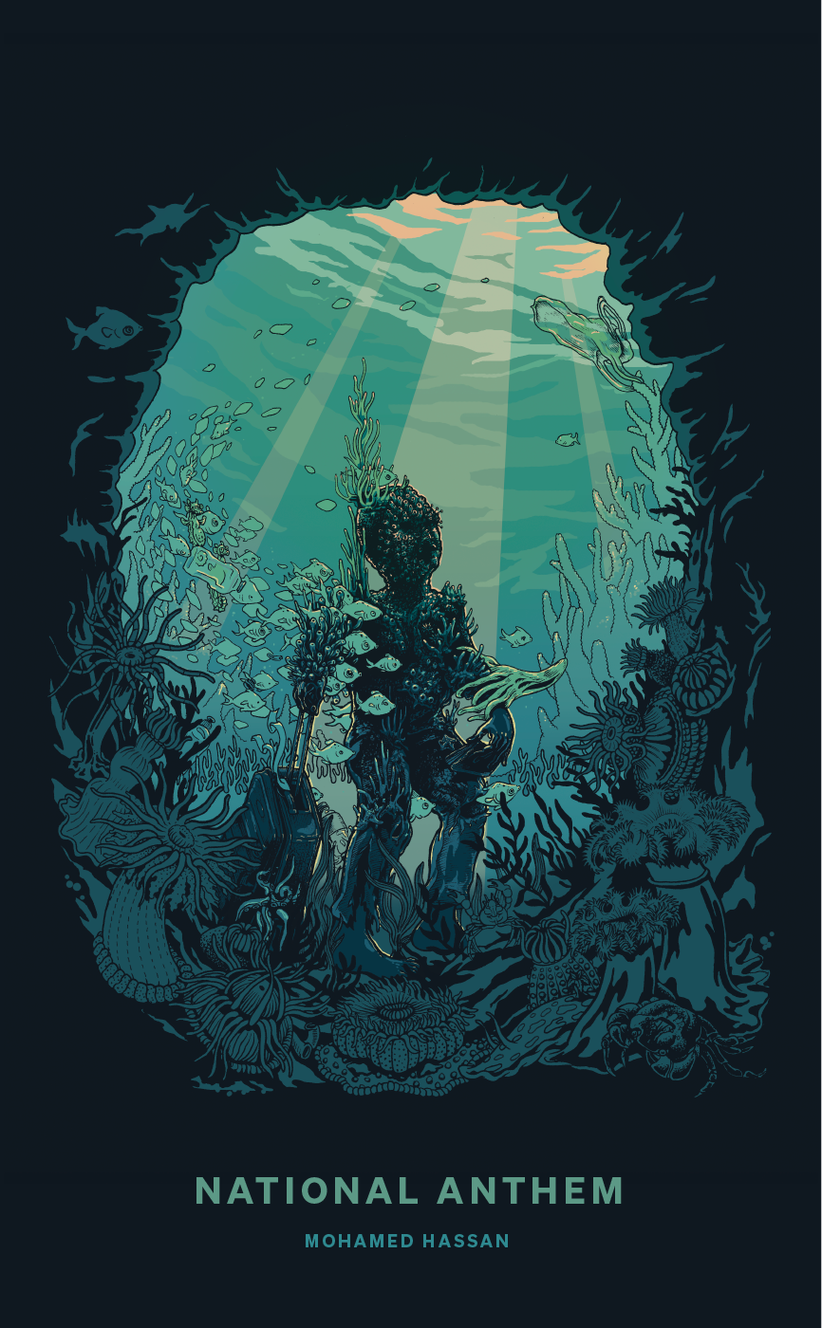
Mohamed Hassan, National Anthem, Dead Bird Books, 2020
Mohamed reads a few poems from National Anthem
Mohamed Hassan is an award-winning journalist and writer who has lived in Egypt, Aotearoa and Turkey. He was the winner of the 2015 NZ National Poetry Slam, a TEDx fellow and recipient of the Gold Trophy at the 2017 New York Radio Awards. His poetry has been watched and shared widely online and taught in schools internationally. His collection, National Anthem, is longlisted for the Ockham New Zealand Book Awards, poetry category.
Dead Bird Books page
Ockham NZ Book Award page
Poetry Shelf review
Political protest and Te Reo has featured strongly in this year’s Robert Burns Poetry Competition entries.
The adult and youth competitions attracted 53 entries last year with only one from overseas.
Judged by poet Kay McKenzie Cooke and Burns Fellow John Newton, the adult competition had a theme Freedom, inspired by Burns’ Here’s a health to them that’s awa.
‘‘The interpretations of the theme freedom ranged from referring to the struggle for political freedom while oppressed; whether that be by health problems or by unfair treatment from past and present injustices; to the image of freedom as expressed in nature.’’
You can access the rest of the ODT article with the complete list of winners and their poems – including the Youth and Unpublished Poets winners.
Published Poet winners:


The Embryo, Repeated
I know that I look the same / but I have manifested a lion
ripe & pumping giddily
I know that I look the same / but I have manifested a lion
present & unasked & ready
I know that I look the same / but I have manifested a lion
precise as mathematics
I know that I look the same / but I have manifested a lion
shoulders up against the wind
I know that I look the same / but I have manifested a lion
peace be upon the lion
I know that I look the same / but I have manifested a lion
& everyone always says how glamorous
I know that I look the same / but I have manifested a lion
as a prize
I know that I look the same / but I have manifested a lion
& how is this manifestation distinguished from all the other animals?
I know that I look the same / but I have manifested a lion
I said how is this lion distinguished from all the other animals?
I know that I look the same / but I have manifested a lion
a toll, a shimmer, a serious cloud, valuable, brief
I know that I look the same / but I have manifested a lion
behold, my lion
I know that I look the same / but I have manifested a lion
l’chayim l’chayim
I know that I look the same / but I have manifested a lion
it is beloved
I know that I look the same / but I have manifested a lion
in the kitchen
I know that I look the same / but I have manifested a lion
ah thunder!
I know that I look the same / but I have manifested a lion
& the urge for daylight is real
I know that I look the same / but I have manifested a lion
& a stag rutting in a meadow
I know that I look the same / but I have manifested a lion
a rare nocturnal lion
I know that I look the same / but I have manifested a lion
ta for noting how this lion is distinguished from the other animals
I have popped it into a segmented tray
I have left it to set at optimal temp
*
& bloody etcetera!
gawd
I owe Cath a letter
she wrote in April & now
it’s almost September
I should phone Pam too
phone Pam write to Cath
tell them I’m moving
to latch back onto the hopeless dresses of
Sde Boker with my goy ex, or
to Whanganui, maybe
What is the time?
Sam Duckor-Jones
Sam is an artist and writer from Wellington. His first poetry collection People From The Pit Stand Up was published in 2018 (VUP) and his second Party Legend will be published in June 2021 (VUP). He has exhibited widely and is represented by Bowen Galleries. In 2020 he bought a church near Greymouth that he is turning into a sculpture.
 NZ Poetry Shelf