
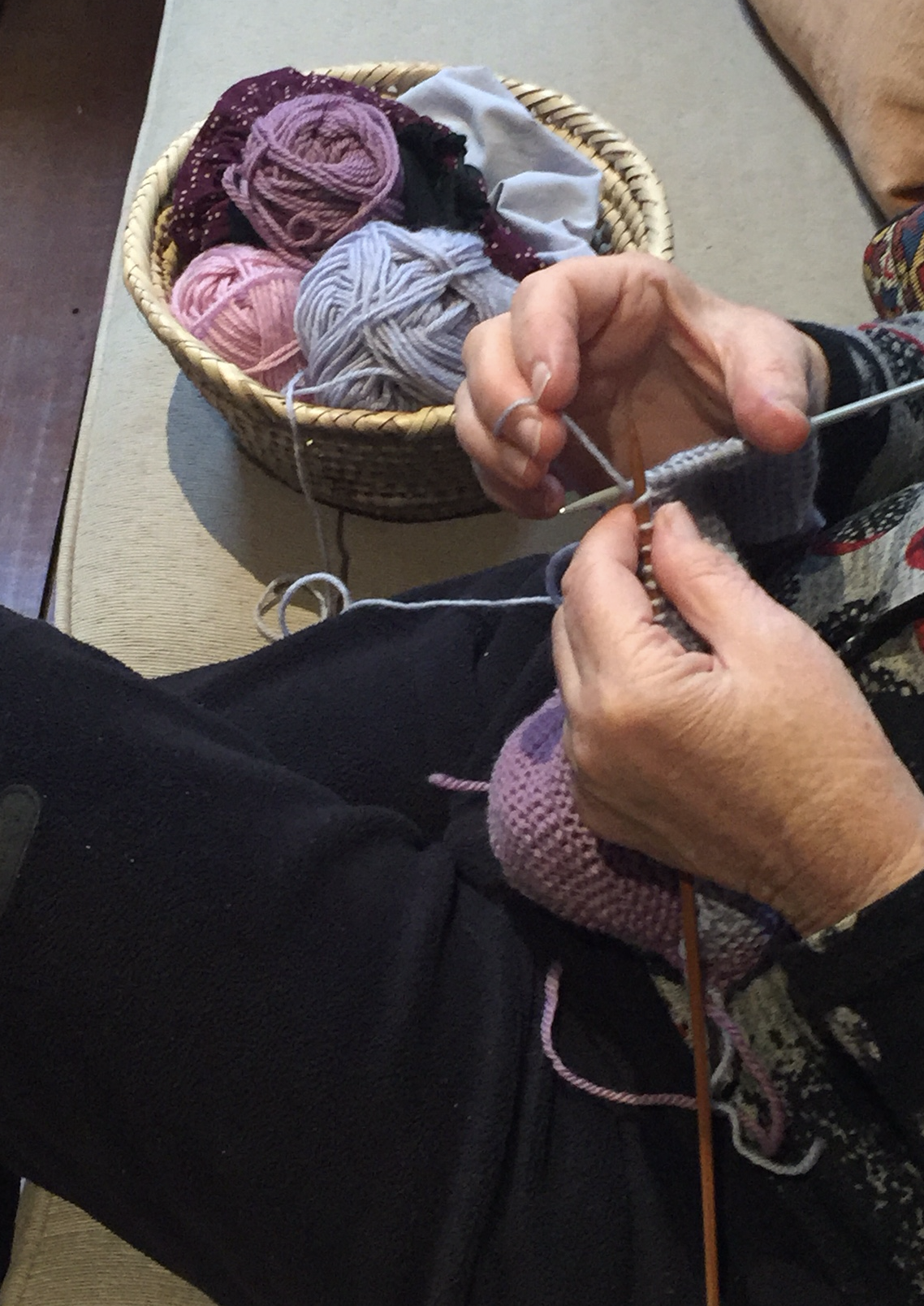
I have always knitted but never very often and never very well. I have a winter cardigan that has been on the go for years and I need help to get it working again. When I was young I knitted a very complicated black jersey. I completed it and it felt like a work of art with its intricate and sublime stitching and hard-to-see-as-you-knit colour. But before I ever put it on, my dog Woody ripped it to shreds. I have never managed to finish anything since. Perhaps this winter I will see if I can find the bag with the grey wool and hope the moths haven’t shredded the cardigan.
I love knitting because it is soothing, because crafting things is a joy, and we can produce things that are of the greatest comfort. (Although at AWF 2021, Brian Turner talked about his grandmother knitting him childhood jerseys he never really liked!) I love the way you can lose yourself in the clicketty clack rhythm, or if you are skilled, you can read and look elsewhere as you knit. But knitting is a metaphor for so much more. Writing a poem is a form of knitting. Relationships and family life are forms of knitting. Telling a story. Living. Loving. Existing.
I am grateful to all the poets and publishers who continue to support my season of themes. These poems are not so about knitting, but have a knitting presence in varying degrees. Ha! I think reading is a form of knitting too! Happy knitting!
Twelve poems about knitting
Lockdown knitting
I hit on knitting for something to do
in the gloom, I get restless,
this end of the room is dim
and outside the window, the sun
burns down on browned-out plants
holding onto the dry clay bank,
relentless blue behind.
What Paul watches all day long.
Smoking for something to do.
He raises his eyebrows ridiculously
as I pull the thread of last year loose,
wants to know what I’m doing.
I say it stops me from chatter.
We say little bits from time to time
it’s peaceful, his coffin
on the dining room table
…32, 34, 36… I’m casting on the front
a dark ship riding into the room
light falling in behind
through the potted palms
in the little courtyard.
I’m halfway up the rib
on announcement day; it’s grim.
Paul says if no one can come
and no one can go,
just chuck him in his car
and straight in the ground.
We take the back seat out.
I knit and wait and watch
at the foot of the bed
and I’m not sure of the pattern:
a black square in the middle
that no one knows how to do.
Marty Smith
Berthe
Reflection on Berthe Morisot’s ‘Young Woman Knitting’
There you sit
where you’re put,
painted feverishly
into place.
Did you mark
the woman who
made you
in a thousand
strokes of pastel
oils? Do you notice
held up to their task
seem to merge, blend
with the pale-pinkness
of your gown,
how your edges,
ill-defined,
threaten to dissolve
into the background,
so that you would
disappear in a haze
of smoke
and the smell of
burning wool?
Know all that as you sit
fixed at your task,
but also note that she –
your creator –
against the green-grey
of the water. So that we
might see you,
defined, so that you might
tip back,
fall,
feel your head caught by the water
and your hair trail in the waves.
Rose Peoples
knitting a poem
I’m knitting this poem
for you. knit 1 purl 2.
found the pattern
in an old drawer
fraying at the seams. knit 1 purl 2.
I’m tatting together
a crochet
to keep us warm. p2sso.
cabling
a colourful coverall
to contain love. p2sso.
no slip-stitched
tangle here, k2tog.
only this
inter/twined/applique
taut to the touch. k2tog.
I’m knitting this poem
for you. knit 1 purl 2.
ribbing together
a cardigan of care
we can don
anytime our world
unravels. knit 1 purl 2.
I’ve sewn up
this poem
for you. bind off.
Vaughan Rapatahana
Skein
having three sons
to see through winter
in a house
with one fireplace
our mother was an
expert knitter
turning out identical
triplets of jerseys
almost continuously
or like Penelope
seated at her loom
she unravelled then
reconstructed frayed elbows
ragged seams and cuffs
hands moving
one over the other
in the firelight
with love
Tony Beyer
Calling
We let the string sleep slack between our houses
hours, days, years, until one of us tugs.
Then, lifted and pulled taut, we speak. Buzz
words coming down the line. A baked bean can
for trumpet and for conch. Our voices echo sound,
plumbing the marks. On my lips, your name, a manner
of holding you and what you spell. Something like
kin and kinship, something like kind; something like,
affection being the grounding stitch of love, which,
purl to plain and slip-one-pass-one-over, knits
our kith. Peculiar patterns we make
with our yarn, shaped to what blows through and what’s
prevailing. Rambunctious winds, or fretful. These times
you are bent beneath a howling. I am picking up
the string to make a steady tether for your heart.
For thy heart. Dear friend, I’m thinking of thee.
Sue Wootton
from The Yield, Otago University Press, 2017
My Mother Spinning
Sit too close
& the spinning bob cools you.
Leave the room
& the foot pedal beats
on a raw nerve.
Leave the house
& a thread of wool follows.
Peter Olds
(picked by Richard Langston)
For my parents
You were meant to die at home
suddenly, one of you stepping in from a walk
to find the other on the floor inside.
Then one of you in the garden
splayed on the earth and
the other in the earth already so
it’s like you fell to them.
That’s not how you went.
Things were more difficult than that.
We still talk, or –
to use the language of crossing over –
communicate.
Newly chaste.
Awfully polite.
Shy ministers of the invisible continent.
To cover the quiet moments
I start to knit a hat, and
in deep times,
like a Victorian daughter,
I rest my knitting on my lap.
We have about a hundred stitches to let go
of Alzheimer’s and stroke
and pick up the daily walks down the goat track
to the beach, you two
ahead of me,
towels slung around your shoulders,
your bare feet finding their own way down
the steep clay path.
Lynn Davidson
from Poetry New Zealand Yearbook 2020, Lynn reads ‘For My Parents’ here
Purl
Side by side
we purl the fine, cream wool.
The baby pushes and glides
beneath your elbows, your fingers
tense with ribbing.
I pick up your slipped stitches,
pass the needles back and forth.
Our tiny singlets grow.
Outside it is afternoon,
the sky paling and snow
clumped on Ben Lomond.
Jillian Sullivan
from Parallel, Steele Roberts. 2014
The Pattern of Memoir
In the days before synthetics from China,
women knitted. My Brownie teacher taught me
at seven, words or wool, anyone can master it.
First, the unravelling of elusive, possibly false
strands of memory.
Next, you settle into long days, row after row,
hoping for a garment approximating truth,
knowing anything re-knitted is always a little
uneven, a compromise at best. I make no mention
of the casting off.
The way your hands finding nothing
to do now, start searching for trouble again,
unearthing that old thing in the back
of the wardrobe just itching for a make-over,
a whole new life.
In the days before synthetics from China,
women knitted. My Brownie teacher taught me
at seven, words or wool, anyone can master it.
First, the unravelling of elusive, possibly false
strands of memory.
Diane Brown
From Every Now and Then I Have Another Child, Otago University Press, 2020
KNITTING
P l e x i s P e r i p l e x i s
Stooped sore with the shells and soaps of gift-giving, the midnight-baked koulouria
and sesame, the red eggs of the resurrection, a map, a compass
shoulder-sloped with the southerly through the crack in the dining stained-glass,
the dawn frosts on the lawn and the knitting mum prudently started:
so you’ll be able to trace your way back, my mikroula, my thesaurus, so you won’t get lost,
fall, be eaten whole, wander for days in bad company, catch cold, worry; so you’ll have
something to fly from Yiayia’s yard with the pots, the tiles dusted-clean, the shed with my
clothes by the tree
I squeeze on and through; down the rows, losing rows; reach down from
the overhead locker, pull out needles and threads and start looping.
Vana Manasiadis
from Ithaca Island Bay Leaves: A Mythistorima, Seraph Press, 2009
coming undone
lists of names unspooling, not dead
but extinct, never-coming-again
owl, quail, snipe, wren
and I’m on my knees, weeding the lettuces
a blackbird hops, watches, drawn by the freshly turned earth
he’s wary he knows what species I am –
the one whose jersey’s unravelling
leopard, rhino, wolf, ibex
and strands of blue wool
unstitch behind me,
snag on blackberry barbs
and break
penguin, dolphin, sea-lion
and above me, gulls on lifting wind
bring salt-tanged keening
shearwater, petrel, albatross
and a cuff of my jersey flops down, hobbles
my hand on the trowel; I re-roll the sleeve
and my dangling hem has gathered dried sepals dropped
by camellias, that rustle, click like a small-clawed cortege
piopio, huia, bat
and I stare at my trowel as if I don’t know
what to do with it.
Carolyn McCurdie
very fine lace knitting
this is a picture of my house
wallpaper silvery with birch trees
covering the workbook
the stories and the pictures
red and yellow blue and blue-green
the smiling suns
jack in the box on the window sill
see Sweetie run
the high shelf in the toyshop
I want to be a ship
the umbrella poem
the oak tree and its acorns
the blue eyes that wouldn’t
the bar of chocolate and our mother at a high window
angelic openings in the calendar
circus elephants on the road at Waitara
hot black sand and the donkey rides at Ngāmotu
but we came ashore after the others
Mama still pale and no baby sister
though we begged her to tell us
when we might see her again
hush darlings she said
look at the tents and the lovely black sand
we will camp out until there is a house for us
but that house burned down right away
and Papa had no watch
or any instruments to make drawings with
and all of us felt sad
because the ship had gone
perhaps with our baby sister hidden somewhere inside
crying to us but we couldn’t hear
now Papa must cut the Sugar Loaf line
now Mama must tell us a new story
and when the earth shakes and the rats run across our blankets
we will not think of her
our sister outside in the dark
beside the rivers and wells
that wait to drown children less wary than us
when my mother was a girl
she thought all grown men had to go to jail
and feared to find her father one day
among the figures working in the prison gardens across the river
under the watchful eye of Marsland Hill
how did she know
afternoon sun slanting through eucalypts
stream curving or carving the valley that divides
here from there, us from them
now from then
or not at all
how did she know
that her grandfather was locked up
for three months pending trial
for the attempted murder of his wife and child
on the farm at the top of Maude Road
and that she, our great grandmother
would drop the charges, needing him
at home and claiming he would often shoot at her
going down the road, for target practice
he was cautioned against excessive drinking and released
to lose the farm and start over
as a teacher in country schools
how did my mother know
that her father, a young man in a country town
was put in the lock-up for two weeks in the year before the war
for sending indecent literature to the girl who jilted him
two postcards and a photograph
he is named but she is not
in the police report that went to the local paper
he was in the second draft
leaving for Palmerston North
dark hair brown eyes five foot seven
oblique scar on left forearm
August 1914
We were too small to remember
the trouble that took Papa to prison
for losing all his money
were we there too we ask Mama
did you take us did we all live in prison for a while
she will tell us only
that it wasn’t so bad
that everyone helped out and soon
he was home again I cannot now recall
how long we were away
but I was glad enough to leave that place
though I was not in favour of the long voyage
to the other side of the world
and dreaded confinement at sea
Well that is another story
now your father ties off his lines
for the company and remembers Cornish hills
Somerset hills and Devon hills under his pencil
he sees the nature path in the valley of the Huatoki
and knows it will take him to slopes covered in red and white pine
rimu and kahikatea
where a house may be built or brought
on land bought with remittances from England
the small child in the big photo
dark hair dark eyes pixie face
is my mother’s sister
they share a middle name
the child in the photo could be a year old
she is holding onto a stool with baby fingers
her feet are bare and she wears a dress
of soft white wool knitted by my grandmother
in whose bedroom the photo hangs
above the treadle sewing machine we are pumping hard
for the noise it makes up and down up and down
up and down and we are never told to stop or be quiet
we know the child in the photo died long ago
before she had time to become my mother’s sister
but we never ask our grandmother
about the very fine lace knitting
of the photo that hangs in her room
when at last we go looking for
the child who would have been our aunt
the trail is cold the dates stones or tears
Date of death: 20 September 1923
Place of death: Stewart Karitane Home Wanganui
Cause or causes of death: Gastroenteritis 2 1/2 Months, Exhaustion
Age and date of birth: 19 Months, Not Recorded
Place of birth: Stratford
Date of burial or cremation: 21 September 1923
Place of burial or cremation: Kopuatama Cemetery
we see our grandfather thrashing the Dodge
between Stratford and Whanganui
and the journey home with the little daughter
he will bury next day at Kopuatama
was our grandmother there
in the car at the Karitane Home at the graveside
the two and a half months of sickness
the birth of a second child
our Uncle Jack
8 July 1923
up and down up and down up and down
noise to cover a heartbeat under soft white wool
I look upon these letters and do not like to destroy them
they are a house of memory and when I read
I am my mother on deck at last
searching for a ripple on the flat Pacific Ocean
I am my father making delicate waves
around each of the Sugar Loaves on the map going to London
I am my brother in a choir of breakers
that bring his body to the landing place
I am my sister in the boat
outside the orbit of the moon and the orbit of the sun
I am my sister a bell-shaped skirt
between ship and shore
I am my sister painting a rock arch
that became fill for the breakwater
I am my sister exhausted
by travelling and the house to clear
I am my sister writing poems
that lie between the thin pages of letters
I am my sister singing
ship to shore choir of breakers alpine meadow
I am myself on the other side of nowhere
waiting for a knock on the door
my mother is taking a photo
of herself and our baby sister
in the mirror on the wall of silvery grey birches
it’s summer and she has propped the baby
between pillows in the armchair
holds the Box Brownie still
leans over the back of the chair smiling
into the mirror
she and her baby by themselves
reflected in silvery light
not for a moment aware of the child
whose passing long ago
mirrors to the day
the arrival of our sister
whose middle name my mother took
from the light of Clair de Lune
and so the daughter library
remakes itself and is not lost
though great libraries burn and cities fall
always there is someone
making copies or packing boxes
writing on the back of a painting or a photo
always there is someone
awake in the frosty dark
hearing the trains roll through and imagining
lying under the stars at Whakaahurangi
face to the sky on the shoulder of the mountain
between worlds and mirror light
***
Michele Leggott
Tony Beyer lives and writes in Taranaki. Recent poems have appeared online in Hamilton Stone Review, Molly Bloom and Otoliths.
Diane Brown is a novelist, memoirist, and poet who runs Creative Writing Dunedin, teaching fiction, memoir and poetry. She has published eight books: two collections of poetry – Before the Divorce We Go To Disneyland, (Jessie Mackay Award Best First Book of Poetry, 1997) Tandem Press 1997 and Learning to Lie Together, Godwit, 2004; two novels, If The Tongue Fits, Tandem Press, 1999 and Eight Stages of Grace, Vintage, 2002—a verse novel which was a finalist in the Montana Book Awards, 2003. Also, a travel memoir, Liars and Lovers, Vintage, 2004; and a prose/poetic travel memoir; Here Comes Another.
Lynn Davidson’s latest poetry collection Islander is published by Shearsman Books and Victoria University Press. She had a Hawthornden Fellowship in 2013 and a Bothy Project Residency at Inshriach Bothy in the Cairngorms in 2016. In 2011 she was Visiting Artist at Massey University. She won the Poetry New Zealand Poetry Award, 2020 and is the 2021 Randell Cottage Writer in Residence. Lynn has a doctorate in creative writing and teaches creative writing. She recently returned to New Zealand after four years living and writing in Edinburgh.
Michele Leggott was the first New Zealand Poet Laureate 2007–09 under the administration of the National Library. She received the Prime Minister’s Award for Literary Achievement in Poetry in 2013. Her collections include Mirabile Dictu (2009), Heartland (2014), and Vanishing Points (2017), all from Auckland University Press. She cofounded the New Zealand Electronic Poetry Centre (NZEPC) with Brian Flaherty at the University of Auckland where she is Professor of English. Michele’s latest collection Mezzaluna: Selected Poems appeared in 2020 (Auckland University Press).
Vana Manasiadis is Greek-New Zealand poet and translator born in Te Whanganui-a-Tara and based in Tāmaki Makaurau after many years living in Kirihi Greece. She is 2021 Ursula Bethell Writer-in-Residence at Te Whare Wanaga o Waitaha Canterbury University. Her most recent book is The Grief Almanac: A Sequel.
Carolyn McCurdie is a Dunedin writer, mainly of poetry and fiction. Her collection, Bones in the Octagon was published by Makaro Press in 2015.
Peter Olds was born in Christchurch, 1944. His mother was a born knitter. All her life she spun and knitted. His Selected Poems was published in 2014 by Cold Hub Press.
Rose Peoples is from Te Awakairangi/Lower Hutt. She is a student at Victoria University and, having finished her law degree last year, decided that the logical next step was to embark upon a Masters in Literature. She is a bookseller at Good Books. Her work has previously appeared in Cordite, Mimicry and Starling.
Vaughan Rapatahana (Te Ātiawa) commutes between homes in Hong Kong, Philippines, and Aotearoa New Zealand. He is widely published across several genre in both his main languages, te reo Māori and English and his work has been translated into Bahasa Malaysia, Italian, French, Mandarin, Romanian, Spanish. Additionally, he has lived and worked for several years in the Republic of Nauru, PR China, Brunei Darussalam, and the Middle East.
Marty Smith spent 2020 writing poems and an essay for her friend Paul, who died in lockdown in April. Now she’s working on her racing project, following riders, trainers and ground staff through the seasons at the Hastings racecourse as they work with their horses.Marty spent lockdown as one of a small team given dispensation from Cranford Hospice to give end-of-life care to their friend, Paul. He does not make it to the end of the extra five days. Nearly. So close. Poem and audio, ‘My Lights for Paul’. VERB Essay: ‘I hope to make six good friends before I die’ (for Paul).
Jillian Sullivan lives in the Ida Valley, Central Otago. Her thirteen published books include creative non-fiction, novels and short stories. Once the drummer in a women’s indie pop band, she’s now grandmother, natural builder and environmentalist. Her awards include the Juncture Memoir Award in America, and the Kathleen Grattan prize for poetry. Her latest book is the collection of essays, Map for the Heart- Ida Valley Essays (Otago University Press 2020).
Sue Wootton lives in Ōtepoti-Dunedin, and works as the publisher at Otago University Press. ‘Calling’ won the 2015 takahē international poetry competition.
Ten poems about clouds
Twelve poems about ice
Ten poems about dreaming
Eleven poems about the moon





 NZ Poetry Shelf