Category Archives: Uncategorized

Going West Festival: The Poetry of Place, with Paula Green, Kerry Hines & Leilani Tamu

I loved having this conversation!

booksellersnz's avatar

pp_kerry_hinesPaula Green’s NZ Poetry Shelf is a blog I pop in on regularly. Green claims that she only writes about poetry that she enjoys, which makes her reviews a breathe-easy and pleasurable read. She reliably sniffs out great local poetry, so my interest was roused when she announced that both session guests, Kerry Hines (right) and Leilani Tamu (below), had been subjects for her blog. Hines and Tamu are very different writers. But Green expressed that both drew uncannily similar responses in her reviews. As if to echo the uncanny, when asked to read from their collections, each chose poems with a titular ‘beach’. In both cases, the poems were atmospheric, and anchored to place.

Concept of place features heavily in both writers’ work. It is discussed that place can be temporal as well as spatial, and that place is often about people, politics, and the memories people have of…

View original post 158 more words

Going West’s opening night – packed, warm & uplifting with the occasional bites!

Great to see a packed hall ( a refurbished hall no less) that was a celebration of books and writers but also a celebration of Murray Gray and Naomi McCleary. They say this might be their last year of involvement. But let’s see. I salute them too whole heartedly!

After the powhiri, Glenn read from Alistair Te Ariki Campbell’s Gallipoli poem which was breathtaking to kick start the night.

Harry Ricketts read a poetry medley and I am sure will have hooked a few poets on the triolet form. So good read aloud. Delicious. In ten minutes he managed to make us laugh as much as ooh and aah and gasp. Great reading.

Glenn then introduced his song poem which was extraordinary (I loved the fascinating back story but would have loved it shortened a tad to fit another song poem in) . It came out of being at the Derek Challis session a few years back and discovering Robin Hyde’s (Derek’s mother) poetry and story. So the poem song was to and for and of Robin. I could hear her poetry in it. The whole thing was a mix of a sea shanty come skipping song come folk song come poem. Glenn sang it unaccompanied and I adored it. Want to hear them all.

In between the poets, Stephanie brought her sharp wit to a a playful and utterly political navigation of the line (take the line in any direction you like) in which she also adopted the persona of The National Party Poet (not CK Stead! but a national party stalwart). She had the audience in stitches. Alongside the political nips that hit home, she celebrated Going West — literary festivals, Auckland literary festivals in particular. Genius.

I missed the rest and (supper and talking to a packed house of readers and writers) to drive home through the long wet scary dark of Scenic Drive from one side of the west to the other. Thoughts bounding with the slish shlosh of the wipers.The squeak of the road on the hairpin corners.

A great night.  Tonight the Poetry Slam.


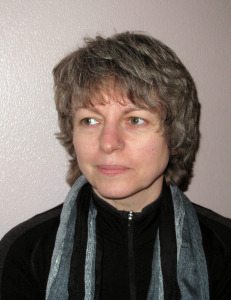
Poetry Shelf interviews Joan Fleming – ‘My only rule is to write from the gut, not from the head’

22594_10153379194378623_813944774194288648_n

Photo Credit: Ben Speare

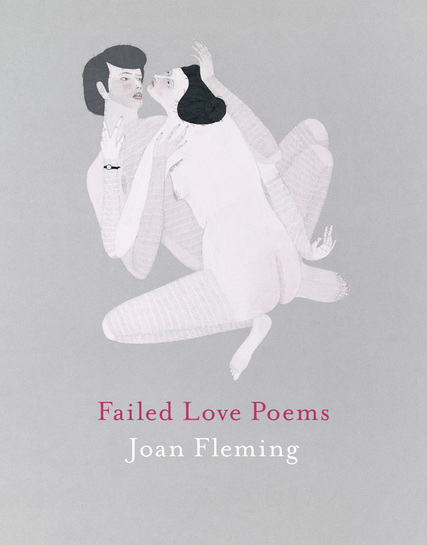
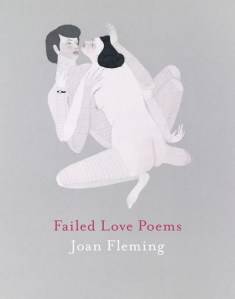
Victoria University Press has just published Joan Fleming’s second poetry collection: Failed Love Poems, a book in which I found so much to admire. Joan graduated with an MA in Creative Writing at IIML, where she was awarded the Biggs Prize in 2007. She is currently working on a Doctorate in ethnopoetics at Monash University in Melbourne. Her debut poetry collection, The Same as Yes was published by Victoria University Press in 2011. Along with Anna Jaquiery, Joan recently edited Verge 2015, a literary journal from Monash University. It is a terrific issue – I reviewed and highly recommended it here.
 

7485719  7485719

To celebrate the arrival of her new collection, Joan agreed to be interviewed.


Did your childhood shape you as a poet? What did you like to read? Did you write as a child? What else did you like to do?

I read constantly as a kid and kept journals. Shel Silverstein, fantasy YA novels with animal characters, kid romances, and a collection of ‘morality’ storybooks with titles like Courage: the Helen Keller story are what I remember reading and re-reading. I had an imaginary friend named Becky, and I think I was a bit fey, always off with the pixies or tucked into a corner, praying under my umbrella. But I was a performer, too. I would do anything goofy, just to be looked at. I was an easy child, but a strange one. I wonder if you can see that in my poems now.


When you started writing poems, were there any poets in particular that you were drawn to (poems/poets as surrogate mentors)?

The poems that carved early grooves in my mind were often lived or shared, somehow. I would memorise poems and recite them to my own head as I walked through Wellington. Paul Muldoon’s “Wind and Tree” is now inextricably Kelburn; Hopkins’ “The Windhover” is Lambton Quay. I discovered Anne Carson and wanted to inscribe everything she’d written on the inside of my body. I carried her “Town” poems with me, like “Town of Uneven Love”: “If he had loved me he would have seen me. / At an upstairs window brow beating against the glass.” See how you can walk yourself deeper and deeper into that poem?! I have an intense memory of drunkenly reading sections of Howl aloud to a living room of people, not all of them friends, and then going out into the alleyway behind the house to cry. Music had a similar effect. The poetry of Radiohead and Bonnie Prince Billy can still bring me to my knees. For me, it was about rhythm, emotion, suggestion. And poetry having palpable effect, an effect you couldn’t escape, even if you wanted to.


I love the way your poems refresh the page. There is an elasticity of grammar, a tilt of perspective, dazzling connections and disconnections, an originality that furnishes a distinctive voice. What are some key things for you when you write a poem?

My only rule is to write from the gut, not from the head. I know when I’m writing from the head. What happens is this flat, crass, nasal voice squats in my frontal lobe and won’t shut up, saying, “this is what a poem should do.” When I’m writing from the gut, there are no directives. Only sensation, surprise, connection, music, and feeling. It takes a lot of time and a lot of reading to get the gut working, but it’s the only way.


I adore the inventive syntax at work in your poems; a syntax that replays ambiguity and honeyed fluency all in one breath. Are there any other poets that have fed your syntactical inventiveness?

Anne Carson and Gertrude Stein are heroes of odd syntax for me. Jerome Rothenberg’s pseudo-translations of ritual poetries have also been influencing my practices of fragment and invention.


Deletion and erasure is a potent device (so apt for revelations and concealments when it comes to matters of the heart). Whereas Mary Ruefle whites out part of a poem in order to create something new, you have used bold black as an erasure tool. It steps away from a thing of aesthetic beauty as we witness on Mary’s page to something far harder hitting. Like a gut kick. Can you talk a little bit about notions of erasure in this collection?

Do they hit hard? That’s good. A couple of the blacked-out poems are angry ones. Erasure turned out to be a way of protecting certain subjects and lending torque to poems that gave too much away. The act of erasure also feels thematic – we perform conscious or unconscious erasures on our memories of love. We select moments and lenses; we tell ourselves a story, that casts the beloved in golden or bitter light. Blackout was a way of enacting that selectivity of the mind – the mind’s failure to tell itself the whole truth about love.


‘Things’ are palpable. They send you on a goose-bump trail such as with paper or sugar or biscuits. At the start of ‘First loss’: ‘When we met, all the songs were about loss,/ all the television shows contained it,/ it was in everything, like sugar.’ And then a little later: ‘your eyes gone hurt and biscuity with broken/ light and hunger.’ What do you want things to do in your poems?

Sometimes I want things to be persons. To have personhood, agency, worldview. Or be receptacles for emotional energies that can’t possibly be named.


At the heart of the book – love. Like a word repeated to the point it is drained of meaning and vitality, love can be elusive. Reading the poems love felt like a human glue. To know love is to have lost love, could that be true? To lose love, is to know love. To have lost love is to invent love, could that be so? What discoveries did you make as you wrote? Or is this only to be discovered as you live?

There is one monstrously important relationship whose aftermath I put to rest in these poems. There are still poems in the book I can’t re-read without getting choked up. I know confessional poetry is unfashionable, but candid, passionate, stirring writing is what I am always looking for. Those are the poems I value. That particular relationship was a ‘failure’ according to the standard narrative. We were together for years, but we didn’t marry, we didn’t have children, it didn’t end when one of us died. But it’s impossible to call it a failed relationship. It was a success. It didn’t last, but in the end (the last sequence in the book is named as much, “The End,”), it made us both larger and more capable of giving and receiving love.


I loved the proseness of the poetry/ the poetry of the prose. Would you write a novella or a novel?

I tried to write a novel a couple of years ago, but it was a dreadful, a plot-less, cringingly autobiographical mess. I’ve entertained the idea of writing a pulp novel about non-monogamy, Confessions of a Call Girl–style (surely it would be a bestseller!?), or a historical novel about my grandparents’ time as missionaries in Central Australia. Though I worry about becoming one of those writers who dilutes her craft by spreading it too thinly. Fiction is an art form I have huge admiration for, but I’m a total novice at it until further notice!


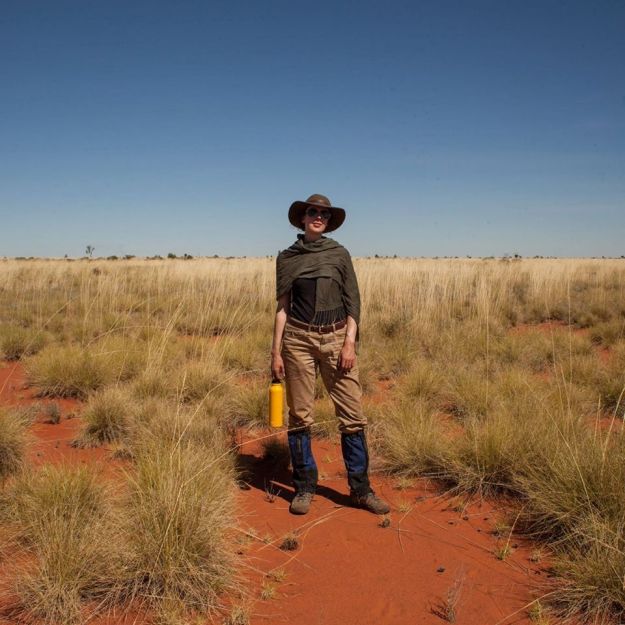
You recently spent time in the Outback. How did that vastness and colour infiltrate your writing?

Yes! Absolutely it has. That time helped strengthen my intuition. Weeks on end in the desert will do strange things to your body-perceptions. The land starts to talk to you, and you can’t help but listen, because it is working on your moods and your dreams.

I’m writing about that time in the Outback now. About my relationships with Yapa (Aboriginal) friends and worldview. I suppose the full effect of that desert-infiltration will show itself in time.


What New Zealand poets are you drawn to now?

Some of the New Zealand poets I’m most excited about haven’t even published full collections yet: Hera Lindsay Bird, Loveday Why, Nina Powles, Lee Posna, Bill Nelson, Emma Barnes, and Sugar Magnolia Wilson. I also want to read everything written by Ashleigh Young, Sarah Jane Barnett, Rachel O’Neill, and Zarah Butcher-McGunnigle. It’s the next generation I’m most drawn to, though poets Jenny Bornholdt and Dinah Hawken still loom large.


Joan Fleming’s webpage

Victoria University Press page

NZ Book Council media release: Decision to place an interim ban on Into the River alarming for Kiwi readers

MEDIA RELEASE from NZ Book Council

9 September 2015

Decision to place an interim ban on Into the River alarming for Kiwi readers

The New Zealand Book Council is dedicated to encouraging a vibrant reading culture in New Zealand. We are therefore alarmed by the Film and Literature Board of Review’s decision to issue an interim restriction order for access to Into the River by Ted Dawe.

The ban means that a highly regarded, award-winning young adult novel cannot be sold or distributed by anyone, and will not be available to readers until October when the Board will consider placing a permanent age restriction rating for the book.

The New Zealand Book Council does not support the move to introduce a permanent age restriction for Into the River. This would mean that the novel could not be openly displayed on shelves in bookstores and libraries, and will drastically limit readers’ awareness of the novel and their ability to discover it.

The decision to impose an age restriction on a novel will set a dangerous precedent, which could lead to more books being restricted in New Zealand.

Peter Biggs, Chair of the Board of the New Zealand Book Council said that “The New Zealand Book Council is committed to opening up choices for readers and believes that access to books and reading is fundamental. Into the River is a challenging and ambitious novel that explores the reality of what many young people are struggling with in New Zealand today.

Furthermore, placing a permanent age restriction on Into the River will restrict the ability of family and whanau to make a decision on what is appropriate reading for their children; it will limit access for mature, advanced young readers.

Research demonstrates that reading fiction provides opportunities for people to understand real-life struggles that they may not otherwise be exposed to. For those experiencing any of the difficulties that are portrayed in this novel, a ban prevents an opportunity for others to understand, acknowledge or relate to their situation”.

For media enquiries, please contact New Zealand Book Chief Executive:

Catriona Ferguson director@bookcouncil.org.nz
Phone: +64 4 801 5546
Mobile: +64 210 248 2637
http://www.bookcouncil.org.nz

Small Holes in the Silence: where you can pre-order Norman Meehan & Hannah Griffin’s third musical poetry instalment

Small_Holes_in_t_55beb4afb57d4_222x198

I love Making Baby Float.

I love hearing Hannah sing Bill.

A new CD on the October horizon.

Heaven.


I got to hear Bill Manhire’s glorious ‘Ballad of the Hurting Girl’ he sent to my Birthday Shelf.

You can order and listen here at Rattle Records, a division of Victoria University Press


Norman Meehan (piano)
Hannah Griffin (voice)
Hayden Chisholm (saxophone)

‘Following the popular and critically acclaimed Buddhist Rain and Making Baby Float, Norman Meehan and Hannah Griffin teamed up with saxophonist Hayden Chisholm for this third instalment in their New Zealand poetry series. The relaxed serendipitous style of Norman and Hannah fits Hayden like a glove. A musician of remarkably understated confidence and sensitivity, Hayden’s wonderfully nuanced phrases float effortlessly around the restrained sensitivity of Norman and Hannah.’ Rattle Records website


yes! reading out of a love of reading … and a desire to read on – Eleanor Catton’s talk at Melbourne Writers’ Festival at Horoeka/Lancewood

On Purpose: A Talk Delivered at the Melbourne Writers’ Festival 2015

  • by Eleanor Catton


    Reading is a creative act: it cannot happen automatically, and it cannot happen passively. Whether you are reading an academic argument or a poem, whether you are reading a dream or an appetite or tracks in the snow, you are using your imagination in the sense that you are seeing something more than what is there. You see not just the words, but what they mean; not just the people, but who they are; not just the shapes, but what the shapes suggest, and how, and why.

    It is impossible to read something when you are bored—in fact, this is a contradiction in terms, for boredom implies an imaginative lack, and reading is both the exercise of the imagination, and the enlargement of it. You can watch television when you are distracted or drunk or half-asleep—the picture will go on without you—but if you are any of these things with a book in your hand then you cannot really be said to be reading. On screen, sight and sound, which are external to the body, are separated from the bodily senses of smell, taste, and touch; on the page, all the senses must be invoked equally. So too with the immaterial dimensions: our imaginations, after all, are not only sensory, but emotional, intellectual, spiritual, and even moral.

    rest of talk here

the Women’s Bookshop is inviting you to select the Top 50 Women Writers of the past 50 years

….. I have made my 5 votes (with) difficulty! Decided to go kiwi all the way.

50/50

It’s 2015 and the Women’s Bookshop is inviting you to select the Top 50 Women Writers of the past 50 years

 
Margaret Atwood & Barbara Kingsolver were ‘neck ’n neck’ for the top two places on the list, with Janet Frame & Patricia Grace not far behind, in both of our nationwide surveys in 2005 and 2010. Five years later, with support from Harper Collins Publishers, we are organising our survey again, entirely online this time (much easier!)

Win the TOP 50 books!

Choose your top five women authors & then select your favourite book by that author. By voting, you will automatically go in the draw to win one of the five piles of the new Top 50 books.

The 50/50 LIST, and the prize winners, will be revealed at a celebration Champagne Party in the bookshop at 5pm on NZ BOOKSHOP DAY, Saturday 31 October – everyone welcome!

The survey opens on 1 September and closes on 9 October, giving individuals and book groups plenty of time to ponder and debate.

VOTE HERE

National Schools Poetry Award for 2015 – the results


I was delighted to see this award reinstated, and that some students would have a chance to do a workshop at IIML. Bravo! I was also delighted to see The NZ Herald do a decent feature on the result, with the winning poem posted in full. Bravo!

Congratulations to all those who were short listed and especially to Grace Lee.


Grace Lee, a Year 13 student at Auckland International College, has won the National Schools Poetry Award for 2015. Grace won the award for her poem ‘Eileithyia’, which she says was inspired by the timeless ritual of birth.

Cliff Fell—competition judge, poet and Victoria Teaching Fellow—says ‘Eileithyia’ is about the most universal of all things, being born. The title refers to the Greek goddess of childbirth and the poem renews the ancient rituals and rites relating to childbirth by seeing them through young, contemporary eyes. What drew Cliff to the poem was the gusto and exuberant music of its lines and imagery. “This is a poem that is unashamedly in love with the idea of life, and which conveys an emotion that is inevitably compelling.”

Grace was one of ten finalists in the poetry competition for Year 12 and 13 secondary school students. Entries came from senior secondary students all over New Zealand. Grace will receive $500 cash, as well as a $500 book grant for her school library. Her poem will be displayed on posters throughout New Zealand. In addition, Grace and the nine other finalists will attend a poetry masterclass at the International Institute of Modern Letters, Victoria University’s creative writing hub, which takes place this weekend.

You can read the winning poem and those of the runners up here.

Judges announced for Ockham NZ Book Awards – I like the new judging format very much indeed

Having been a Book Award judge, and having read around 160 books, I love this new idea (three judges per category). Bravo! To just read the poetry books, or the books in your field sounds pretty fine to me. Far more manageable. I agree that it means you can read deeper and slower. All in all, the way the awards are being reshaped is spot on.

Here is the press release:

2016 Ockham New Zealand Book Awards judges announced

The 2016 Ockham New Zealand Book Awards will be judged by 12 eminent academics, writers, journalist, commentators, former publishers and booksellers from around New Zealand; a three-fold increase on the number of judges in previous years which reflects the Awards’ new judging structure.

Each of the Awards’ four categories – Fiction, Poetry, General Non-Fiction and Illustrated Non-Fiction – and the awards for Best First Book  in those categories, will be judged by a panel of three judges, all specialists in their fields. A Maori language adviser will judge the Maori Language Award.

The judges will announce their longlist finalists on November 25, 2015, and their shortlist on March 8, 2016.
New Zealand Book Awards Trust chairwoman, Nicola Legat, says the judges selected for the Ockham New Zealand Book Awards are second-to-none.

“Authors and publishers can expect to receive the rigour and respect from this year’s line-up that their books deserve. Rather than four judges reading 150 or more books, as has been the case previously, these specialists will read only the books in their category, allowing for a more detailed examination of the works,” she says.

The Fiction category, whose $50,000 prize is now known as The Acorn Foundation Literary Award, will be judged by distinguished writer Owen Marshall CNZM; Wellington bookseller and reviewer Tilly Lloyd, and former Director of the Auckland Writers Festival and Creative New Zealand senior literature adviser Jill Rawnsley.

The Poetry Prize will be judged by former Auckland University Press publisher Elizabeth Caffin MNZM; James K Baxter expert Dr Paul Millar, of the University of Canterbury, and poet and University of Auckland academic Dr Selina Tusitala Marsh.

The General Non-Fiction Prize will be judged by Metro Editor-At-Large Simon Wilson; Professor Lydia Wevers, literary historian, critic and director of the Stout Research Centre at Victoria University of Wellington, and Dr Jarrod Gilbert, a former Book Awards winner for Patched: A History of Gangs in New Zealand, of the University of Canterbury.

The Illustrated Non-Fiction Prize will be judged by former publisher Jane Connor, publisher of the magisterial The Trees of New Zealand, which won the Book of the Year award in 2012; Associate Professor Linda Tyler, Director of the Centre for Art Studies at The University of Auckland, and Leonie Hayden, the editor of Mana magazine.

“It’s always an honour to be invited to judge these prestigious and important awards but also a major commitment of time.” says Ms Legat. “So we are enormously grateful that these very busy and skilled people are happy to demonstrate their support for the awards by diving in to months of reading and debate. We very much look forward to their final longlist, shortlist and winner selections.”

The winners will be announced on May 10, 2016, at an event at the Auckland Writers Festival.

Entries to the 2016 Ockham New Zealand Book Awards can be made via http://booksellers.co.nz/awards/new-zealand-book-awards/submissions . Books published between June 1, 2014 and December 21, 2015 are eligible for entry.

The New Zealand Book Awards is enormously grateful to the generosity of its partners: Ockham Residential, The Acorn Foundation and enduring funder Creative New Zealand.

ENDS

For interview opportunities and further information please contact: Penny Hartill, director, hPR 09 445 7525, 021 721 424, penny@hartillpr.co.nz

Attached: one of the 12, 2016 Ockham New Zealand Book Awards judges – Owen Marshall CNZM. Mr Marshall is one of the three fiction category judges.

Editor’s Notes:
The Ockham New Zealand Book Awards are the country’s premier literary honours for works written by New Zealanders. After a one year hiatus, the awards will return in 2016 thanks to sponsorship from Auckland property development company, Ockham Residential. The partnership, along with news of the awards’ new structure was announced last month. In July this year, the awards received a $50,000 windfall, earmarked for the top fiction work, from Tauranga community organisation, The Acorn Foundation, on behalf of one of its donors.

First established in 1968 as the Wattie Book Awards (later the Goodman Fielder Wattie Book Awards), they have also been known as the Montana New Zealand Book Awards and the New Zealand Post Book Awards. The honours, now given for Fiction, Illustrated Non-fiction, General Non-Fiction and Poetry, as well as for Best First Book and Māori language, are governed by the New Zealand Book Awards Trust (a registered charity).  Members of the Trust are Nicola Legat, Karen Ferns, Paula Morris, Kyle Mewburn, Stella Chrysostomou, David Bowles and Julia Marshall. Creative New Zealand is a significant annual funder of the awards.

The Trust also administers the New Zealand Book Awards for Children and Young Adults and National Poetry Day.

Penny Hartill
Director
P: 09 445 7525
M: 021 721 424
T: @pennyhartill
W: http://www.hartillpr.co.nz

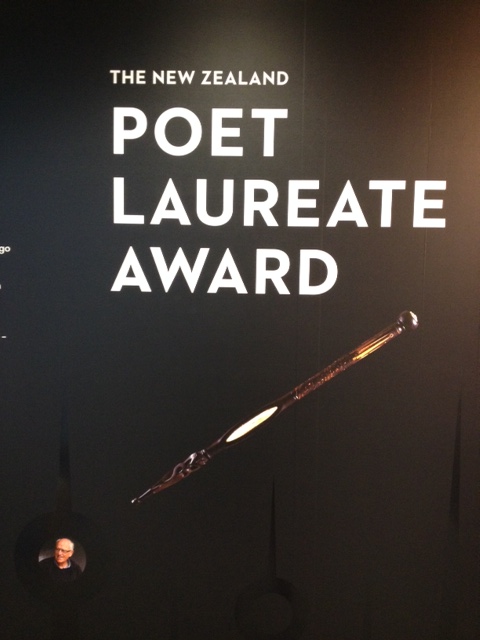
NZ Poet Laureate Award event last night – The baton is passed, as Ian Wedde, says


photophoto


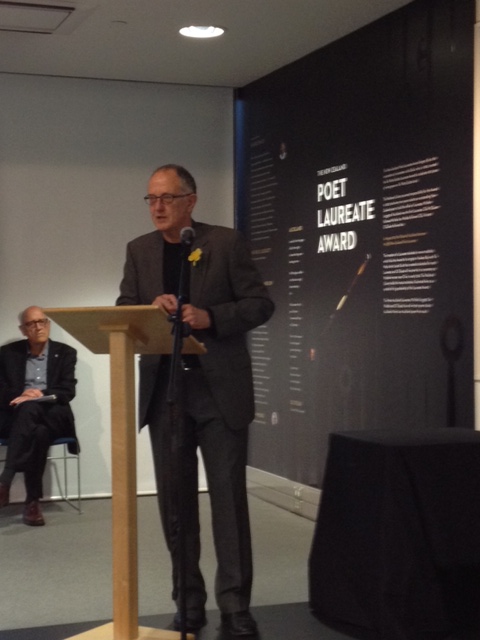
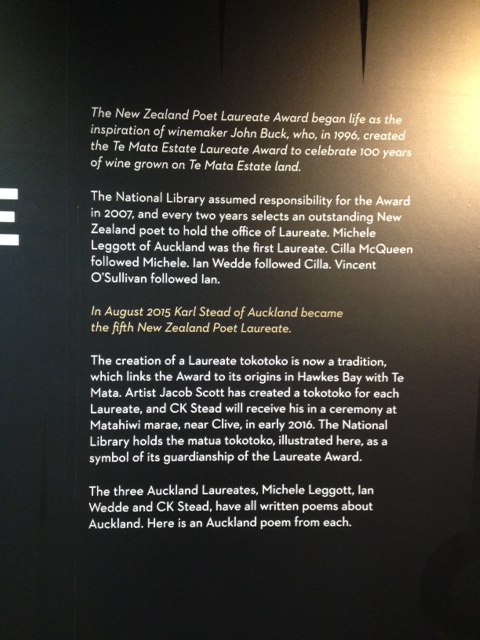
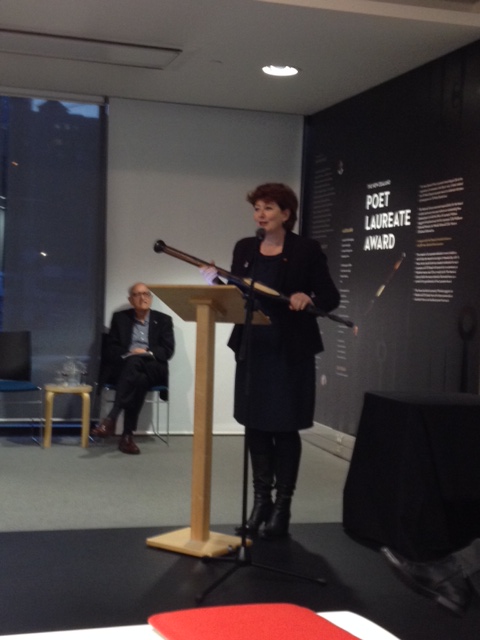
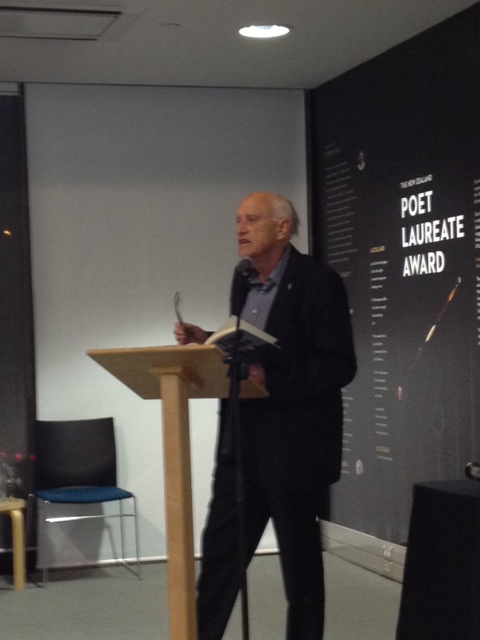
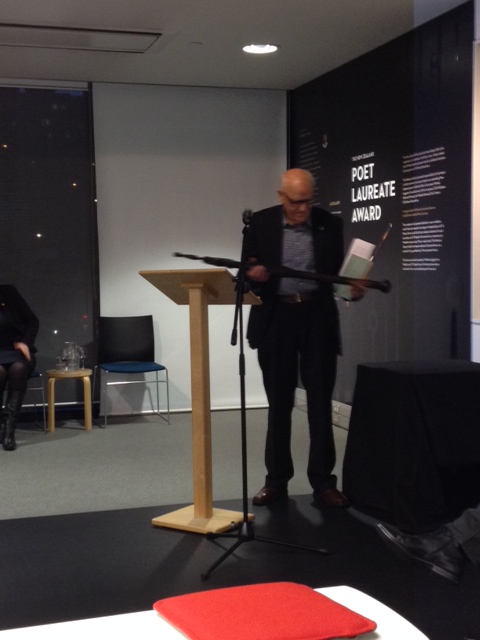
Last night CK Stead was awarded the 2015 NZ Poet Laureateship at the National Library in Parnell with the support of friends and family.

Chris Szekel, Head Librarian at The Alexander Turnball Library, and responsible for the award, steered the speeches.

Ian Wedde, as a former Laureate said a few words, The RT Hon Maggie Barry, as Minister of the Arts, said a few words and then it was over to Karl.

Karl underlined how poetry had been a significant part of his life from an early age: ‘Poetry found me in Mt Albert Grammar School library’ and ‘Poetry has always been somewhere near the centre of my consciousness.’ He added: ‘Poetry is still close to the centre of my life, otherwise I would not have accepted this award.’

He acknowledged presences (atua) in the room with him (Allen Curnow, Kendrick Smithyman, Bill Pearson, Maurice Shadbolt, Maurice Duggan, Keith Sinclair). His fellow writers. I found this  very moving.

He acknowledged writers in the room and his family.

Karl read two poems, ‘Look Who’s Talking’ and ‘Crossing Cook Strait,’ suggesting the writers behind these poems, James K Baxter and Curnow, would have been Laureates if the award had existed then.

It was very clear that this writer, writes out of mesh of poetic relationships. Vitally so.

I drove back west from a lovely occasion – full of the warmth generated by a shared love of poetry and admiration of one of our most esteemed poets. It touched me.

photo 2 photo 1 photo 1 photo 3 photo 2