
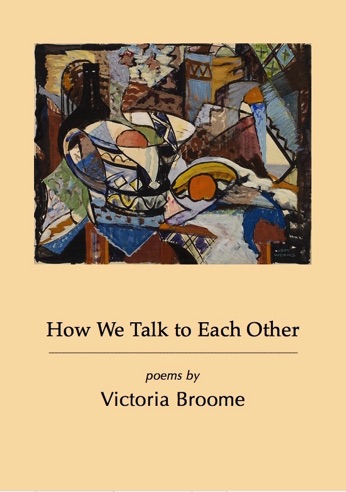
Victoria Broome, ‘The Heart of My Father’ from How We Talk to Each Other, Cold Hub Press, 2019
Victoria Broome has published poems in literary journals and anthologies, was awarded the CNZ Louis Johnson Bursary (2005) and has twice been placed in the Kathleen Grattan Award (2010, 2015). How We Talk to Each Other is her debut collection.
Cold Hub Press author page
Poetry Shelf review of How We Talk to Each Other
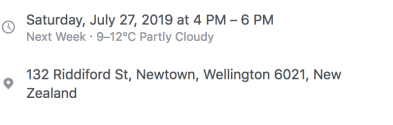
Starling Issue 8 will go live on Tuesday 23 July, and to celebrate we’ll be holding a launch party on Saturday the 27th at Newtown’s finest bookstore, Book Hound!
There will be readings from ten of the writers featured in the Issue 8:
Rose Lu
Sinead Overbye
Rose Peoples
Danica Soich
Mel Ansell
Vita O’Brien
Cadence Chung
Isabelle McNeur
Claudia Jardine
Rebecca Hawkes
Come along and enjoy some of the best new writing around, and help us celebrate the new issue!

Verb Podcast!
Kaveh Akbar & Kim Hill live at Meow (from the 2018 festival)
It was a real honour to host Iranian-US poet Kaveh Akbar at LitCrawl last year. Kaveh was a generous guest and incredibly moving poet. This conversation with RNZ’s Kim Hill was a festival highlight. Listen on our Podcast Page here. Enjoy! (And whet your appetite for more conversation and poetry in performance coming in 2019…).
From mid-July to October each year, the International Institute of Modern Letters (IIML), home of Victoria University of Wellington’s renowned creative writing programme, runs a series of events highlighting writers active in and around Wellington, as well as guests from overseas.
Sessions take place on Mondays at lunchtime, with additional evening events from time to time.
Writers on Mondays is a stimulating way to start the working week – and it’s free!
The 2019 Writers on Mondays events are listed in full below. You can also download the programme (2,050KB PDF). Previous years’ programmes are available to download at the bottom of this page.
Writers on Mondays is presented with the Museum of New Zealand Te Papa Tongarewa, Phantom Billstickers, National Poetry Day and Circa Theatre.
Events run Monday 12.15 – 1.15pm on The Marae, Level 4, Te Papa with the exception of the two Short Sharp Script sessions at Circa Theatre.
Admission is free, all welcome.
No food may be taken onto Te Papa Marae.
The 2019 Creative New Zealand/Victoria University Writer in Residence Lynda Chanwai-Earle is a ground-breaking poet and playwright, whose work HEAT was the first-ever play to be powered by solar and wind power. This year, she is working on the second and third plays in her ‘Antarctic Trilogy’, and co-writing a television drama drawing on the real-life murder of a Chinese student in Auckland that was also the basis for her play Man in a Suitcase. Lynda is a well-known public broadcaster with RNZ, and has toured in a Māori theatre company visiting schools and prisons. She explores her interlocking creative lives with producer/playwright Miria George.
New York poet Amy Leigh Wicks finds a new home in Kaikōura in The Dangerous Country of Love and Marriage, and New Zealander Nikki-Lee Birdsey plumbs the fault lines between her lives in America and Aotearoa in Night As Day, while Chicago poet Steven Toussaint composed the deeply musical poems of Lay Studies in the United States, the United Kingdom, and New Zealand. Sugar Magnolia Wilson hails from Fern Flat, but the poems of A Woman’s Heart is like a Needle at the Bottom of the Ocean travel to Korea and into intimate and distant histories. essa may ranapiri (Ngāti Raukawa) is a non-binary/takatāpui poet whose Ransack rummages through language and history in a search of a place to call their own. All five poets layer place and history, love and loss in their books, yet all five voices are utterly distinctive. Introduced by Chris Price, they read poems from here, there, and everywhere.
Dinah Hawken’s urgent yet contemplative poems have been celebrated in Aotearoa since her award-winning début, It Has No Sound and is Blue (1987). In There Is No Harbour, Hawken sets the depth of injustice Māori have endured in Taranaki against her own family history in search of greater clarity in the present. In her new book, PEAT, Lynn Jenner enlists poet and Landfall editor Charles Brasch to help her think through aspects of the land and the national character unearthed by the construction of the Kāpiti Expressway. Two Kāpiti writers, who share a conviction that the past is not a foreign country but everywhere at hand if only we know how to look, join chair Bill Manhire in what promises to be a fascinating discussion.
Cultural historian and writer Maria Tumarkin moved from the Ukraine to Australia at age 15. Her latest bookapplies a freewheeling intelligence to five common axioms such as ‘time heals all wounds’, interrogating their accuracy and adequacy in the face of trauma. “Maria Tumarkin’s shape-shifting Axiomatic deploys all the resources of narrative, reportage and essay,” writes Pankaj Mishra in the Guardian. “It is a work of great power and beauty.” Tumarkin is the author of three other acclaimed books of ideas: Traumascapes, Courage, and Otherland. She also collaborates with visual artists, psychologists and public historians, and teaches writing at the University of Melbourne. She appears in conversation with Chris Price.
Best New Zealand Poems is published annually by Victoria University of Wellington’s International Institute of Modern Letters. Get ready for Phantom Billstickers National Poetry Day (on 23 August) by coming along to hear nine of the best read work selected for Best New Zealand Poems 2018—and be sure to visit http://www.bestnewzealandpoems.org.nz to view the full selection. Join 2018 editor Fiona Farrell as she introduces Nikki-Lee Birdsey, Jenny Bornholdt, Doc Drumheller, Sam Duckor-Jones, Bernadette Hall, Anna Jackson, Therese Lloyd, Mary McCallum, and Chris Tse.
In Are Friends Electric?, 2019 Ockham NZ Book Award for Poetry winner Helen Heath explores the merger of human beings with technology, and asks questions about the potential of a digital afterlife to assuage human desires and griefs. She talks with Royal Society Science Book Prize and the Prime Minister’s Science Communication Prize winner Rebecca Priestley about her memoir of science on the icy continent, Fifteen Million Years in Antarctica. This deeply personal tour of the place Priestley had longed to visit since childhood also explores her anxieties, both for herself, and for the threatened place she loves.
A wonderful opportunity to hear a fresh mix of prose and poetry by the current cohort of writers in the Master of Arts in Creative Writing Programme at Victoria University of Wellington’s International Institute of Modern Letters. Caleb Harris, Ash Davida Jane, Elaine Webster, Cris Cucerzan, Rebecca Reilly, Geraldine Warren, Stacey Teague, Una Cruickshank, Mikee Sto-Domingo, and Fiona Lincoln are introduced (in that order) by Kate Duignan.
Part 2 of the popular Next Page sessions features readings from (in order) Danyl McLauchlan, Preya Gothanayagi, Melanie Ansell, Jane Cherry, Catarina de Peters Leitão,Tanya Ashcroft, Manon Revuelta, Dave Glynn, Louisa Buchanan, and Janey Thornton. They are introduced by Chris Price.
Actors perform dynamic new work by MA scriptwriting students from the IIML. This week scripts by Sally Bollinger, Mitchell Botting, Emily Callam, Emilie Hope, and Jonathan King are introduced by Ken Duncum.
More exciting work in progress from the second group of IIML scriptwriters, at Circa Theatre. This week the spotlight falls on work from David Mamea, Helmut Marko, Monica Pausina, Sophie Scott, and Rachael Stokes. Introduced by Ken Duncum.
Elizabeth Knox’s new novel The Absolute Book is set in London, Norfolk, the Wye Valley, and Auckland, as well as in the hospitals and train stations of Purgatory. Old acts of revenge return with force, as three people are driven towards a reckoning felt in more than one world. Craig Cliff’s second novel Nailing Down the Saint explores the life of St Joseph of Copertino, as recreated by the movie industry. Can rational materialism explain everything? Join Kate Duignan to discuss parallel worlds, moral reckonings and religious borrowings in these novels.
Lawrence Patchett’s first novel The Burning River is a work of fictional futurology set in a version of New Zealand where a plastic miner who survives by alliances and trade is swept into a perilous inland journey with new companions. In Carl Shuker’s novel A Mistake, a gifted female surgeon at Wellington Hospital must make her way in a male-dominated world. Fergus Barrowman explores the allegiances and codes these characters must navigate to survive, and the different types of world-building that have gone into each of these novels.


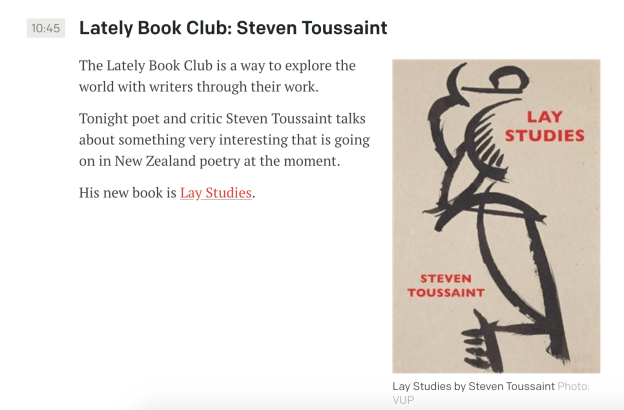
This is a terrific conversation – listen here.
Lay Studies VUP
at the Spinoff: ‘TMI: An essay on contemporary poetry in Aotearoa/New Zealand’
‘This much is obvious: something electrifying is taking place in New Zealand poetry. I became a permanent resident of this country four years ago, and at that time I privately considered verse here to have grown a little stale. While stand-out collections frequently knocked me over – among them Amy Brown’s The Odour of Sanctity (2013), Chris Holdaway’s Six Melodies (2014), and John Dennison’s Otherwise (2015) – my general impression was that a nostalgic suburban quietism had captured the style, tone, and subject matter of New Zealand poetry, calling to mind James K. Baxter’s warning to denizens of this ‘Happy Island’ that ‘one of the functions of artists in a community is to provide a healthy and permanent element of rebellion; not to become a species of civil servant’. Since then, however, a talented cohort of writers in their 20s and 30s, many of them women, LGBTQ, and people of colour, have exploded onto the scene in a searching and incendiary spirit, and have transformed the literary landscape irrevocably.’
Steven Toussaint, from the Spinoff essay
Lay Studies will be launched at Time Out Bookstore on Friday July 19th 6-8 pm
You can’t, always
I’m not going to cry. All winter the television
sulks in the corner of our love. You put the lentils
in a colander to flush the ugly bits. You peel oranges
to their pith and talk about your past like it was mine too.
You say it was sunnier in Queens than it could ever be in
an unhappy kitchen with a lover made of feathers.
I want to tell you about the way a man can look down
a corridor, the way a hunter visits his scope. There are things
too big to ever fold into your hands. A barbule is enough
to demonstrate how even soft things fall down,
like small people from towers that trade in shadows.
When I say I need you, it clambers up a stairwell in my throat
like you were the only window left in 110 levels of pain.
I’m not going to say I get it. You toss the lentils
in a brine pot and power-up the television.
You say we spend too much of life watching
the kind of comedies that make you sad. Like Home Improvement
and The Cosby Show that make you think of time
and the way we were happy in Queens
before small people sat on window ledges, before
the hunter’s scope settled on an ordinary bird.
I’m not going to cry. All morning chopping onions,
watching Bill Cosby hug his wife in Brooklyn Heights
before he was a rapist, and before you first registered
towers on the skyline by their absence.
When I say I need you I am a soft thing falling
on something familiar, and it is violence
in the way dispassionate surgery is violence
or the way The Cosby Show is what you get
before you get what you never wanted.
I’ll take what I can.
Elizabeth Morton
Auckland writer, Elizabeth Morton, is published in New Zealand, Australia, Ireland, the UK, Canada and the USA. She was feature poet in the Poetry New Zealand Yearbook 2017, and is included in Best Small Fictions 2016. Her first poetry collection, Wolf, was published with Mākaro Press in 2017. She is completing a MLitt at the University of Glasgow, usually in her pyjamas.
National Poetry Day just seems to get better and better. What a genius idea UBS Canterbury!


‘Carousel’ was published in Sport 46
Morgan Bach is a poet from Wellington, and has been living in London for the last few years. Her first book of poems, Some of Us Eat the Seeds, was published by VUP in 2015. She is cobbling new poems together, and existing in a state comprised of London-notmakingthemostFOMO-guilt, wanderlust and homesickness, all blended up and battling.
 NZ Poetry Shelf