Category Archives: Poetry

Catherine Vidler’s Chaingrass poems – skeletal like a leaf-haul in autumn


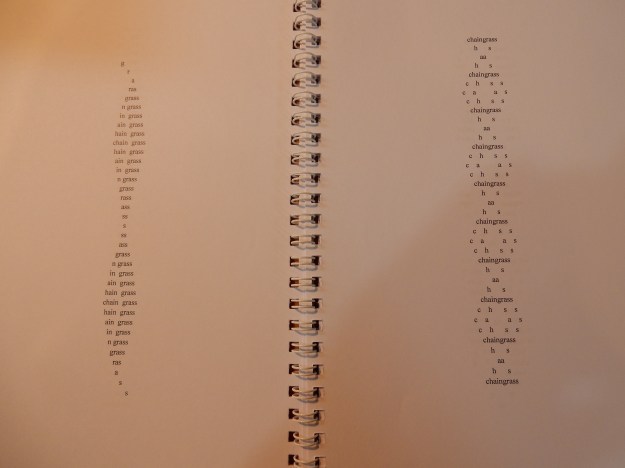
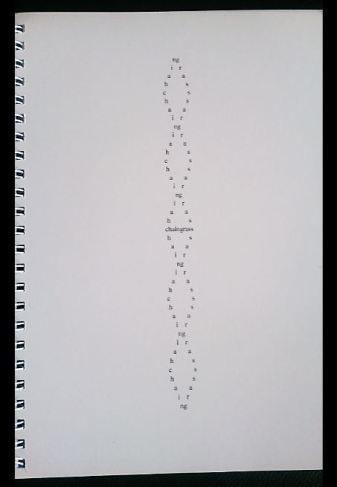
Catherine Vidler has used Bill Manhire’s poem ‘Falseweed’ as the starting point for a series of poems. I am hesitant to name this endeavour concrete poetry. I am not sure why. Perhaps because although the poems plant a visual imprint on the page, a tangible icon to lock eyes upon, the effect is more like a kinetic web, an ethereal tissue that evokes memory, anecdote, fleeting sensations. I have seen these poems referred to as visual poetry.
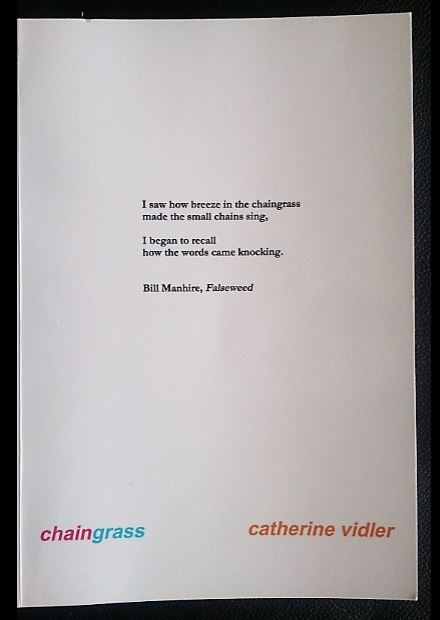


chaingrass_stale_objects_cover.JPG

The cover of the paperback (SoD)


Bill’s lines haunt – a kind of causeway to daydreams. Catherine has set up camp on the causeway and in an almost stream-of-conscious way lets Bill’s words float and tumble and take shape. Sometimes I see the visual imprint but I can no longer read the words with my myopia. That doesn’t matter to me. I know the words are there. Sometimes they are lost in smudged grey blocks of once-were-words. I get the nostalgic kick of cross stitch – me at school in the sixties making thread patterns on linen like generations of women before me. I was never very good and found my mind wandering to patterns in the sky.

Then again it is like trying to catch a dandelion kiss and blow it to your grandmother. The tissue poems are like a map of a mind wandering from the poetic line. At times a molecular snapshot, at times the pattern of a choreographer, at times the movement of the wind. Accepting the book on these terms, my terms really, no page is static.

I am reminded of the utter of joy of abstract art. In Paris I sat in front of Gerhard Richter’s mound of yellow pollen for an hour, sitting and looking at the yellow. It began to move and hum – just as yellow on a canvas can move and hum – and lift you beyond colour, can sink and submerge you in colour. It’s not like I entered a Zen-like space – I instead entered a fullness, a richness of experience that braided physical images with deep feeling.


If you are going to read this book the verb ‘to read’ acquires new dimensions.


Catherine’s chaingrass poems also appear in a smaller chapbook. There is a sense (sensation) of leafing through the long grass because it is the long-grass poems that have made it here. Shuffle too and fro, your eye catches glints of wordchains and you are caught  in the long grass. The white space renders the word stamp elegant, skeletal like a leaf-haul in autumn; altogether beautiful and mesmerising. Yet there is change, transformation, a magnetic pull of letters to displace and connect the word fragments. The grass is memory. By this point the visual dance, almost molecular, shifts to a new key, and yes, it becomes music.
 

chaingrass_zimZalla_cover.JPG

The cover of the chapbook (zimZalla)


For the big, Stale Objects dePress book:

chaingrass, SOd press 2016

The book can be purchased online through Lulu here.


For the zimZalla book:

Chaingrass, zimZalla obect 039, 2016, zimzalla.co.uk

The book can be purchased online at zimZalla’s object page


Catherine Vidler‘s collection Furious Triangle was published by Puncher & Wattmann in 2011. She is the editor of trans-Tasman literary magazine Snorkel.

vidler-photo.JPG


from chaingrass the chapbook

DSCN7279.jpg

DSCN7278.jpg

The Guardian: Anne Carson’s fragmentary writing and its rewards

Full piece in The Guardian here

9781101946848.jpg

Refreshing breaks: how fragmented stories can be fulfilling reading

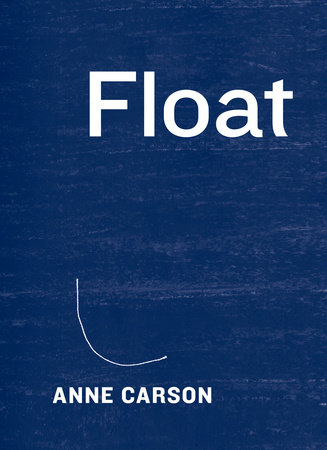
“Reading can be freefall,” runs the blurb on the back of Anne Carson’s new poetry collection, one of several recently published books to offer readers a more interactive way to engage with the printed word. Historically, fragmentation has been used as a troubling effect, or to indicate a subject under stress. These books, however, attempt to unleash the fragment’s liberating force. The effect can be exhilarating.

If the title of Carson’s collection, Float, suggests a lack of direction, so does its format: a transparent slipcase housing 22 chapbooks that we are invited to read in any order. Does that mean the collection doesn’t, then, possess an overall unity? Or is it possible for we readers to supply meaning ourselves?

In 2002, Carson published her translations of Sappho’s poetry, a body of work that, bar a single poem, only exists in fragments because the papyri on which they were written are so damaged. As Carson writes in Float of one work by Sappho: “Half the poem is empty space.” Her translations communicate this fragmentation to the reader, using brackets to convey where the source texts are torn or disintegrated. “Brackets,” she writes in her introduction to the poems, “are exciting. Even though you are approaching Sappho in translation, that is no reason you should miss the drama of trying to read a papyrus torn in half or riddled with holes or smaller than a postage stamp – brackets imply a free space of imaginal adventure”.

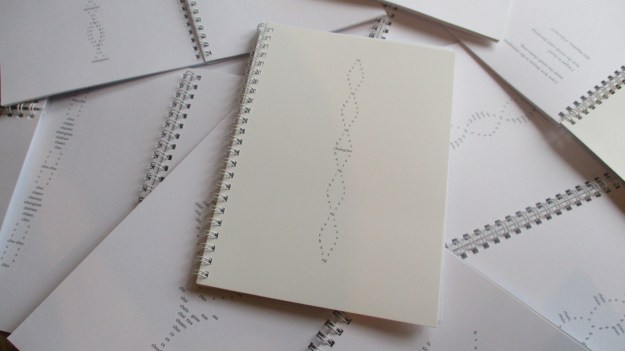
A spiral-bound notebook of visual poems, created in response to the word ‘chaingrass’ from Bill Manhire’s poem ‘Falseweed’

chaingrassimage.jpg


A spiral-bound notebook of visual poems, created in response to the word‘chaingrass’ from Bill Manhire’s poem ‘Falseweed’, has just been released in the UK by zimZalla.

zimZalla is a publishing project which makes literary objects. It is administrated by poet and publisher Tom Jenks and operates out of Manchester.

The poems were made by Catherine Vidler and the book designed by Tom Jenks.

The notebook is preceded by two other ‘chaingrass’ collections which Catherine has made and which have been published this year. A large collection of poems and patterns was published by Stale Objects dePress in Sydney in September, and a PDF chapbook of the poems together with an interview with Catherine, was recently featured in the journal Jazz Cigarette in the United States.

an interview and poem

stale objects


Poetry Shelf Poem – Heidi North-Bailey’s ‘The Women’ is like a delicious sweet almond with a bitter sweet kernel

Mary McCallum from Mākaro Press and Heidi North-Bailey have given me permission to post this marvelous mother poem from Heidi’s debut poetry collection.  The poem is so beautifully lyrical, exquisitely layered, the gaps large and resonant, the line of women vital; the hidden stories pull you back for another look, and then another. This is one of my favourite poems of the year to date.

The Women - North Bailey.jpg

The Women - North Bailey2.jpg


©Heidi North-Bailey 2015


Possibility of Flight cover WEB


Poetry Shelf review: Rachel Bush’s Thought Horses – The bridge between reader and printed word on the page is luminous with activity


Thought Horses Rachel Bush, Victoria University Press, 2016


Rachel Bush was born in Christchurch and lived a number of years in Nelson. That she lived to see a bound copy of her last poetry collection, Thought Horses, was special because this very special collection stopped me in my poetry tracks. I rarely tweet about the books I read but this book was an exception – I urged everyone on Twitter to run down the road, buy a copy of Thought Horses, take time out from routine and noise and beginning reading.

I adore this book. Everything I love about poetry is at work here. The poems reflect my personal biases on what good poetry can do. The bridge between reader and printed word on the page is luminous with activity.


Thought Horses is written out of exquisite poetic fluency; written on the breath, on a long, sweet exhale so that it flows. There is a slowness here as though the poet is observing, absorbing and  reflecting the world through a single, leisurely pan.

The book, like Sarah Broom’s exquisite last collection, is written out of illness. The poems hold onto life, exude life, become life as they embrace sky, elephants, fan palms, birds, Venice, Anne Carson, departed friends, departing things. In the lines between are the fingertips of death. The subject matter is roving but the collection is harmonious with a unity of sound, craft, story. Perhaps it is to do with grace, writing with grace. Individual phrases catch me: ‘the rind of winter’ ‘lost is my quiet’ ‘Truth floats like scum on sea/ water’ ‘The best spring/ is in your own high/ free step’

This is the joy of poetry.

The first poem, ‘Thought Horses’ should be attached to the wall above every restless bed because it is as though the poet was thinking aloud on the line as she lay awake between four and six. Where does the mind wander? The poem provides ‘some things to think of’ and the list resembles a miniature self portrait, an anxiety map, a guide to the following day. I am expert in navigating night waking. I read this book on a plane to Nelson, after little sleep, with the world askew, and this poem nailed it.


You think of the poem you wrote about leaving a house, and how

houses we have owned will come back to us in dreams.

You think about taking your computer into the next room.

You think maybe you ought to try to sleep.


If I were an anthologist, hunting through the collection, I would build a sizable list of contenders for an updated anthology of New Zealand poems. ‘Sing Them’ is one of them. I am hoping someone asks me to edit a new anthology so I can start with this poem. It is light and lovely with little sharp bits and is a hymn to what words can do, and how poems are sung into being, into us. Each verse is a little shift, a tilt of the head to see things a bit differently, with tactile things animating the elusive, unrealness of words.


Because every day the poems

stay folded and pressed flat in

a suitcase of their pages

till the composer unfolds

them in sound lines and when

you sing them, they float.


Another poem to put in my anthology is ‘These Days’ with five little snapshots of the moods of different days that ache in the acuteness of remembering. There is the need to sleep when it is too light, the boy resisting with his string of NOs, ‘days that could make you depressed and flat as a squashed dog,’ the mother’s lesson to the dawdling son, the classroom singing, and the sweet, sugary days:


Long sugary days, you find these words come out

blurty blurty snap snap snap one after the

other and thoughts go off down little paths you

hadn’t noticed, like maybe lunch with a friend

whose round face under a merino beanie

smiles a vegetative smile, showing small teeth.


Then there is the poem I have already anthologised in A Treasury of Poems for Children because it is so vivid and surprising and is perfect to hook young ears and eyes. From ‘Early’:


The darkness wears a quiet sound

of fires died down and people who stir

in sleep. Soon they will slip on

their daily selves, button them up.


I have to point you in the direction of ‘It Ends with Forever’ which leads us back to mother and daughter and the way single words can stick in the head across a lifetime (‘frisky’ ‘forever’). This is a two-toned poem. An utterly poignant poem where death comes a little closer. In the second verse, the mother responds to the idea she will die one day by comparing herself to a kitten. She will live frisky, not forever. And then the maternal image in the first verse that made me well up:


Ah then sometimes, I wanted,

still want, something safe

and kind and firm and tight

as when our mother rolled

us in thin woollen blankets

on cold nights


OH, there are so many poems that lift you out of your skin. Mark Broach asks what is the point of poetry in the Latest Listener (April 23) and then gets a handful of poets to respond. This book is a point of poetry. Its needle pricks you. It makes you feel and be curious and review how your day will unfold. It shows the way poetry opens portals into what matters. For example, at the end of ‘ “All my feelings would have been of common things” ‘:


I once thought

many things would make my life happier

and now one by one I will let them go.


Rachel’s collection sits on my top shelf with a handful of poetry books that rise above the bulk to become something astonishing. Why? Because the heart is engaged. Because the writing is as contoured and as musical as the world no matter which way you look. Because this book was written so close to death, yet it shows the joy of life in little things, in big things, in ideas, relations, places. We all do this. We all write the world. But Rachel has made the word incandescent and in taking us back into the grit and light of living changes us. If you buy one poetry book this year, make it this one.


Victoria University Press page.

My tribute and an interview with Nelson school girl, Lucy  here.

Four poems along with Louise Wrightson’s tribute.


Three poems from Hoopla 16: Helen Jacobs, Harvey Molloy, Ish Doney


Mākaro Press recently released its third series of Hoopla poetry collections. Under the guiding eye of series editor, Mary McCallum, each year includes a debut, a mid-career and a late-career New Zealand poet. The design is uniform and eye-catching with simple but striking covers and fold-in jackets.

To celebrate this series, Mākaro Press has given Poetry Shelf permission to post a  poem from each collection (tough picking!)


This year sees a collection by young poet Ish Doney. Ish completed a design degree in Wellington, and currently lives in Scotland with an aim to move elsewhere soon. The poems generate a youthful zest, as they navigate love, loss, home, family, departure, distance. Feeling is paramount but, rather than smothering the poems, sets up shop in the pace of a line, sharp and surprising detail, images that prick your skin.


Screen Shot 2016-04-22 at 2.45.18 PM

Mid-career poet, Harvey Molloy has published widely both here and abroad. He was born in Lancashire but moved to New Zealand as a teenager and now lives in Wellington. As the key word on the cover indicates, these poems move through kaleidoscopic worlds.  This is a poet unafraid of directions a poem might take, of stories being told, of shifting forms, of a mind reflecting, contemplating, observing.Screen Shot 2016-04-22 at 2.47.20 PM.png

Helen Jacobs (Elaine Jakobsson) was once the Mayor of Eastbourne, but moved to Christchurch in 1995. She has been publishing poems for 35 years both in New Zealand and abroad. Since her arrival in Christchurch in 1995, Helen has belonged to the Canterbury Poets Collective. At the age of 85, she has now relinquished some of her lifelong passions such as gardening and bush walks but not writing. Her new poems come out of old age with delicious vitality — her ear and eye are active participants in the world. The collection renews your relationships with the things that surround you.


Screen Shot 2016-04-22 at 2.47.33 PM.png


Poetry Shelf, Poet’s Choice: local poets share favourite reads of 2015

For the past two years I have posted an annual list of reading picks by poets and poetry fans to celebrate poetry. The lists turned out to be a sumptuous poetry guide for summer reading – with a few other reading treats thrown in for good measure.

This year I have invited some local poets to share favourite reads over the past year. Rather than assemble the enormous list of previous years, I plan to post them as they arrive.

Happy summer reading!

Poetry Shelf review — Emma Neale’s Tender Machines takes you into a deep private space in her writing; in ways that sing and challenge, that move and muster every poetic muscle and tendon as you read

418MHC3lAEL._SX346_BO1,204,203,200_    418MHC3lAEL._SX346_BO1,204,203,200_


Emma Neale Tender Machines Otago University Press 2015

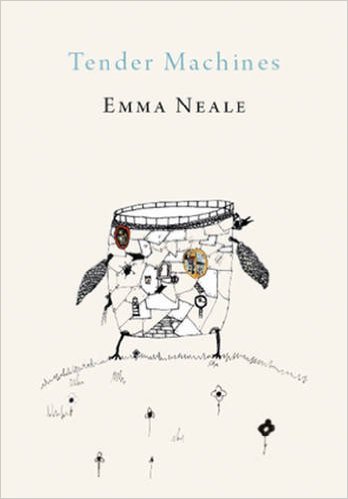
Emma Neale’s new poetry collection features a striking drawing by her son, Abe. Surprising, inventive, poetic even. The poetry is Emma’s best yet, dare I say it. To step off from the title, tenderness meets sharp edges meets exquisite moving parts, small yet perfectly formed. The collection holds you in the intimate embrace of home, yet takes you out into the wider allure of the wider world. Issues, ideas, preoccupations.

The first section, ‘Bad Housekeeping,’ is where poet tends hearth. Mostly, and movingly, Emma navigates her relations with her young son.  She is up against the elbows of insistence, demands, resistance. The mind of the mother is anchoring, roving, admitting. She is in the heart of a toddler tantrum and in the palm of world issues. These poems affect you. You can savour the poetic craft that is honey for the ear. Such musical harmonies and schisms. That is one joy of reading. You can enter the toughness and rewards of motherhood. It is as though maternal experience is the stock pot that is simmered and concentrated to a syrup that is both sweet and tart on the tongue.  The poems become the kind of poems you can hang stories upon; of this child and that child, of this moment of mothering and that. Poetry has the ability to bear story, experience, imaginings, ideas, music — all in its one tender machine (oxymoron and all). These remarkable poems do this. ‘Hard Task, Master’ is a miniature snapshot of the child — its ending breathtaking:


as he tries

to build and build

the deck of himself

against the hard, tall wall

of the world.


At times it is the concatenation of verb or noun on the line that catches you in a knot of maternal thought — son glued to mother, mother glued to son. As in ‘Towards a Theory of Aggression in Early Childhood Development’:


Hit, push, lash, scratch,

these cheeks, this jaw, this shoulder,

are these in truth our edges, outlines, will we cry

as he does, daily, nightly, sky-wrenching as sunrise

yet still hold him in our arms


There is poetic braveness here that doesn’t loiter in conventional maternal paradigms. This is a poet opening layers of skin to get to where it hurts, confuses, demands, yet never loses sight of the enduring bond. The love. This is from ‘Domestic’:


you’re our darling our treasure.


You fling a tea cup at the cat,

plump up her spine like a goose-down pillow,


jab your thumbs at your father’s face

as if to pull out its two blue plums


but ah, little fisty-kins, honeyghoul, thorny-pie,

grapple hook of your daddy’s flooded eye,


stitch by stitch hope’s small black sutures

sew love’s shadow behind you.


The rest of the collection represents a mind engaged with the world at large. There is a strong political vein that never relinquishes the notion that the personal is political and that, importantly, the political is personal. Big issues such as consumerism, the compromised state of the planet, greed, waste are there potency ingredient in the ink of the pen, yet Emma’s ideas find poetic life in a variety of ways. Always there is an attentiveness to sound, to the way the poems hit the ear before the eye/mind drifts elsewhere. Assonance is plentiful. Delicious. The musicality is a first port of admiration that sends you back to reread with ears on alert. One poem, overtly and self-reflexively, plays with musical effects, yet delivers a subterranean plea for the earth (‘”Properly Protecting the Most Pure Marine Ecosystem Left on Earth Was Not Consistent with the Government’s Economic Growth Objective”‘. Here is a sample:


The spring tries to write

its long lyric poem again:

grass blade rhymes wing tip;

leaf rim, gull keen;

salt foam, thought arc;

surf break, line break;

historical break, heart break;

riven river, toxic stream;

smoked ozone, glacial melt.


So many standout poems. I especially loved the way ‘Suburban Story’ moves. It begins with a ‘shopkeeper at my old corner store’ and then travels through a poignant catalogue of losses, minor and major. Again the exquisite ear at work, again the pulsating detail.

This is a collection of reflection, revelation, absorption. Emma wrote many of these poems during her tenure as The NZSA/Beaton Fellow, The Otago Robert Burns Fellow and The University of Otago/ Sir James Wallace Pah Homestead Writer in Residence. Such awards benefit the poet immeasurably with the gift of writing space and time. You can see it in the gold nuggets of this book. In another favourite poem, ‘Sleep-talking,’ the clogged channels of thought become poetry. Emma takes you into a deep private space in her writing; in ways that sing and challenge, that move and muster every poetic muscle and tendon as you read — in this poem and in the book as a whole.


Perhaps for the self to hold its own air

it must be played in the key of sleep:

the body an instrument that over time

we must keep pitched, soaked in night like a reed softened in water,

while dreams tune the mind’s strings with a touch that seems

as precise as if the musician’s ear cranes deep


Otago University Press page

RNZ review

Emma Neale on her title

From the book: ‘Origins‘ posted on Poetry Shelf

Poem Friday: Anna Jackson’s ‘Scenes from the photographer’s childhood: wardrobe’ — Within that silent beat, poetry blooms


Scenes from the photographer’s childhood: wardrobe


She kneels in the red light of her wardrobe, leaning

over one tub of chemicals to pull out the dripping

sheet from the one in the far corner, the space so

small, the smell so sharp, the image not that

of her mother, poking her amused face

around the bathroom door as she heaved

it open, pushing across the floor the barricade

set up to keep her out, nor of her own fury, still

sharp days later, but the shot she had taken

seconds earlier of her body, her legs

half shaven, still half dressed in foam.

Every night, without fail, whatever

time she takes her bath, within minutes

her mother suddenly just has to wash

her hands. It is this, even more than the

ruined image, that makes her scream

when her mother opens the wardrobe now,

an extended scream that the exhausted

mother next door, in her faded blue thrift

shop dress, covered in spilt milk, thinks will

never end, and so joins in, even though

it will wake the baby, which it does: and now

they are all screaming, the girl in B, the neighbour

in G, and the baby in F, a long, tense chord

of such helpless rage, almost a panic, it seems

it must rise up, it will ruin them all, there

can never be any release, their throats, all three,

scraped raw, the scream continuing, the

exhausted mother holding, perfectly, her note

of G, as the baby drops to E, the photographer

rising to C, holding for four beats and then

stopping, just as the baby stops, and so

the mother stops too and for the long moment

before the baby starts again, stands rapt

in the most perfect silence

she has ever known and will ever know

again, milk all through her dress, blue

jug in pieces on the floor,

exactly at the midpoint of her life.

© Anna Jackson 2015


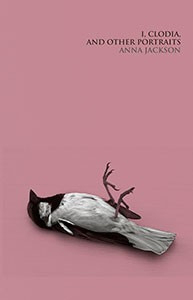
Author bio: Anna is the Programme Director in the English Department at Victoria University. She has published five poetry collections, including Thicket, which was shortlisted for the New Zealand Post Book Awards in 2011. Her latest collection  I, Clodia, and Other Portraits was published by Auckland University Press in  2014 (my review here). Anna is currently organising a Ruapehu Writer’s Festival with Helen Rickerby to be held in Ohakune, March 2016 (Facebook page here).

Paula’s note: This surprising poem, holds narrative in its palm, a sharp moment that reverberates  with implication. I get to the end and I am pulled back to the beginning, again and again. The musical chord that holds the moment together (and thus the poem)  jars, unsettles — until that moment of silence and it feels like time has iced over. Within that silent beat, poetry blooms. Ha! I need to get to work but this poem keeps distracting me. I adore the power of poetry to do just that.


1415925155755    1415925155755


Auckland University page

New Zealand Book Council page

Anna Jackson’s poem, ‘Afraid of falls?’ on Poetry Shelf.

Anna Jackson’s interview on Poetry Shelf


Poem Friday – Carolyn McCurdie’s ‘A Potato Sonnet: Jersey Bennes for Christmas’ – each word gleams in the light bright space of the page


A Potato Sonnet: Jersey Bennes for Christmas


They gleam in the black

crumbled earth;


steady, as if candles

glow through layers of silk,


underpin the season’s quick

shifts of tinselled light


and the brisk heel-tap, chatter

of crowds in the street.


This is old, wondrous

as moon-rise,


mundane

as the maternal voice


that calls, come in

to the table.


© Carolyn McCurdie Bones in the Octagon  Mākaro Press 2015


Author Bio:  Carolyn McCurdie is a Dunedin writer. She won the Lilian Ida Smith Award in 1998 for short stories and a collection of stories — Albatross was published in 2014 by e-book publisher Rosa Mira Books. A children’s novel, The Unquiet, was published in 2006 by Longacre Press. She was the winner of the 2013 NZ Poetry Society International Poetry Competition and her first poetry collection, Bones in the Octagon, was published in 2015 by Mākaro Press as part of their Hoopla series. Carolyn is active in Dunedin’s live poetry scene, where she is a member of the Octagon Poets Collective.

Paula’s note: The potato is comfort food, but this particular potato hooks you to the extended  family table where the sun is blazing down and family stories circulate. Christmas. Ah. Reading the poem, each word gleams in the light bright space of the page along with the deep pit of personal memory. Each word is so perfectly placed for ear and eye. This is the first poem I read in Carolyn’s debut collection (the title lured me in — especially the idea of a sonnet meeting up with potatoes). There is a quietness, an attentiveness, delicious overlaps of meaning and propulsion. I can’t wait to settle back into the book and discover more.


Mākaro Press author page


Other books in 2015 Hoopla series:

Mr Clean & the Junkie by Jennifer Compton (I reviewed this here)
Native Bird by Bryan Walpert