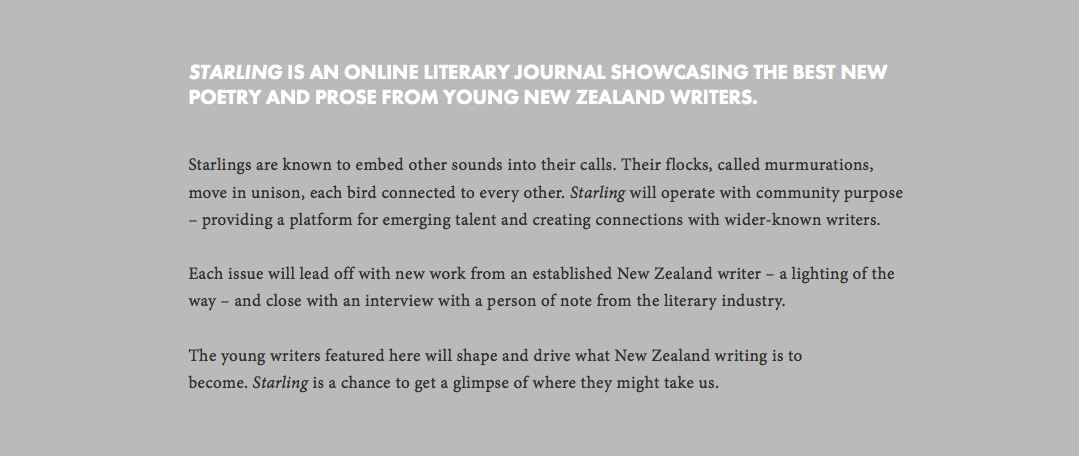
Starling is a new journal for writers under the age of 25
Their web site is here.

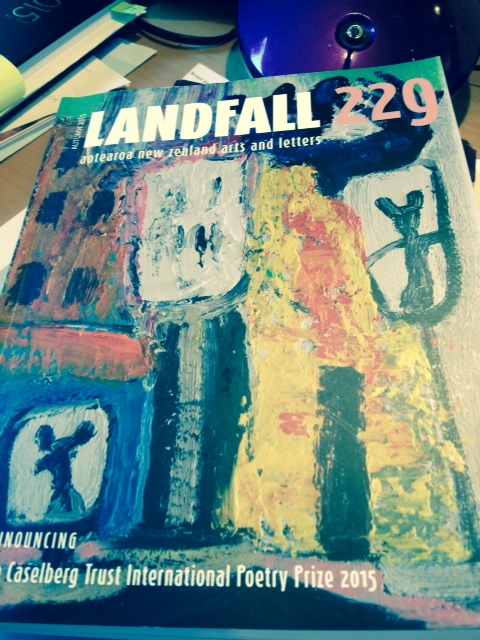
Shortly after Sport arrives in my box, I get a bright new issue of Landfall. My little list below maps my ‘loves’ so far — like little ‘like’ ‘share’ ‘favourite’ or ‘retweet’ buttons. Editors might compile a journal with an arc of contours (aural, thematic, emotional pitch, genre, experimentation, quietness and so on) as I have always done with an anthology so you move through shifting readerly experiences from start to finish. However, I never read a journal like this. It’s dip and delve.
1. Straight to the review section to books I have missed, and books I have reviewed. Ha! I Have missed (all meanings intended) reading Ian Wedde’s The Grass Catcher: A digression about home (Victoria University Press). Martin Edmond’s scintillating review meditates on the implications of writing the past alongside his critique of Ian’s illuminations of his own. ‘Home’ was a key notion that came under scrutiny within my doctoral thesis and within the context of Italian women writing novels in the twentieth century. It still fascinates me. This review has sent me scuttling to buy the book. In particular: ‘This is not one of those writer’s memoirs that says: here is how I became the resplendent creature I am today. It is too multi-faceted, too in love with the world, you might say, to serve such a purpose.’
2. Rata Gordon’s poem ‘Tinkering’ is like an electric train on electric tracks. You get to the end and you want to travel that route again. Wow!
3. Discovering Michael Harlow picked Sue Wootton’s poem, ‘Luthier,’ as the winning entry in The Caselberg Trust International Poetry Prize (2015). This poem is sumptuous in detail and that detail evokes mood, music, character, place in a transcendental kind of way. I would love to hear this poem read aloud to hear the poet lift and connect and pause, the hit of certain words on the line (flitch, slink, Sitka, bedrock). Sue demonstrates the way a poem can take a small moment/thought/action/thing and then open out intimately for the reader. A word that comes to mind and that is so overused when speaking poetry is luminous. But this poem is utterly and breathtakingly luminous.
4. Discovering Christina Conrad still writes poems.
5. Short poems can be very very good. So much happens in the white space that holds them This is the case with Louise Wallace’s ‘Mirage/Arizona.’
6. Tina Makeriti’s essay, ‘This Compulsion in Us.’ Strikes a chord because I am fascinated by museums too; enthralled by the things that stick to the objects that only you can see or hear or feel. Loved Tina’s exploration of a museum’s paradox, in that it preserves treasures yet ‘also captures and immobilises things that make sense only in motion, that should breathe and transform.’
7. Runner-up in The Caselberg Trust International Poetry Prize (2015), the opening lines in Jessica le Bas’s ‘Four Photographs from a Window’ : ‘The first is a shot in the dark/ buttoned up and black suited’
8. An Elizabeth Smither short story that underlines what an exquisite hand she has when it comes to fiction (‘The Trees’).
9. The way Sue Reidy’s poem, ‘The primitive,’ became etched on my skin.
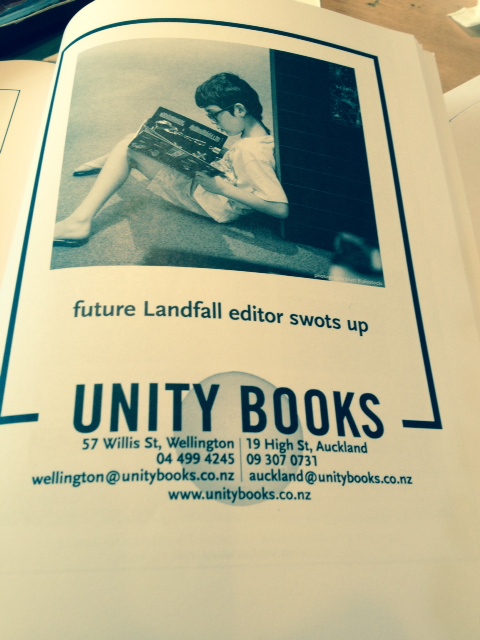
10. Lots more delights but I have to mention the Unity-Books, standout ad. A child reading a book, thank you!
Sometimes a literary journal is just the ticket for rainy-day blues, diversion, or the need to put a finger on a literary pulse. Ha! The notion of a literary pulse is where debate ensues. Each finger will be sensitive to different nuances, different implications. I strongly believe that national anthologies that claim to represent a wide group ( New Zealand, for example) must be challenged if gender, ethnicity, age or geographic-location biases fuel significant blind spots. For decades, women were the blind spot in anthologies and journals, and now, at times it seems there is token representation of work by Māori, Pasifika and Asian authors. Literary journals, however, are often the bloodline of a place, a niche, a literary disposition, and nearly always reveal the predilections of the editor. Sport comes out of Wellington, and it is to a great degree of Wellington (not in subject matter, but in terms of authors selected). It is a celebration of the writing by both established and emerging writers that have some connection with the city, often through Victoria University or its Press. I have no problem with this. I most definitely have no problem with this when the work included catches my attention and sends me in directions both familiar and unfamiliar.
The latest issue worked a treat for my rainy-day blues.
Seven essays are sprinkled through the selection of poetry and fiction, and if this is a new feature, it is a feature I applaud in this climate of idea-sharing in creative and stimulating forms. Long may it continue.
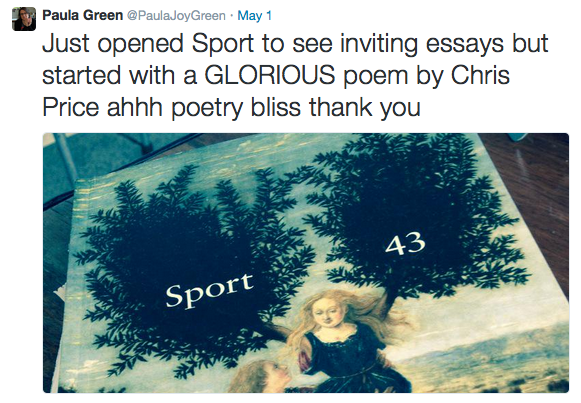
When I first picked up the book, I went straight to Chris Price (out of longing for a new collection perhaps) and immediately did a tweet review. Tucked away at the back of the book, it felt like the best had been saved for last with the playful, audacious flick and flash of words that catch your ear and send you flying to a nursery rhyme or Murphy’s Law or cheeky wit or the subtle twist and let’s-be-serious of the last word, ‘unspoken.’
This time I went to an unfamiliar name first, ‘Ruth Upperton,’ and what a discovery. Think I must have yearning for the comfort and absolute pleasure of poetic musicality (why I like the poems of Michele Leggott and Bill Manhire so much). Ruth has appeared in other journals, has just finished a law degree and lives in Palmerston North. Her five poems are different, the one from the other, but are linked by gorgeous rhyming (off, aslant, sliding), infectious repetitions, aural chords, sumptuous words. There is poetry out of sentences and there is poetry out of curiosity. You shift between comfort and strangeness.
from ‘The lonely crow’
Nothing sadder than a lonely river.
Nothing darker than a single crow.
Shiver at the strong’s surrender.
Play a tune on your June piano.
James Brown’s terrific poem, ‘Mercy,’ made me hungry for a new James Brown collection.
Anna Jackson’s three cooking-show poems suggest she is just getting better and better ( I am working my way through Catallus so I can review her new collection soon). I love the way the ingredients (excuse the pun) in these poems shift and flicker from one poem to the next, and in their new baking dishes taste a little different. The sort of poems that evoke a steady engagement at the level of sound and narrative.
Sarah Jane Barnett’s sequence of poems, Addis Ababa,’ caught me by surprise. They take me to an elsewhere, the elsewhere of displacement, of otherness, of immigrants. The poems step up from everything Sarah has previously written, and then take another step into risk, empathy, inquiry, experience. What a combination.
Rachel Bush’s ‘Long and short,’ is a poem that moved me with its exquisite detail and revelation, a family story (true or false) that catches in the throat. The poetic glue: the baked bread.
So many things accumulate. They weigh us
off balance. We struggle to stay upright,
we lurch and are precarious. Our feet are flat
and sudden. It was easier when we had
a mum and dad. Easily we could blame them
when we were less than we desired.
Still most essays and fiction to read, but started here: Damien Wilkinson’s lecture/essay navigates a subset of the ‘ought’ and ‘ought not’ of narrative: the way it ought/ ought not represent some kind of personal change (character based). Fascinating following the thread of argument. Is this a requisite ingredient in poetry? That poems ought to navigate some kind of change? I raise this because, and I am shifting tack a little here, I am fond of poems that exhibit some kind of movement (and movement may be zen-like and hold change within its sameness and vice-versa). Poetic movement need not be on a grand, spectacular scale. It might be miniature shivers in the poem, sweet little movements that you catch out of the corner of your eye, or a flicker in your ear, or a faint tremble of your heart, or the tug of an idea that is itching to confound, challenge and pull you elsewhere. That is what I felt when I read, ‘She cannot work,’ Ashleigh Young’s foray into fiction. It is what I felt reading this issue of Sport, a catalogue of movements that displaced my state of fatigue.
Sport: miniature shivers in the writing, sweet little movements that you catch out of the corner of your eye, or a flicker in your ear, or a faint tremble of your heart, or the tug of an idea that is itching to confound, challenge and pull you elsewhere.
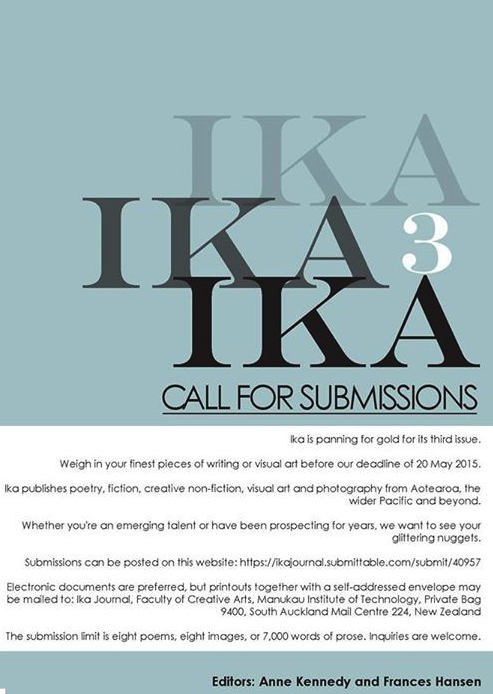
Weigh in your finest pieces of writing or visual art before our deadline of 20 May 2015.
Ika publishes poetry, fiction, creative non-fiction, visual art and photography from Aotearoa, the wider Pacific and beyond.
Whether you’re an emerging talent or have been prospecting for years, we want to see your glittering nuggets.
The submission limit is eight poems, eight images, or 7,000 words of prose.
Submissions for Best New Zealand Poems 2015 are open from 1January 2015 and must be received by 15 December 2015.
What to submit
When to submit
How to submit
Postal submissions should be directed to:
BNZP editor
c/o International Institute of Modern Letters
Victoria University
PO Box 600
Wellington
New Zealand
Email submissions of individual poems or a small selection of poems should be submitted, preferably as attachments, to: modernletters@vuw.ac.nz.
Whether posting or emailing, please include the following information with each individual submission:
The place and date of publication of each poem submitted (including web links if relevant).
Your name, email and the poem title on each page you submit.

Poetry NZ‘s 50th issue will be published later this year. Submissions are now open (closing 31st July). Please subscribe to our page for updates.
Poetry NZ is a print journal, established in 1951 by Louis Johnson, edited between 1993 and 2014 by Alistair Paterson, and now housed by Massey University. The current editor is Jack Ross.
 NZ Poetry Shelf