

Book Award lists should promote debate. Ideas and issues should be raised. As long as judges and authors don’t come under personal attack. It is a time of celebration, let’s not forget that, but it is also a time when diverse opinions may draw attention to our healthy landscape of books.
I have just started writing a big book on poetry by New Zealand women. I have carried this project with me for a long time, and it something I care about very much indeed. It is a book I am writing with a great sense of liberation and an equal dose of love.
I bring many questions to my writing.
The shortlist for poetry and fiction in the Ockham NZ Book Awards includes 0ne woman (Patricia Grace) and seven men. There are no women poets.
This is simply a matter of choice on the part of the judges and I do not wish to undermine the quality of the books they have selected. However, in my view, it casts a disconcerting light upon what women have been producing in the past year or so.
Women produced astonishing books in 2015. I reviewed their poetry books on this blog and praised the diligent craft, the exquisite music, the sumptuous detail, the complexities that challenge and the simplicity that soothes. I have lauded books by women that have moved me like no other, and that have contributed much to the possibilities of what a poem might do.
I am gobsmacked that not a single one made it to the shortlist.
Men have written extraordinary poetry in the past year, but so too have women.
Today is International Women’s Day. In celebration of this, here is a selection of poetry and fiction I have loved in the past year and would have been happy to award.
This list is partial. Please add to it. Some of these women are my friends, so yes there is unconscious bias. Some of these women I would recognise in the street, some I would not.
Eleven Poetry Books by women to adore
(I have reviewed all these to some degree on Poetry Shelf or interviewed the poets)
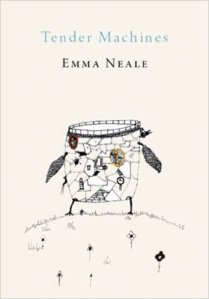
Emma Neale Tender Machines This is a domestic book that is utterly complex. Yet it moves beyond home to become a book of the world. The music is divine. I am utterly moved. The Poetry Shelf trophy is yours Emma.
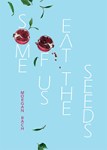
Joan Fleming Failed Love Stories Poetry that dazzles and shifts me. This book is on replay!
Holly Painter Excerpts from a Natural History Startling debut that blew me out the window and made me want to write
Sarah Jane Barnett Work Poetry that takes risks and is unafraid of ideas. Adored this.
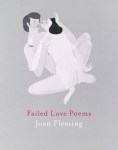
Johanna Aitchison Miss Dust Spare, strange, surprising, wonderful to read.
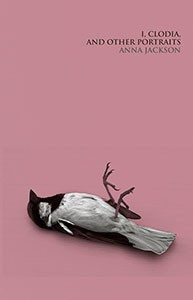
Anna Jackson I, Clodia and Other Portraits The voice gets under my skin no matter how many times I read it. So much to say about it.
Jennifer Compton My Clean & The Junkie This narrative satisfies on so many levels.
Airini Beautrais Dear Neil Roberts Risk taking at the level of politics and the personal.
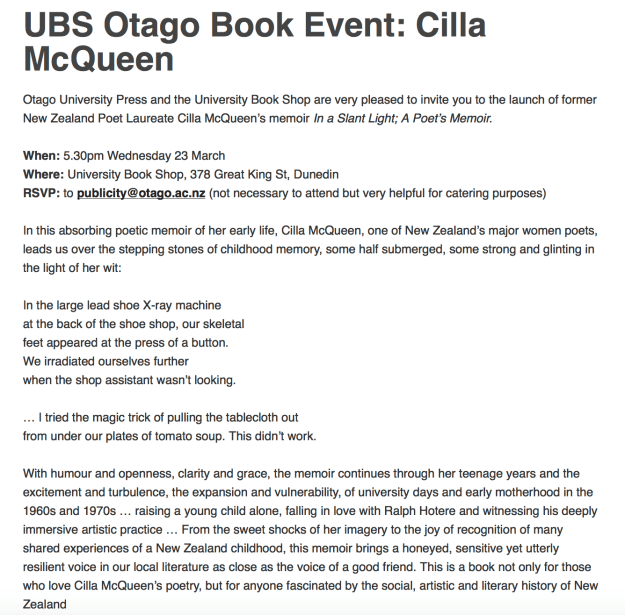
Morgan Bach Some of Us Eat the Seeds Beauty of the cover matches the surprise and beauty of the poetry within.
Hinemoana Baker waha/ mouth This poetry lit a fire in my head not sure which year it fits though. But wow!
Diane Brown Taking My Mother to the Opera This is poetry making pin pricks as it moves and gets you chewing back through your own circumstances.
…. and this is just a start. Ha! Serie Barford with her gorgeous mix of poetry and prose.
Yep I am going over board here just to show you that women have footed it with the best of the men. Whichever year you look at, a different set of judges would come up with a different mix of books. Yes let’s celebrate that worthy shortlist but let’s also remember that canon shaping only revels in and reveals part of the story.
Fiction (I haven’t read so widely here and have a wee stack to get too – Laurence Fearnley and Charlotte Grimshaw here I come!)
Anna Smaill The Chimes This book – plot character, setting, premise, events – still sticks to me. The sentences are exquisite. Some books you lose in brain mist. Not this one.
Sue Orr The Party Line I see this book becoming a NZ classic – a novel of the back blocks. The characters are what move you so profoundly. So perfectly crafted.
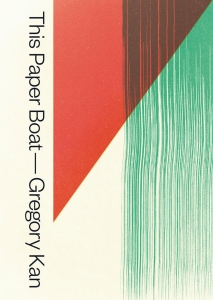
Gregory Kan This Paper Boat Auckland University Press 2016
Gregory Kan’s debut poetry collection, This Paper Boat, is a joy to read on so many levels.
Kan’s poetry has featured in a number of literary journals and an early version of the book was shortlisted for the Kathleen Grattan Poetry Prize in 2013. He lives in Auckland.
Paper Boat traces ghosts. We hold onto Kan’s coat tails as he tracks family and the spirit of poet, Robin Hyde (Iris Wilkinson). The gateway to family becomes the gateway to Iris and the gateway to Iris becomes the gateway to family. There is overlap between family and missing poet but there is also a deep channel. The channel of difficulty, hard knocks, the tough to decipher. There is the creek of foreignness. The abrasiveness of the world when the world is not singular.
Kan enters the thicket of memory as he sets out to recover the family stories. He shows the father as son fishing in the drains, the mother as daughter obedient at school. Yet while he fills his pockets with parental anecdotes, there is too, the poignant way his parents remain other, mysterious, a gap that can never be completely filled:
In the past when I thought about people my parents
were somehow
not among them. But some wound stayed
wide in all of us, and now I see in their faces
strange rivers and waterfalls, tilted over with broom.
The familial stands are immensely moving, but so too is the search for Iris. Kan untangles Iris in the traces she has left – in her poems, her writings, her letters. He stands outside the gate to Wellington house, listening hard, or beside the rock pool. There is something that sets hairs on end when you stand in the footsteps of ghosts, the exact stone, the exact spot, and at times it is though they become both audible and visible. Hyde’s poems in Houses by the Sea, are sumptuous in detail. I think of this as Kan muses on the rock-pool bounty. When he stands at her gate:
I have to hear you to keep you
here, and I have to keep you
here to keep coming back.
I think too of Michele Leggott’s plea at the back of DIA to listen hard to the lost matrix of women poets, the early poets. To find ways to bring them close.
Kan brings Iris (Robin) close. His traces. Iris becomes woman as much as she does poet and the channel of difficulty fills with her darknesses as much as it does Kan’s. There is an aching core of confinement: her pregnancy, her loss of the baby, her second pregnancy, her placement of the baby elsewhere, her mental illness. His confinement in a jungle. His great-aunt’s abandonment as a baby.
The strands of love, foreignness and of difficulty are amplified by the look of the book. The way you aren’t reading a singular river of text that conforms to some kind of pattern. A singular narrative. It is like static, like hiccups, like stutters across the width of reading. I love this. Forms change. Forms make much of the white space. A page looks beautiful, but the white space becomes a transmission point for the voices barely heard.
At one point the blocks of text resemble the silhouettes of photographs in a family album. At another point, poems masquerade as censored Facebook entries.Later still, a fable-like poem tumbles across pages in italics.
The writing is understated, graceful, fluent, visually alive.
I want to pick up Hyde again. I want to stand by that Wellington rock pool and see what I can hear. I have read this book three times and it won’t be the last.
In the final pages, as part a ritual for The Hungry Ghost Festival, Kan sends a paper boat down the river ‘to ensure// that the ghosts find their way/ back.’
The book with its heartfelt offerings is like a paper boat, floating on an ethereal current so that poetry finds its way back to us all (or Hyde, or family).
Auckland University Press page
A terrific interview with Sarah Jane Barnett
Sequence in Sport
For Eventfinda tickets go here
The Poet Laureate Celebrations includes this event! Looking forward to my trip south.
People talked about quake
brain, but the Canterbury
earthquakes, despite or
because of this, generated
amazing bursts of
creativity: music, dance,
astonishing street art;
and poetry.
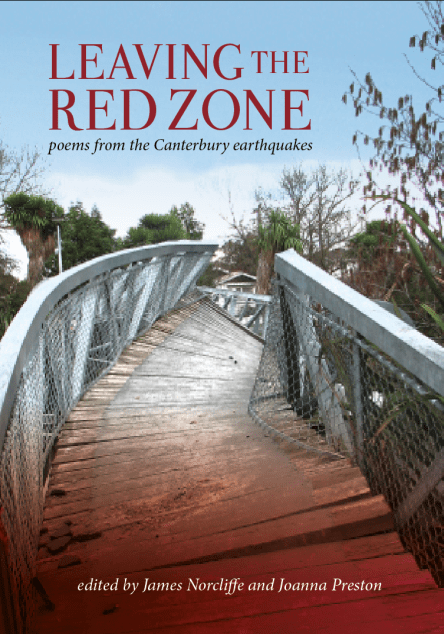
148 poems from 87 poets:
here are sorrow,
resignation, defiance,
stoicism, humour black
and wry, and everything in
between.
YOU ARE INVITED TO THE LAUNCH OF
LEAVING THE RED ZONE
~ poems from the Canterbury earthquakes, edited by
James Norcliffe and Joanna Preston.
Venue: The Laboratory, 17 West Belt, Lincoln.
Time: Monday 29 February 2016, 7.00 till 8.30pm.
Purchase book at the Special Launch Price of $30 (RRP $39.95). Pay by cash, cheque,
or pre-launch bank deposit into 03 1704 0049456 025.
Profits from sales will be donated to the Mayor’s Earthquake Relief Fund.
Food and drink will be available to buy from 6.00pm. For full menu service book
a table by phoning The Laboratory 325 3006.
For more details see Joanna’s blog
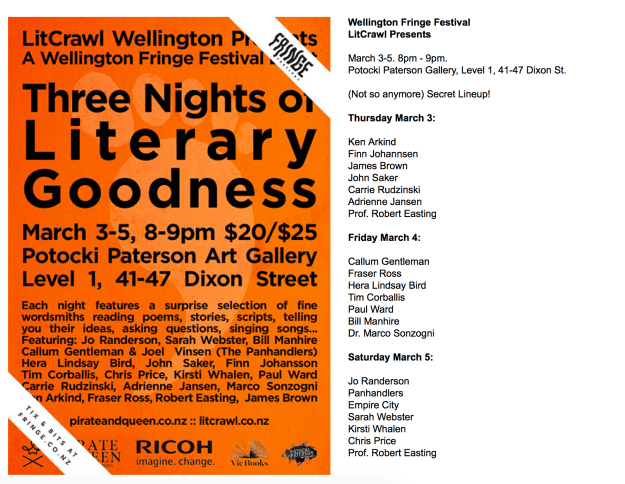
LitCrawl is three nights of Literary Goodness. Each night is different, and every one is a juicy box of chocolates. Artists include: The Pandhandlers (as seen in Writing Tunes & Playing Poetry in last year’s LitCrawl), Bill Manhire, Robert Easting, Sarah Webster, Hera Lindsay Bird, Tim Corballis, The Empire City, Chris Price, Ken Arkind. Plus more.
When: Thurs 3, Fri 4 & Sat 5 March
Where: Potocki Paterson Art Gallery, Level 1, 41 – 47 Dixon St
Tickets: Get them! At the Fringe site here. Doorsales available if there’s room left.
‘Come on, let’s push the inflatable out
on the night’s wide waters, see
how far it goes.’
Chris Price from ‘Venera’
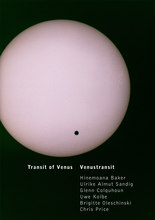
Three German poets came to view the transit of Venus with three New Zealand poets at Uawa/ Tolaga Bay on June 6th 2012.
They observed the black dot. They wrote poems.
In the same year they met in Germany and translated a selection of each other’s poems before performing together at the Frankfurt Book Fair.
Victoria University Press has just published a beautiful edition of the poems, in both English and German, with images, notes and interviews.
The poets:
Hinemoana Baker, Glenn Colquhoun, Chris Price
Uwe Kolbe, Brigitte Oleschinski, Ulrike Almut Sandig
It is as though poetry is the inflatable that six poets pushed out into the ‘night’s wide waters’ of writing; into the passage of the black dot, the thought of Cook’s eye trained all those centuries back, into the little repetitions of stone or buttercup or light.
As you might expect no poem cluster is the same.
Each lift and slip of the inflatable is as much a lift and slip for the reader as it is the writer. A voyage of discovery, in a way.
I especially loved the way the poems took me back to that once-in-a-lifetime experience. How to make poetry of such things?
I was also drawn to the pairings of poets and the way they translated each other’s work.
As the ever enthusiastic Rick Stein says: There should be more of this. What other projects can we invent that bring poets together in such fertile ways?
The poems are simply and intricately addictive. Congratulations and thank you VUP! The book is a little gem.
VUP page
Hinemoana Baker is a Wellington poet, musician and teacher. She is the Creative New Zealand Berlin Writer in Residence in 2015–16.
Urike Almut Sandig is a Berlin poet who works with various composers and musicians. She has received numerous awards and scholarships, most recently a scholarship from the Berlin Senate.
Glenn Colquhoun is a poet, children’s writer, and GP. In 2014 he represented New Zealand on the Commonwealth Poets United poetry project which celebrated the Glasgow Commonwealth Games.
Uwe Kolbe is a poet, translator and lecturer who lives in Hamburg. He has received many prizes and awards, most recently the Heinrich Mann Prize from the Academy of the Arts in Berlin, and the Meran Poetry Award.
Brigitte Oleschinski is a Berlin poet, essayist and performer. She received the prestigious Peter-Huchel-Preis in 1998. She is best known for her poetry collections Mental Heat Control (1990), Your Passport is Not Guilty (1997) and Geisterströmung (2004).
Chris Price is a Wellington poet, nonfiction writer, musician and teacher. Her most recent poetry collection is Beside Herself (2016).
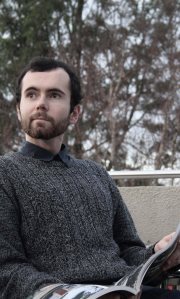
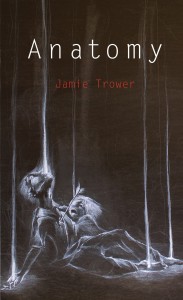
Mary McCallum of Mākaro Press interviews debut poet Jamie Trower about his collection Anatomy, which they published under their Submarine imprint in 2015.
(for my review of the book see here)
Mary McCallum: As a new poetry publisher we get a lot of emails from people wanting to submit their collections of poetry. Some of those emails are like explosive devices — as soon as you open them you know you’re in danger. All the tiny words on the screen shimmer with the excitement of being written by someone for whom words are not simply tools or exciting ways to evoke the world of experience or imagination, but tiny rockets that have changed or saved a life.
This was the case when I opened an email from Aucklander Jamie Trower – a young man in his early twenties who had only just discovered poetry, but who had nonetheless crafted a whole collection that he wanted me to read. A collection of poems that charted his recovery from a terrible childhood brain injury that could have killed him.
What a ride. It felt to me reading Anatomy for the first time – and I continue to feel this – that Jamie had given himself permission to write how he wanted to write, and discover what he wanted to discover using words in a way that he’d never thought possible. With obvious delight he raged on the page, and laughed at and interrogated it. Words came and he connected them and lit the fuse. Which is not to say Jamie wasn’t open to editing. He was. He loved the whole process … more of a chance to play with words, more connections to fire. We published it, dear reader, and this week I talked to Jamie about the book so close to his heart – how he wrote it and why, and where to now.
M: What made you start to write poetry?
J: In the months of rehab after I sustained a severe brain injury as a nine-year-old, I learned to use a typewriter. I wrote sporadic, jumbled notes of how I was feeling and the changes I noticed in my wheelchair-bound body. I really started writing poetry after taking a creative writing course at the University of Auckland two years ago. It was then that I went back to the notes that I wrote in rehab and found myself expanding and stretching the words into poetry.
M: What do you like about it?
J: The beauty and ease of poetry. How a single moment can be expanded on, heightened, strengthened, transformed, stretched, redefined and moulded in a couple of lines. How a writer can adapt a thought, a feeling or an event so easily through compressed, rhythmic language.
M: Who are your poetry heroes? Are there any poets you try and emulate?
J: I am in awe of Sam Hunt, Paul Muldoon, Ben Okri – the list goes on! I think their writings are compelling and eloquently formed. I draw on their poetry quite a bit – how they use simple thoughts and words to create a big impact.
M: Your poetry collection feels like one long narrative poem about what you went through when you had a brain injury as a child – rather than lots of separate poems – do you see it that way?
J: Anatomy is definitely narrative in its structure: a start, middle and end. I tried to separate the poetic canvas by titling the poems – making it feel like more of a collection rather than a narrative – and pairing it with a traditional form of storytelling. I decided in the editing process to parallel poetry with prose to guide the reader, and to allow the emotion I felt to show through more.
M: In Anatomy you indicate the typewriter was an important tool in your rehab – is poetry also important as a form of therapy in getting over what happened to you?
J: Poetry will always be my rehab, my therapy, my hospital, my home. This use of self-expression and self-examination helped me (and still does) realise that I needed to take control of my own body, my own disability. I hope to continue to use the lessons that poetry has taught me for many years to come.
M: What are you writing now?
J: I’m writing my next poetry collection, and I’m brainstorming a novel on the side. I’m excited to see what comes of it!
M: Who are you reading?
J: Right now I’m reading Michele Leggott’s Heartland (for the tenth time, it feels). She very kindly came to the launch of Anatomy, which was very, very cool.
Mākaro Press page
 NZ Poetry Shelf