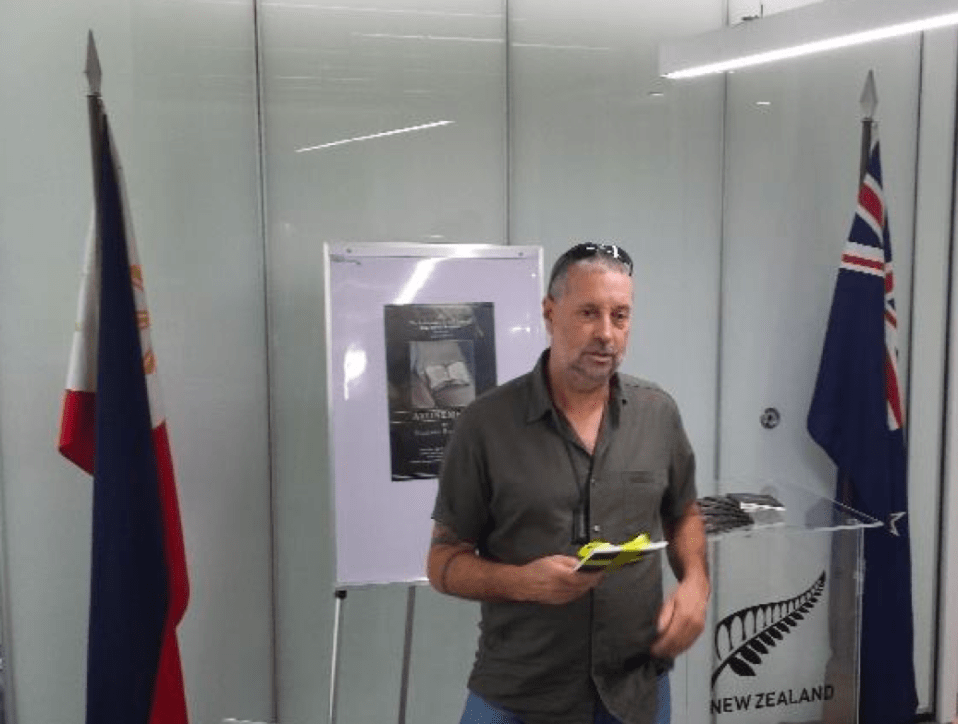
The Philippine edition of Atonement, was launched at the New Zealand Embassy, Manila in late January this year.
Launch photos here

The Philippine edition of Atonement, was launched at the New Zealand Embassy, Manila in late January this year.
Launch photos here



I fall with the rhythm of rowing
into long narrow light
bridges sigh like single oars
from ‘last supper in Venice’
Rabbit Rabbit Kerrin P Sharpe , Victoria University Press, 2016
Victoria University Press is publishing a heavenly suite of poetry books this year (actually all the presses are!). So many good poetry books I think I need a poetry book club where we can talk about poetry to our heart’s content with coffee and sweet little cakes. A once a month indulgence!
Kerrin P Sharpe is a very fine poet whose previous books hooked me with their agility, their lightness of touch, their grounding. She is currently the Writer-in-Residence at St Andrews College in Christchurch. In 2008, she was awarded the NZ Post Creative Writing Teacher’s Award by the International Institute of Modern Letters. She is a terrific mentor for young writers.
Kerrin’s latest book is an utter treat in the way things condense to the near point of evaporation and then unfold with such grace you get goosebumps. Bare threads shiver and shimmer as speech-bubble anecdotes hover above and below. There is necessary tenderness. Sometimes it is like looking into the mysterious dark of family archives where things or photographs or memories twitch in the patchy shadows. You move from smoky dream to real life to near fable.
If you think of poem writing as hitting the whirr and pace on a bike so the whole world feels perfect, then Kerrin is hitting that perfect whirr and pace as she writes. There is a honeyed fluency that is downright enviable (enhanced by the lack of capitals and full stops).
So many poems stand out, but I keep returning to the mother poems: the pitch of the line, the tilted head of the daughter looking, the inventive tropes, the extraordinary stories that resist mother frames. These poems belong in an anthology of mother poems because they are surprising in where they take you, the way they move you and the presence of things that do little cartwheels on the page.
I loved the way the mother’s Astrakhan coat prompts mystery that meets strange fable that meets down-to-earth pathos in ‘when a crayfish could feed 6 men‘:
yet though the coat
cracked the small change
it was when my mother’s money
stretched beyond the frontier towns
that she no longer wore
what after her funeral seemed
little more than a fleece
There is a glorious and daring alignment of the mother’s belly and the ship she builds in ‘The mary blanche in situ.’ All poem borders slip and slide. Where does mother begin and ship end? Where does trope set sail and real life intrude? Entering the poem is like entering a show, both magical and wondrous, and you just want to get another ticket and go through again.
my mother built her own ship
because she hated
the idea of drowning
In ‘the morning of my mother’s funeral her cup is sober minded,’ a single tea pot pours, in a little stream, like stream-of-conscious English Breakfast,the grief and thoughts of a key life moment. The poem catches the unrealness of losing a loved one; of life not stopping its circular routines and paying attention with you.
two plumbers install a shower
my mother will never use
they eat her peanut rockies
in the coronation tin
A delicious inventiveness drives the collection as a whole, as though reality is strained through kaleidoscopic filters to refurbish ordinary things with off kilter tints. There is the train that keeps a son breathing, there is the mouth of the sky that opens and drops bodies, the daughter that decides the bee sting is a butterfly kiss. In ‘a language goes silent,’ a Chinese fruit shop uses the bare threads, the strange tilts to move you:
Amy and Harry
lived in the fruit
of their shop
like mango stones
I adore this book. It shows just what things can do when you let them loose in a poem. Wonderful!
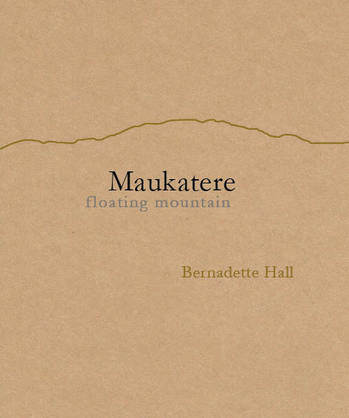
There are gauzy bandages of mist all down the East Cast as far as Bluff
Having to face our own despairs, we moved out onto the promontory
The ship was an illusion, a golden ship and a galleon,so high in the water
He may not be such a beautiful man when he is older, when the bones take over
I’m so glad we went to meet you, little darling, walking towards us through the tussock
Bernadette Hall has published numerous poetry collections with Victoria University Press – books that resonate so beautifully for both ear and heart. Her poems are like intricate lacework. Just gorgeous.
With her latest project, Bernadette was drawn to work with two younger women on a chapbook that drew inspiration from her local mountain, from the stories that have bedded down in the area and in her mind. Helen Rickerby from Seraph Press published the book and poet Rachel O’Neill did the illustrations. Three women walking round a mountain, as Bernadette says.
The poem is like a long poem (around 14 pages) made of drifting pieces, like little dandelion kisses that hit the page and hook you. Settler stories, as Bernadette says. There is the Tangler drifting in at out; an Irish figure, both loner and trickster, who acted as a buyer-seller go-between at the fairs. The poems are the fidgety intermediary between light and dark; the glint of the present and the shadows of history.
‘and she repeats it/ like the blade of light/ that repeats itself’
Reading this is like entering the metaphorical woods, where you get whiffs of story and elsewhere and skimming voices. Mountain as woods. Standing alongside a mountain, walking around that mountain, can be a portal to voice. This is a collection of voice; think of the way you stand somewhere old and it is like you can hear the past.
And in that mysterious pull of voice, you get the hit of physical detail, earthy and grounding.
‘A day of patchy rain – another chink in things’
‘What joy in the new experimental poets – up early throwing stones into the lake’
‘There are gauzy bandages of mist all down the East Coast as far as Bluff’
‘the wounds in the marshland fill slowly with fresh water’
Reading this is magical. The woods are knotty. The mountain is. You can take so many paths, both illuminated and dark.
Helen Rickerby has produced a beautiful hand-bound book with thick paper and an elegant design. The book is a labour of love; picture a sewing circle with stories shared. The limited, hand-numbered edition has virtually sold out but a second print run is in the pipeline.
Rachel O’Neill has produced the most exquisite sequence of drawings that carry their own narrative. Little cross-hatched beauties. Enigmatic. Labour intensive. The hooded-lamp figure connects us to the poems where the little glows are like a unifying thread. The lantern head pulses with meaning. The figure is defined and dependent upon both light and dark in order to exist, in order to comprehend. Again there is the subtle and beautiful link to the poems where the light references rebound. It is as though certain things, whether recalled or invented, are caught in the beam of poet.
This is a very special book.
Bernadette co-founded Hagley Writers’ Institute In Christchurch. She lives at Amberley Beach in the Hurinui in North Canterbury. Bernadette was awarded The Prime Minister’s Award for Poetry in 2015.
Rachel’s debut collection was One Human in Height (Hue & Cry Press). She is a filmmaker, writer and artist.
Seraph Press page
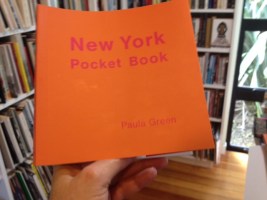
Such nervous anticipation as poets wait to see poems become book object.
I am no exception. Finally I have a copy of New York Pocket Book and I so love what Helen Rickerby from Seraph Press has done. It is like a little guide book I could take to NYC in my purse. I picture myself writing a suite of city pocket books so I could have a little row of them on my shelf. What madness. Rome Pocket Book. London Pocket Book. Paris Pocket Book. But I have always wanted to go to Barcelona. If only.
Tonight , well at 5pm, I am looking forward to 15 poets taking us on a mini world trip with city poems. The links might be tenuous but that is part of the delight.
When: 5 until 7 pm
Where: Gow Langsford Gallery, Lorne Street (in Michael’s show)
Who:
Paula Green, Helen Rickerby, Angela Andrews, Sophie Van Waardenberg, Courtney Sina Meredith, Murray Edmond, Vana Manasiadis, Sophia Johnson, Gregory Kan, Michele Leggott, Albert Wendt, Janet Charman, Steven Toussaint, CK Stead, Robert Sullivan.
You are most welcome!


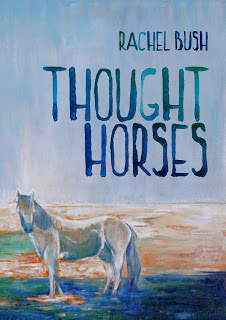
A new post at The Red Room:
I like to read and review New Zealand poetry, and because I live in Wellington quite a few of these collections come from Victoria University Press. When Ashleigh Young began working as their editor, I began to notice her careful hand on the collections. I asked Ashleigh a few questions about being an editor.
—
Sarah Jane Barnett: I was watching the show Comedians in Cars Getting Coffee and Jerry Seinfeld asked Barack Obama, ‘If politics was a sport, what sport would it be?’ So, if editing was a sport, what sport would it be?
Ashleigh Young: I was about to say cricket – long bouts of brooding interrupted by sudden bouts of high-speed action and head-clutching – but you can say that about almost anything. About life. I wonder if maybe editing is a bit like tenpin bowling. Every bit of editorial interference is a small act of violence, essentially trying to knock things down – but there’s this attempt at elegance, at the graceful flourish. And then there’s the stubborn beauty of the pins that remain standing. Also, tenpin bowling is the sport of grudging office team-building that ends up being quite fun.
Just contradicting myself, though, I think there’s something intrinsically un-sporty about editing. The writer and the editor shouldn’t feel like they’re adversaries grappling for ultimate power. No one should be spraying champagne around if they ‘win’. They can do that at the book launch.
For the rest of the interview go to Sarah’s blog: here
Mary McCallum from Mākaro Press and Heidi North-Bailey have given me permission to post this marvelous mother poem from Heidi’s debut poetry collection. The poem is so beautifully lyrical, exquisitely layered, the gaps large and resonant, the line of women vital; the hidden stories pull you back for another look, and then another. This is one of my favourite poems of the year to date.


©Heidi North-Bailey 2015

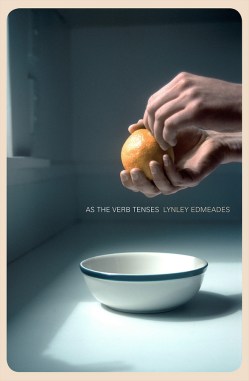
Listening In
The mere presence of her was the necessary part.
Over-hearers, their little coves of ears
were, of course, listening in.
Together, we could hear history
painting a diagram of itself, and things began
to form layers. My mother’s hand
upon the pillow, the pillow soft upon the bed.
©Lynley Edmeades from As the Verb Tenses Otago University Press 2016
This mother poem is a perfect advertisement for a collection that shows how real life can give poetry a vital tang; that poems excised from who you, where you and where you are from sometimes lack the power to kick start your heart from daily routine. The gaps are resplendent. The detail: lyrical, tender, uplifting, deliciously layered.
Everything slows down to a leisurely pace.
Elsewhere in the book: ‘You’re wondering what to do with this, this slowness.’
Absorb and connect. Absorb and connect. This is a terrific debut (oh! and a stand-out cover).
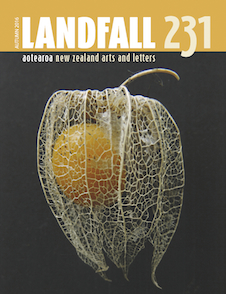
We are well served by literary journals at the moment. Each delivers slightly different treats, biases, focuses but all offer high quality writing that resist any singular NZ model.
The latest Landfall (as you can see) has a stunning cover with its Peter Peryer photograph.
Inside: poetry (37 poets!), fiction, non-fiction, art and book reviews (including an excellent review of Anna Smaill’s The Chimes, one of my top fiction reads of the past year).
The poets range from the very familiar, whether young or old, to those new to me. And that is as it should be. David Eggleton is keeping the magazine fresh whilst giving vital space to our literary elders and maintaining a strong and welcome Pacific flavour.
A tasting plate of lines that got me (I seem to have been struck by mothers, fathers, surprising images, little twists):
from Brian Turner’s ‘Weekends’:
think of what a place could be
when it’s not what we possess
that counts most
but what we are possessed by
from CK Stead’s ‘One: Like a bird’ (for Kay):
You were beautiful, and I
sang, as I could in those days
all the way home—like a bird.
from Leilani Tamu’s ‘Researching Ali’i’:
I searched for you in boxes
the archivist muttered poison
from Rata Gordon’s ‘A Baby’:
I want to make a baby out of one peach and one prickle.
I want to use the kitchen sponge, sticky rice and a rubber band.
I want to use the coffee grinder.
from Siobhan Harvey’s ‘Spaceboy and the White Hole’:
he pictures matter barely visible, the light
of white holes as they transmit their secret
messages, sharp elegies, about letting go.
from Ruth Arnison’s ‘The Visit’:
Even from the road her house gave us the creeps.
Pale, communion wafer thin, and disapproving,
its severe windows three-quarter blinded.
from Heather McQuillan’s ‘In which I defend my father’s right to solitude’:
our father has a fine tooth way
of finding vulnerabilities
on the outward flanks
the wolf is always at his door
from Doc Drumheller’s ‘My Father’s Fingers’:
Days after my father died I felt a sense
of urgency to take care of his hot-house.
from Koenraad Kuiper’s ‘from Benedictine Sonnets’:
Mother always knitted particularly socks.
Knitting socks is a fine skill under the lamplight.
from Elizabeth Smither’s ‘Three “Willow” Pattern Bowls’:
My father thought I meant the plate
and wrapped one from the china cabinet
I carried it close to my heart
all the way back for a second reprimand.
from Bob Orr’s ‘Seven Haiku’:
I don’t care about
frogs
basho’s dead
from Will Leadbetter’s ‘Three Variations on “The Red Wheelbarrow” by William Carlos Williams’:
Nothing depends upon
the green wheelbarrow
Great winter reading!
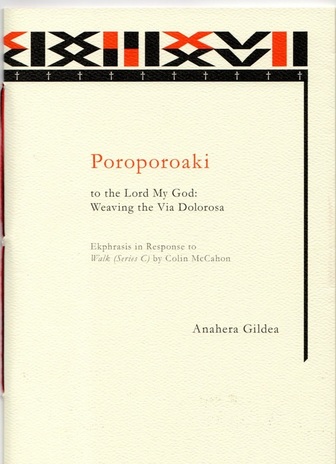
Anahera Gildea, Seraph Press, 2016
Designed and produced by Helen Rickerby of Seraph Press, this is the most exquisite chapbook imaginable. Add the gorgeous paper stock to the extra heavenly endpapers, the hand stitching and an internal design that is elegant and minimalist and you have a rare poetry treat. It is a work of beauty and all poets will be dreaming of their very own chap book. I for one!
XIV
Sometimes it is enough
to sit and look out.
Other times you have to walk
across bone, stone and shell.
Anahera Gildea’s poem is written in response to ‘Walk (Series C)‘ by Colin McCahon and is as much for James K Baxter as it is a response to the painting. It is an example of poetry as gift/taonga. Each line carefully stitched like the stitching in the kahu-kuri she makes for Baxter. This poet knows you don’t need many lines on the page to entice a reader to linger. You are walking alongside McCahon’s painting, you are walking along the wild and dark threat and wonder at Muriwai Beach, you are walking the Stations of the Cross and you are walking the poem. It is, for me, a very moving sequence.


Fale Aitu / Spirit House Tusiata Avia, Victoria University Press, 2016
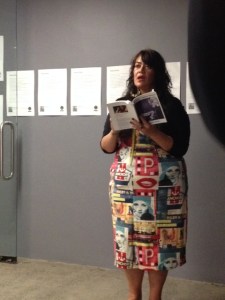
Last night I drove into the city into some kind of warm, semi-tropical wetness —like a season that no longer knew what it ought or wanted to be — to go to the launch of Tusiata Avia’s new poetry collection. Tautai, the Pacific Art Gallery, was a perfect space, and filled to the brim with friends, family, writers and strong publisher support. I loved the warmth and writerly connections in the room. I have been reading Tusiata’s book on planes as poetry now seems to be my activity of choice in the air. I adore this book and have so much to say about it but want to save that for another occasion. I was an early reader so have had a long-term relationship with it.
the launch
The room went dark and an MIT student, bedecked in swishes of red, performed a piece from a previous collection, Blood Clot. Mesmerising.
Tusiata’s cousin and current Burns Fellow, Victor Rodger, gave a terrific speech that included a potted biography. I loved the way he applauded Tusiata not just as a tremendous poet, but as a teacher and solo mother. Her names means artist in Samoan and he saw artist in the numerous roles Tusiata embodies. Writing comes out of so much. He identified her new poems as brave, startling, moving and political. Spiky. I totally agree.
Having dedicated her book to her parents, Tusiata said that it was hard to be the parent of a poet who wrote about family. When she told her mother what she was writing, her mother embraced it. She opened her arms wide. She said the skeletons need to come out. The atua. Tusiata’s speech underlined how important this book is. It is not simply an exercise in how you can play with language, it goes to the roots of that it means to be daughter, mother, poet. It goes further than family into what it means to exist, to co-exist, in a global family. When a poet knows how to write what matters so much to her, when her words bring that alive with a such animation, poise and melody, it matters to you.
Four poems read. Lyrical, song-like, chant-like, that place feet on ground, that open the windows to let atua in and out, that cannot turn a blind eye, that hold tight to the love of a daughter, that come back to the body that is pulsing with life.
Yes I had goose bumps. You could hear a pin drop.
Fergus Barrowman, VUP publisher, made the important point that these poems face the dark but they also face an insistent life force.
Congratulations, this was a goosebump launch for a goosebump book.


 NZ Poetry Shelf