Category Archives: NZ poetry book

Poetry Shelf Winter Season: Johanna Emeney off-piste


Shaken Down


In the hospital corridor,

the one two of my shoes

on hard lino,

then something

sounds broken—


a thermometer—


I have left people here

in rooms

and cabinets.

They’ve gone cold

in others’ hands.


The spine of me

spills

into so many

ball bearings…


Orderlies wheel

prone passengers.

Nurses pass

with busy eyes,


until one pauses

to put on gloves,

coveralls, booties.

She sticks up a sign


[DANGER HAZARDOUS SUBSTANCE]


and calls

for a flashlight,

holds it at an angle

to find beads of me-

rcury lodged in cracks

between wall and floor.


Without a fuss

she gathers masking tape,

an eyedropper,

index cards,

and uses them to

corral what is herdable

into new glass tubing.

Her cards say:

MY MOTHER DIED

WHEN I WAS YOUNG TOO, LOVE


What miracle

to approach

naked breakage,

to chase it unafraid,

gather it up

and talk it back down

to something

resembling normal.


©Johanna Emeney,  Family History, Mākaro Press, 2017


Author note: “Shaken down” grew from two ideas rattling about—a fresh one and a memory:

1) A friend told me that one of the first jobs nurses learn is to shake down a thermometer.

2) I kept thinking of a nurse who had been exceptionally kind to me on the night my mother was killed. This nurse, probably about twenty years my senior, told me about losing her own mother, and how it had affected her.

This is the first poem I wrote that departs from naturalism, moving towards a very minor kind of magical realism. To start with, I was just trying to recapture the experience of walking alone down a hospital corridor, having lost my mother in a car accident, my father still in the ICU. The huge loneliness and disbelief still felt such that they called for more than a realist presentation. The broken thermometer, leaking its apparently irretrievable, noxious mercury, the I-speaker, her spine turning liquid and draining out of her body—together, they were what it was like.

The nurse in the poem who executes practical measures in tidying up the mess (I had to google “how to clean up a small Mercury spill”) is supposed to symbolise that beautiful truth about good nurses—their ability to balance the medical and the personal so adeptly.

Had I not ventured into territory more fantastical than my norm, I think the poem would have been sentimental and lacked emotional verisimilitude. That would have been a shame, because to express gratitude genuinely, you can’t sound mawkish or trite—in real life or in a poem.


Johanna Emeney’s two books of poetry are Apple & Tree (Cape Catley, 2011) and Family History (Mākaro Press, 2017). In 2018, Ibidem Press will publish her academic textbook The Rise of Autobiographical Medical Poetry and The Medical Humanities, based on her doctoral study, and she is currently working a chapter on poetry for Routledge’s Companion to Literature and Disability. Jo has a background in English Literature, Japanese and Education—subjects she read at Pembroke College, Cambridge. She works as a tutor at Massey University, Auckland, and co-facilitates the Michael King Young Writers Programme with Rosalind Ali.


From Paula: For Poetry Shelf’s Winter Season, I invited 12 poets to pick one of their own poems that marks a shift in direction, that is outside the usual tracks of their poetry, that moves out of character, that nudges comfort zones of writing. It might be subject matter, style, form, approach, tone, effect, motivation, borrowings, revelation, invention, experimentation, exclusions, inclusions, melody …. anything!

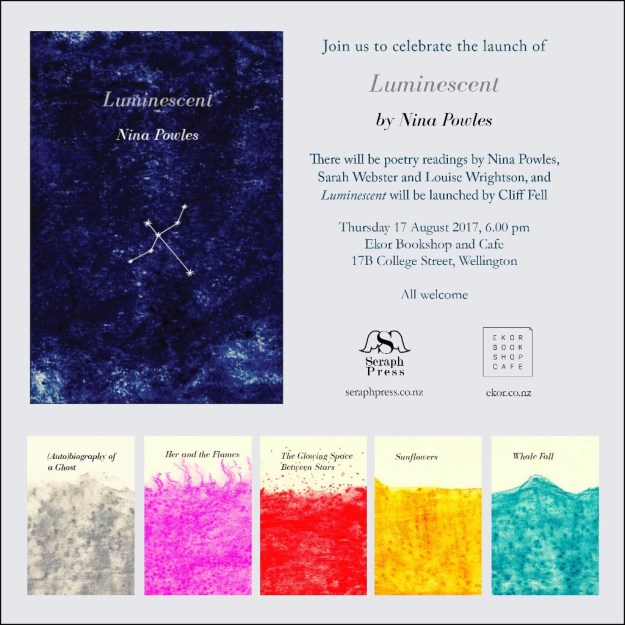
Invitation to launch of Luminescent by Nina Powles

dc10965e-f65b-4cd6-80eb-5c44f8a3eb4b.jpg06da5a13-4f07-4345-9e92-80f1401630eb.jpg

Poetry Shelf Winter Season: Ian Wedde off-piste


From ‘A hymn to beauty: days of a year’


Beauty

you’re the trouble I’m in

because there’s a lot of sweetness in my life

with that rude kind of magnificence

as when they hung Le Bateau upside down,

unusually animated and sparking.

Happy Birthday Montgomery Clift:

Where did I see this guy—in Red River

or in From Here to Eternity?

Accept and you become whole

bend and you straighten.


I hung around a little too long

I was good but now I’m gone,

I may find myself in a tight spot

but forge ahead

where satellite images show Yongbyon

and a mariner in the distance appears cordial.

Happy Birthday Betty Hutton

who is to be found in the lines and gradations

of unsullied snow

for your heart will always be

where your riches are.


They’re Justified and they’re Ancient

and they drive an ice-cream van

so do what will help

and don’t worry what others think

if King Kong premieres in New York.

In his eyes, beauty may be seen.

Happy Birthday Lou Reed,

as fast as a musician scatters sounds

out of an instrument.

One thing only do I want

to marvel there.


©Ian Wedde Three Regrets and a Hymn to Beauty (Auckland University Press, 2005)


Note for poetry shelf

In ‘Enjoyment’, the preface to Selected Poems (2017), I ‘confess to restlessness and the enjoyment of subverting my own practice’, which is one way of saying I got bored with myself and switched tracks regularly over the years. In a selection covering fourteen collections these swerves look more abrupt than they were. One place where they converge is in ‘A hymn to beauty: days of a year’, a sequence of fifty-seven sections that sampled lines from songs, the day’s horoscope advice to Librans, a ‘today in history’ clip from the Evening Post, the birthday of someone famous, a quote from the shambolic literature of the Sublime, and a religious homily. It took up 22 pages in its original covers (Three Regrets and a Hymn to Beauty, AUP 2005) and I only stopped when a sensible little voice told me to—I was having too much fun. It took me out of an autoethnography groove, it allowed me to mess around with a complex word, beauty, without being trapped by aestheticising lyric conventions, and it construed narrative meanings that had nothing to do with my intentions. Fergus Barrowman first published the whole thing in Sport 32 (Summer 2004) for which I thank him. Here are three sections, the opening one and two more picked at random with my eyes shut.


Ian Wedde’s first (very small) book was published by Amphedesma Press in 1971 and in May this year his (fairly chunky) Selected Poems was published by Auckland University Press, with artwork by John Reynolds. A small book about the art of Judy Millar, Refer Judy Millar, is just out from Wunderblock in Berlin. His essay ‘How Not To Be At Home’ is in the anthology Home: New Writing just out from Massey University Press.


From Paula: For Poetry Shelf’s Winter Season, I invited 12 poets to pick one of their own poems that marks a shift in direction, that is outside the usual tracks of their poetry, that moves out of character, that nudges comfort zones of writing. It might be subject matter, style, form, approach, tone, effect, motivation, borrowings, revelation, invention, experimentation, exclusions, inclusions, melody …. anything!


Tim Upperton critiques Manifesto Aotearoa at Pantograph Punch

Manifesto_feature.jpg


Full review here. This is terrific writing that raises issues on poetry and the whole business of political poetry.  I realise that statement is ambiguous – so take it to mean both the review and the anthology!


Two cheers for democracy: A review of Manifesto Aotearoa


‘One hundred and one political poems, by nearly one hundred and one poets – who knew we had so many? Yet it’s odd, in an anthology as generous and inclusive as this, how you notice who’s missing. It’s a shame that outstanding political poetry from the past is outside the ambit of this book – the broadsides of Whim-Wham, Glover, Baxter, Fairburn and Frame would have provided a rich historical context for this contemporary offering.

Co-editor Philip Temple rightly points out that there’s another anthology-in-waiting here. I particularly missed Bill Manhire’s ‘Hotel Emergencies,’ and among other practising poets, I also missed Helen Lehndorf, Jenny Bornholdt, Ashleigh Young, Hinemoana Baker, Stefanie Lash, Bob Orr, Tim Jones, Sarah Jane Barnett, Sam Hunt, Helen Heath, and Apirana Taylor (there’s an excerpt from Taylor’s ‘Sad joke on a marae’ in Temple’s introduction). But this is an invitation-to-submit volume rather than a survey of what’s already out there in books, magazines and online, so maybe some poets simply missed the memo. (I missed the memo.) And maybe some poets just don’t have a political poem in them. But maybe every poem is political. And if that’s too woolly and undefined, then what is a political poem, exactly?


‘Poetry on the page, in New Zealand at least, seldom raises its voice, so when it does, you prick up your ears and listen.

But the strident, raised voice of many of the poems here also bothered me.’

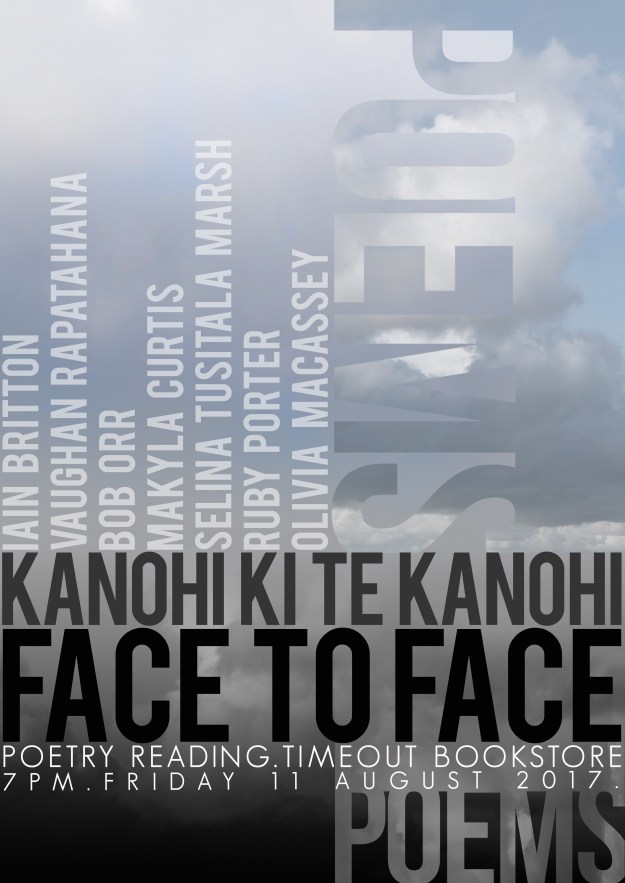
Kanohi ki te kanohi – Face to face: stellar poetry reading at TimeOut Bookstore

Face to Face Poetry Reading - Friday 11 August 2017.jpg

The Intaglio Poems.jpg

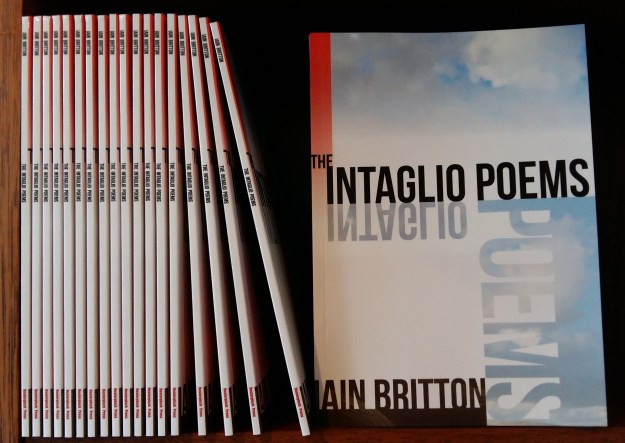
Also a chance to celebrate the arrival of Iain’s new book.

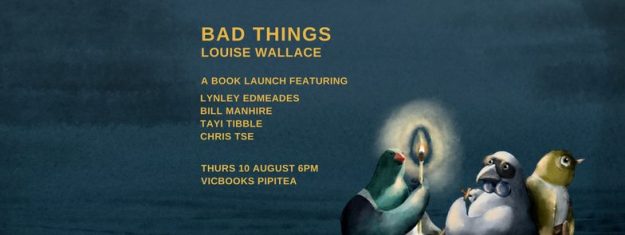
Louise Wallace & guests to launch her new collection August 10th

Sad to miss this event! Glad I get to read to the book!


20046639_10159006640045402_1957579315497457026_n.jpg


Screen Shot 2017-07-15 at 5.01.22 PM.png

Book launch for BAD THINGS: a new book of poems by Louise Wallace. With readings from Lynley Edmeades, Bill Manhire, Tayi Tibble and Chris Tse. All welcome.

Books by all authors available for purchase on the night, along with limited edition cover art prints by Kimberly Andrews.

Drink, nibble, get your books signed and be merry.

VUP page


Poets on Tour: McMillan & Beautrais at the Big House in Auckland

Screen Shot 2017-07-13 at 9.23.03 AM.png

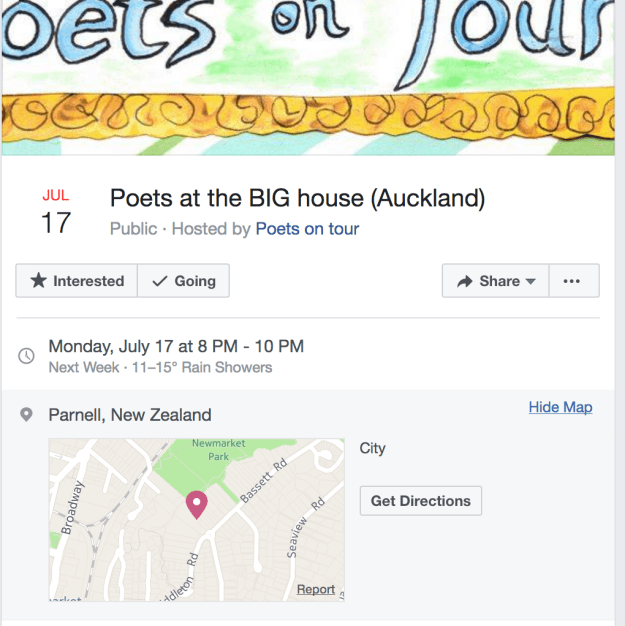
‘Poets at the big house. Airini Beautrais (brand new book ‘Flow: Whanganui River Poems’, Maria McMillan (brand new book ‘The Ski Flier’, Tulia Thompson and possibly an awesome guest who I don’t have confirmation of when I created this invite but she’s awesome and I’ll update when we know. Bring wine (or not), sit by the fire, listen to us read things, watch us perform things. We’ll sign our new books (cash sales only).’

Note from Paula: Not sure of exact address

Some details here on Facebook

Elizabeth Morton’s Wolf: ‘Wolf goes to suburbia’

9780994137821.jpg

Wolf, Elizabeth Morton, Mākaro Press, 2017


Elizabeth Morton’s debut collection is a mysterious, eye-catching, sound-catching read, with piquant detail and a poetic net that catches all manner of things – the light and the shade. I was particularly drawn to the opening sequence of poems featuring Wolf. Wolf is ‘a critter of humanity’; he is an outsider, an outcast, living on the edge and off scraps. The writing is assured, pungent and rich in atmosphere. I love the way Elizabeth deliberately slows things down, like a raconteur, so the art of the storyteller infuses the poetic line. As a reader, you pay attention to the amassing detail that startles and shines. I also like the way the lower-case letters that precede full stops is like a little hiccup or start on the line. It shifts the fluency and is akin to looking at a view where things pop in the corner of your eye.


Wolf goes to suburbia

rubbish bags hunch in
deathrow orange. yogurt pots
tickle the gutter pit.
newspapers suck asphalt.

like everything else,
Wolf is a shambles –

hide all a-scab with
the nippings of fleas.
skull abuzz with the
echoes of home-

the belchings of elk,
the titterings of muskrats.

today Wolf is a critter
of humanity.

where gophers whistled
trucks now vroom.
where hornets rattled
traffic lights now click

into the emerald of his
mother-world.

Wolf mouths his way
into a rubbish bag.

the yellow night
covers him like a rash.


© Elizabeth Morton 2017


Elizabeth Morton is a poet, fiction writer, and reviewer from Auckland. Her poetry and prose are published in New Zealand, UK, USA, Australia, Canada and online. She is the feature poet in the Poetry New Zealand Yearbook 2017. Her own poetry collection, Wolf, was published by Mākaro Press (2017). In 2013 she was winner of the New Voices Emerging Poets competition. She was shortlisted for the Kathleen Grattan Award (2015) and was, twice, 2nd place in the Sunday Star-Times Short Story Competition (2015, 2016). Her flash fiction was selected for the international anthology, The Best Small Fictions 2016.

Side-projects include: collecting obscure words, penning bad rap music, studying the brain, and exploring the coastal rock pools. She likes to write about broken things, and things with teeth.


Mākaro Press page

Emma Shi’s review at The Booksellers

from Landfall Online: Helen Lehndorf reviews Hannah Mettner and Kate Camp

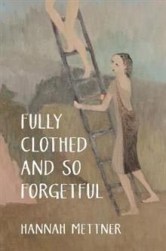
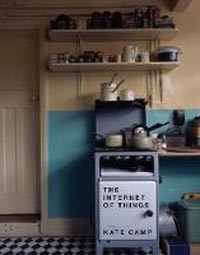
fully_clothed_and_so_forgetful_mettner.jpg     the_internet_of_things_camp_2.jpg

Fully Clothed and So Forgetful by Hannah Mettner (Victoria University Press, 2017), 91 pp., $25; The Internet of Things by Kate Camp (Victoria University Press, 2017), 61 pp., $25

One quality I love about first volumes of poetry is that they often contain an element of the poet’s origin story. Hannah Mettner’s Fully Clothed and So Forgetful certainly does: there are poems referencing childhood, relationships with siblings and wider family, elements of cultural confusion after an across-the-world move, parenthood – all described with deftness, wit and originality. How about that title? It’s a delight … inviting, and very human.

full review here

Poets on Tour: Airini Beautrais and Maria McMillan

As Rick Stein would say, we need more of this! Such a very good idea.

19467708_1052419191560472_5223254982623851632_o.jpg


From Maria and Airini:

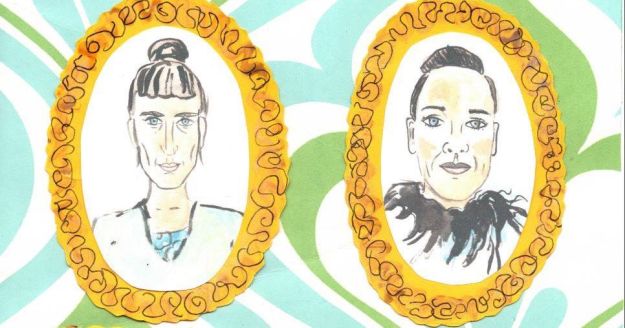
‘(Our portraits are by the wondrous Sarah Laing) Airini and Maria are going on tour in July! Like rock stars only way cooler. Napier 15th, Thames 16th, Auckland tbc, Wellington 28th, Palmerston North 29th and Paraparaumu Beach on the 30th. We’re promoting our new books: Maria‘s and Airini‘s.’

See here for details

Paula’s seven thoughts on Maria’s new book here.