Category Archives: NZ poetry

An invitation from Landing Press for poetry by migrants and those with refugee backgrounds

If you know someone that might be interested – please share. I know there are some creative writing groups that might take this up but don’t know how to contact them – Paula


Hi there,

I am writing to you on behalf of Landing Press based in Wellington.

We are working on a collection of poems by migrants and refugee-background individuals living in New Zealand and want to invite you/your organisation to send us poems. And please help us spread the word about this great opportunity.

The only requirement is that the poems must be written by migrants or refugees, whether they have lived in New Zealand for a month or fifty years.


·         You can send up to 3 poems.

·         Email them to landingpresspoems@gmail.com. Include your name and phone number.

·         Or you can post them to 97 Tireti Road, Porirua 5022. Include your name and postal address. (Keep a copy of your poem).

·         Send us your poems by Monday, 16th July.


A selection of poems will be published later in the year as a companion to a book of poetry on the themes of migrants and refugees, written by Adrienne Jansen and Carina Gallegos. Both books will be published by Landing Press. All writers whose work is included in the selection will receive a copy of the book.

Landing Press is a very small press, but we have a big vision. We believe that poetry is a powerful way in which our many voices can be heard. 

Feel free to get in touch if you have any questions.


Kind regards

Devinda Senanayake


For Landing Press
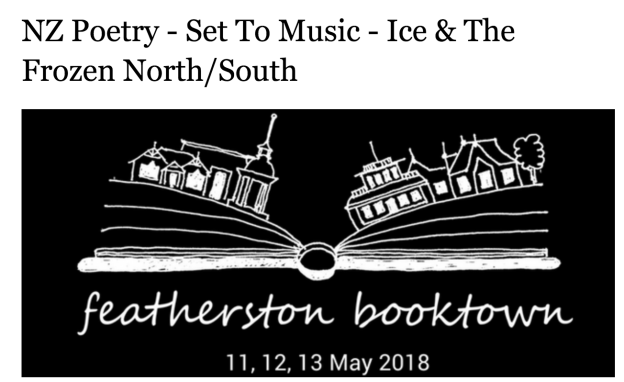
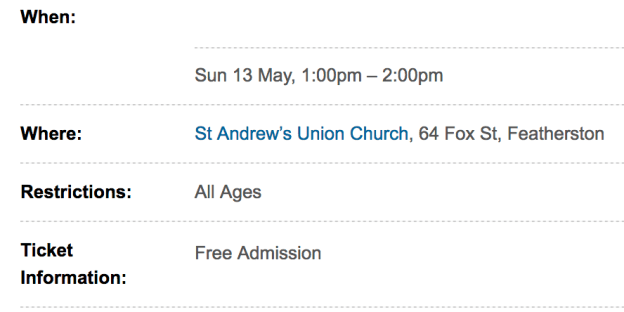
NZ poetry to set to music in Featherston

Screen Shot 2018-04-27 at 3.05.46 PM.png

Screen Shot 2018-04-27 at 3.06.09 PM.png


This year, the programme will offer a selection of Bill Manhire’s poems set as songs that speak to ice and the frozen north/south.

The themes and inspirations will be drawn from the albums Antarctica (‘These Rough Notes’) and a new album in progress that centres on themes from Nordic mythology and the frozen north (to be released as Bifrost (after the rainbow bridge that link the earth and the homeland of the gods, and that is celebrated in the Ragnarok)).

Composer and pianist, Norman Meehan, and vocalist, Hannah Griffin, have been collaborating for more than ten years, performing poetry as song. That collaboration has seen them work extensively with New Zealand’s inaugural Poet Laureate, Bill Manhire. This year they will be joined by violinist, Martin Riseley.

Entry: Koha

This is an event involved in the Featherston Booktown Festival on Friday 11th, Saturday 12th & Sunday 13th May celebrating everything to do with books, writers and reading.

The three-day programme includes writing workshops; poetry readings; talks by leading authors and illustrators; and a book fair including stalls with rare and second hand books. There are also events specifically for children while this year’s festival has a special emphasis on poetry and young adult fiction.

details here

Culture trip offers ten great NZ poets


Screen Shot 2018-04-27 at 10.46.37 AM.png


‘While New Zealand is most famous for its astounding natural beauty, friendly people and now legendary cinematic prowess, it has also been called home by some truly exceptional poets. Here’s a top 10 of New Zealanders who’ve graced the world with their poetry.’

Go here for the ten poets.


This on Janet Frame whose poetry keeps pulling me back, year after year:


Janet Frame

Janet Frame was probably one of – if not the – greatest writers that New Zealand has ever produced. More than that, she was one of the most thought provoking and powerful writers of recent times. So much so that she was frequently spoken of as a Nobel Prize candidate for literature. She was more prolifically a writer of fiction – and that was what she will be chiefly remembered for – but she also published a single book of poetry.

If you’ve never read Frame’s work then you really should. She spent about a decade in mental hospitals after being incorrectly diagnosed with schizophrenia. Of this time she wrote: “I inhabited a territory of loneliness which … resembles the place where the dying spend their time before death, and from where those who do return, living, to the world bring, inevitably, a unique point of view that is a nightmare, a treasure, and a lifelong possession …” Her poetry collection is called The Pocket Mirror.


This is a tip-of-the-iceberg kind of list! Iceberg is not exactly the best trope though.


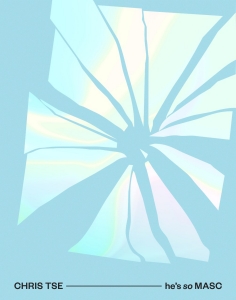
Poetry Shelf Audio Spot: Chris Tse reads ‘I want things that won’t make me happy’


1520467973785.jpg      1520467973785.jpg


Chris Tse, ‘I want things that won’t make me happy’, He’s so MASC, Auckland University Press, 2018

Auckland University Press page


Some poems from the Ockham NZ poetry finalists: Briar Wood’s ‘Kuramārōtini’


Kuramārōtini


So the story goes

that trickster Kupe

cheated his friend

into diving overboard

to free the lines

then paddled rapidly away.


Some hoa.

Best to know that

legendary navigators take huge risks

and do not make the safest companions.


Ākuanei—

she asked herself—

what do I want—

home in Hawaiki

or the travelling years?


What does he want—

the waka my father gifted—

Matahourua and me?


Or maybe unhappiness

with the man she’d married

drove her to the coast.

It’s possible—

she was curious and Hoturapa wasn’t

the kind of man who liked a journey

so she chose Kupe.


Yet even an inveterate traveller

might become weary in a waka

on the open sea,

looking out for landfall.


Travelling direct to her destination—

as the future loomed towards her

she named that radiant land

on the horizon

Aotearoa.


©Briar Wood from Rāwāhi


Briar Wood grew up in South Auckland, Aotearoa New Zealand. Until 2012, she lived and worked as a lecturer in Britain. Welcome Beltane (Palores Press, 2012) made poetic links between family histories and contemporary places. The most recent collection Rāwāhi (Anahera Press, 2017) is focused through a return to Northland places where her Te Hikutū ki Hokianga, Ngāpuhi Nui whakapapa resonates with ecological concerns.

Monday Poem: by Gregory Kan


I wanted what happened to be something

I could know

and I wanted what I knew to be something

I could describe

something to which others could say

I know this

this happened to me also.

At the back of the room is a mirror

dreaming it’s become itself at last.

I keep walking

as if I know all the parts

and could play them.


©Gregory Kan


Gregory Kan is a writer and coder based in Wellington. His poetry has been featured or is forthcoming in literary journals such as the Atlanta Review, Landfall, The Listener, SPORT and Best New Zealand Poems. His poetry and philosophical works have also featured in exhibitions and publications for contemporary art institutions such as the Auckland Art Gallery, Artspace, the Adam Art Gallery, the Dunedin Public Art Gallery and the Physics Room. Auckland University Press published his first book, This Paper Boat, in 2016. An earlier incarnation of This Paper Boat was shortlisted for the Kathleen Grattan Poetry Prize in 2013. The book was also a finalist in the Ockham New Zealand Book Awards for Best Poetry in 2017. He was a Grimshaw-Sargeson Fellow for 2017. His second poetry collection, Under Glass, is forthcoming.


National Library’s Peter Ireland on the tokotoko event for our Poet Laureate at Matahiwi


Selina with fue - 2 FLS.JPG

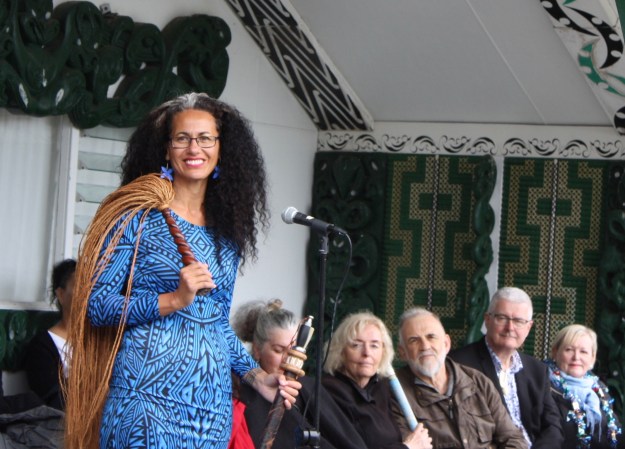
Poet Laureate, Selina Tusitala Marsh, with fue and ‘Tusitala.’ Photographer: Fiona Lam Sheung


Poet Laureate, Matahiwi, tokotoko


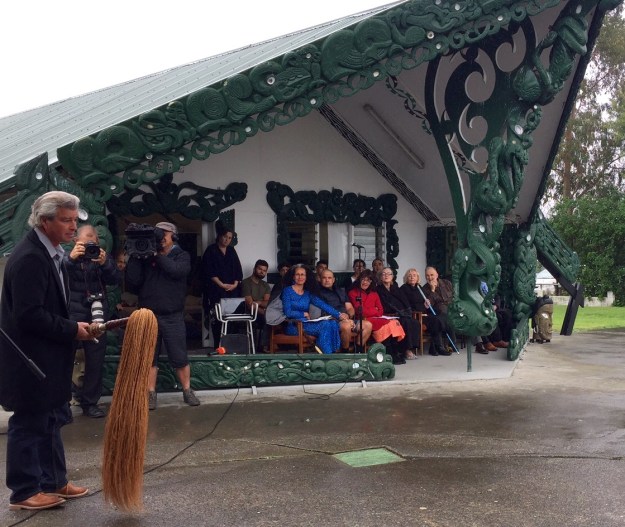
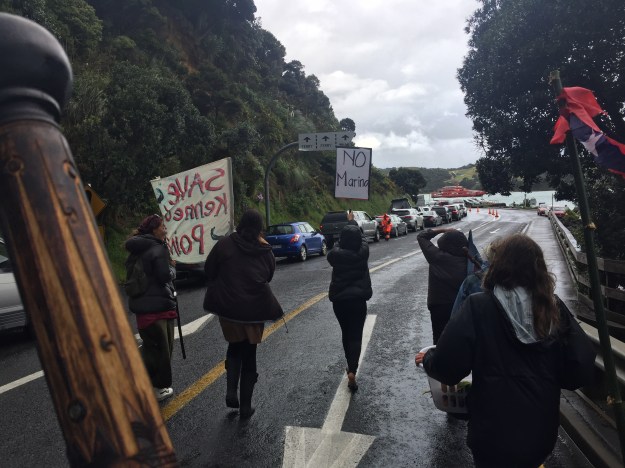
Last weekend at Matahiwi marae near Clive, Selina Tusitala Marsh received her very own tokotoko. Since her appointment as Laureate in August last year she has been inseparable from the National Library’s matua tokotoko, loaned in anticipation of Jacob Scott creating hers. During that time Selina has shared this taonga with ‘three thousand pairs of hands’ from students of St Joseph’s school in Otahuhu – on the tokotoko’s first public outing – to those of Barack Obama on his recent visit to New Zealand. It’s been on protest marches, on half marathons and has even been dunked in a river – by accident, I think. All of this is a far cry from the tokotoko’s more sedate duties of sitting in a display case at the Auckland office of the National Library, and there can be no going back now! This preamble to last weekend speaks volumes for where Selina has taken the work of the Poet Laureate; it’s ‘out there’ like never before.

John Buck of Te Mata Winery in Hawkes started all this off in 1996 when he initiated the Te Mata Estate Laureate Award. Together with the honour, each Laureate received a tokotoko and a generous stipend of wine – and still do. The National Library took over responsibility for the Laureate in 2007 and Michele Leggott was the first Laureate appointed by the Library. Michele joined Selina last weekend with friends and fellow poets Tusiata Avia and Serie Barford. Selina’s family and the National Library were there in good numbers. It was quite a party all in all.


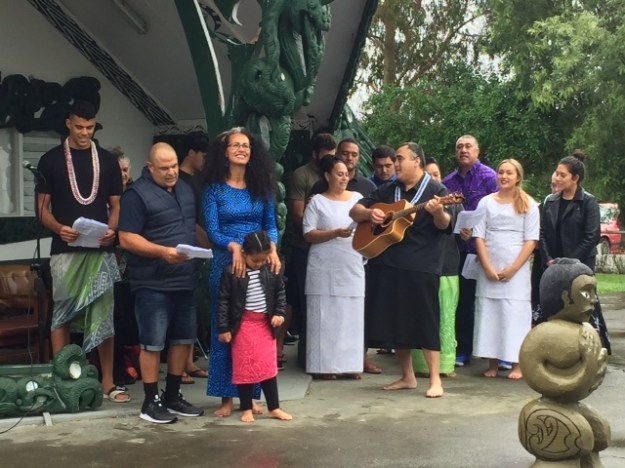
Selina and aiga on paepae EJ.JPG

Selina and family with Luka her brother with the guitar, leading a waiata. Photographer: Elizabeth Jones

Jacob - EJ.jpg

Jacob Scott having just unveiled ‘Tusitala’ before presenting it to Selina. Photographer: Elizabeth Jones


Selina has been working closely with Jacob on the creation of her tokotoko and was amazed, as we all were, with what Jacob has made. Selina’s tokotoko – ‘Tusitala’ – is carved out of maire, our heaviest indigenous wood, sharing that distinction with the matua tokotoko, to which it has other carved features in common. It is splendidly crowned with a fue or Samoan orator’s fly whisk – and clearer of the air of any unsympathetic spirits. To aid in what will undoubtedly be a lot of travel, the tokotoko is made in several sections and the fue, which was a gift to Selina from His Highness Tuiatua Tupua Tamasese Efi, unscrews off the top.

I’m restricting myself to korero about the tokotoko because it is central to the way Selina thinks of her part in the Laureate story, and it feels right to allow Selina first go at capturing the spirit of the weekend. There was poetry aplenty, there was the most talented lot of students performing in Selina’s honour, and cool days on the edge of spoiling rain held at bay I’m sure by the warmth and breadth of Selina’s smile. There was Poets’ Night Out, the public reading on Saturday night in Havelock North, another round of pizza at Pipi café, kaumatua Tom Mulligan presiding with his special brand of manaakitanga and pride in what the Laureate means for Matahiwi. It was thrilling, exhausting, scintillating, as words blazed a trail across the firmament of poetry – and I badly need for it all to happen again this weekend. Most of all there was warmth and celebration and aroha by the bucketful. To close, a salute to Selina, our brilliant ‘Fast Talking PL.’


Tokotoko for Penguins 4 from 4.jpg

Matua tokotoko in foreground joining protest against new marina on Waiheke on penguin nesting ground. Photographer unidentified.


Peter Ireland, 20 April 2018


Peter Ireland has ‘minded’ the Poets Laureate for the National Library since 2007. They seem not to have minded.


Māori television clip

NZ Herald and Hawkes Bay Today clip


Poetry Review: David Merrit’s Crisis & Duplication


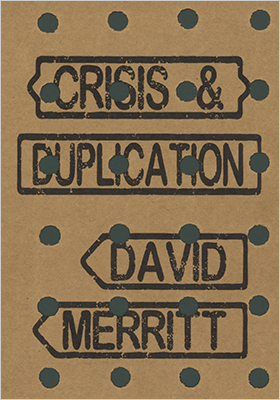
CrisisDuplicationWebcover.png


I am thinking of creating (private) lists of books to read in particular circumstances. For example what to read when you have no power or running water and can only read by candlelight after a day consumed with slow-paced domestic chores. Thrillers worked for me.

And David Merrit’s Crisis & Duplication. I sat on the couch in the grey gloom and read it three times in a row. It is a slender chapbook published by Compound Press last year.

The book is in two halves with a foldout centrepiece. The first half draws Frank Sargeson into the poet’s musing self-reflective quick-fire monologue. It is sharp, angular and surprising.


I always seem to be writing poems in Wellington

sunlight on  a cold but bright winter’s day. I will

be outside a cafe in reflected mirror glass, dodging

bullets, writing inbetween showers & dristy

mizzle.


David is musing on the mirror image: himself and Frank, the connections, the writing surges and space for improvement. It is audacious, spiky, riveting.


It’s an easy poem this, preordained, quick

off the tongue, one poet, very alive,

400 miles south for now, compares life

& times with another poet, 60 years

ago still alive & kicking, a Janet Frame

tucked away in a back shed, her glittering

far away eyes focused on her own escape,

‘cept you like me, we never escaped to

 the place they call overseas.


The second half navigates the stages of making a book – not a big press book but a grassroots number. A miniature history of desktop publishing. It is risograph printed and bound with premium banana box card. Excellent to look at and hold.


So what do I do in a mini crisis? Will I set up invented conversations with someone who has affected me (also in the garden? writing poems? reading books?)? Is the occasion of writing a poem a crisis for some? A tilt, a topple, a brief epiphany?

To what degree is a poem a duplication?

In the grey gloom with no idea when the lights would be on, the spaghetti effect of questions was extremely welcome. Then again so was the downright admiration of the words on the line.

Yes, I recommend this book highly. Power or no power.


Interview and book details at Compound Press page.