Category Archives: NZ poems

Monday Poem by Bernadette Hall


from a sonnet sequence called  Fancy Dancing


vii.

Drowning is painless, or so they say, when we die

we’ll look as though we’re sleeping. How many thousands

and thousands are sleeping now in the swollen waters

of the Mediterranean? It’s enough to break your heart.

Maggie dropped in for a drink after work

the other day. Tears in the street. I’ve given her

our mother’s lovely little blue Limoges plate.

We talked about the grandfather we’d never met,

Alexander, thrown out of the family for some reason

we are left to imagine. I found him earlier this year,

lying all on his own in an unmarked grave  in Ashburton.

You can drown in loneliness, it seems, just like in water.

We’ll put up a stone with his name on it, such a small gesture.


©Bernadette Hall


Bernadette Hall lives in a renovated bach at Amberley Beach in the Hurunui, North Canterbury. She has published ten collections of poetry, the most recent being Life & Customs (VUP 2013) and Maukatere, floating mountain (Seraph Press 2016). In 2015 shereceived the Prime Minister’s Award for Literary Achievement in Poetry. In 2016 she was invested as a Member of the New Zealand Order of Merit for services to literature.  In 2017 she joined with three other Christchurch writers to inaugurate He Kōrero Pukapuka, a book club which meets weekly at the Christchurch Men’s Prison.


An invitation from Landing Press for poetry by migrants and those with refugee backgrounds

If you know someone that might be interested – please share. I know there are some creative writing groups that might take this up but don’t know how to contact them – Paula


Hi there,

I am writing to you on behalf of Landing Press based in Wellington.

We are working on a collection of poems by migrants and refugee-background individuals living in New Zealand and want to invite you/your organisation to send us poems. And please help us spread the word about this great opportunity.

The only requirement is that the poems must be written by migrants or refugees, whether they have lived in New Zealand for a month or fifty years.


·         You can send up to 3 poems.

·         Email them to landingpresspoems@gmail.com. Include your name and phone number.

·         Or you can post them to 97 Tireti Road, Porirua 5022. Include your name and postal address. (Keep a copy of your poem).

·         Send us your poems by Monday, 16th July.


A selection of poems will be published later in the year as a companion to a book of poetry on the themes of migrants and refugees, written by Adrienne Jansen and Carina Gallegos. Both books will be published by Landing Press. All writers whose work is included in the selection will receive a copy of the book.

Landing Press is a very small press, but we have a big vision. We believe that poetry is a powerful way in which our many voices can be heard. 

Feel free to get in touch if you have any questions.


Kind regards

Devinda Senanayake


For Landing Press

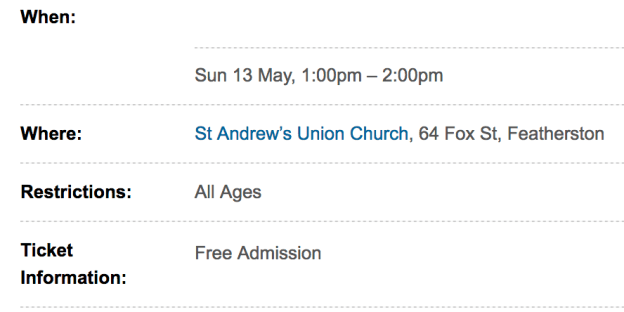
NZ poetry to set to music in Featherston

Screen Shot 2018-04-27 at 3.05.46 PM.png

Screen Shot 2018-04-27 at 3.06.09 PM.png


This year, the programme will offer a selection of Bill Manhire’s poems set as songs that speak to ice and the frozen north/south.

The themes and inspirations will be drawn from the albums Antarctica (‘These Rough Notes’) and a new album in progress that centres on themes from Nordic mythology and the frozen north (to be released as Bifrost (after the rainbow bridge that link the earth and the homeland of the gods, and that is celebrated in the Ragnarok)).

Composer and pianist, Norman Meehan, and vocalist, Hannah Griffin, have been collaborating for more than ten years, performing poetry as song. That collaboration has seen them work extensively with New Zealand’s inaugural Poet Laureate, Bill Manhire. This year they will be joined by violinist, Martin Riseley.

Entry: Koha

This is an event involved in the Featherston Booktown Festival on Friday 11th, Saturday 12th & Sunday 13th May celebrating everything to do with books, writers and reading.

The three-day programme includes writing workshops; poetry readings; talks by leading authors and illustrators; and a book fair including stalls with rare and second hand books. There are also events specifically for children while this year’s festival has a special emphasis on poetry and young adult fiction.

details here

Culture trip offers ten great NZ poets


Screen Shot 2018-04-27 at 10.46.37 AM.png


‘While New Zealand is most famous for its astounding natural beauty, friendly people and now legendary cinematic prowess, it has also been called home by some truly exceptional poets. Here’s a top 10 of New Zealanders who’ve graced the world with their poetry.’

Go here for the ten poets.


This on Janet Frame whose poetry keeps pulling me back, year after year:


Janet Frame

Janet Frame was probably one of – if not the – greatest writers that New Zealand has ever produced. More than that, she was one of the most thought provoking and powerful writers of recent times. So much so that she was frequently spoken of as a Nobel Prize candidate for literature. She was more prolifically a writer of fiction – and that was what she will be chiefly remembered for – but she also published a single book of poetry.

If you’ve never read Frame’s work then you really should. She spent about a decade in mental hospitals after being incorrectly diagnosed with schizophrenia. Of this time she wrote: “I inhabited a territory of loneliness which … resembles the place where the dying spend their time before death, and from where those who do return, living, to the world bring, inevitably, a unique point of view that is a nightmare, a treasure, and a lifelong possession …” Her poetry collection is called The Pocket Mirror.


This is a tip-of-the-iceberg kind of list! Iceberg is not exactly the best trope though.


Poetry Shelf Audio Spot: Chris Tse reads ‘I want things that won’t make me happy’


1520467973785.jpg      1520467973785.jpg


Chris Tse, ‘I want things that won’t make me happy’, He’s so MASC, Auckland University Press, 2018

Auckland University Press page


Some poems from the Ockham NZ poetry finalists: Briar Wood’s ‘Kuramārōtini’


Kuramārōtini


So the story goes

that trickster Kupe

cheated his friend

into diving overboard

to free the lines

then paddled rapidly away.


Some hoa.

Best to know that

legendary navigators take huge risks

and do not make the safest companions.


Ākuanei—

she asked herself—

what do I want—

home in Hawaiki

or the travelling years?


What does he want—

the waka my father gifted—

Matahourua and me?


Or maybe unhappiness

with the man she’d married

drove her to the coast.

It’s possible—

she was curious and Hoturapa wasn’t

the kind of man who liked a journey

so she chose Kupe.


Yet even an inveterate traveller

might become weary in a waka

on the open sea,

looking out for landfall.


Travelling direct to her destination—

as the future loomed towards her

she named that radiant land

on the horizon

Aotearoa.


©Briar Wood from Rāwāhi


Briar Wood grew up in South Auckland, Aotearoa New Zealand. Until 2012, she lived and worked as a lecturer in Britain. Welcome Beltane (Palores Press, 2012) made poetic links between family histories and contemporary places. The most recent collection Rāwāhi (Anahera Press, 2017) is focused through a return to Northland places where her Te Hikutū ki Hokianga, Ngāpuhi Nui whakapapa resonates with ecological concerns.

Monday Poem: by Gregory Kan


I wanted what happened to be something

I could know

and I wanted what I knew to be something

I could describe

something to which others could say

I know this

this happened to me also.

At the back of the room is a mirror

dreaming it’s become itself at last.

I keep walking

as if I know all the parts

and could play them.


©Gregory Kan


Gregory Kan is a writer and coder based in Wellington. His poetry has been featured or is forthcoming in literary journals such as the Atlanta Review, Landfall, The Listener, SPORT and Best New Zealand Poems. His poetry and philosophical works have also featured in exhibitions and publications for contemporary art institutions such as the Auckland Art Gallery, Artspace, the Adam Art Gallery, the Dunedin Public Art Gallery and the Physics Room. Auckland University Press published his first book, This Paper Boat, in 2016. An earlier incarnation of This Paper Boat was shortlisted for the Kathleen Grattan Poetry Prize in 2013. The book was also a finalist in the Ockham New Zealand Book Awards for Best Poetry in 2017. He was a Grimshaw-Sargeson Fellow for 2017. His second poetry collection, Under Glass, is forthcoming.


Poetry Review: David Merrit’s Crisis & Duplication


CrisisDuplicationWebcover.png


I am thinking of creating (private) lists of books to read in particular circumstances. For example what to read when you have no power or running water and can only read by candlelight after a day consumed with slow-paced domestic chores. Thrillers worked for me.

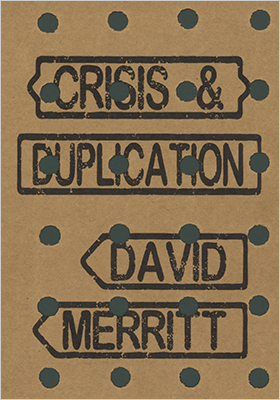
And David Merrit’s Crisis & Duplication. I sat on the couch in the grey gloom and read it three times in a row. It is a slender chapbook published by Compound Press last year.

The book is in two halves with a foldout centrepiece. The first half draws Frank Sargeson into the poet’s musing self-reflective quick-fire monologue. It is sharp, angular and surprising.


I always seem to be writing poems in Wellington

sunlight on  a cold but bright winter’s day. I will

be outside a cafe in reflected mirror glass, dodging

bullets, writing inbetween showers & dristy

mizzle.


David is musing on the mirror image: himself and Frank, the connections, the writing surges and space for improvement. It is audacious, spiky, riveting.


It’s an easy poem this, preordained, quick

off the tongue, one poet, very alive,

400 miles south for now, compares life

& times with another poet, 60 years

ago still alive & kicking, a Janet Frame

tucked away in a back shed, her glittering

far away eyes focused on her own escape,

‘cept you like me, we never escaped to

 the place they call overseas.


The second half navigates the stages of making a book – not a big press book but a grassroots number. A miniature history of desktop publishing. It is risograph printed and bound with premium banana box card. Excellent to look at and hold.


So what do I do in a mini crisis? Will I set up invented conversations with someone who has affected me (also in the garden? writing poems? reading books?)? Is the occasion of writing a poem a crisis for some? A tilt, a topple, a brief epiphany?

To what degree is a poem a duplication?

In the grey gloom with no idea when the lights would be on, the spaghetti effect of questions was extremely welcome. Then again so was the downright admiration of the words on the line.

Yes, I recommend this book highly. Power or no power.


Interview and book details at Compound Press page.


At Jacket 2: Vaughan Rapatahana interviews Robert Sullivan and includes new poems

Vaughan Rapatahana’s interview here


What would you like to see more of in Aotearoa poetry from your point of view as a poet? In other words is there sufficient recognition, publishing scope, critical space given to poets who craft their work in ‘different’ ways?

I’d love to see new voices find publication from a wide range of styles and personal backgrounds so that we reflect our diverse community in terms of race, class, gender, sexuality, and beyond to be as inclusive as possible. Poets have never had greater access to media and to publishing than now, although our mainstream publishers no longer have deep pockets. It’s always a writer’s task to convince, or make curious, or satisfy, or entertain a readership, and it’s a lyric poet’s task to evoke the particulars of being and a sense of the flow state that created the feelings attached to being ‘somewhere’ at the time. A poem might be on the fridge next to a flat roster, or on the edge of a windswept cliff facing the ghosts of Kapiti Island. There are so many other kinds of poetry I wouldn’t know where to begin, except to encourage that too.


Paula: I am dead keen to see a new book of poetry – love the new ones.


Poems from the Ockham NZ Book Award poetry shortlist: Tony Beyer’s ‘The Characters’


The Characters


a comfort to think

that in Nagano where


typewriters used to be made

they still remember


Bashō’s visit and the long-

expired snow he came to view


each snow flake

then as now unique each


fluent stroke of the brush

comprehensible but singular


© Tony Beyer from Anchor Stone


Tony Beyer was born and grew up in Auckland, and now lives in Taranaki after a career as a secondary school teacher in several parts of the North Island. His seventeen poetry titles include Jesus Hobo (Caveman Press, 1971), The Singing Ground (The Caxton Press, 1986), The Century (HeadworX, 1998), Electric Yachts (Puriri Press, 2003), Dream Boat: selected poems (HeadworX, 2007) and Anchor Stone (Cold Hub Press, 2017). His work has been widely published, anthologised and reviewed in New Zealand and elsewhere.