Category Archives: NZ author

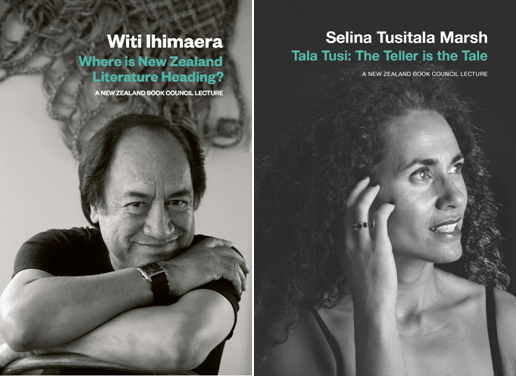
Read the 2015 & 2016 NZBC Lectures – Witi and Selina


Capture.135517.PNG

 
from NZBC:

The New Zealand Book Council Lecture has become a prominent part of the literary landscape in Aotearoa New Zealand. It provides an opportunity for one of our country’s leading writers to discuss an aspect of literature close to their heart.

The Lecture seeks to enlighten – and also provoke. As James K. Baxter said: “It is reasonable and necessary that… every poet should be a prophet.”

Our 2016 prophet is Pasifika poet and scholar, Selina Tusitala Marsh. Not only is she an accomplished writer and teacher on the national and international stage, Selina is a feisty, restless, generous, collegial and unique contributor to Aotearoa New Zealand’s sense of itself – as a culture and as a country.

This is the third recent Book Council lecture. Eleanor Catton gave the 2014 Lecture, and in 2015 Witi Ihimaera confronted us with the question: What new New Zealand will our writers write into existence? Selina, in her 2016 Lecture, gives us the beginning of an insightful and original answer.

Read Witi and Selina’s NZBC Lectures here.

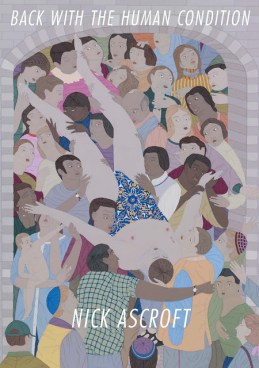
Pantograph Punch reviews Nick Ascroft’s new poetry collection

backwiththehumancondition

for the full review by Airini Beautrais go here

Junctures and Meaning: A review of Back With the Human Condition by Nick Ascroft

Nick Ascroft has garnered a reputation as a comic poet, and rightly so: anyone who’s seen him in performance can attest to the hilarity of his lines.

Back With the Human Condition, Ascroft’s third collection of poetry, is studded with highly entertaining and performable pieces. There’s ‘Juju,’ an ode to a fabulous haircut; ‘The Lord of Work,’ a list or litany poem with a punchline ending; ‘Five Character Descriptions I Am Too Lazy to Novelise,’ which shifts between the nonsensical and the macabre; and ‘Waiting For the Toast to Pop,’ the best poem on the subject of toast I have come across.

Comedy’s not the only string to Ascroft’s poetic bow. While many of the poems are clearly the work of a humourist, I also had the strong sense throughout of being in the company of a semiotician. This feeling continued with the poem titled ‘Never Was a Semiologist.’ With a background in linguistics, Ascroft is clearly interested in signifier and signified, and many poems in the collection eschew accessibility for complicated plays-on-words.

Escalator Press debuts its first poetry book


Everything-is-here-Web-Cover-72dpi-202x300.jpg

Not just some poetry hack

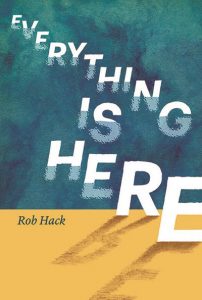
Everything is here is Rob Hack’s first collection of poems. It explores his relationship to his Rarotongan heritage as well as his connection to Niue and New Zealand, and the places where his family lived when he was growing up.

Award-winning New Zealand poet Dinah Hawken describes Everything is here as: “…stories from Porirua East, Niue, Paris, Rarotonga, Sydney, the Kapiti Coast; stories told in spare, accessible poems that are both strongly placed, and full of people and day-to-day things. What delightfully holds everything together is Rob’s easy tone and his characteristic, understated humour.”

Hack is a graduate of the Whitireia Creative Writing Programme and completed his Masters at the International Institute of Modern Letters, Victoria University, and is also a jack-of-many-other-trades.

This is the first book of poetry from Escalator Press. The cover is designed by internationally renowned graphic designer Sarah Maxey.


About the author

Rob Hack was born in Invercargill. His mother was from the Cook Islands and his father from New Zealand. He’s worked as an insurance salesman, greenkeeper, builder, night shift worker, personal trainer, cattle station worker and more. He currently spends his handyman earnings on petrol to visit his grandchildren each week and on second-hand poetry books. He’s lived in Paekakariki since 2005 and has performed his poems in Kapiti and Wellington for 15 years. Rob hosts a poetry show on Paekakariki FM called ‘Not at the Table: poetry and stuff ’.

About Escalator Press

Escalator Press is an imprint set up by the Whitireia Creative Writing Programme, and publishes work by new and established writers associated with Whitireia. With production and marketing by the Whitireia Publishing Programme – New Zealand’s highly regarded training course for the publishing industry – Escalator Press is built on traditional publishing values, whether in print or digital media, while developing its own distinctive model and publishing exciting new voices.


Emma Neale and Sarah Jane Barnett in conversation on Pantograph Punch

9780143770053

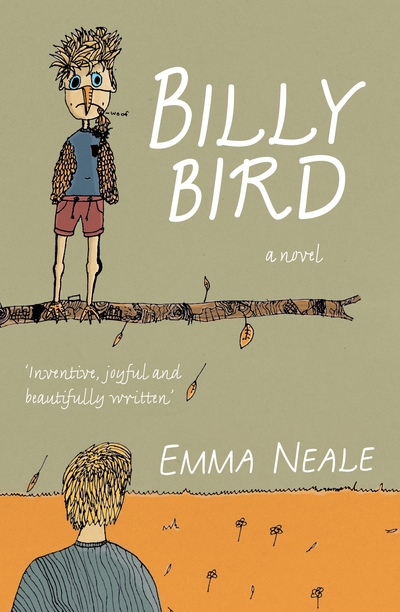
Billy Bird is such a terrific novel; it grips you tight with its poignant family tensions, its heartache boy at the centre, its sweetly crafted sentences. I loved it. I would be disappointed not see it on the forthcoming book-award fiction list as it has been one of my favourite reads of the year.

Hot off the press: Sarah Jane Barnett is the new Books Editor at Pantograph Punch – it is relaunching today! Great news. And a great interview to relaunch with!


Here is the start of an interview that explores the novel (among other things!). Full interview here.

Sarah Jane Barnett: First, a belated congratulations for the long listing your poetry collection Tender Machines at the 2016 Ockham Awards. It’s a beautiful collection. You’ve also recently launched a new novel Billy Bird, which – among many things – is about a family, a tragic event, and a young boy who takes on the persona of a bird. One of the reasons that I find your work so exciting is the way you write honestly and unabashedly about families. It took me a long time to feel comfortable writing about being a parent, possibly because the experience is as tough and brutal as it is joyous. It felt exposing, but in the end unavoidable. How, emotionally, did it feel to write Billy Bird?

Emma Neale: I understand the reluctance to write about parenthood, actually: a number of hesitations can turn people away from it as a subject. I’ve talked to writers who want their creative life to be a complete break from parenthood, as they find its contradictions, frustrations and sheer exhaustion too debilitating to revisit on the page; to writers who go in fear of the personal, full stop; or who agonise over what their own children will think of the work when they’re adults; or who fear that their work will be dismissed as ‘only’ domestic.

For me, the experience of parenthood has at times been so dividing, so challenging and shaking – potentially major early health issues for our children as babies; postnatal depression; pulling through that and wanting to be as present for the children as possible, but also to keep up some form of intellectual and creative life, and make a financial contribution (however small) to the family; that I found that even when I had carved out solitude for writing, there was so much teeming around in my head about family dynamics, and childhood development, that frequently these subjects jostled out others.

On the other hand, I’ve always been interested in how identity is shaped by our early family environments – and my own role as a mother was inevitably going to be ‘field research’! I also think, as time has gone on (one son is 14, one is nearly 7), I’ve been more able to see that each phase in their lives truly is a phase. Moments of crisis don’t have to signal permanent disaster. Some of the vulnerabilities and fears of early motherhood have just naturally dissipated as I’ve watched the children grow into confident, humorous, thoughtful, warm, wacky, creative adventurers.
img_3702

Glenn Colquhoun’s new book

BWB7760_Text_Cover_LateLove_High Res-1.jpg


E-Tangata published an extract from Glenn’s new book. For the full extract go here.


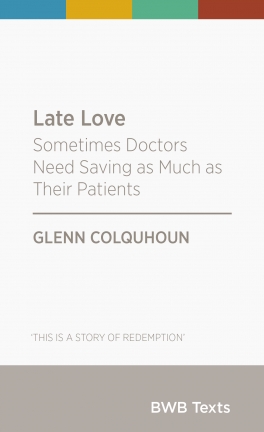
In this extract from his new book Late Love: Sometimes Doctors Need Saving as Much as Their Patients, he writes about how his poetry has leaked into his medicine, and changed the way he practises. 


The High Chaparral

For most of my career medicine has not been so friendly. I have struggled with doubt. I have always felt that at any point I might do the wrong thing. For a long time this meant that consultations were noisy with my own thoughts. Life was lived in two parts. In one I would go to work and be unsure and struggle with the waiting room and paper trails and fires popping up. In the other I would imagine. I would dream that I could fly. I would soar up over the world like a young seagull and look down and be amazed. Moments would open up like a ranch slider. Inside I found they were timeless. Poetry was good and medicine was bad. I joked that poetry was the first girl I ever loved, the one I always wanted but never felt confident enough to ask out, and that medicine was the girl I got pregnant behind the bike shed and thought I had to make an honest woman of.

A few years ago I began to compile a book based on the stories of a group of patients I saw over the course of one day in general practice. For a year I visited as many of them as I could and asked them about their lives leading up to that consultation. I saw them in their homes and among those things they cared about, then afterwards flew up into the sky like a seagull with an old piece of string and looked down. When I came to write about them I saw them with wet eyes — the sort of love that poetry demands of those who write it.


Copyright © 2016 Glenn Colquhoun

This is an extract from Glenn Colquhoun’s book Late Love: Sometimes Doctors Need Saving as Much as Their Patients, published by Bridget Williams Books.

e-letter

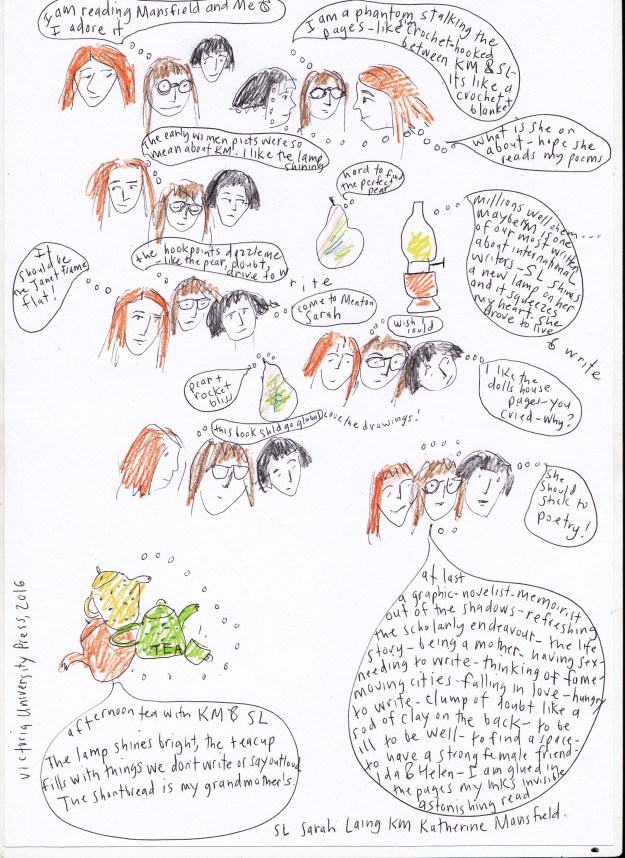
Sarah Laing’s Mansfield and Me is a breath of fresh air. I wanted to write about it for my book but also for the blog, in a different way, so decided, somewhat self-consciously to draw myself into my reading because I felt stitched into the book as I read. Maybe it’s because this is as much about two writers struggling with words, wanting to be noticed and slipping on self-doubt as it is about trying to live. I felt like a tracing paper sheet laid over the pages. What I want to shout out loud is that this wonderful refreshing view on life & writing & motherhood & Mansfield & Laing is turning over a new leaf for us. Mansfield and Woolf wanted to showcase a new way of writing – Sarah has picked up that torch. This is groundbreaking. It deserves an international audience.

Congratulations: Airini Beautrais wins Landfall Essay Competition 2016

Airini Beautrais.jpg


Airini Beautrais has been named the winner of the 2016 Landfall Essay Competition for her essay ‘Umlaut’.

Competition judge David Eggleton said that her essay stood out as ‘written by someone unwilling to be boring, willing to take risks, and enough of a seasoned practitioner to carry it off with sustained verve’:

‘Umlaut’ is dextrous, exuberant and comical, if sardonic. It’s an account of the vexing business of unusual names and the thorny encounters they can provoke in this country with bureaucracy, with the insular-minded, with the proudly ignorant. It’s about the absurdities of modern life: how we negotiate otherness, how we negotiate our constantly revised colonial heritage on a daily basis. Sometimes verging on slapstick, nevertheless it’s a tour de force of a kind.


Airini Beautrais says she had thought that the umlaut in her children’s surname would make a good subject for a poem: ‘But the notes I put together seemed to lend themselves to an essay. As I wrote it and considered the issues around names, language and culture I found a lot of anger surfaced, but also a lot of humour. I was surprised how emotional this piece of writing became for me.’

Airini has published three books of poetry: Secret Heart (2006, winner of the NZSA Jessie Mackay award for best first book of poetry at the 2007 Montana New Zealand Book Awards), Western Line (2011) and Dear Neil Roberts (2014, longlisted for the 2016 Ockham New Zealand Book Awards). She holds a PhD in Creative Writing from the International Institute of Modern Letters and her poetry and short fiction has appeared in a range of print and online journals. In 2016 she was shortlisted for the Sarah Broom poetry prize. Airini lives in Whanganui with her partner and two children.


The Landfall Essay Competition is judged ‘blind’ by Landfall editor David Eggleton. The winner receives $3000 and a year’s subscription to Landfall. There were 51 essays submitted for the 2016 competition.

Michalia Arathimos came second, and third place went to Carolyn Cossey. The three essays will be published in Landfall 232 in November.