
Full piece and a few poems here
Bob Orr has been a well-regarded New Zealand poet for several decades, having eight collections of poetry produced to date, with a new collection due out soon. He is also rather different to so many ‘modern’ poets, in that he has always paddled his own poetic waka (or canoe) in and through his own currents. Oaring across his own ocean, if you will.
Bob never completed any tertiary education. He never attended any university ‘creative writing’ classes in an endeavour to craft his poetry ‘better.’ Up until very recently, when he was the 2017 University of Waikato Writer in Residence, he eschewed any applications for literary grants. He rarely, if ever, uses a computer to write with or on — he doesn’t even have an email address. Indeed, he continues to write with an old style ribbon-fed typewriter. Bob Orr is a bit of a Luddite — all of which ensures that his stream of poetry flows deep from his heart and mind and is never obfuscated by the trends, tropes, and trivialities of the latest poetic fad. Like another key New Zealand poet, Sam Hunt, Bob Orr has always remained a people’s poet, by which I mean, a writer who keeps it simple, who never overreaches into pretentiousness and amorphous cleverdickism.
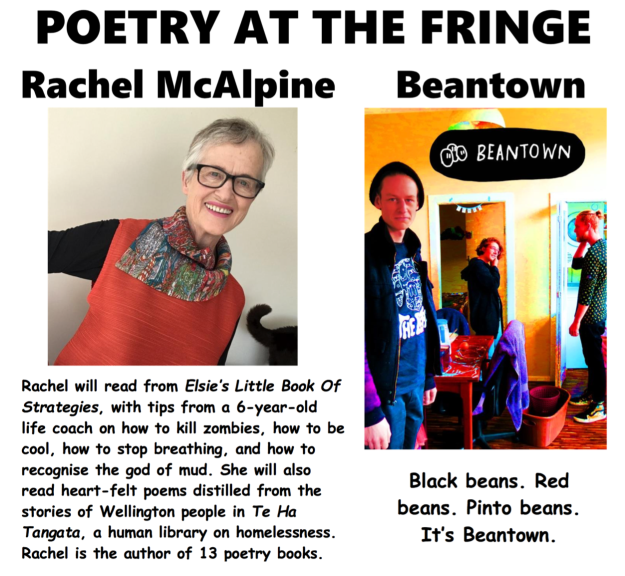
Great news for Rachel McAlpine. Full post here
From Rachel:
I am excited and honoured to have been chosen as one of the writers in residence at Yeonhui Art Space in Seoul for the month of September. Everything about this residency gives me such a buzz.
One of My Baxter Poems
(from Moth Hour)
Coming down off the spine of the Botanical Gardens
onto the green flank of the dragon, shadows arch
under my feet. In the dell below, the shell-shaped stage
is strewn with red Camelias. November
and across the valley on the dense dark Tinakori hill
houses begin to light up like Guy Fawkes.
At the top of Patanga Crescent the pared-down villa
trembles with young men thinking,
pens lost in the wide sleeves of their dead uncles.
They are ecstatic and do everything extravagantly
in the last light: read, drink, fuck.
On the windowsill – a stone, leaf, a twig with buds,
and the black cat left behind mewling by the old lady
now in the Home of Compassion. No change.
©Anne Kennedy
Anne Kennedy’s new novel The Ice Shelf is due from VUP in October. She teaches writing at Manukau Institute of Technology.
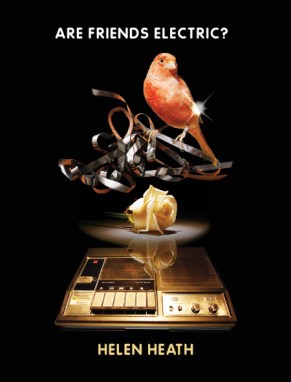
Wonderful conversation, wonderful book, plus the joys of reading Fleur Adcock.
‘This episode I caught up with poet, essayist and teacher Helen Heath. Helen recently published an astounding collection of poetry which poses the question Are Friends Electric? We got together to talk about Fleur Adcock’s poem ‘Gas’, first published in her 1971 collection High Tide in the Garden and it’s also available in Fleur Adcock Poems 1960-2000, and Helen’s exciting new book.’
Listen here

full piece here
In the story of the Trojan Horse, after a ten-year siege, the Greeks pretend to sail away and leave a “gift” of a wooden horse on the doorstep of the city of Troy. The Trojans pull the horse into their city. But, under the cover of night, a select force of men creep out of it, torching the city, and thus winning the war for the Greeks.
I am a Greek-New Zealand writer and I am building a horse like this — or, more accurately, I’m allowing it to build itself.
But, in this story, the Trojan Horse is a non-fiction book that I’m writing about the media in Aotearoa — and the warriors are writers. Māori writers, Pasifika writers, French and Chinese and “other” writers. Any writers that haven’t been identified by the press as part of a Pākehā mainstream.
And the city of Troy is Pākehā culture, which I envisage in this book as a walled fortress. In front of this fortress, the horse is taking shape. There are voices clamouring inside it, about to be let out.
The voices belong to some of Aotearoa’s foremost writers: Tusiata Avia, Tina Makereti, Chris Tse, Paula Morris, and Karlo Mila, among many others, who I’ve interviewed for my upcoming book, The Outliers: Who do we want to be?

Founded from her central Wellington flat in 2016, Mimicry was born from Holly’s enthusiasm for her friend’s creative endeavours and desire for a forum that published work just for the sake of it. Self-described as “Aotearoa’s most playful journal”, Mimicry was intended from the outset to be, almost subversively, relaxed, organic, and unintimidating.
Working at Victoria University Press as an editor at the time, Holly had valuable insights into the operation of New Zealand’s literary community. This put her in a prime position to just create the exact kind of publication she wanted herself. She was prepared to be reckless and sink money and time into something new, to test the waters of what she could do and how she could showcase the works of people she admired.
full piece here
We talked to Helen about poetry that has been meaningful to her over the years, and why poetry isn’t just for weddings and funerals.
Is there anything about NZ poetry that sets it apart do you think?
I think our poetry is often very funny. I love the self-awareness and self-deprecating humour in a lot of New Zealand poetry.
Regarding poets who write about the natural world from their lived experience, I think New Zealand poets have a way of enmeshing ‘nature’ and self in their work which speaks to how interconnected many of us (New Zealanders) are with our environment.
I could be biased, but I also think New Zealand poetry is of a consistently high standard.
Full conversation here


 NZ Poetry Shelf