
The Letter from Rilke
Did you get the moon?
(I ask) as you come in
in your hoodie with your tripod.
You laugh. Recall another evening.
When you did ‘get the moon.’
Nice to see the sky. Okay. True.
Clock ticks. One always looks
for a total time of ecstasy
called writing. Taking a photo
it’s all there – or it’s not.
But even to trace letters
has no immediacy. It’s
like the moon rising.
There. You said. Some trace
of old enormity beckons.
The jug is heating up.
Footsteps. Water pump. Floorboards
shaking. I peel off
the outer layer of my insistence.
There is a letter from Rilke
underneath. As if it were a
landscape on the skin. He writes
about how it is impossible for
anything to escape itself. The sea
burnished with the full moon
blue of hyacinths. When you
look into them.
© Murray Edmond Shaggy Magpie Songs Auckland University Press, 2015
Author Bio: Murray Edmond was born in Hamilton in 1949. He has published thirteen books of poems. Letters and Paragraphs (1987) and Fool Moon (2005) were New Zealand Book Awards finalists. His latest volume of poems is Shaggy Magpie Songs (2015) from Auckland University Press. A collection of fiction, Strait Men and Other Tales, will be published by Steele Roberts in October 2015. His collection of critical writings, Then It Was Now Again: Selected Critical Writing was published by Atuanui Press in 2014. A study of Noh theatre and the Western avant-garde, Noh Business, was published by Atelos Press in California in 2005 and the long poem A Piece of Work was published by Tinfish Press in Hawai’i in 2002. He co-edited the anthology Big Smoke: New Zealand Poems 1960–1975 (AUP, 2000); and is the editor of the peer-reviewed, online journal of poetics Ka Mate Ka Ora: A New Zealand Journal of Poetry and Poetics. Since the 1970s, Edmond has been active in experimental and innovative theatre companies and for over 25 years taught theatre and drama at The University of Auckland, retiring from his position as Associate Professor of Drama at the end of 2014. He works as the dramaturge for Indian Ink Theatre Company, whose latest play, Kiss the Fish, was awarded Best New Play of 2014 in the Chapman Tripp Awards.
Note from Paula: Reading a Murray Edmond poem is like entering a linguistic harbour – you are held by the sway and slip of words, the way that sharp sea air alerts your senses, rejuvenates skin and eye and ear. He is the master of word play but the coils and overlaps and skids never feel stuck in exercise mode. This word play is infectious. It nourishes the gap and supports the bridge. Beneath the surface there is always heart, and with that subterranean heart, these are poems that matter.
Moons are a favoured motif in this collection and others. Mysterious; a drawcard in the pitch black of night or a poem or a myth or mood. The first line startles in its punning sidetracks (‘Did you get the moon?’). The last lines startling in their pitch for beauty. In between, gossamer threads that make silvery links between things. Luminous. Eye catching. In the heart of the poem, a relationship. And then another. A letter read. Under the skin; a poet, a lover perhaps. Like a boat under the milky moon you slip and sway upon the crest of the poem. It haunts. Lines stick like glue (‘I peel off/ the outer layer of my insistence’ ‘As if it were a/ landscape on the skin’). Do you get the poem? Jammed packed as it is with light and dark, everyday detail (Floorboards/ shaking’). The line that sends you between the lines (‘He writes/ about how it is impossible for/ anything to escape itself’). Get – arrivals. Glorious.
Auckland University Press page
NZ Book Council page
nzepc page
Stone
Stony this, stony that. They are cold
today, these stones on the desk.
Stone cold. Stone blind. Stone deaf.
Heart, reception, stare, silence.
They remember the slingshot.
It is said he is a man to reckon with.
He hasn’t spoken to his son for years.
It is said that words will never hurt you.
‘To be hard in hard times,’ he announces,
‘we must build an expressway like an arrow
through the quiet heart
of your coastal town.’ Cold facts
say one thing, cold politics another.
We remember the ballistic missile.
The falling debris and the striking edge.
© Dinah Hawken Ocean and Stone Victoria University Press, 2015
Author bio: Dinah Hawken is one of New Zealand’s most critically acclaimed poets. Born in Hawera in 1943, she trained as a physiotherapist, psychotherapist and social worker in New Zealand and the United States. Most of the poems in her award-winning first collection It Has No Sound and Is Blue (1987) were written in New York in the mid-1980s while she was studying at Brooklyn College and working with the homeless and mentally ill. Her two most recent books, One Shapely Thing: Poems and Journals (2006) and The Leaf-Ride (2011), were both shortlisted for the New Zealand Book Awards. Dinah was named the 2007 winner of the biennial Lauris Edmond Award for Distinguished Contribution to Poetry in New Zealand. She lives in Paekakariki.
Note from Paula: This poem is in Dinah’s new collection just out from Victoria University Press. It is an utterly beautiful book in every detail (the feel of the pages, the choice of font, the simplicity of the cover and of course the billowing beauty of the poems themselves. I have been a Dinah-Hawken fan for a long time. I remember the pleasure of writing a long essay on Small Stories of Devotion as part of my Masters degree. There has been a sustaining chord between Dinah’s work and my writing since those far-off days. In part it is to do with the grace, the elegance, the economy, the lyricism. In part it is to do with the sumptuous view that settles as you open the window of the poem. In part it is the curious self that questions the world and the way we do things.
This poem is a thing of beauty, and it draws upon all the things I have detailed above. There is the lyricism that builds out of stress, meter and repetition (‘Stone cold. Stone blind. Stone deaf.’) There is the way a thing (stone) shakes with life and possibility. There is the way, with that small frame of the window ajar, we fall upon the beauty of an object (a stone) and then fall away to the hurt we inflict upon each other — at the level of the individual, the level of a town, the level of a nation. It really is the kind of poem that needs to speak for itself, to shimmer on the page in its own marvelous way. Its window catches any number of lights.
Victoria University Press page
NZ Book Council page
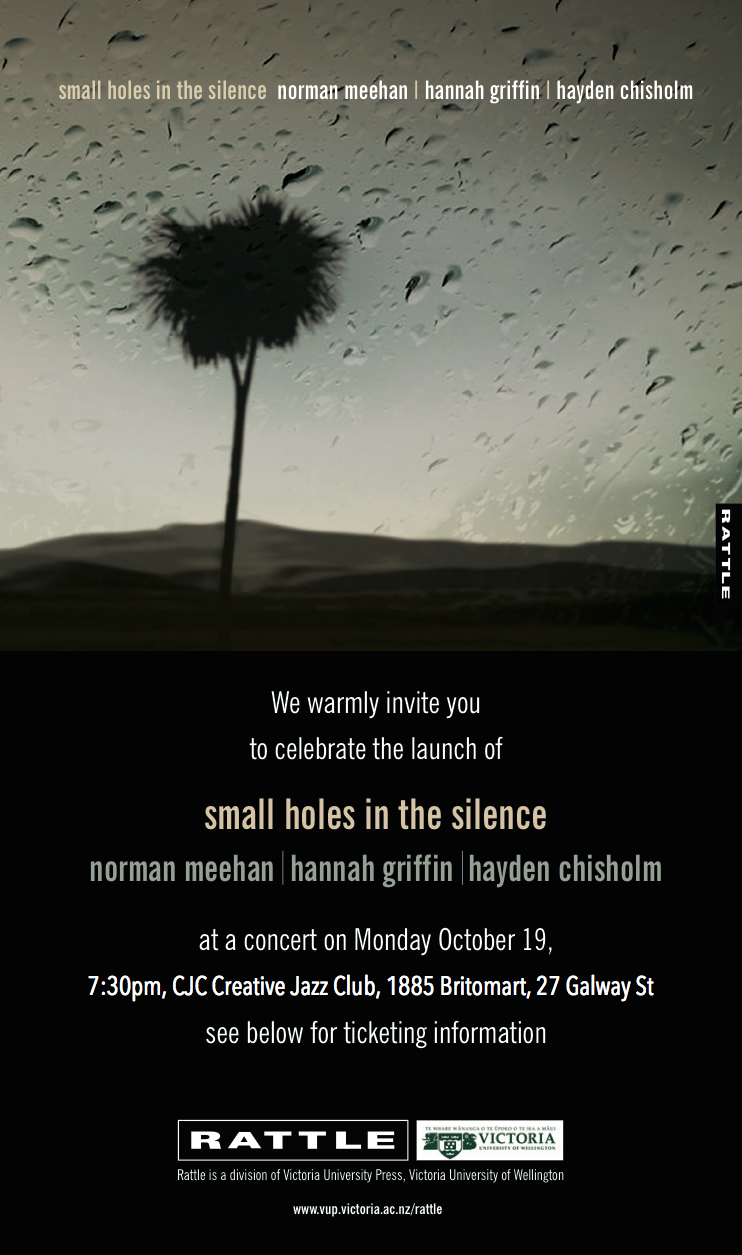
‘The approach taken by Bill, Norman, Hannah and Colin has been one that seeks to marry the words and music as seamlessly as possible. Performances include readings of the poems by Bill, sometimes accompanied by an anecdote or brief explanation to illuminate the poem’s genesis followed by performances of the poems as songs. Hannah’s nuanced interpretation of these words is complemented by Colin’s obligatos and solos and as a trio (with Norman at the piano) the three make delicate music that draws from European jazz, from the folk traditions of Great Britain and New Zealand, and from popular song.’
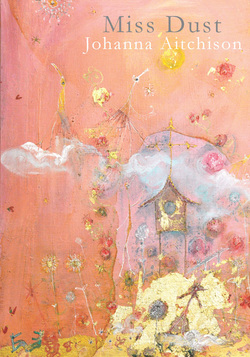
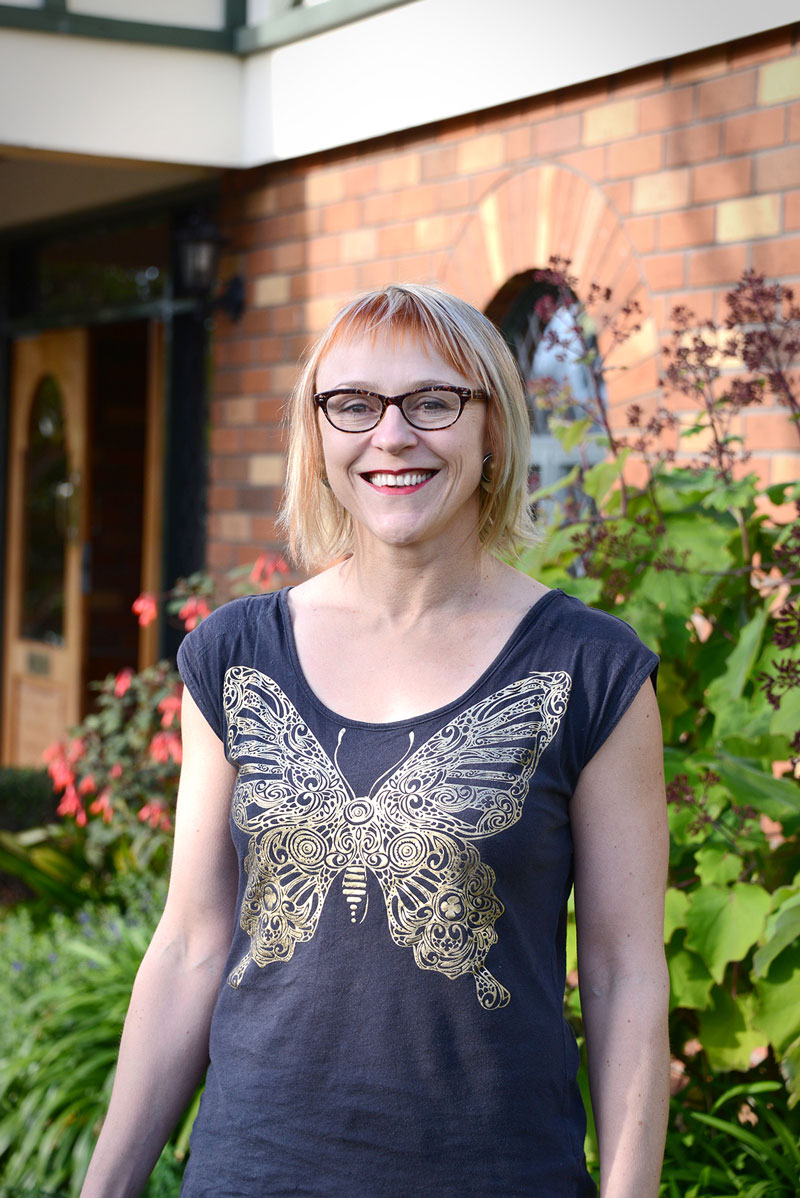
Johanna is a poet who was living in Palmerston North (quite a hub of poetry activity!) but currently in Iowa. I haven’t read her debut chapbook from Pemmican Press, Oh My God I’m Flying (1991), but I really loved her second collection, Long Girl Ago (Victoria Press, 2007). The poems felt fresh, playful, finely crafted, and surprising in the little revelations, particularly in the poems that placed little frames on Japan. The book was shortlisted for best book of poetry the following year. Johanna’s new collection, Miss Dust, was recently released by Seraph Press. It is a collection in two parts with many bridges between, and the freshness, the economy and the diligent craft remain a vital feature.
What catches me with these new poems is the heightened degree of surprise. This is poetry tilted on its axis. The first section is devoted to a sequence that gives life to Miss Dust. When read together, the section forms a long narrative poem, or perhaps you could say, a long character poem in pieces. In trying to liken the startling effect of reading this life, I came up with a hybrid analogy: it is like an Eleanor Rigby portrait meets a Salvador Dali painting meets a dislocating dream state meets a short film by Alison Maclean meets Edward Lear meets a veiled memoir.
The idea of dust is ephemeral — it leaves traces and smears, it veils and it clouds. Perfect word for a character that hides behind tropes, white space and poetic jump cuts. The tropes are borderline surreal (‘The curtains of her house are ash’). At dinner with her online date, he ‘ordered for her the dark.’ Yet even though things are strange, it is the effect of the bridges and the gaps that augment the mood, the portrait, the arc of a life. Take ‘Miss Dust and the Affair.’ The little leaps from one thing to the next, from one action to the next, miss the gritty details that might pepper confession, exchanged story. The poem is mysterious and haunting, but if you lift out the stepping stones (that occur on other occasions throughout the book) you get a terrific story of love lost: affair kiss lips lines waves rocks cheeks. That story is the undercurrent of the poem, hiding in the dust. Miss Dust, herself, would sum up the undercurrent with two words (‘black heart’), words that crop up in a number of the poems.
The movement between things is also surprising or disconcerting in the poems and feeds into the crucial threads of loss and love and life. In ‘Miss Dust makes a promise to her black heart,’ every line seems to offer a new twist — the way the dreaming mind takes the ordinary and then skews it to show a deep-seated feeling pulsing through.
Here is the cure: sitting
on someone else’s carpet,
she makes herself a promise,
with the help of a chisel
and a block of A4 refill.
She chips out a beach scene
three streets away, hammers in
stones that warm or cool
You can’t just read this poem and walk away. It holds you tight as Miss Dust walks into the beach scene and ‘lowers the plunger/ onto one more set of grounds.’ There is that jarring kink between the scene carved (hope, therapy, cure) that catapults the black heart to elsewhere and the chore of making coffee. For me, the word ‘grounds’ flicks and shifts. Yes, the coffee is ground (the daily chore/grind) but also, like the beach scene, ground is another place to lay down roots. To tend damaged roots. Soil, black like the black heart. A single word, and you can set up camp for hours.
I don’t know of a sequence in New Zealand poetry quite like this (maybe I got whiffs of the early surrealness of Gregory O’Brien). Reading and lingering in the half light of Miss Dust, is utterly moving as you fall between the gaps of her life.
The second half of the book is not Miss Dust but there is a similar degree of surprise, little echoes that seem familiar (the half house), the dislocating and then relocating pieces, the way nouns and verbs startle (‘I’m starting to skin your loneliness Miss Shoulder’). There is a stunning Japanese poem, ‘Jun,’ that pulls you back to the previous collection with its final, breathtaking stanza.
one of the saddest things i did in japan was to teach to jun’s photo
on his empty desk i asked the students to count the students
in the class the students said do we count jun
Johanna has delivered a new collection that never lets the dust settle (excuse the pun). Each poem reproduces a glorious jittery, shimmery movement between things, between actions and between things and actions. At the core of that movement: feeling. Yes, you enter a world that is, at times, a little like the bewildering jumps and turns of a dreamscape, but just as with the dream, you fall upon cores of truth. Simple, everyday cores of truth that have as much to do with how you feel the world as how you see the world. I loved this collection.
Seraph Press page
a regular feature at The Spin Off … Friday is Poetry Day!
Ashleigh’s poem here
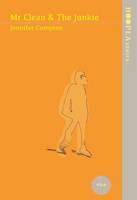
Jennifer Compton, Mr Clean & The Junkie Mākaro Press, 2015
Jennifer Compton’s new poetry collection, Mr Clean & The Junkie, is a fabulous read – the kind of book you devour in one gulp. It is a long narrative poem in four parts with a coda. Each section is written in couplets – shortish lines that deliver the perfect rhythm for the occasion. This is a 1970s love story set in Sydney (and briefly NZ), yet it is a love story with a difference. It reminded me a bit of Pirandello’s play Six Characters in Search of an Author, in that the stitching is on show — how you tell/show the story, along with the choices you make, is as much a part of the narrative as plot, characters and so. The difference here, though, it is like a poem in search of a character in search of a film director in search of character in search of a poem. Self-reflexive behaviour on the part of authors has been done to death in recent decades, so it has the potential to appear lack lustre. Not in this case. I loved the way the poetry is a series of smudges. A bit like the way life imitates cinema as much as cinema imitates life.
I spent ages on the first page. It got thoughts rolling. I loved the voice. I loved the intrusion of the director (we figure that out as we read) and I loved the way I kept putting the poem in the role of the camera (long shots to gain wider perspective or distance, tracking shots, surprising angles, refreshing views) or the editing suites with jump cuts and smooth transitions. Or sitting back and admiring the composition within the frame. Or tropes. The slow reveal.
The two main characters (My Clean and The Junkie) are definitely in search of flesh and blood, yet you can also see this as genre writing – a narrative poem that is part thriller, part whodunit, part crime writing. Then again it is part feminist critique and part postmodern explosion.
Here is a sample from the first page:
Our hero is discovered sleeping.
We find him as the camera finds him.
Our hero is dreaming of the white mouse
cleaning his whiskers in extreme close-up.
As he dreams we snoop about his habitat.
Everything is there for a reason and we will
see it from another angle before we reach The End.
I imagine ambient sound during the credit sequence.
The mouse begins to run the wheel because
the wheel is there under his paws.
The slow zoom out reveals the wheel is in a cage,
of course.
And fade to the floor-to-ceiling, slatted blinds,
chocked ajar,
looming over our man asleep on his futon.
What do they look like? Bars.
The writing is tight. The plot pulls you along at break-neck pace and then stops you in your tracks as the director’s voice pulls you out of plot and character with wry stumbling blocks. Little flurries of sidetracks. Or how to proceed? The central idea’s beguiling (poem version of a film version of a love story), the dry humour infectious (after a curtain is pulled back to reveal a spectacular view of Sydney’s Harbour Bridge and Opera House: ‘If you’ve got it/ flaunt it.’). But there is poetry at work here. It is there in the cadence of each line, the end word and the rhythm. It is there in the use of tropes that arch across the length of the book in little delicious echoes. The caged mouse on the wheel stands in for the symbolic cage of the hero (his father’s expectations and life choices). Most of all, however, the poetry sparks and flicks in the white space; the bits that are left on the editor’s floor or the angles that the director chooses not to show. Things are hinted at. Significant events that give flesh to character are caught within a line or two. That white space, that economy, is what gives this long poem its magnetic pull.
The collection is released as part of Mākaro Press’s 2015 Hoopla series. The beautifully designed books share design features and size, and include a new poet, mid-career poet and late-career poet. The other poets this year are: Carolyn McCurdie (Bones in the Octagon) and Bryan Walpert (Native bird). Jennifer is an award-winning poet and playwright who has lived in Australia since the 1970s. She has won both The Kathleen Grattan Award for Poetry (This City, Otago University Press, 2011) and The Katherine Mansfield Award.
Reading Mr Clean and The Junkie is entertaining, diverting, challenging, laughter inducing. How wonderful that a poetry collection can do all of this. I loved it!
Origins
When my father made love to my mother
and their salts and foams seethed and lifted
so that a child washed up on their tides,
perhaps they held each other
in an old rotting villa with cracks and gaps
that let the rooms’ winter breath
unravel along the street
like spider silk adrift on the air.
Perhaps outside that house
an untrimmed, straggling macrocarpa
tossed in the wind like a woman in fever sheets
and the clouded sky came close and tight
as a fist screwing a lid on a jar
while nearby the city’s river cried deep in its bed,
birds circled but found they couldn’t alight;
as a chill hide of questions
grew a stubborn lichen
across the corroding, rented roof.
For there are days when the human heart
feels like spit rubbed in mud,
the mind a junk room
of broom handles and wheel-less prams,
must-stink chair nobody will sit in,
little black fly heads
sprinkled in a corner web,
ear bones of vanished mice,
single bits of faded jigsaws,
carpet littered with broken envelopes
addressees illegible,
and even when love creeps close
over the slanting floorboards,
sorrow drifts in with the smell of snow
clustered on its skin.
© Emma Neale
Originally printed in Landfall; appears also in Tender Machines (Otago University Press, 2015).
Author bio: Emma Neale works as an editor. On alternate years, she runs a one-semester poetry workshop at the University of Otago. She has published five novels and five collections of poetry, the most recent of which is Tender Machines (Dunedin: OUP, 2015).
Note from Paula: Usually in my Friday poem slot I have invited poets to write a note about their poem and I have added my own thoughts. Some poets are happy to provide sideways anecdotes or points of origin for their poems; others prefer to let the poems speak for themselves. I have no dogmatic stance on either option. Notes on poems can be utterly fascinating and provide unexpected roads into your reading. I don’t think they ever shut a poem down — as readers, when we press a poem’s start button, anything can happen. So I have decided to make the ‘note’ aspect of my Poem-Friday feature flexible – taken up on a case by case basis.
This poem stalled me. It is the sort of poem I love to write about because it engages every part of my body — my eye, my ear, my heart and my mind. A poetry coup. Yet I wanted the poem to stand in its off-white space on the screen – shimmering, flickering on a cerebral and aural scale. Without my commentary. Intruding static. Yet I can’t help myself. Just a tad. I adore the loving craft of each line, the words and word connections that catch you by surprise, the surprise upheld like an internal beat, the way physical detail judders and then sets you off on memory tangents. At the core, heart.
This poem is the first poem in the book. Read it, and then you can’t wait to devour the poems that follow. Within the next weeks I will post a review.
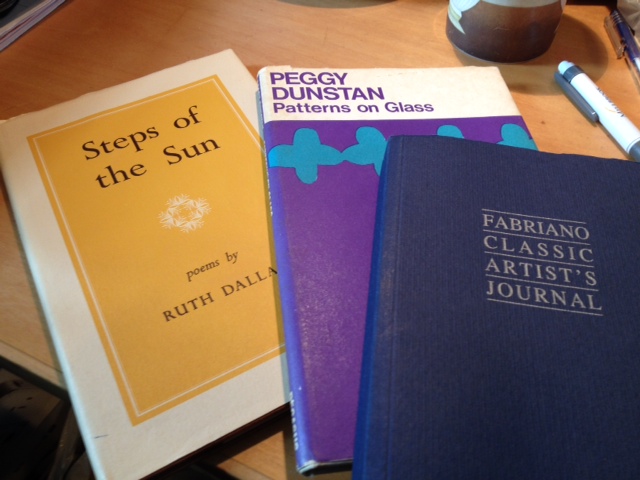
Today I am clearing my study ready to start writing a book on New Zealand women’s poetry. I am working my way through deadlines (almost done). I have finished my astonishing visit as Writer in Residence at Fairburn School in South Auckland. Still so many books to review and share here. Interviews to do. Friday poems to kick start again.
Thanks to Chris Else, I have borrowed his collections of Landfall, Sport and Takahe before they moves on to a good home. Five wine boxes full — what discoveries will I make within their pages? It is so very exciting and so very helpful when I am not attached to a university. I am full of gratitude.
Then today the most lovely surprise package from Laurence Fearnley who had discovered a collection of poetry books in a second-hand bookshop in Dunedin. I have neither of these books, beautiful much-loved editions that I will treasure. I got goosebumps as I held them. Again I am full of gratitude.
It makes me feel I am part of a very supportive writing community.
I face this project that I am about to start on Monday (full strength) with a mix of nerves, terror, pleasure, doubt, excitement — the way once you start reading and writing anything can happen as you traverse the unexpected, the unfamiliar, the wayward and the illuminating.
I can’t wait.

Photo Credit: Ben Speare
Victoria University Press has just published Joan Fleming’s second poetry collection: Failed Love Poems, a book in which I found so much to admire. Joan graduated with an MA in Creative Writing at IIML, where she was awarded the Biggs Prize in 2007. She is currently working on a Doctorate in ethnopoetics at Monash University in Melbourne. Her debut poetry collection, The Same as Yes was published by Victoria University Press in 2011. Along with Anna Jaquiery, Joan recently edited Verge 2015, a literary journal from Monash University. It is a terrific issue – I reviewed and highly recommended it here.
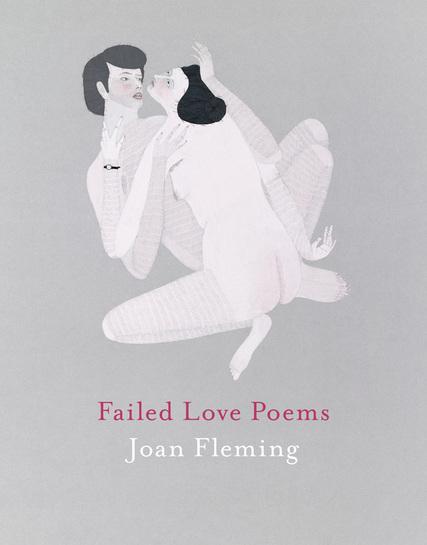
To celebrate the arrival of her new collection, Joan agreed to be interviewed.
Did your childhood shape you as a poet? What did you like to read? Did you write as a child? What else did you like to do?
I read constantly as a kid and kept journals. Shel Silverstein, fantasy YA novels with animal characters, kid romances, and a collection of ‘morality’ storybooks with titles like Courage: the Helen Keller story are what I remember reading and re-reading. I had an imaginary friend named Becky, and I think I was a bit fey, always off with the pixies or tucked into a corner, praying under my umbrella. But I was a performer, too. I would do anything goofy, just to be looked at. I was an easy child, but a strange one. I wonder if you can see that in my poems now.
When you started writing poems, were there any poets in particular that you were drawn to (poems/poets as surrogate mentors)?
The poems that carved early grooves in my mind were often lived or shared, somehow. I would memorise poems and recite them to my own head as I walked through Wellington. Paul Muldoon’s “Wind and Tree” is now inextricably Kelburn; Hopkins’ “The Windhover” is Lambton Quay. I discovered Anne Carson and wanted to inscribe everything she’d written on the inside of my body. I carried her “Town” poems with me, like “Town of Uneven Love”: “If he had loved me he would have seen me. / At an upstairs window brow beating against the glass.” See how you can walk yourself deeper and deeper into that poem?! I have an intense memory of drunkenly reading sections of Howl aloud to a living room of people, not all of them friends, and then going out into the alleyway behind the house to cry. Music had a similar effect. The poetry of Radiohead and Bonnie Prince Billy can still bring me to my knees. For me, it was about rhythm, emotion, suggestion. And poetry having palpable effect, an effect you couldn’t escape, even if you wanted to.
I love the way your poems refresh the page. There is an elasticity of grammar, a tilt of perspective, dazzling connections and disconnections, an originality that furnishes a distinctive voice. What are some key things for you when you write a poem?
My only rule is to write from the gut, not from the head. I know when I’m writing from the head. What happens is this flat, crass, nasal voice squats in my frontal lobe and won’t shut up, saying, “this is what a poem should do.” When I’m writing from the gut, there are no directives. Only sensation, surprise, connection, music, and feeling. It takes a lot of time and a lot of reading to get the gut working, but it’s the only way.
I adore the inventive syntax at work in your poems; a syntax that replays ambiguity and honeyed fluency all in one breath. Are there any other poets that have fed your syntactical inventiveness?
Anne Carson and Gertrude Stein are heroes of odd syntax for me. Jerome Rothenberg’s pseudo-translations of ritual poetries have also been influencing my practices of fragment and invention.
Deletion and erasure is a potent device (so apt for revelations and concealments when it comes to matters of the heart). Whereas Mary Ruefle whites out part of a poem in order to create something new, you have used bold black as an erasure tool. It steps away from a thing of aesthetic beauty as we witness on Mary’s page to something far harder hitting. Like a gut kick. Can you talk a little bit about notions of erasure in this collection?
Do they hit hard? That’s good. A couple of the blacked-out poems are angry ones. Erasure turned out to be a way of protecting certain subjects and lending torque to poems that gave too much away. The act of erasure also feels thematic – we perform conscious or unconscious erasures on our memories of love. We select moments and lenses; we tell ourselves a story, that casts the beloved in golden or bitter light. Blackout was a way of enacting that selectivity of the mind – the mind’s failure to tell itself the whole truth about love.
‘Things’ are palpable. They send you on a goose-bump trail such as with paper or sugar or biscuits. At the start of ‘First loss’: ‘When we met, all the songs were about loss,/ all the television shows contained it,/ it was in everything, like sugar.’ And then a little later: ‘your eyes gone hurt and biscuity with broken/ light and hunger.’ What do you want things to do in your poems?
Sometimes I want things to be persons. To have personhood, agency, worldview. Or be receptacles for emotional energies that can’t possibly be named.
At the heart of the book – love. Like a word repeated to the point it is drained of meaning and vitality, love can be elusive. Reading the poems love felt like a human glue. To know love is to have lost love, could that be true? To lose love, is to know love. To have lost love is to invent love, could that be so? What discoveries did you make as you wrote? Or is this only to be discovered as you live?
There is one monstrously important relationship whose aftermath I put to rest in these poems. There are still poems in the book I can’t re-read without getting choked up. I know confessional poetry is unfashionable, but candid, passionate, stirring writing is what I am always looking for. Those are the poems I value. That particular relationship was a ‘failure’ according to the standard narrative. We were together for years, but we didn’t marry, we didn’t have children, it didn’t end when one of us died. But it’s impossible to call it a failed relationship. It was a success. It didn’t last, but in the end (the last sequence in the book is named as much, “The End,”), it made us both larger and more capable of giving and receiving love.
I loved the proseness of the poetry/ the poetry of the prose. Would you write a novella or a novel?
I tried to write a novel a couple of years ago, but it was a dreadful, a plot-less, cringingly autobiographical mess. I’ve entertained the idea of writing a pulp novel about non-monogamy, Confessions of a Call Girl–style (surely it would be a bestseller!?), or a historical novel about my grandparents’ time as missionaries in Central Australia. Though I worry about becoming one of those writers who dilutes her craft by spreading it too thinly. Fiction is an art form I have huge admiration for, but I’m a total novice at it until further notice!
You recently spent time in the Outback. How did that vastness and colour infiltrate your writing?
Yes! Absolutely it has. That time helped strengthen my intuition. Weeks on end in the desert will do strange things to your body-perceptions. The land starts to talk to you, and you can’t help but listen, because it is working on your moods and your dreams.
I’m writing about that time in the Outback now. About my relationships with Yapa (Aboriginal) friends and worldview. I suppose the full effect of that desert-infiltration will show itself in time.
What New Zealand poets are you drawn to now?
Some of the New Zealand poets I’m most excited about haven’t even published full collections yet: Hera Lindsay Bird, Loveday Why, Nina Powles, Lee Posna, Bill Nelson, Emma Barnes, and Sugar Magnolia Wilson. I also want to read everything written by Ashleigh Young, Sarah Jane Barnett, Rachel O’Neill, and Zarah Butcher-McGunnigle. It’s the next generation I’m most drawn to, though poets Jenny Bornholdt and Dinah Hawken still loom large.
Joan Fleming’s webpage
Victoria University Press page
 NZ Poetry Shelf