On elephant’s shoulders, Sudha Rao, The Cuba Press, 2022
Poetry books are so often objects to treasure, physical treats to hold.
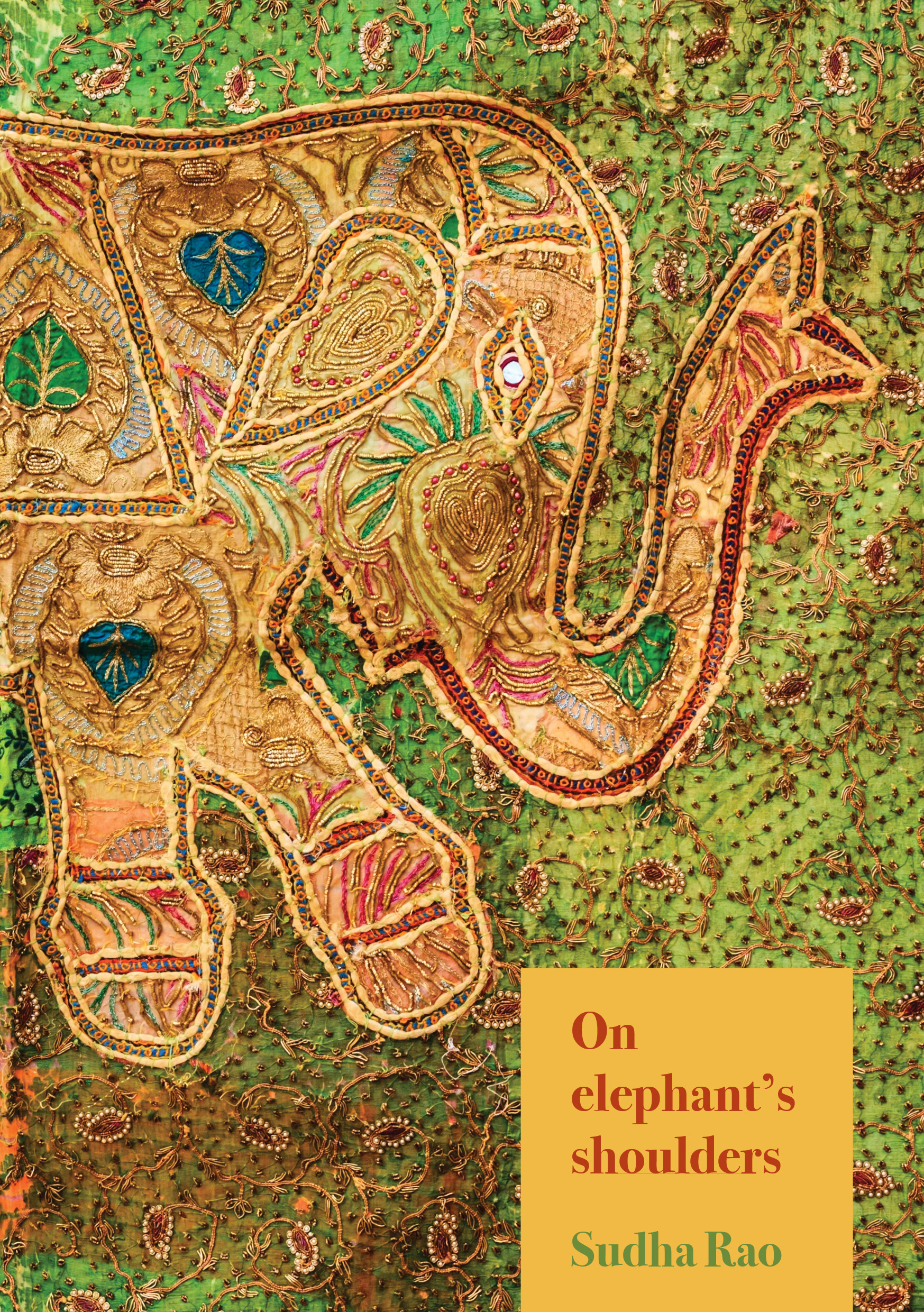
Sudha Rao’s On elephant’s shoulders is exactly this, with its exquisite, embroidered cover image (sorry no acknowledgement of source or creator). The interior design is equally appealing; a perfectly sized font with ample space for the poems to breathe and readers to sojourn. The title also captivates, and I especially love the fact there is neither definite nor indefinite article to support ‘elephant’. I am pirouetting on the title, imagining elephant as both anchor and viewing platform. Falling into the title, over and over. I am both grounded and liberated.
The opening poem, ‘Warp and weft’, establishes the collection as a book of arrivals and departures. It sets the scene for recurrent motifs, ideas, words, images – and I love that. The poem is divided into three parts: passages, shadows and braids. The three terms are an excellent guide to the book as a whole. I am particularly captivated by the recurring ‘braids: there are plaits, the father’s hands, the grandmother’s hair, the South Island rivers, a way of writing, a way of living between here and there, this home and that home.
“I am a bracelet of memories bearing the weight of your bones.”
from ‘Threads across waters’
The poetry, in keeping with braid notions, exudes both economy and perfumed richness, an evocative serving of detail. The detail enhances a scene, a series of relationships, poetry as musical score. The detail may be repeated, as in echoey ‘braid’, you might move from the scent of turmeric to a ‘sunflower flowering’.
What renders the collection poignant, especially in its poetic tracing of a migrant’s experience, is the presence/absence braid, whether we are talking geography, kin, food, gestures, memories. Everything feeds into a braided version of home that is near and far, intimate and longed for.
[…] When you crossed
old waters, did you know
how cold new waters would be?
from ‘Cradle’
I talked about stitching when I recently reviewed Elizabeth Morton’s terrific collection Naming the Beasts, and stitching seems appropriate here, especially bearing in mind the sublime cover. Stitching is a way of talking about poetic craft, about the little threads that are both visible and invisible parts of the art and craft of a work, in the edge and the tension. Sudha has stitched her poetry in threads that gleam of the everyday, the detail so alive with living, epiphany, challenge, but that also work behind the scenes as the poems flow like little exhalations. Measured. Mesmerising. Magnificent.
This is a collection to treasure.
“‘There is rhythm in the cabbage tree when it combs clouds.”
from ‘Keeping time’
Originally from South India, Sudha Rao migrated to Dunedin with her parents and trained in classical South Indian dance. She moved to Wellington to establish Dance Aotearoa New Zealand (DANZ). Sudha’s poems have appeared in literary journals and anthologies in New Zealand and overseas, including Ko Aotearoa Tātou | We Are New Zealand and Best New Zealand Poems. Sudha was a participant in the International Bengaluru Poetry Festival 2019 and performs in Wellington with Meow Gurrrls.
The rain is dampening down the day before it has even started, but I plan on reading books in bed, making fish tacos for dinner, eating cheese scones and writing some more poems for children. I posted Claire McLintock’s cancer thoughts from Canvas on social media and felt so many connections. YES to living each day fully. It may be sleep or dream or reading or writing. But the choices I make – I know some of you might think I am crazy busy but I’m not – mean I live in a state of unbelievable happiness, calm and strength. It is like a miracle, and that I love words helps no end.
Claire and her husband are selling fundraising TShirtsfor Sweet Louise with Workshop.
This morning I was thinking about how important conversations and connections are when you are cut off from ‘normal’ life. I can’t imagine getting on a plane for a long time, or laughing in a crowded cafe. Or even going to festivals and launching books. But I can imagine connections and conversations through the exquisite reach of blogging. Even doing my own secret writing!
With these words drifting in my head, I read Janet Newman’s email. She writes:
Reading Robert Sullivan’s Rākaihautū there [on reawakened Poetry Shelf] and Anna Jackson’s response made me think of a poem I wrote after another poem from Tūnui / Comet. My poem reflects on the loss of productive farmland to lifestyle blocks, an old issue that is finally starting to seep into national and political consciousness. I thought you might like to read it.
I loved reading Janet’s poem – and I love how conversations and connections keep rippling out from Robert’s poetry, from the poem that relaunched Poetry Shelf, and from Anna’s. Poetry has the power to forge links with who, where and how we are in the world, the way we connect with and care for the land, the way we connect with and care for our own wellbeing. It is wonder and it is joy.
Goodbye Kukutauaki Road
“… there’s only a certain percentage of elite soils in this area, or even around the country. And once those are gone, they’re gone forever. You can never get them back.”
––Pukekohe farmer Stan Clark
my old friend. I know how far you travel. Back to my no-gear, pedal-brake bike tyres catching in dull gravel, school bus turning in smoky dust, Dad milking Jerseys in a walk-through shed: six sheds, six houses and a sheep farm at your end. Back to war veterans clutching marbles in your land ballot. Back to Te Rauparaha’s boundary: Kukutauaki Stream near Paekākāriki, a snare for catching kākāriki. Out west, sunsets over Waitārere Beach. East, rainbows over the Tararua Range, colourful as your jam-packed letterboxes jostling with wheelie bins for shoulder space. Yet why do I see your bitumen shine as loss my friend, your slick curves as enclosure? You’re smooth as a black cow and our vehicles slide down your spine all the way to Wellington, coast nose-to-tail through the gully. Return to pūkeko stalking lifestyle blocks, kererū ghosting rural retreats. I wave as my car swings past your long, blue sign. Bye, bye no exit Kukutauaki Road.
Janet Newman
(after ‘Hello Great North Road’ by Robert Sullivan)
Janet Newman is a poet and scholar. Her debut poetry collection is Unseasoned Campaigner (OUP 2021), the manuscript of which was shortlised for the 2019 Kathleen Grattan Poetry Award. Her poems have been anthologised in Manifesto Aotearoa (OUP 2017) and No Other Place To Stand (AUP 2022). Raised on a Horowhenua dairy farm she now farms beef cattle. She holds a PhD in English from Massey University for her thesis Imagining Ecologies: Traditions of Ecopoetry in Aotearoa New Zealand (2019).
Naming the Beast, Elizabeth Morton, Otago University Press, 2022
You don’t want book reviews to diminish your reading experience, to lead you up the garden path of expectation, to lay false trails and unreliable hopes. Imagine the review as a tasting room where you let a morsel of the book swirl on your tongue, releasing flavour, leaving a vital aftertaste. You don’t want book jargon, you just want an aromatic taste (precursor) of the writing, the ideas, the feelings, the connections.
Elizabeth Morton’s Naming the Beast is poetry gold. It is the kind of book you savour slowly, absorbing brocade textures, the sumptuous threads, the surprising patterns, satisfying layers. This is poetry that is sonorous, sensual, startling. It got me thinking about how enmeshed I become in certain poetry collections. How I am laid bare as a reader. How I am spiked and soothed. I get caught in a poem, no question.
Elizabeth writes about being in someone else’s poem:
In somebody else’s poem it’s goddamned desolate. I’m in a house with no windows; just venetian blinds on blank walls. The rotary phone bleats hircine, and I hold a real gun to my head. In a poem, the gun goes off. I wake in another poem, planting succulents because love goes as far as my toes, and no further.
from ‘We write what we know when we run out of things we don’t’
I could simply pitch this as a collection of beasts and wild(er)ness, because beasts and wildness are an integral part, but it is also a collection of time, mothers, luck, castles, fire, relatives. The subject matter roves and ranges, at times resembling stream of consciousness connections, lily pad leaps, edgeways writing. The music is symphonic. The lexicon is extraordinary; words feed subterranean narratives and dreamscapes, pungent fields of details. There is plainness and there is opulence. There is the off-real and there is the hyperreal.
Celebrate the richness of poetry, the allure of detail thickets, but there is too the invitation of the unsaid, the vibrating space, the reading alcoves.
I admire the collection’s invisible stitching, the behind-the-scenes craft of the poet that produces such poetic fluency. Yet at other times, the making of poetry is poignantly visible. Poetry comes protagonist, a character moving in and out of shadow and light.
Ah, I have used book jargon, kindled your expectations crazily, so I return to my idea of a tasting room – I will hold out a tasting platter for you, and let some of Elizabeth’s lines spark your reading tastebuds.
First, bark the moon. Make ceremony from a stammer, from a steaming crockpot of two-minute noodles, from the way the taxi driver sucks his bottom teeth as he drives you north.
from ‘Instructions on how to lose a mind’
My mother is the night owl. My father is the tussock, I own memories, alone. My celestial object is done for. The rust core of a lamp that was already out – a red star coughing though light-years of average days, days spent picking lemons and walking average suburbs, nodding at ordinary dogs.
from ‘Stolen pepeha’
We pipette soluble proteins like mothers do. Mothers are no minor characters, who arrange herbs like rubrics, under the soft light of a kettle stove. Home is a fume-cupboard where legend is filtered like breath. Our mothers huddle around pantries of cod liver oils, vitamins, and bleach. Their hands haul the sun over the eastern hillocks, like an axiom.
from ‘Immunohistochemistry’
I want to say I know this place with my eyes closed. I can run, butt naked, through cabbage rows and dairy cows, and the Waikato will annunciate my name with a branding iron and an ear tag that speaks to a bloodline sniffed out by regret. I am writing in my first language. My second is shame. When I dream I dream words I cannot spell.
from ‘God of nations’
If I were a robot, I would be in a better poem. If I were a person, I’d want the telephone wires to hum like stars, and the stars to be unavoidable.
form ‘Hard sell’
Get a copy of this book, open it, pick a poem, take a road trip within its lines, inhabit as a small retreat, sojourn in a series of alcoves. This collection is gold.
Elizabeth Morton grew up in suburban Auckland. Her poetry and prose have been published in New Zealand, the UK, the USA, Canada, Ireland, Australia and online. She holds an MLitt in Creative Writing from the University of Glasgow. Morton has accrued many literary acknowledgements for her work, and her previous collection of poetry, This is Your Real Name (OUP, 2020), was longlisted for the Mary and Peter Biggs Award for Poetry in the 2021 Ockham New Zealand Book Awards. The manuscript of Naming the Beasts was shortlisted for the 2021 Kathleen Grattan Poetry Award.
I am trying to love it, all of it, including the stomachaches and the scars that pucker on my legs. They say the world is poisoned but I feel like I just have to give it a go first, sample the arsenic-yellow paintbrush just to see if it might stain something bright. “That’ll be us,” my friend says when we pass a group of kids, picnic-lunched, sun-dizzy, at the local graveyard. I can’t tell which part he means: the picnic or the being-six-foot-deep-in-a-grave. He is an actor, not a poet, and doesn’t take kindly to being immortalised in a poem. His art is all glitter and stage lights and sweat. The moment all the sweeter for not being preserved. Verse erodes on the human tongue, and a tongue is nothing but a slab of meat ‒ which is to say, it will rot. But I just can’t help it. I want to taxidermy this crude human heart just so somebody down the line remembers how it felt. Oh, how it felt: too much, too much, always bursting with clotty red blood. There’s nothing in a graveyard that you can’t find somewhere in the gristle of a human. And nothing clawing in my mind that can’t be stopped by the sight of a wild sparrow-chewed blackberry, a window glowing golden at night, two friends trying on a silly hat. I keep them like sweets under my tongue, and when, as all flesh does, it rots ‒ there’ll be sugar spilling out into the grass.
Cadence Chung
Cadence Chung is a poet, student, and musician currently studying at the New Zealand School of Music. Her original musical In Blind Faith premiered at BATS Theatre in August 2022, and her debut poetry book anomalia was published by We Are Babies Press in April 2022. Her poetry takes inspiration from Tumblr text posts, antique stores, and dead poets.
“When viewed in deep time, things come alive that seemed inert. … Ice breathes. Rock has tides. Mountains ebb and flow. Stone pulses. We live on a restless Earth.”
—Robert Macfarlane in Underlands
tomb with a view – earthed on a volcano’s seaward slope I kneel in fresh-cut lawn – not knowing whose bones decompose below – only interested in the sheen of this headstone – a slab of flashing feldspar hewn in loving memory – my mother the geologist
surveys well-kempt lanes – reading the names on strangers’ graves – the cemetery lawnmower hums around us – clippers licking to and fro constant as the waves – eroding the basalt cliff below that threatens all our bones – even diamond gravestones aren’t forever
nor this rich labradorite – it births aurora borealis in the right light – glints of scintillating indigo blue morpho – sips of methylated lavender a happenstance of kissing crystal facings – turned brilliant in crushing heat – how we are all made
anew through strain – the only constant thing is change in this restless earth – my mother sees these shifts like a slow-motion picture – technicolour aeons on the geological map – this is her gift to her children she invented two new deaths – but gave us all of time
etched on a headstone – if we can learn to read igneous glints of a frenzied planetary history – continents stretch like cats and we are very small fleas – we do not live for long we make our homes – in the fertile shadow of the volcano – we build cities on fault lines
that fell cathedrals – we pray for everyone we love to live forever then where there are graves – the lawnmowers graze where there are cemeteries – there are rising stones and women – who want to know the names not written on those monuments but inside their very substance– ancient incantations in crystal language
tonight after the wake – we will gather on this hillside to light fireworks – with a stray roman candle the dry cut grass will blaze – brilliant as lava on this dormant caldera and through it all the cemetery lawnmower – will hum darkly among the graves tending to them – until the real volcano wakens
from a dream beyond all naming – reclaims the fallen and their stones sowed like seeds beneath the lawn – returns us all to the molten cradle – where the start of all life flows in liquid light the sound of shifting continents – sure and steady as a mother’s heartbeat
Rebecca Hawkes
Rebecca Hawkes is a poet, painter, editor. Her first chapbook of poems Softcore coldsores appeared in the reignition of the AUP New Poets series (2019). Her debut collection Meat Lovers (AUP 2022) was awarded The Laurel Prize Best International First Collection 2022. Rachel edits the poetry journal Sweet Mammalian with Nikki-Lee Birdsey, and has co-edited an anthology of poetry on climate change, No Other Place To Stand (AUP 2022). Raised on a Mid-Canterbury sheep and beef farm, Rebecca now lives in Te Whanganui-a-Tara / Wellington. She is a founding member of popstar poets’ posse Show Ponies and holds a Masters degree in nonfiction creative writing with Distinction from the International Institute of Modern Letters.
Shine, there’s shine and starlings and I’m starting to wake up to a series of occasional poems, so far a series of one, the first in a procession I look forward to as the starlings, nesting as usual in the wall behind the fridge, start again with a new season of fledging and flights. Yesterday Susan came over from next door with pastry that needed baking in our oven because hers has broken down and Lucinda was soon summoned to check on the state of the pastry while Robert was left on speaker-phone stoking his fire. He had been out gathering clay – but was it clay or had he been gathering mud, he wondered – to make a koauau to improve his poetry readings by layering in taonga pūoro. I like his poetry readings because of the way they sound just like him talking and how talking to him on the phone is like a poetry reading I am invited to interrupt when occasionally I have something to add, a sudden flight, but poetry readings have taken on more and more shine and dimension these days with music and dancing, even in my dreams. Last night, I dreamed of Robert’s koauau before waking to find a new series of occasional poetry launching on Poetry Shelf with Robert’s poem about gathering clay – but was it clay or was it mud, he wonders in the poem as he wondered on the phone, when he must have already been echoing the poem I read as an echo of the call, the poem he must have written before he talked to me about the mud, no the clay, and the koauau which is not yet made but one day will sound its sound into the air. I feel it echo in me before its first sounding and I want to mark the occasion of the dream-sounding of the koauau and to mark the occasion too of the occasional poetry series launch, and the occasion of the clay-gathering and the pastry baking and the phone call and the reading of Robert’s poem, so I am writing an occasional poem of my own, this poem, if it is a poem, not just a muddy stream of words, probably needing music backing it, or back-up dancers feathered and shining, sounding a sound beyond the words, beyond the work, beyond the occasion, beyond the writing first thing in the morning, the new moon (Tirea now, we have passed Mutuwhenua) still quietly auspicious though invisible now as the sun rises, rises and turns, has been rising for a while now, rising as I write, the birds quietening and my shoulders stiffening, and I still in my pyjamas – I don’t even know the time.
Anna Jackson
Anna Jackson’s latest collection of poetry is Pasture and Flock: New and Selected Poems (Auckland University Press, 2018). She also recently released Actions and Travels, a book on poetry (Auckland University Press, 2022). She is based in Wellington.
thinks about driving to Waihao to fetch some uku to make a koauau. It’s at Waihao Box where you said the local boaties couldn’t stand walking around your group of mana whenua collecting uku for taonga pūoro. I want to play taonga pūoro like you. It’ll improve my poetry readings where I need to lean against the fourth wall to be heard.
It ain’t easy. I still can’t click my fingers properly let alone make a clay flute in my head. It’s the idea that some non-Māori boaties are out there waiting to troll me for holding up their kayak adventure when this billy goat wants a koauau journey for healing. Āuē. I’m still in my dressing gown. If only Tangaroa would be my valet. Tomorrow it’s Mutuwhenua. I don’t even know the tides.
Robert Sullivan
Robert Sullivan belongs to the Ngāpuhi and Kāi Tahu iwi. He has won awards for his editing, poetry, and writing for children. Tunui Comet is his eighth collection of poetry. Robert’s an Associate Professor of Creative Writing at Massey University. He is a great fan of all kinds of decolonisation.
It’s almost a month since I celebrated the arrival of glorious poet, editor and mentor Chris Tse as our National Poet Laureate.
Time then to give a blog update. I feel like, as I just said on Twitter, I have emerged from the stables after the past months, and my mind is like a horse galloping cantering dancing around the paddock before settling in for a long nap. Glorious. A bone marrow transplant is such a refresher for the mind.
I have read so much this year – and in my time back home pretty much a sublime book per day. It got me musing on how I had to hunt hard for good children’s titles as so few of them had been reviewed in New Zealand. I was musing on how I love our local children’s book communities, what they are producing, and how in my experience children still love books: reading and writing, stories and poems! Against my better judgement, with my energy tank far from full, still coping with physical challenges, I decided to transform Poetry Box into a celebration hub for children’s books, for adults and for the young, all book categories. To challenge children to write poems. To challenge adults to share children’s books. To make as many connections as I can.
I am motivated to support our young readers and writers, to support our wonderful local children’s authors, and to showcase our fabulous librarians, booksellers, and publishers.
I am also doing my own secret writing projects because words are what hold me on an even keel at the moment – writing and reading make my heart sing and allow zero room for negativity or ‘if only’ or ‘why me?’ or glumness in my head. No matter what challenges I face.
But crazily madly a part of me also wants to wake up Poetry Shelf. And yes madness as this blog has always taken such a big bite of me. Not just the posts I assemble and write but all the communications and responses to requests – and even at times, aggressive emails. I can’t cope with demands at the moment, or deadlines, or even feeling like I am failing. When I don’t get to celebrate all your magnificent books, even when I have loved reading something, or when I have loved a book a little less, I feel bad. That becomes a form of failing for me. Not good.
So I am trying to make a plan where I can wake up Poetry Shelf just a tiny bit. What I want to do is occasionally review a poetry book I have loved or post a poem I have loved – or even post a notice now and then. Without rigid commitment or tight schedules or comprehensive coverage or worrying about what I don’t do.
So this is what I am thinking. I might never answer your emails or the phone. But slowly, step by step, I will start to shine little lights again on our fabulous poets and what they are doing. To share the way poetry is a source of joy and challenge, is balm and solace, refreshment – is re-engagement with our fickle and vulnerable and beloved world.
Watch this space!
Oh and keep an eye out for Roar Squeak Purr (my big anthology of animal poems by adults and children, out mid October thanks to the wonderful team at Penguin).
Love
Paula
PS I can’t tell you how much your cards and poem choices and the books (and chocolate!) you popped in the post have meant to me. I still have three envelopes to open for days when I feel fatigue and pain and glumness settling in. A thousand times thank you for your support and care and generosity. It has mattered so much.
What great news to hear Chris Tse will be our next Poet Laureate. His poetry is remarkable, he is a sublime anthologist, an excellent reviewer and is doing a stellar job editing the Friday Poem at The Spinoff. I am excited by the prospect of new poetry produced during his tenure and how he will inspire us with whatever he chooses to do in the public arenas. And that is what I love about the Poet Laureate role – how individual poets can ignite a passion for poetry across communities, ages, locations, ways of writing. Each poet makes the role their own, and each leaves us with a gift of words, the power of poetry to illuminate who and how and where we are.
So I raise my glass and toast Chris Tse – a supremely good choice! I wish him all the best over his two years.
To celebrate I am re-posting a conversation we had earlier this year to acknowledge the arrival of his terrific new collection, Super Model Minority (Auckland University Press, 2022). Plus two readings from the book.
“The Poet Laureate Award celebrates outstanding contributions to New Zealand poetry. The Laureate is an accomplished and highly regarded poet who can advocate for New Zealand poetry and inspire current and future readers.” NZ Poet Laureate website
A reading
‘BOY OH BOY OH BOY OH BOY’ from Super Model Minority
‘Tomorrow, and tomorrow, and tomorrow’ from Super Model Minority
The conversation
Paula: In 2022 I am running a few email conversations with poets whose work has affected me over time. I have loved your poetry since your appearance in AUP New Poets 4 (2004). Your new book, Super Model Minority, strengthens my enduring relationship with your writing. The collection is an explosion inside me, but first I want to touch upon the spiky times we live in. What helps you? I am finding books keep repairing me, sending me on extraordinary package holidays, depositing me in the sky to drift and dream, to think. All genres. What are books doing for you at the moment?
Chris: Books have been such a comfort for me these past few years. Emma Barnes and I were still up to our necks in reading for Out Here when we went into lockdown in March 2020, so there was plenty to keep me busy and distracted. Things did get a bit more difficult when we couldn’t access some older and out-of-print books, but we made it work. I’m not a very fast reader so I do tend to take my time with several books on the go at any given time. Books have always made me happy – I was always happiest hunched over a book while my family watched rugby or played mahjong in the background. These days a big part of that happiness is the thrill I get seeing friends getting published and receiving well-earned praise for their amazing work. It’s such an exciting time to be a reader and a writer – to be able to experience the world through the poetry of essa may ranapiri and Rebecca Hawkes, or to have your brain recharged by the essays of Megan Dunn and Lana Lopesi. Aside from a few small projects I have no plans to start writing a new book, so I’m just hungry for stories and ideas right now to see where that might take me next. I want to read as much as I can for pleasure while I can.
Paula:Out Here gripped me on every human level imaginable, yet I never considered how Covid might prevent access to the archives. That was such a joy for me researching for Wild Honey. With Emma, you have gathered something special. Wide ranging and vital. It is how I feel about the younger generation of poets. I fall upon brittle, vulnerable, edgy, risky, exposed heart, potent – and I am grateful to Starling and The Spinoff’s Friday Poems for representing these wide-ranging voices. I am decades older than you, but how is the new generation affecting you?
Chris: For me, it’s such an exciting time to be a poetry reader right now with so many young poets producing ground-breaking and challenging work. Also, they’re voices and perspectives that we’ve been sorely lacking for such a long time – poets like Cadence Chung, Khadro Mohamed, Lily Holloway and Ruby Solly are all redefining what ‘New Zealand poetry’ means in their own ways. If I look back at what it was like to be a poet at their age, the playing field has shifted a lot because of journals like Starling and Stasis, and publishers like We Are Babies Press. I find their energy so infectious and inspiring – it certainly makes me want to keep pushing myself as a writer.
Paula: Exactly how I feel! But I also have poets I have carried across the decades since my debut collection in the 1990s. Bill Manhire, Michele Leggot, Bernadette Hall, Dinah Hawken, JC Sturm, Hone Tuwhare. Poets that helped me become a writer in so many ways. Particularly as I didn’t do any creative writing courses. Were there poets from the past or the present that were writing aides for you? In person or on paper?
Chris: My exposure to New Zealand poetry was sorely lacking as a high school student, so I’m really grateful that the papers and creative writing workshops I did at university introduced me to the canon and more contemporary writers. Jenny Bornholdt, Stephanie de Montalk, Bill Manhire and Alison Wong are poets whose work played a huge role in shaping my fumblings as a young poet. My poetry world was further expanded when I started to stumble across contemporary US poets like D.A. Powell, Frank Bidart, Cole Swensen and Richard Siken, whose first collection Crush I have written and spoken a lot about. It really is one of those life-changing books that set me on my current path. For Super Model Minority specifically, I turned to Chen Chen, Ocean Vuong, Danez Smith, Tusiata Avia, Nina Mingya Powles and Sam Duckor-Jones for comfort and inspiration. Their work feels so vital during these times of change and uncertainty.
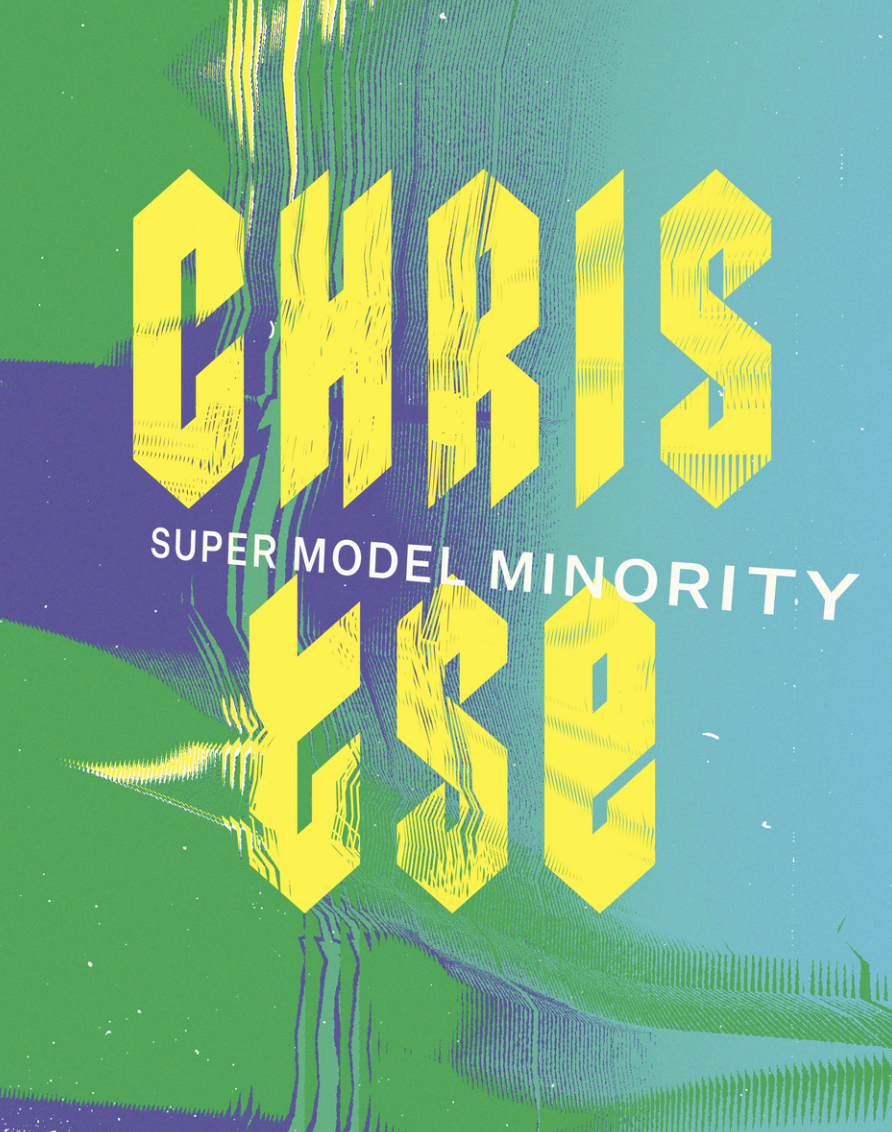
Super Model Minority, Chris Tse, Auckland University Press, 2022
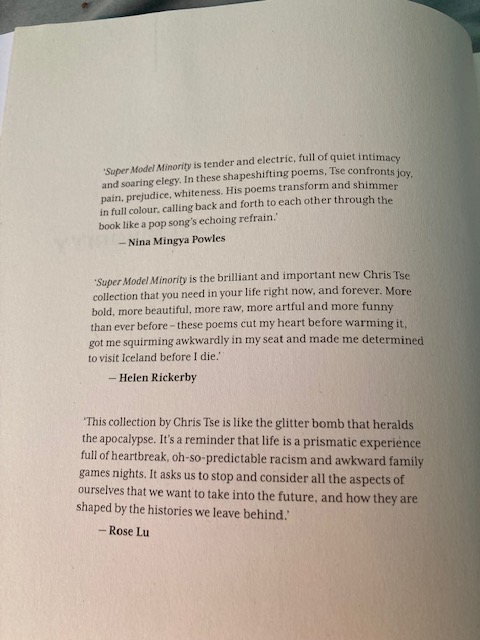
Paula: Inspired and comforted seem crucial for both readers and writers. Your new collection is body shattering and heart repairing. And yes, both inspiring and of comfort. The book includes the best endorsements ever (Nina Mingya Powles, Helen Rickerby, Rose Lu). They catch how the reading experience affected me perfectly. Would you couch the writing experience in similar terms?
Chris: Writing this book caught me off-guard, in a number of ways. First, I didn’t think I’d have a manuscript ready so soon after HE’S SO MASC – I was happy to take my time with the next book. Then a few things happened that set off something in me – an urgency to write and respond: the pro-democracy protests in Hong Kong, the aftermath of the Christchurch mosque attacks, and the rise of anti-Asian sentiment as a result of the Covid-19 pandemic. These events all triggered powerful emotions, but the overriding frustration I felt was that things seem to stay the same no matter how much we push for societal change and equality. I was overcome by anger, sadness, and helplessness, so I decided to write myself out of that state and turn it into energy. The poems kept coming and I found myself confronting a lot that I’ve left unspoken for so long – some of it out of guilt, some of it out of fear. Overall, the writing process taught me a lot about myself because of these responses and the realisation that it’s important to hold on to hope throughout the dark times – I’m not as nihilistic as I thought I once was, even if that’s how it may come across in the book!
Paula: I am coming across a number of poets who are re-examining a drive to write poetry in a world that is overwhelming, disheartening. Gregory O’Brien muses on poetry expectations: ‘If the times are dark, oppressive, tunnel-like – as they seem presently – maybe poetry can be a lantern?’ For me it’s Covid and impinging greedy powers. Shattered everyday lives in Hong Kong, Syria, Afghanistan, Ukraine. And it’s like you say – despite waves of resistance, critique, standing up and speaking out – a world free of sexism, racism, poverty, classism, homophobia can feel impossible. And yet … poetry can be essential at an individual level. It seems so, for you and I, as both readers and writers.
I will use my tongue for good. I say I will because this book needs to start with the future even though the future has always scared me with its metallic fingernails poking through the metaphysical portal come-hithering. Aspiration—and the threat of what we have awakened from the salty ashes of a world gone mad— aspiration will bolster my stretch goals. I will use my tongue to taste utopia, and share its delights with my minority brothers and sisters before the unmarked vans arrive to usher me back in time.
from ‘Utopia? BIG MOOD!’
The first poem ‘Utopia? BIG MOOD!’ is an inspired entry to the book. The opening line gives me goose bumps. I want it tattooed on my skin. Heck just reading it make me want to cry, stand up and getting going. It implicates the writing of poetry in the world and the world in the writing of poetry. It gives me hope reading this. You say it all in the poem but do you carry utopia in your heart? Despite your sadness and anger and helplessness?
Chris: That’s such a lovely quote from Greg – it sums up exactly how I feel as a poet and when I’m reading submissions for the Friday Poem. I’ve definitely noticed that recently poets are using poetry to light the way, even if we’re not sure where a particular path is leading us. Better to walk in light than stumble in darkness I suppose. I’m so glad that the first line resonates for you in that way. Here’s the thing – the first lines of all three of my books are a thread that ties them together. (I won’t presume that anyone is reading my work that closely to spot it!) All three books open with a reference to speech or being heard. In Snakes, it’s “No one asked me to speak…”; in HE’S SO MASC I wanted the flipside so the first line is “Shut the fuck up”. I knew I wanted the first line in Super Model Minority to echo the first two books – “I will use my tongue for good” felt like the best way to open this book about confrontation and working towards a brighter future. So, to answer your question, I do carry some form of utopia in my heart because without it I’d be resigning myself to a future that is ruled by sadness and anger. If there’s a conclusion that I come to in the book, it’s that utopia will always be out of reach because we’ll never agree on a singular utopia – the version we carry in each of us is built upon our own desires and subjective perspectives of the world around us.
Paula: Ah it gives me hope to imagine our world no longer governed by despair and anger. I loved your review of Janet Charman’s new collection with Kathryn Ryan on RNZ National ((The Pistils, OUP). I haven’t read the book yet but I got the sense it was personal, intricate, political. The same words apply to your collection. Each poem opens up in the process of reading, and then lingers long after you put the book down. It feels so deeply personal. The way you reassess vital things: the past, the importance of names (your name), speaking more than one language, your parents, relationships, being gay. And in this personal exposure and self-navigation, there are the politics that feed and shape who you are. Inseparable. It feels like a landmark book to me. Is that placing too much on its shoulders?
Chris: It feels like a landmark book for me personally in terms how far I’ve come as a writer over the last decade. I look at my three books side by side and even though there are things I would change in the first two (and I’m sure I may have similar feelings about some of the poems in Super Model Minority in a few years!) I’m really proud of this body of work I’ve created. HE’S SO MASC has those early flourishes of the personal and the political, and I remember being so worried about how it would be received because it was so different in tone and outlook than Snakes. All of my books to date have required a lot of self-reflection and self-critique to get to a place where I’m not only comfortable writing about these topics, but also to be able to share them. Even though the work is personal I hope people can see themselves in it too, or can see why some of the things I write about are a big deal for me and the queer and POC communities.
Paula: Would you see yourself then as a hermit poet, a social poet where you share what you are writing along the way, or something in between?
Chris: I’ve got a small group of trusted writers who I send works in progress to if I’m stuck on something, but this time around I did hold a lot back until it was ready in manuscript form because I wanted to work on trusting my own instincts. However, when it comes to sending work out into the world for publication, I’d say I’m more on the social side, although there were a few poems from Super Model Minority that I chose not to submit anywhere because I felt like they needed to be read in the context of the collection as a whole.
Paula: Is there a poem (or two) that really hits the mark. Whatever that mark might be! That surprised you even.
when asked to explain the lines that lead to now, you describe /
the shape of your body as it hits water / the shape of cold water
shocking muscle / the shape of fleshy chambers forced to loosen
and acquiesce / the shape of your grandparents in their coffins /
the shape of coffins that are too small to contain entire lifetimes /
the soft and hard moments we can’t forget no matter how often we
turn our backs to the light / [you write this poem out of love / but
even love can be a blindfold] / the shape of you and your parents
standing in your grandparents’ driveway / after being kicked out
for talking to your aunty’s white boyfriend / your hand reaching
out to someone you don’t recognise in a dream /
from ‘Identikit’
Chris: I’m really proud of ‘Identikit’ in this collection – finishing that one felt like a fist-in-the-air moment. I think it’s because it covers a lot of historical and emotional terrain that I’ve wanted to write about but had struggled to find a way to balance the pain with moments of joy. Same with ‘Love theme for the end of the world’, which is the slightly more optimistic and hopeful sibling to ‘Identikit’. In fact, the way the “…for the end of the world” poems revealed themselves as I wrote them was surprising to me, because they felt like a valve had ruptured and all this pent up pressure was being spilled out onto the page.
Paula: I wrote down ‘a bath bomb effect’ in my notebook as I was reading. The whole book really. A slow release of effervescence. The kind of poetry that you think and feel. That inspires and comforts! This comes through when you perform or record your poetry. The poems you recorded from the book for Poetry Shelf. Your performances with the Show Ponies. Your readings have got a whole lot of love on the blog. Mesmerising! Does it affect the writing? The future performances in the air?
Chris: Sometimes I’ll have a feeling as I’m writing as to whether or not a poem will be one suited for performances. ‘The Magician’, ‘What’s fun until it gets weird?’ and ‘Poetry to make boys cry’ were written to be performed at particular events so I was conscious about how they flow and build during a performance. Having that embedded into the poem really helps me when it comes to performing it, and hopefully that effect comes across on the page when others are reading it. Reading my work out loud, either at home or to a crowd, has become a much more integral part of my writing and revision process in recent years, even if it isn’t necessarily a poem that I think will make it into high rotation as a ‘live’ poem. This wasn’t really a major consideration when I was writing Snakes because the thought of sharing my work in that way wasn’t really front of mind, although I do love the opportunities that book presents when I’m asked to do a long set and have the chance to read a substantial selection from it.
Paula: I agree that what you write must be a big deal for the queer and POC communities. I am heartened by an increased visibility of Asian writers not just as poets but as editors. But at times I am also disheartened. How do you feel?
Chris: It really is heartening to see so many POC and queer writers getting published and stepping into editing and leadership roles, but there’s still a long way to go to undo decades of erasure and disengagement with the industry, and to not feel like we exist only to be a tick in the diversity box. When it feels like we’re not getting anywhere, I hold on to as many moments of joy as I can and celebrate our achievements. I’ll never forget being on the bus home after the last event at Verb 2019 and being overwhelmed with emotion after spending the weekend attending events featuring so many Asian authors. It felt like such a turning point to have so many writers I could consider contemporaries, and to be graced by the presence of US poet Chen Chen, who has been a major inspiration. The other time I’ve had the same feeling was while rehearsing for a staged reading of Nathan Joe’s play Scenes from a Yellow Peril – the entire cast and crew were Asian. It’s the dual power of being seen and finding your people! When I started writing, the concept of ‘a Chinese New Zealand writer’ felt so murky and out of reach, and I also wasn’t even sure if it was a role I particularly wanted to inhabit. The word ‘whakama’ comes to mind when I think about who I was at that time, and it’s taken me literally decades to push back against that shame and unpack the effect of racism on my life to understand why I need to be loud and proud about who I am.
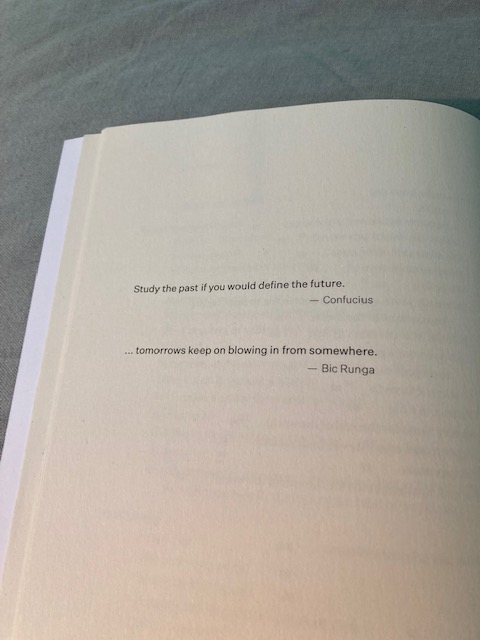
Paula: Your epigraphs signpost both past and future. This is important. Both in view of poetry and life. Like I have already said, many poets are examining the place and practice of poetry in our overwhelming and uncertain world. Are you writing poems? What do you hope for poetry, as either reader or writer, as editor of The Friday Poem?
Chris: It’s been wonderful seeing more people read and engage with poetry over the last few years both on the page or in person. I think a lot of this is a result of people not relying on old structures and established means of production, and just getting on with getting their work out there through new channels, or putting on innovative events and festivals and mixing poetry with other artforms. It’s proof that we can continue to challenge people’s perceptions of poetry and to find ways to introduce it into people’s everyday lives. But it’s more than just poetry being ‘cool’ again – a lot of work still needs to be done to address diversity, equity and accessibility. From my perspective as a writer, reader and editor, the future looks bright – and isn’t that what we want poetry to do? To show us the power of possibility and give us reasons to be hopeful.
I guess there’s always the pull of more to do—flags to fly and words to scratch into the world’s longest stretch of concrete.
I guess what I’m saying is—I am not done with snakes and wolves; I am not done with feathers or glitter on the roof of my mouth.
This is me begging for a fountain to taker all my wishes. This is me speaking a storm into my every day.
from ‘Wish list—Permadeath’
Chris Tse was born and raised in Lower Hutt. He studied English literature and film at Victoria University of Wellington, where he also completed an MA in Creative Writing at the International Institute of Modern Letters. Tse was one of three poets featured in AUP New Poets 4 (2011), and his work has appeared in publications in New Zealand and overseas. His first collection How to be Dead in a Year of Snakes (2014) won the Jessie Mackay Award for Best First Book of Poetry, and his second book HE’S SO MASC was published to critical acclaim in 2018. He is co-editor of AUP’s Out Here: An Anthology of Takatāpui and LGBTQIA+ Writers from Aotearoa, published in 2021.
Poetry Shelf: Chris Tse reads from Super Model Minority



 NZ Poetry Shelf