Author Archives: Paula Green

Poetry Shelf noticeboard: I am opening Poetry Shelf Lounge for online NZ book launches

DSCN9859.jpg

working from home


Kia ora readers, writers, publishers and booksellers


With book launches already being cancelled, and uncertain months ahead as we work hard to keep our communities well, I am going to open Poetry Shelf Lounge to host online launches of fiction, nonfiction and poetry. I could do children’s books on child-friendly Poetry Box.

I will post Poetry Shelf launches around 5 to 6 pm (wine and nibbles optional!)

I can post launch features with audio and/or texts of a launch speech, an author reading and thank-you speech. Photos. Videos. Whatever works for you and that I can do.

I like the idea of bridging communities and having the launches posted in more than one place if that works.

I am already at capacity with the time I devote to my blog and writing deadlines so this is in your hands. I don’t have time to write material or chase people. And I may have to limit myself to one or two a week! I do have time to assemble posts and spread the word.

Publishers and publicists feel free to get in touch with me – and gather the material for a Poetry Shelf Lounge launch.


My blog reaches more people than a book launch does but I can link to other significant sites.

This is a time to strengthen our book communities and invent new ways to celebrate our books without putting people at risk.

If you have ideas on how to help or make this idea even better let me know. Goodness knows if it will work but I want to give it a shot! Other ideas are simmering:


* host NZ poetry readings online if they are going to be cancelled (is the Pasifika reading in Te Atatu Library to be cancelled or the first Lounge reading?)

* host NZ book discussion podcasts

* host author interviews video or audio

* any other suggestions?


Maybe there is a better way and place to do this – but this a grassroots project so let’s see what we can do to boost books.


Ngā mihi

Paula Green


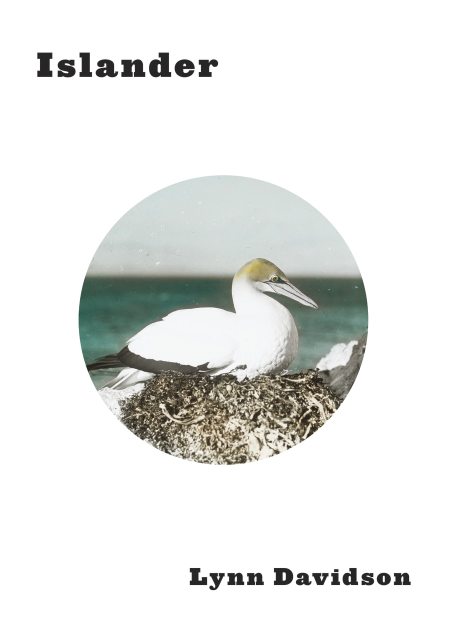
Poetry Shelf audio spot: Lynn Davidson reads ‘Even though it’s not the beginning’


Islander__83638.1547675687-1.jpg


Lynn Davidson reads ‘Even though it’s not the beginning’ from Islander (2109, Victoria University Press)


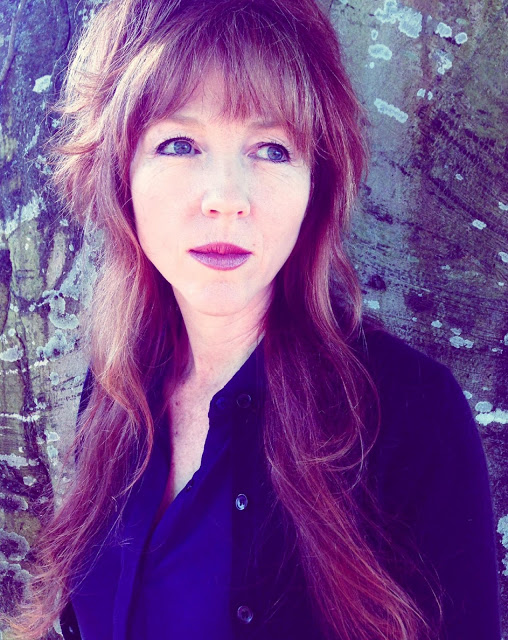
Lynn Davidson is the author of five collections of poetry and a novel, Ghost Net, along with essays and short stories. She grew up in Kāpiti, Wellington and currently lives in Edinburgh.


My review of Islander

Victoria University Press author page


Poetry Shelf noticeboard: Tracey Slaughter new managing editor of Poetry New Zealand


dark+bark+3.jpg


Exciting news from Jack Ross: I am delighted to announce that an agreement has been reached between Dr Tracey Slaughter, Senior Lecturer in Creative Writing at Waikato University; Dr Jack Ross (me), the present managing editor of Poetry New Zealand; and Nicola Legat, head of Massey University Press, our publisher, for the future housing of the journal in the School of Arts at Waikato.

Poetry Shelf archives: Aimee-Jane Anderson-O’Connor celebrates Olivia Macassey’s ‘Outhwaite Park’


Outhwaite Park         


and three cheers for the old neighbourhood

clawing its way through the dirt and the

new

houses that squat where the vacant lots reflected us


and three shadows

for the people we used to be, for

rice and dope and chilli olives, three shadows

for your silhouette, with its cigarette, for the sound

of a swing at midnight

the sound of a swing when the swinger is crying


three sighs for the stubborn authenticity of a face

harsh with streetlights

the horrors of a clarinet

devastating revelations

and for the lies, for the unmoved trees

which made it all seem underwater

for the melancholy see-saws and the warm air, for her dress

in the crooked oblong of doorway, her crooked dress

in the yellow of the door

the stumbling between houses, clutching salads and lovers

the bodies passed out on our floors


three tears

for the pale orange poppies

that bloom where you kissed me

bloom where you kissed me


and three tears

for the people we used to fuck

for backbones scraped on the washing machine

for the strangers who slept outside your bedroom door

and the schoolgirls and drag queens playing table tennis

and the cockroaches breeding in the microwave;


and the four am trains and six am buses,

mint icecreams, roofs of carparks, moulting hedgehogs

lit by the phonebox, the grass overrun by wirewoves

and rotting cardboard, my summer clothes, my love —


and tunnels we crept through at dawn, birds which sang blind in the dark

the refrigerator with its empty hum, before we borrowed credibility,

we had the insane faces of barbie dolls, the overpainted walls

and exploding demolition fires

we had stones in our shoes and delinquents in our ceilings

catching our prayers before they got to the sky,

and that bridge most of us

never jumped from, we were saving it for a rainy day,


yeah three tears for the old neighbourhood

clawing its way through the dirt

and the park

that I see and can never return to

that stage on which all our memories were undone,


and I am again in the wood chips at midnight

with my neck pressed against the silence of your mouth

and I am again on the swing at dawn

watching the policeman make his way across the grass


Olivia Macassey

appeared in New New Zealand Poets in Performance, ed. Jack Ross and Jan Kemp (Auckland: AUP, 2008)


Aimee-Jane Anderson-O’Connor:

I first heard this poem in Tracey Slaughter’s creative writing class, and I still remember the shiver down my spine. There were those neighbourhoods like mine right there in the lecture hall and this voice that talked a bit like how I talked: yeah. It was one of those poems that you read at the exact right moment, and it was the first that I printed out and carried with me.
It’s beautiful and sort of pining, but all the same gritted and stubborn. It’s got this sort of nostalgia, but with claws. The parties, but also the grubby silences after them, the confetti and the roaches and the cardboard rotting lonely in the corner. The impossibility of going back, but also the impossibility of wholly forgetting: ‘The park that I see and can never return to’. It was the first time I remember seeing repetition in a poem and really loving it. The first poem I read out loud again and again. That rhythm, that imagery, those final lines. The white space after them. Those echoes in the half-dark. I come back to this poem often.


Olivia Macassey‘s work has appeared in Takahē, Rabbit, Poetry New Zealand, Otoliths, Ngā Kupu Waikato, Landfall and elsewhere. Her books are The Burnt Hotel and Love in the Age of Mechanical Reproduction.

Aimee-Jane Anderson-O’Connor was awarded the 2018 Charles Brasch Young Writers’ Essay Competition, and the 2017 Monash Prize for Emerging Writers. Her poem ‘Instructions’ was named by The Spinoff as the best poem of 2018, and she took up The Spinoff Review of Books Writer-in-Residence Award at the start of 2019. Her work has appeared in Starling, Mayhem, Brief, Poetry New Zealand, Landfall, Turbine, Mimicry, Min-a-rets, Sweet Mammalian, Sport and Verge. She writes thanks to the tireless support of some of the best people on this great watery rock.

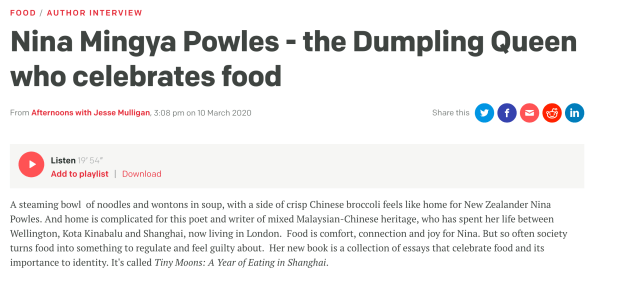
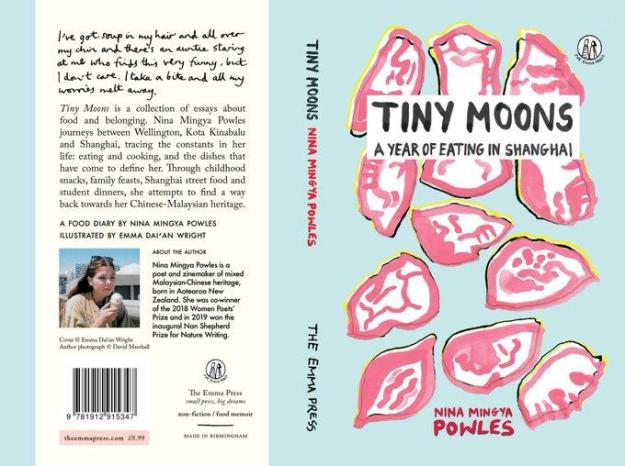
Poetry Shelf noticeboard: Nina Mingya Powles in conversation with Jessie Mullingan @RNZ

This was a great conversation! Listen here.


Screen Shot 2020-03-11 at 9.14.01 AM.png


eight_col_nina.jpg


Poetry Shelf Live and the Wellington Writers Programme


IMG_5393IMG_5394


‘We are making our grandchildren’s world with our words. We

perceive a world in which everyone sits at the table together, with enough for everyone.

We will make this country great again.’


Joy Harjo from ‘Advice for Countries, Advanced, Developing and falling’ in An American Sunrise (2019)


A weekend in Wellington is always a treat – especially when there are writers and readers events on. I had a blue-sky, social-charging time and I loved it. Laurie Anderson on the Friday night delivered an improvised platter of musical quotations with a handful of musicians that together created a wow blast of sound and exquisite individual turns on percussion, strings, keyboards. Ah transcendental. Just wonderful. Read Simon Sweetman‘s thoughts on the night – he describes it far better than I can.

One bowl of muesli and fruit, one short black and I was all set for a Saturday of listening to other authors. First up Coming to our Senses with Long Litt Woon (The Way through the Woods) and Laurence Fearnley (Scented). Laurence is on my must-read stack by my reading sofa. Her novel engages with the landscape by way of scent, sparked perhaps by by her long interest in the scent of the outdoors. I loved this from her: ‘Writing about the South Island is a political act – I’m digging my heels in and see myself as a regionalist writer’. I also loved this: ‘I’m not a plot-driven novelist. I tend to like delving into sentences. I like dense descriptions. I imagined the book as dark brown.’

Next went to a warm, thoughtful, insightful conversation: Kiran Dass and Jokha Alharthi (Celestial Bodies). Fabulous!

And of course my poetry highlight: Selina Tusila Marsh in conversation with USA Poet Laureate Joy Harjo. I had been reading Joy in preparation for my Poetry Live session and utterly loved her writing. This is how I introduced her on Sunday:

Joy Harjo is a performer, writer (and sax player!) of the Muscogee Creek Nation. She’s the current US Poet Laureate with many awards and honours and has published nine poetry collections, a memoir, a play, produced music albums. She lives in Tulsa Oklahoma where she is a Tulsa Artist Fellow. Reading Joy’s poems, words are like a blood pulse as they question and move and remember – in place out of place in time out of time. I have just read Conflict Resolution for Holy Beings and An American Sunrise. This was what I was thinking when we have to endure the multiple offensiveness of Trump in our faces even at the bottom of the world to pick up Joy’s poetry is a balm that takes you behind and beyond and above and below into a different USA and it is heartbreaking and wounding and the poems might be like rooms where you mourn but each collection is an opportunity for breathtaking body anchoring travel that allows you to see and feel afresh. Joy’s poetry is so very necessary, If you read one poem this weekended read ‘How to Write a Poem in a Time of War’ from An American Sunrise.

But if you went on Saturday night you got to hear Joy read a good sized selection of poems, including the poem I mention above! Joy’s response to her appointment as the first Native American Poet Laureate in USA: ‘a profound announcement for indigenous people as we’ve been so disappeared. I want to be seen as human beings and this position does that. Human beings write poetry. Even if it’s oral, it’s literature.’

So many things to hold close that Joy offered: ‘No peace in the world until all our stories have a place, until we all have a place of respect.’

She suggested we could think of poems as ‘little houses, little bird houses for time grief joy heartbreak anything history what we cannot hold. Go to poetry for times of transformation, to celebrate and acknowledge birth, to acknowledge death. We need poetry.’

Joy: Indigenous poets are often influenced by oral traditions – a reading voice singing voice flute voice more holistic.

Joy: You start with the breath. Breath is essentially spirit.

Joy: You learn about asking, asking for help.

Joy: Probably the biggest part is to listen. You have to be patient.

Joy: The lessons get more intense.

Joy: If you are going to listen to a stone, what range is that?


My energy pot was on empty so was in bed by 8 pm, and so very sadly missed Chris Tse’s The Joy Of Queer Lit Salon. From all accounts it was a breathtaking event that the audience want repeated.


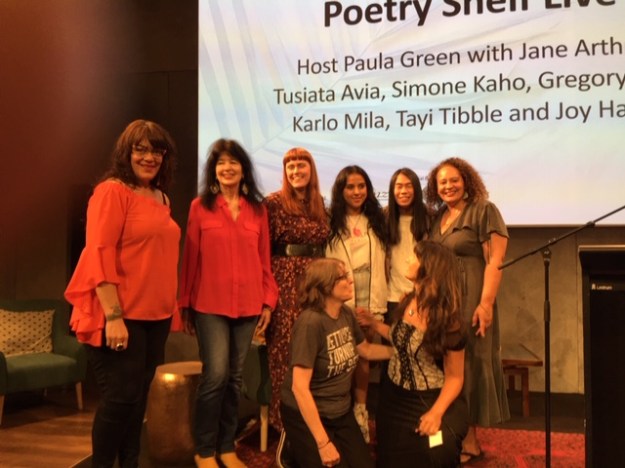
Sunday and I hosted Paula Green’s Poetry Shelf Live. Lynn Jenner was unwell (I was so looking forward to hearing her read as her inventive and moving Peat is so good). My dear friend Tusiata Avia was in town coincidentally so she stepped in and read instead along with Karlo Mila, Simon Kaho, Gregory Kan, Jane Arthur, Tayi Tibble and Joy Harjo.

I love the poetry of my invited guests and got to sit back and absorb. I laughed and cried and felt the power of poetry to move in multiple directions: soft and loud, fierce and contemplative. Ah if a poem is like a little house as Joy says, it is a house with windows and doors wide open, and we are able to move through and reside there as heart, mind and lungs connect.

A friend of Hinemoana Baker’s from Berlin came to me at the end crying and speaking through tears and heaving breath about how moved she was by the session. I got what she was saying because I felt the same way. I guess for all kinds of reasons we are feeling fragile at the moment – and poetry can be so vital. After four years of Wild Honey reading, writing, conversing and listening I have decided the connective tissue of poetry is love aroha. I felt and said that, ‘We in this room are linked by poetry, by a love of it, and that matters enormously’. I felt that at this session.


So thank you Wellington – for all the book fans who supported the events. For the poets who read with me.

I also want to thank Claire Maybe and her festival team. Claire has such a passion for books and such a wide embrace, you just feel the love of books, stories, poetry, ideas, feelings. Yes I would have LOVED to hear Elizabeth Knox, Witi Ihimaera, Lawrence Patchett and Kate Tempest (for starters) on at other weekends but this was a highlight of my year and I am so grateful.


‘Come on Poetry,’ I sigh, my breath

whitening the dark. ‘The moon is sick of you.’

We walk the white path made of seashells

back to the orange light of the house.

‘Wait,’ I say at the sliding door. ‘Wait.’


Hinemoana Baker from ‘manifesto’ in waha / mouth (2014)


IMG_5401