
Gumboots squelch across the paddock
it’s still dark and she’s making her way
over to the milking shed
a coat covers her to her knees
and tents over her growing belly
I imagine her working like normal
using her knees to lift
to carry the bucket home for breakfast
creamy milk, unpasteurised
perfect for porridge
trek back across the paddock, Tama-nui-te-rā
has begun to poke his head above the horizon
to warm the back of her
her belly starts to stir
then greet her with a few kicks
then she can get ready for her job
at the shop in town
or the mill,
whichever came first
and clean or cook
right up until the very due date
that week she will have her first girl
at eighteen
and a few years and girls later
she will marry down at the courthouse
then years later she will have 13 grandchildren
of course she will have favourites
and she will continue to work
and work and work
right up until the very last minute
and Tama-nui-te-rā will greet her
one last time
then farewell her not long after
*
her heels click across the footpath
it’s dusk and she’s making her way
a few streets over to the bus stop
a coat covers her to the ankles
it tents over her entirely
Jessie Puru
Jessie Puru, Ngāti Te Ata, Tainui,Ngā Puhi, is a Māori/ Pākeha poet and mother of one daughter living in Auckland. Her work has been published in Ika, Blackmail Press, Landfall, Poetry (US), and she was runner up for the Emerging Poets Competition in 2019. Jessie is currently working on her first collection of poems following the life of a young wāhine trying to find her connection with Te Ao Māori. She also has a Bachelor of Creative Arts from MIT and Master of Creative Writing degree from AUT.
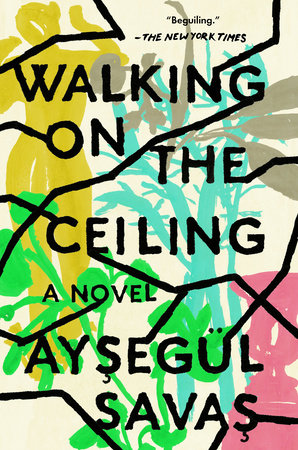
Ayşegül Savaş grew up in Turkey and Denmark, and currently lives in Paris and teaches at the Sorbonne. Her writing has appeared in The New Yorker, Granta, The Guardian, The Paris Review Daily, The Dublin Review and elsewhere, and was shortlisted for the Glimmer Train Fiction Prize and the Graywolf Emerging Writers Award. She has an MFA from the University of San Francisco. Her debut, Walking on the Ceiling, was published May 2019 (Riverhead Books, an imprint of Penguin Random House). Her second novel, White on White, is forthcoming from Riverhead Books.
I spotted this book on The New Yorker book page – just a few sentences that sent me hunting down a copy (The Women’s bookshop had a wee stack).
I adore this book. It is light and dark, economical, sumptuous, sweetly crafted. It made me sad and it filled me with joy.
Nunu moves from Istanbul, her home town, to Paris. She barely knows a soul but meets M., a British writer whose novels are set in Istanbul. Together they roam the streets and museums of Paris, and as they roam, they draw the far-off streets of the city they love closer. It is a novel of movement – writing as a form of travel, travelling as a way of recalling the faulty and elusive past.
The sad thread for me is the mother-daughter relationship – enigmatic, strange, silent.
This is novel writing at its utmost elegance as it brings two cities to life: kaleidoscopic, kinetic, clandestine. Catching the physicality, the sensual layers. It is so very moving, this portrait of a young woman finding herself missing as much as she recognises her presence.
The title makes sense near the end of the book! Took me by delicious surprise.
I am in love with this book.
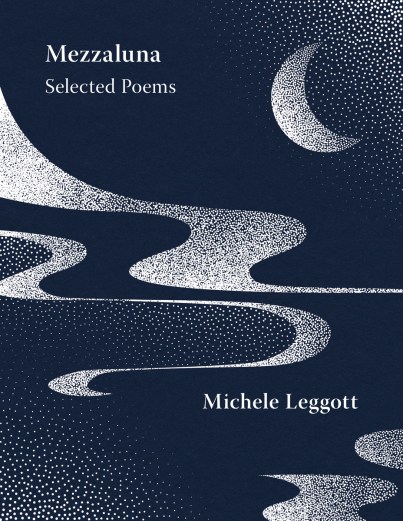
Mezzaluna: Selected Poems Michele leggott, Auckland University Press, 2020
people still go to cottages in moody seaside weather
to read for a week how will we do it now?
when I go for walks words stalk along too
I’ll be travelling mid-February and can’t guarantee a lucid mind
what about a big table in a room with windows
looking over the wild and wavy event?
from ‘Colloquy’ Swimmers and Dancers
Michele Leggott is continuing to make extraordinary contributions to poetry in Aotearoa. I rank her with Bill Manhire: two poets who have not only published astonishing poetry, but who have also been significant mentors and teachers in university programmes and introduced poetry initiatives, and edited vital anthologies. We are in debt to Bill for his vision for the IIML and offshoot projects, and the Poet Laureateship (now administered by The National Library but established with the efforts of Bill and Te Mata Estate). Michele was the first Poet Laureate under the National Library administration. She established the NZ Electronic Poetry Centre, set up the Lounge readings in Auckland, and has organised various gatherings of poets, including symposiums in Bluff, Christchurch and Auckland. Not forgetting her diverse contributions as Professor of English at the University of Auckland.
More than anything, we are in Michele’s debt for the light she has placed upon women poets from the past, especially Robin Hyde and Lola Ridge.
words come so slowly
it has been lonely
a phoenix palm
and behind it
crystalline glitter
another story, waving
plaintain paradisiaca a bird
musey with waves
Helicon a harbour cone
here
bright
Greek
over Narrowneck
from ‘Withywind’ from Like This? (1998)
I have been reading Michele’s poetry since her debut collection, Like This? (1988) and have followed the thematic and lyrical contours ever since. The first word that springs to mind is heart. Michele has written within the academy, with her prodigious intellect flaring, but she is a heart poet beholden to neither theoretical trend nor poetic fad. Her poetry has always linked hands with the writing of other women, and over time has become increasingly personal and more accessible for readers.
Michele’s Mezzaluna: Selected Poems appeared mid March, just before we moved into lockdown. Its visibility suffered as our reading, writing, publishing and reviewing lives moved into upheaval. There is an excellent interview with Lynn Freeman on Standing Room Only and a short conversation with Paula Morris as part of The Auckland Writer’s Festival online series. The highlight of the latter is hearing Michele read an extract from her poem ‘The Fascicles’ from Vanishing Points (2017) (she is the last writer in the zoom session).
Fine ground darkness pours into the vessel
beans and flowers adorn the fall—
ichor! ichor! drink to the eyes locked on yours
the mouth that smiles and will speak for itself
I have always done the talking and she
put the words in my mouth saying do melisma
like sunlight be melisma like no sunlight pressed
redness before dark print an iris on her
from ‘Blue Irises’ in DIA (1994)
Difficulty has never been an issue for me as a reader of poetry – I love venturing into poetry thickets where meaning might appear in whiffs, and where enigma, evasion and multiplicity are active ingredients. Michele’s mid-career poetry collections, perhaps from DIA through to Mirabile Dictu, delivered various shades of difficulty and I loved them for that. Her lexicon has drawn upon the arcane, the archaic, slang, borrowed words, foreign languages. There were highways and byways to other poems, a history of research and reading. Intimacy was as likely as distance. And even though her poetry has become increasingly personal, self confessional in parts, it has always been so. Family appears, sons, food, beloved places, a shaping of home along with a profound engagement with other writing, other stories, myths, conversations.
The poems underline the way poetry threads ideas, memory, motifs, experience, opinion, reading history. The how of writing is as crucial as the what of writing.
imagine the world goes dark
a bowl of granite or a stone bird
incised by tools the nature of which
is unknown just that they are metal
and therefore from otherwhere
just that the weight of the bowl
precludes light and lightness
of thought my feet take a path
I can no longer see my eyes
won’t bring me the bird only now
has my hand found the stones
I could add to the smooth interior
of my despair the world goes dark
I look into the eyes of my stone bird
hammers before memory
silence and the world that is not
from ‘mirabile dictu’ in Mirabile Dictu
Along Mezzaluna’s reading tracks you will find honeysuckle, daffodils, roses, melons, breath, the wind, stars, here, there, light, dark, heart. Always heart. Always the interplay between light and dark. Michele has dedicated Mezzaluna to those who travel light and lift darkness’. Yes reading is a fertile way of travelling, life equally so; light and dark stick to us like biddybids, but our relations with and navigation of both are unique. What do we carry with us? What do we keep placing in our personal baggage? What do we do with the dark? For Michele, with her slow movement into blindness decades back, and all the challenges that have affected every aspect of her life, blindness has understandably also seeped into her writing. She has always been attuned to the sound of words, the mobility of language, words as sound dance in the ear, in harmony and discord. But the possibilities of sound, under Michele’s deft guidance, have become a glorious anchor for everything that has mattered and will matter.
The lush terrain of the visual is also a sumptuous part of Michele’s poetry. The recurring motifs I have already mentioned range from piquant to honeyed, visual bouquets in their own physicality but players in so much more. Participants in ideas, the mythological references, the recuperation of memory, family history, personal challenges.
It is equally rewarding to listen for the other women, particularly the poets who have captured Michele’s attention and diligent rescue work: I am thinking of the way Robin Hyde, Eileen Duggan and Ursula Bethell have become a visible part of the network. More recently Lola Ridge. Michele’s latest project is Emily Harris, a New Plymouth poet who died in 1925 and whose work has been located in Sappho-like traces. Michele response to the missing poet is to recreate versions in Vanishing Traces.
I have heard Michele perform poems from most of her collections and it has always affected me deeply. To listen to poems from As Far As I Can See – the poems that expose her move into blindness – these have been audience-affecting occasions. I have sat in a line of poetry fans and we have been utterly still, barely able to take breath at the daring exposure, the heartbreaking experience, the exquisite and utterly memorable poetry.
Ah, no matter what I write, no matter what I signal, I feel like I am shortchanging this rich and elegantly constructed volume. Michele told Paula Morris she had originally sent in a longer version but had cut it back and, in doing so, focused on the DNA of each book, on what was important. As she read and replayed, she carried a key question across the books: ‘What does a poem look like?’
This is such a good question to carry with you as you read – yes Michele’s poems do change, the lines shorten, the lexicon is more familiar, but there is common ground. Perhaps it comes down to a love of a sound, and how that love of sound is amplified when you can’t see the physical world. It is a rejuvenating, heart-engaging, thought-provoking read and it feels like this Michele’s poetry deserves a whole book of response. Michele Leggott warrants a whole book that navigates what her poetry does: its connections, its liberations, its epiphanies, its testings.
Mezzaluna showcases the work of one of our most inquisitive and sensual poets who ventures into the unknown, into an inhabited world, with an open heart and free-flowing mind. Glorious.
Auckland University Press author page
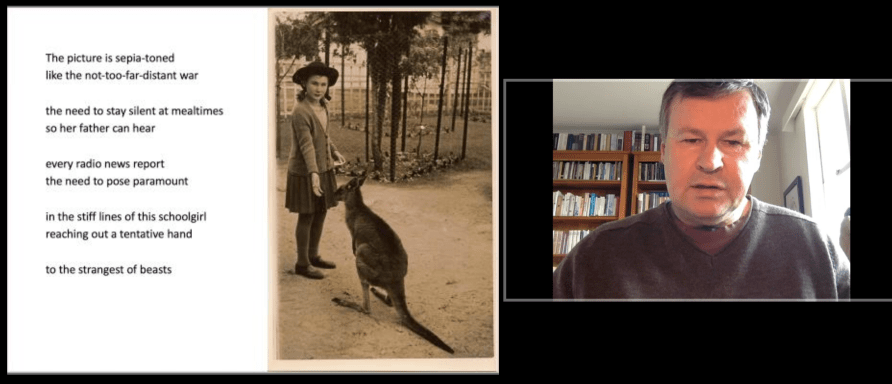
You can watch Jack’s video here
1942: Some Notes on the Poem
A few years ago I was invited to attend a poetry festival at the University of Canberra. While I was there, one of the organisers asked me to contribute to a project where poets wrote new pieces about the local landscape for a textile artist to interpret.
I have to say that I felt a bit of a fraud in agreeing to participate. What do I know about the Canberra landscape? I’m from New Zealand, not Australia, and this was my very first visit to Australian Capital Territory.
However, my mother was born in Sydney, and I have made a lot of trips across the Tasman at one time or another, so I said I would see if anything came to mind before their deadline. Sometimes I think my wife is right to label me a ‘publication whore’ – any new project that comes up I tend to agree to. I love exhibition catalogues, and poetry posters, and chapbooks, and all that species of arty ephemera.
What I ended up writing was a four-part poem about various family associations with Canberra and Australia in general. My uncle graduated from Duntroon, the Military College there, back in the late 1940s. I have a number of friends who studied at Australian National University. The first poem in the sequence, though, and the only one I really feel fond of now, is this one based on a photograph of my mother as a schoolgirl, pictured feeding a wallaby.
I put into it a lot of what I’d heard from her about her childhood during the Second World War – the sense of imminent doom caused by austerity, the Japanese mini-subs in Sydney Habour, the bombing of Darwin. It’s for this reason that I called it ‘1942’, even though it’s difficult to say precisely what year it was taken: more likely a couple of years before that.
My mother suffers from dementia, and every piece of memory salvaged from her rich life experience seems particularly important to us as a result. This photo, in particular, we only found after my father’s death, as he’d replaced all the pictures in her album with shots of his own collection of militaria. It’s one of the very few images we have of her as a child.
But the picture itself! It was so odd, so obviously staged – as she described it to us, her father was barking orders at her all the time she was holding out her hand to fake the ‘feeding’ episode. It speaks to me of lost time, a depth of emotion one can seldom attain in the everyday.
The textile artist I mentioned above, Dianne Firth, did a wonderful job of interpreting all four of the parts of my poem in her exhibition, Poetry and Place (Canberra: Belconnen Art Centre, 25 August – 17 September 2017), but this is the only part of it that I still feel a genuine affection for.
My wife, Bronwyn Lloyd, must have thought so, too, since she made it into a hinged poster work – the poem reproduced opposite the picture –for Christmas 2016. We used this one-off poster again for the celebration of my mother’s 90th birthday a couple of months ago.
“You really did me proud,” she said. She’s a hard-bitten Aussie still at heart. I’ve seldom seen her so moved.
– Jack Ross, Mairangi Bay, 2 August 2020
Jack Ross works as a senior lecturer in creative writing at Massey University. He is the author of five poetry collections and eight works of fiction, most recently Ghost Stories (Lasavia Publishing, 2019). He blogs here
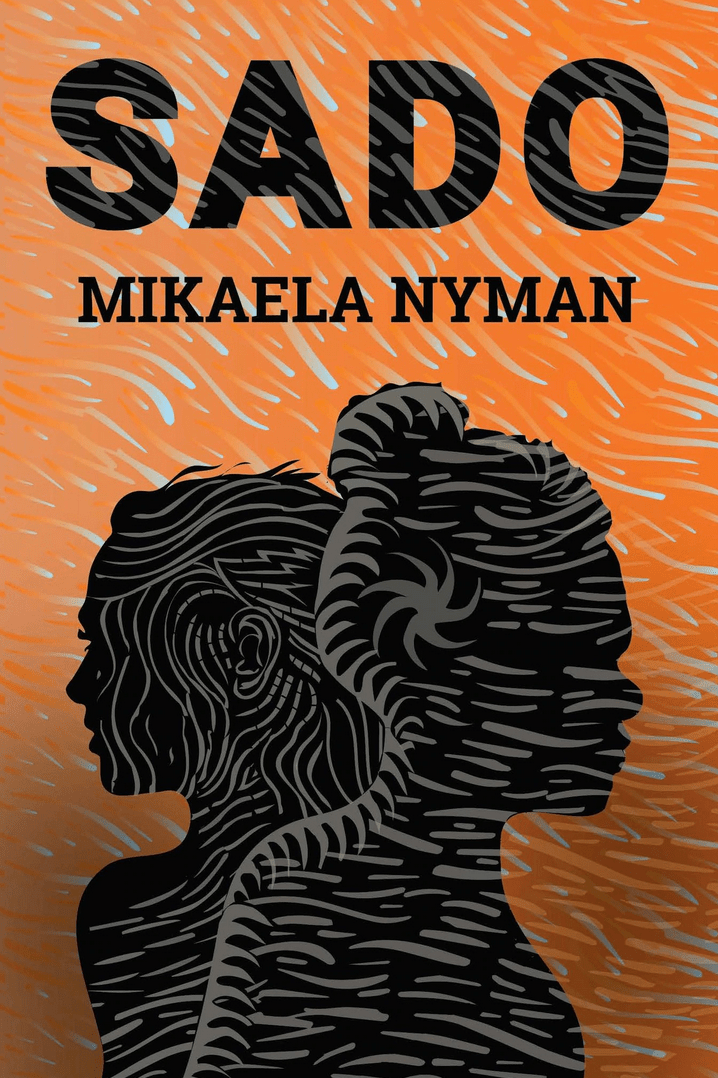
Sado Mikaela Nyman, Victoria University Press, 2020
At the end of the day, poetry and fiction are just different languages in which to express what matters most to me.
Mikaela Nyman, VUP Q & A
During lockdown Poetry Shelf hosted a virtual launch for Mikaela Nyman’s debut novel Sado. To miss out on the celebration of your first novel with friends and family, with people buying your books and you signing them is a big thing, and it seems so many of the books that were due during lockdown have missed out in other ways. Bookshops were shut, print media was on life-raft rations. And we were all struggling with subterranean anxiety, surreal connections with a surreal world. What mattered became a key question. I was delighted to see Mikaela has recently celebrated the book at a launch event with Elizabeth Smither.
Books are getting less attention in print media at the moment, but thank heavens for the commitment of some editors (Canvas is still doing its utmost best to include NZ reviews). And thank heavens for online review activity. But I do hear authors saying their recent books have disappeared into the ether.
I recently read a wonderful Q & A that Mikaela did for Victoria University Press; it has prompted me to post the link here and include a few personal reactions to the novel.
She doesn’t trust her memory to retain the sharp edges. One day this will appear no worse than a regular spring storm. People will try to convince her it wasn’t half as terrifying, that she’s made it up, that they watched movies and drank wine or cups of spice tea while the storm blew itself out. It would be unfair to anyone who was caught in this cyclone and in the storms to come. Because there are going to be more of them, increasing in frequency and intensity as the earth and the oceans warm up and create this atmospheric oscillation, this unpredictable lashing and swirling.
from Sado
Reading Sado during a time of world catastrophe – when some people are struggling to cope with the effect of Covid on their lives, when some people have greater access to what they need – is timely. Mikaela’s novel is set in 2015 in Vanuata at the time Tropical Cyclone Pam hit. The devastation is widespread – physical yes, but it also impacts on lives in myriad ways. Cathryn is an NGO worker from Aotearoa, with a local boyfriend and a teenage son. Faia is a radio journalist, a community organiser who works hard for women. There are various tensions between contemporary life and tradition. However the blazing-hot kernel of the story is a car accident where a young baby is killed, and kastom (custom) declares a child must be offered in compensation.
It grew out of the realisation that Vanuatu didn’t seem to feature on people’s radar in New Zealand – despite the fact that it is only a three-hour direct flight away, and we have thousands of Ni-Vanuatu come every year to work in our vineyards and orchards.
Mikaela, VUP Q & A
Patriarchy is a dominant force – women’s lives are regulated with scant access to power, individual choices, work opportunities. Justice is called into question by different actions of the Supreme Court and the Council of Chiefs. Yet Sado showcases the power of women to connect, to support, to communicate.
My nagging question: how did Mikaela get to write a novel outside her own culture and negotiate ideas of trespass? Mikaela was born in Finland, spent four years in Vanuatu and now lives in New Plymouth with her family. She writes poetry, fiction and nonfiction in both English and Swedish, and has published a collection of poetry in the latter. Her PhD in Creative Writing (IIML) involved a collaboration with Ni-Vanuatu writers. In her endnotes Mikaela describes Sado as a work of fiction shaped by her own experience of the cyclone, and her enduring friendships with writers and former colleagues in Vanuatu. Her expressed hope, having found only a few slender volumes by Ni-Vanuatu women, is that her novel will encourage ‘women writers from Vanuatu to tell their own stories’.
The questions mounted as I read – but have in fact been addressed by the Victoria University Press interview:
And so I chose to become an ally and supporter, and perhaps a conduit for New Zealanders to glean a different perspective of their Pacific neighbour. To help explain what it feels like to be at the receiving end of such a natural disaster in our Pacific neighbourhood and to have to deal with an unprecedented influx of responders and well-intended, but perhaps misplaced, relief efforts. In parallel, I’ve shared my writing, my knowledge and skills with emerging Ni-Vanuatu women writers, facilitating creative writing workshops and collaborative poetry events, in order to find my place in the world and enable Ni-Vanuatu writers to grow as writers and see their work published. ‘Nothing about us without us,’ one of my Māori colleagues said to me when we discussed the ethos informing my research and novel writing. It reinforced my decision that working in alliance and collaboration would be the best ethical choice. Taking heart from the fact that these Ni-Vanuatu women writers were among my first readers and encouraged me to keep writing this world that they recognised, while at the same time ensuring I left space for Ni-Vanuatu writers to tell their own stories. The kind of insider stories I couldn’t possibly tell.
Mikaela, VUP Q & A
So for me the novel has two vital impacts. The way I muse on the context in which the book was written. The slow surfacing of women’s voices, women writers, in Vanuatu. Poet and academic, Selina Tusitala Marsh has spent a number of years researching women writers across Pacific regions, working hard at finding ways to make their voices visible, and importantly, to find an apt expression of her own reading engagements. Selina’s book is still in the making but will be a significant arrival. If Vanuatu women’s books can springboard from Mikaela’s projects and engagements, along with the efforts of local women, then that is a blessing.
The second impact is the narrative itself: gripping, character driven, building complexity in its representation of place, people, culture. That Mikaela is a poet is made clear in the sentences and rhythmical fluency, at times lyrical, at times economical. I have no difficulty with the interplay of different registers. In a sense it mirrors the entanglement of culture, relationships and experience that is paramount. At the moment, in a world struggling with clashing perspectives, needs and outcomes, everything is complicated, so many challenges.
The novel’s complexity is also placed in sharp relief by the focus on various characters. Even in the aftermath of catastrophe, life carries on. Relationships might change, circumstances are affected, and what is normal shifts. So many entangled threads: Carolyn’s teenage son, her Ni-Vanuatu boyfriend, her mother, her attachment to Aotearoa, her friendships, her reaction to cultural difference, and of course the impact of climate change. All manner of storms – minor and major – that affect individuals, partnerships, families in all manner of ways.
As a reader I need multiple views and multiple engagements. Sado does open Vanuatu for me, I feel like I have visited somewhere I have never been before, and encountered versions of it through the eyes and thoughts and feelings of a visitor, a visitor who has lived there. I am grateful for this book that has moved me on many levels, but like Mikaela, I hunger for space to make as many voices and stories and concerns visible and viable.
Listen to Mikaela read an extract at her Poetry Shelf online launch
Dedication
This one’s for the aunty
that taught me
how to knead bread
properly.
Not with love,
but like you hate it.
The warm skin
of someone whose skin
doesn’t deserve it.
The aunty who calls out;
”Beat it down girl”
when the air bubbles
gasp through the dough.
And so you beat them
so far down
that you beat them
all the way out.
This one’s for
the girl in the tutu
and gumboots.
Shit covered
and tractor riding.
Pāpā doing her hair in loose braids,
those old farm ropes
swinging.
Tug of war fighting
to the sugar plum fairy.
This one’s for
the boy who thinks himself magic
then throws himself off
the top of the monkey bars
then doesn’t fly
but falls.
For the smashed nose,
for the freckles falling
from the face
in patterned rain.
Salt water cleaning the eyes
of a not special boy.
This one’s for
the girl with white skin
but black everything else
“Pig dog! Pig dog!”
They say,
pulling her hair
until she barks.
Reaching out
from behind black eyes
to find nothing.
The ladder out
already pulled up
to a light that emanates
from everywhere
but below.
This one’s
for the man
who speaks not with words
but with hands in the soil.
Roots coiling down
towards magma core.
Digging to Rangiatea,
he knows he’ll get there
if he just digs and digs.
And now
you are all here
and we are ready
to begin.
Ruby Solly
Ruby Solly is a Kai Tahu / Waitaha writer and musician living in Pōneke. She has had poetry and creative non-fiction published in Landfall, Sport, Poetry NZ, Starling, Mimicry, Minarets, E-Tangata, The Spinoff, and Pantograph Punch amongst others. Victoria University Press will be publishing her debut book of poetry ‘Tōku Pāpā’ in early 2021. Ruby is also a scriptwriter and her film ‘Super Special’ which aims to share knowledge around traditional Māori views and practices around menstruation has been featured in film festivals within New Zealand and the US. As a musician, she has played with artists such as Yo-yo Ma as part of his Bach Project, Trinity Roots, Whirimako Black, Rikki Gooch, and Ariana Tikao. Ruby is a taonga puoro (traditional Māori musical instruments) player and therapist with a first-class master’s in music therapy where she conducted kaupapa Māori research into the use of taonga puoro in acute mental health.

National Poetry Day Competition 2020 Dunedin Public Libraries in partnership with the Otago-Southland branch of the New Zealand Society of Authors invite you to celebrate National Poetry Day by creating poetry.
The competition is open to all residents of Otago-Southland and entries will be allocated to one of three categories:
Primary school aged children
Intermediate/high-school aged young people
Adults over the age of 18
You can write about anything, or opt for one of our suggested themes under the following categories:
Open category – choose your own subject
The Invisible
If…
A poem using all of these words in any order: matchstick, luck, slack, trick
The winning entries in each age group (1st, 2nd, 3rd, highly-commended) will be published in Dunedin Public Libraries’ e-magazine NB and website.
Winners will be announced publicly on National Poetry Day Friday 21st August 2020
Fill out the online entry form and attach a copy of your poem (500 words or less).
Complete the entry form which is available at all Dunedin Public Libraries or you can print a copy here.
Postal entries should be sent with a copy of your poem to:
2020 Vision Competition
c/o Kay Mercer
Dunedin Public Libraries
PO Box 5542
Moray Place
Dunedin 9058
CLOSING DATE: Monday 10th August 2020
 NZ Poetry Shelf