Monthly Archives: October 2022

Poetry Shelf Occasional Poems: Hannah Mettner’s ‘Love poem as women’s work’

Love poem as women’s work

There are so many tiny hitches, being a woman. I wake up and think, god, I have to wash my hair. And you know how that goes—I block the plughole again. Again, I check my breasts for lumps with conditioner running down my back. Amazing how I am destined always to find what I’m looking for. My horoscope app tells me I can be a world unto myself and I find that I already am.

Stopping in for two-for-one Tuesdays at the video store after doing the grocery shopping. Checking out something black-and-white and something for the kids, because we couldn’t afford the new release rack. What did we do before we binge-watched television? Everything was analogue then, the evenings ticking neatly to their closure. Just getting the children to bed seemed to take all night.

A blackbird flies into the window and lies twitching on the ground outside for several minutes as we watch from behind the glass. Next day it happens again, I sigh and take up the shovel. I try to forget that we live in a country of fitfully dozing volcanoes. Any of them could wake, any minute, and destroy us all. My nails are always catching on something as I stride out into the fault.

Sometimes I find myself looking at my children, nearly taller than me now, and thinking, I will be survived by them. Sometimes I find myself looking at the man I made them with and thinking, will we survive the raising of them.

Hannah Mettner

Hannah Mettner is a Wellington-based poet from Tūranganui-a-Kiwa. Her first collection, Fully Clothed and so Forgetful (VUP 2017), was longlisted for the 2018 Ockham New Zealand Book Awards, and won the Jessie Mackay Award for best first book of poetry. With Sugar Magnolia Wilson and Morgan Bach, she is one of the founding editors of Sweet Mammalian. A new collection is forthcoming from THWUP in 2023.
Poetry Shelf Occasional Reviews: Sudha Rao’s On elephant’s shoulders

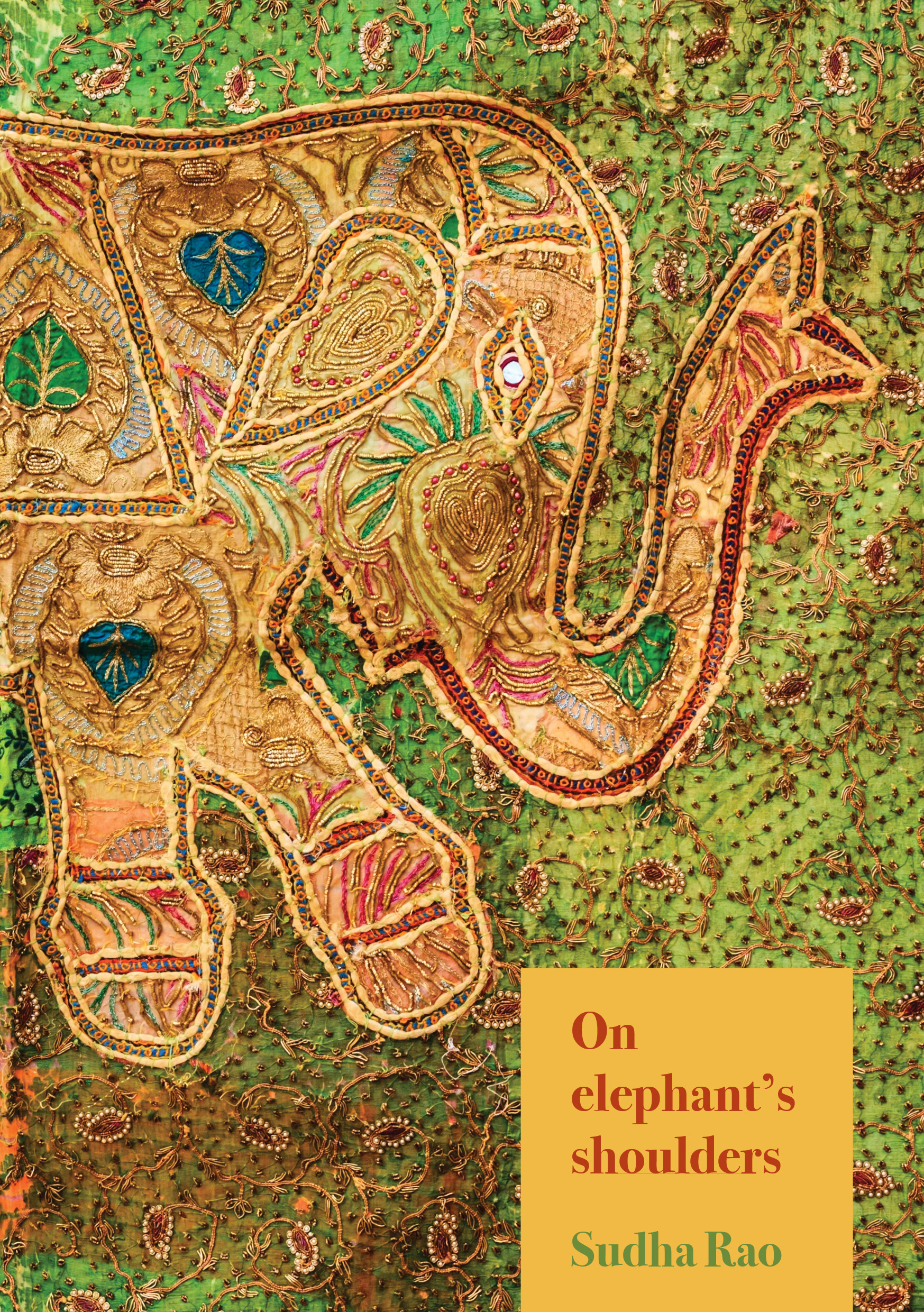
On elephant’s shoulders, Sudha Rao, The Cuba Press, 2022

Poetry books are so often objects to treasure, physical treats to hold.

Sudha Rao’s On elephant’s shoulders is exactly this, with its exquisite, embroidered cover image (sorry no acknowledgement of source or creator). The interior design is equally appealing; a perfectly sized font with ample space for the poems to breathe and readers to sojourn. The title also captivates, and I especially love the fact there is neither definite nor indefinite article to support ‘elephant’. I am pirouetting on the title, imagining elephant as both anchor and viewing platform. Falling into the title, over and over. I am both grounded and liberated.

The opening poem, ‘Warp and weft’, establishes the collection as a book of arrivals and departures. It sets the scene for recurrent motifs, ideas, words, images – and I love that. The poem is divided into three parts: passages, shadows and braids. The three terms are an excellent guide to the book as a whole. I am particularly captivated by the recurring ‘braids: there are plaits, the father’s hands, the grandmother’s hair, the South Island rivers, a way of writing, a way of living between here and there, this home and that home.

“I am a bracelet of memories bearing the weight of your bones.”

from ‘Threads across waters’

The poetry, in keeping with braid notions, exudes both economy and perfumed richness, an evocative serving of detail. The detail enhances a scene, a series of relationships, poetry as musical score. The detail may be repeated, as in echoey ‘braid’, you might move from the scent of turmeric to a ‘sunflower flowering’.

What renders the collection poignant, especially in its poetic tracing of a migrant’s experience, is the presence/absence braid, whether we are talking geography, kin, food, gestures, memories. Everything feeds into a braided version of home that is near and far, intimate and longed for.

[…] When you crossed

old waters, did you know

how cold new waters would be?

from ‘Cradle’

I talked about stitching when I recently reviewed Elizabeth Morton’s terrific collection Naming the Beasts, and stitching seems appropriate here, especially bearing in mind the sublime cover. Stitching is a way of talking about poetic craft, about the little threads that are both visible and invisible parts of the art and craft of a work, in the edge and the tension. Sudha has stitched her poetry in threads that gleam of the everyday, the detail so alive with living, epiphany, challenge, but that also work behind the scenes as the poems flow like little exhalations. Measured. Mesmerising. Magnificent.

This is a collection to treasure.

“‘There is rhythm in the cabbage tree when it combs clouds.”

from ‘Keeping time’

Originally from South India, Sudha Rao migrated to Dunedin with her parents and trained in classical South Indian dance. She moved to Wellington to establish Dance Aotearoa New Zealand (DANZ). Sudha’s poems have appeared in literary journals and anthologies in New Zealand and overseas, including Ko Aotearoa Tātou | We Are New Zealand and Best New Zealand Poems. Sudha was a participant in the International Bengaluru Poetry Festival 2019 and performs in Wellington with Meow Gurrrls.

The Cuba Press page

Poetry Shelf Occasional Poems: Elizabeth Smither’s ‘The Etruscans’

The Etruscans  

In the British Museum
I love the Etruscans best.
I thought I would be simpatico with others

more genteel, less roughly hewed
as if from sandstone, not marble
deep thinkers, at it for years

by frozen water or under chandeliers
but these rough-hewn who loved
the present moment and pleasure

are the best this afternoon
when the darkness comes at three
the hour I imagine they dance.

Elizabeth Smither

Elizabeth Smither’s new collection, ‘My American Chair’ will be published in October/November by AUP and MadHat (USA).

Poetry Shelf occasional Poems: weekend diary and Janet Newman’s ‘Goodbye Kukutauaki Road’

The rain is dampening down the day before it has even started, but I plan on reading books in bed, making fish tacos for dinner, eating cheese scones and writing some more poems for children. I posted Claire McLintock’s cancer thoughts from Canvas on social media and felt so many connections. YES to living each day fully. It may be sleep or dream or reading or writing. But the choices I make – I know some of you might think I am crazy busy but I’m not – mean I live in a state of unbelievable happiness, calm and strength. It is like a miracle, and that I love words helps no end.

Claire and her husband are selling fundraising TShirts for Sweet Louise with Workshop.

This morning I was thinking about how important conversations and connections are when you are cut off from ‘normal’ life. I can’t imagine getting on a plane for a long time, or laughing in a crowded cafe. Or even going to festivals and launching books. But I can imagine connections and conversations through the exquisite reach of blogging. Even doing my own secret writing!

With these words drifting in my head, I read Janet Newman’s email. She writes:

Reading Robert Sullivan’s Rākaihautū there [on reawakened Poetry Shelf] and Anna Jackson’s response made me think of a poem I wrote after another poem from Tūnui / Comet. My poem reflects on the loss of productive farmland to lifestyle blocks, an old issue that is finally starting to seep into national and political consciousness. I thought you might like to read it. 

I loved reading Janet’s poem – and I love how conversations and connections keep rippling out from Robert’s poetry, from the poem that relaunched Poetry Shelf, and from Anna’s. Poetry has the power to forge links with who, where and how we are in the world, the way we connect with and care for the land, the way we connect with and care for our own wellbeing. It is wonder and it is joy.

Goodbye Kukutauaki Road

“… there’s only a certain percentage of elite soils in this area, or even around the country. And once those are gone, they’re gone forever. You can never get them back.”

––Pukekohe farmer Stan Clark


my old friend.
I know how far you travel.
            Back to my no-gear,
pedal-brake bike tyres
catching in dull gravel,
school bus
turning in smoky dust, Dad milking Jerseys
in a walk-through shed: six sheds, six houses
and a sheep farm at your end.
Back to war veterans clutching
marbles in your land ballot.
Back to Te Rauparaha’s boundary:
Kukutauaki Stream near Paekākāriki,
a snare for catching kākāriki.
           Out west, sunsets
over Waitārere Beach. East, rainbows
over the Tararua Range, colourful
as your jam-packed letterboxes jostling with wheelie bins 
for shoulder space.
Yet why do I see your bitumen shine
as loss my friend, your slick curves
as enclosure?
           You’re smooth
as a black cow and our vehicles slide down
your spine all the way to Wellington,
coast nose-to-tail through the gully. Return
to pūkeko stalking lifestyle blocks, kererū
ghosting rural retreats.
           I wave as my car swings past
your long, blue sign. Bye, bye
no exit Kukutauaki Road.


Janet Newman

(after ‘Hello Great North Road’ by Robert Sullivan)


Janet Newman is a poet and scholar. Her debut poetry collection is Unseasoned Campaigner (OUP 2021), the manuscript of which was shortlised for the 2019 Kathleen Grattan Poetry Award. Her poems have been anthologised in Manifesto Aotearoa (OUP 2017) and No Other Place To Stand (AUP 2022). Raised on a Horowhenua dairy farm she now farms beef cattle. She holds a PhD in English from Massey University for her thesis Imagining Ecologies: Traditions of Ecopoetry in Aotearoa New Zealand (2019).