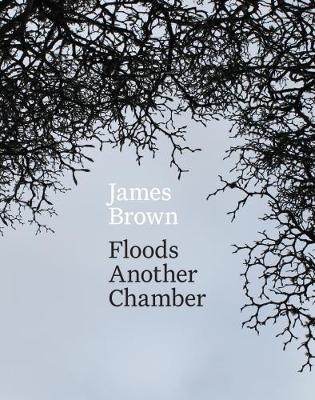
James Brown’s latest poetry book is Floods Another Chamber (VUP, 2017). You can find ‘Soft Returns’ in this collection.
Victoria University Press page

James Brown’s latest poetry book is Floods Another Chamber (VUP, 2017). You can find ‘Soft Returns’ in this collection.
Victoria University Press page
Yes! What a breath of outstandingly fresh air. I love Selina’s approach to picking the poems – you need to read the whole piece here
And it is a crackingly good selection. I can’t wait to read and listen. Some of my favourite reads from 2017 included. Content’s page here
From the intro:
‘I dedicate this last 12 months of choosing the ‘best’, to my friend and mentor, the late Associate Professor Teresia Teaiwa, whose Memorial Scholarship Fund continues to help give Pasifika peoples a choice.
Everybody loves free books (excluding my sons). I accepted this invitation to judge 2017’s batch of newly published poems because frankly, I wanted the books. I wanted to be able to map the latest constellation of Aotearoa’s poetry stars and navigate the various poetic journeys being offered from a particular time and place. I wanted to be inspired. After reading what seemed like, say, 3000 plus poems, I got what I wanted.
But I soon discovered that this was not an easy task. It wasn’t just a matter of reading a few poems and picking the ones I liked ‘best’. The sheer variety of form, tone, subject matter and lyricism soon problematised what I had thought was the ‘best’. Many a judge before me has acknowledged the impossibility of the task ahead. Most point to the bright sticky pink bubble gum of subjectivity that clicks and pops in the mouth whilst reading: ‘click, I like this one; pop, don’t like this one. Blow, I’m in my own bubble anyway.’ Presumably, this lets one off the hook. But I soon discovered that what I liked was too small a cage in which to read these free-range poems—just to further mix my metaphors in the post-euphoria of having climbed the Mt Everest of 2017’s poetic metaphors. Note to self: stop with the tongue in cheek stuff and get on with the serious business of writing this Introduction! (Aah, but whose tongue and in whose cheek?)
As a Pasifika Poet-Scholar, I wanted a more egalitarian way to ‘judge’ the ‘best’. I wanted to do something different, more collaborative, more epistemologically Pasifika—recalling Sia Figiel’s famously poetic passage nestled in the middle of her novel, Where We Once Belonged:
there is no ‘I’
only ‘we’
So, I decided to seek out the opinions, responses, reactions of the ‘we’ for a select numbers of poems that I hadn’t liked enough to include in my measly top 25. I gave out books and I gave out poems (with the payment that they could keep what they liked). My readers? Fellow Waiheke Trail Tribe runners, real estate agents, book club members, students, teachers, family members, people at the bus stop I saw often enough to bug. I asked them to give me 1-3 poems they liked and why.’
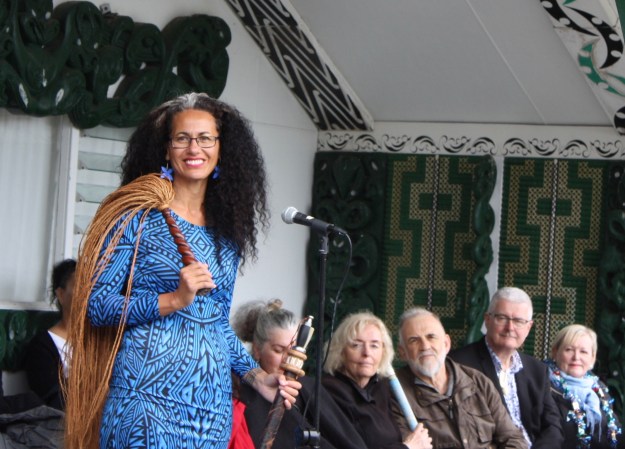
Selina at the Tokotoko Laureate event. Photo credit: Fiona Lam Sheung
‘Wherever there is a need for translation there is discomfort – a chasm that must be scaffolded, or connected by branch, bond or bridge. There is almost a desperation in the need to both enlighten and to be understood. In te reo Māori (the Māori language) the concept of te wheiao represents this liminal or transitional space. It is a term that has appeared in our incantations of mythology from the beginning of memory. It is a phrase that acknowledges a place between places, a third space, a chamber of waiting and uncertainty and one that has no set time, nor prescribed gestation period. It is also a place that is unavoidable and through which we must travel in order to gain full understanding. It is after darkness, but before light. It is the birth of all ideas. It can be the site of great discovery, or rampant anxiety, but regardless, it is a necessary place. There is no other way to reach te ao marama (the world of light). And it is in no way associated with shame.’
This is essential reading and you can read it here
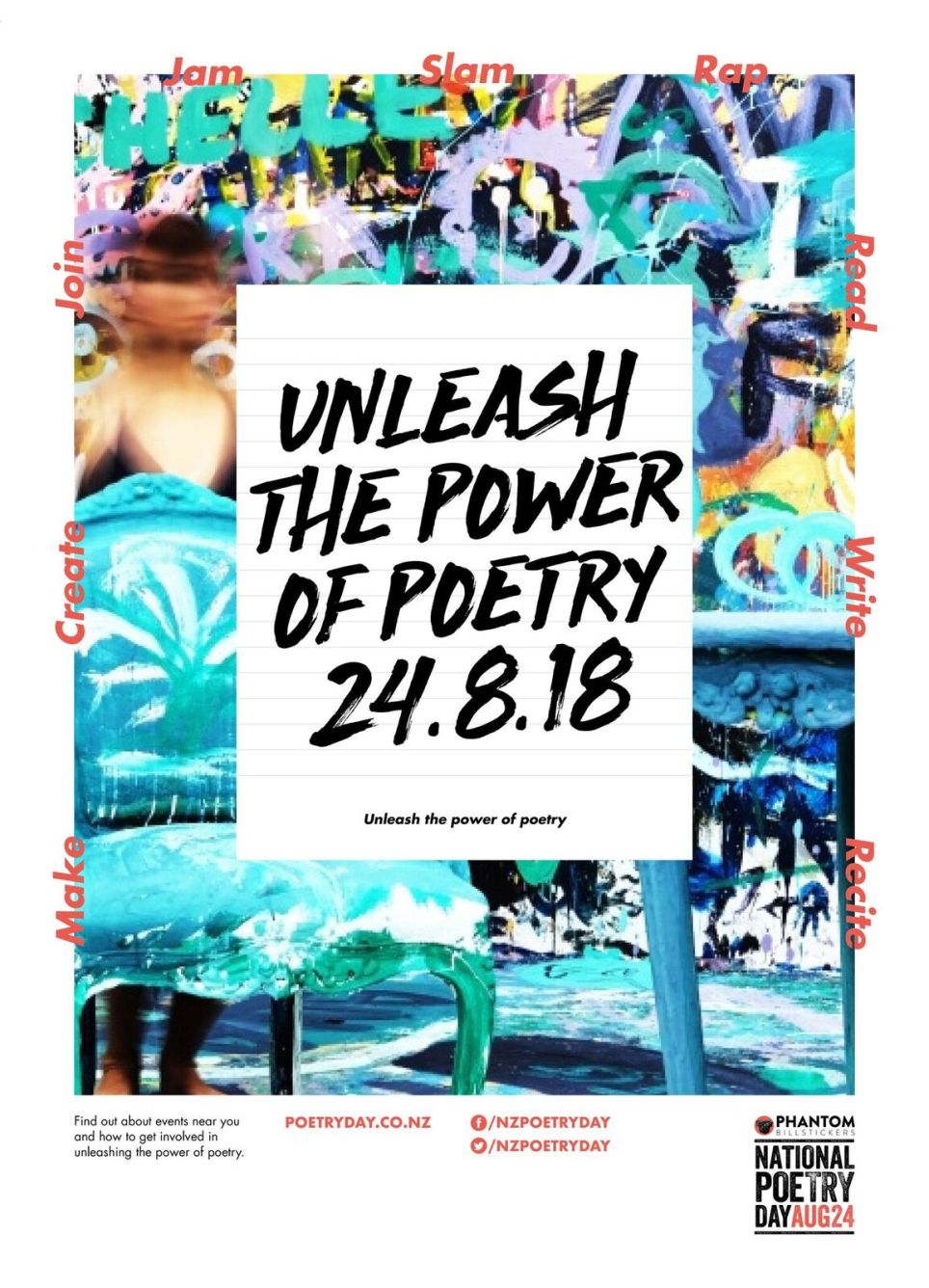
New Zealand is a nation of poets and poetry lovers. Last year Phantom Billstickers National Poetry Day broke all records, with 120 events taking place in cities and towns all over the country.
This year, Phantom Billstickers National Poetry Day (#NZPoetryDay) will be held on Friday 24 August 2018 and is set to be even bigger. Expect chances to read poetry on public transport, street posters and footpaths; to hear it in special events in cafes, bars, bookshops, libraries, schools, universities, theatres, clubs and community centres; and to enter your own work in to poetry competitions for all ages.
Phantom Billstickers National Poetry Day 2018 will feature a range of events and activities, from readings headlined by Poet Laureate Selina Tusitala Marsh to Slam Poetry contests to events that celebrate local writers and places. David Merritt’s ‘Poetry in a Box’ will see poetry bricks in 25 different locations around the country – in schools, cafés, libraries, galleries – culminating in a co-ordinated “simultaneous reading” on the day.
The cut-off date for organisers to register events and apply for seed funding is Wednesday 23 May 2018 at 5:00pm. Events can be registered online via this link. For enquiries about registering an event or applying for seed funding, please contact National Administrator Harley Hern on email poetryday@nzbookawards.org.nz. For full information go here.
Held on the fourth Friday in August, National Poetry Day is a popular fixture on the nation’s cultural calendar. For the third year Phantom Billstickers are supporting this through a naming rights sponsorship, and plan to proudly ‘splash poetry across New Zealand’ in the weeks leading up to National Poetry Day with a massive street poster campaign.
Paula Morris, National Poetry Day spokesperson for the New Zealand Book Awards Trust said, “Last year’s twentieth-anniversary celebrations brought out more great poets, charismatic performers and avid readers than ever before. Poetry has the power to speak to and for us, from the personal to the political – to mark our big occasions, comment on our society, and challenge the way we see the world. National Poetry Day is a chance to encounter poetry in unexpected places, and to engage with the many things it’s able to do and say.”
The poetry winner of the prestigious Ockham New Zealand Book Awards, announced on Tuesday 15 May 2018, will be available to take part in selected events on Phantom Billstickers National Poetry Day, as will the other poetry finalists. The shortlisted writers for the Poetry prize are: Tony Beyer (New Plymouth), Elizabeth Smither (Taranaki), Briar Wood (Northland), and Sue Wootton (Dunedin).
Nicola Legat, New Zealand Book Awards Trust Chair, said: “In the year that we celebrate 50 years since New Zealand’s prestigious book awards were first established, it’s rewarding and affirming to reflect on how many great books of poetry have been celebrated in the awards’ winner lists. These books of poetry were noticed, brought richness to readers’ lives and are eminently worth rereading. They have held their ground and their authors constitute a poetry hall of fame: Allen Curnow, Bill Manhire, Fleur Adcock, Elizabeth Smither, Brian Turner, Vincent O’Sullivan, Michelle Leggott, Hone Tuwhare, Kate Camp, Ian Wedde, Jenny Bornholdt, Glenn Colquhoun and so many more. Here’s to New Zealand poetry!”
Wild
Measure my wild. Down to my last leaf,
my furled, my desiccated. This deciduousness,
this bloom. Calculate my xylem levels.
My spore count, fungal, scarlet
in a bluebell glade. Whoosh,
where the foliage closes on a great cat.
Test me: how many tigers in my jungle,
how many lions at roam? Map my rivers,
deltas, estuaries. Mollusc, whelk, worm.
Monitor my silt. Do I have spoonbills,
high-stepping and watchful over the darting fish?
Rainfall on pines. Dappled sunlight
in my dells. Under moss, the fallen log, under
the log the hibernating hedgehog. Late my dates,
or soon? Return of the albatross, godwits
gathering. What clouds me, shifts,
but: indigo thunder-stack, pink wisp. Count the mice.
What will survive me, O my cockroaches, O my lice?
Scaffold me with metal, cage me in glass, tube me,
needle me, fill me, flush me. Saline solution:
the ocean. Oxygen therapy: the sky.
Mineral deficiency: socks off. Soil. Dark
rot, eye-less wriggle, while the roots seek, seek.
Un-diagnosable, that ticklish insect.
Mountain peak speak only snow, and thus
I am diminished; thus I rest in my pulse. Sweet
heart. Monitor my yearn, and treat it with trees.
Un-pane me. Wilden my outlook.
Membrane animal, skin mammal under the osmosis moon.
Allow my tides. All this to say, in love we nest, and on Earth.
©Sue Wootton from The Yield
Sue Wootton lives in Dunedin where she writes fiction and poetry and, as a PhD candidate at the University of Otago, is researching the importance of literature to health and wellbeing. Her debut novel, Strip (Mākaro Press), was longlisted for the fiction prize in the 2017 Ockham NZ Book Awards, and her most recent publication, The Yield (Otago University Press) is shortlisted in the 2018 poetry category of the awards. She is the selecting editor for the Otago Daily Times Weekend Poem column and edits the weekly Health Humanities blog Corpus: Conversations about Medicine and Life, found at corpus.nz
The poem “Wild” was awarded 2nd place in the International Hippocrates Prize for Poetry and Medicine in 2013. Sue’s website is suewootton.com

 NZ Poetry Shelf