Monthly Archives: August 2015

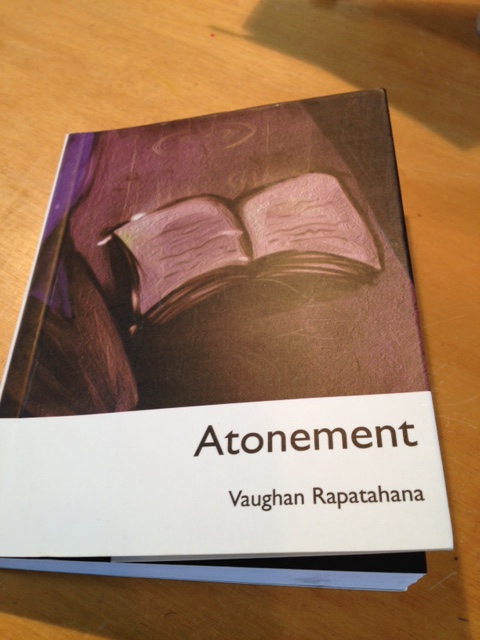
Poetry Postcards: Vaughan Rapatahana’s Atonement feels good snug in your palm


photo 1 photo 2


Atonement Vaughan Rapatahana, ASM/Flying Islands, Macau and MCCM Creations, Hong Kong 2015

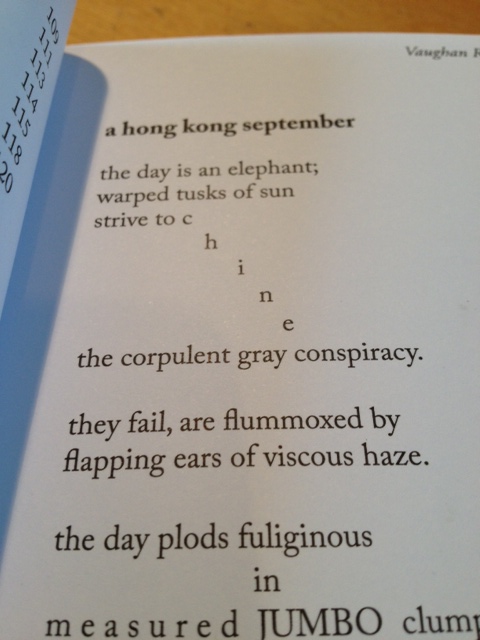
This is a gorgeous looking pocket book of poetry that feels good snug in your palm. It includes artwork by Pauline Canlas Wu and Darren Canlas Wu’s musical score of one of the poems. The poems serve disconnections and connections on people, place, politics, the weather, and love. There is a glorious marriage of lyricism, musing, image building that has anchors in numerous legacies (language poetry, myth, diverse lexicons). It is the language that prompts such evocative and delicious poetic sparks. Unlike many poets, Vaughan has not switched on the big-word filter — so the vocabulary is arcane and arching as much as it is everyday and accessible. I love that. It is like this palmful of poems is part rap, ragtime, jamming, spooling, riffs, sweet chords, minor keys, jump cuts, out-takes, in takes, double backs and so on. The playfulness is also there in the visual choices as words stutter and stretch and take diagonal turns. Whiffs of concrete poetry, language poetry abound, but you can’t simply reduce these poems to sumptuous word play. You might get led anywhere visually and aurally. An elephant trope replays Hong Kong. A Māori myth sets up shop in a Chinese context. Cantonese, Māori, and French interrupt and feed the English. You might feel like you are in the company of poetic cousins at times: Janet Charman, Jack Ross, Michele Leggott, Sam Sampson, Roger Horrocks, Leigh Davis, Steven Touissant. There are philosophical traces and political barbs. Musical hooks. Self confession. Concealment. This book is an utter delight.

Vaughan Rapatahana (Te Atiawa, Ngāti Te Whiti) lives in Hong Kong with homes in Philippines and New Zealand. This is his fourth collection of poetry. He has a Doctorate from the University of Auckland, has won several awards and has published in a variety of genres. He is the co-editor of Why English? Confronting the Hydra (Multilingual Matters, UK), a follow up to English Language as Hydra (2012).


Recordings of poems at the University of Auckland


WOW!!! THE BARDS GO WILD 80 Events for National Poetry Day (Friday, 28 August)

A press release:

From seasoned award-winners to newbies facing a microphone for the first time, National Poetry Day — Friday, 28 August —unleashes the power and excitement of poetry for one incredible day of activity all around New Zealand.

Celebrating its 18th year, National Poetry Day 2015 features an astounding 80 events from Kerikeri to Southland and into cyberspace. This year’s calendar holds something for everyone, from aspiring  to established poets, and from those who enjoy poetry to those who think poetry isn’t for them. The 2015 calendar of events offers a way for anyone to get involved in the poetry community, discover New Zealand poets, share their own work or find out what it is all about.

“One of the best things about poetry is you can make it into whatever you want it to be,” says national coordinator, Miriam Barr. “There are no rules in poetry, or rather all the rules are there to be broken and bent. Poetry lets you say what you need to say, the way you want to say it.” This year, the New Zealand poetry community brings you poetry slams, poetry-music jams, poetry art exhibitions, performance poetry, poetry with dance, poetry street-chalking, bookshop readings, famous poets reading their work, writing competitions, open mic events that invite you to share, and a bunch of online events open to  everyone.

The full calendar of events is live online now.  Competitions open for submissions across August and warm-up events kick off the week leading up to National Poetry Day.

Highlights of this year’s National Poetry include:

Nationwide For the first time ever, National Poetry Day will be celebrated with an international link-up: ‘The Ex-Pat Poet’s Portal’ features interviews with and readings by Dr Amy Brown, Jennifer Compton and Anna Forsyth, New Zealand-born poets living in Melbourne. It’s hosted by Melbourne poet and host of La Mama Poetica, Amanda Anastasi, and streamed live on a Google Hangout broadcast, with questions live on Twitter and a YouTube video after the event. There’s also the Poetry Phone, Poems in Your Pocket and more.
Kerikeri  ‘Rhymes in the Vines’ celebrates poetry in Northland at Fat Pig Vineyard with an open mic and wine-tasting to wind-down the day after National Poetry Day on the 29th of August.
Whangarei  An open mic and the launch of Fast Fibres 2, a compilation of poems by Northland poets at Mokaba Café featuring local poets Piet Nieuwland, Michael Botur, Victoria del la Varis-Woodcock, Maureen Sudlow, and more.
Auckland seems to specialise in quirky events. They include readings at the Happy Tea House, Grey Lynn, a poetry-event venue in a converted sleep-out (hot drinks, orange juice, and breakfast supplied); a poetry walk that starts at the phone box outside Carl’s Junior, next to Aotea Square, and to get people warmed up, the ninth annual ‘Resurrection Night’, in which poets dress up as or pay homage to a dead poet. Slightly more mainstream and totally engaging are readings at the Takapuna Library with Robert Sullivan and others; ‘All Tomorrow’s Poets’, showcasing 10 young poets, in the tiny space above Time Out Bookstore in Mt Eden; the twelfth annual reading event by the marvellous ‘Divine Muses’ with Siobhan Harvey, Tusiata Avia and Jack Ross among the line-up; ‘Poetry Central’, an evening of poetry reading and festivities at Auckland Central City Library.
West Auckland Kumeu An open mic night. Bethells Beach: The “We” Society Poetry Day Wrap Party launches the society’s anthology at Te Henga Studios.
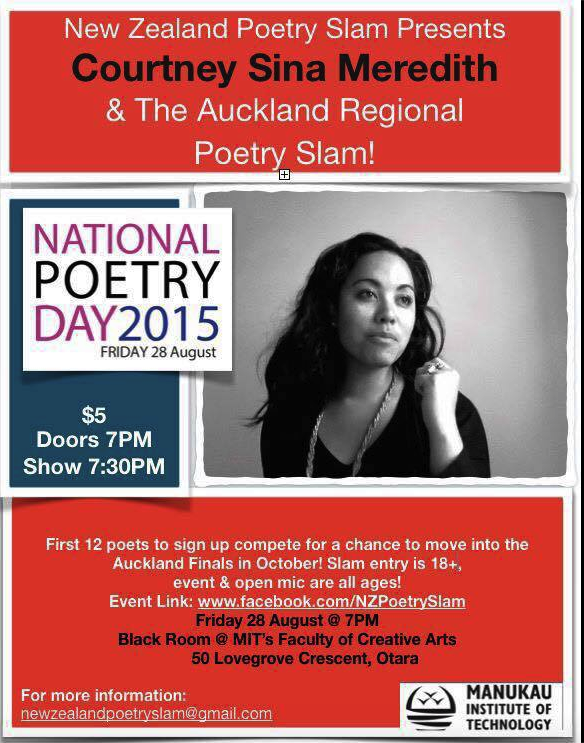
South Auckland A poetry slam at Manukau Institute of Technology, featuring Courtney Sina Meredith.
Hamilton An open mic night followed by a poetry slam at the Garden Place Library; ‘Poetry and Paint’, in which poems become paintings, at the University of Waikato’s Art Fusion Gallery, and  an exhibition of the work created at ‘Poetry and Paint’ with a night of performance poetry.

Katikati Three events, including the annual Haiku Poetry Path prize-draw and an open mic event at Browny’s Café.
Palmerston North Five events, including the Pamutana Poetry Picnic, New Zealand poems set to music by New Zealand composers and performed by the Palmerston North Girls’ High School chamber choir, and the Wisdom Lounge, a digital exhibition showcasing poems and poetic proverbs from Manawatu and around the world.
Wairoa Three events, including the announcement of the winners of the local  poetry competition — Te Roto, Te Awa, Te Moana -The Lake, the River, the Ocean, for poems in English or Te Reo Māori  on one of these themes.
Havelock North  The enterprising owners of Wardini Books have three events: an after-school event, an open mic night and a competition for poets aged between five and 18, judged by Paula Green and Emily Dobson, and open to the entire Hawkes Bay region.
New Plymouth Three events, including a competition for poems about Taranaki, a ‘mix and match’ poetry-making event and a poetry walk on the city’s foreshore. Chalk supplied.
Dannevirke The winner of the Tararua District Library’s Online Poetry Competition is announced.
Wairarapa poetry rolls through the district with an incredible number of events in one day at Pukaha, Featherston, Masterton, Greytown, Martinborough, Carterton and West Taratahi.

Wellington and its surrounding regions are surely a New Zealand poetry epicentre, with an outstanding seven events. They include:National Poetry Day Warm-Up at Te Papa in which eight poets with poems in in Best NZ Poems 2014 (John Dennison, Dinah Hawken, Anna Jackson, Gregory O’Brien, Claire Orchard, Nina Powles, Helen Rickerby and Kerrin P Sharpe) read their poems; Unity Books has a lunchtime reading titled ‘6 Poets in 60 Minutes’; Vic Books at the University has reading and music; at the Kapiti Coast Library, the winners of the Laughing Out Loud poetry competition are announced during an open mic night; in Upper Hutt the winners of the 15th annual Upper Hutt Poetry Competition will be announced at two events at the Upper Hutt City Library; and in Woburn, Lower Hutt there’s a reading of poems about the landscape.
Nelson has six events, including four events at the Elma Turner Library (including ‘Poems for Pikelets’) and Stoke Library, an inspired window of poems at Page and Blackmore Booksellers, open to contributions from people anywhere in the country), and a reading at Page and Blackmore which will also announce the winner of their nationwide Animal Laureate poetry competition.
In Christchurch there are readings at the South Library, Sydenham, and the Hagley Writer Institute has two events, including a workshop and the announcement of the winners of their poetry competition.
Dunedin The Dunedin Public Library is a stellar supporter of National Poetry Day, and 2015 is no exception. This year, during ‘Many Happy Returns’, glasses will be raised to toast Dunedin’s literary treasures on National Poetry Day. This year Poetry Day coincides with the birthday of Dunedin writer, the late Janet Frame. MC’d by Diane Brown, with readings from, Hinemoana Baker, David Eggleton and 2015 Burns Fellow Louise Wallace, as well as three rising stars selected from the Dunedin Secondary Schools Poetry Competition. The evening culminates in the announcement of the 2015 Janet Frame Literary Trust Award recipient.

Oamaru has two events including a performance by David Eggelton and the Spinemark Poetry Challenge.
Tiny Outram hosts J & K Rolling’s Outriders Poetry Tour, an open mic session plus readings of southern poems by Jenny Powell, Kay McKenzie Cooke and Richard Reeve.
Cromwell Paper Plus is holding an open mic event and announcing the winners of its Youth Poetry Competition, for poems about central Otago.
Greymouth The District library announces the winners of its poetry competition winners, and there’s a tour of local poets to three local rest homes.
Gore Jenny Powell and Kay Mackenzie Cooke are on tour, there’s a huge poetry display in the library, and an open mic lunchtime the week following Poetry Day.

It’s an amazing line-up! For more details on National Poetry Day events (including times, entry cost etc), go to https://nznationalpoetryday.wordpress.com/calendar-of-events.

National Poetry Day is managed by the New Zealand Book Awards Trust, which also administers the New Zealand Book Awards and the New Zealand Book Awards for Children and Young Adults. In 2015, the Day is administered for the Trust by Booksellers New Zealand and funded by Creative New Zealand.

Media please note:
National Poetry Day Coordinator, Miriam Barr, is available for interview.
Participating poets and event organisers in your area are also available for interview. Contact details are on the calendar of events for individual events organisers.

For further information please contact Sarah Forster, Booksellers New Zealand
T:  04 815 8367 E: sarah.forster@booksellers.co.nz

Nina Powles on Katherine Mansfield’s newly-discovered poems

This from Nina Powles:


“Up and up beat her wings”

Lecture by Dr Gerri Kimber on her discovery of new poems by Katherine Mansfield, 5/8/15 at the City Gallery, Wellington


In 1999, a folder of papers was bequeathed to the Newberry Library in Chicago. It contained two letters to publishers sent in 1910 and 1911, typescripts of 35 poems, and a calling card embossed with a Chelsea address and the name KATHARINA MANSFIELD printed in a striking modern font.

The folder, labelled The Earth’s Child and other poems, had always been there. But no one had ever opened it; or if they had, no one realised what they’d seen.

Renowned Mansfield scholar and editor of the new Collected Works of Katherine Mansfield published by Edinburgh University Press, Dr Gerri Kimber, made this discovery in June this year. Currently in Wellington undertaking research at the Alexander Turnbull Library, she flicked through pictures of the folder’s contents at a lecture at the City Gallery.

Kimber believes Mansfield must have written the poems during or soon after Mansfield’s time in Bavaria, where she was sent by her mother, in 1909-1910. Almost all the poems are untitled except for a number, clearly intended to be read as a sequence. As a poet, this detail leaps out at me; it seems to show careful consideration for how the poems are meant to operate not just on their own but together, and the specific effect of this on the reader.

Mansfield is not best known for her poetry. The poems we knew of up until now are often more interesting from a biographical perspective, or read in relation to her fiction. Kimber doesn’t pretend otherwise: “I make no claims for the quality of her poetry.” But she does believe that throughout the published poems there are “flashes of brilliance.” However, throughout this sequence of poems all written in 1910, “these flashes of brilliance are everywhere—almost in every poem.”

The new poems aren’t yet available anywhere until next year, when they will be included in Volume 4 of the Collected Works. So we can only take Kimber’s word for it.

But as she flicks rapidly through photos of the typescripts, I read them as fast as I can. Words and phrases flare up at me, and I scribble them down at hectic speed: “the leaves smother closely” (poem 1), “trembling and burning ghosts” (poem 3), “her body was fashioned out of moonlight” (poem 7), “the foam that breaks over the world’s edge” (poem 23). The final poem Kimber shows us is strangely titled “To KM”. It describes herself in the third person—“she is a bird”—and although I could only read it once very fast, it seemed like an eerie premonition of Mansfield’s looming illness and death. It ends:


“A moment – a moment … I die.”

Up and up beat her wings.


These poems are from a period in her life from which Mansfield destroyed every scrap of written evidence that she could get her hands on. These were the years 1909-1911, when she just convinced her father Harold Beauchamp to let her return to London to try and establish herself as a writer. These years of her early twenties, the same age I am now, were her years of drugs, sex and (it seems) poetry. Her health never fully recovered.

So how and why did this folder of poems survive? Maybe it survived by accident, and if she knew we had it now, she’d be furious and burn it. Or maybe a more likely explanation is that she kept them not for their sentimental value but their literary value. Although they never got published, maybe she wasn’t disheartened. Maybe she still saw life in them.

What’s more interesting than the quality of the poems is the revelation that at this time, when she was just 22, Mansfield clearly saw herself as a poet. To some degree she always did; she continued writing poetry throughout her life. She’s not remembered as an exceptionally brilliant poet, but as I watch the typescripts flicker past on the screen in front of me, I can’t help but wonder whether maybe, if she hadn’t died so young, she might have become one.

Nina Powles, August 2015

2015 Emerging Poets Competition


Proudly supported by The Divine Muses Poetry Reading and Penguin Random House New Zealand, the Emerging Poets Competition is now in its 4th year. The competition enables writers who have to achieve that all important first publication to gain success and exposure. Our previous winners, including poet, editor and blogger, Elizabeth Welsh and poet and book reviewer, Elizabeth Morton, have gone on to achieve publication success in NZ literary journals. In 2015, our judge is poet and novelist, Rosetta Allan, a former competition runner up.

About the competition:

Closing Date: 7th August 2015

Results announced at Divine Muses Poetry Reading on National Poetry Day 2015, 28th August 2015

First Prize: $200 worth of Penguin Random House NZ books

Second Prize: $100 worth of Penguin Random House NZ books


Notice of the 2015 Emerging Poets Competition rules and entry form are available here.

About our judge:

Rosetta Allan’s books include the poetry collections, Little Rock (2007) and Over Lunch (2010), and her debut novel Purgatory (Penguin Random House NZ, 2014). Her poetry and essays have appeared in publications and anthologies in New Zealand, Australia and the USA, and in online literary journals, including most recently the essay Dear Mother, songs of the Kamikaze, released in The Griffith Review #48. She is the co-winner of the IWW Kathleen Grattan Best Sequence of Poetry 2010 and Metonomy’s Best Poem 2010, and was runner up in the 2013 Emerging Poets Competition. Rosetta is available for interviews

For further information contact:
Siobhan Harvey: siobhan.harvey@aut.ac.nz

or Jane Sanders: jane.sanders@artagent.co.nz


http://www.artagent.co.nz/poetry/newvoices.htm         http://www.penguinrandomhouse.co.nz/

The Berlin Writer’s Residency: Poetry Shelf Interviews Hinemoana Baker – I need to feel surprised by the language but not distracted by it.


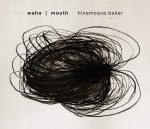
Hinemoana Baker  Album cover finished  waha_front__71664.1407673414.1280.1280

Photo credit: Robert Cross

Hinemoana Baker is an acclaimed Wellington-based poet who was recently awarded the Berlin Writer’s Residency. She descends from the South Island’s Ngāi Tahu and from the North Island’s Ngāti Raukawa, Ngāti Toa and Te Āti Awa. She also has English and Bavarian lineage. Victoria University Press has published her three poetry collections: mātuhi | needle (2004), kōiwi | kōiwi (2010) and  waha | mouth (2014). She has produced five CDs of poetry and music. Hinemoana was the Queensland Poet in Residence, has participated in the Iowa International Creative Writing Programme and was Victoria University’s Writer in Residence in 2014. She is currently convening a Poetry Workshop and with Tina Makereti co-convenes  a Māori and Pasifika Writing Workshop at IIML in Wellington.


Congratulations on receiving the 2015 Berlin residency Hinemoana. This seems like a golden opportunity to talk about poetry and writing, but first, what projects do you plan to work on while you are there?

Thank you very much Paula, I really appreciate the congratulations. It still doesn’t quite seem real yet, but I’m booking my tickets this afternoon, so it must be, right?? In Berlin I hope to finish a new collection of poetry. As is the way of writing projects, I will also be continuing work on a family memoir called ‘Dear Mother Basillise’, which is proving to be an even more gigantic undertaking than I had thought at first.


Poets often suggest writing a poem is an act of discovery as opposed to the rendition of a predetermined plan. Being in a foreign city is also an act or discovery but it may involve a bit of planning. What sorts of places and experiences attract you?

Several things. I spent a week or so there in 2012, and I was compelled by the history of the city, and fell in love with its present-day self, too. The markets, the many dogs on the streets, the public transport, the way people seem to walk so much slower than they do here.

Also, my mother’s ancestors are from Oberammergau in Bavaria, so travelling there will be much easier from Berlin. I visited once in my 20s, but I want to go again. It’s near the Black Forest, and it’s where the residents have staged the Passion Play every ten years since 1634, in return for god having spared them from the plague. The play brings many tourists to the village. The script has a history of anti-semitism, though some changes have been made to that over the years. I feel a million miles away from a place like Oberammergau, in almost every way, and yet my close ancestors sailed here from there (via Hamburg).

I am keen to experience the arts culture of Berlin, music and poetry and sonic art and burlesque and everything else. I want to join the Berlin Pop Choir and do tango. I want to eat grilled fish sandwiches at the market every weekend and drink Weiss Bier. I want to bike everywhere. Walk around in snow. Visit friends (and hopefully woo publishers) in Italy, London, Manchester. Drift through the Christmas Markets and museums and art galleries. Be anonymous.


What effect does travel have upon your writing? Can you write on the move? Or do you absorb and store and write later when it comes to poetry?

I write best when I’m on the move. Trains work best for me. I think it’s something to do with there being boundaries around the length and nature of the experience. And someone else is driving.


When you started writing poems as a young adult, were there any poets in particular that you were drawn to (poems/poets as surrogate mentors)?

I wrote poems and stories and even a few chapters of a novel as a young child. I don’t remember being really transformed by poetry until I was a teenager, though. Alistair Campbell and Fleur Adcock and Hone Tuwhare and Leonard Cohen, I memorised poems and said them aloud to myself until I cried. I had a wonderful English teacher at Waimea College who really encouraged my own writing.

I read a lot of Enid Blyton and Doctor Seuss as a kid, and I turned out ok. I was pretty much an only child, so I played a lot on my own or with my next-door-neighbour skater-boy friends. I liked skateboarding. I liked music. I became addicted to Louis Armstrong at a young age, and then Kate Bush when I turned 12.


What New Zealand poets are you drawn to now?

So many! I’m going to choose three here (refer to comment about time and boundaries above). Lynn Jenner – her latest book, Lost and Gone Away, is sustaining me at the moment. A person on Facebook whose user name isn’t, I don’t think, her real name: Hangi Pants. Heh heh. She posts poems in her feed once a month or so and I hang out for those days. It’s such good stuff. And Bill Manhire. If I had written ‘Hotel Emergencies’ I would probably just put my pen down and spend the rest of my life feeling smug. Thank god Bill hasn’t done that.


I agree on ‘Hotel Emergencies!’ Name three NZ poetry books that you have loved.

OK three different poets this time. The Bengal Engine’s Mango Afterglow by Geoff Cochrane. Star Waka by Robert Sullivan. Wild Dogs Under My Skirt by Tusiata Avia.


What about poets from elsewhere?

Sharon Olds, Joyelle McSweeney and Joy Harjo.


What poets have mattered to you over the past year? Some may have mattered as a reader and others may have sparked you as a writer.

My friend and art mentor Siân Torrington has begun writing more alongside her visual art. Her courage and determination towards freedom are things I’d like to emulate. Also her work ethic. I have been very moved by Rilke and Pablo Neruda, whose work I’ve only really started to investigate in the last couple of years.


I love the way your poetry is anchored in the real world in a way that makes physical detail luminous yet does so much more. This is what I wrote in my review of your most recent collection (waha | mouth): ‘your poetic melodies remind us that there are other layers of reality embedded here, layers that sing and tremble in the candle light — joy, pain, recognition, trust, narratives that we inherit and carry with us.’ What are some key things for you when you write a poem?

I have to feel like the poem is being co-written in a way – by me and by the poem itself. I need to feel surprised by the language but not distracted by it. I want to feel after I’ve written it that it has taught me something about the nature of life, or love, or the heart, or politics, or power, or just language.


Do you see yourself as a political poet? Overtly so or in more subtle ways?

No, not really. But I see myself as a person who is acutely aware of the dynamics of power. I am not as well-versed in local or global history and politics as I would like to be, but I’m constantly learning and reading. When that learning moves me and/or transforms me, it will no doubt make its way into my poems in some way.


In 99 Ways into NZ Poetry, I talked about the way the opening poem of your debut collection mātuhi | needle acts as a mihi. It invites us as readers across the threshold into the meeting ground that is poetry but that is also a surrogate marae. Now I see your poetry (as a whole) laying down invitations. Labels are tricky things but do you see yourself as a Māori poet? What differences does your Māori inheritance make to your writing?

I think the one thing my Māori self contributes to my writing, whether I like it or not, is a keen sense that there are feelings everywhere. People and places are alive and sensate and usually in some state of pain or longing. There’s a saying I heard once, I can’t remember where, but it was someone indigenous speaking about someone else ‘acting as if she has no relatives’. My relatives are everywhere, and not just because I have a big extended family.


The titles of your collections juxtapose English and Māori underlining these two personal lineages. Do you see this relationship as a rope (entwined, frayed, strong)? A bridge with different rhythms of traffic?

I’m not going to do it any more, this bi-lingual title thing. I’ve done what I wanted to do with it. Which is to, somehow, lock the different voices together for a moment.


You are a terrific musician and performer of your work. It shows, too, with the writing on the page. There is an exquisite cadence that draws upon silence as much as it does the shifting melodies. Do you write poetry as musician as much as you do as wordsmith?

I think in the end the thing I’m most interested in is sound. Adding meaning to the mix is a bonus, but it’s hard to keep meaning contained, and it can get a bit out of hand. I hope to make good and interesting sounds in people’s heads and in the air with what I write on the page.


Do you think your writing has changed over time?

Yes, but only in that I’ve gotten more confident.


I love the way you are unafraid of heart. Your poetry has a beating pulse that is both warm and inviting and utterly human. As a reader there are electric connections between my heart and the heart of the poem. How does heart matter to you as you write?

I try and make poems that matter, in the sense that people might care about them, because they might get that heart feeling from them. What you’ve said here is very honouring, Paula.


Is there a single poem or two in your collections that particularly resonates with you?

‘Rope’, because I didn’t even hear the ‘rape’ rhyme until a few hours after I’d written it. And ‘Magnet Bay’, because it was the last holiday I had with my ex-partner Christine, and I remember walking that beautiful land with her and playing taonga pūoro in the sun.


Your two books are beautiful to behold. How important is it to you that a poetry book is an object of beauty in view of its ‘look.’

I like a good cover image! And I like the book’s arrangement and font to be reader-friendly and readily available.


As my review attests, I loved your last collection. Did you make any discoveries as you wrote it?

You’re very kind. I discovered as I wrote it that it is very hard for me to write about things as they are happening. Sometimes I can do it – I wrote the Terrorism poem in kōiwi while that appalling crap was still going on. But mostly I have to wait. The experiences I had in the years writing waha will probably turn up in my next collection.


In the blurb for this book you wrote: ‘I’d like to think that opening this book to read is like standing at the mouth of a cave, or a river, or a grave, with a candle in your hand.’ I adore the comparison of the act of reading to holding the light of candle to a poem where something will always remain in the dim shadows, barely sighted, inaudible. How do the light and dark of poetry matter to you?

Like all the binaries – tension/release, light/dark, sad/happy – it’s the dance they do that makes art, for me. If you believe in binaries, that is.


What irks you in poetry?

Cliché.


What delights you?

Courage.


Is doubt a key part of the writing process along with an elusive horizon of where you are satisfied with a poem?

I don’t know if it’s a key part, but it seems to be an unavoidable part of my process. There’s some kind of off-balance precarious posture I manage to achieve between giving up altogether and re-working obsessively. It never feels comfortable or certain, and it never feels reproducible. After finishing a poem, I’m often certain, I’ll never be able to write another one.


The constant mantra to be a better writer is to write, write, write and read read read. You also need to live! What activities enrich your writing life?

Walking the wild coastline of Wellington, and her streets and waterfront, her Town Belt. Visiting with other artists’ work whenever I can. I teach creative writing sometimes, and that always makes me fall in love with language all over again.


Some poets argue that there are no rules in poetry and all rules are to be broken. Do you agree? Do you have cardinal rules?

Cardinal rules, no. Guidelines, yes. They’re really the same as for other kinds of writing. Show don’t tell. Concrete images. Verbs and nouns are often more powerful than adjectives. Etc. But there are some that pertain to poetry in particular I suppose – especially around line breaks and stanzas etc. That said, if I did have a cardinal rule, it would probably be ‘Don’t publish a poem your writing group hasn’t seen.’ One day I might break this rule but it’s served me well so far.


Do you find social media an entertaining and useful tool or white noise?

Yes.


Finally if you were to be trapped for hours (in a waiting room, on a mountain, inside on a rainy day) what poetry book would you read?

Something by Robert Hass – I’d have lots of time for re-reading, and Robert Hass very much rewards re-reading…


Hinemoana’s web site

Victoria University Press page

Victoria University page

NZ Book Council Author page