
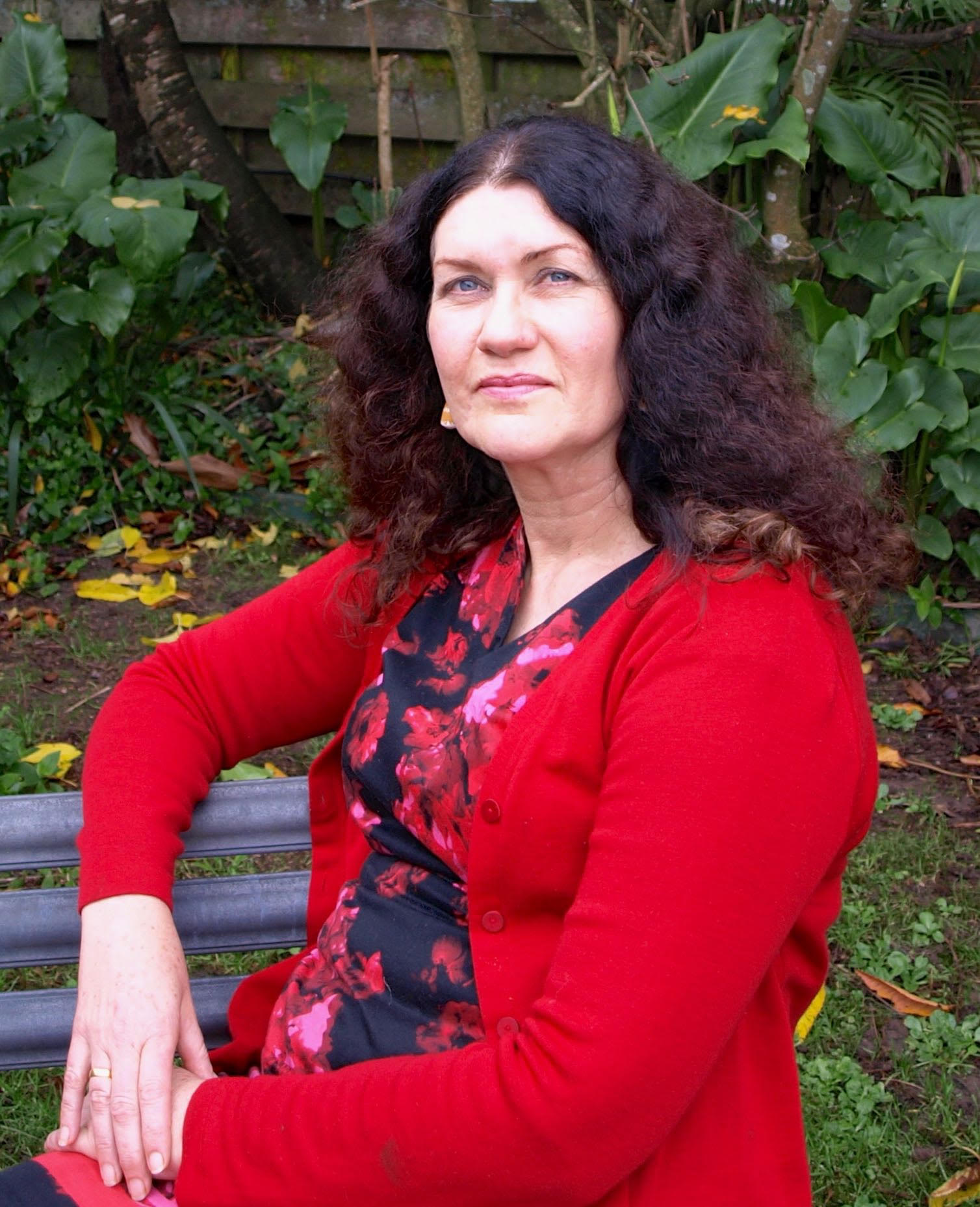
Serie Barford is of Samoan and European descent and lives in Aotearoa. Her poetry and short stories have been published in literary online anthologies such as Snorkel, Trout, Blackmail Press, Cordite Poetry Review and Jacket and in recent print editions such as Maui Ola (AUP:2013), Pacific Identities and Wellbeing (Routledge 2013), Essential New Zealand Poems (Random House:2014) and Whispers and Vanities (Huia:2014). Her third poetry collection, Tapa Talk, was published by Huia in 2007 and her fourth collection, Entangled Islands, was released by Anahera Press in December 2015. Serie was the recipient of the 2011 Seresin Landfall Residency.
To celebrate the arrival of her new collection, Serie agreed to answers a few questions for Poetry Shelf.
Did you write as a child? What else did you like to do?
I clearly remember the first poem I wrote outside of a classroom setting. I was at primary school and had spent the night with my paternal grandmother. I wrote a poem about the rain and her flooded garden. Her spontaneous delight kick-started my love affair with poetry. A few weeks later I declared, “When I grow up I’m going to write books!”
I had a teacher who favoured Donald Grave’s writing principles. She facilitated a process that encouraged students to write authentically. We were allowed to go to sleep or write freely every Friday afternoon. Our journals were collected and locked in a cupboard when the bell rang. We were told “your words are safe with me.” The teacher scribbled personal responses to our ramblings. By the end of the year we were writing as quickly as we could to maximise our precious hour. She was a sympathetic audience and we trusted her with stories from our lives. Many years later I met this teacher again and told her how important the writing hour had been to the class. She laughed and said, “I just wanted peace and quiet on a Friday afternoon!”
Those Friday afternoon writing sessions were the closest school ever came to validating the storytelling environment of my home. I still like to write conversationally and shares stories as if they’re anecdotal recounts.
I also liked the family picnics, parties and meals that the maternal (Samoan) side of my family shared all the time. I still get a “buzz” when I walk into a crowded room and know that everyone present has a familial story that relates us by blood or association.
I started relating to other people’s poetry when I discovered a slim volume entitled Some Modern Poetry from Western Samoa in the Wesley bookshop in Apia in 1975. It was edited by Albert Wendt. I was hooked by the opening stanza of Rupert Petaia’s poem:
Kidnapped
I was six when
Mama was careless
she sent me to school
alone
five days a week
One day I was
kidnapped by a band
of Western philosophers
armed with glossy-pictured
textbooks and
registered reputations
‘Holder of B.A.
and M.A. degrees……..
These days I refer to Albert as my “literary papa’ and I still have this book on my bookshelf. It cost 50 sene (cents) at the time. I won a ‘Special Prize for English’ when I was in Form Five (Year 11) and was presented with a handsome edition of The Poems of John Keats. We didn’t study non-European poetry when I was at school and we weren’t rewarded for our scholastic achievements with “other voice” books. John Keats resides on a varnished shelf beside Whetu Moana, Mauri Ola and other books with a South Pacific focus.
What poets inspired you when you started writing poetry as an adult?
I wasn’t inspired by any of the poets I studied at varsity until I encountered their work years later in non-institutional settings. One day my Samoan grandmother asked me at the dinner table, “What did they teach you today?” I couldn’t say that the professor had talked about cocks and sexual desire and sexual politics because my maternal family hadn’t left their beloved homeland and made huge sacrifices so that I could study poetry about orgasms. We were studying Adrienne Rich’s Reforming the Crystal.
I am trying to imagine
how it feels to you
to want a woman
trying to hallucinate
desire
centered in a cock
focused like a burning-glass
desire without discrimination:
to want a woman like a fix
To put this in context, my grandmother was born in 1912, was a teenage bride and the blooded sheet from her wedding night was proudly paraded through the village by her mother the next morning. My grandmother was the daughter of a taupou (a ceremonial female village virgin) and had witnessed public deflowerings of taupou when she was a child. We talked openly about such matters. But the poetry and sexual politics I studied in Stage I English in 1979 was a world away from our dinner table and only increased my sense of isolation at university.
I was inspired and supported by poets I met at the Poetry Live evenings during the 1980s and early 1990s. This was the first time I’d heard Maori and Pasifika poets live. I listened to John Pule, David Eggleton, Robert Sullivan, Albert Livingstone Refiti, Michael O’Leary, Emily Karaka, Haare Williams and Apirana Taylor, as well as many other wonderful poets. Through them I learned to appreciate poets such as Hone Tuwhare, Alistair Te Ariki Campbell, Sam Hunt and James K. Baxter.
In 1984 I bought a couple of volumes of poetry while I was waiting for a bus in Los Angeles; Relearning the Alphabet by Denise Levertov and The Women and the Men by Nikki Giovanni. I read and reread their poems as I flew from LA to Alaska to Dusseldorf and felt inspired to write. I returned to Aotearoa-New Zealand a few weeks later with a clutch of poems that appeared in Plea to the Spanish Lady, the first of two experimental collections published by Hard Echo Press.
I only read “other voice” writers while I was struggling with identity issues but now that I have found my personal voice and tūrangawaewae (standing place) I have eclectic tastes, although I’m still drawn to to the works of Polynesian writers when I want to be nourished and swamped by a sense of familiarity and belonging.
Your poetry is so evocative. As reader, it is as though you can absorb a poem through senses, bite into flavor and smell the poem’s very essence. What kinds of things do you want your poetry to do?
I like my poetry to feel ‘alive’ and hope that it will continue to contribute to the canon of Pasifika literature and writing in general that is flowing from the South Pacific and connecting us to people around the world. I imagine the universe as an infinite tapa canvas with tusili’i (fine, wavy lines) connecting disparate beings and ecosystems. I’m fascinated by the Samoan concept of ‘Ia te’u le va’ – to take care of/cherish relationships across Spacetime. In ‘Connections’ a poem from Tapa Talk (Huia:2007) I wrote:
there’s no such thing as empty space
just distances between things
made meaningful by fine lines
connecting designs and beings
in the seen and unseen worlds
distances can be shortened
made intimate or dangerous
or lengthened
until the connections weakens
finally withers away
I want my writing to explore and express connections and disconnections by positioning myself and my audience within various communities of belonging, as if we are plotted on a sociogram. Each narrative maps my emotional, physical, intellectual and spiritual journey through Spacetime. By engaging with my journey the audience fixes itself upon my (metaphorical) tapa canvas. We are connected long enough to hongi. To mingle breath. To experience the human condition on the same page for a few seconds.
Your new collection, Entangled Islands, is like an album of anecdotes and occasions transcribed lyrically. It feels both political and personal. What was important to you as you wrote?
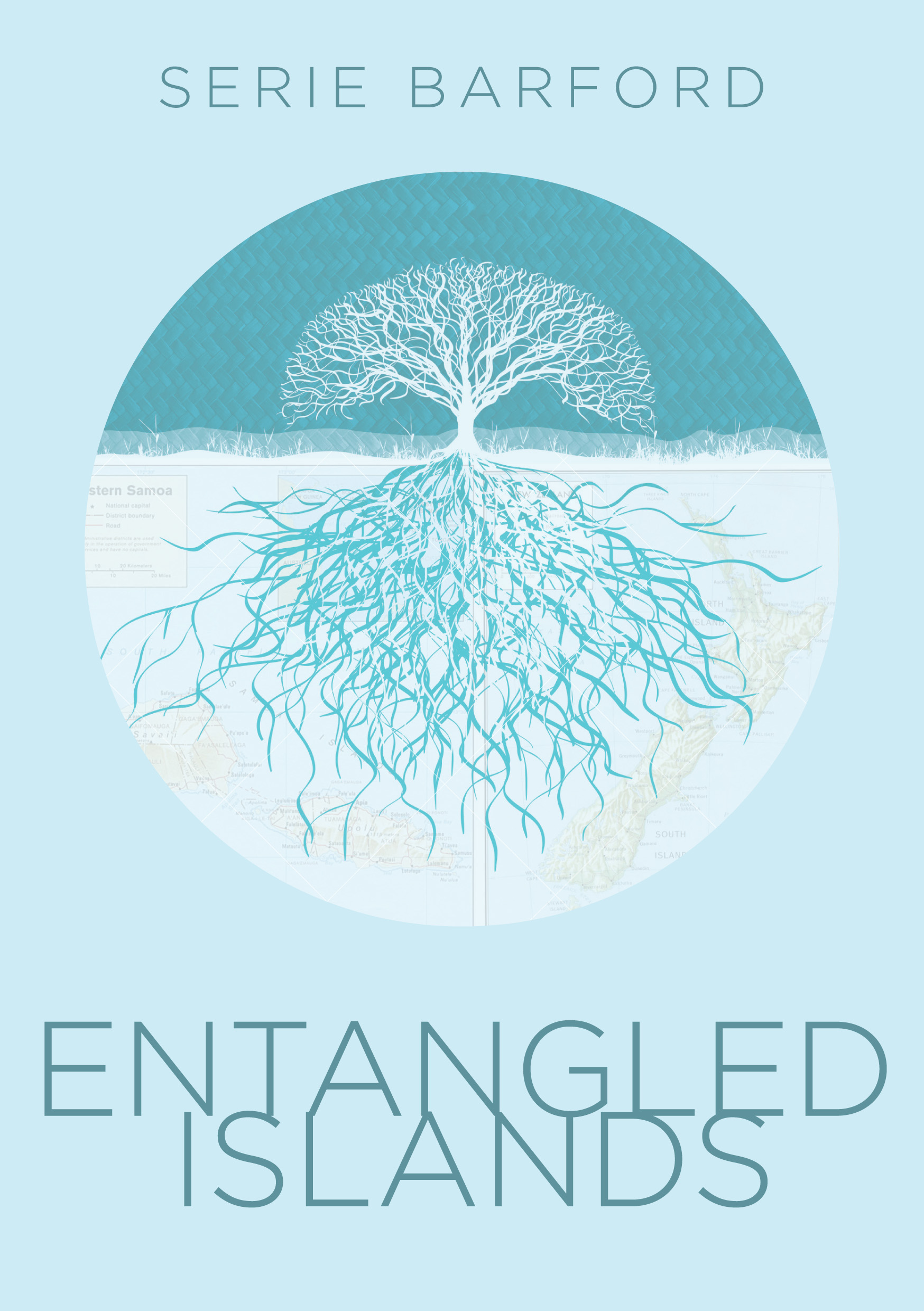
Entangled Islands is attentive to liminal zones and explores blurred boundaries where states of being and historical events co-exist with political and personal pou whenua – posts that mark territorial boundaries or places and events of significance.
I chose the motif of a fala su’i, a woven pandanus mat fringed with wool, to represent a Spacetime matrix. Each poem or short story is a co-ordinate that can be located and mapped within one of seven embroidered panels. Each panel is a chapter. Entangled Islands begins with the arrival of a life force and ends with a life force returning to its namesake – Sirius/Takurua. The audience traverses Spacetime with the me, the narrator, guiding them over trails and revealing pou whenua that stand upon the matrix mat demanding attention, understanding and empathy.
I have exercised a certain amount of poetic license because traditional fala su’i are fringed but not embroidered like the Cook Island tivaevae. However, descendants of Polynesian migrants are fusing tradition and innovation, and I was inspired by an embroidered fala su’i that was for sale at a festival. It was a syncretic creation and did not look out of place in cosmopolitan Aukilani (Auckland).
Entangled Islands explores and reinforces the concept of Ia teu le va. Albert Wendt describes the Va as the between-ness that relates or holds separate entities and things together in the unity-in-all; the space that is context, giving meaning to things.
I love the title. It can signify knots, webs, even braid. I got a sense of tangles that are personal and tangles that implicate communities, history, patches of the world. Tell me about the tangles you trace.
The introduction explains that “ ‘Entangled Islands’ was the first in a series of exhibitions held at the Auckland War Memorial Museum to mark the WWI centenary period. Damon Salesa’s speech on opening night referred to the colonial, genealogical and spatial entanglements that resulted from New Zealand’s occupation of Western Samoa … Our family history is entangled with colonial expansion, suppression, intermarriage, migration and migrants’ dreams of a better life for their children on the islands where they live.”
Anahera Press

