Tag Archives: Otago University Press

Poetry Shelf interviews Cilla McQueen – ‘I’m always listening. It’s a subtle thing, poetry.’


Cilla 2014

Photo Credit: Rhian Gallagher


Cilla McQueen has published 14 poetry collections, has won the NZ Book Award for Poetry three times and was New Zealand Poet Laureate 2009 -11.  Her last collection of writing was  an exquisite suite of little books in a box entitled Edwin’s Eggs and other poetic novellas (OUP, 2014). The book, written during her Laureateship and posted in pieces on the Laureate blog, was a poetic response to pictorial works in the National Library. I reviewed and loved it here.  Reading favourite Cilla poems that other poets picked on an Otago University post sent me flying back to all the poems I have loved, and like Michele, Emma, Ian, Bill and Brian, I would have trouble picking just one. Every book serves a poetry talisman to carry with you. I am currently writing the foundation stones of women’s poetry in New Zealand but I also want to cast a light on several women in the last few decades (small part of a larger work).  I want to explore women poets who are a significant part of the strata upon which we write. Cilla is one of them.

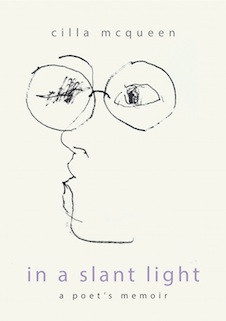
What prompted this interview, however, is the recent release of In Slant Light: A Poet’s Memoir.  This book has affected me on so many levels. It is beautifully written. It takes me back to the unfolding of self and notself on the page when you barely call yourself a poet. That Cilla started writing poetry when most around her were men, and most of the women poets were hiding in the shade, meant that she was ‘daring’ to write.  Or ‘transgressing’ as she also puts it.  The book makes me want to delve back and write my way through Cilla’s poetry. I want to sit in a kitchen and drink tea with her and talk about writing and books and life. Her memoir leaves gaps, and I love that, but it reveals the dimensions of a life that have enriched the dimensions of the poems on the page.

In Slant Life: A Poet’s Memoir  Otago University Press, 2016


The Interview

Did your childhood shape you as a poet? Your new memoir is most definitely the memoir of a passionate reader.

Yes, I’m sure it did. I was fortunate to have parents who knew the importance of reading and who loved all the arts.

Screen Shot 2016-04-30 at 10.37.08 AM

Cilla 1954 Arthur Street School


What did you like to read as a child?

Everything – A.A. Milne, Lois Lenski’s The Little Airplane, lots of fairy stories, adventure stories, myths and legends. Especially stories about going through some portal into another world, for instance Alice in Wonderland and Through the Looking Glass; the Narnia books by CS Lewis; The Door That Wasn’t There by Ursula Horsley Smith, with Rosemary Cosgrove’s illustrations.


Oh yes! I loved those portals too. Did you write as a child? What else did you like to do?

I wrote letters to my aunts, uncles and grandparents overseas, usually to thank them for birthday or Christmas presents. These were a hard task but were insisted on by my mother, who made sure the spelling and writing were up to standard. I wrote poems and stories in cut-in-half exercise books. I thought of these as real books and was pleased with them. I also liked ballet, mime, gymnastics, making up plays.


Did you write in your teenage years? Did you read poetry?

I was very taken with concrete poetry at one stage and had fun chopping up lines of words and putting them in a new order, to make nonsense or a peculiar new sort of sense.


What three words resonate with your time as a teenager?

Eager, curious, self-conscious.


Great words. Fascinating to consider the degree they stick with us. When you started writing poems, were there any poets in particular that you were drawn to?

Shakespeare, Donne, Villon, Dylan Thomas, Prévert; Beat poets; e e cummings; began to read New Zealand poetry after meeting James K. Baxter in 1967.


Your first book appeared in 1982 (Homing In) when not as many women poets were as visible as they are today. How did this affect you as a writer?

I felt shy, unsure, surprised that it was well received. As a new woman writer I felt junior in a mainly male artistic circle. I also felt somehow transgressive, for daring to write.


Do you think it makes a difference when the pen is held by a woman?

It certainly ‘makes a difference’ to the life of the woman holding the pen. And further, to the minds and lives of the women who read her writing.


Your poems are infused with such musicality they sing themselves to life. Yet what makes them matter so very much is the heartbeat — the way a poem will creep deep under your skin as reader because it makes the world matter. What are some key things for you when you write a poem?

A sense of joy in the release of restrictions of everyday language, a feeling that anything goes – I can think, experiment, change, manipulate the language to make it supple and economical. I’m always listening. It’s a subtle thing, poetry. Cocteau wrote that ‘[Poetry’s] modesty consists in masking its own equations’ (Diary of an Unknown).


Do you think your poetry has changed across the decades?

It’s probably better self-edited. I didn’t go to a writing school, so made all my mistakes in public, as it were. The work has gone through periods of change, particularly unruly in the performance poems, but also periods of paring down and stripping, also lyric periods when musicality seemed paramount. Each new poem brings to bear all the language experience of previous poems.


otago291603.jpg  otago291603.jpg


Your new memoir has affected me on so many levels. Partly because I am a poet who also had to find her writing life, who has lived with a painter for thirty years, who spent a long time with another language and who found joy in many of the books and films you mention. But most importantly, because the memoir is so beautifully written and because it raises issues that will have affected many women writing.

What were the joys and difficulties of writing a memoir?

Looking for and finding fresh memories and writing them down; recasting familiar ones, looking around the edges of the familiar; realising one’s place in the past and in present time. Pinning down what happened when, and thinking about the reasons why.


Why poetry and not prose?

Associated memories flood in very fast – I need to use compressed language to retain the feel of them. I find that a fragment of memory is best expressed in poetry because it presents itself not as a narrative but as a simultaneous  display, more like a dream. It seems that poetry can collapse time.


Did you have filters at work as you wrote? A need to conceal for the sake of others and for the sake of self?

No need to conceal, but a natural process of selection operated, and on top of that, the selective forces of poetry. I didn’t feel compelled to lay all bare – what’s the point.


For me, your memoir represents the emergence of multiple, overlapping selves (reader, poet, mother, wife, lover, friend, teacher). What moved me so deeply was the way in which the poet found room to breathe and exist. At one point, in the middle of your life with Ralph Hotere and your daughter, you write: ‘I have to look carefully to find myself amongst all this.’ What tipped you into writing?

I had been writing a journal for several years, just for myself. As I started to read more poetry the language of my daily thoughts was affected; thoughts appeared in chunks and slivers, which I then worked on until the product resembled a poem, or so it seemed to me. When Ralph and Andrea and I spent a few months in Avignon in 1978 I began to write seriously, with their encouragement. I sent an early poem on a postcard to Hone Tuwhare, ‘Saturday Afternoon in Provence’, about the Pont du Gard.


Your memoir, so poetic on the page makes the gaps of telling poignant. What did you most love about this period? What did you find most difficult?

I loved the inspired conversation of creative discovery in a life where the arts were central, 24/7. My difficulties were normal – balancing lives, being teacher, wife, mother and breadwinner until Ralph’s work started to sell.


This is memoir written out of love, and that is infectious, but there are subterranean hurdles. Is writing joy for you, or is it pain, or is it a mix of both?

Of course, it is a mix of both.


You studied and taught French. Did this affect your poems at all?

It gave me practice in thinking in another language, about grammar, vocabulary and syntax. There’s a clarity in French syntax that I find satisfying; through teaching, I learned to see language as a magical, plastic substance.


Music has been a significant part of your life as a poet, particularly in view of your performances. What key things matter in this poem-music collaboration?

The ability to listen. Trust in another performer’s musical ear. Inner hearing of the musicality in words. A sense of time. Delight in shared discovery through improvisation.


The detail in the memoir is so vivid it makes time and place shimmer on the line. It is a way of laying down roots in a poem. Would you write a sequel?

I don’t usually like to do the same thing twice. In fact, in the sequence of my oeuvre, especially in long poems such as ‘Bump and Grind, (spinal fusion)’ in Benzina (1988); the Berlin Diary (1990); ‘The Autoclave’ in Markings (2000), and many Bluff poems, I’ve already traced the progress of my life until now.


What irks you in poetry?

Its difficulty.


What delights you?

Its difficulty.


The constant mantra to be a better writer is to write, write, write and read read read. You also need to live! What activities enrich your writing life?

Gardening, walking, drawing, thinking up imaginary music.


Finally, if you were to be trapped for hours (in a waiting room, on a mountain, inside on a rainy day) what poetry book would you read?

I’d like a Complete Shakespeare, please.


Thanks Cilla.


Otago University Press page

Poets pick favourite Cilla poems

Cilla’s Laureate page

NZ Book Council page

NZ Electronic Poetry Centre page

Te Ara video clip


Edwin’s Egg


Fabulous poetry covers this year: Here is another

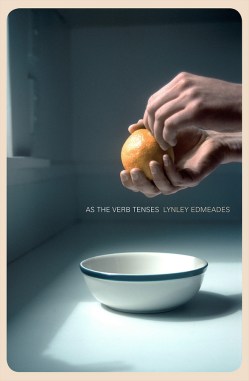
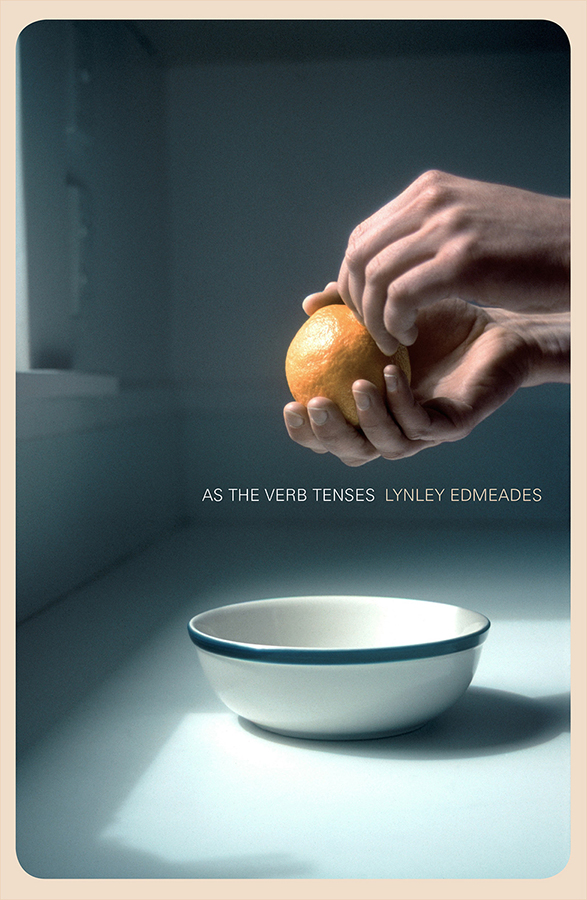
As the Verb Tenses.jpg

‘As the Verb Tenses is the work of a reflective and sensitive poetic talent: one run with gleaming wires of joy. In poems that gather together the vivid details of childhood memory, the surreal juxtapositions of life in the contemporary West, the wry observations of a temporary expatriate, the deeply lodged pain of historical and personal loss, Lynley Edmeades speaks to us in delicately spun lines that press out ironies, dissonances and profound formative experience.’

from Otago University Press. Launched tonight with Chris Price.

Cilla McQueen Conjures the Past: A Poet’s Memoir

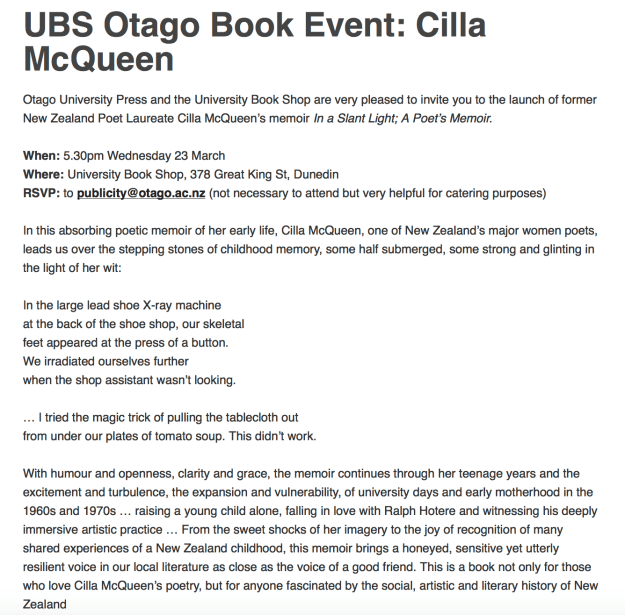
In a Slant Light - Cilla McQueen


Press release from Otago University Press:


… can’t be sure about the authenticity of memory,

but by my lights it’s all I’ve got to go on.


So begins Cilla McQueen’s entrancing poetic memoir, In a Slant Light. One moment brought to light leads to another unfolding – as in the writing of a poem: In A Slant Light is a layered, intuitive interaction with the past.

‘The joy of writing a memoir,’ says Cilla, ‘is the wonderful sense of discovering the past as you go; writing itself becomes an act of memory.’


McQueen, one of New Zealand’s major women poets, leads us over the stepping stones of childhood recollections, some half submerged, some strong and glinting in the light of her wit:

I tried the magic trick of pulling the tablecloth out

from under our plates of tomato soup. This didn’t work.


With humour and openness, clarity and grace, the journey continues through her teenage years and the excitement and turbulence, the expansion and vulnerability, of university days and early motherhood in the 1960s and 1970s … raising a young child alone, falling in love with Ralph Hotere and witnessing his deeply immersive artistic practice …


This account of the life of an extraordinary verbal artist is immensely warm and welcoming. The lightness of Cilla’s touch coupled with the grit of her endurance through challenging personal circumstances makes the reader feel privileged to be invited in to the quiet wisdom worn here with both integrity and modesty.


This is a book not only for those who love Cilla McQueen’s poetry, but for anyone fascinated by the social, artistic and literary history of New Zealand.


Bluff poet Cilla McQueen was the New Zealand Poet Laureate 2009–11. She has published 14 volumes of poetry and has won the New Zealand Book Award for Poetry three times. Her work has been extensively anthologised. Cilla’s most recent publication was Edwin’s Egg and other poetic novellas (OUP, 2014).


In a Slant Light

A poet’s memoir

By Cilla McQueen


Release Date: March 2016

ISBN 978-1-877578-71-7

$35, hardback with ribbon

OUP

Poetry Shelf, Poets’ Choice: Cilla McQueen and Brian Turner make some picks

418MHC3lAEL._SX346_BO1,204,203,200_

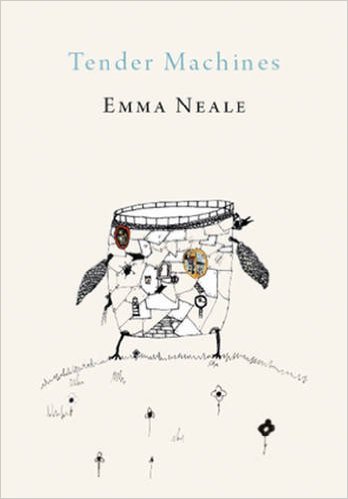
My pick is Emma Neale’s Tender Machines (OUP). Emma’s poetry is resonant on many levels and repays close reading. In her supple, expert language, she takes a loving look at the human condition in a collection which has depth, wisdom and insight.

Cilla McQueen


Being_Here_cover__66009.1423089464.140.215  Being_Here_cover__66009.1423089464.140.215   Being_Here_cover__66009.1423089464.140.215

Mostly I read poetry and non-fiction, and a lot of the latter is to to do with environmental issues in an effort to understand and do something about the disgusting rate at which we’re destroying the place. Recently I read Michael McCarthy‘s The Moth Snowstorm, which Helen Macdonald termed ‘a deeply affecting memoir and a heartbreaking account of ecological impoverishment’. I concur. Much of what McCarthy writes about mirrors what’s happened and continues to here, in NZ, and elsewhere.

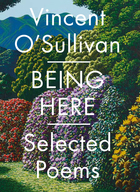
Three of the volumes of poetry that I’ve read and liked most in the past year are Robin Robertson‘s The Wrecking Light, Vincent O’Sullivan‘s Being Here, and Emma Neale‘s Tender Machines. Robertson doesn’t pussy-foot around, covers a lot of ground, can be caustic, blunt, wry and shattering. O’Sullivan ranges widely both in tone and content. Apart from the wry and sly ways he approaches things I like the ways in which he highlights human absurdities. As I hear him, it’s not as if we’re too much troubled by human absurdity, it’s that we’re not troubled enough. In Emma Neale’s Tender Machines she grapples with long-standing human predicaments, the difficulties we have personally keeping a lot of the ‘ongoing human symphony’ playing while trying to work out how to silence our dreadful ‘inner racket’.

I’d like to be able to buy and read far more NZ poetry than I do these days. Back in the 1960s, when I began trying to write poems, it was possible to be familiar with nearly all of the volumes of poems by NZ writers. Not now; the result is great gaps in one’s reading. Does it matter? I don’t know.

Brian Turner

Poetry Shelf review — Emma Neale’s Tender Machines takes you into a deep private space in her writing; in ways that sing and challenge, that move and muster every poetic muscle and tendon as you read

418MHC3lAEL._SX346_BO1,204,203,200_    418MHC3lAEL._SX346_BO1,204,203,200_


Emma Neale Tender Machines Otago University Press 2015

Emma Neale’s new poetry collection features a striking drawing by her son, Abe. Surprising, inventive, poetic even. The poetry is Emma’s best yet, dare I say it. To step off from the title, tenderness meets sharp edges meets exquisite moving parts, small yet perfectly formed. The collection holds you in the intimate embrace of home, yet takes you out into the wider allure of the wider world. Issues, ideas, preoccupations.

The first section, ‘Bad Housekeeping,’ is where poet tends hearth. Mostly, and movingly, Emma navigates her relations with her young son.  She is up against the elbows of insistence, demands, resistance. The mind of the mother is anchoring, roving, admitting. She is in the heart of a toddler tantrum and in the palm of world issues. These poems affect you. You can savour the poetic craft that is honey for the ear. Such musical harmonies and schisms. That is one joy of reading. You can enter the toughness and rewards of motherhood. It is as though maternal experience is the stock pot that is simmered and concentrated to a syrup that is both sweet and tart on the tongue.  The poems become the kind of poems you can hang stories upon; of this child and that child, of this moment of mothering and that. Poetry has the ability to bear story, experience, imaginings, ideas, music — all in its one tender machine (oxymoron and all). These remarkable poems do this. ‘Hard Task, Master’ is a miniature snapshot of the child — its ending breathtaking:


as he tries

to build and build

the deck of himself

against the hard, tall wall

of the world.


At times it is the concatenation of verb or noun on the line that catches you in a knot of maternal thought — son glued to mother, mother glued to son. As in ‘Towards a Theory of Aggression in Early Childhood Development’:


Hit, push, lash, scratch,

these cheeks, this jaw, this shoulder,

are these in truth our edges, outlines, will we cry

as he does, daily, nightly, sky-wrenching as sunrise

yet still hold him in our arms


There is poetic braveness here that doesn’t loiter in conventional maternal paradigms. This is a poet opening layers of skin to get to where it hurts, confuses, demands, yet never loses sight of the enduring bond. The love. This is from ‘Domestic’:


you’re our darling our treasure.


You fling a tea cup at the cat,

plump up her spine like a goose-down pillow,


jab your thumbs at your father’s face

as if to pull out its two blue plums


but ah, little fisty-kins, honeyghoul, thorny-pie,

grapple hook of your daddy’s flooded eye,


stitch by stitch hope’s small black sutures

sew love’s shadow behind you.


The rest of the collection represents a mind engaged with the world at large. There is a strong political vein that never relinquishes the notion that the personal is political and that, importantly, the political is personal. Big issues such as consumerism, the compromised state of the planet, greed, waste are there potency ingredient in the ink of the pen, yet Emma’s ideas find poetic life in a variety of ways. Always there is an attentiveness to sound, to the way the poems hit the ear before the eye/mind drifts elsewhere. Assonance is plentiful. Delicious. The musicality is a first port of admiration that sends you back to reread with ears on alert. One poem, overtly and self-reflexively, plays with musical effects, yet delivers a subterranean plea for the earth (‘”Properly Protecting the Most Pure Marine Ecosystem Left on Earth Was Not Consistent with the Government’s Economic Growth Objective”‘. Here is a sample:


The spring tries to write

its long lyric poem again:

grass blade rhymes wing tip;

leaf rim, gull keen;

salt foam, thought arc;

surf break, line break;

historical break, heart break;

riven river, toxic stream;

smoked ozone, glacial melt.


So many standout poems. I especially loved the way ‘Suburban Story’ moves. It begins with a ‘shopkeeper at my old corner store’ and then travels through a poignant catalogue of losses, minor and major. Again the exquisite ear at work, again the pulsating detail.

This is a collection of reflection, revelation, absorption. Emma wrote many of these poems during her tenure as The NZSA/Beaton Fellow, The Otago Robert Burns Fellow and The University of Otago/ Sir James Wallace Pah Homestead Writer in Residence. Such awards benefit the poet immeasurably with the gift of writing space and time. You can see it in the gold nuggets of this book. In another favourite poem, ‘Sleep-talking,’ the clogged channels of thought become poetry. Emma takes you into a deep private space in her writing; in ways that sing and challenge, that move and muster every poetic muscle and tendon as you read — in this poem and in the book as a whole.


Perhaps for the self to hold its own air

it must be played in the key of sleep:

the body an instrument that over time

we must keep pitched, soaked in night like a reed softened in water,

while dreams tune the mind’s strings with a touch that seems

as precise as if the musician’s ear cranes deep


Otago University Press page

RNZ review

Emma Neale on her title

From the book: ‘Origins‘ posted on Poetry Shelf

Warmest congratulations to Michael Harlow – Winner of 2015 Kathleen Grattan Poetry Award

Poetry Shelf extends warm congratulations to Michael and the Highly Recommended poets.


Press release:

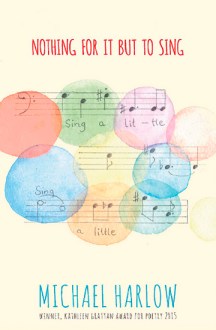
Michael Harlow has won the Kathleen Grattan Poetry Award 2015 with his collection of poems Nothing For It But To Sing.

‘Michael Harlow’s poems,’ says Emma Neale, judge of this year’s Grattan Award, ‘are small detonations that release deeply complex stories of psychological separations and attractions, of memory and desire.’

‘This is a poet with such a command of music, the dart and turn of movement in language, that he can get away with words that make us squirm in apprentice workshops or bad pop songs – heart, soul – and make them seem newly shone and psychically right.’


On hearing the news Michael Harlow said, ‘I’m absolutely delighted particularly because it involves publication with Otago University Press. It will be wonderful to be on the OUP list.’

Michael was at a World Poetry Festival in Romania when he received the news. Commenting on the $10,000 award money he said, ‘it will buy time – the thing that all writers need. I’m planning to use the time to work on a book of prose poems.’


The award attracted 109 entries. Six poets were highly commended: Hannah Mettner, Elizabeth Morton, David Howard, Nick Ascroft, Alice Miller and Victoria Broome.

The Kathleen Grattan Award is one of the richest poetry prizes in New Zealand. Otago University Press accepts the winning manuscript for publication and the winner also receives a year’s subscription to Landfall.


Auckland poet Kathleen Grattan, a journalist and former editor of the New Zealand Woman’s Weekly, died in 1990. Her daughter Jocelyn Grattan, who also worked for Woman’s Weekly, shared her mother’s love of literature. Jocelyn generously left Landfall a bequest with which to establish an award in memory of her mother.

Previous winners are Joanna Preston (The Summer King, 2008); Leigh Davis (Stunning Debut of the Repairing of a Life, 2009); Jennifer Compton (The City, 2010); Emma Neale (The Truth Garden, 2011) and Siobhan Harvey (Cloudboy, 2013).

The biennial award will next be granted in 2017 (see Otago University Press website for further details: http://www.otago.ac.nz/press).


About Michael Harlow

Michael Harlow has published ten books of poetry: Giotto’s Elephant (AUP, 1991) and The Tram Conductor’s Blue Cap (AUP, 2009) were both finalists in the national book awards. Harlow has held numerous fellowships and residencies including the Katherine Mansfield Fellowship and the Burns Fellowship. In 2014 he was awarded the prestigious Lauris Edmond Memorial Award for Distinguished Contribution to New Zealand Poetry. This year (2015) he received the Beatson Fellowship for writers. Michael Harlow lives and works as a writer, editor and Jungian therapist in Alexandra, Central Otago.

Diane Brown’s memoir in verse is out now — love the cover and title — looking forward to seeing it!

Taking My Mothter to the Opera

‘I like the idea of doing a narrative in poetic form and using dialogue in poetry to create character,’ says Diane Brown. ‘Taking My Mother to the Opera is not a series of individual poems so much as one long poem. It tells a story: the sum is more than the parts.’

Poem Friday: Emma Neale’s ‘Origins’ … At the core, heart.


Origins


When my father made love to my mother

and their salts and foams seethed and lifted

so that a child washed up on their tides,

perhaps they held each other

in an old rotting villa with cracks and gaps

that let the rooms’ winter breath

unravel along the street

like spider silk adrift on the air.


Perhaps outside that house

an untrimmed, straggling macrocarpa

tossed in the wind like a woman in fever sheets

and the clouded sky came close and tight

as a fist screwing a lid on a jar

while nearby the city’s river cried deep in its bed,

birds circled but found they couldn’t alight;

as a chill hide of questions

grew a stubborn lichen

across the corroding, rented roof.


For there are days when the human heart

feels like spit rubbed in mud,

the mind a junk room

of broom handles and wheel-less prams,

must-stink chair nobody will sit in,

little black fly heads

sprinkled in a corner web,

ear bones of vanished mice,

single bits of faded jigsaws,

carpet littered with broken envelopes

addressees illegible,

and even when love creeps close

over the slanting floorboards,

sorrow drifts in with the smell of snow

clustered on its skin.


© Emma Neale

Originally printed in Landfall; appears also in Tender Machines (Otago University Press, 2015).

Author bio: Emma Neale works as an editor. On alternate years, she runs a one-semester poetry workshop at the University of Otago. She has published five novels and five collections of poetry, the most recent of which is Tender Machines (Dunedin: OUP, 2015).

Note from Paula: Usually in my Friday poem slot I have invited poets to write a note about their poem and I have added my own thoughts. Some poets are happy to provide sideways anecdotes or points of origin for their poems; others prefer to let the poems speak for themselves. I have no dogmatic stance on either option. Notes on poems can be utterly fascinating and provide unexpected roads into your reading. I don’t think they ever shut a poem down — as readers, when we press a poem’s start button, anything can happen. So I have decided to make the ‘note’ aspect of my  Poem-Friday feature flexible – taken up on a case by case basis.

This poem stalled me. It is the sort of poem I love to write about because it engages every part of my body — my eye, my ear, my heart and my mind. A poetry coup. Yet I wanted the poem to stand in its off-white space on the screen – shimmering, flickering on a cerebral and aural scale. Without my commentary. Intruding static. Yet I can’t help myself. Just a tad. I adore the loving craft of each line, the words and word connections that catch you by surprise, the surprise upheld like an internal beat, the way physical detail judders and then sets you off on memory tangents. At the core, heart.

This poem is the first poem in the book. Read it, and then you can’t wait to devour the poems that follow. Within the next weeks I will post a review.