Tag Archives: Michele Leggott

Poetry Shelf interviews Gregory O’Brien — The poem has to dive down into and surface from some essential state of being

Screen shot 2015-03-14 at 9.52.32 AM

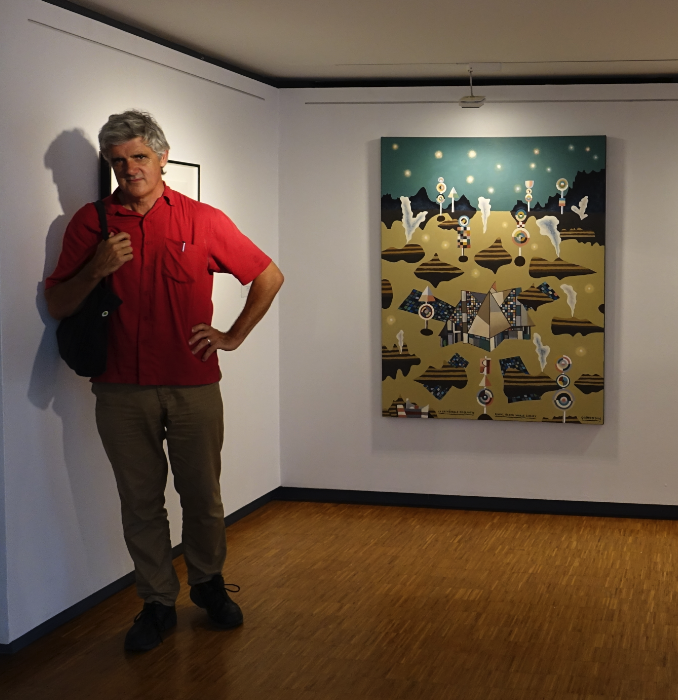
Gregory O’Brien at Tjibaou Cultural Centre, Noumea, March 2015

Photo Credit: Elizabeth Thomson


Gregory O’Brien is the  2015 Stout Memorial Fellow at the Stout Research Centre, Victoria University, where he is currently working on a book about poetry, painting and the environment. His new collection of poems is Whale Years (Auckland University Press). He has published numerous books of fiction, non-fiction and poetry. Since 2011 he has contributed to the ongoing Kermadec art project, works from which are on show at the Tjibaou Cultural Centre, New Caledonia, until July.


The interview


‘Ocean sound, what is it

you listen for?’


Did your childhood shape you as a poet? What did you like to read? Did you write as a child?

As far as I can recall, I drew more than I painted. And I always gravitated towards illustrated books—Tove Jansson’s ‘Moomin’ books stand out, and I remember The Lord of the Rings, as much for its illuminated maps as for the words. I went through a phase of reading comics—Whizzer & Chips rather than Batman. I date my interest in the interplay of words and visual images to those early encounters.

I doodled at every available opportunity and I remember being hauled out of class and punished for drawing, rather well, a crouching deer on the inside cover of my maths book. I usually captioned my drawings—so maybe those captions could be thought of as my first writings. Occasionally I filled in speech- or thought-balloons above various life-forms.


When you started writing poems as a young adult, were there any poets in particular that you were drawn to (poems/poets as surrogate mentors)?

I can trace this pretty exactly, I think. Aged 14: Bob Dylan’s ‘Writings & Drawings’. Aged 15: Dylan Thomas. Aged 16: James K. Baxter and Flann O’Brien (I liked to pretend Flann was an actual relative. I even screen-printed his book-title AT SWIM-TWO-BIRDS on a singlet—an item I still have in my wee box of treasures.) Aged 17: John Cage (Silence, and A Year from Monday). By the age of 18, I was living in Dargaville, and it was as if everybody suddenly jumped on board the NZ Road Services bus or bandwagon—I was reading Kenneth Patchen, William Blake, Edith Sitwell, T. S. Eliot, Ezra Pound, e e cummings; also Allen Curnow, Janet Frame, Sam Hunt… I had known about Eileen Duggan for some years, because she was a relative, on my mother’s side. More than anything else, however, it was discovering Robin Dudding’s journal ISLANDS that turned my world around, that brought the whole business home…. Therein I discovered Ian Wedde, Bill Manhire, Elizabeth Smither, CK Stead…


Did university life transform your poetry writing? Theoretical impulses, research discoveries, peers?

I was six years out of school by the time I finished my BA, so my university life was mixed in, very much, with everything else that was going on: with 15 months in Dargaville, a year or so in Sydney… At university, I certainly wasn’t drawn to theory except in so far as I thought it was a grand imaginative game that might, periodically, yield unpredictable and outlandish results. I enjoyed the pottiness of Ezra Pound’s literary (rather than his political) theorising… An ABC of Reading is a great book. Probably the Zen-inclined John Cage and the Trappist Thomas Merton were the two non-fiction writers I held closest to me.


Reading your poetry makes me want to write. I love the way your poems delve deep into the world, surprisingly, thoughtfully yet never let go of the music of the line. Words overlap and loop and echo. There is an infectious joy of language at work. What are key things for you when you write a poem?

I listen to a lot of music. I want the poems to have something of the music that I love. I spend a lot of my time looking at art. And I want my poems to have something of the art that I love. There are aspects of composition, tone, rhythm and character which span all these different creative modes. Those are the key factors for me when I write… At a certain point, an appropriate form makes itself known…. The poem has to dive down into and surface from some essential state of being… There is certainly a joy in doing the things that you love; so there’s joy in the making and, preceding that, in the state of being that leads to the making….


Do you see yourself as a philosophical poet? Almost Zen-like at times?

My concept of philosophy is broad and shambolic enough to accommodate what I do as a writer. I’ve never read extensively in the field of Zen (apart from the books of John Cage and the writing of my friend Richard von Sturmer). I’ve read a little, and somewhat randomly, in the field of non-conformist Catholic thought: Simone Weill, Meister Eckhart, Merton, Baxter… These peregrinations may have affected me more than I realise or am prepared to say.


Do you think your writing has changed over time?

I guess writing has to evolve – otherwise it will become predictable and a total drag. I’m as entranced as I ever was with the process, the business, the labour of it. At the same time, I remain devoted to the finished form of it: The printed book, with its covers and half-title and title-page; and the shapes of words on the page and maybe illustrations. Poetry is an art that, if it’s working, is constantly reinventing itself.

I look back at my early poems and find fault. I find myself blaming an over-voracious intake of French Surrealism; too much Kenneth Patchen one year, too much Stevie Smith the next… Too much John Berryman! And, next year, not enough John Berryman! But the ship sails on, and finds new oceans to ply.


You write in a variety of genres (poetry, non-fiction, critical writing). Do they seep into each other? Your critical writing offers the reader a freshness of vision and appraisal – not just at the level of ideas but the way you present those ideas, lucidly, almost poetically. Does one genre have a particular grip on you as a writer?

I’m only starting to realise the inter-relatedness of these different genres. A few years back I started to explore poetry’s potential to carry information, also to elaborate upon a thought in a more detailed kind of way, ie. to have an almost essayistic function. So quite a few of my longer poems (some of the odes and, particularly, ‘Memory of a fish’ in my new book) are laden with facts, figures and reasonably clearly articulated information.

Needless to say poetry infuses the writing I produce in relation to the visual arts. I find looking at art exciting; it appeals to my poetic self. I don’t really have a critical self. I hope my non-fiction writing has a cadence, a music and a subconscious (rather than a conscious) purposefulness. Pondering my recent writings on artists such as Pat Hanly, Barry Brickell and Michael Hight, I remember in each case hearing a note—a song, almost—in my ear, and I was beholden to it.


Do you think we have a history of thinking and writing about the process of poetry? Any examples that sparked you?

James K. Baxter wrote wonderfully about writing poetry. Bill Manhire’s Doubtful Sounds is an immensely useful and energising book. 99 Ways Into New Zealand Poetry is terrific too. I refer back to my set of the journal ISLANDS and, yes, it seems to me we New Zealanders have been writing about the process as well as the product. Janet Frame’s oeuvre might be our greatest, most enduring instance of writing about writing, thinking about writing, writing about thinking, and thinking about thinking.


Your poetry discussions with Kim Hill are terrific. The entries points into a book are paramount; the way you delight in what a poem can do. What is important for you when you review a book?

I think a book has to become part of your life to really make an impression. It’s the same with music or visual arts. It can’t be a purely intellectual thing, it has to take you over, to some degree. It has to be disarming. Accordingly I tend not to discuss books that don’t ‘do it’ for me. Life’s too short. Fortunately, I have catholic tastes. There are things I enjoy very much in Kevin Ireland, as there are things I enjoy in Michele Leggott. I guess this makes me a lucky guy.


I agree wholeheartedly. I am not interesting in reviewing books on Poetry Shelf unless they have caught me, stalled me (for good reasons!).

What poets have mattered to you over the past year? Some may have mattered as a reader and others may have been crucial in your development as a writer?

Two years ago I went to Paris and met up with one of my all-time heroes, the French poet and art-writer Yves Bonnefoy. He turned 90 last year (Joyeux anniversaire, Yves!) During my recent travels around the Pacific (from New Caledonia to Chile), I’ve taken bilingual editions of Yves with me everywhere. I am interested in the way he has turned the creative conundrum of being an Art Writer and a Poet into something unified and compelling (channelling earlier French poet-art-writers from Baudelaire to Apollinaire, with a nod to Yves’s near-contemporaries, that wondrous group of wanna-be French-art-poets, John Ashbery and the New Yorkers). I also took the poems of Neruda and Borges with me everywhere I went.


What New Zealand poets are you drawn to now?

New Zealand poetry is interesting at the moment. It’s all over the place. As it should be. There are plenty of people I read voraciously. As well as the poets mentioned already: Anna Jackson, Vince O’Sullivan, you Paula, Lynn Davidson, Kate Camp, Geoff Cochrane… Last year I edited a weekly column for the Best American Poets website—that was a good chance to ‘play favourites’, as Kim Hill would say. (All those posts are archived here: http://blog.bestamericanpoetry.com/the_best_american_poetry/new-zealand/) There are some great first books appearing at the moment: Leilani Tamu’s The Art of Excavation; John Dennison’s Otherwise. This bodes very well indeed.


Name three NZ poetry books that you have loved recently.

I was rereading Riemke Ensing’s Topographies (with Nigel Brown’s illustrations) the other day; I found that book very inspiring when it appeared way back in 1984. Lately I’ve also been reading Bob Orr’s crystalline Odysseus in Woolloomooloo and Peter Bland’s Collected Poems… I could go on.


Your new collection, Whale Years, satisfies on so many levels. These new poems offer a glorious tribute to the sea; to the South Pacific routes you have travelled. What discoveries did you make about poetry as you wrote? The world? Interior or external?

The Kermadec voyage, and subsequent travels—most recently to New Caledonia—opened up a huge areas of subjective experience as well as of human and natural history. How do you write about that kind of space, that energy, that life-force? Wherever you travel, the air is different; the ‘night’ has a different character; the smells and textures of the vast Pacific vary from place to place. And people move differently wherever you go – they claim a different kind of space within the environment. My recent travels have been like a door opened on a new world. The last three years of my poetry-writing have been the most intense since I was in my early twenties.


That shows in this book Greg. I am looking forward to reviewing it because it touched a chord in so many ways. I love the idea that poems become little acts of homage. What difficulties did you have as traveller transforming ‘elsewhere’ into poetry? To what degree do you navigate poetry/other place as trespasser, tourist, interloper?

The artist Robin White likes to point out that there is only one ocean on earth. All our oceans are joined together—it’s the same body of water. So, if you take the sea to be your home (which, as Oceanians, believe it or not, we should do), then as long as you’re at sea you’re still, to some degree, in your home environment.

As a poet entering a new environment, I bring with me my responses, my eye, my mind and various kinds of baggage. I’m a curious person by nature so I always want to find new things—things I don’t know anything about. I like it when my preconceptions fall apart. I love being wrong about things; I enjoy the subsidence of the known world. I quote the great post-colonialist writer Wilson Harris in Whale Years: ‘If you can tilt the field then you will dislodge certain objects in the field and your own prepossessions may be dislodged as well.’

I feel that, as a poet, I am most in my element when I am sitting on the ground and learning new things. When the field of the known has been tilted. And filling my notebooks with various tracings of that new knowledge or sensation.


This is a good way to look poetry that takes hold of you; it ‘tilts’ you. I also loved the elasticity of your language – the way a single word ripples throughout a poem gleaning new connections and possibilities. Or the way words backtrack and loop. At times I felt a whiff of Bill Manhire, at others Gertrude Stein. Yet a poem by Gregory O’Brien is idiosyncratic. Are there poets you feel in debt to in terms of the use of language?

Strangely, I can’t read Gertrude Stein anymore. She is one of a very few writers I have been in love with and then the relationship has waned. Maybe, early on, she loosened up my use of language, the extent to which the rational mind is left to run things. There was a music I found in Stein, for sure. But this was something—increasingly—I found in more conventional writers like Wallace Stevens, Robert Creeley and, most recently, in Herman Melville. Moby Dick is a piece of great, symphonic, oceanic music. The novel (for want of a better term) is an incredible noise, a racket of spoken and sung sounds. Melville’s style reminds me of all the depth-finders, radars, monitors and gauges on the bridge of HMNZ Otago as we sailed north to Raoul Island in May 2011. All that information pinging and popping…


Is there a single poem or two in the collection that particularly resonates with you?

The long poem, ‘Memory of a fish’, is the piece that connects various experiences from the three year period in which the book was written, and brings them together—in an essayistic fashion, almost. I enjoy the ebb and flow of the triplets, and the world’s details tripping along them, like things washing ashore on Oneraki Beach… When I was writing that poem I felt I was living inside it, totally. And I haven’t quite climbed out of it yet, to be honest.


The book also demonstrates that eclectic field you plunge into as a reader with its preface quotes. What areas are you drawn into at the moment? Any astonishing finds?

The quotations at the beginning of the three sections of the book are constellations in the night sky above the poetry-ground. They mark points of reference, further co-ordinates, which have guided the writing: W. S. Graham’s ‘The stones roll out to shelter in the sea.’ The Flemish proverb: ‘Don’t let the herring swim over your head.’ Those are verbal artefacts I have carried around with me, much as you would pick up a shell or a colourful leaf. They were/are talismans. So I have stored them inside the book as well. Cherished things.


‘Constellation’ is perfect. I was thinking underground roots that nourish. Or one of any number of maps you can lay over the poems (the map of domestic intrusion, the map of childhood, the map of objects, the map of reading). But yes the process of writing has its constellation-guides as you venture into and from both dark and light.

Poetry finds its way into a number of your paintings (as it does with John Pule). There are a number of drawings included in the book that add a delicious visual layer. How do you negotiate the relationship between painting and poetry? Does one matter more? Do they feed off each other?

My notebooks contain a thick broth of visual and verbal ingredients. These materials arrive in my journal simultaneously. When writing or painting, I separate the words from the visual images and work on them more-or-less separately. When it comes to putting together a book, like Whale Years, these two disparate activities are reunited again. I’ve always loved illustrated books. (I think immediately of Bill Manhire’s The Elaboration, with pictures by Ralph Hotere; Blaise Cendrars’ long Trans-Siberian poem, illustrated by Sonia Delaunay; William Blake illustrating himself, and so on)


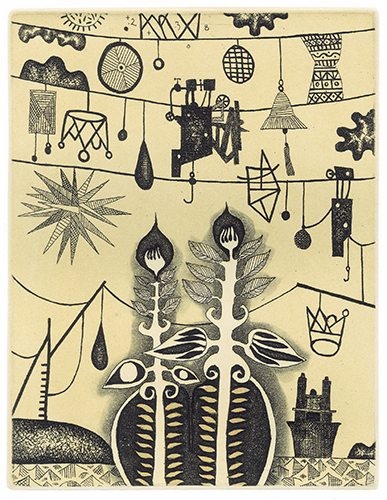
notes-on-the-raising-of-the-bones-of-pablo-neruda-at-isla-negra-gregory-obrien-and-john-reynolds-etching-2014

NOTES ON THE RAISING OF THE BONES OF PABLO NERUDA AT ISLA NEGRA by John Reynolds & Gregory O’Brien, etching, 2014

You have collaborated with a number of other artists and writers. What have been the joys and pitfalls of collaboration?

There are no pitfalls, as far as I can see. Somehow, I’ve found my way into a few collaborative circumstances and very much enjoyed the results. In the past year I’ve made etchings with my two painter-friends John Reynolds and John Pule. Like Charles Baudelaire and Frank O’Hara before me, I seem to have been lucky enough to fall in with a good crowd of painters (and also photographers—but that’s another story).


sailing-to-raoul-gregory-o_brien-and-john-pule-etching-aquatint-with-colour-roll-2011

SAILING TO RAOUL by John Pule & Gregory O’Brien, etching, 2012 (John titled this work, riffing off Yeats’s ‘Sailing to Byzantium’)


The constant mantra to be a better writer is to write, write, write and read read read. You also need to live! What activities enrich your writing life?

Certainly my recent travels around the Pacific have been hugely enriching. I’m not a proper swimmer, but since I was a child I have had a great passion for floating in, or being upon salt water. (My book News of the Swimmer Reaches Shore grew out of that propensity.) The everydayness of existence is the most enriching thing—as the poems of Horace and Neruda and Wedde keep reminding me. What a great and pleasant swarm of information and sensation we find ourselves amidst, every day of our lives.


Finally if you were to be trapped for hours (in a waiting room, on a mountain, inside on a rainy day) what poetry book would you read?

I keep coming back to the Collected Poems of James K. Baxter. Not because it’s the best book ever written but because of the simple fact that it occupies a huge and resonant place in my life.


Auckland University Press page

New Zealand Book  Council page

Arts Foundation page

The Kermadecs page

National Radio page (discussing poetry highlights of 2014 with Kim Hill)


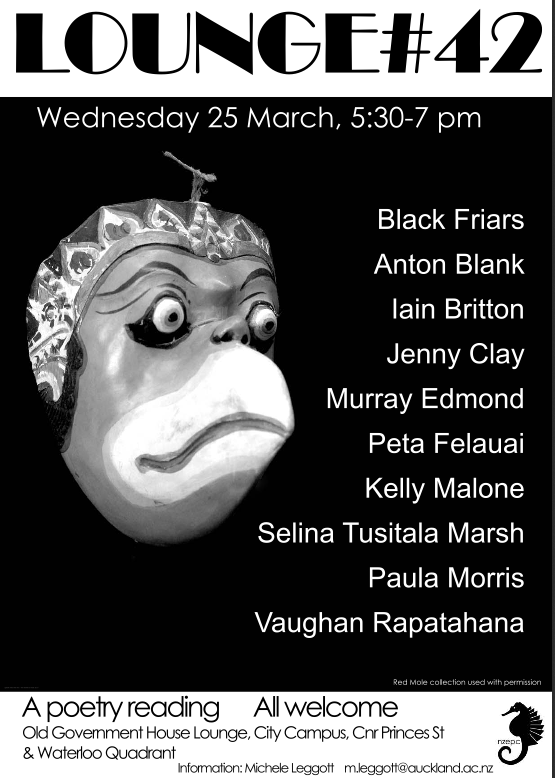
Lounge 42 at Old Government House: Line up includes Paula Morris and Selina Tusitala Marsh

Screen shot 2015-03-11 at 8.57.32 AM

Free entry. Food and drinks for sale in the Buttery.

The LOUNGE readings are a continuing project of the New Zealand Electronic Poetry Centre (nzepc), Auckland University Press and Auckland University English, Drama and Writing Studies,  in association with the Staff Common Room Club at Old Government House.

LOUNGE READINGS #42-44: 25 March, 29 April, 27 May 2014

Landfall 228 highlights

large_landfill    large_landfill

The latest issue of Landfall contains the essays by the winner (Diana Bridge) and runners-up (Sarah Bainbridge, Simon Thomas, Scott Hamilton) of the 2014 Landfall Essay Competition. Judge, David Eggleton, selected 11 finalists (all listed) from 39 entries before selecting the winners. He is also publishing the essay by another finalist, Tina Makareti in Landfall 229. Having read the judge’s comments, I am now interested to read the essays themselves.

What I have done though is read all the poetry. Four poems particularly stood out for me.

Carolyn McCurdie’s ‘Hut’ The opening lines are tremendous: ‘If I come back as a building/ it will be as a tramping hut.’ The poem deposits you in in its heart which is the heart of the hut. Right there in a place where words so frequently stop, yet Carolyn’s lines are memorable.

Reihana Robinson’s ‘And Blessed Be’ The lively word play of this poem is utterly infectious.

Semira Davis’s ‘White Girl: Māori World’  The poem has a razor-sharp edge that stops you in your tracks. Is it okay for a skinny white girl to speak Te Reo?

Rhian Ghallager’s ‘The Speed of God’ is a stunning example of poetry that is original (yes!), breathtaking, spare and refreshes repetition. Some poems rise above all the pother poems we write, and for me, this is one of them. Here is the opening stanza:

‘What if God had slowed down after making the grass and the stars and the

whales and let things settle for a bit so the day could practise leaving into the

arms of the night and the tides tinker their rhythms and the stars

find their most dramatic positions.’

I was capitivated by Michele Leggott’s essay, ‘Self-Portrait: Still Life, A Family Portrait.’ It is both inventive and moving. I don’t want to say anything more but let it unfold for you as you read it.

Oh and I also loved the portraits by Lorene Taurerewa. One features on the cover.

And as for the fiction, that is part of my summer reading.

Great issue, David Eggleton.

Updated From Poets and Fans of Poetry: Favourite poetry reads of 2014

I am not sure if two lists make this an annual event (so I resisted temptation to put ‘annual’ in the title!), but here are the books that have stuck with local poets and fans of poetry in the past year. Unlike most ‘best of 2014 book lists’, the invitation is to select favourite reads no matter where or when those reads were published. The only limitation—this is a poetry list.

Over summer, I will muse over the future of my two blogs. If I do decide to keep them running, I will make a few changes changes to clear space for my own writing time. One thing is certain, I can never review all NZ poetry books on this blog. I have a huge stack of books I want to review, but know I can only do a handful over the next few weeks.  I guess with the scarcity of poetry reviews in New Zealand, I feel pressure to share all the wonderful writing that I discover.  I would certainly be keen to post reviews and musing by other poets.

Thanks to everyone who contributed to this list at a time when we all have such busy schedules, and thanks to everyone who contributed to the blog over the past year. It wouldn’t work with out you. Thanks, too, to everyone who shared my posts on social media and who followed both this and NZ Poetry Box.

John Adams:

The Life-guard, Ian Wedde, AUP.

Stark metaphors, sustained muscular writing that disturbs. A strong surface with an underbelly that provokes contemplation and rewards reflection. The final group “Shadow stands up” successfully blends quotidian observation with humour. Stuff to savour.

Autobiography of a Marguerite, Zarah Butcher-McGunnigle, Hue & Cry Press.

The disquieting disclosures of these poems builds a unique experience of family; patterns of mother and daughter; trials of close binding. How can we be, with such context? A journey to a foreign part.

Fearing the Kynge, Bernard Brown, Foundation Press (c/o 14 Birdwood Crescent, Parnell.

A short collection around Henry VIII and those who passed through his life, sometimes more quickly than they’d wished. Beautifully illustrated, the text ranges from the hearty pun to closely worked items that reward revisiting.

Sailing Alone around the Room, Billy Collins, Random House.

This masterly collection includes unforgettable, accessible gems. I love his riff on Blues; and any poet will weep with laughter at the enacted difficulty of Paradelle.

Rosetta Allen:

Cloudboy Siobhan Harvey Otago University Press

‘When the eye was overcast,
there could be no poetry.’

If the face was made to mirror the stars, then the entire body responds to the cloudscape that is this beautiful collection of poetry called Cloudboy. Harvey herself says ‘The body is a nest alive with new song’, and I feel it as I read her perfected lines, full of ever changing details of the atmosphere between a very special son, and an obviously devoted mother. No longer a passive pass time, cloud watching has become an active search for understanding, beauty, love and courage. And I too find myself looking up, with appreciation.
One Human in Height Rachel O’Neill Hue & Cry

‘I love that Father finds the faint trace of cyanide on his ring finger just in time and chops it off.’

I found the words of O’Neill’s poetry happily settled on the page. The humility trumpets itself without fanfare. Each poem, each line containing a neatly package surprise – I a kid in the back seat of a her car, unravelling lollies, and remembering, feeling part of the scene, included and instantly befriended. I adore the rhymes in the midst of lines, the lists that are not lists, the epiphanies that pile up until you have to let some go, the meaning where there is no meaning, and I believed every bit of it – almost.

Sarah Jane Barnett:

The Lonely Nude by Emily Dobson (VUP) An extremely beautiful collection about dislocation, identity, expectation, and the body. It traces Dobson’s own experiences of leaving New Zealand, living in the US, and her return. Dobson’s poems are spare and exquisitely crafted. She’s definitely my #1 poetry crush of 2014.

Etymology by Bryan Walpert (Cinnamon Press) Even though Etymology came out in 2009, I only managed to read it this year. As the title suggests, the poems are about the way we create meaning, not only in terms of words, but in our relationships and lives. It’s so sharp and clever that it made me want to give up writing.

Curriculum Vitae by Harold Jones (Xlibris/self published) Jones’ debut collection was my surprise of the year. Generally speaking, self published collections aren’t very good. I should have known that this would be the exception when I found out Jones has been published as part of AUP New Poets 4. Curriculum Vitae is a wonderful exploration of aging, regret, and memory. It was the only collection this year that made me cry.

Airini Beautrais:

2014 has been such a fruitful year for poetry. I haven’t quite finished reading all the wonderful local books that have come out, some as recently as last week. I have loved Hinemoana Baker’s waha/mouth (VUP 2014). And Maria McMillan’s Tree Space is an amazingly assured first full-length collection (also VUP 2014).

Diana Bridge:

For me this year has been weighted towards prose. I began it with the biography of Penelope Fitzgerald, which I interleaved with a re-reading of all her novels. Her last, The Blue Flower, was recently described with insight by Alan Hollinghurst as having ” something of the overall effect of a poem, a constellation of images and ideas.”

While I am waiting for the next collection of wonderful Australian poet, Judith Beveridge, I have been reading through her last two: Wolf Notes and Storm and Honey (Giramondo, 2003 and 2009), relishing her naturalist’s eye coupled to extraordinary and sustained imaginative powers. All her poems are filled with grace and intelligence.

Now a single poem, one I had been searching for since I first read it in the New York Review (October 7, 2004): Seamus Heaney‘s ‘ What Passed at Colonus’, written in memory of Czeslaw Milosz. I would want this to be one of the last poems I ever read.

Amy Brown:
Horse with Hat, by Marty Smith (VUP, 2014): This collection is a poignant and wry family biography. It juxtaposes earthy and transcendent subjects (the racetrack, the farm, Catholicism, war) as naturally as its stunning accompanying collages (by Brendan O’Brien) do. I especially loved Smith’s horses; I can picture the ‘dawn horses’ ‘who flatten, who scatter’ perfectly.

Final Theory, by Bonny Cassidy (Giramondo, 2014): This verse novel develops an eerie, quietly filmic atmosphere of post-apocalypse. Cassidy is an Australian poet, who wrote part of this poem while travelling in New Zealand – the landscape she describes is simultaneously recognisable and alien – a place where ‘three stilled turbines balance the space like stupas’ and ‘the ocean’s a mouthed thought’. Exquisitely clear and unsettling, it is the sort of book I’d love to write one day.

Mondrian’s Flowers, By Alan Loney and Max Gimblett (Granary Books, 2002): I stumbled upon this poetic biography of Piet Mondrian while reviewing Loney and Gimblett’s recent eMailing Flowers to Mondrian. Only 41 books were made, each with rough-cut watercolour pages and an exposed primary-coloured spine. Three long poems by Loney in tribute to Mondrian are punctuated by Gimblett’s watercolours. Reading it is a meditative act; if you’re in Wellington, I recommend looking at the copy in the National Library. Her

Rachel Bush:

Marty Smith, Horse with Hat Victoria University Press Marty Smith’s work is new to me. Rural New Zealand, family stories, and the stories of a generation are combined in her excellent first volume of poetry. It’s poignant stuff that doesn’t balk at the sorts of tough, sad realities that exist in all families.

Lindsay Pope Headwinds Makaro Press Lindsay Pope’s engaging first book of poems is very timely. Family events, like the birth of a grandchild and low key domestic things like making muesli feature in it, but he’s also drawn to write about solitary lives like that of the caretaker on Stephens Island or the man in ‘Outpost’ whose closest contact with the outside world comes through the radio he operates.

Vincent O’Sullivan Us, then Victoria University Press I enjoy the ease with which Vincent O’Sullivan can refer as easily to a Dunedin Beach as he does to lines from Robert Frost or Wallace Stevens or to the poetry of McGonagall. He investigates difficult questions, but doesn’t come up with facile, tidy answers to them.. This is a collection thoughtful, witty, sure-footed poems.

Michael Harlow Sweeping the Courtyard: The selected poems of Michael Harlow Cold Hub Press
Poems chosen from seven books of poetry by Michael Harlow make  for a lively and varied collection. He is interested in and  sensitive to how each poem looks on the page. I enjoy his distinct and often quirky voice.

Kay Cooke:
Essential NZ Poems Facing The Empty Page selected by Siobhan Harvey, James Norcliffe and Harry Ricketts. Published by Godwit. A real  treasury indeed of NZ poets. (Although I missed Tim Jones and Helen Lehendorf not being there).

Si no te hubieras ido / If only you hadn’t gone by Rogelio Gueda with translations from the Spanish by Roger Hickin and an introduction by Vincent O’Sullivan. A gem of a book with poems about distance, love and Dunedin. Published by Cold Hub Press.

You Fit The Description: The Selected Poems of Peter Olds published by Cold Hub Press. The long-awaited collection of Olds’ poetry; a prolific New Zealand poet whose background in poetry in Aotearoa stretches back to the James K. Baxter era. I’m thoroughly enjoying this book which is sure to become a classic. I haven’t finished reading it yet, but so far – It’s a cracker.

A chapbook that has both inspired and thrilled me with its re-imagined worlds within worlds, delicately traced with a steely eye, is Jenny Powell’s Trouble published by Cold Hub Press.

Ruth Arnison’s PoARTry @ Olveston (self-published) with its clever mix of paintings and words, is also a favourite from my 2014 pile of poetry.

Karen Craig:

I’m looking at the three books I’ve laid out on my table and what I notice is that they all have lots to do with the sea, seabirds, islands. And I have a wonderful feeling that if I were to pry up their covers I’d hear sounds of imaginary oceans, like when you hold a seashell up to your ear. Because, like seashells, these poets have taken the sounds of our world and clarified and amplified them, made them resonate, turned them into a deep, quiet, prolonged roar. Each with a different pitch, of course.

1. Richard Blanco Looking for The Gulf Motel, University of Pittsburgh Press 2012 (You can get it at Auckland Libraries!). Richard Blanco’s seasides are Cuba, where he was born; Florida, where as a boy he emigrated with his family; and now Maine, where he ended up for love. He sings the enigma of memory, the yearn of sorrow, the terror of romantic love. “The sea is never the same twice. Today / the waves open their lions’ mouths hungry / for the shore, and I feel the earth helpless.”

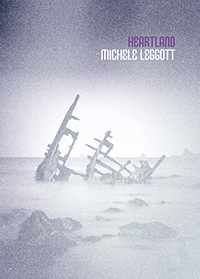
2. Michele Leggott Heartland Auckland University Press 2014. These poems burn like the hot blue stars which recur in one of them. You dive in to their mesmerising, punctuationless (as always) whirl and find at the heart a distillation of spirit that is so honest as to be unforgettable. The long poem about the introduction into her life of her guide-dog ends with the simplest of phrases, “her name is Olive”, and it’s as if a choir broke out.

3. Bob Orr Odysseus in Woolloomooloo Steele Roberts 2014. Bob Orr embraces the sacred and the profane better than anyone. From the ancient mysteries to modern gazes, from Penrose to Valparaiso, his imagery amazes me and his turns-of-phrase make me want to get down on my knees and say Hallelujah! “As the Southern Cross / salts these hours / I shiver beneath signs and wonders.”

David Eggleton:

There were a number of outstanding poetry books I read this year, but these in particular offered things which have stayed with me.

  1. Kay Mackenzie Cooke’s book-length sequence Born to a Red-Headed Woman (Otago University Press) offers a remarkable evocation of growing up in rural Southland: ‘The teacher draws close, / her own fingers cool, // narrow streamlined/ dragonflies that touch down/ briefly where my fingertips/ have begun to make mist, / What lovely moons you have, she says.’
  2. In Sweeping the Courtyard: the Selected Poems of Michael Harlow, Michael Harlow’s poems are like miniature echo-chambers, their lines teasing and entrancing with repetitions of words and phrases which resonate with subtle implications: ‘We were walking out of the park, your/ hair on fire under a full fall of moon, / the flowering almond its bridal white/ fading earlier than was remembered// I could hear, a leaf-fall of thought . . .’
  3. I was impressed by the restless inquisitive searching tone, the careful observation, in Jenny Powell’s small collection Trouble (Cold Hub), as in her poem describing the scene in a photograph ‘Guided Walking Party on the Franz Josef Glacier, New Zealand c. 1908’: ‘five women/ standing on/ frozen contortions of time/ frock hems damp/ from trailing overground undulations . . .’
  4. I was also pleasurably arrested by the precise and telling imagistic phrases that made up Hinemoana Baker’s collection waha:mouth (Victoria University Press), as for example in ‘what the whale said’: ‘ I break/ the brine, my flukes a black book// a mast in your mind/ cross of the drowned. . .’
  5. I was amused by the rhythms and rhymes forming sweet and sour stanza combinations in Tim Upperton’s poetry collection The Night We Ate the Baby (Haunui Press), as in ‘All the Things I Never Knew’: ‘Bobbie watches headlights move/ across the wall. / A little rain begins to fall — / a little rain to end the day. // It falls differently in L.A./ Choctaw Ridge is far away.’
  6. Likewise, I enjoyed the almost whispered whimsy and well-turned verses in Peter Bland’s short book Hunting Elephants (Steele Roberts), as in his dream-poem about James K. Baxter: ‘Not/ a pretty sight/ with his soup-stained beard/ but there’s a lovely/ holy glow / to his skin . . .’
  7. Tom Weston’s collection Only One Question (Steele Roberts) contains a number of extraordinary poems, especially about crime and punishment. He shows us characters who have the fatalism, or else the tragic destiny of Joseph Conrad’s characters, as in the title poem: ‘When he sends children to prison the parents go too, / trailing along like wind-ripped flags.’
  8. And, finally, I was taken with the rapping urgency of Leilani Tamu’s street-wise voice in The Art of Excavation (Anahera Press), as in ‘You’, a poem about her father: ‘. . . driving around Auckland in your crusty-as car/ a hole in your sock, an empty pocket, a heart full/ of dreams but never a cent . . .’

Laurence Fearnley:

Dylan Thomas SELECTED POEMS (Penguin Classics)

I watched a couple of science fiction/space movies recently and, in general, I found them pretty dull and really long. But, a couple of them  included poems by Dylan Thomas. The film Solaris had ‘And Death Shall have No Dominion’ and Interstellar included ‘Do Not Go Gentle Into That Good Night.’ So I found my copy of Dylan Thomas’s poems and I noticed in its introduction that Thomas is described as ‘dense and often difficult’. I don’t know about that.  I liked the imagery in some of the poems – ‘Where birds ride like leaves…’ (When I Woke)  or ‘…the shabby curtains of the skin…’ (A Process in the Weather of the Heart), for example . After reading Thomas I got out my James K Baxter and Janet Frame books and spent a while flicking back and forth between the three writers.

Joan Fleming:
I have never read anything like George Dyungayan’s Bulu Line: A West Kimberley Song Cycle (Puncher & Wattman, 2014), edited and translated by Stuart Cooke. Cooke braids a dimensional translation of an Aboriginal song-poem from many strands: the words of the song in language, traditional owners’ verbatim explanations, an ethnomusicologist’s commentary, and his own circling, cycling rendering in english. Such important work; this book is a bit of a game-changer.

Siobhan Harvey:

Alexandra Fraser, Conversations by Owl Light (Steele Roberts) is a first collection which engages with concepts of chemistry, love, botany, family, astronomy, tarot and ancestry. The author’s evocative language, pinpoint accuracy and sumptuous concern for human interaction make is a 2014 standout.

Ancestry also underpins another exciting first book, Leilani Tamu’s The Art of Excavation (Anahera Press). Excavating her family and Pacific history, the book is an entwining of legend and cultural realism.

Miriam Barr, Bullet Hole Riddle (Steele Roberts) packs a powerful punch. A triptych charting the narrator’s cruel, abusive history, it’s a book of unflinching honesty and potent impact.

Dinah Hawken:

The Great Enigma, New Collected Poems, Tomas Transtromer, New Directions Books, 2006.

This has been my favourite book for a couple of years. I’d love to be able to write like him and it would take too long to tell why.

Body English, Text and Images by Len Lye, edited by Roger Horrocks, Holloway Press, 2009.

I splashed out and bought this book a few months ago, not long after reading Roger Horrocks’ biography of Len Lye.
I knew I would love it because Lye was so extraordinary; particularly in his understanding of how the body gives rise to all creative ventures including poetry. ‘ I hold/words in the bone.’

Otari, Poems and Prose, Louise Wrightson, Otari Press, 2014.

This very new, first book by Louise Wrightson has been written slowly, close to home. Louise lives on the edge of Otari/Wilton’s Bush in Wellington and has written a book about place that is dedicated, funny and beautifully produced.

David Hill: 

I’d like to mention:  1. Ruby Duby Du, by Elizabeth Smither (Cold Hub Press, PO Box 156, Lyttleton). Smither’s enchanting poems for her new grand-daughter, which manage to combine tenderness with her distinctive cool, meticulous observation.

2. A Treasury of NZ Poems for Children, ed by Paula Green, illustrated by Jenny Cooper (Random House). Yes, I know I’m not supposed to include Paula Green’s poems, but she’s just (“just”!!) the editor of this terrific anthology which ranges from Baxter to school-kids. Exuberant, engaging, educational, and made more so by Jenny Cooper’s magic illustrations.

Bill Manhire:

Do song lyrics count as poetry? If so, I’ve been enjoying The Lines Are Open from The Close Readers (aka Damien Wilkins). It includes tracks about departed writing friends like Barbara Anderson and Nigel Cox. One of them – “The Ballad of Tarzan Presley” http://theclosereaders.com/track/the-ballad-of-tarzan-presley – makes my heart hurt yet somehow leaves me happy.

It’s been a strong year for New Zealand poetry.  So many accomplished first collections! I was pleased to see Frances Samuel’s Sleeping on Horseback (VUP) in print – I’ve been waiting for some version of this book for about ten years. Another impressive first book is Kerry Hines’s Young Country, in which the poet’s words keep company with the images of 19th-century photographer William Williams. It’s a mix that can seem easy and obvious, but is surprisingly hard to do well. Between them, Hines and Auckland University Press make the task seem effortless.

A couple of other great reading pleasures this year have been A Dark Dreambox of Another Kind: The Poems of Alfred Starr Hamilton (edited by Ben Estes and Alan Felsenthal, and published by The Song Cave) and Maurice Riordan’s new collection from Faber, The Water Stealer.  Alfred Starr Hamilton is the poetry equivalent of the apparently naïve artist, of a Chagall or an Alfred Wallis. He has an appealing clumsiness, and specialises in astonishing small moments, as in his one-line poem “Carrot”: “I wanted to find a little yellow candlelight in the garden.” Maurice Riordan manages to be lyrical and thoughtful all at once, and is also the editor of The Finest Music: Early Irish Lyrics, a handsome anthology which includes translations from Tennyson to Riordan himself, as well as a number specially commissioned for the book.

Alice Miller:

Sam Sampson, Halcyon Ghosts (AUP, 2014)
‘shadow this, take and come up/  shadow, come to the present … the sur-/ face… the Lion —– the Light  —– the Luminous’

Lee Posna, Arboretum (Compound Press, 2014)

Steven Toussaint, Fiddlehead (Compound Press, 2014)

Emma Neale:

Poetry books this year I enjoyed…. I still have many books on my bedside table that I’m still only part way through – e.g. Stefanie Lash’s Bird Murder and Hinemoana Baker’s Waha-Mouth and more and more… but of those I have finished, the memorable ones are:

Siobhan Harvey, Cloudboy – I hope it’s all right to nominate a book I edited – it’s the only one I’ll let myself name out of some other wonderful books I worked on this year – but this one stood out for the ’tensile delicacy’ with which it maintains the extended metaphor of boy and mother as shifting cloudscape; for its subtle use of line and page as physical space as well as rhythmic unit; for its music and invigorating intelligence. It is an important milestone in local publishing, I reckon, for the poise in that sustained motif; for the fact that the metaphor never feels strained or gimmicky; and for the richness of the psychology in the relationships portrayed across the developing sequence.

Alice Miller, The Limits – for its dreamy eeriness, its evocation of beauty even as it catches the jittery sense of a civilisation crumbling; for its creation of the atmosphere of dread and yet a sense of old-new mythology as well.

Michael Harlow, Sweeping the Courtyard – a selected from Harlow seems long overdue, and it’s a joy to have this now that older volumes are out of print. His sense of the surreal, the power of the subconscious, and his ear attuned to the lilt and rise of a sometimes slightly eccentric syntax shows a musical ear for how to upend where the emphasis normally falls in a line. It keeps us listening closely to the swerve and duck of words: how meaning can shimmer from one sense to another, depending on how you hold light to the line. His sense of the power of the subconscious and seems to perhaps have filtered through to a poet like Alice Miller.

Peter Olds, Selected Poems – I am a latecomer to Peter’s work, and the stretch of experience here, as well as the energetic vernacular, was both refreshing and sometimes devastating to read. Many of the poems record pushing himself right to the edge of risk, and the cost is shown to be very bleak at times – which means that the mischievous, finger-flipping humour that survives in some poems is all the more welcome.

Tim Upperton, The Night We Ate the Baby –  I kept waiting for my kids to ask why I was reading this book. They never did. I enjoyed it for its technical control and its grim, self-loathing, Beckettian humour. It reminds me a little of Simon Armitage’s work: Simon Armitage meets Wendy Cope in a horror film with dialogue done by Dylan Moran? Something like that: it leaves me a happy kind of uncomfortable.

Zarah Butcher McGonnigle Autobiography of a Margeurite – I loved the concept – sometimes I loved the concept more than individual poems, but this was a bold, adventurous debut.

Cilla McQueen Edwin’s Egg and Other Poetic Novellas –  witty, surprising, gracefully succinct, playful – the implied dialogue between archival image and the text was gorgeously unseating and sideways, sometimes; others, poignant, piquant, peppery, plangent.

Vivienne Plumb:

My favourite poetry read of this year was a copy of Paris Spleen by Charles Baudelaire, purchased at the wonderful Scorpio books independent bookstore, 113 Riccarton Rd, Christchurch.  Originally published in 1869, this new reprint is from Alma Classics Ltd, U.K. (2010). These pieces by Baudelaire are considered to be very early prose poems.
Baudelaire wrote that ‘Parisian life is rich in poetic, marvellous subjects’, and described in a letter of 1862 his ambition to make the pieces that were eventually dubbed ‘prose poems’.
Excellent!

Lindsay Pope:

Leaf-Huts and Snow-Houses by Olav H. Hauge. Pat White introduced me to this Norwegian poet. He lived nearly all his life in his native Ulvik where he worked as a gardener. His writing is simple and precise yet laced with a lot of wisdom.

Lindsay Rabbitt:

Odysseus in Woolloomooloo, by Bob Orr (Steele Roberts, 2014), 60 pp., $19.99

‘If James Joyce could reanimate Ulysses [Odysseus] on the banks of the Liffey, why not bring the wily old wanderer to the South Pacific?’ Iain Sharp posits in his review of Odysseus in Woolloomooloo (a harbour-side Sydney suburb) in the July edition of Landfall Review Online, which I tout as my favourite review of a NZ poetry book, coincidentally on my favourite NZ poetry book (that I’ve read) published 2014. I have five of Bob Orr’s eight books of verse in my bookcase, including his first, the scarce-as-hen’s-teeth Blue Footpaths, published by The Amphedesma Press out of London in 1971, and this beautifully-produced latest offering sees Orr, a boatman on the Waitemata Harbour, and one of our finest lyric poets, at the top of his game, whether retracing his boyhood homeland in rural Waikato, or recalling his Wellington days, or visiting a terminally-ill friend in Sydney, or wandering the streets of Auckland, or out night fishing: ‘As the Southern Cross / salts these hours / I shiver beneath signs and wonders.’

Jack Ross:
Char, René. Furor and Mystery & Other Writings. Trans. Mary Ann Caws & Nancy Kline. 1992. Introduction by Sandra Bermann. Foreword by Marie-Claude Char. Black Widow Press Translation Series. Black Widow Press. Boston. MA: Commonwealth Books, Inc., 2010.

This is a big, generous dual-text selection of a lot of work form the whole span of René Char’s career, from early surrealist days, though the darkness of the Vichy years in France, and into postwar existentialism and disillusionment. Char was one of Paul Celan’s favourite poets, and a close personal friend, and the affinities between the two poets are quite striking — though probably more in the mood and underlying seriousness than the surface texture of their work.

I’ve also been reading a lot of NZ poetry books this year for Poetry NZ. I tried to say something about each of them at the back of the latest issue, but you can link to the detail of my remarks.

Lisa Samuels:

A few poetry books I found in 2014, with room for more

Iain Britton, Photosynthesis (Kilmog Press 2014). A beautifully hand-made art book in 40 copies, with 20 poems that attend to the medial line between the conscious report of observed and felt phenomena and the image moment that swerves the mind.

Jill Magi, Labor (Nightboat 2014). An essay in poetry, framed as a workography, that lays bare the devastated internal landscape of university labor. The university lecturer must strain the bad faith of corporate academia through her body in order to try and make a good faith realm for students and ideas.

Alan Halsey, Rampant Inertia (Shearsman 2014). From asemic (and glossed) clinamen to translingualism to talking places, this book has a world-attending and word-spelunking energy I crave in poetry.

Stephanie Anderson, In the key of those who can no longer organize their environments (Horseless Press 2013). Call it cento, source work, or reassembled appropriation, this book knows how to balance its languages in a vibrant sonic think-space for social thought and bodies in peril and houses and history.

Doc Drumheller, 10 x (10 + -10) = 0 (The Republic of Oma Rapeti Press 2014). A complex and delightful document of lingual devotion and social mixing. Drumheller has assembled his 10 pamphlets produced over 10 years to make helixes of anagrams and energetic rhymes. The poet as seer and Shakespearean “fool” for cultural attention.

Sam Sampson:

This year I’ve been revisiting Keith Waldrop’s Transcendental Studies: A Trilogy (University of California Press, 2009). When first opening the book I was drawn to his use of collaged lines and the effortless sway between the personal and metaphysical. The topology, or bricolage of purloined texts adds to the rich texture and music of his poems. He suggested in a recent interview, that poetry is ‘having nothing to say, and saying it,’ explaining, he was more interested in a sense of music, than the drive towards a philosophic, or information based poetics.

I’ve also had the pleasure of reading two recent volumes from the American publisher Black Ocean: Zach Savich’s Century Swept Brutal, and Elisa Gabbert’s The Self Unstable.

At the local level, I really enjoyed Alice Miller’s collection The Limits (Auckland University Press, 2014), with its elliptical and economical syntax. The imagery is deceptively refractive, and (as Barbara Guest suggests), at its best, a circling, or delimitation of the frame extends the line beyond the page.

The second discovery was an event I was involved in for the New Zealand Electronic Poetry Centre (nzepc) LOUNGE #41, where the NZ based American poet Steven Toussaint read. His rhythms contain a remarkable subtlety, an unmistakable momentum of word and thing (word-ling). There are a number of his poems online, or you could search out his chapbook Fiddlehead (Compound Press, 2014).

Iain Sharp:

I was pleased to see Alan Brunton’s Beyond the Ohlala Mountains topping The Listener’s belated list of 2014 poetry books. With its breadth of vision, wit and musicality it tops my list too, but I’d also like to draw attention to a couple of Auckland University publications that The Listener did not mention.

Sam Sampson’s second book Halcyon Days is the brainiest local poetry, I reckon, since the untimely demise of Leigh Davis. Yes, it’s challenging work, but the reward is in peeling back the layers and discovering the care with which Sampson has chosen each phrase.

Kerry Hines’s debut, Young Country, not only pays tribute to (and reproduces some of the fascinating images of) the great underrated New Zealand photographer William Williams but also opens up new approaches to writing about our colonial past.
Marty Smith:

waha/mouth Hinemoana Baker (Victoria University Press)

is breathtakingly, cracklingly alive. It should be read with a de-fibrillator. I get breath loss and my heart-beat jumps when the poems go leading into unexploded places, then all over again with wrenching images, like Tinkerbell

‘       I turn from black to white inside

my own limbs. Who makes this howl, whose

hindquarters drag like a bag of coal?’

Raw relationships are opened up, as in the itching madness of ‘Malady,’ and ‘running’ pulls me breathless

and still you caught me grabbed

my arm my clothes my woollen jersey unravelled as you

pulled until there was a thin gray thread

getting longer between us and the faster I ran

the colder I got

and the travelling sadness of this:

I miss you, It’s like a cave in this mouth.

It’s a terrible saxophone solo.

Read the back cover. I’d like to think that I read this book with a candle guttering in my mouth the whole way.

 Bird murder Stefanie Lash

I’m completely besotted. The first place I love it is the sound echo in the title, but really the first place I love it is the little embedded crime sticker. You can’t peel it off, can’t get away from it, because this is a post-colonial protest at the fate of the Huia. I have to admit to a nostalgia for the world of my great-aunt and my grandmother, who were full Victorian Gothic, so I might be a suspect judge. But my fascination really comes from the twisty linguistic inventiveness. I love how the protest is laid out in the conventions of a traditional murder mystery, but full of flavour in an amped up version of this genre. And yet, not. It’s laid out in lush and hallucinatory images, in gorgeous language. Look at this murder scene –

‘the man is grey, and a shining black concave meniscus

of blood has formed, like oil on water,

where he has dropped his whiskey glass

and the characters are absolutely skewered:

Mrs Cockatrice is rosy, lucent:

her guests, enchanted.

Mrs Teck’s lips peel off her teeth

in a real storm of delight.

Mr Cockatrice, always sheepish,

always just on the brink of a toast.

Not saying anything about the huia, that pleasure shall be left untouched for the reader. I will say, what a feat, to keep to the form so that the narrative feeds its own texture into the whole drama. I just love it.

 Tree Space Maria McMillan

I love how these poems are experiments with hushes and stops and gaps, so when I read it I get a sense of space, of joy in the richly observed world, in its breathing biology, as it were, in the stops of sadness which are a powerful reminder of what we must do to keep it.

‘The ocean is never

the same twice. You don’t know if you’ll open the door

on yellow fish flicking past, or a swarm of jellyfish little

fisted stomachs pulsing

I love how the poems sharply enact the sensations of their worlds, so the smell of the bush floor rises up in Tree Space

In the dark birds are heavier and we can hear the small valleys of

their footfalls.

It’s true that death and life smell the same here

so it gives me a slight creeping dread, but then it moves straight to ‘leap like a sugar glider’.

I love how the intricacies of scientific wonder carry such a pure joy

Joe tells me the flagella

in these new colonies

is trapped inside

so each daughter

makes a tiny hole in herself

and pushes her whole self through,

turns herself right side out

the opposite of the observations of our collective humanity –

‘ The kingdoms of life are often revised.

Humans are closer than turtles to dinosaurs.

Truth had two legs before it had four.

And I love how deceptively simple the cover is, itself anchored but floating. I happen to know Maria has knitted gloves of this cover.

Elizabeth Smither:

‘I am a poet who is a woman, not a woman poet’ Ruth Fainlight has said. I dip into her New and Collected Poems (Bloodaxe, 2010) every year for a voice that is warm and wise and tough. Last Christmas she sent me a card designed by her photographer son: stone angels in flight over a cemetery. I love to think of her wild dead brother, Harry, threatening to burn down the offices of Faber & Faber if they didn’t return the poems of his they were going to publish.

Chris Tse:

I’d like to name two books and one poetic curios that have reminded me this year of the possibilities and joy that poetry can bring. Reading them was like surveying a city from the top of a skyscraper – there’s a sense of wonderment mixed with danger as you grapple with a dizzying and unfamiliar view of the familiar. All three are daring, inventive bodies of work that reveal and give so much more with subsequent readings – the hallmark of all great poetry:

Bird Murder by Stefanie Lash (Mākaro Press, 2014)
Autobiography of a Marguerite by Zarah Butcher-McGunnigle (Hue & Cry Press, 2014)
Pen Pal by Sugar Magnolia Wilson (Cats & Spaghetti Press, 2014)


Reina Whaitiri:

A Treasury of NZ Poems for Children published by Random House New Zealand.
This is a beautifully produced book. Everything works really well. The illustrations are absolutely delightful and will bring pleasure to any child, young or old. The poems themselves cover such a wide range of topics and they too will delight.

Dark Sparring by Selina Tusitala Marsh and published by AUP.
There is such a wealth of wisdom and profound insight in the poems presented here.
The CD included is an extra bonus and reminds us that poetry should be heard and not
only read quietly to one’s self.

Puna Wai Korero published by AUP.
The poems in this anthology reveal some deep-seated resentments and longings as well
as heart-felt love and desire. They offer insights into the hearts and minds of Maori, some living today and some who have passed on.

Kirsti Whalen:

Motherland Fatherland Homelandsexuals by Patricia Lockwood Penguin, New York
A strange, beautiful navigation of a feminist dreamscape. Hilarious and moving in equal measure.

Bullet Hole Riddle by Miriam Barr Steele Roberts
The most arresting modern poetry collection I may have ever read, tackling abuse and consent with lyrical command.

Castaly by Ian Wedde  AUP
This collection predates me but I loved the challenge of it: the longer poems casting out in exploration and the shorter acutely observed.

A History of Silence Carrie Rudzinski  Self published
Rudzinski generally performs her work, but her words sing equally vibrantly from the page. This book is much like going on a road trip with someone you love, while questioning everything.

Sue Wootton:

Here my poetry picks for 2014. Comments for these first two are taken from my fuller reviews which appear in Takahe 82 and 83.

Zarah Butcher-McGunnigle Autobiography of a Marguerite Auckland: Hue & Cry Press (2014).
This book-length poetic narrative speaks powerfully to the claustrophobic effect of chronic illness: the endless burrowing for meaning, the constant search for a sense of order, the fleeting glimpses of certainty which dissolve as soon as they’re probed. The usual orientation measures no longer apply: “Outside there is no weather…my watch has stopped.” Butcher-McGunnigle’s writing goes to the aching heart of disconnection and of longing for repair.

Janis Freegard The Continuing Adventures of Alice Spider by. USA: Anomalous Press (2013).  Alice is frank and tart (actually “she’s a trollopy little tart”). She sets traps with words and makes you wriggle like heck when you get caught. Alice Works ought to be pinned above every writer’s desk. It tells what happens when Alice gets a real job. After a while Alice concludes: “Work is the sale of strength, of thought, of dexterity. Alice takes up writing. She sells her soul.”

Also: I have really enjoyed these 3 collections: Si no te hubieras ido/If only you hadn’t gone by Rogelio Guedea (with superb translations by Roger Hickin), Cold Hub Press 2014. A poetic sequence about absence, yearning, solitude and love: “I know you’re asleep while I’m writing this,/ there on the other side of the world, / that’s why I do it, just to see if we might bump into each other / in some corner of your dreams: otra vez.”

Parallel by Jillian Sullivan, Steele Roberts 2014. A collection which examines the warp, weft and weave of family, developed from the manuscript which won Sullivan the 2011 Kathleen Grattan award for a sequence of poetry: “how every kind of death we don’t desire / hangs like a mask above our stories, above our vows.”

Edwin’s Egg &other poetic novellas by Cilla McQueen, Otago University Press, 2014. What’s not to love here? This wee box, opened, spills pure delight: “The more the imagination grasps at the idea the greater the void created.”  Also: “The scones are satisfying.”


Michele Leggott’s Small Stories from Two Decades performed at the Devonport Art’s Festival: a video link and transcript

cl-michele-leggott

Michele Leggott did a presentation at the recent Devonport Art’s Festival and has kindly allowed Poetry Shelf to post a transcript and a link to a video stream.

Small Stories from Two Decades

There was a send-off, they gave me flowers and asked where I would go. To open the eyes of the soul, I said. There is a way but this is only the first gate. I give what is left of the light of my eyes, I have fallen out of a clear sky.

It is twenty years since one small incident changed the way I read and think about the world. I thought it might be interesting to trace the progression of blindness from that critical threshold, when something completely other stepped into our lives, to where it has brought us, still negotiating the terms of what makes a life, a socius and a creative practice. The exploration formed itself into seven interlocking stories, each determined to show that poetry is a language to hold onto when other languages start to disappear.

*

1

The red light disappears

I grew up knowing my grandfather died at the age of 37, and that my father, turning twelve, was convinced he had killed him. You see your father taken to hospital with pneumonia on your twelfth birthday and four days later he is dead. What could be clearer than that? My mother always said she was relieved when my father turned 38. He was, she said, hell to live with during that year, sure that he would die. That he was stepping along a spiral road whose arms might curl around him as suddenly as the siren of an ambulance. In our family, you look out for trouble at 37.

Or it finds you at an intersection in a provincial city, waiting for the lights to change. The children in the back are seven and four, the talk goes to and fro, the long day of driving is hardly underway. I glance at the red light. It is not there. I look again. It has come back. Then the lights turn green. Shaken, I drive on, to Taranaki and back, to and from work through the months afterwards, wondering why the eye doctor can find nothing wrong. We have known about the mild nightblindness for some time now. I don’t drive at night but otherwise it has not affected us much. But this disappearing of the red light. What is it? What happened to blank it out? why was it back a moment later?

At the end of a terrible year during which I thought I was going crazy, the doctor looked again and saw what had been there all along. The retinitis had found its way into my central vision. I opened a file on the computer and called it Writing Back.

I am 37 and there is a disturbance, a sparkling rip in my vision that signals the onset of pericentral darkness. This is not poetry but ophthalmics. I cannot make out your expression across a room. I read standard print inefficiently because the rip phosphoresces along the line in front of and behind the scanning eye’s point of focus. A permanent circular cursor through which memory and cognition battle for the incoming sensory trace. If I stop to check, the rip parks itself on the desired detail. I am thrown back on first and best glance backed up by what I know, not allowing that to be obliterated by the dystrophies of custom, piety, oh-but-I-haven’t-

But poetry is a language to hold onto when other languages disappear. Watching the fiery shape that circled in front of my eyes in dark places, I knew it was a retinal afterimage. But it was also Dante’s rose, it was Eliot’s knot of fire and Circe’s hello, from an island with a name that sounded like a wind harp. I spent the summer writing back to these and other circles.

moon humour at midday now you have reached the             end

of the colonnade with its view of blue waters

risen over white silica that entranced touch

irises pushed aside the house laid open to swiftness

high above the literal

contingency

Later I discovered that my grandfather died when he was 36. It was the year of his death, 1937, that stuck with my father and began the spiral walking.

*

2

If touch is a torch and the difference still you

She was a Cretan bee person, perhaps a dew person, with composite eyes, tendril hair and a flounced skirt. Her attendants flew over an open flower while she stood on dancing feet nearby. I redrew her. The skirt fell away and its outline became flexible limbs. She sprang from the page, she sprang from the screen. She sprang from the leg of the little Minoan table and off they went together, the bee person, the dew person. I stood in my garden, said one. Dance me to the end of love, said the other. It is an old story, possibly a spiral.

What I liked best about making the movie was artifice. We called it Heaven’s Cloudy Smile, two sequences, one by me the other by poet and performer Alan Brunton. We shot scenes in Auckland and Wellington. Director Sally Rodwell spliced them into a narrative that brought one poet into the other’s domain, call it blindness, call it descent, call it a terrace with a far-reaching view. At the end of the Auckland filming I sat on the front porch watching a new moon and waiting for a taxi to take me to the airport. A van pulled up, out sprang a driver looking like a man who has come home from work to find a film crew in his house. He hands me into the van and we roar up the road into the setting sun. Sally was like that. Anyone could find themselves on camera, caught from a day or a night into the day or the night. In Thistle Hall I watched Alan at work in a room with a single shelf of books, a jug of milk and a white curtain blowing through an open window. He turned over pages of Artaud. The curtain billowed. He drank the milk. Innumerable bees crawled over the book, obliterating Artaud’s face. Two steps away stage lights lit the gauzy curtain and a fan sent it billowing through the window that was a square cut into a theatre flat. An apiarist stood by, waiting to rehouse his drowsy bees. Milk and honey. Body and soul. Light and dark.

But it is the final night of the shoot that stays with me, not for the tricks of light or mise en scene but as soundscape. We were late arriving at the studio in Lyall Bay. The schedule had run out of hours and the voice-overs had yet to be done. Something about tiredness, about living and working closely for so many days. So many arguments, so many compromises. Something about the surf breaking evenly on the dark beach in a rising wind. Sally pushes harder than ever, sure of her direction in this and in every matter concerning voice and visuals. The planes intersect. Fire and dew collect in the corner of an eye. The great oratory of the labyrinth seems for a moment on the tip of your tongue.

If touch is a torch and the difference still you, can it matter so very much if I do not see your face? I hold you, I kiss you. How can I go on without you? The price of the gate is too high, it tears me apart and I am afraid.

*

3

There is the thrill of discovery

The conservator reads invisible words from the sheet of paper he is holding under ultraviolet light. As sentences take shape I hear part of a story written by poet Robin Hyde before she left New Zealand for good early in 1938. Typewriter indents, tactile but ghostly, have drawn us to the title page of her most famous sequence of poems. Now the indents show that the page was a backing sheet for the story before Hyde rolled it into her machine again and began typing the poems about beaches from her Wellington childhood.

Not here our sands, those salt-and-pepper sands

Mounding us to the chins: (don’t you remember?

Won’t the lost shake for any cry at all?)

Listen: our sands, so clean you didn’t care

If fine grains hit your teeth, stuck in your hair,

Were moist against the sunburn on your knees.

Everything glowed – old tar-bubble November,

Nothing around us but blue-bubbling air;

We liked being quiet then. To move or call

Crumpled the work of hands, his big red hands:

(It was he, our father, piled the mounds for us)

Don’t you remember? Won’t the lost shake for any cry at all? But her Wellington memories, vivid and sharp-edged, are double lensed. She has been home visiting family before Christmas, and it is the hot weather of December 1937 that has opened the old vistas. As she boards the train for Auckland, a twelve year old boy in the Hutt Valley is about to see his father lowered into the ground at the old Taita Cemetery. The same air. The same heat. The same city. She is leaving. He must stay.

There is the thrill of discovery. The curator comes in. She has found a printing date on the back of the studio portrait of Robin Hyde in her exhibition at the library, a few steps from the conservation workroom. Until this morning I had only a grainy crop of the photo taken from a magazine. Now there is a fine print and the chance of tracing its negative in the nearby collections of the national museum.

A couple of months go by. The staff at the museum cannot find the negative, so we will use the library’s print for the cover image of Hyde’s Collected Poems. The museum makes one more search. Miss I Wilkinson’s handwritten initial has been misfiled under J. The negative is there, and with it four others with the same date. When the files arrive five new photographs of Iris Wilkinson a.k.a. Robin Hyde open one after another on my desktop. There are five sections in the Collected Poems of one who could write, also in 1937:

If you have linen women, raspberry women

Red and thick of the mouth, with dock-leaf women

(Little light foxy spores – mind them, such women,)

If you have green grape women, flour-bin women,

Amber-in-forest, wild-mint-scented women,

Trey-bit in church or drudging kit-bag women,

Little sad bedraggled wind-has-weazened-me women,

White bean women, perhaps anemone women,

And harp-like facing the starlight women,

Young Bronzey Plumage, what will you do with women?

*

4

The poem talks to the future

We are standing at the end of a loggia still dripping with wisteria though it is early June. The Meeting of Poets in Coimbra is over. Today we found our way from the ruins at Conímbriga to Luso in the Mondego Valley. Now we have come to the summer palace hotel in the grounds of the park at Buçaco. Afternoon light bathes the fantasy architecture of the palace. An armillary sphere flashes its bracelets from the top of the navigator’s tower. We are in Portugal, talking to the Lusitani. But I was not expecting the flash of copper from the tower. Alan Brunton’s voice in the movie put it differently:

On top of a tower is a crystal sphere,

a crystal sphere on top of a tower

that lends a kind of hauteur to the scene —

below it there is a fountain

which cascades down 144 steps.

At the bottom, magnolias surround a pool.

The words follow us into the forest with its Via Crucis chapels and little hermitages. There are several fountains, all exquisite, but none to match Fonte Fria, the fountain of the Sun’s Gate. We walk up the double flight of 144 steps. We pause for contemplation at each of the ten pools with their black and white mosaic tiles. In the cave at the top we see water pouring from the wide open mouth of a stone dolphin. We walk slowly down, one either side of the cascade, and come to the pool at the bottom. There are no magnolias. White-painted stones bear rough messages in black: No Washing in the Fountain. No Picking of Floras and Ramagens. A black swan and a white swan ripple the surface of the water.

Alan and Sally and their baby daughter Ruby visited Buçaco in the summer of 1987. They travelled on to northern Spain and looked out over the Western Ocean at Finisterre. The Buçaco fountain and its pools were pledged in memory to that itinerant summer and the promises one made to the other that brought them back to New Zealand the following year.

Our journey takes us into the Serra da Estrela and south among the hill towns near the Spanish border. We come to Lisbon, to the Hotel Borges on Rua Garrett. Outside is a larger than life bronze of Fernando Pessoa, Portugal’s most celebrated modern poet. He sits in the shade of an umbrella near the Cafe Brasileira, a favourite watering hole for writers and artists in the 1910s and 20s. Tourists have their photos taken with Pessoa, sitting in the bronze seat supplied for the purpose. I wonder whether Alan, dead almost two years of a heart attack, would have loved or loathed this commemoration of a national icon. Certainly he would have appreciated the sculptor’s decision to scale up the poet’s dimensions.

My notebook is full of the trip and of Pessoa, fragments scavenged from books and websites before leaving and now interleaved with the data of the lived journey. It is time to go home. We stand where trajectory and notation cross, one into the other, remembering and forgetting detail. I hear Alan’s voice again:

You must assign a correct path to the poem.

It is recognisable only by its date of composition.

Which may not be the same date it writes about.

It is the sound of one person talking.

The other part of the conversation is taken by silence.

The poem talks to the future.

I’m talking to you.

*

5

Poésie faite par tous

Bring people together. Make spaces for speech and for listening. Make time for seeing how event is a poem, its speakers people to whom we give attention or who give the gift of their attention to us. When they go from the place they take the poem with them, severally and as a whole, moving out with the new-made thing. By these means it travels on in a heart here, in memory there. By these means it will reappear somewhere else, in another time and another place. Every poem is an event with a horizon. Poetry is made by all in the free invention of each moment and each event: Lautréamont’s poésie faite par tous. The beginning of a revolutionary celebration. A going on.

Bring poets together. Make events that take them from one place to another. Call them festivals, symposiums, meetings. Call them bars, cafes, theatres. Call them marae or community halls. Call them feasts or farewells, a-capella notes for stepping from one island to another. I do not evolve, I TRAVEL, observes Fernando Pessoa. We don’t only read to believe, writes Martin Edmond. Sometimes we do it to travel, to forget, to dream, to change. Or Lisa Robertson: We need dignity and texture and fountains.

Bring dancers with whirling bundles of flax. Bring flutes and drums. Bring the saxophone to lead the white coffin from the deconsecrated chapel. Sally Rodwell, unable to live without Alan and terrified of the psych ward to which she felt she was descending, has ended her own life after four years of widowhood. The saxophonist hears his high C break into a thousand pieces and fall to the stone floor.

touching the ears we go

into and out of our time

trying yes to reconcile

how it was with what has come

and taken us somewhere Else

the moon’s the same

coming in closer than before

as if to say look I am your

consolation though I never knew

how much you cared

and I can’t know how it feels

to lose what I never had do you understand?

I’m not here because

I was your hallucination

it makes me weep to see

you cry and I want to say

please open your eyes

and take your fingers

out of your beautiful ears

I was going my own way

deeper and deeper into space

but now we must talk again

please listen

please lift up your beautiful head

I’m waiting for you catechumens

just outside the window

*

6

The blog, the book and the crayfish

Posts for my part of the Poet Laureate blog run from January of one year to July of the next. They are snapshots of events connected with the laureateship and with the project that became a book called Mirabile Dictu. A small number of poems were posted to the blog, usually to mark the occasion for which they were written or as staging points in the evolution of the book.

Mirabile Dictu means wonderful to relate, and the book’s poems appear in the order they were written, starting with a poet’s funeral and finishing with a family wedding. They make a whole that traverses time and place. In some ways they are one long poem in many parts, a poem that started not knowing where it would end.

The blog and the poems continued beyond the last poem of the book, a kind of overflow to wrap up the 18 months of the laureateship. There were many highlights in the real world during that year-and-a-half and the blog tries to catch and put visuals to some of them. But it was the work of writing another world into existence, of hearing and seeing it take shape alongside daily reality, that made the laureate time exceptional. As each poem was written, it was sent to those whose words or presence are part of its tissue memory, a network of first readers who made the experience intensely sociable, criss-crossing and overlapping with each other, one leading to the next or back to an earlier meeting point. Expert feedback arrived from these first readers, who were quick to nose out inaccuracies.

I was listening to the radio after getting back from the book launch and handing over the laureateship. I was also composing a thank you for my cousin’s gift of some spectacular seafood after the family gathering in Wellington. In that heady moment the answer to an old question seemed suddenly clear.

poetry is a crayfish    or two

packed in wood shavings    flying

home in a chillibox with my name on it

dear family it’s been a long time

let’s go hunting the past    in order

to find the future    you ask me

what poetry is    and I tell you about

the whale and her calf tracking in the gulf

the coastguard has been alerted

because boaties might collide with them

the Rimutaka Hill Road is closed

the Rimutaka Hill Road is always closed

a work in progress or a bit character

like the dairy giant Fonterra

or the prime minister John Key

who was on the same flight last night

the survivor of the wreck is wearing

a French naval uniform    no lies

at the end of a long week    La Glorieuse

for entente cordiale    La Glorieuse

the old man bought a couple of Tiger Moths

back in the day    top dressed and flew

supplies into the farm    four minutes more

daylight since the shortest day    dear family

one cray is lost in action    the other

will not make it past dinner time tonight

this is poetry    you make it happen

wherever there are ears eyes

and mouths    wherever we sit down

to add flying hours to the work

in progress    wherever dear family    we are

and the news comes in thick and fast

*

7

It is the middle of June last year

I am trying to complete an editing project. I am trying to write an introduction. I am trying to bring together the book of poems I can still see on my computer screen. It is a race against time. I am using the audio software to listen when I need to read the screen. I am using a magnifier window to bring parts of the screen into close focus. My head hurts. The sentences won’t form. I cannot leap the gap that opens between the end of one huge word in white on my black screen and the beginning of the next huge word. It will not do. I cannot do it.

We have spent several months learning how to write and edit with the audio software. I dream constantly of being five years old and learning to read, learning to write, learning to think. I am often in the dappled shade under the tree at the school gate. I have my book and the crayon which is dark until on paper it releases the colour that is neither blue nor green but somewhere between or both. I know how to write. I know how to draw. I know how to read the world. I am five years old, and it is now.

Then it happens. I turn off the visuals and write using my ears and fingers. The words come easily. They are slow but they do not hurt. The visuals have gone. I take out the last contact lens for the last time and go to sleep terrified. In the morning I will say that this is the moment I stopped beating up my eyes. They have done their work and I am thankful for it. Without them I would not have deep reservoirs of visual memory. Let us go on into the dark and not be afraid. There is a lot to be done. It is June last year. It is now.

let me show you

how she walked into the arms of a tau cross

following the bird’s call   it was simple

dark blocks to left and right   the hallway

filled with light from the front door   the bird

in a bedroom the cat arriving the dog

excited and best shut away   the bird

calling from behind the door with the dog

released and now in the other room   the front door

open the cat shut away the bird quiet and perhaps

gone   wings against light streaming into the house

aerialist in a tight corner   cursor

against the light a moment

let me show you the walking the rooms

the bird’s call in the house   the open door

the rooms full of sunlight   a tau cross

against which the bird rises and falls

a moment in her arms   calling

depth and height and exit

a gate a journey a tau cross

fan of tailfeathers quick prayer

in the week of the olive harvest   let them be safe

whom she sees in the hallway   disappearing

into one or other of the rooms   small again

in the house of their growing up

gates and journeys surround her

walking into the arms of a tau cross

where the bird makes its simple call   a tau cross

with its arms full of sunlight

*

3907 words

Sources

There was a send-off   Leggott 1999 ‘A woman, a rose’, As far as I can see, Auckland University Press, 36

I am 37   Leggott 1993-94 ‘Writing Back’, unpublished prose

moon humour at midday   Leggott 1994 ‘Circle’, Dia, AUP, 45

If touch is a torch   Leggott 1999 ‘A woman, a rose’, As far as I can see, 39

Not here our sands   Hyde 2003 ‘The Beaches’ Young Knowledge: The Poems of Robin Hyde, Leggott (ed), AUP, 371

If you have linen women   Hyde 2003 ‘If you have linen women’, Young Knowledge, 273

On top of a tower   Brunton 1998 unpublished script for Heaven’s Cloudy Smile, Rodwell dir, Wellington: GG Films/Red Mole

You must assign a correct path   Brunton 1997 ‘Film’, quoted in Beyond the Ohlala Mountains: Poems 1968-2002, Leggott and Edmond (eds), Auckland: Titus Books, 4 I do not evolve   Pessoa 1998 Letter to Adolfo Casais Monteiro, quoted in Poems of Fernando Pessoa, Honig and Brown (eds), San Francisco: City Lights, 150

We don’t only read to believe   Edmond 2006 Luca Antara. http://lucaantara.blogspot.com.au/2006_04_01_archive.html 12 April (accessed 10 December 2013)

We need dignity   Robertson 2003 ‘Spatial Synthetics: A Theory’, Occasional Works and Seven Walks from the Office of Soft Architecture,Astoria: Clear Cut Press, 78

touching the ears we go   Leggott 2006 ‘Hello and Goodbye’, unpublished sequence

poetry is a crayfish   Leggott 2009 ‘tiger moth‘, New Zealand Poet Laureate http://nzpoetlaureate.natlib.govt.nz/p/michelle-leggott.html 10 August (accessed 10 December 2013)

let me show you   Leggott 2013 ‘The Looking Glass’, unpublished sequence

Images for powerpoint presntation, Canberra 25 November 2013

title and intro

Coimbra spiral, 2004. Mark Fryer.

1

Through a glass darkly, Michele and James 1993. Michele Leggott.

2

Bee person, dew person. As far as I can see, 1999.

Nunzio’s gate, Heaven’s Cloudy Smile,1998. Sally Rodwell.

3

Portrait of Robin Hyde #4, , 1936. Spencer Digby.

Hyde portraits #1, #2, #3, #4, #5. 1936. Spencer Digby.   .

4

Buçaco. palace hotel with swan, 2004. Mark Fryer.

5

Assisi Gate, 2008. Mark Fryer.

6

Laureate CD design, 2009. James Fryer.

7

Coimbra spirals down street, 2004. Mark Fryer.

© Michele Leggott

On The Shelf in September: Poetry picks by Chris Tse, Hinemoana Baker, Karen Craig

Chris Tse

I emerged from a film festival-induced haze to find that my to-read pile has grown exponentially. (Fittingly, one of the books that I’ve recently finished and enjoyed is Helen Rickerby’s Cinema for its wistful and charming tales of reality colliding with the world of movies.) Near the top of my daunting pile are Maria McMillan’s Tree Space and Hinemoana Baker’s waha | mouth (both VUP, 2014), and Sam Sampson’s Halcyon Ghosts (AUP, 2014). I’ve also been itching to get stuck into When My Brother Was an Aztec by Natalie Diaz (Copper Canyon Press, 2012). I stumbled across her poem ‘My Brother at 3am’ and then went searching for whatever else I could find by her.

I’ve been dipping in and out of books by two American poets (there’s a spooky synchronicity with their titles): Scarecrone by Melissa Broder (Publishing Genius Press, 2014) and Scary, No Scary by Zachary Schomburg (Black Ocean, 2011). Both write deliciously dark poems, which read like fables that speak of how terrifying and confusing the modern world can be. At times these poems have an irreverent edge to them, and both poets use such precise language and ominous images to conjure up worlds of unease.

Chris Tse‘s first poetry collection, How to be Dead in a Year of Snakes (AUP), will be available in stores and online from 22 September.


Hinemoana Baker

Bird murder  When I closed this book after reading it for the first time, my exact words were ‘Now that’s how it’s done.’ Bird murder is a dark chronicle of close-packed language and noir thrills. Being a bird-lover from way back, I delighted in the book’s central murder, and I secretly hoped it was the Stellar’s Jay itself that did it. Overall, though, it’s simply the exceptional quality and music of the sentences that blows me away. An example from ‘Setting’:

Mrs Cockatrice, pink hair a-boule

sets the table for her guests.

Her ornamental milking stool


will do for a child.


And one more, from ‘Solar midnight’:


I came from a lake with an island on it

and on the island there was a lake.

The water was so silver. I had feathers then.’

– Bird murder by Stefanie Lash, Mākaro Press, Hoopla Series. Eastbourne, 2014.


The Red Bird I was alerted to Joyelle by Shannon Welch, whose Iowa Writing Workshop I attended at the IIML in 2003. It would be hard to overstate the effect it had on me reading these lines from ‘Still Life w/ Influences’:


Up on the hill,

a white tent had just got unsteadily to its feet

like a foal or a just-foaled cathedral.

I’ve been known to say loudly, on several occasions since, if I’d written that I could die happy. A glib hat-tip but the feeling is entirely genuine. This particular book travels from whales to guitarists to car accidents and beagles and doubles back. In the introduction, Allen Grossman says Joyelle ‘is a poetic realist. Her poems are neither reductive nor fantastic. But they are profoundly mysterious in the way any truthful account of the world must be.’

– The Red Bird by Joyelle McSweeney, Fence Books / Saturnalia Books. New York NY, 2002.

Hinemoana Baker‘s latest collection of poetry, waha | mouth, has just been released by Victoria University Press. I will review it on Poetry Shelf.


Karen Craig

Two poets I’ve been spending a lot of time with recently are Thom Gunn and Mark Doty, prompted by my job at Auckland Libraries, where we’ve been working on adding some lists of recommended reads in GLBTQI fiction and literature to our website. Thom Gunn is an old acquaintance who never ceases to awe me with the hard (yet supple — how they suited his poems, those black leather biker jackets) intelligence of his vision and the cool leanness of his language. The book I’m reading now is the Selected Poems edited by August Kleinzahler (Farrar, Straus and Giroux, 2009), which includes my favourite poem ‘Considering the Snail’, where the snail “moves in a wood of desire,/ pale antlers barely stirring/ as he hunts.” That’s already good. “What is a snail’s fury?” That’s genius, for me.

Mark Doty is a new find for me. A friend recommended his memoir Dog Years for a “Sadness” display we did at Central Library, saying it was the saddest book she’d ever read. If I tell you it’s over 200 pages and I read it all in one day and night, that will give you an idea of how this man gets inside your heart. He’s one of those people that when I was in high-school we used to call “beautiful”, and, when we used the term in our English essays, be told — rightly — that it was too imprecise. So to be more precise on Mark Doty’s beauty: a largeness of spirit, a sense of wonder and mystery, emotivity and desire, the musicality of the ordinary.  I’m reading Paragon Park (David R. Godine, 2012), a collection of his early poems, while waiting for the more complete collection Fire to Fire (New York : HarperCollins, c2008). To match Thom Gunn’s snail, an amazing “Turtle, Swan”, where he addresses his lover, at the start of the AIDS epidemic, “you with your white and muscular wings / that rise and ripple beneath or above me, / your magnificent neck, eyes the deep mottled autumnal colors / of polished tortoise —  I do not want you ever to die.”

On an other note, I’ve got Michele Leggott and Martin Edmond’s Beyond the Ohlala Mountains: Alan Brunton, poems 1968-2002 (Titus Books, 2013) from the library. I’ve just started dipping in, but I could see immediately that this is the kind of book which makes you really understand what is meant by “labour of love”. Beautifully composed, a careful, pondered – never ponderous – and, subtly, poetic introduction, which will have something for everyone. And the poems! A universe, no, a multiverse, of raptures and pandemoniums.

About me:
I work at Auckland’s Central City Library promoting fiction and literature both on the shelves and off the shelves, through book launches, author talks, lectures and — with great joy, always – poetry celebrations, including National Poetry Day evenings in conjunction with nzepc, Stars of Pasifika Poetry every March, and The Day of the Dead Beat Poets, every November 2. For the next 12 months I’m serving in a just-created role focussing on initiatives across the libraries to raise awareness of our collections. I write the Books in the City (http://albooksinthecity.blogspot.co.nz/) blog.

Gregory O’Brien talks to Kim Hill about Michele Leggot: hearing Michele read was simplybreathtaking

cp-heartland   cp-heartland

Gregory O’Brien was in conversation with Kim Hill this morning talking about Michele Leggott’s collection, Heartland (AUP). Michele’s book is a finalist in the Poetry section of The NZ Post Book Awards this year. Kim and Gregory pondered ‘difficulty’ in poetry but mostly  uncovered the way Michele’s book opens its arms to the reader.  Gregory is a poetry storehouse as he leads you this way and that, towards and away from the poems. Hearing Michele read from one or two was magnificent– the musicality evident, the electric connections multiple, the images resonant, the personal glimpses alluring. You can hear the discussion here.

MEGA-READING AT OGH LOUNGE 6 August, 5.30-7 PM ALL WELCOME!

MEGA-READING AT OGH LOUNGE 6 August, 5.30-7 PM
ALL WELCOME!

LOUNGE #39 WEDNESDAY 6 August
Old Government House Lounge, UoA City Campus, Princes St and Waterloo Quadrant, 5.30-7 pm

Featuring  performances by:
Colin Basterfield
Amanda Eason
Murray Edmond
Sisilia Eteuati
Brian Flaherty
Gregory Kan
Fiona Melrose
Alice Miller
Peter Simpson & Jonathan Besser
Penny Somervaile
Free entry. Food and drinks for sale in the Buttery. Information Michele Leggott  m.leggott@auckland.ac.nz  or 09 373 7599 ext. 87342. Poster: http://www.nzepc.auckland.ac.nz/events/lounge39_poster.pdf

The LOUNGE readings are a continuing project of the New Zealand Electronic Poetry Centre (nzepc), Auckland University Press and Auckland University English, Drama and Writing Studies,  in association with the Staff Common Room Club at Old Government House.

LOUNGE READINGS #39-41: 6 August, 17 September, 22 October 2014

Congratulations to all the poetry finalists at The NZ Post Book Awards

This is such a strong list! Bravo Victoria University Press and your strong support of New Zealand Poetry. These books are uniformly marvellous.
Poetry 
  • Gathering Evidence, by Caoilinn Hughes, Victoria University Press
  • Heartland, by Michele Leggott, Auckland University Press
  • Horse with Hat, by Marty Smith, Victoria University Press
  • Us, then, by Vincent O’Sullivan, Victoria University Press

See my review of Gathering Evidence here

See my review of Heartland here

See my review of Horse with a Hat here


Poetry Shelf review: Michele Leggott’s Heartland–these poems settle beneath your skin

leggott-michele-2014-cTim-Page

Photo credit: Tim Page

Michele Leggott was the inaugural NZ Poet Laureate under the National Library scheme (2007), was made a Member of the New Zealand Order of Merit for her services to poetry (2009) and last year received The Prime Minister’s Award for Literary Achievement in Poetry. She is an award-winning poet, was a founding director of the New Zealand Electronic Poetry Centre and is currently a professor in The University of Auckland’s English Department. She has published several anthologies (including the substantial edition of Robin Hyde poems). She has contributed much to New Zealand poetry, not just in the books she writes, but through the work she does in the wider, poetry communities.

cp-heartland   cp-heartland  cp-heartland

Michele’s new collection, Heartland, is a companion to Mirabile Dictu—same shape (marking a departure from the landscape format of her previous books) and same preoccupations. These two new books are inextricably linked to the poetry that comes before, but there is a shift in the way the poetry opens out to you. Her previous work was linguistically difficult, musically fluent and offered semantic lacework that drew you to sources signposting an astonishing range of reading and interests. These early collections have been amongst my all-time favourite poetry experiences in the New Zealand context. The difficulty was a lure for me, and once you entered the mesh of poetic possibilities, the rewards were immense. Her new books exhibit the same delight in language, a keenly tuned ear and an ability to stroll through worlds both physical and cerebral, and absorb points of fascination.

The blurb suggests ‘Heartland steps on from Mirabile Dictu, tracing the idea of family as a series of intersecting arcs, some boat-shaped, others vaults or canopies, still others vapour trails behind a mountain or light refracted through water.’ However family is shaped and traced by the poet, this book draws family from the shadows to centre stage—into the heart of the matter. Familial stories become the vital substance of a poem. Mythological sidetracks, traces of poet forbears, intellectual musings deliver the reader back to the intimate family fold. This is arms-open-wide poetry, that then draws you in close to the stories and legends  that form and sustain a family (families). Voyagers, settlers, husbands and wives, men who went to war, women who stayed behind, missing relatives, rediscovered relatives, close family, extended family, the loving husband, the sons.

Yet, as with any poetry collection by Michele, the moment you begin to say it is this, is the moment you recognise it as more than this. What makes these poems settle beneath your skin is the way Michele writes the world. The critical role of the ear is evident, not just in the aural honey generated in each line but in the way the poet listens to the world. Poems arrive differently it seems, in the dark, before they become light. The very first poem leads you to the ear: ‘my friend you are a voice/ against a dark red wall.’ In a number of poems Michele is travelling, both at home and abroad, back in time, through the poetic lines of others, and as a traveller, she is highly attuned to sound of things, to dialogue, to the pitch of weather and the rhythm of an anecdote. Her poems are, in part, resonant soundtracks of the travelled world: ‘the grass ghosts singing/ in our ears,’ ‘black wings crying,’ ‘dog snuffling,’ ‘swans clattering/ into the sky,’ ‘soft sound of light on stone’ ‘shattering glass,’ ‘a museum flicking past my inattentive ear.’ Her poems are also traces of the visible world filtered through memory, and the eyes and archives of others: ‘the joker in the orange vest,’ ‘a line of fish skeletons at our feet,’ ‘late light on the cliffs,’ ‘the valley fell away/ in a green tilt,’ ‘hello to the brick veneer.’

Then there is the elegant beauty, that sweet aural treat, in the bare bones of the line, where sounds lift and connect as melody: ‘thick drift of leaves,’ ‘blood red or pitch black because of the ash cloud,’ ‘to look at heaven from the end of a dark wharf,’ ‘begin the talk that catches its tail.’ Repetition is like a refrain in several poems (‘experiments [our life together]’ and ‘talking to the sky’), where the repetition produces song and/or a sumptuous list poem. Rhythm shifts and settles like the moveable rhythms of the traveller in the magnificent sequence, ‘Many Hands.’   Line breaks hold you back at times, and then produce little startles with a shift in expectation. There are the abundant caesurae (takes me to Louise Glück and her love of interruption)—little pauses in the line that stall you or that signal tremors and trembles of the narrating self, and the self that has stepped into the shoes of others, of extended family. A moment of inward breath, breath held.

The rewards of these poems are multiple—from the acute observation to the infectious musicality and the internal beating heart. And to that you need to add wit and humour. You fall upon little jokes or wry twists on a line, surprisingly, wonderfully (the names of the train-wreck couple , or the dogs for example). There is, too, the open debt to the poets who have nourished her. Michele goes hunting for the graves of poet Lola Ridge’s parents, and, in that hunt, brings Lola to our attention again. Michele gets to see the statue of Henry Lawson, but there is no statue of Lola. Ah, that long line of invisible women. Michele is always ready with her torch.

The collection is replete with standout poems, poems that force you to stay awhile because you hit that spot where poetry is a conduit to joy—the way place is as evocative as people. ‘Olive’ is a poem that particularly resonated for me. The poem interlaces two events linked in time but that produce myriad connections. On the day of the Greymouth mine explosion, the delivery of Michele’s guide dog, Olive, is postponed. It is an utterly moving poem—poignant on so many levels. The subterranean terror and blackness is alongside the poet’s lack of vision; the guide dog that is a lifeline is alongside the tenuous hope of the outside world; lost in the dark reverberates both ways; the song that lifted from the valley alongside the song that is this poem, sits alongside the song that guides the poet’s heart, her ink and drive to write.

from ‘Olive’

my dog how can you move with such grace

through these days   pulling sea and sky along

with you under the red-flowering trees     mixing it

up and down the road with all comers     this is not peace

but motion   ten thousand people looking up

the valley to a dip in the ranges while someone sings

You’ll Never Walk Alone not peace but motion

what is her name they ask me and I say

she has been here since the start       her name is Olive


Michele’s new collection is testimony to the powers of a poem to move and catch you in ways that can be as plain as day and as mysterious as night. You are caught on the musical coat tails of a line, lifted into the heart of what matters, taken outside and inside, into the slipstream of family, along the contours of home and nothome, within the beating pulse of story. This is a terrific reading experience.


nzepc page

New Zealand Book Council page

Auckland University Press

My review of Mirabile Dictu

Rachel Blau duPlessis on Heartland