Tag Archives: Louise Wallace

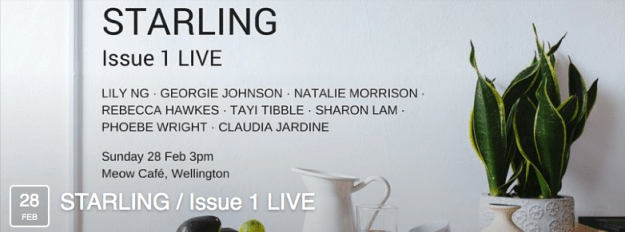
Starling goes live at Wellington’s Meow Cafe

Screen shot 2016-02-09 at 12.41.14 PM


STARLING: A new online literary journal publishing poetry and prose by New Zealand writers under 25 years old. Founded by Louise Wallace & co-edited with Francis Cooke.

ISSUE 1 LIVE: Eight incredible young writers from our first issue will take to the stage to read their work:

Lily Ng / Georgie Johnson / Natalie Morrison / Rebecca Hawkes / Tayi Tibble / Sharon Lam / Phoebe Wright / Claudia Jardine

Come along to celebrate the arrival of Starling at this relaxed all-ages, free event. Bring your mates or bring your kids! Soak up some inspiration for the afternoon. Meow’s delicious coffee and food available for purchase, as well as beer and wine for those 18 and over if it happens to be one of those stellar sunny days Wellington is famous for.

Starling: Showcasing New Zealand’s Best Young Writers – to be edited by Louise Wallace & Marty Smith

Starling takes flight

Showcasing New Zealand’s Best Young Writers

A new opportunity for young writers has emerged today. Starling (www.starlingmag.com) is an online literary journal that will be published twice yearly, accepting poetry and prose from only New Zealanders under 25 years of age.

The founder and editor is poet, Louise Wallace, author of two collections of poetry and the current Robert Burns Fellow at the University of Otago. The journal will be an opportunity for young writers to showcase their work in a professional environment to a national audience. “There is nothing quite like this out there at the moment in New Zealand – certainly not with the national focus we hope to cultivate,” Wallace says. “It can be difficult for young writers to find publication with our more established print journals when they are competing for space with writers who have twenty or thirty or forty year’s experience. Starling levels the playing field.”

Wallace is keen to convey that the quality of the work will still be there. “Just because a writer is under a certain age, does not mean the quality of the work is any less. The journal has a high standard for acceptance and we are committed to presenting our contributors and their work seriously – in that way the submissions we receive and the writing we publish will be the best of the best.”

Starling is also focused on a community approach. Each issue of the journal will open with new work from an established New Zealand writer and will close with an interview with a person of note from the literary industry. Wallace says there are a few things that are crucial to the journal’s success. “The first is obviously getting young writers to submit. But we also need support from readers. We have a selection of posters available on our website that people can download and put up out in the real world to encourage submissions, and the website also allows supporters to sign up for email updates. Without these people taking that extra step, there will be no community.”

Submissions are now open for Issue 1, with a deadline of 20 October 2015, the issue to be published January 2016.

Wallace is joined by Co-editor, Francis Cooke, and Schools Coordinator, Marty Smith, who like Wallace, are graduates of the International Institute of Modern Letters MA programme. Cooke’s short stories have been published in a number of national journals, and Smith’s first collection of poems, Horse with Hat, won the Jesse Mackay Award for Best First Book of Poetry at the 2014 NZ Post Book awards, and was a finalist in the poetry category. Smith is also a high school teacher, and will work with Wallace to deliver the journal as a resource for New Zealand teachers in the classroom.

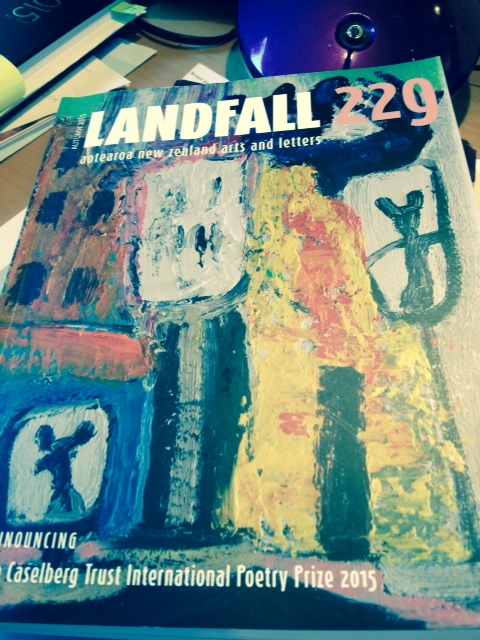
Ten things to love about Landfall 229

photo


Shortly after Sport arrives in my box, I get a bright new issue of Landfall. My little list below maps my ‘loves’ so far — like little ‘like’ ‘share’ ‘favourite’ or ‘retweet’ buttons. Editors might compile a journal with an arc of contours (aural, thematic, emotional pitch, genre, experimentation, quietness and so on) as I have always done with an anthology so you move through shifting readerly experiences from start to finish. However, I never read a journal like this.  It’s dip and delve.

1. Straight to the review section to books I have missed, and books I have reviewed. Ha! I Have missed (all meanings intended) reading Ian Wedde’s The Grass Catcher: A digression about home (Victoria University Press). Martin Edmond’s scintillating review meditates on the implications of writing the past alongside his critique of Ian’s illuminations of his own. ‘Home’ was a key notion that came under scrutiny within my doctoral thesis and within the context of Italian women writing novels in the twentieth century. It still fascinates me. This review has sent me scuttling to buy the book. In particular: ‘This is not one of those writer’s memoirs that says: here is how I became the resplendent creature I am today. It is too multi-faceted, too in love with the world, you might say, to serve such a purpose.’

2. Rata Gordon’s poem  ‘Tinkering’ is like an electric train on electric tracks. You get to the end and you want to travel that route again. Wow!

3. Discovering Michael Harlow picked  Sue Wootton’s poem, ‘Luthier,’ as the winning entry in The Caselberg Trust International Poetry Prize (2015). This poem is sumptuous in detail and that detail evokes mood, music, character, place in a transcendental kind of way. I would love to hear this poem read aloud to hear the poet lift and connect and pause, the hit of certain words on the line (flitch, slink, Sitka, bedrock). Sue demonstrates the way a poem can take a small moment/thought/action/thing and then open out intimately for the reader. A word that comes to mind and that is so overused when speaking poetry is luminous. But this poem is utterly and breathtakingly luminous.

4. Discovering Christina Conrad still writes poems.

5. Short poems can be very very good. So much happens in the white space that holds them This is the case with Louise Wallace’s ‘Mirage/Arizona.’

6. Tina Makeriti’s essay, ‘This Compulsion in Us.’ Strikes a chord because I am fascinated by museums too; enthralled by the things that stick to the objects that only you can see or hear or feel. Loved Tina’s exploration of a museum’s paradox, in that it preserves treasures yet ‘also captures and immobilises things that make sense only in motion, that should breathe and transform.’

7. Runner-up in The Caselberg Trust International Poetry Prize (2015), the opening lines in Jessica le Bas’s ‘Four Photographs from a Window’ : ‘The first is a shot in the dark/ buttoned up and black suited’

8. An Elizabeth Smither short story that underlines what an exquisite hand she has when it comes to fiction (‘The Trees’).

9. The way Sue Reidy’s poem, ‘The primitive,’ became etched on my skin.

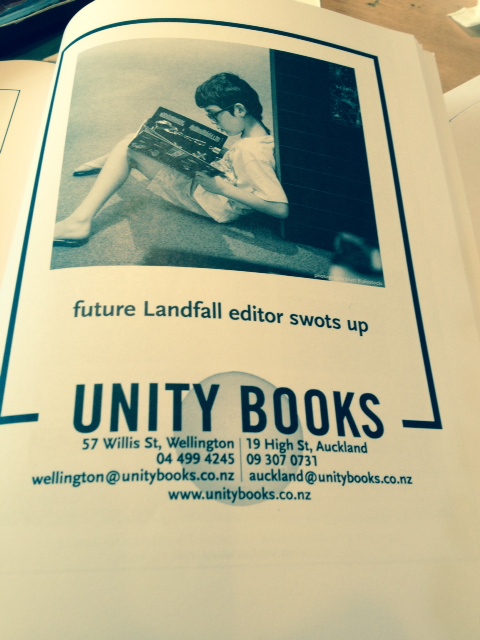
10. Lots more delights but I have to mention the Unity-Books, standout ad. A child reading a book, thank you!

photo


The winner of Lousie Wallace’s Enough, thanks to VUP

enough_front__19529.1371430013.140.215   enough_front__19529.1371430013.140.215   enough_front__19529.1371430013.140.215   enough_front__19529.1371430013.140.215

Thanks to Victoria University Press, Poetry Shelf has randomly selected Emma Neale to receive the giveaway copy of Lousie Wallace’s Enough.

For my review see here.

More giveaway copies of new NZ poetry books coming up in next few weeks as I post reviews.

Louise Wallace’s Enough: Wherever you look there is energy

Louise Wallace (Rory Mearns 2013)

Louise Wallace’s debut poetry collection, Since June, was a delight. In my Herald review I saw it as ‘a satisfying mix of economy, elegance, strangeness, lightness, boldness and different personae.’  Louise was awarded the Briggs Prize in 2008 at The International Institute of Modern Letters. Since then her poems have been published in New Zealand (including The Best of Best New Zealand Poems), Australia and Germany. She has taught Creative Writing at Massey University and the Nelson Marlborough Institute of Technology for the past five years.
enough_front__19529.1371430013.140.215  enough_front__19529.1371430013.140.215  enough_front__19529.1371430013.140.215  enough_front__19529.1371430013.140.215

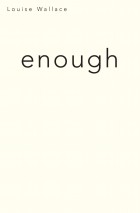
Victoria University Press has just released Louise’s second book of poems, Enough. This new collection reflects the geographical movement of the poet (she was raised in Gisborne, recently spent three years in Nelson and has returned to Wellington). It is a terrific follow-on in both scope and sensibility. Her poems have points of origin in diverse places — from the random-article function in Wikipedia (thus poems on Cooper County, Missouri, Breakfast Television, Whaling in the Faroe Islands to name a few) to Lynn Davidson’s lines in a collaborative artwork to Dorothy in Emily Perkin’s The Forrests. Such a vivacious mix of subject matter adds texture to poems that are light footed and sure. Again, Louise finds little kinks in reality, in experience and in anecdote to produce a collection that surprises and takes risks, but that also relishes large patches of calm and ordinariness.

The title itself stalls you. ‘Enough.’ Enough what. Enough how. The word twitches and trembles in its multiplicity of meaning, from the hand raised to stay stop, to the arms outstretched that signal plenty, to (as the title poem itself suggests) the fearsome possibility that nothing is ever enough. Placing that particular  title on the cover of the book, also whispers (oh so quietly) that to write poems is sometimes –provisionally and momentarily– enough (in the face of all other meanings). Perhaps reading and writing poetry can make the world, for an hour or an afternoon, more bearable.

I don’t see this collection as trying to fit or suit poetic trends. It is a collection written out of shifting movement, out of hurt and honesty and love. Alongside a mind inventing and imagining, this is a poet engaged with ‘the gestation of a second difficult book.’ The traces of living are hot spots. One poem, ‘Getting things done,’ is like a secret, narrative undercurrent throughout the book. The narrator moves, the narrator arrives, the narrator unpacks, the narrator gets things done. Having listed the visible signs of ‘doing’ the narrator climbs in a box with her cup of tea and ‘starts’: ‘She shuts the curtains on the outside world/ even though it’s very nice weather/ and there are sounds of children playing/ and then screaming and then she starts.’

This poem reverberated for me on so many levels. The little mantra ‘I will get things done‘ was followed by the isolated last line ‘she writes.’ The poem is testimony to the stamina required by women to maintain the domestic sphere and then to make space for themselves (to do, if not to be). Making the box is making room in the head, away from domestic routine, the clutter and the demands to a moment of stillness and quiet. Making the box is also making the poem. The poet can climb into the poem with her blocked ears and her inky pen. The acute register of the final line is in the way the two words echo and rebound in the cavity of history — in the way women have always had to make a box (a room, a space, a moment) from which and in which to write (Louise’s first collection poignantly acknowledged the women who had preceded her). This simple poem opens out into marvelousness.

Louise’s poems can sidestep out of doubt and anxiety with such poetic agility the dark feeling exposes something completely other – a quirky image, a surprising ending, humour, startling detail. In ‘In the end,’ the detail of the head being stoked opens a new view of the grandmother, and it is very moving.

You fall upon juxtapositions that add to the humour, anecdote or heart of the poem. In ‘A hand’ an old woman refuses the narrator’s help, so the latter imagines herself (bitterly at first) as an old woman and then laughs: ‘The round of my head/ against the car park grey.’ I love the way ‘grey’ is the miniature prefigurement of old age and grey hair. In ‘Well how would you be about it’ someone watches the meals on wheels being buried in the garden: ‘Her neighbour watches and reports back — / the no-good little tell-tale tit.’ Or the delicious leap from ‘a grisly stew’ of worry to a hat made of peacock’s feathers in ‘The feathered hat.’

The structure of Louise’s collection works beautifully, with its movement from prose poem to poem to little poem to bite-size poem and hither and thither. Wherever you look there is energy — whether in the plainness, the heart, the anecdotal swivels, the hesitations, the repetitions or the idiosyncratic detail. This is a poetry collection to savour.

Thanks to Victoria University Press I have a copy of Enough to give away to someone who comments on this post by Thursday 31st October.

Victoria University Press page

New Zealand Book Council page

Interview with Louise Wallace on Radio NZ

Review of Since June in the Otago Daily Times

Poems in Snorkel

Best New Zealand Poems page