Tag Archives: Elizabeth Smither

#awf16 Going to the Sarah Broom Award


(excuse my photos but I have managed an eerie poetry light on everyone!)
IMG_3461

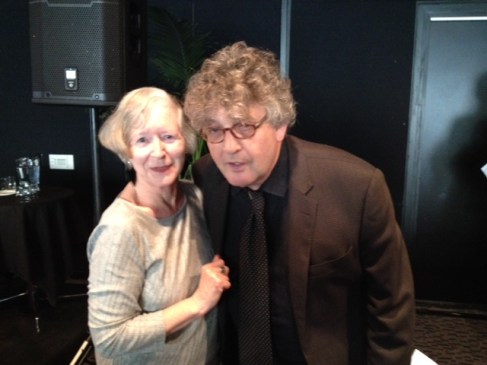
Going to the Sarah Broom Award is always a sad-glad occasion for me as I get to remember a wonderful poet and to celebrate the vitality of New Zealand poetry.

This year was no exception. The award is a gift from Sarah’s husband, Michael Gleissner. His dedicated drive to support NZ poetry offers an award for a poet at any stage of their career. For the past two occasions, an overseas judge has selected the shortlist and winner. This year, acclaimed Irish poet, Paul Muldoon, was judge. He had no idea who wrote the poems and insisted on reading all the entries (over 250) because he wanted to find the entries that ‘judge you, that read you and impress themselves upon you.’


Paul’s short list: Airini Beautrais, Elizabeth Smither and Amanda Hunt

Paul began with a moving tribute to Sarah, Sarah’s family and her poetry. He read her poem (among others) ‘Holding the Line’ and said: ‘We’re all trying to hold the line of poetry which seems a little perilous, but that’s what we’re all trying to do.’

Each poet read a handful of poems.
 

IMG_3452

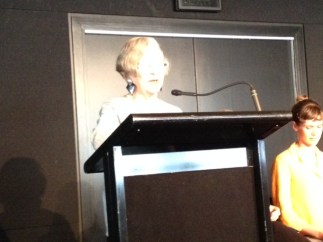
The winner, Elizabeth Smither read the poem about her mother that she read at the Laureate Circle event in Wellington. Kate Camp and I were in a frenzy to read it again. Elizabeth so kindly gave Kate her copy and signed it and emailed me one. It is the kind of a poem that has built a room of its own in my head. The sort of poem that rises and pierces your heart with the acute depiction of a moment. Elizabeth is outside in her car in the street seeing her mother move through her house without realising her daughter is watching. Elizabeth followed it with a poem, ‘The name in the fridge’ that made me laugh out loud. She and friend had put the name of someone they wished ill of in the freezer but nothing bad happened (see poem below). As Paul said, Elizabeth has the skill to blend humour with seriousness. Yes, her poems can handle that and so much more. The stillness, insight and deep connection to humanity makes Elizabeth a poet writing at her very best.

Elizabeth is a former NZ Poet Laureate, has published numerous poetry collections that have garnered awards and high praise, along with short stories and novels. She lives in New Plymouth.


The name in the fridge

Someone we both disliked: you wrote

his name on a slip of paper

folded it, and inserted it in the freezer


under a tray of ice cubes, next to

a frozen chicken, frozen vegetables

a casserole sectioned into cartons.


You’d read about it. Nothing too serious

would happen. Perhaps he’d lose his job

or his dog would need taking to the vet.


The dog would recover, the bill be huge.

His wife might flirt with someone at a party

and be noticed: notice was a big part of it.


When nothing happened after six months:

his dog had puppies, he got promoted

we took out the paper, ice-encrusted


and brushed it against our jerseys. Soft

powder fell into the sink. You said

you’d take it with you when you went to England


as if it would be more potent there.

A huge fridge near an Aga

stuffed with grouse and pheasants and wild boar.


©Elizabeth Smither
 

IMG_3456


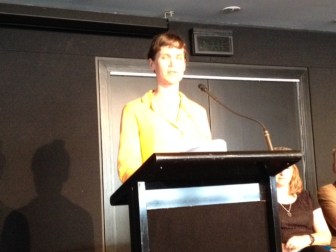
Airini Beautrais read from a sequence of poems that forge links with the Whanganui River. As a poet she bends the line and then makes it glow with luminous detail so that as you listen to the contours of voice you are both skimming the slopes of  every day living and doing little side jumps to out-of-the-everyday. It all comes down to voice. To human beings finding their way in different circumstances. As I listened I felt like I want to read the river, to read the whole sequence, and follow people as much as river currents.

Airini has published three collections of poetry and is a graduate of IIML. Her most recent collection, Dear Neil Roberts, was longlisted for the Ockham NZ Book Awards in the Poetry Category. Like Amanda she studied ecological science at university. Her debut collection was named Best First Book of Poetry at the Montana NZ Book Awards 2007. She lives in Whanganui.

Airini acknowledged the significance of  Sarah’s poetry: ‘As a mother and writer I find Sarah’s poetry particularly moving, and also inspirational. I am inspired by her bravery and strength. She has left us an important legacy.’


Observatory


Kids, who wants to look up through the telescope?

This is the largest unmodified refractor telescope in use

in New Zealand. Birthday girl, you first. I hope

you’ll see a planet up there, with rings. That might come loose

if you fiddle with it, be careful. It looks like smoke?

That would be a cloud. Is that really a planet? Yes.

Nah, I stuck a picture up on the end. That was a joke.

Could an asteroid destroy humanity? Well, I guess

there’s a chance. No object we know of threatens us any time soon.

Is there life like ours, out there? Keep looking up, wave a little.

Parents, bring your kids back one Friday night, maybe the moon

will be visible. Who hasn’t had a turn yet? Look there, and it’ll

be right in the middle. Ha, that’s what everyone says. You know how

they called this planet Saturn? They really should have named it Oh wow.

©Airini Beautrais
 

IMG_3453


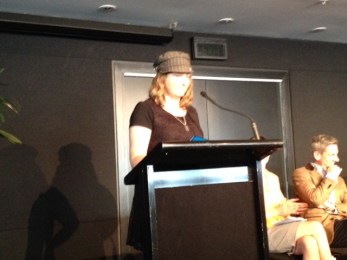
Amanda Hunt read a bunch of native bird poems that were glorious renditions of birds but offered so much more in terms of life and living. Like Elizabeth she had the ability to make us laugh and pause. There was the joy of hearing a poet for the first time that you know absolutely nothing about and have no idea what effect her poems will have on you. I loved the static between visual detail and people doing things.

Amanda is a poet and ecologist based in Rotorua and, while she has been writing poems for awhile, is beginning to seek increased publishing opportunities. She studied medicine and environmental science at the University of Auckland. She has worked in environmental and resource management throughout New Zealand and Australia, but returned to her home town a few years ago.

Amanda said that she ‘felt the award helps to keep Sarah’s amazing work very much alive and it was a real honour to be reading at this event in her name.’


Overture

He says

the grey warbler sounds

like the beginning of a Bizet aria


a small pale bird

ruffling its feathers

inside a red dress

one wing outstretched

as its sings the same song

over and over


all our birds have

funny names and

our voices are strange so

he has to ask us to repeat

what we say

over and over


the cold is on the border

of being worth dressing for

he came without gloves

it’s still winter and the

wind blitzes us from the south


but in the morning he’s not sure

if it’s snow he sees on the hills or

the sun in his eyes


we drive on the wrong side of the road

there are no newspapers in his language

and he still wakes late with jet lag


and yet

every morning

in the kowhai tree behind his house

the first notes of a song

he already knows.

©Amanda Hunt
 

IMG_3459

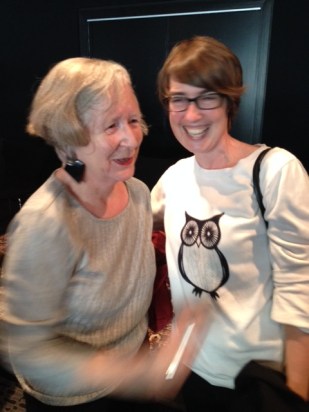
(Elizabeth with her AUP editor, Anna Hodge)

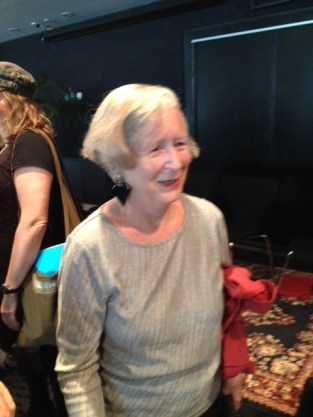
When Elizabeth was announced as winner she was a little shocked (I do think the finalists could be told back stage so they don’t have to sit on stage for an hour, with the the sizable store of nerves that build when you are about to read in public). She searched in her bag for a piece of paper while Paul supplied her with another poem to read.

I thought her thank-you speech was very moving. She said, ‘It feels like having your first poem accepted again. The chase is always on the for the next poem that might be better though it is always moving out of reach.’

Elizabeth was reminded of her short story where a young girl, notebook in arm, struggled to be a writer in Paris. Elizabeth had included this quote from Mavis Gallant in her story: ‘She was sustained by the French refusal to accept poverty as a sign of failure in an artist.’

Elizabeth said that poets would be familiar with this and ‘That is why the Sarah Broom Award is so marvelous. Sarah and Michael have exactly understood the position, the amount is perfect, the conditions are wonderful.’

Like Airini and Amanda, she paid moving tribute to Sarah’s poems: ‘I heard that a whole new cluster of planets has just been discovered. That’s how I think of Sarah’s poems: flying through space, serene and beautiful, wrought from tragedy and beauty.’

Elizabeth also thanked the audience! She made us feel that as readers we matter: ‘And I want to thank the audience for being present. Poetry could not survive without you. The girl in the French cafe was counting on that: if she could write something, someone would read it and she then would be a writer.’

Thanks to AWF for hosting this event.

Thanks for a terrific occasion Michael. Three very special writers. One very special award.
IMG_3458

cp-gleam.jpgcp-tigers-at-awhitu.jpg

A Circle of Laureates, a galaxy of poetry

This event prompted me to hunt for cheap fares to Wellington because it seemed like a rare and special poetry occasion. And it was! A sold-out event!

The National Library, as current administrator of the NZ Poet Laureate awards, hosted the evening as part of Wellington Writers Week.  John Buck from Te Mata Wines instigated the Laureateship in 1997, with Bill Manhire taking the debut spot. John was there with wine to share. He still retains an involvement.

Fergus Barrowman from VUP was the MC. He made the important point that the award is ‘an activist portfolio not just an honour.’ The earliest debut publication by a Laureate was in 1964 while the most recent debut was 1988.  Three generations of poets! Cilla McQueen and Michele Leggott calculated over 700 years of life/poetry experience across the ten laureates to date.

Bill Manhire (1997) spoke about what the Laureateship meant to him and the two ways it expanded his sense of what he might do as a poet, as a public figure. Firstly he began to write poems with some kind of public dimension. Secondly he explored the way the role centred on the promotion of poetry. He wanted to ‘talk it up.’ Both are options we can be thankful for. Bill’s poems that stand on a public stage are poems that embrace the knots and crests of humanity. I talked about the way ‘Hotel Emergencies’ does this on Summer Noelle in January.

Bill read ‘Erebus Voices’ and I sat there thinking this is a poem that belongs in the world and can be heard again. And again. And then again. Because it both moves and matters. Bill shows so adeptly the way poems can shift us to laughter, to wry grins at the surprise of it all, but also lead to far more unfathomable movements of the heart.

‘I am here beside my brother, terror./ I am the place of human error.’

I especially loved the way he started with the poem of a fellow poet. He ‘talked her poem up,’ and I fell in love with it all over again: Rachel Bush’s ‘The Strong Mothers.’


Hone Tuwhare was represented by his son Rob. We listened to Hone read ‘No Ordinary Sun,’ we listened to Rob read Hone and then Rob picked up his guitar and sang a Graham Brazier version of one of the poems. A version of friendship. Quiet, haunting, utterly melodic. This was love. Hairs standing on your arm on end from start to finish in the Tuwhare bracket.

‘Oh tree/ in the shadowless mountains/ the white plains and/ the drab sea floor/ your end is at last written.’


Elizabeth Smither read a cross section of poems that delighted the audience. But one as-yet-unpublished poem in particular stuck to me. Kate Camp, her mum and I – all went ‘wow.’ I adored the story of Elizabeth seeing her mother move through her house, the windows bright, unaware of the daughter driving by. By the time I got to congratulate her, dear Elizabeth had already signed her copy for Kate. How lovely! Like a bouquet of flowers. Elizabeth emailed the poem so I can read and write about it for my book.

‘It was all those unseen moments we do not see/ the best of a mother/ competent and gracious in her solitude’


Brian Turner with his delicious wit said: ‘I’ve been called a political animal many times and it’s not always a compliment!’ And that is what makes his poems so enduring. The way he hits the right pitch of land and sky but with a deep love that is unafraid to match beauty with issues. He read a cluster of short poems where every word sang. Gee whizz this was good. Here are few lines I loved without the line breaks (sorry):

‘and the shadows are mauve birthmarks on the hills’

‘If the sky knew half of what we were doing down here it would be inconsolable and we would have nothing but rain’

‘where a river sings, a river always sang’

See what I mean!


Jenny Bornholdt

Jenny rued the way Wellington Writers Week has dropped ‘readers’ from the title. She said she would reclaim readers, in the perfect setting (the library), with a longish poem: ‘A long way from home.’ This was a highlight for me. The poem is all about illness and reading; the ability to read and a time when it flees. Here are some sample lines:

‘How as a child, books were the lens// through which I eyed the muddy track to adulthood’

‘For six weeks now I’ve been outside weather/ and of reading. Outside of myself.’

‘I have tried to read but nothing/ sticks. That anchor of my life has been raised and// I’m all at sea.’


Michele Leggott, like Bill, brings poetry to a a public arena through her tireless promotion and expansive love. Michele read an extract from a long work (‘The Fasciclies’) that bridges Taranaki and Lyttelton, the 1860s and the 1970s, and the connections between two women.

My notebook is full of Persian-like doodles of birds and shapes interspersed with notes but, as I listened to Michele, my pen stalled. I felt like I could hear Robin Hyde with her luminous detail and observations in the seams. For this was luminous writing. There is a bridge between reader and poem. Sometimes you cross it. Sometimes it seems impassable. I just wanted to cross the bridge and read the whole poem.

You can find the whole piece here.


Cilla McQueen read ‘Ripples’ a long poem that showcases her strengths as a writer. It is in her latest collection, The Radio Room (2010). Another highlight. Other poets make an appearance, Joanna and Hone. Moving. Uplifting in a way.

‘After the funeral service you leaned down towards me out of a cloud;/  “Kia mau!” you shouted into my mind.’

Cilla McQueen’s memoir is due next week from Otago University Press.


Ian Wedde also has a childhood memoir out, The Grass Catcher, which is on my must-read list. Ian’s poetry produces my ideal poetry trifecta of relations: music, ideas, heart. Oh! And singing its way through, a sense of story. He read from ‘The Life Guard.’ Ha! It’s all here. Listen to the start:

‘You have to start somewhere/ in those morose times,/ / a clearing in the forest say,/ filled with golden shafts of sunlight// and skirmishes’


Vincent O’Sullivan has a new book out from VUP, which I am about to review for a newspaper, so perfect to hear him read his poetic contours. He has the ability to refresh anything. To tilt tropes, to enhance the music of a line, to poke you with an idea, to make you feel. Once again I got caught up in the moment of listening and didn’t catch lines in my notebook.


Ck Stead is the current Poet Laureate. He began with a poem about Allen Curnow, who he felt would have been Laureate if he had lived within the Laureate time span. Karl had struggled over whether to read a top-hit kind of poem or read new things. I know that feeling and first thought I would only ever read a poem once in public when first published. That soon fell by the wayside.

It was a moment of audience empathy as Karl confessed he thought he would read it, then wouldn’t, then finally after hearing Bill, decided he would. And we were glad, indeed, as he read an elegy for his mother. Utterly moving.

Poetry is such a love for Karl. He made this clear when I was filming his ‘thank you’ speech for the Sarah Broom Poetry Award. And hearing him read on this occasion, lifted the poems off the pages where I have loved them, to a new life in the air/ear.

from ‘Elegy’ but without that scattered layout that makes much of white space (sorry):

‘She’s there somewhere/ the ferryman/ assures me.// He tells me/ she was reluctant to go/ but silent – // stood in the prow/ no tears/ and never looked back.’

Karl filled the room with the warmth of poetry. Music. Heart. Ideas. A perfect end.


The tokotoko table, with all the talking sticks carved especially for each poet, was like a quilt with stories. I wished someone had held up the mother tokotoko for all to see and told that story. And indeed held up each tokotoko, for each tokotoko has its own.

Karl will get his at the Matahiwi ceremony in April. I am honoured to be part of this occasion along with Gregory O’Brien and Chris Price.


A Circle of Laureates was a magnificent occasion. I bumped into Elizabeth Knox the next day and we were both enthusing about how good it was. Peter Ireland from the National Library had put in all the hard work! Kindly acknowledged on the night by Ian. Every poet held my attention. There is a big age range here, but to me, it is a way of honouring our poetry elders.

As a poet, I write with one foot in the past and one foot in the future.I want to know who I’m writing out of. This is my tradition. This is my innovation. This circle.

It reminded me of Selina Tusitala Marsh’s’s poem ‘A Circle of Stones in her debut collection where she honours the women she writes from, towards and beside.

Thank you to everyone who made this event possible. It was worth my spur-of-the-moment cheap flight, my accidental data blow out, my misbooking home that meant a new booking, the chance to hear the Lauris-Edmond finalists, and losing myself in Jessie Mackay in The Alexander Turnbull Library.  Thirty-six hours of poetry. Heaven.

Thanks! Ten Poets Laureate to celebrate!


Poetry Highlights at Wellington’s Writer’s Week in March

For the full programme see here but this is the poetry on offer.


I would love to go to the Laureate Circle but can’t make it at this stage (might just fly down on a whim!). I would really like to post pieces on any of the poetry events at the festival. Any takers?


Friday March 11th 7pm  A Circle of Laureates

Screen shot 2016-01-30 at 9.48.49 AM


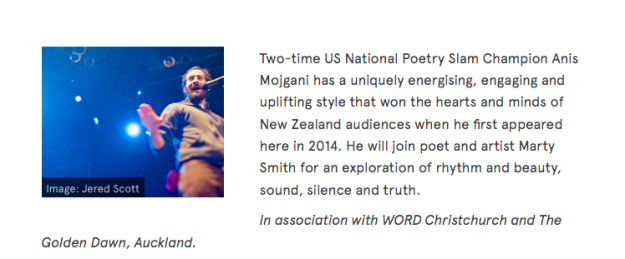
Friday March 11th 5pm   Anis Mojgani and Marty Smith

Screen shot 2016-01-30 at 9.55.17 AM


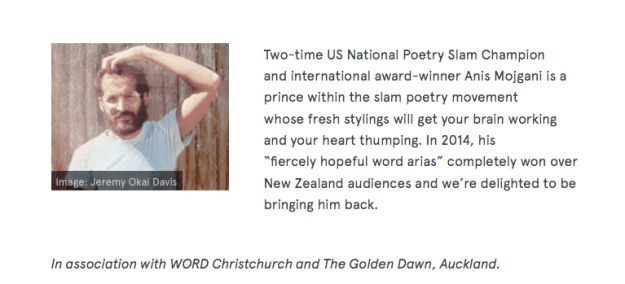
Thursday March 10th 1.45pm Anis Mojgani

Screen shot 2016-01-30 at 9.57.28 AM


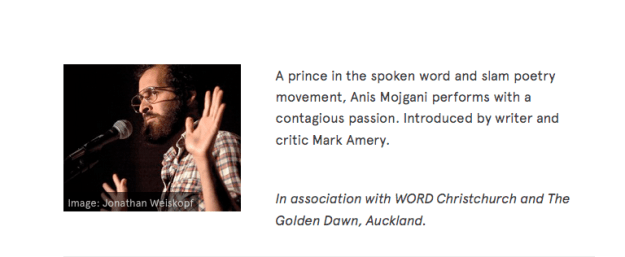
Sunday 13th March 2.30 pm  Anis Mojgani with Mark Amery

Screen shot 2016-01-30 at 9.59.20 AM


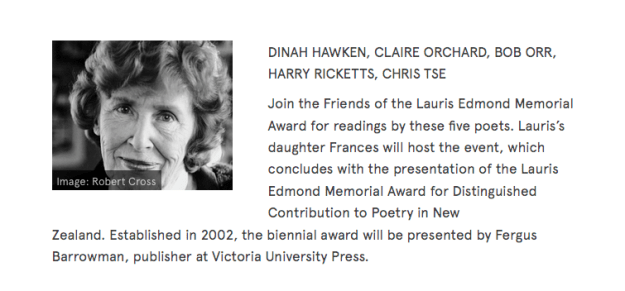
Saturday 12th March 3.30 pm Five Poets and a Prize


Screen shot 2016-01-30 at 10.00.52 AM

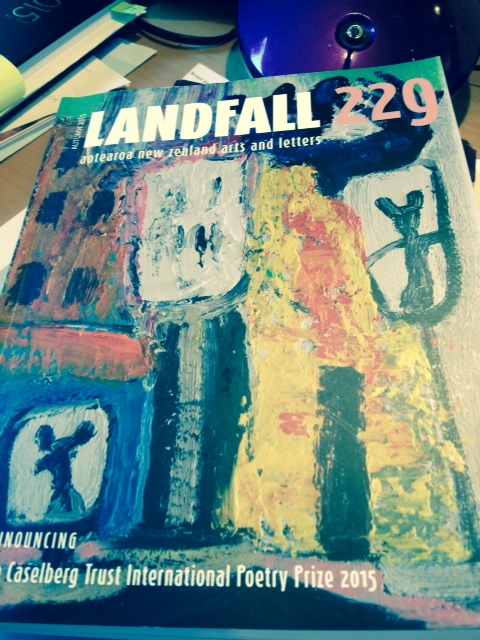
Ten things to love about Landfall 229

photo


Shortly after Sport arrives in my box, I get a bright new issue of Landfall. My little list below maps my ‘loves’ so far — like little ‘like’ ‘share’ ‘favourite’ or ‘retweet’ buttons. Editors might compile a journal with an arc of contours (aural, thematic, emotional pitch, genre, experimentation, quietness and so on) as I have always done with an anthology so you move through shifting readerly experiences from start to finish. However, I never read a journal like this.  It’s dip and delve.

1. Straight to the review section to books I have missed, and books I have reviewed. Ha! I Have missed (all meanings intended) reading Ian Wedde’s The Grass Catcher: A digression about home (Victoria University Press). Martin Edmond’s scintillating review meditates on the implications of writing the past alongside his critique of Ian’s illuminations of his own. ‘Home’ was a key notion that came under scrutiny within my doctoral thesis and within the context of Italian women writing novels in the twentieth century. It still fascinates me. This review has sent me scuttling to buy the book. In particular: ‘This is not one of those writer’s memoirs that says: here is how I became the resplendent creature I am today. It is too multi-faceted, too in love with the world, you might say, to serve such a purpose.’

2. Rata Gordon’s poem  ‘Tinkering’ is like an electric train on electric tracks. You get to the end and you want to travel that route again. Wow!

3. Discovering Michael Harlow picked  Sue Wootton’s poem, ‘Luthier,’ as the winning entry in The Caselberg Trust International Poetry Prize (2015). This poem is sumptuous in detail and that detail evokes mood, music, character, place in a transcendental kind of way. I would love to hear this poem read aloud to hear the poet lift and connect and pause, the hit of certain words on the line (flitch, slink, Sitka, bedrock). Sue demonstrates the way a poem can take a small moment/thought/action/thing and then open out intimately for the reader. A word that comes to mind and that is so overused when speaking poetry is luminous. But this poem is utterly and breathtakingly luminous.

4. Discovering Christina Conrad still writes poems.

5. Short poems can be very very good. So much happens in the white space that holds them This is the case with Louise Wallace’s ‘Mirage/Arizona.’

6. Tina Makeriti’s essay, ‘This Compulsion in Us.’ Strikes a chord because I am fascinated by museums too; enthralled by the things that stick to the objects that only you can see or hear or feel. Loved Tina’s exploration of a museum’s paradox, in that it preserves treasures yet ‘also captures and immobilises things that make sense only in motion, that should breathe and transform.’

7. Runner-up in The Caselberg Trust International Poetry Prize (2015), the opening lines in Jessica le Bas’s ‘Four Photographs from a Window’ : ‘The first is a shot in the dark/ buttoned up and black suited’

8. An Elizabeth Smither short story that underlines what an exquisite hand she has when it comes to fiction (‘The Trees’).

9. The way Sue Reidy’s poem, ‘The primitive,’ became etched on my skin.

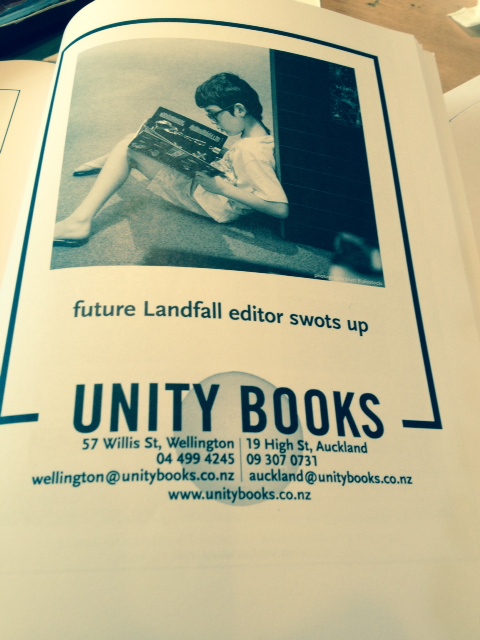
10. Lots more delights but I have to mention the Unity-Books, standout ad. A child reading a book, thank you!

photo


Congratulations to Elizabeth Smither – Winner of the NZSA Janet Frame Memorial Award for Literature 2014

IMG_6152 9780473268305 cover

Congratulations to Elizabeth Smither

Winner of the NZSA Janet Frame Memorial Award for Literature 2014

New Plymouth-based poet Elizabeth Smither emerged as the winner from a competitive shortlist to be awarded the 2014 Janet Frame Memorial Award for Literature. This biennial award for $3,000 is offered by the NZSA to support a mid-career writer of literary or imaginative fiction, or poetry. This money comes from a gift generously provided by The Janet Frame Literary Trust.
The judging panel stated that they were ‘impressed by the calibre of the applicants and most gratified with their overall quality, feeling it important that the award bearing Janet Frame’s name should continue to gather prestige, with many of New Zealand’s more distinguished writers vying for this accolade.’


Highly Commended places go to: Cilla McQueen, Laurence Fearnley, Vivienne Plumb, Tina Shaw, and Siobhan Harvey

Elizabeth Smither’s Ruby Duby Du deserves to be under the pillow of every new mother and father

IMG_6152

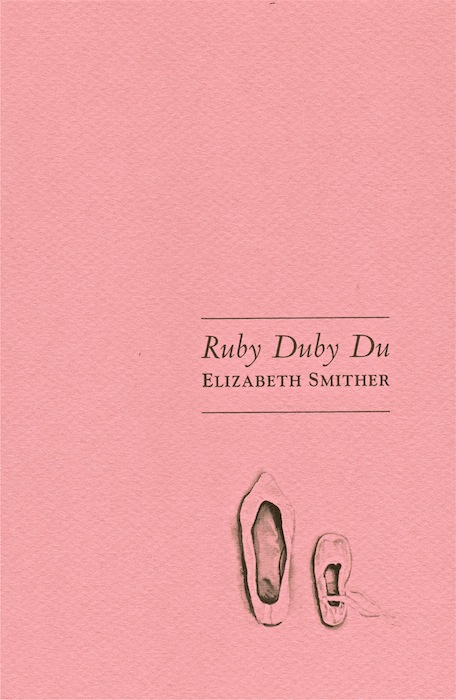
Elizabeth Smither, Ruby Duby Du, Cold Hub Press, 2013

Elizabeth Smither is an award-wining poet and novelist. She was named New Zealand Poet Laureate in 2002 and was awarded the Prime Minister’s Award for Literary Achievement in Poetry in 2008. On the back of her new book, Ruby Duby Du, Elizabeth says, ‘None of these compares to being a grandmother.’

9780473268305 cover 9780473268305 cover 9780473268305 cover

This delightful book signals the burgeoning output of small presses –- handcrafted books with smallish print runs, scope for new poets to emerge, and established poets to publish miniature gems or take sidestepping risks. Elizabeth’s book, published by Dunedin’s Cold Hub Press, is a gold nugget of a book and deserves to be under the pillow of every new mother and father, and in the gift box of every newborn child. It is an utter delight from curling fingertip to wriggling toe.

The new collection, with delicate illustrations by artist Kathryn Madill, is a book of poems dedicated to Ruby (born 2011) from her grandmother, Elizabeth. It begins with the announcement of a pregnancy, and ends with Ruby in her father’s arms and the counting of stars. Love is both the movement and the anchor that holds Elizabeth’s poetry in warm embrace. These poems are intimate, personal and captivatingly real.

I was taken back, convincingly, mesmerisingly to the birth of my daughters — to a time when the world moves into acute and breathtaking focus (as though you have a new pair of glasses). To a time when certain things matter so much less and fade into pale.

Each poem resonates with a particular moment — measuring Ruby in the womb (‘the height of a tall vase/ a blue iris’); cleaning windows for Ruby’s visit (‘Your grandmother/ had clean windows for her first granddaughter/ and everything glowed from then’).

There is tenderness and charm, but there is also wit running through the veins of these poems — the cheekiness of the grandmother along with the deep love. In ‘The grandparents intervene’ (a terrific poem!) the grandparents await news of the birth in their separate houses (‘In two separate houses broken sleep/ and then you broke into the world, Ruby’). The poem ends on the two clocks (his ‘from a ship’ and hers ‘from a shop that sold antiques’). The clock is resonant of time to come and time past but is also enriched by these divergent origins.

Elizabeth’s wit is sparkling in ‘Ruby and the mock-rivalry.’ The baby (that can’t yet speak) tells the grandfather she wants to captain an ocean liner. The grandmother knows the only reason Ruby might want to go to sea is ‘to write a book in which case/ the breath of the sea might come in handy.’

More than anything, these poems are songs to Ruby. Elizabeth has drawn upon her craft as a poet, found the music in a line, the detail that you want to hold onto and share (let’s take a photograph and preserve this moment), the way the movement in a new life can generate delicious movement in a poem (what poem can survive without this). There is thought (the way some occurrences can be slipped through a philosophical filter) and there is heart (the way some things are steered by gut and intuition, along with love).

In ‘Ruby and the vegetable rockery,’ Elizabeth aligns silver beet and Ruby (‘Though they are unacquainted at present/ each is pulling itself up by the roots’). I have never read a poem where a baby and silver beet are poetic companions, but Elizabeth’s collection is full of surprises. The poem, like the book as a whole, is layered like the vegetable rockery – the poet has planted herself and Ruby in every nook and cranny, and you will brush against the sheer joy of new life. Elizabeth shows that poetry can put the world (in this case, Ruby) in loving focus. It is a gift to read. It is a gift to share!


New Zealand Book Council author page

University of Auckland author file

Auckland University Press author page

Hamesh Wyatt review of The Blue Coat

Caitlin Sinclair review of The Blue Coat

On Poetry: Elizabeth Smither is the witness of a mystery

Elizabeth Smither has contributed this piece as the first in an occasional series (On Poetry) from New Zealand writers. Elizabeth has written numerous collections of poetry, the most recent of which, The Blue Coat, I have just reviewed in the Herald. This collection shows Elizabeth at her very best — in the way she opens little doors onto tiny corners of the world and in the way she makes those corners hum and shimmer and shine. Elizabeth’s poems reflect craft, attention and an infectious engagement with the world. These skills are also at work in her fiction writing. I was particularly taken with her novel, Lola.

Night horse…. how a poem comes into being

My daughter-in-law, Kate has brought her horse, Alice, from Melbourne. Alice, who in Melbourne was stabled with other horses, made the solo journey with great nonchalance. The sea did not trouble her, the stable where she was quarantined, the new field where she was on her own with a glimpse of cows in the distance. The strangers bringing her carrots.

But one night when I had been visiting and was turning my car to drive home I saw a secret Alice. A mist was rising from the grass and Alice in her crusader’s coat with its hem that flared out like the stiffened band of a dress was moving in it. The car lights lit her for a moment but she did not look up. She was moving to a mysterious purpose, her eyes circled by light like a tournament horse in a mask. She had her secret life and I had the drive home.

I also had the poem which can never be a substitute for something that is seen – Alice goes on – and if she was still at sea she would be the horse breasting the prow of the Titanic on a night with no icebergs. All I had was a glimpse as the car turned and I raised the beam to full for the pitch-black country road – on Alice I had the good sense to have them dipped. I like to think that I was the witness of a mystery.


Night horse

In the field by the driveway

as I turn the car a horse

is stepping in the moonlight.


Its canvas coat shines, incandescent.

Around its eyes a mask

a Sienese horse might wear.


No banners stir the air, but mystery

in the way it is stepping

as if no human should see


the night horse going about its business.

The soft grass bowing to the silent hooves

the head alert, tending where


the moonlight glows and communes

in descending sweeps that fall

through the air like ribbons


as if the horse moves in a trance

so compelling, so other-worldly

it doesn’t see the car lights.

The own life of others, human, animal or plant, how mysterious it is. We go towards it – perhaps if I hadn’t been so astonished I should have parked the car, got out and had the temerity to enter the field (the open field of poetry) and investigate further. The wonderful thing is that this mysterious world which we are hardly capable of penetrating or understanding – but whenever has that stopped a poem from making the attempt?  – comes towards us too.  The Sienese horses came to me not because Alice is a speedster but because of their daring and the light, falling in sweeping circles put me in mind of a cheering crowd. Ultimately images may be nothing more than an attempt at homage.

I’ve never caught Alice in this mystery again but I still hope to, to see something more unfold. I’ve watched her roll and a friend told me she once fell over a horse sleeping in a field in the dark and they both cried out in shock.

Mysterious Alice: thank you for letting me witness a little of your secret life.

Elizabeth Smither

New Zealand Book Council author page

University of Auckland author file

Auckland University Press author page

Hamesh Wyatt review of The Blue Coat

Caitlin Sinclair review of The Blue Coat