Tag Archives: compound press

Poetry Shelf review: Kirsten Warner’s Mitochondrial Eve


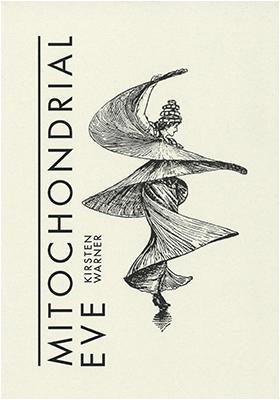
mitochondrialeve_webcover.png


Kirsten Warner, Mitochondrial Eve, Compound Press, 2018


Kirsten’s Warner is a writer, poet, journalist and musician and former chair of the Auckland Society of Authors. She graduated with an MA in Creative Writing with Distinction from AUT and won the Landfall essay competition in 2008. She performs as a musician with partner Bernie Griffen in the folk-blues band Bernie Griffen and The Thin Men. Makāro Press published her debut novel The Sound of Breaking Glass in 2018. Her poetry has appeared in a number of journals and  anthologies. Her debut chapbook Mitochondrial Eve also came out in 2018. This slender collection is the kind of book you can spend ages with. I read it on the plane to Wellington and once I got to the end of the book I returned to the beginning and read it again. Goodness knows what the passengers either side of me thought. They wouldn’t have known I was poetry rich with a stack of books waiting to be read in my bag.

The six poem titles resemble a narrative framing device: beginning with heartbreak, then moving through dailiness and despair, to a degree of release:


The Location of Heartbreak

Plant a Red Hibiscus

Channel Surfing

S. O. S.

In a Nutshell

Off the Leash


Each poem is exquisitely layered as things are held at arm’s length, obstacles loom, the real world intrudes bright and harmonic, words are lithe on the line. Here is the first stanza of the first poem that pulls you into threat and challenge through the rhythm of walking with its pauses and asides:


I surface dismantled

heart-sore here in the area of the left breast,

certain the most meaningful part of life

is lived while dreaming

and that to awake is to fail to fall

into an abyss of light.


from ‘The Location of Heartbreak’


The heart-threatened core (of the poem, of self), unsettling and hard to reach, is like an insistent pulse that keeps me reading:


I step over cracks so I won’t marry a Jack

resist walking out into traffic

we don’t have a bath and I’d have to find blades

and it’s an end I want not intensification

someone to find me before I drift away.


The second poem, ‘Plant a Red Hibiscus’, returns to the rhythm of ‘feet on the pavement’, but changes pace as the speaker takes charge of a bulldozer. Always the incandescent  core, like a burning wound, enigmatic, exposing; the poet never still. Here is the musing speaker at the bulldozer’s helm; I am holding my breath as I read:


Things that also might be worth living for are

small dark orphan babies who need arms to hold them

I would sit for hours.

Gathering fallen leaves,

we are all compost exchanging molecules and air.

Plant a red hibiscus.


Spread good dark soil, pick up dry leaves, hold a baby.


I don’t make assumptions about the speaker in the six poems. She might be the ‘Egyptian Goddess stalking the town!’ She might be part poet, part invention, part delight in different voices. The poem ‘In a Nutshell’ samples role hopping from Eve with mitochondrial disorder (misbehaving cells that can’t burn food and convert oxygen to energy) to Katherine Mansfield in her German pension, Suzie Wong getting STDs, Carmen Miranda breaking into song, Mata Hari watching time flying over rooftops, until the final glorious, puzzling stanza that hooks the stitches of everyday into the whip and pain of existence:


When I eat nuts

I am Nut

the whole shebang

born of ululation

moisture and fire crackers.

I have no consort

he’s outside

drinking

fagging

shooting up

hocking my starry dress

trying to get back up me.

I bear down

without drugs

swallow the night

virgin again

every morning

to make school lunches

and hold up the sky.


This hallucinogenic, rollercoaster, gut punch of book runs through me like fire. I love it.


Kirsten Warner WordPress page

Poetry Shelf review: Murray Edmond’s Back Before You Know

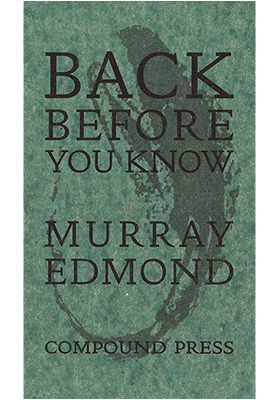
ME_BBYK_StoreCover.png


Murray Edmond, Back Before You Know, Compound Press, 2019

Jonas Bones, Jonas Bones esquire,

whale-stabber, seal-clubber,

great hands held like tongs in the fire,

road-digger, gold-grubber—

JONAS: Never did have no blasted luck,

every plan came unstuck—

Always up to his ears in muck

couldn’t make two ends meet.

So one last chance to call a stop

one last throw on a crumbling life,

on the King Country line he set up shop,

with one lone child and one sharp wife.

from ‘The Ballad of Jonas Bones’


Murray Edmond is a playwright, poet and fiction writer; he has worked as an editor, critic and dramaturge. Several of his poetry collections have been finalists in the New Zealand Book Awards:   Letters and Paragraphs, Fool Moon and Shaggy Magpie Songs. He has worked extensively in theatre including twenty years with Indian Ink on the creation of all the company’s scripts.

Murray’s new collection comprises two long poems that play with other sources; with fable, allegory, history, theatre, poetics, the ballad form. The first poem, ‘The Ballad of Jonas Bones’ steps off from Robert Penn Warren’s ‘The Ballad of Billie Potts’ (1943), from Kentucky to the Waikato / King Country. Murray claims his version as a palimpsest or adaptation, leaving traces of the original version, ghost-like and haunting. We may find vestiges of place, the story that gets passed down the line from ear to mouth, the innkeepers who rob their well-off guests, a character’s return to origins, the cutting shards of history, the kaleidoscopic turns of humanity. I haven’t read Warren’s poem but I sense its eerie presence.

Murray’s fluctuating rhythm and rhymes are like shifting river currents, his poem a river poem carrying the debris of story, hand-me-down anecdote. There’s gold and there’s mud, there’s error and there’s incident, there’s greed and there’s survival. Dialogue gives it life as a theatre piece, staged to the point I invent the presence of audience and a live version runs through my head. I am watching as the past is made present and the future present is gestured at in the revised story along with the original skelton. A wider context is superimposed and hides in the seams: ‘frontier’ stories that mutate in the telling, the more significant misrepresentations that shaped our histories, the way individual stories are muffled within the dominant narratives.

Ah but alongside these fertile underground veins is the fact this is a cracking good story with its blinding twists and wounding heart. For some reason I kept thinking of Blanche Baughan’s affecting long ballad, ‘Shingle Short’.

The second poem, ‘The Fancier Pigeon’, is equally arresting with Murray characteristically playful. I am reading with a wry smile, every sense provoked, my reading momentum both fluid and addictive.  We meet the fancier pigeon and the pigeon fancier (she with her hair aglint) when they meet perched on stools at a bar:


She had hair the colour of apricot

she smelt like a cake just taken

from the oven and her father played

drums in a band in the only night club

in town


I am always reluctant to spoil the unfolding of a poem, long or short, in ways that ruin the reading experience, that spotlight the darkened nooks and crannies, the poem’s pauses or digressions. That dampens the joy of reading. But I will say when the two characters kiss a pigeon drops a ring at their feet – they decide they will each keep the ring for a week and then only met when they exchange the ring. Such an emblematic hook.

The poem feels cinematic (visually sharp, moody hued), theatrical (with both dialogue and action body gripping) and fable-like (overlaying universal themes of love, betrayal, mishap and destiny). The poem also feels cinematic with its smudged lighting as though we can’t quite be sure what happens between this scene and the next, with the cue to fable never far off, the characters, a quartet, shifting and sliding in and out of view.


and it was there

the girl had stopped her

as she walked

“Has he come asking for me”

of course he had so she said “No”

and as if she were granting wishes

she asked

“You wanna come out on the lake

with me in the canoe?”

and she had lead her down

among the bulrushes


What I love about the poem – beyond the supple language play and the sensual images, the addictive and offbeat characters, and the narrative tug – is the way the world adheres. As reader you can’t just stick to the poet’s diverting fable – because the real world intrudes, the hurt and broken world if you hold the bigger picture, and the miniature daily stories if you hold the way humanity is formed by individuals. Both things matter at the level of the humane.

The book’s punning title, like a cypher, a tease, is also a ‘dropped ring’. It is re-sited as the last line: ‘BACK AGAIN BEFORE YOU KNOW’.  And I am looping back on the unknown and the achingly familiar, the beginning that is ending that is beginning and so on, the switch back roads and the clifftop vantage points, the downright miraculous and the daily mundane. Ah setting sail on this poetic loop, with its blurs and its epiphanies, is sheer bliss. Poetry bliss.


Compound Press author page

In the hammock: Reading Min-a-rets (8)


Minarets8Autumn2018_webcover.png


Min-a-rets issue 8 autumn 2018


edited by Erena Shingade

published by Compound Press

drawings by Harry Moritz

poems by:

Victor Billot

Freya Daly Sadgrove

Lee Thomson

Zack Anderson

Murray Edmond

Courtney Sina Meredith

Manon Revuelta

Naomi Scully


This is multi-note poetry – each poem a sharp turn to different effect but the poetry co-exists so sweetly.  There is not a dud note.

Today I am in the mood for surprise.

Zack Anderson’s ‘Vapor Wake’ is a lush string of words, a momentum of startling image and sound. A taste:


shadow the streaming track

the wormy spoor

the hex print

the luminous index

data streaming from me

like a wedding dress

a mantle, a mantis

a veil


Murray Edmond goes ‘Camping in the existential forest’ with tercets that wryly build a miniature narrative, strange, theatrical and evocative:


III

Someone coming in

gumboots. Tramp tramp tramp. Beat

of own tell-tale heart.


Courtney Sina Meredith hooks me with an off-kilter memoir-like cluster of little pieces, definitely luminous. From ‘Pony’:


Baths

Unless my memory is playing tricks on me. The rats

were white with blazing red eyes.


I’m translating myself from a time when I was sure.


I recently did an email conversation with Manon Revuelta where I enthused about her debut collection, Girl Teeth. This new poem, ‘Prayer’, shows the subtle along with the degrees of surprise and lyricism Manon is capable of. A taste:


Look at this busy dance I do with my hand

When I’m talking to people

Shredding paper in the darkness of my pocket

It is the quiet work of saying things


Min-a-ret 8 is a treat to be read on multiple occasions like a good album that needs multiple listenings.


Min-a-rets page

Erena Shingade is a poet and arts writer from Auckland, New Zealand. Her work has been published by platforms such as The Spinoff, Landfall, Mimicry, Blackmail Press, Atlanta Review, Ka Mate Ka Ora, & the New Zealand Electronic Poetry Centre. After completing an MA thesis on the Zen Buddhist poetry of Richard von Sturmer in 2017, she continues to research the intersection of the poetic and the religious. During the day she works as a publicist for Allen & Unwin.

Poetry Review: David Merrit’s Crisis & Duplication


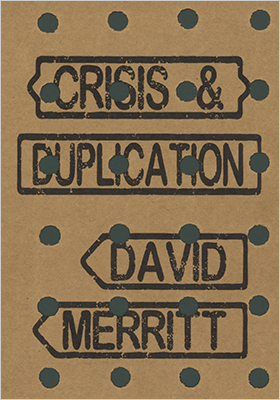
CrisisDuplicationWebcover.png


I am thinking of creating (private) lists of books to read in particular circumstances. For example what to read when you have no power or running water and can only read by candlelight after a day consumed with slow-paced domestic chores. Thrillers worked for me.

And David Merrit’s Crisis & Duplication. I sat on the couch in the grey gloom and read it three times in a row. It is a slender chapbook published by Compound Press last year.

The book is in two halves with a foldout centrepiece. The first half draws Frank Sargeson into the poet’s musing self-reflective quick-fire monologue. It is sharp, angular and surprising.


I always seem to be writing poems in Wellington

sunlight on  a cold but bright winter’s day. I will

be outside a cafe in reflected mirror glass, dodging

bullets, writing inbetween showers & dristy

mizzle.


David is musing on the mirror image: himself and Frank, the connections, the writing surges and space for improvement. It is audacious, spiky, riveting.


It’s an easy poem this, preordained, quick

off the tongue, one poet, very alive,

400 miles south for now, compares life

& times with another poet, 60 years

ago still alive & kicking, a Janet Frame

tucked away in a back shed, her glittering

far away eyes focused on her own escape,

‘cept you like me, we never escaped to

 the place they call overseas.


The second half navigates the stages of making a book – not a big press book but a grassroots number. A miniature history of desktop publishing. It is risograph printed and bound with premium banana box card. Excellent to look at and hold.


So what do I do in a mini crisis? Will I set up invented conversations with someone who has affected me (also in the garden? writing poems? reading books?)? Is the occasion of writing a poem a crisis for some? A tilt, a topple, a brief epiphany?

To what degree is a poem a duplication?

In the grey gloom with no idea when the lights would be on, the spaghetti effect of questions was extremely welcome. Then again so was the downright admiration of the words on the line.

Yes, I recommend this book highly. Power or no power.


Interview and book details at Compound Press page.