For Eventfinda tickets go here
The Poet Laureate Celebrations includes this event! Looking forward to my trip south.
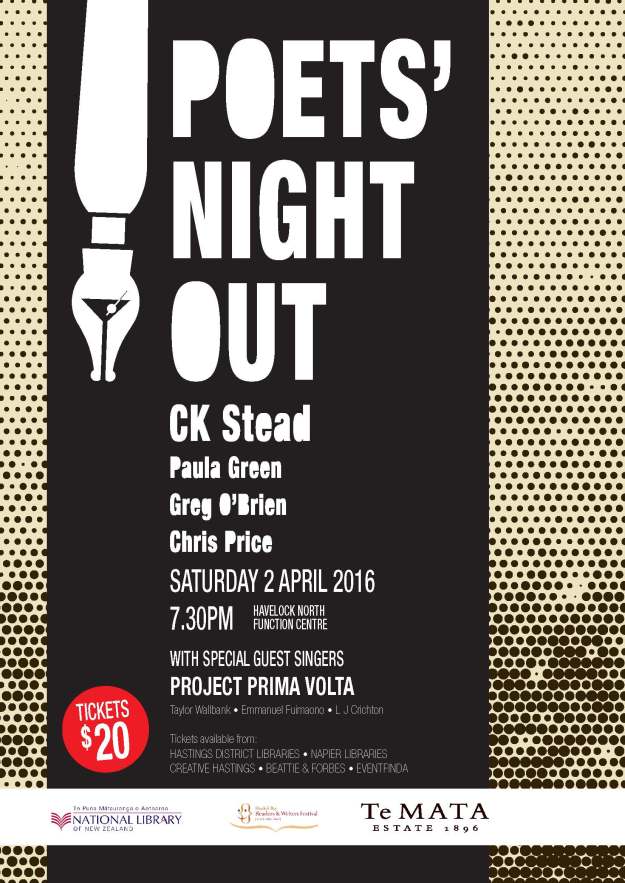

For Eventfinda tickets go here
The Poet Laureate Celebrations includes this event! Looking forward to my trip south.
For the full programme see here but this is the poetry on offer.
I would love to go to the Laureate Circle but can’t make it at this stage (might just fly down on a whim!). I would really like to post pieces on any of the poetry events at the festival. Any takers?
Friday March 11th 7pm A Circle of Laureates
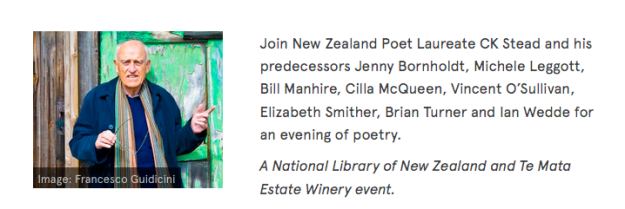
Friday March 11th 5pm Anis Mojgani and Marty Smith
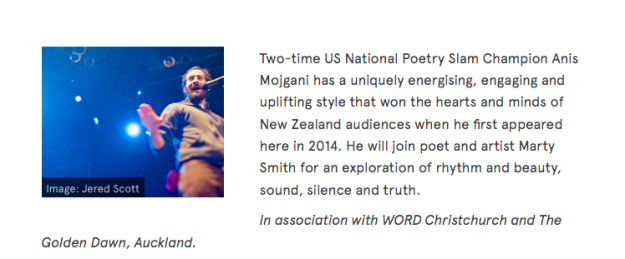
Thursday March 10th 1.45pm Anis Mojgani
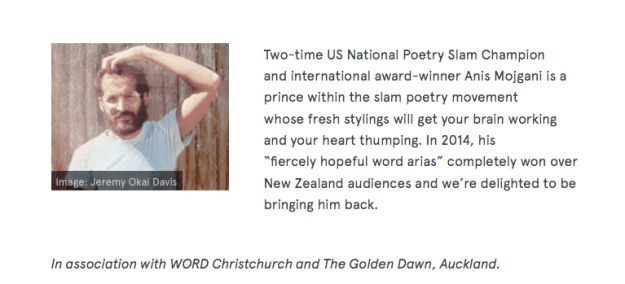
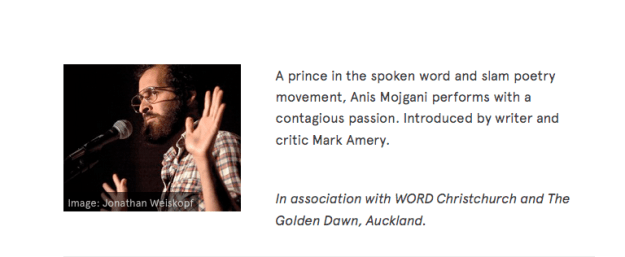
Sunday 13th March 2.30 pm Anis Mojgani with Mark Amery
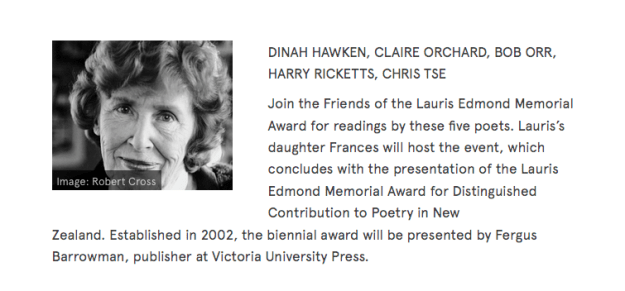
Saturday 12th March 3.30 pm Five Poets and a Prize
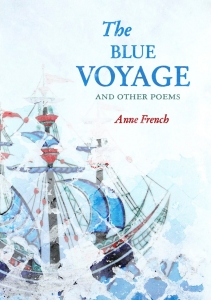
On Wednesday at Auckland University Press I launched Anne French’s new collection, The Blue Voyage. Anne has always been a sailor (a ‘yachtie’) and the sea figures somewhere in all her books. The title sequence in this one is based on sailing in the Aegean, south of Turkey. This gives her both seascapes and landscapes/cityscapes, the flora, and even something of the history and changing politics, of the region. There is an amusing set of poems by Anne’s invented local poet, William Butler Smith who has more than an accidental connection with W.B. Yeats; and by contrast, some translations of exquisitely delicate poems by the Korean modernist, Han Yong-un. Anne has always seemed to me a clever poet who tells things as they are, and as they have been, from a woman’s perspective (remember The male as evader, a few years back?) – and that is still the case; but there are gentler notes now, and some very touching elegies, including one for Nigel Cox, one to ‘Uncle Max’, and one (in cricketing terms) to ‘Auntie Paddy’ whose
heart ticked on long after
she’d stopped eating, talking, or looking
forward to anything but the walk
back to the pavilion.
I think maybe the central poem of the book for me is one called ‘Ziran’, where after a rough passage sailing they have emerged into calm seas and she’s ‘leaning back against two sail bags / singing Puccini.’
The Chinese word for ‘natural’ is self-so,
John tells me later: true to its own nature
and the way of the world. Self-so then is this joy
that fills every part of me and lifts me into myself.
The thought of being lifted into, rather than out of, oneself is typical of the small surprises she delivers. This is a book full of Self-so.
CK Stead
Thanks for sharing these. I put all the names in a hat and drew out Nicola Easthope. I will send you a wee bundle of poetry books. Can you email me your postal address please?
Sarah Jane Barnett: Congratulations on your 500th post! What an achievement and also such a contribution to New Zealand poetry readers. The book I’m enjoying at the moment is Joan Fleming’s Failed Love Poems. It’s an intense read and I feel immersed in the characters, especially in the second section. The poem ‘The invention of enough’ blew my mind!
Harvey Molloy: One book that comes to mind is Native Bird by Bryan Walpert. It’s such a well-crafted, polished book. There’s a diversity of poetic forms and tones so the work’s quite dynamic. There’s also a certain reticence in places, a skirting around painful issues which I find quite refreshing – – at times emotions are understated and there’s a control and restraint which I find quite moving; the poetry is at times actively self-conscious but never cold or impersonal (for example the poem, ‘Ōakura’). I’ll be coming back to this book.
Sian Robyns: Airini Beautrais’ Dear Neil Roberts had me enthralled enraged and weeping. To paraphrase ‘History Books’ (p 43), she admitted Neil Roberts into our histories and gave us a harrowing reminder of the particular awfulness of Muldoon’s New Zealand. Sadly, we still maintain a silence closely resembling stupidity.
Can I have two? I also loved Jennifer Compton’s Mr Clean and the Junkie. I loved the story, the sense of place, and that swooping, interfering, conversational, self-aware authorial voice.
Crissi Blair: I loved Caoilinn Hughes’ Gathering Evidence which I had from the library after hearing Gregory O’Brien talking to Kim Hill about her marvellous first lines. Congratulations on your 500th post Paula. You are doing a great job at spreading the poetry word!
Nicola Easthope: One Aotearoa poetry book I have enjoyed this year (there are so many) is Janet Frame’s The Goose Bath, winner of the 2007 Montana NZ Book Awards. I have come late to Janet’s poetry (having gobbled up her prose at university in the late 80s) and love meeting her flaring imagination and dance of language through poems with apparently innocent beginnings that usually turn, back and forth, between the light and the dark of her life.The entire collection leaves me fizzing and aching with appreciation.
Lara Anderson:
The body is a nest alive with new song
The brain is fluent in ghost
The tongue is rich with poetry ~ Siobhan Harvey from ‘Cumulus’ in Cloudboy Otago University Press, 2014
These are just a few of my favourite lines in a book of NZ poetry that I have read and re-read this year. Using the metaphor of clouds to express her feelings and to give poetic form to her son. Harvey is at times both confronted and confronting. You would think that over an extended piece you would get tired of the cloud metaphor but it provides a cohesion that allows the reader to trace the ever changing cloudscapes – like watching the weather dance across the city in time-lapse fashion. Every time I re-read her work I garner something new from it.
Anyway, thank you for your 500 wonderful posts!
Susan Wardell: I stole away from evening toddler-ing duties for a full hour to attend the launch of Emma Neale’s Tender Machines. For the first three days I kept the book lovingly tucked in it’s friendly brown-paper bag, carrying it around in my over-sized, multipurpose parenting handbag, and stealing it out just a few times a day, in the gaps between work-work and home-work, to savour the poems one, or maybe (greedily) two, at a time – along with the salted crackers keeping my ‘morning’ sickness at bay – then carefully replacing it. Parked by the road or outside the house, while my daughter squirmed/sang/ate raisins in the back seat, I cried more than a bit, and more than once, as I read Emma’s poignant, humourous, gentle, and sometimes brutally-true poems about, well… about life. To find something that could capture, without reifying, the beauty and fragility of the mundane and domestic, reading the micro everyday of mealtimes and bedtimes into the macro of our uncertain global times…. it is special. I don’t believe I had ever read what I could call a ‘true’ poem about parenting before I read Emma’s (earlier) work. This collection, too, became a lifeline, another level at which to process my own experience, emotion, as a mother and a woman and a citizen of a broken world. I breathed. It was ok to be human after all. I forgave myself as the book came out of it’s paper sheath permanently and, in the space of only a week, gained nutella fingerprints, sand in the page creases, water bottle stains, and dog ears. I finished it and cried a bit more into the spaghetti, not sure whether to blame hormones or metaphors. This collection is personal in a tender and unapologetic way, political in a raw and thoughtful way, beautiful in a subtle, tangible, heart-lifting way. It is both grounded and soaring; it is both the heartbeat and the wind. It came at just the right moment for me personally, in the way poetry often does. But I am also pleased to think of it’s permanence now, in print; it will remain as a beautiful little signpost in the history, the story, of NZ poetry… should the archaeologists of the future unearth my well-loved copy, they will know us better for it.
Kathryn Crookenden: Congratulations on your 500th post for NZ Poetry Shelf and thank you for all your efforts to promote poetry in New Zealand. I enjoy reading the blog, especially the reviews and the interviews with poets.
I have enjoyed reading Frances Samuel’s Sleeping on Horseback this year. I got it out of the library twice and then bought my own copy because there were so many poems that I enjoyed and wanted to keep going back to. Through her poems I have travelled with Chinese poets and Russian writers, visited Japan and Latvia in summer, and considered how to draw spires and towers. I like her wry humour and sharp observations. My favourite poem in the collection is ‘Just twinkling in the moonlight’ with its baby ‘all shiny with the moon.’ I’d also like to mention the gardening anthology, The Earth’s Deep Breathing, which has been a good companion for the last few weeks as I’ve been getting my own garden into shape, and Glenn Colquhoun’s The Art of Walking Upright which I read earlier this year – there are some beautiful kuia honoured in his poems.
Maureen Sudlow: I am currently reading the collected poems of Ruth Dallas, published by the University of Otago Press, and I am struck again with the breadth and depth of her writing. Some of her work is influenced by the early Chinese poets, and some returns to the strong heritage of her own environment and upbringing. Ruth also includes haiku, which are one of my favourite poetic forms, and which are not often included in general poetry collections.
Her poems are gathered into five groups that show changes to Ruth’s writing over time. I particularly love ‘Felled Trees’:
Nobody has come to burn them,
Long green grass grows up between them.
Up between white boughs that lie
Dead and empty, dry,
That once were full of leaves and sky.
and ‘Night Rain’
Needles of the rain
Restitch
Restitch the linen of the flesh
The rich variety of her writing brings me back to read again and again. If you have no other New Zealand Poet on your shelves, you must at least have Ruth Dallas. Ruth has gone but she has left a treasure trove of words behind for us to enjoy.
Helen Anderson: I am very pleased to have the opportunity to write about C.K Stead’s Collected Poems 1951 – 2006. This was a very welcome gift that has sat beside my bed all year for dipping into. It was published in 2008 and came to me via Hard to Find book store having never been opened! I had the privilege of being in Professor Stead’s classes far too many years ago and reading his text The New Poetic published back in 1964 accounted for my first experience of some understanding of the poetic enterprise. Collected Poems is full of surprises, the range is extraordinary and the collection includes previously unpublished work. It is an ongoing lesson about the power of language to invoke memory, to rebuild perception and to take us beyond our boundaries when crafted by a poet who is serious, playful, cynical and optimistic and an artist.
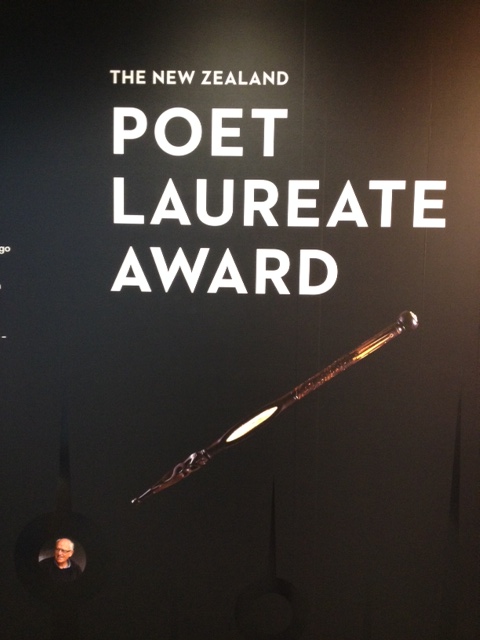
Last night CK Stead was awarded the 2015 NZ Poet Laureateship at the National Library in Parnell with the support of friends and family.
Chris Szekel, Head Librarian at The Alexander Turnball Library, and responsible for the award, steered the speeches.
Ian Wedde, as a former Laureate said a few words, The RT Hon Maggie Barry, as Minister of the Arts, said a few words and then it was over to Karl.
Karl underlined how poetry had been a significant part of his life from an early age: ‘Poetry found me in Mt Albert Grammar School library’ and ‘Poetry has always been somewhere near the centre of my consciousness.’ He added: ‘Poetry is still close to the centre of my life, otherwise I would not have accepted this award.’
He acknowledged presences (atua) in the room with him (Allen Curnow, Kendrick Smithyman, Bill Pearson, Maurice Shadbolt, Maurice Duggan, Keith Sinclair). His fellow writers. I found this very moving.
He acknowledged writers in the room and his family.
Karl read two poems, ‘Look Who’s Talking’ and ‘Crossing Cook Strait,’ suggesting the writers behind these poems, James K Baxter and Curnow, would have been Laureates if the award had existed then.
It was very clear that this writer, writes out of mesh of poetic relationships. Vitally so.
I drove back west from a lovely occasion – full of the warmth generated by a shared love of poetry and admiration of one of our most esteemed poets. It touched me.
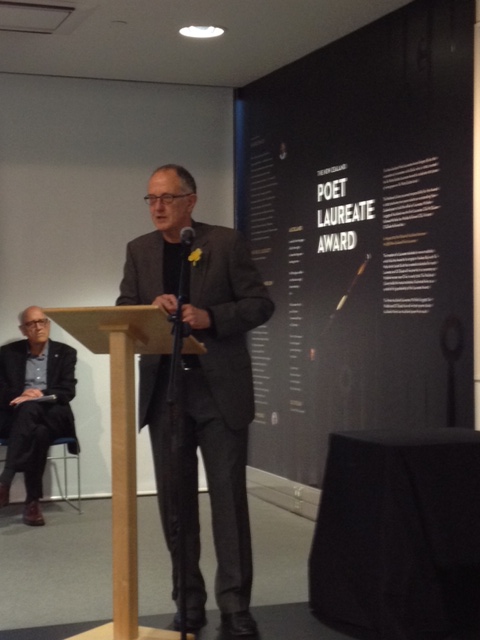
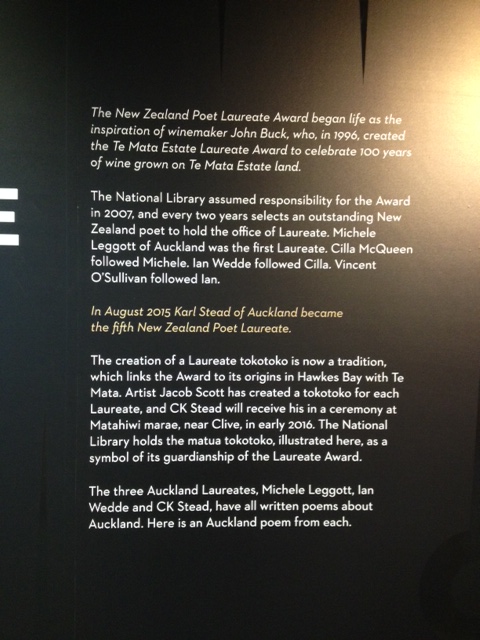
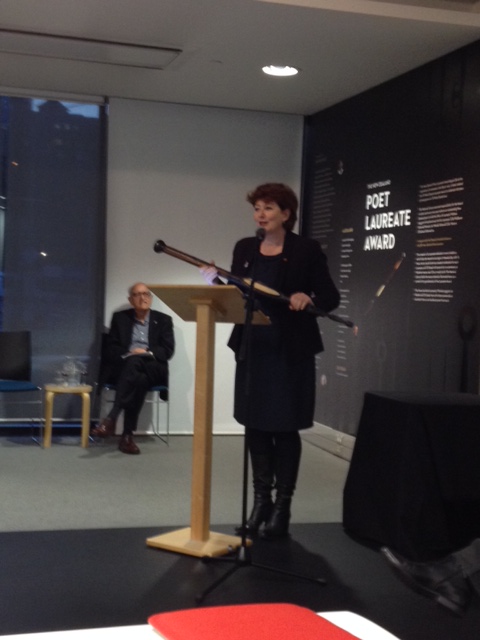
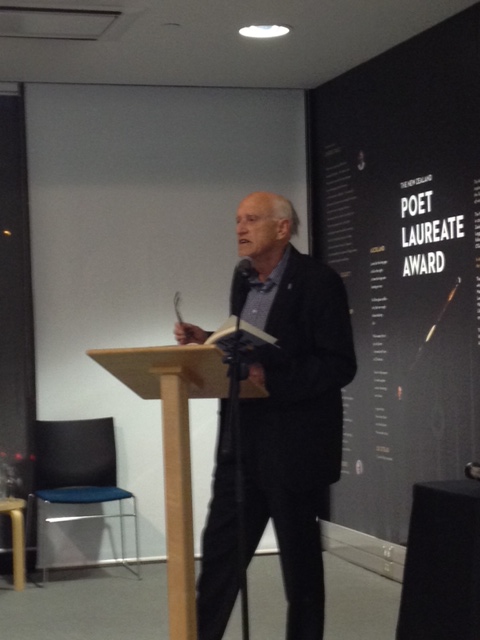
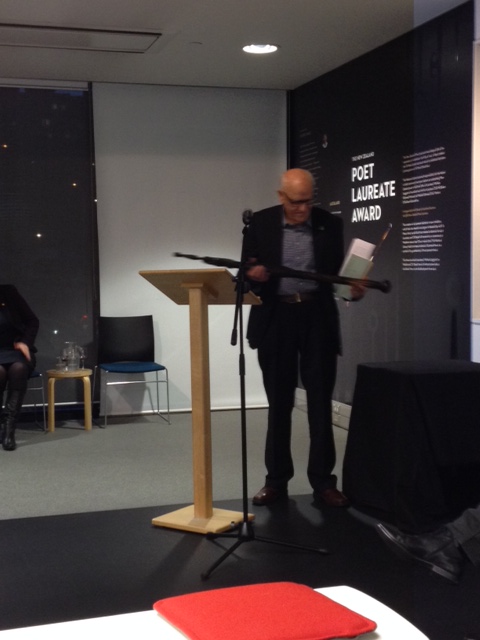
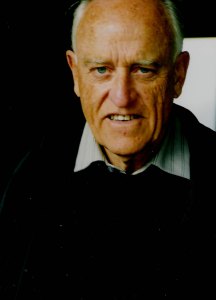
Photo credit: Marti Friedlander
CK Stead is our new Poet Laureate.
I was in the thick of stand-still, rush-hour traffic on the way to a South Auckland School this morning when I heard the news and it gave me a much needed boost. Poetry has always been a primary love in the broad spectrum of Karl’s work. His poetry catches your attention on so many levels because his poems become a meeting ground for intellect, heart, experience, musicality, craft, acumen, a history of reading and thought, engagement with the world in all its physical, human and temporal manifestations.
I am delighted to celebrate this result.
Here is a snippet from an interview I did with Karl for Poetry Shelf last year:
Your poems are delightfully complex packages that offer countless rewards for the reader—musicality, wit, acute intelligence, lucidity, warmth, intimacy, playfulness, an enviable history of reading, irony, sensual detail, humour, lyricism. What are key things for you when you write a poem?
It has to be a meeting of words and feeling, in which the words are at the very least equal in importance, and the feeling can be of any kind, not just one kind. I like wit, think laughter can be tonic, but of course it doesn’t fit all occasions.
There were a number of significant poets in NZ from the 1940s onwards and you have interacted with many of them (Curnow, Mason, Glover, Baxter and so on). Were there any in particular whose poetry struck a profound chord with you?
Curnow was always the most important for me. But when I was young Fairburn’s lyricism seemed very attractive; Glover at his rare best (the Sing’s Harry poems); Mason likewise (‘Be Swift O sun’); Baxter – especially in his later poems: they have all been important to me.
Do you think your writing has changed over time? I see an increased tenderness, a contemplative backward gaze, moments where you poke fun at and/or revisit the younger ‘Karls,’ a moving and poetic engagement with age, writerly ghosts and death. Yet still there is that love and that keen intelligence that penetrates every line you write.
You are very kind! I certainly feel ‘older and wiser’ in the sense that things don’t matter so much, one accepts the fact of human folly and one’s own share in it. Indignation doesn’t stop, but there is a kind of weary acceptance, and laughter. I still feel embarrassment – especially when looking back – but I recognize that as not only a safeguard against social mistakes, but also as another manifestation of ego, as if one feels one should be exempt from folly.
There have been shifting attitudes to the ‘New Zealand’ label since Curnow started calling for a national identity (he was laying the foundation stones that we then had the privilege to use as we might). Does it make a difference that you are writing in New Zealand? Does a sense of home matter to you?
When I was young I was a literary nationalist. Now I regard nationalism as a form of tribalism and the result of genetic programming no longer suitable or safe in the modern world. So I have changed a lot. But I still recognize regional elements as important, even essential, in the poetic process. I think Curnow himself became more a regional poet and less a nationalist one; but the arguments that had swirled around all that had had the effect of committing him to positions which he didn’t want to resile from, so he remained the committed nationalist, perhaps after the need had passed.
What irks you in poetry? What delights you?
I suppose any kind of excess, of language or of feeling; and solemnity – especially the sense that poetry is taking itself too seriously and asking for special respect.
There are many kinds of delight in poetry, but almost all of them involve economy. If an idea or an experience or a scene or a personality or whatever can be conveyed as well in 10 words as in 20, those 10 words will be full of an energy which the more relaxed and expansive version lacks. They will be radio-active.
Name three NZ poetry books that you have loved.
Singling out living poets might be invidious, but here are three by poets now dead: You will know when you get there (Curnow); Jerusalem Sonnets (Baxter); Pipe Dreams in Ponsonby (David Mitchel).
The full interview here.
This morning I ran along the beach into the hit of the west-coast wind, and it felt like a hinge between four glorious days at the Auckland Writers Festival and getting back to work. As I ran, I pictured myself asking Murakami running questions. Where does he like to run? Is it in a wild space where you hardly see another soul as I do and your mind empties as the rhythm of the run takes over. You might see a puffed up dotterel out of the corner of an eye or a pied stilt wading. The rhythm of the run sends me into a pre-writing state but mostly it is is just me and breathtaking beauty.
This morning as I ran it took awhile to get into that equilibrium of silence as the festival keep drifting through. What I loved. What I loved a little less.
My bouquets in no particular order
1. To Anne O’Brien and her team for creating a dazzling programme that pulled me out of hermithood into the city for four full-to-the-brim, glorious days, that filled an auditorium over and over, that offered free sessions. This was one of the best festivals I have attended yet in terms of the range and quality of voices on offer. The audiences.
2. The new dedicated focus on children’s writing with the School Days, Family Day and sessions featuring a children’s author. I was coming out of a session and saw David Walliams at his signing table and was incredibly moved. He was looking with careful attention at a picture a young child had drawn for him, taken the time to pause and wonder, when his signing queue had stretched out into the square at the start of my session. It seems to me the festival has also become a gift for our emerging readers and writers, our thinkers and our scientists, our comics and our leaders. Thank you!
3. The amount of poetry this year. Sure I still love a line up of ten poets like a tapas tasting lunch that shows you the terrific width of our poetry communities. But I love the way poets now read along side international authors and local fiction writers in panels. This exposes our poets to a much wider audience. One stand out for me (sadly I missed some poets I had wanted to see due to clashes) was John Dennison. I have just reviewed his stunning debut collection on the blog but his poems lifted and became even more exquisite as I listened and shut my eyes. Two poets came to mind: Gregory O’Brien and Bill Manhire. I could hear a faint, appealing somethingness of them in John’s intonations, the pauses, the repetitions, the stresses — the downright joyous musicality. If you don’t have John’s book, I highly recommend it. Maybe you can find him reading a poem or two on YouTube.
4. More poetry. The session with Anna Jackson and Daniel Mendelsohn on translation gymnastics was fascinating. I had Anna’s new book, I, Clodia, and a bilingual edition of Catallus in my bag all weekend as I am working on a review. I think I will save some of the gems from Anna until I do the review. But hearing the poems read aloud, we all leaned forward into the beauty of them. Gorgeous!
5. The Gala Night story tellers hit the mark. Sometimes I have been at previous ones counting how many to go. Not this time. The last one spoke, the time was up and I had stayed glued to every word.
6. Mrs Dalloway: I was in awe of Rebecca Vaughan maintaining those weaving voices for ninety minutes, pulling us into the shifting detail, moods, revelations.
7. Amy Bloom in conversation with Carole Beu. I had just read Lucky Us. Sparkling, scintillating, sent me straight to the book stall to buy the short stories.
8. Kim Thúy, a Vietnamese-Canadian novelist, in the panel session on Asian Histories. I didn’t know her at all but loved the little stories that ballooned out from a single word. Loved it when she said Vietnamese don’t show the feelings so much, and that her parents never asked her how she felt, but would ask her if she was hungry, then feed her mood. Dashed to the bookstall and bought Man. This writing is astonishing and I want to read everything she has written. I bumped into her when she was talking to her friend Anne Kennedy and so she inscribed my book. Ah the joy of lucky moments at festivals.
9. More poetry. Hearing Chris Tse reading a breathtaking selection from his debut collection How to Be Dead in the Year of Snakes.
10. Some favourite chairs: John Freeman, Carole Beu, Noelle McCarthy, Catherine Robertson, Christine O’Brien, Ruth Harley (many I missed sadly).
11. The privilege of sitting on stage with Edwin Thumboo to talk about poetry and Singapore was an utter highlight. He is, as I said in the session, like Margaret Mahy was, and Michele Leggott and Bill Manhire are: writers whose work fills you with endless admiration but who also occupy the world as writers in a way that is extraordinary. He is a Singaporean national taonga, so how good he read and spoke to a packed house. We barely scratched the surface of what we could have traversed, but to hear his poems hit the air/ear was such a treat. Preparing for the session sent me on new paths of thinking. I am so grateful to the festival for this opportunity.
12. David Mitchell in two sessions. In the first he was jet lagged and in the second, in a panel. Here are some of the gems I loved: He used to make his own Middle Earths with card and paper. He was a low maintenance kid! He stalled on a sip of tea then talked on the über novel, then cautioned new writers to be careful naming things as the name sticks. On character: A character moving into a new book brings a suitcase of credibility from previous ones. On discussing how to pronounce ‘archipelago’ with Catherine Robertson, they both slide into an hilarious word jam. On links between books: there are doors wormholes tunnels from one book to next but not many. Ponders on how to make many different things coexist in one book: one way is to compartmentalise. He apologises for bringing his wife into the discussion (she was back stage!) on entering the female mind as a writer of his protagonist. He has five friends on earth, three of whom don’t read him! Question: Do you have an attic mind? Mitchell: a junk shop mind. On names: high scrabble scores generally make useful names. They stick to the eyeball. On the intensity of writing: You get through the intense immersion of the current novel underway ‘with little kisses of thinking about the next one.’ On fear: you should go outside your comfort zone. Have I bitten off more than I can chew? is important. He offered to read a Stephanie-Johnson draft when she said showing unfinished novels to others was an imposition. He said he wasn’t a novelist; he writes novellas with bridges and tunnels between. [I love this idea the connection can go through air or underground!].
13. Emily St. John Mandel on editing: Retype your entire draft, read the whole thing aloud to yourself, edit pages in random order.
14. Helen MacDonald. Now I have to read her book, H is for Hawk. Things I loved she said: We use nature to prove our concepts to us. On the joy of festivals: They let thoughts and words be said that aren’t normally available in everyday life. There’s no past or present when you are flying a hawk. When you have a big loss: After a year of grief, I started to grow around the holes. It was all about love.
15. Carol Ann Duffy. Carol Ann Duffy. Carol Ann Duffy. Carol Ann Duffy. Hearing her read. And loved this bit from John Campbell on the joy of reading her poems: (can’t quite remember exact words) but ‘drilling down into your particular way of knowing.’
16. The fabulous Tim Winton: I think perhaps people are wired to hope.
17. Hearing Ashleigh Young read her remarkable new poems, especially the casino one and the road one. They felt like a glorious step up from her debut. Fresh, elastic, lyrical, effervescent, surprising. I am going to post one on the blog as soon as possible so I can talk about it. I do hope a new book is on the horizon line.
18. Anne Kennedy talking about Janet Frame’s Owls Do Cry, the Great Kiwi Classic this year. She was so lucid, so on the button, with what she said. Reading the book for her was like a sock between the eyes. She loved the way the vernacular had been transformed into the poetic, but that it was above all a triumph of kiwiness. Anne said Janet rescued kiwiana and polished it like a gem. For Courtney Sina Meredith reading it was like a rite of passage. She said she was terrified of it at university (if you can’t get into this, you can’t get into New Zealand literature) but then she became deeply connected. Wonderful! Damien Barr cried after he read it (hearing his autobiographical anecdote I am not surprised). Great session steered by Kate De Goldi, but more audience involvement would have been good. I think that is the intent of the NZ Book Council that it becomes a very interactive session.
19. The Honoured NZ Writer: CK Stead. Wonderful movement through his life and career. Loved the poems breaking into the conversation. Like the way he said Catallus gave him a persona where he could go to the edge of things that had sometimes happened to him, or that were an invention. It became an area of freedom when he was not mentally a confessional poet. He had returned to NZ because he wanted to be a NZ writer and turned down the option of a very different academic career in Britain. He doesn’t regret it but sometimes ponders the possibilities of that different track.
I have been especially drawn to Karl’s recent poetry collections, their reflectiveness, musicality, ability to matter and move. You saw that a bit in the conversation. On being a critic: I was too dogmatic, too excited, things could have been said more subtly. I discovered what it was like to be characterised by what was a small part of me. On rereading Death of the Body for this ‘ordeal’ decided it was so much cleverer than I am now. A terrific way to end the festival.
20. Hearing fabulous Irish poet, Vona Groarke read her own poems and talk so beautifully about the finalists in the Sarah Broom Poetry Awards. I am so tempted to get to Wellington to hear her talk and read for a whole hour!
21. Stepping into the shoes of Alice Miller to read her finalist poems at The Sarah Broom Poetry Awards. I was amazed at how reading the poems of another poet out loud in front of an audience drew me so much closer into the very heart of them. The poems were breathtakingly good. I should do this more often. Find a special place to stand and read aloud the poems of another.
22. Ah! Murakami. Ah what a tremendous session. Ah! Ah! My daughter gave me some of his novels to read over summer and I was hooked. How had I not read him before? The outright surprise, wonder and delight of where he leads you. So to find out he was coming to the festival was the absolute highlight. I loved the fact he wrote his first novel and cast it into the bin as dreadful. He then wrote it in English as he had a limited vocabulary and stock of phrases. He translated it back into Japanese and achieved the simplicity, the economy and clarity of writing that is now his trademark. He likes his writing to be unpredictable to himself, which it is why it is so gloriously unpredictable to the reader. He feels he can be anybody when he writes (not all writers feel this!). He enjoys reading his books that have been translated into English (a few years after the original) as it is like reading it afresh and he can’t remember what happens. He likes Japanese tofu and donuts! Maybe a tofu donut! The chair, John Freeman, was exceptional. What made this session so utterly special were the silences, the long pauses that became little pivots of contemplation for both speaker and audience. One writer said Murakami says more in his silences than some writers say with truckloads of words. The t shirt he was wearing:
Keep
calm
and
read
Murakami
23. The volunteers, the lovely stage crew, the festival team and of course all the readers and writers who filled the Aotea Centre with a buzz of ideas and response. Astonishing!
Thank you thank you thank you
The brickbats that aren’t really brickbats at all
I. I wish Anne O’Brien could get to see more than the odd session. To sit back and enjoy the fruits of her labour.
2. Missing out on a ticket to The World’s Wife. My fault. From all accounts it was fabulous.
3. I was a chair, so feel free to criticise me (like all chairs I walked away wondering how I could have done a better job!), but sometimes the research and commitment as chair takes over whereas it should take the back seat along with your own ego. It seems we now live in an age where audiences have no problems in letting a chair know when they are dominating the conversation. Fair enough maybe, as it keeps us on our toes. The other tricky thing is that the audience will be a clashing mix of expectation, and equally varied mix of experience of the subject and writing under the spotlight. We are all different kinds of readers searching for different things. The sessions where the writers opened out into a warm and and sparking conversation were gold.
4. Why didn’t I run to the free sessions to make sure I got a seat?! Missed out on a few gems.
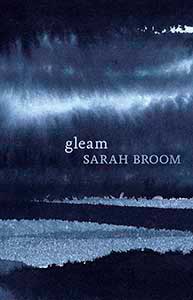
At the Auckland Writers Festival on Sunday, Sam Hunt announced the winner of the inaugural Sarah Broom Poetry Award.
Michael Gleissner spoke about the genesis of this award in his introductory remarks. He wanted to create something in honour of his wife, poet Sarah Broom (1972-2013) that would benefit the poetry community. This award is his invention with the help of various friends of Sarah’s from around the world. He worked hard to get funding and to put the award in place.
On the entry form, Michael made the aim of the award clear: That the award was to honour a NZ poet whether established or emerging and to provide a financial contribution towards writing a poetry manuscript. This then is an award open to any NZ poet regardless of age, style, experience or location.
I was delighted and moved as a friend and admirer of Sarah and her work to be part of the award panel. More than anything I wanted to help get this award off the ground in any way I could. My background role was to make suggestions for Sam Hunt, and to do any jobs that cropped up (such as filming Karl). It was an absolute pleasure to read all the submissions and as I have already said on this blog it prompted me to start a new feature, Poem Friday. I want to put you in touch with some of the astonishing poetry I have come across and will come across. NZ poetry is thriving.
On this occasion, Sam Hunt was Head Judge (or Chief Judge as he wittily said on Sunday) and it fell to him to pick the winner and indeed have the final decision on the shortlist–no easy task.
What blew me away about the Sunday session was hearing three very fine poets read. I am already a long-time fan of the poetry of Emma Neale but to hear the musicality of those poems lift and soar through the air again made my skin prickle. I had not heard Kirsti before (bar a YouTube clip) but I now have her voice in my head with all its gorgeous intonations and I cannot wait to see her get a book out. I had filmed Karl but found myself catching my breath as he began to read. At his home I had been wondering if his cat was going to leap onto the couch (just as he read the word ‘cat’) but she settled back on the floor (or he!).
In my School Session on the Wednesday, I talked about two NZ writers who have shaped me as a poet. Yes, we were doing ‘sound’ and I was exploring the way poetry hits and hooks the ear– so to talk abut the aural delights of Margaret Mahy and Bill Manhire was so perfectly apt. But these two writers have also gifted us with a generosity that is humbling– a way of inhabiting the world with empathy, attentiveness to those around, an ability to listen to others, to support and promote, to be good and to be kind, to be gracious, to celebrate the power and versatility of words. It seemed to me I saw this in Emma and Kirsti. They embraced the ethos of the award to honour, celebrate and promote poetry. I was in awe of their graciousness and aplomb. And I found Karl’s speech very moving, particularly when he said he hoped the award would keep the name and poetry of Sarah alive to us all (off the cuff, a second after I told him he had won!).
Awards are tricky things– they bring out the best and the worst in people (thus the barrage of aggressive texts, emails and face-to-face comments I have endured over the past weeks and yesterday).
I want to thank everyone who has, in the spirit of the Award, remembered Sarah (and her poems!), who has opened up to the glorious poetry of the three finalists, and who has witnessed the way poetry can touch us. I did feel a little sad at the end of the session, I was holding onto my memory of Sarah, as I was hugging my publisher. I cannot thank Michael enough for the extraordinary amount of work he has had to do in what must have been a demanding and difficult year for him and his three young children. And to the real treat of getting to know Dr Sarah Ross, the other panelist judge, from Victoria University. The poetry community has benefited from this– not just the winning poet and not just the three finalists.
Thank you.
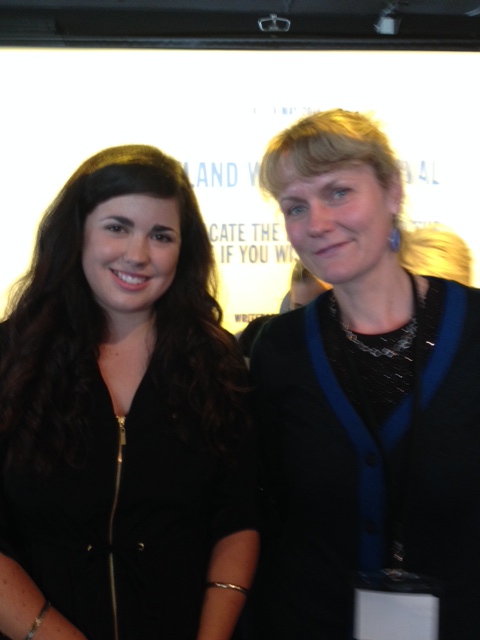
from my IPhone on the day (just learning!):
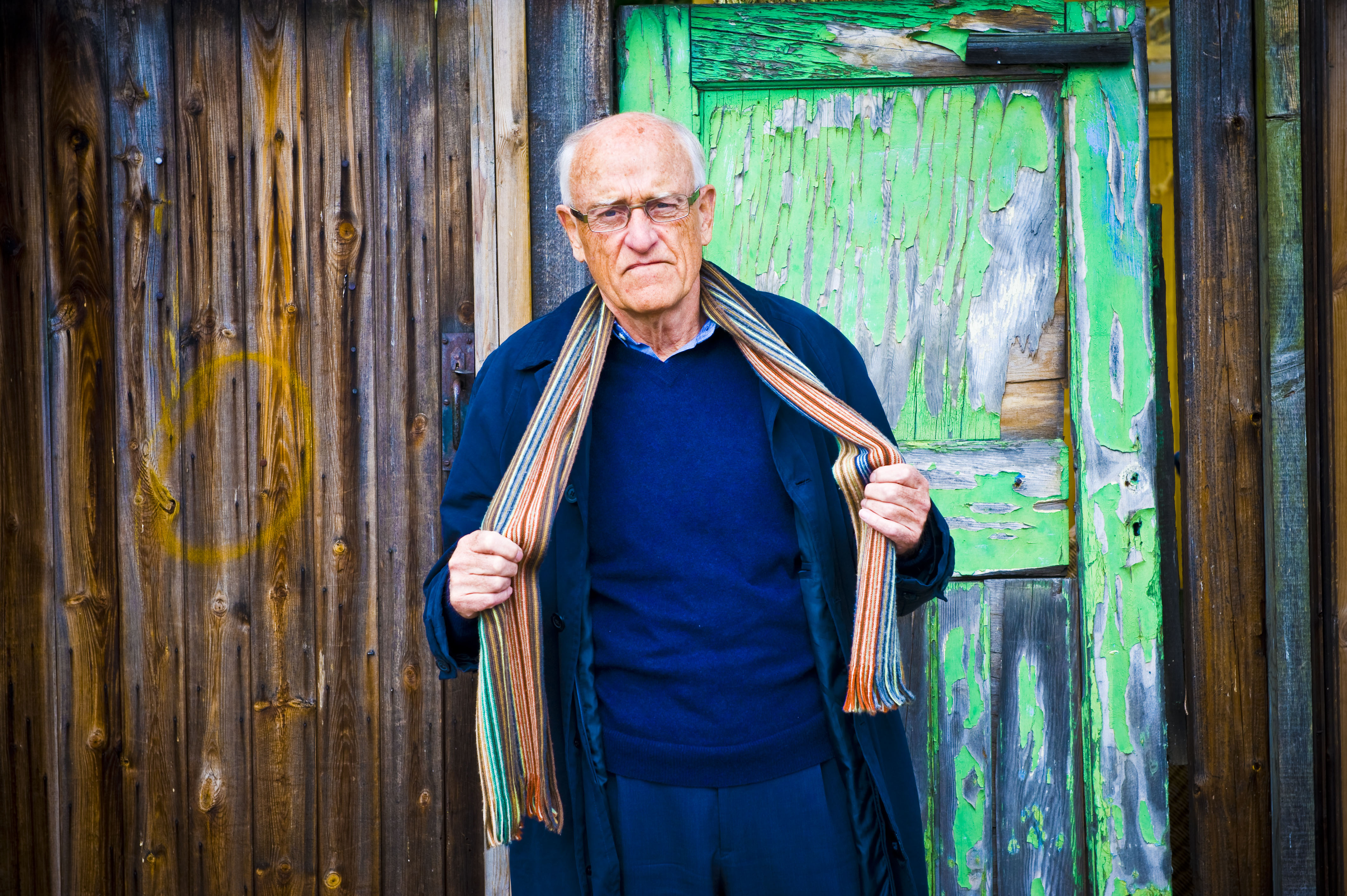
C.K. Stead was announced as the winner of the inaugural Sarah Broom Poetry Prize at the Auckland Writers’ Festival on Sunday 18 May.
Stead is one of New Zealand’s most prominent writers and critics, as well as a recipient of New Zealand’s highest honour (the Order of New Zealand), and the 2009 Montana Book Award for his Collected Poems, among numerous other awards.
The iconic New Zealand poet Sam Hunt was the invited guest judge for 2014.
“Sitting in judgement on 3000 odd poems by 300 odd poets is a daunting task”, writes Hunt. “When poems of the voice and presence of Karl Stead’s – and, to varying degrees, the poems of all my ‘top lot’ -come along, those hours of reading/listening, become more than worth the while. They become a total pleasure. Stead’s poems, particularly, did just that.”
Stead accepted the award via video on Sunday, as he is currently in Europe. “One is always delighted to win a literary prize”, he says, “but this a very special one because Sarah Broom was a special person. I admired her poetry hugely and I wish I had met her personally.”
“It’s a delight and an honour. I understand that this was a strong field — so that’s reassuring at my age to be told that you are still in business.”
“I am delighted to have won, and i hope that the award continues and that it keeps, along with the poetry itself, the name of Sarah Broom alive to us all.”
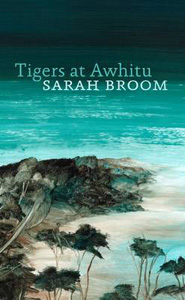
The Sarah Broom Poetry Prize was established this year to celebrate the life and work of Sarah Broom (1972-2013), the author of Tigers at Awhitu and Gleam. The aim of Sarah’s husband, Michael Gleissner, was to create an award that would honour a New Zealand poet, whether established or emerging, and that would provide financial support towards writing a poetry collection.
The award of $12,000 was announced at a dedicated event at the Auckland Writers’ Festival, where shortlisted poets Emma Neale and Kirsti Whalen also read from their work.
 NZ Poetry Shelf