Tag Archives: Chris Tse

The Ockham NZ Poetry short list- two reviews, an interview and a book in my bag

I am heading off to Wellington this morning to go to A Circle of Laureates, the Lauris Edmond prize event and do a smidgeon of reading in between. Thought I would share these first:

1411440756602

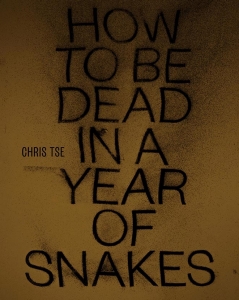
How to Be Dead in a Year of Snakes Chris Tse, Auckland University Press

Chris Tse is a writer, musician and actor whose poetry first appeared in AUP New Posts 4 (Auckland University Press, 2011). He resides in Wellington, his home town.

Chris’s debut collection, How to Be Dead in a Year of Snakes, responds to a moment in history not so much by narrating that history but by installing a chorus of voices. He takes an event from 1905 when Lionel Terry went hunting for a Chinaman in Haining Street, Wellington and ended up murdering Joe Kum Yung. Within the opening pages, the chilling event is situated in a wider context where laws proscribe the alienness that situates  Chinese as outsiders. This is what gets under your skin as you read.

The poems draw upon and draw in notions of distance, defeat, guilt and forgiveness. There are the unsettled imaginings of what it is to be home, to be at home and to be out of home to the extent that home becomes difficult and different. Mostly it is a matter of death (and casting back into life) whereby phantoms stalk and cry about what might have been and what is: ‘You spend your thoughts drowning in your family-/ missing from this vista- and contemplate a return with nothing to show/ for your absence.’

The collection harvests shifting forms, voices and tones that promote poetry as mood, state of mind, emotional residue. Yes, there is detailed evidence of history but this is not a realist account, a story told in such a way. Instead the poetic spareness, the drifting phantom voices give stronger presence to things that are much harder to put into words. How to be dead, for example. How to find the co-ordinates of estrangement, of that which is unbearably lost and is hard to tally (family, home, what matters in life). On page four you move from a matter-of-fact representation of the law to page five and the wife in Canton (‘you carry her bones in your body’). Two disparate but equally potent aches.

For the rest of the review see here


OLYMPUS DIGITAL CAMERA       $_35


From an interview I did with David Eggleton last year:

I love the title of your new collection (The Conch Shell, Otago University Press). The blurb suggests that this collection ‘calls to the scattered tribes of contemporary New Zealand.’ What tribes do you belong to? What literary tribes? How does the word ‘contemporary’ modify things?

Yes, I’m blowing my own (conch) trumpet at sunrise. That title refers to tide-lines of life, to surf-like sounds, to gathering good vibrations, to gods of the sea who, clarion-like, lull the waves, and to the summer of shakes, the year of quakes. And so on, to the final burnout of the run-ragged consumer. The rest is the tribal outcast, and everything you cannot pin down, or ascribe a bar code to.

In fact, the word ‘tribe’ is fraught. I think James K. Baxter brought it into the literary realm. My own tribal background is distinctly heterogeneous rather than Fonterra-homogenous, but if I look around at my contemporaries, poets and otherwise, I see most of them making it up as they go along. A poem tests a proposition; it doesn’t always prove it.


These new poems offer shifting tones, preoccupations, rhythms. What discoveries did you make about poetry as you wrote? The world? Interior or external?

My poems like to dwell on the silver wake of a container ship, or the wet sand beneath the upturned hull of a dinghy, or the half-seen, the overheard. Poets re-arrange, but they have duties of care. X.J. Kennedy has pointed out that: ‘The world is full of poets with languid wrenches who don’t bother to take the last six turns on their bolts.’

It’s been five years since my last poetry collection Time of the Icebergs appeared, and one reason my collections have been regularly spaced that far apart is the need for more elbow-grease and line-tightening to get the burnish just so.

The poet’s mind, like anyone else’s is made up of reptilian substrate, limbic empathy and neo-cortical rationality. These shape your reveries and hopefully together lift them out of banality. Our ideas are dreams, styles, superstitions. We rationalise our temperaments, draw curtains over our windows, but poems carry an anarchic charge that reveals the force that through the green fuse drives the flower.

A poet is in the business of the unsayable being said, showing you fear in a handful of dust. A poet is amanuensis to the subconscious ceaselessly murmuring, and indeed to the planetary hum, the gravitational pull of the earth, the wobble of placental jellyfish in the womb — anything alive, mindless and gooey.


Is there a single poem or two in the collection that particularly resonates with you?

Every poem resonates on its own wavelength, but I found constructing an immediate elegiac response to my father’s death one of the most turbulent. A bit like getting to grips with a storm, with a howling wind that has shape and substance.


Returning to the notion of detail, I see the accumulation of things in your poems as an overlay of highways to elsewhere whether heart, issues, ideas, fancy, memory. Yet the things also pulsate as things in their own right. What draws you to ‘the thisness of things’ (the blurb)?

Things accumulate in my poems in almost haptic fashion, wrestled there like sculptural ingredients. They accumulate, as in the random haphazard assemblages of the Dadaist Kurt Schwitters, built out of found objects in the streets. Yes, I want to acknowledge the ‘thisness’ of things, but not in the sense of ‘property’. Rather, in the sense of: he who kisses the joy as it flies, lives in eternity’s sunrise.


For the complete interview see here


Tim-FB 9780473288396-TU

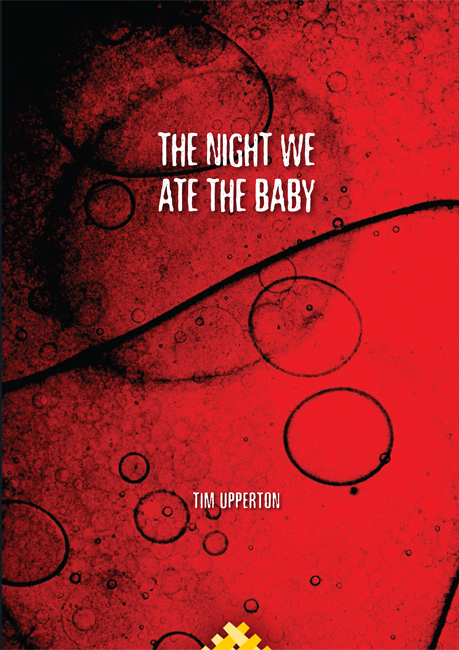
Tim Upperton, The Night We Ate The Baby HauNui Press, 2014

Tim Upperton’s debut poetry collection, A House on Fire, was published by Steele Roberts in 2009. Since then, his poetry has been published in numerous journals and he has won awards for a number of them. The poems for this new collection were written with the assistance of a Doctoral Scholarship from Massey University of New Zealand, so perhaps they form/formed part of his doctoral submission. Tim will be reading as part of the Haunui Press ‘Deep Friend Poetry Reading’ series at Vic Books on 26th March. Details here.

This latest book is unlike any other collection I have seen in New Zealand; chiefly in terms of the measure of discomfort. The forms are various, scooping an edgy wit into prose blocks, villanelle, triplets, couplets and freer patterns. Yet there is connective glue at work here, and that is what makes this collection stand out. I think it comes down to voice (whether or not it is the personal voice of the poet doesn’t really matter) because the voice steering the poems is sharp, forthright, witty, edgy, grumpy. It unsettles. It keeps you on your toes. On the back of the book, Ashleigh Young suggests that ‘[t]hese willfully, calmly disagreeable poems have tenderness and courage at their heart.’ I would agree. Therein lies the pleasure of reading these poems; there is more to the brittle edginess than meets the initial eye.

The first poem, ‘Avoid,’ very clearly announces that this is a poet who loves language, that is unafraid of rhyme and rhythm working arm in arm. The poem is a miniature explosion of sound effects — with sliding assonance, bounding consonants, near rhyme and sumptuous aural connections. It brought to mind the refrain in Don McGlashan’s song,  ‘Marvellous Year,’ and Bill Manhire’s glorious ‘1950s’ in the use of rhythm and rhyme, and aural trapeze work that is ear defying. Whereas Don’s song represents a potted portrait of the world in all its warts and glory (in a marvellous year), and Bill’s poem is a nostalgic recuperation of things, Tim sets up the collection’s  negative disposition and itemises things to avoid!

For the rest of the review see here


ghost_cover_front__73226.1427153026.140.215   ghost_cover_front__73226.1427153026.140.215   ghost_cover_front__73226.1427153026.140.215

Roger Horrocks Song in the Ghost Machine

I haven’t read this book! Last year I picked it up to review then found something about it was very close to a fragile starting point I had for a book in my head. I can’t talk about poems I am writing until they are written. I didn’t want to scare my starting point off so left in the pile to read.

Now that I am hard at work writing about NZ women’s poetry, my starting point is in a little holding bay where it may or may not survive. It has been there for over a decade though and has moved to second place in  a queue.

So I am throwing caution to the wind and taking this book to read on the plane.


My thoughts: 2016 Ockham NZ Book Award Poetry short list

Congratulations to all those who make the short lists! Especially in a year that was larger than a year.

Here is the short list for poetry, see below for other categories.

Poetry
How to be Dead in a Year of Snakes, by Chris Tse (Auckland University Press)
The Night We Ate the Baby, by Tim Upperton (Haunui Press)
Song of the Ghost in the Machine, by Roger Horrocks (Victoria University Press)
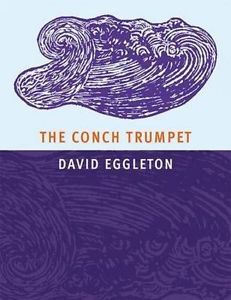
The Conch Trumpet, by David Eggleton (Otago University Press)
Would this be my list? No! But that doesn’t mean a thing. Book Awards will always reflect the predilections of the judges. And there are some strong collections here that I have reviewed and loved. Great to see Chris’s debut collection make the cut.
Good to see a small press make it along with the big presses who continue to show an admiral devotion to poetry.
Whom do I mourn? Emma Neale’s extraordinary collection, Tender Machines. Ahh!
I haven’t read many of the novels that made it but how I adored Anna Smaill’s The Chimes that did not. Sorry to be a party pooper on that one.
And how good to see Fiona Farrell and Lynn Jenner make the non-fiction list. I reviewed both those books on the blog and thought they were standout examples of how we can write about the world, catastrophe, home.
Fiction plus poetry equals one woman out of eight.  No women poets. Does this mean the men wrote all the best books in the past year? No way!
Is NZ literature in fine heart? Utterly yes. Astonishing books missed the long lists in both poetry and fiction. We are publishing such quality writing it makes judging almost impossible for Book Award Judges.
For those that missed out, good books have a life beyond book awards. Astonishing books are bigger than book awards. Remember that.
For those that have been picked, enjoy the well-deserved moment, then let the white noise settle and get on with what really matters. Writing.
The 2016 Ockham New Zealand Book Awards finalists are: 
Fiction
The Back of His Head, by Patrick Evans (Victoria University Press)
Chappy, by Patricia Grace (Penguin Random House)
Coming Rain, by Stephen Daisley (Text Publishing)
The Invisible Mile, by David Coventry (Victoria University Press)
Poetry
How to be Dead in a Year of Snakes, by Chris Tse (Auckland University Press)
The Night We Ate the Baby, by Tim Upperton (Haunui Press)
Song of the Ghost in the Machine, by Roger Horrocks (Victoria University Press)
The Conch Trumpet, by David Eggleton (Otago University Press)
General Non-Fiction
Maurice Gee: Life and Work, by Rachel Barrowman (Victoria University Press)
The Villa at the Edge of the Empire: One Hundred Ways to Read a City, by Fiona Farrell (Penguin Random House)
Māori Boy: A Memoir of Childhood, by Witi Ihimaera (Penguin Random House)
Lost and Gone Away, by Lynn Jenner (Auckland University Press)
Illustrated Non-Fiction
Te Ara Puoro: A Journey into the World of Māori Music, by Richard Nunns (Potton and Burton)
New Zealand Photography Collected, by Athol McCredie (Te Papa Press)
Tangata Whenua: An Illustrated History by Atholl Anderson, Judith Binney, Aroha Harris (Bridget Williams Books)
Real Modern: Everyday New Zealand in the 1950s and 1960s, by Bronwyn Labrum (Te Papa Press)
The Fiction category is judged by distinguished writer Owen Marshall CNZM, Wellington bookseller and reviewer Tilly Lloyd, and former Director of the Auckland Writers Festival and former Creative New Zealand senior literature adviser Jill Rawnsley.
The Poetry Prize is judged by former Auckland University Press publisher Elizabeth Caffin MNZM, Dr Paul Millar, of the University of Canterbury, and poet and University of Auckland academic Dr Selina Tusitala Marsh.
The General Non-Fiction Prize is judged by Metro Editor-At-Large Simon Wilson, Professor Lydia Wevers, literary historian, critic and director of the Stout Research Centre at Victoria University of Wellington, and Dr Jarrod Gilbert, a former Book Awards winner for Patched: A History of Gangs in New Zealand, of the University of Canterbury.
The Illustrated Non-Fiction Prize is judged by former publisher Jane Connor, publisher of the magisterial The Trees of New Zealand, which won the Book of the Year award in 2012, Associate Professor Linda Tyler, Director of the Centre for Art Studies at The University of Auckland, and Leonie Hayden, the editor of Mana magazine.
The winners (including of the four Best First Book Awards) will be announced at a ceremony on Tuesday May 10 2016, held as the opening night event of the Auckland Writers Festival. The awards ceremony is open to the public for the first time. Tickets to the event can be purchased via Ticketmaster once festival bookings open on Friday 18 March.

Tastes of Ika 3 – Ika 4, a few days left for submissions

IMG_3027


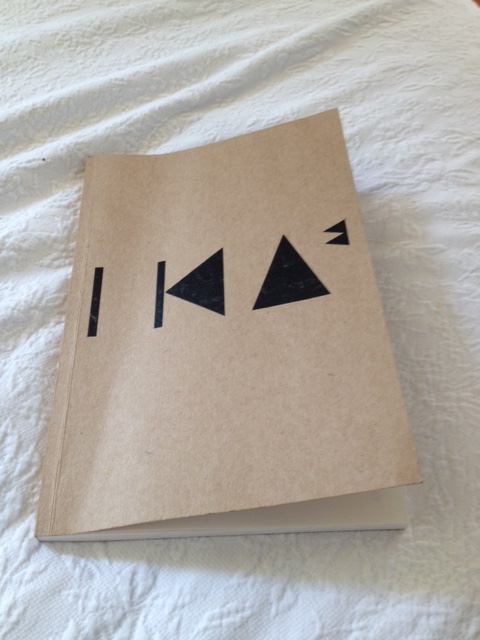
Ika 3 looks cool. It is the literature and arts journal from Manukau Institute of Technology and is edited by Anne Kennedy. Anne is a poet and novelist and she is about to head to Victoria University where she will be the 2016 Writer in Residence.

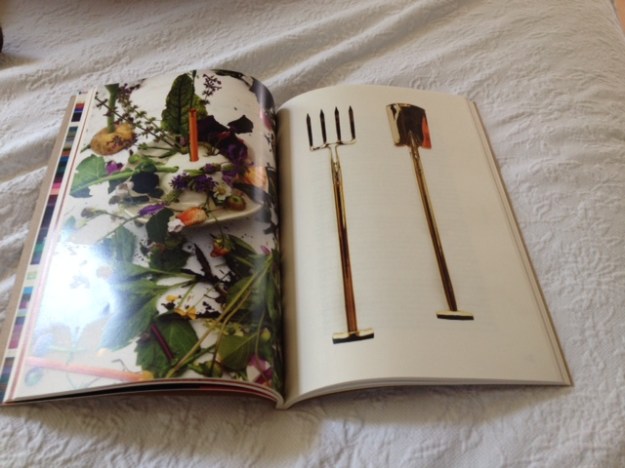
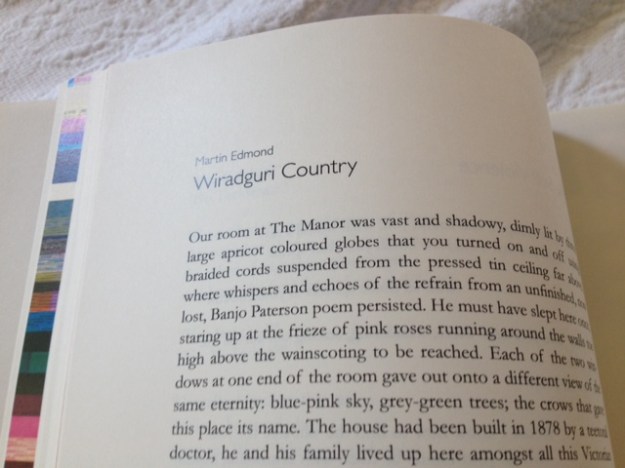
The internal design is fresh. The issue looks like it is wrapped in brown paper. It feels slightly rough to the hand. It features prose, poetry and art from students and staff, and stretches out to include work by well known writers from both here and overseas.

The mix is eclectic. There are appealing grades/gradients of lyricism and subject matter, but what makes this issue pop out from others is the political elbow that juts out, the raw angles, the Pacific Island presence. Compared with this journal, others seemed saturated in white. To have such diverse reading lines in to brown skinned voices makes this newish journal a vital presence within our writing/reading options.

A bundle of poets made me snap to attention. I love the playfulness of Tusiata Avia’s ‘We are the diaspora of us all’ where play becomes play with a potent bite. I love the way Chris Tse’s ‘This house’ is inventive, detail rich, personal, kinetic and catches both heart and mind. Faith Wilson’s ‘Echo (bootleg remix)’ is a poem bisected in two and the interplay of dual voices is sharp, hard, heart hitting. You need to read again to find different paths. Donovan Kūhiō Colleps wraps place and moment so acutely in ‘Muscular Dreams,’ and I love the way lines coil and repeat. J A Vili’s ‘Mother’s Rope’ is spare, just a handful of words on the page, but it is the white hot core of the issue. Sophie Van Waarden’s ‘Water Girl’ confirms that this young poet writes with linguistic grace, verve and surprise and is an emerging poet to watch.

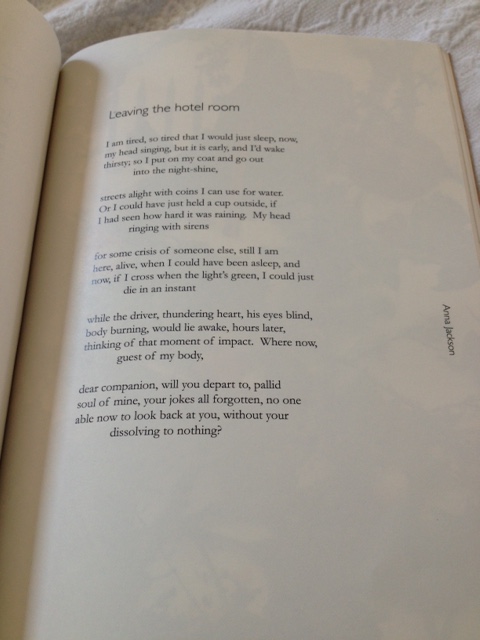
There is much more. See some treats below in the photos, including Anna Jackson’s surprising ‘Leaving the hotel room.’ This journal is worth a subscription! The art is mind catching as well as eye-catching. Again I come back to the words fresh and vital.


Work is about to start on the next issue. Submissions for Ika 4 are due by February 1st.

Submit here.

Submission details:

We invite submissions across Moananui for Ika 4 from emerging to established practitioners in the fields of writing (poetry, prose fiction, non-fiction), performance, and visual art.

Ika 4 will be published in print and accompanied by a website for moving image and performance, to be launched as part of the Auckland Writers Festival in May 2016.

Electronic documents are preferred, but printouts together with a self-addressed envelope may be mailed to: Ika Journal, Faculty of Creative Arts, Manukau Institute of Technology, Private Bag, 9400, South Auckland Mail Centre 224, New Zealand.

Video works must be in the form of mp4 files and can be submitted via private Vimeo / Youtube links.

The submission limits are: eight poems, eight images, three video/performances, 7,000 words of prose.

Inquiries to: ikajournal@gmail.com

Editor: Anne Kennedy
Arts Editor: Richard Orjis

IMG_3028

IMG_3029

IMG_3032

IMG_3030

AWF15 bouquets and brickbats

This morning I ran along the beach into the hit of the west-coast wind, and it felt like a hinge between four glorious days at the Auckland Writers Festival and getting back to work. As I ran, I pictured myself asking Murakami running questions. Where does he like to run? Is it in a wild space where you hardly see another soul as I do and your mind empties as the rhythm of the run takes over. You might see a puffed up dotterel out of the corner of an eye or a pied stilt wading. The rhythm of the run sends me into a pre-writing state but mostly it is is just me and breathtaking beauty.

This morning as I ran it took awhile to get into that equilibrium of silence as the festival keep drifting through. What I loved. What I loved a little less.


My bouquets in no particular order

1. To Anne O’Brien and her team for creating a dazzling programme that pulled me out of hermithood into the city for four full-to-the-brim, glorious days, that filled an auditorium over and over, that offered free sessions. This was one of the best festivals I have attended yet in terms of the range and quality of voices on offer. The audiences.

2. The new dedicated focus on children’s writing with the School Days, Family Day and sessions featuring a children’s author. I was coming out of a session and saw David Walliams at his signing table and was incredibly moved. He was looking with careful attention at a picture a young child had drawn for him, taken the time to pause and wonder, when his signing queue had stretched out into the square at the start of my session. It seems to me the festival has also become a gift for our emerging readers and writers, our thinkers and our scientists, our comics and our leaders. Thank you!

3. The amount of poetry this year. Sure I still love a line up of ten poets like a tapas tasting lunch that shows you the terrific width of our poetry communities. But I love the way poets now read along side international authors and local fiction writers in panels. This exposes our poets to a much wider audience. One stand out for me (sadly I missed some poets I had wanted to see due to clashes) was John Dennison. I have just reviewed his stunning debut collection on the blog but his poems lifted and became even more exquisite as I listened and shut my eyes. Two poets came to mind: Gregory O’Brien and Bill Manhire. I could hear a faint, appealing somethingness  of them in John’s intonations, the pauses, the repetitions, the stresses — the downright joyous musicality. If you don’t have John’s book, I highly recommend it. Maybe you can find him reading a poem or two on YouTube.

4. More poetry. The session with Anna Jackson and Daniel Mendelsohn on translation gymnastics was fascinating. I had Anna’s new book, I, Clodia, and a bilingual edition of Catallus in my bag all weekend as I am working on a review. I think I will save some of the gems from Anna until I do the review. But hearing the poems read aloud, we all leaned forward into the beauty of them. Gorgeous!

5. The Gala Night story tellers hit the mark. Sometimes I have been at previous ones counting how many to go. Not this time. The last one spoke, the time was up and I had stayed glued to every word.

6. Mrs Dalloway: I was in awe of Rebecca Vaughan maintaining those weaving voices for ninety minutes, pulling us into the shifting detail, moods, revelations.

7. Amy Bloom in conversation with Carole Beu. I had just read Lucky Us. Sparkling, scintillating, sent me straight to the book stall to buy the short stories.

8. Kim Thúy, a Vietnamese-Canadian novelist, in the panel session on Asian Histories. I didn’t know her at all but loved the little stories that ballooned out from a single word. Loved it when she said Vietnamese don’t show the feelings so much, and that her parents never asked her how she felt, but would ask her if she was hungry, then feed her mood. Dashed to the bookstall and bought Man. This writing is astonishing and I want to read everything she has written. I bumped into her when she was talking to her friend Anne Kennedy and so she inscribed my book. Ah the joy of lucky moments at festivals.

9. More poetry. Hearing Chris Tse reading a breathtaking selection from his debut collection How to Be Dead in the Year of Snakes.

10. Some favourite chairs: John Freeman, Carole Beu, Noelle McCarthy, Catherine Robertson, Christine O’Brien, Ruth Harley (many I missed sadly).

11. The privilege of sitting on stage with Edwin Thumboo to talk about poetry and Singapore was an utter highlight. He is, as I said in the session, like Margaret Mahy was, and Michele Leggott and Bill Manhire are: writers whose work fills you with endless admiration but who also occupy the world as writers in a way that is extraordinary. He is a Singaporean national taonga, so how good he read and spoke to a packed house. We barely scratched the surface of what we could have traversed, but to hear his poems hit the air/ear was such a treat. Preparing for the session sent me on new paths of thinking. I am so grateful to the festival for this opportunity.

12. David Mitchell in two sessions. In the first he was jet lagged and in the second, in a panel. Here are some of the gems I loved: He used to make his own Middle Earths with card and paper. He was a low maintenance kid! He stalled on a sip of tea then talked on the über novel, then cautioned new writers to be careful naming things as the name sticks. On character: A character moving into a new book brings a suitcase of credibility from previous ones. On discussing how to pronounce ‘archipelago’ with Catherine Robertson,  they both slide into an hilarious word jam. On links between books: there are doors wormholes tunnels from one book to next but not many. Ponders on how to make many different things coexist in one book: one way is to compartmentalise. He apologises for bringing his wife into the discussion (she was back stage!) on entering the female mind as a writer of his protagonist. He has five friends on earth, three of whom don’t read him! Question: Do you have an attic mind?  Mitchell: a junk shop mind. On names: high scrabble scores generally make useful names. They stick to the eyeball.  On the intensity of writing: You get through the intense immersion of the current novel underway ‘with little kisses of thinking about the next one.’ On fear: you should go outside your comfort zone. Have I bitten off more than I can chew? is important. He offered to read a Stephanie-Johnson draft when she said showing unfinished novels to others was an imposition. He said he wasn’t a novelist; he writes novellas with bridges and tunnels between. [I love this idea the connection can go through air or underground!].

13. Emily St. John Mandel on editing: Retype your entire draft, read the whole thing aloud to yourself, edit pages in random order.

14. Helen MacDonald. Now I have to read her book, H is for Hawk. Things I loved she said: We use nature to prove our concepts to us. On the joy of festivals: They let thoughts and words be said that aren’t normally available in everyday life.  There’s no past or present when you are flying a hawk. When you have a big loss: After a year of grief, I started to grow around the holes. It was all about love.

15. Carol Ann Duffy. Carol Ann Duffy. Carol Ann Duffy.  Carol Ann Duffy. Hearing her read. And loved this bit from John Campbell on the joy of reading her poems: (can’t quite remember exact words) but ‘drilling down into your particular way of knowing.’

16. The fabulous Tim Winton: I  think perhaps people are wired to hope.

17. Hearing Ashleigh Young read her remarkable new poems, especially the casino one and the road one. They felt like a glorious step up from her debut. Fresh, elastic, lyrical, effervescent, surprising. I am going to post one on the blog as soon as possible so I can talk about it. I do hope a new book is on the horizon line.

18. Anne Kennedy talking about Janet Frame’s Owls Do Cry, the Great Kiwi Classic this year. She was so lucid, so on the button, with what she said. Reading the book for her was like a sock between the eyes. She loved the way the vernacular had been transformed into the poetic, but that it was above all a triumph of kiwiness. Anne said Janet rescued kiwiana and polished it like a gem. For Courtney Sina Meredith reading it was like a rite of passage. She said she was terrified of it at university (if you can’t get into this, you can’t get into New Zealand literature) but then she became deeply connected. Wonderful! Damien Barr cried after he read it (hearing his autobiographical anecdote I am not surprised). Great session steered by Kate De Goldi, but more audience involvement would have been good. I think that is the intent of the NZ Book Council that it becomes a very interactive session.

19. The Honoured NZ Writer: CK Stead. Wonderful movement through his life and career. Loved the poems breaking into the conversation. Like the way he said Catallus gave him a persona where he could go to the edge of things that had sometimes happened to him, or that were an invention. It became an area of freedom when he was not mentally a confessional poet. He had returned to NZ because he wanted to be a NZ writer and turned down the option of a very different academic career in Britain. He doesn’t regret it but sometimes ponders the possibilities of that different track.

I have been especially drawn to Karl’s recent poetry collections, their reflectiveness, musicality, ability to matter and move. You saw that a bit in the conversation. On being a critic: I was too dogmatic, too excited, things could have been said more subtly. I discovered what it was like to be characterised by what was a small part of me. On rereading Death of the Body for this ‘ordeal’ decided it was so much cleverer than I am now. A terrific way to end the festival.

20. Hearing fabulous Irish poet, Vona Groarke read her own poems and talk so beautifully about the finalists in the Sarah Broom Poetry Awards. I am so tempted to get to Wellington to hear her talk and read for a whole hour!

21. Stepping into the shoes of Alice Miller to read her finalist poems at The Sarah Broom Poetry Awards. I was amazed at how reading the poems of another poet out loud in front of an audience drew me so much closer into the very heart of them. The poems were breathtakingly good. I should do this more often. Find a special place to stand and read aloud the poems of another.

22. Ah! Murakami. Ah what a tremendous session. Ah! Ah! My daughter gave me some of his novels to read over summer and I was hooked. How had I not read him before? The outright surprise, wonder and delight of where he leads you. So to find out he was coming to the festival was the absolute highlight. I loved the fact he wrote his first novel and cast it into the bin as dreadful. He then wrote it in English as he had a limited vocabulary and stock of phrases. He translated it back into Japanese and achieved the simplicity, the economy and clarity of writing that is now his trademark. He likes his writing to be unpredictable to himself, which it is why it is so gloriously unpredictable to the reader. He feels he can be anybody when he writes (not all writers feel this!). He enjoys reading his books that have been translated into English (a few years after the original) as it is like reading it afresh and he can’t remember what happens. He likes Japanese tofu and donuts! Maybe a tofu donut! The chair, John Freeman, was exceptional. What made this session so utterly special were the silences, the long pauses that became little pivots of contemplation for both speaker and audience. One writer said Murakami says more in his silences than some writers say with truckloads of words. The t shirt he was wearing:

Keep

calm

and

read

Murakami


23. The volunteers, the lovely stage crew, the festival team and of course all the readers and writers who filled the Aotea Centre with a buzz of ideas and response. Astonishing!

Thank you thank you thank you


The brickbats that aren’t really brickbats at all

I. I wish Anne O’Brien could get to see more than the odd session. To sit back and enjoy the fruits of her labour.

2. Missing out on a ticket to The World’s Wife. My fault. From all accounts it was fabulous.

3. I was a chair, so feel free to criticise me (like all chairs I walked away wondering how I could have done a better job!), but sometimes the research and commitment as chair takes over whereas it should take the back seat along with your own ego. It seems we now live in an age where audiences have no problems in letting a chair know when they are dominating the conversation. Fair enough maybe, as it keeps us on our toes. The other tricky thing is that the audience will be a clashing mix of expectation, and equally varied mix of experience of the subject and writing under the spotlight. We are all different kinds of readers searching for different things. The sessions where the writers opened out into a warm and and sparking conversation were gold.

4. Why didn’t I run to the free sessions to make sure I got a seat?! Missed out on a few gems.


Chris Tse’s How to Be Dead in a Year of Snakes — At times it feels like the intake of breath associated with the silence you grant the dead

1411440756602

How to Be Dead in a Year of Snakes Chris Tse, Auckland University Press

Chris Tse is a writer, musician and actor whose poetry first appeared in AUP New Posts 4 (Auckland University Press, 2011). He resides in Wellington, his home town.

Chris’s debut collection, How to Be Dead in a Year of Snakes, responds to a moment in history not so much by narrating that history but by installing a chorus of voices. He takes an event from 1905 when Lionel Terry went hunting for a Chinaman in Haining Street, Wellington and ended up murdering Joe Kum Yung. Within the opening pages, the chilling event is situated in a wider context where laws proscribe the alienness that situates  Chinese as outsiders. This is what gets under your skin as you read.

The poems draw upon and draw in notions of distance, defeat, guilt and forgiveness. There are the unsettled imaginings of what it is to be home, to be at home and to be out of home to the extent that home becomes difficult and different. Mostly it is a matter of death (and casting back into life) whereby phantoms stalk and cry about what might have been and what is: ‘You spend your thoughts drowning in your family-/ missing from this vista- and contemplate a return with nothing to show/ for your absence.’

The collection harvests shifting forms, voices and tones that promote poetry as mood, state of mind, emotional residue. Yes, there is detailed evidence of history but this is not a realist account, a story told in such a way. Instead the poetic spareness, the drifting phantom voices give stronger presence to things that are much harder to put into words. How to be dead, for example. How to find the co-ordinates of estrangement, of that which is unbearably lost and is hard to tally (family, home, what matters in life). On page four you move from a matter-of-fact representation of the law to page five and the wife in Canton (‘you carry her bones in your body’). Two disparate but equally potent aches.

At times the poems are syncopated, with words stretched over little bridges of silence or white space. It adds an accumulating breathlessness. At times it feels like the intake of breath associated with the silence you grant the dead. When you stop and remember. Thus (as it appears in one poem), it also becomes static: ‘Listen: there’s a hunger in the air. It’s reciting prophecies./ It’s doubled up.’

Many lines sing out and stick as they haunt:

‘to kill a man is to marry a shadow’

‘We must divide the world around us into safety sets or else it splinters/ of its own accord into anarchy.’

‘The world is full of murder and words are usually the first to go’

‘Peace is a loose ideal for the abandoned/ left to sing their songs/ to themselves’

‘there will be voices to say your name/ to clear the way. The rest is up to you.’

There are many vessels of emptiness (the body, the head, the memory, the thing) and in a way each poem is a version of a vessel that becomes provisionally and movingly full. Just for a moment: ‘Now your onus is to surround/ yourself in objects    of your former permanence// a bone flute that stores folk songs and lullabies within,/ chopsticks that remember the taste of every meal.’

This collection shows so beautifully, so movingly, the power of poetry to give renewed presence to history; so that the silent bridges billow with a new awareness of how we get to this point.

Thanks to AUP I have a copy of the book for someone who likes or comments on this post.

Hear Chris read from the book

AUP author page

Updated From Poets and Fans of Poetry: Favourite poetry reads of 2014

I am not sure if two lists make this an annual event (so I resisted temptation to put ‘annual’ in the title!), but here are the books that have stuck with local poets and fans of poetry in the past year. Unlike most ‘best of 2014 book lists’, the invitation is to select favourite reads no matter where or when those reads were published. The only limitation—this is a poetry list.

Over summer, I will muse over the future of my two blogs. If I do decide to keep them running, I will make a few changes changes to clear space for my own writing time. One thing is certain, I can never review all NZ poetry books on this blog. I have a huge stack of books I want to review, but know I can only do a handful over the next few weeks.  I guess with the scarcity of poetry reviews in New Zealand, I feel pressure to share all the wonderful writing that I discover.  I would certainly be keen to post reviews and musing by other poets.

Thanks to everyone who contributed to this list at a time when we all have such busy schedules, and thanks to everyone who contributed to the blog over the past year. It wouldn’t work with out you. Thanks, too, to everyone who shared my posts on social media and who followed both this and NZ Poetry Box.

John Adams:

The Life-guard, Ian Wedde, AUP.

Stark metaphors, sustained muscular writing that disturbs. A strong surface with an underbelly that provokes contemplation and rewards reflection. The final group “Shadow stands up” successfully blends quotidian observation with humour. Stuff to savour.

Autobiography of a Marguerite, Zarah Butcher-McGunnigle, Hue & Cry Press.

The disquieting disclosures of these poems builds a unique experience of family; patterns of mother and daughter; trials of close binding. How can we be, with such context? A journey to a foreign part.

Fearing the Kynge, Bernard Brown, Foundation Press (c/o 14 Birdwood Crescent, Parnell.

A short collection around Henry VIII and those who passed through his life, sometimes more quickly than they’d wished. Beautifully illustrated, the text ranges from the hearty pun to closely worked items that reward revisiting.

Sailing Alone around the Room, Billy Collins, Random House.

This masterly collection includes unforgettable, accessible gems. I love his riff on Blues; and any poet will weep with laughter at the enacted difficulty of Paradelle.

Rosetta Allen:

Cloudboy Siobhan Harvey Otago University Press

‘When the eye was overcast,
there could be no poetry.’

If the face was made to mirror the stars, then the entire body responds to the cloudscape that is this beautiful collection of poetry called Cloudboy. Harvey herself says ‘The body is a nest alive with new song’, and I feel it as I read her perfected lines, full of ever changing details of the atmosphere between a very special son, and an obviously devoted mother. No longer a passive pass time, cloud watching has become an active search for understanding, beauty, love and courage. And I too find myself looking up, with appreciation.
One Human in Height Rachel O’Neill Hue & Cry

‘I love that Father finds the faint trace of cyanide on his ring finger just in time and chops it off.’

I found the words of O’Neill’s poetry happily settled on the page. The humility trumpets itself without fanfare. Each poem, each line containing a neatly package surprise – I a kid in the back seat of a her car, unravelling lollies, and remembering, feeling part of the scene, included and instantly befriended. I adore the rhymes in the midst of lines, the lists that are not lists, the epiphanies that pile up until you have to let some go, the meaning where there is no meaning, and I believed every bit of it – almost.

Sarah Jane Barnett:

The Lonely Nude by Emily Dobson (VUP) An extremely beautiful collection about dislocation, identity, expectation, and the body. It traces Dobson’s own experiences of leaving New Zealand, living in the US, and her return. Dobson’s poems are spare and exquisitely crafted. She’s definitely my #1 poetry crush of 2014.

Etymology by Bryan Walpert (Cinnamon Press) Even though Etymology came out in 2009, I only managed to read it this year. As the title suggests, the poems are about the way we create meaning, not only in terms of words, but in our relationships and lives. It’s so sharp and clever that it made me want to give up writing.

Curriculum Vitae by Harold Jones (Xlibris/self published) Jones’ debut collection was my surprise of the year. Generally speaking, self published collections aren’t very good. I should have known that this would be the exception when I found out Jones has been published as part of AUP New Poets 4. Curriculum Vitae is a wonderful exploration of aging, regret, and memory. It was the only collection this year that made me cry.

Airini Beautrais:

2014 has been such a fruitful year for poetry. I haven’t quite finished reading all the wonderful local books that have come out, some as recently as last week. I have loved Hinemoana Baker’s waha/mouth (VUP 2014). And Maria McMillan’s Tree Space is an amazingly assured first full-length collection (also VUP 2014).

Diana Bridge:

For me this year has been weighted towards prose. I began it with the biography of Penelope Fitzgerald, which I interleaved with a re-reading of all her novels. Her last, The Blue Flower, was recently described with insight by Alan Hollinghurst as having ” something of the overall effect of a poem, a constellation of images and ideas.”

While I am waiting for the next collection of wonderful Australian poet, Judith Beveridge, I have been reading through her last two: Wolf Notes and Storm and Honey (Giramondo, 2003 and 2009), relishing her naturalist’s eye coupled to extraordinary and sustained imaginative powers. All her poems are filled with grace and intelligence.

Now a single poem, one I had been searching for since I first read it in the New York Review (October 7, 2004): Seamus Heaney‘s ‘ What Passed at Colonus’, written in memory of Czeslaw Milosz. I would want this to be one of the last poems I ever read.

Amy Brown:
Horse with Hat, by Marty Smith (VUP, 2014): This collection is a poignant and wry family biography. It juxtaposes earthy and transcendent subjects (the racetrack, the farm, Catholicism, war) as naturally as its stunning accompanying collages (by Brendan O’Brien) do. I especially loved Smith’s horses; I can picture the ‘dawn horses’ ‘who flatten, who scatter’ perfectly.

Final Theory, by Bonny Cassidy (Giramondo, 2014): This verse novel develops an eerie, quietly filmic atmosphere of post-apocalypse. Cassidy is an Australian poet, who wrote part of this poem while travelling in New Zealand – the landscape she describes is simultaneously recognisable and alien – a place where ‘three stilled turbines balance the space like stupas’ and ‘the ocean’s a mouthed thought’. Exquisitely clear and unsettling, it is the sort of book I’d love to write one day.

Mondrian’s Flowers, By Alan Loney and Max Gimblett (Granary Books, 2002): I stumbled upon this poetic biography of Piet Mondrian while reviewing Loney and Gimblett’s recent eMailing Flowers to Mondrian. Only 41 books were made, each with rough-cut watercolour pages and an exposed primary-coloured spine. Three long poems by Loney in tribute to Mondrian are punctuated by Gimblett’s watercolours. Reading it is a meditative act; if you’re in Wellington, I recommend looking at the copy in the National Library. Her

Rachel Bush:

Marty Smith, Horse with Hat Victoria University Press Marty Smith’s work is new to me. Rural New Zealand, family stories, and the stories of a generation are combined in her excellent first volume of poetry. It’s poignant stuff that doesn’t balk at the sorts of tough, sad realities that exist in all families.

Lindsay Pope Headwinds Makaro Press Lindsay Pope’s engaging first book of poems is very timely. Family events, like the birth of a grandchild and low key domestic things like making muesli feature in it, but he’s also drawn to write about solitary lives like that of the caretaker on Stephens Island or the man in ‘Outpost’ whose closest contact with the outside world comes through the radio he operates.

Vincent O’Sullivan Us, then Victoria University Press I enjoy the ease with which Vincent O’Sullivan can refer as easily to a Dunedin Beach as he does to lines from Robert Frost or Wallace Stevens or to the poetry of McGonagall. He investigates difficult questions, but doesn’t come up with facile, tidy answers to them.. This is a collection thoughtful, witty, sure-footed poems.

Michael Harlow Sweeping the Courtyard: The selected poems of Michael Harlow Cold Hub Press
Poems chosen from seven books of poetry by Michael Harlow make  for a lively and varied collection. He is interested in and  sensitive to how each poem looks on the page. I enjoy his distinct and often quirky voice.

Kay Cooke:
Essential NZ Poems Facing The Empty Page selected by Siobhan Harvey, James Norcliffe and Harry Ricketts. Published by Godwit. A real  treasury indeed of NZ poets. (Although I missed Tim Jones and Helen Lehendorf not being there).

Si no te hubieras ido / If only you hadn’t gone by Rogelio Gueda with translations from the Spanish by Roger Hickin and an introduction by Vincent O’Sullivan. A gem of a book with poems about distance, love and Dunedin. Published by Cold Hub Press.

You Fit The Description: The Selected Poems of Peter Olds published by Cold Hub Press. The long-awaited collection of Olds’ poetry; a prolific New Zealand poet whose background in poetry in Aotearoa stretches back to the James K. Baxter era. I’m thoroughly enjoying this book which is sure to become a classic. I haven’t finished reading it yet, but so far – It’s a cracker.

A chapbook that has both inspired and thrilled me with its re-imagined worlds within worlds, delicately traced with a steely eye, is Jenny Powell’s Trouble published by Cold Hub Press.

Ruth Arnison’s PoARTry @ Olveston (self-published) with its clever mix of paintings and words, is also a favourite from my 2014 pile of poetry.

Karen Craig:

I’m looking at the three books I’ve laid out on my table and what I notice is that they all have lots to do with the sea, seabirds, islands. And I have a wonderful feeling that if I were to pry up their covers I’d hear sounds of imaginary oceans, like when you hold a seashell up to your ear. Because, like seashells, these poets have taken the sounds of our world and clarified and amplified them, made them resonate, turned them into a deep, quiet, prolonged roar. Each with a different pitch, of course.

1. Richard Blanco Looking for The Gulf Motel, University of Pittsburgh Press 2012 (You can get it at Auckland Libraries!). Richard Blanco’s seasides are Cuba, where he was born; Florida, where as a boy he emigrated with his family; and now Maine, where he ended up for love. He sings the enigma of memory, the yearn of sorrow, the terror of romantic love. “The sea is never the same twice. Today / the waves open their lions’ mouths hungry / for the shore, and I feel the earth helpless.”

2. Michele Leggott Heartland Auckland University Press 2014. These poems burn like the hot blue stars which recur in one of them. You dive in to their mesmerising, punctuationless (as always) whirl and find at the heart a distillation of spirit that is so honest as to be unforgettable. The long poem about the introduction into her life of her guide-dog ends with the simplest of phrases, “her name is Olive”, and it’s as if a choir broke out.

3. Bob Orr Odysseus in Woolloomooloo Steele Roberts 2014. Bob Orr embraces the sacred and the profane better than anyone. From the ancient mysteries to modern gazes, from Penrose to Valparaiso, his imagery amazes me and his turns-of-phrase make me want to get down on my knees and say Hallelujah! “As the Southern Cross / salts these hours / I shiver beneath signs and wonders.”

David Eggleton:

There were a number of outstanding poetry books I read this year, but these in particular offered things which have stayed with me.

  1. Kay Mackenzie Cooke’s book-length sequence Born to a Red-Headed Woman (Otago University Press) offers a remarkable evocation of growing up in rural Southland: ‘The teacher draws close, / her own fingers cool, // narrow streamlined/ dragonflies that touch down/ briefly where my fingertips/ have begun to make mist, / What lovely moons you have, she says.’
  2. In Sweeping the Courtyard: the Selected Poems of Michael Harlow, Michael Harlow’s poems are like miniature echo-chambers, their lines teasing and entrancing with repetitions of words and phrases which resonate with subtle implications: ‘We were walking out of the park, your/ hair on fire under a full fall of moon, / the flowering almond its bridal white/ fading earlier than was remembered// I could hear, a leaf-fall of thought . . .’
  3. I was impressed by the restless inquisitive searching tone, the careful observation, in Jenny Powell’s small collection Trouble (Cold Hub), as in her poem describing the scene in a photograph ‘Guided Walking Party on the Franz Josef Glacier, New Zealand c. 1908’: ‘five women/ standing on/ frozen contortions of time/ frock hems damp/ from trailing overground undulations . . .’
  4. I was also pleasurably arrested by the precise and telling imagistic phrases that made up Hinemoana Baker’s collection waha:mouth (Victoria University Press), as for example in ‘what the whale said’: ‘ I break/ the brine, my flukes a black book// a mast in your mind/ cross of the drowned. . .’
  5. I was amused by the rhythms and rhymes forming sweet and sour stanza combinations in Tim Upperton’s poetry collection The Night We Ate the Baby (Haunui Press), as in ‘All the Things I Never Knew’: ‘Bobbie watches headlights move/ across the wall. / A little rain begins to fall — / a little rain to end the day. // It falls differently in L.A./ Choctaw Ridge is far away.’
  6. Likewise, I enjoyed the almost whispered whimsy and well-turned verses in Peter Bland’s short book Hunting Elephants (Steele Roberts), as in his dream-poem about James K. Baxter: ‘Not/ a pretty sight/ with his soup-stained beard/ but there’s a lovely/ holy glow / to his skin . . .’
  7. Tom Weston’s collection Only One Question (Steele Roberts) contains a number of extraordinary poems, especially about crime and punishment. He shows us characters who have the fatalism, or else the tragic destiny of Joseph Conrad’s characters, as in the title poem: ‘When he sends children to prison the parents go too, / trailing along like wind-ripped flags.’
  8. And, finally, I was taken with the rapping urgency of Leilani Tamu’s street-wise voice in The Art of Excavation (Anahera Press), as in ‘You’, a poem about her father: ‘. . . driving around Auckland in your crusty-as car/ a hole in your sock, an empty pocket, a heart full/ of dreams but never a cent . . .’

Laurence Fearnley:

Dylan Thomas SELECTED POEMS (Penguin Classics)

I watched a couple of science fiction/space movies recently and, in general, I found them pretty dull and really long. But, a couple of them  included poems by Dylan Thomas. The film Solaris had ‘And Death Shall have No Dominion’ and Interstellar included ‘Do Not Go Gentle Into That Good Night.’ So I found my copy of Dylan Thomas’s poems and I noticed in its introduction that Thomas is described as ‘dense and often difficult’. I don’t know about that.  I liked the imagery in some of the poems – ‘Where birds ride like leaves…’ (When I Woke)  or ‘…the shabby curtains of the skin…’ (A Process in the Weather of the Heart), for example . After reading Thomas I got out my James K Baxter and Janet Frame books and spent a while flicking back and forth between the three writers.

Joan Fleming:
I have never read anything like George Dyungayan’s Bulu Line: A West Kimberley Song Cycle (Puncher & Wattman, 2014), edited and translated by Stuart Cooke. Cooke braids a dimensional translation of an Aboriginal song-poem from many strands: the words of the song in language, traditional owners’ verbatim explanations, an ethnomusicologist’s commentary, and his own circling, cycling rendering in english. Such important work; this book is a bit of a game-changer.

Siobhan Harvey:

Alexandra Fraser, Conversations by Owl Light (Steele Roberts) is a first collection which engages with concepts of chemistry, love, botany, family, astronomy, tarot and ancestry. The author’s evocative language, pinpoint accuracy and sumptuous concern for human interaction make is a 2014 standout.

Ancestry also underpins another exciting first book, Leilani Tamu’s The Art of Excavation (Anahera Press). Excavating her family and Pacific history, the book is an entwining of legend and cultural realism.

Miriam Barr, Bullet Hole Riddle (Steele Roberts) packs a powerful punch. A triptych charting the narrator’s cruel, abusive history, it’s a book of unflinching honesty and potent impact.

Dinah Hawken:

The Great Enigma, New Collected Poems, Tomas Transtromer, New Directions Books, 2006.

This has been my favourite book for a couple of years. I’d love to be able to write like him and it would take too long to tell why.

Body English, Text and Images by Len Lye, edited by Roger Horrocks, Holloway Press, 2009.

I splashed out and bought this book a few months ago, not long after reading Roger Horrocks’ biography of Len Lye.
I knew I would love it because Lye was so extraordinary; particularly in his understanding of how the body gives rise to all creative ventures including poetry. ‘ I hold/words in the bone.’

Otari, Poems and Prose, Louise Wrightson, Otari Press, 2014.

This very new, first book by Louise Wrightson has been written slowly, close to home. Louise lives on the edge of Otari/Wilton’s Bush in Wellington and has written a book about place that is dedicated, funny and beautifully produced.

David Hill: 

I’d like to mention:  1. Ruby Duby Du, by Elizabeth Smither (Cold Hub Press, PO Box 156, Lyttleton). Smither’s enchanting poems for her new grand-daughter, which manage to combine tenderness with her distinctive cool, meticulous observation.

2. A Treasury of NZ Poems for Children, ed by Paula Green, illustrated by Jenny Cooper (Random House). Yes, I know I’m not supposed to include Paula Green’s poems, but she’s just (“just”!!) the editor of this terrific anthology which ranges from Baxter to school-kids. Exuberant, engaging, educational, and made more so by Jenny Cooper’s magic illustrations.

Bill Manhire:

Do song lyrics count as poetry? If so, I’ve been enjoying The Lines Are Open from The Close Readers (aka Damien Wilkins). It includes tracks about departed writing friends like Barbara Anderson and Nigel Cox. One of them – “The Ballad of Tarzan Presley” http://theclosereaders.com/track/the-ballad-of-tarzan-presley – makes my heart hurt yet somehow leaves me happy.

It’s been a strong year for New Zealand poetry.  So many accomplished first collections! I was pleased to see Frances Samuel’s Sleeping on Horseback (VUP) in print – I’ve been waiting for some version of this book for about ten years. Another impressive first book is Kerry Hines’s Young Country, in which the poet’s words keep company with the images of 19th-century photographer William Williams. It’s a mix that can seem easy and obvious, but is surprisingly hard to do well. Between them, Hines and Auckland University Press make the task seem effortless.

A couple of other great reading pleasures this year have been A Dark Dreambox of Another Kind: The Poems of Alfred Starr Hamilton (edited by Ben Estes and Alan Felsenthal, and published by The Song Cave) and Maurice Riordan’s new collection from Faber, The Water Stealer.  Alfred Starr Hamilton is the poetry equivalent of the apparently naïve artist, of a Chagall or an Alfred Wallis. He has an appealing clumsiness, and specialises in astonishing small moments, as in his one-line poem “Carrot”: “I wanted to find a little yellow candlelight in the garden.” Maurice Riordan manages to be lyrical and thoughtful all at once, and is also the editor of The Finest Music: Early Irish Lyrics, a handsome anthology which includes translations from Tennyson to Riordan himself, as well as a number specially commissioned for the book.

Alice Miller:

Sam Sampson, Halcyon Ghosts (AUP, 2014)
‘shadow this, take and come up/  shadow, come to the present … the sur-/ face… the Lion —– the Light  —– the Luminous’

Lee Posna, Arboretum (Compound Press, 2014)

Steven Toussaint, Fiddlehead (Compound Press, 2014)

Emma Neale:

Poetry books this year I enjoyed…. I still have many books on my bedside table that I’m still only part way through – e.g. Stefanie Lash’s Bird Murder and Hinemoana Baker’s Waha-Mouth and more and more… but of those I have finished, the memorable ones are:

Siobhan Harvey, Cloudboy – I hope it’s all right to nominate a book I edited – it’s the only one I’ll let myself name out of some other wonderful books I worked on this year – but this one stood out for the ’tensile delicacy’ with which it maintains the extended metaphor of boy and mother as shifting cloudscape; for its subtle use of line and page as physical space as well as rhythmic unit; for its music and invigorating intelligence. It is an important milestone in local publishing, I reckon, for the poise in that sustained motif; for the fact that the metaphor never feels strained or gimmicky; and for the richness of the psychology in the relationships portrayed across the developing sequence.

Alice Miller, The Limits – for its dreamy eeriness, its evocation of beauty even as it catches the jittery sense of a civilisation crumbling; for its creation of the atmosphere of dread and yet a sense of old-new mythology as well.

Michael Harlow, Sweeping the Courtyard – a selected from Harlow seems long overdue, and it’s a joy to have this now that older volumes are out of print. His sense of the surreal, the power of the subconscious, and his ear attuned to the lilt and rise of a sometimes slightly eccentric syntax shows a musical ear for how to upend where the emphasis normally falls in a line. It keeps us listening closely to the swerve and duck of words: how meaning can shimmer from one sense to another, depending on how you hold light to the line. His sense of the power of the subconscious and seems to perhaps have filtered through to a poet like Alice Miller.

Peter Olds, Selected Poems – I am a latecomer to Peter’s work, and the stretch of experience here, as well as the energetic vernacular, was both refreshing and sometimes devastating to read. Many of the poems record pushing himself right to the edge of risk, and the cost is shown to be very bleak at times – which means that the mischievous, finger-flipping humour that survives in some poems is all the more welcome.

Tim Upperton, The Night We Ate the Baby –  I kept waiting for my kids to ask why I was reading this book. They never did. I enjoyed it for its technical control and its grim, self-loathing, Beckettian humour. It reminds me a little of Simon Armitage’s work: Simon Armitage meets Wendy Cope in a horror film with dialogue done by Dylan Moran? Something like that: it leaves me a happy kind of uncomfortable.

Zarah Butcher McGonnigle Autobiography of a Margeurite – I loved the concept – sometimes I loved the concept more than individual poems, but this was a bold, adventurous debut.

Cilla McQueen Edwin’s Egg and Other Poetic Novellas –  witty, surprising, gracefully succinct, playful – the implied dialogue between archival image and the text was gorgeously unseating and sideways, sometimes; others, poignant, piquant, peppery, plangent.

Vivienne Plumb:

My favourite poetry read of this year was a copy of Paris Spleen by Charles Baudelaire, purchased at the wonderful Scorpio books independent bookstore, 113 Riccarton Rd, Christchurch.  Originally published in 1869, this new reprint is from Alma Classics Ltd, U.K. (2010). These pieces by Baudelaire are considered to be very early prose poems.
Baudelaire wrote that ‘Parisian life is rich in poetic, marvellous subjects’, and described in a letter of 1862 his ambition to make the pieces that were eventually dubbed ‘prose poems’.
Excellent!

Lindsay Pope:

Leaf-Huts and Snow-Houses by Olav H. Hauge. Pat White introduced me to this Norwegian poet. He lived nearly all his life in his native Ulvik where he worked as a gardener. His writing is simple and precise yet laced with a lot of wisdom.

Lindsay Rabbitt:

Odysseus in Woolloomooloo, by Bob Orr (Steele Roberts, 2014), 60 pp., $19.99

‘If James Joyce could reanimate Ulysses [Odysseus] on the banks of the Liffey, why not bring the wily old wanderer to the South Pacific?’ Iain Sharp posits in his review of Odysseus in Woolloomooloo (a harbour-side Sydney suburb) in the July edition of Landfall Review Online, which I tout as my favourite review of a NZ poetry book, coincidentally on my favourite NZ poetry book (that I’ve read) published 2014. I have five of Bob Orr’s eight books of verse in my bookcase, including his first, the scarce-as-hen’s-teeth Blue Footpaths, published by The Amphedesma Press out of London in 1971, and this beautifully-produced latest offering sees Orr, a boatman on the Waitemata Harbour, and one of our finest lyric poets, at the top of his game, whether retracing his boyhood homeland in rural Waikato, or recalling his Wellington days, or visiting a terminally-ill friend in Sydney, or wandering the streets of Auckland, or out night fishing: ‘As the Southern Cross / salts these hours / I shiver beneath signs and wonders.’

Jack Ross:
Char, René. Furor and Mystery & Other Writings. Trans. Mary Ann Caws & Nancy Kline. 1992. Introduction by Sandra Bermann. Foreword by Marie-Claude Char. Black Widow Press Translation Series. Black Widow Press. Boston. MA: Commonwealth Books, Inc., 2010.

This is a big, generous dual-text selection of a lot of work form the whole span of René Char’s career, from early surrealist days, though the darkness of the Vichy years in France, and into postwar existentialism and disillusionment. Char was one of Paul Celan’s favourite poets, and a close personal friend, and the affinities between the two poets are quite striking — though probably more in the mood and underlying seriousness than the surface texture of their work.

I’ve also been reading a lot of NZ poetry books this year for Poetry NZ. I tried to say something about each of them at the back of the latest issue, but you can link to the detail of my remarks.

Lisa Samuels:

A few poetry books I found in 2014, with room for more

Iain Britton, Photosynthesis (Kilmog Press 2014). A beautifully hand-made art book in 40 copies, with 20 poems that attend to the medial line between the conscious report of observed and felt phenomena and the image moment that swerves the mind.

Jill Magi, Labor (Nightboat 2014). An essay in poetry, framed as a workography, that lays bare the devastated internal landscape of university labor. The university lecturer must strain the bad faith of corporate academia through her body in order to try and make a good faith realm for students and ideas.

Alan Halsey, Rampant Inertia (Shearsman 2014). From asemic (and glossed) clinamen to translingualism to talking places, this book has a world-attending and word-spelunking energy I crave in poetry.

Stephanie Anderson, In the key of those who can no longer organize their environments (Horseless Press 2013). Call it cento, source work, or reassembled appropriation, this book knows how to balance its languages in a vibrant sonic think-space for social thought and bodies in peril and houses and history.

Doc Drumheller, 10 x (10 + -10) = 0 (The Republic of Oma Rapeti Press 2014). A complex and delightful document of lingual devotion and social mixing. Drumheller has assembled his 10 pamphlets produced over 10 years to make helixes of anagrams and energetic rhymes. The poet as seer and Shakespearean “fool” for cultural attention.

Sam Sampson:

This year I’ve been revisiting Keith Waldrop’s Transcendental Studies: A Trilogy (University of California Press, 2009). When first opening the book I was drawn to his use of collaged lines and the effortless sway between the personal and metaphysical. The topology, or bricolage of purloined texts adds to the rich texture and music of his poems. He suggested in a recent interview, that poetry is ‘having nothing to say, and saying it,’ explaining, he was more interested in a sense of music, than the drive towards a philosophic, or information based poetics.

I’ve also had the pleasure of reading two recent volumes from the American publisher Black Ocean: Zach Savich’s Century Swept Brutal, and Elisa Gabbert’s The Self Unstable.

At the local level, I really enjoyed Alice Miller’s collection The Limits (Auckland University Press, 2014), with its elliptical and economical syntax. The imagery is deceptively refractive, and (as Barbara Guest suggests), at its best, a circling, or delimitation of the frame extends the line beyond the page.

The second discovery was an event I was involved in for the New Zealand Electronic Poetry Centre (nzepc) LOUNGE #41, where the NZ based American poet Steven Toussaint read. His rhythms contain a remarkable subtlety, an unmistakable momentum of word and thing (word-ling). There are a number of his poems online, or you could search out his chapbook Fiddlehead (Compound Press, 2014).

Iain Sharp:

I was pleased to see Alan Brunton’s Beyond the Ohlala Mountains topping The Listener’s belated list of 2014 poetry books. With its breadth of vision, wit and musicality it tops my list too, but I’d also like to draw attention to a couple of Auckland University publications that The Listener did not mention.

Sam Sampson’s second book Halcyon Days is the brainiest local poetry, I reckon, since the untimely demise of Leigh Davis. Yes, it’s challenging work, but the reward is in peeling back the layers and discovering the care with which Sampson has chosen each phrase.

Kerry Hines’s debut, Young Country, not only pays tribute to (and reproduces some of the fascinating images of) the great underrated New Zealand photographer William Williams but also opens up new approaches to writing about our colonial past.
Marty Smith:

waha/mouth Hinemoana Baker (Victoria University Press)

is breathtakingly, cracklingly alive. It should be read with a de-fibrillator. I get breath loss and my heart-beat jumps when the poems go leading into unexploded places, then all over again with wrenching images, like Tinkerbell

‘       I turn from black to white inside

my own limbs. Who makes this howl, whose

hindquarters drag like a bag of coal?’

Raw relationships are opened up, as in the itching madness of ‘Malady,’ and ‘running’ pulls me breathless

and still you caught me grabbed

my arm my clothes my woollen jersey unravelled as you

pulled until there was a thin gray thread

getting longer between us and the faster I ran

the colder I got

and the travelling sadness of this:

I miss you, It’s like a cave in this mouth.

It’s a terrible saxophone solo.

Read the back cover. I’d like to think that I read this book with a candle guttering in my mouth the whole way.

 Bird murder Stefanie Lash

I’m completely besotted. The first place I love it is the sound echo in the title, but really the first place I love it is the little embedded crime sticker. You can’t peel it off, can’t get away from it, because this is a post-colonial protest at the fate of the Huia. I have to admit to a nostalgia for the world of my great-aunt and my grandmother, who were full Victorian Gothic, so I might be a suspect judge. But my fascination really comes from the twisty linguistic inventiveness. I love how the protest is laid out in the conventions of a traditional murder mystery, but full of flavour in an amped up version of this genre. And yet, not. It’s laid out in lush and hallucinatory images, in gorgeous language. Look at this murder scene –

‘the man is grey, and a shining black concave meniscus

of blood has formed, like oil on water,

where he has dropped his whiskey glass

and the characters are absolutely skewered:

Mrs Cockatrice is rosy, lucent:

her guests, enchanted.

Mrs Teck’s lips peel off her teeth

in a real storm of delight.

Mr Cockatrice, always sheepish,

always just on the brink of a toast.

Not saying anything about the huia, that pleasure shall be left untouched for the reader. I will say, what a feat, to keep to the form so that the narrative feeds its own texture into the whole drama. I just love it.

 Tree Space Maria McMillan

I love how these poems are experiments with hushes and stops and gaps, so when I read it I get a sense of space, of joy in the richly observed world, in its breathing biology, as it were, in the stops of sadness which are a powerful reminder of what we must do to keep it.

‘The ocean is never

the same twice. You don’t know if you’ll open the door

on yellow fish flicking past, or a swarm of jellyfish little

fisted stomachs pulsing

I love how the poems sharply enact the sensations of their worlds, so the smell of the bush floor rises up in Tree Space

In the dark birds are heavier and we can hear the small valleys of

their footfalls.

It’s true that death and life smell the same here

so it gives me a slight creeping dread, but then it moves straight to ‘leap like a sugar glider’.

I love how the intricacies of scientific wonder carry such a pure joy

Joe tells me the flagella

in these new colonies

is trapped inside

so each daughter

makes a tiny hole in herself

and pushes her whole self through,

turns herself right side out

the opposite of the observations of our collective humanity –

‘ The kingdoms of life are often revised.

Humans are closer than turtles to dinosaurs.

Truth had two legs before it had four.

And I love how deceptively simple the cover is, itself anchored but floating. I happen to know Maria has knitted gloves of this cover.

Elizabeth Smither:

‘I am a poet who is a woman, not a woman poet’ Ruth Fainlight has said. I dip into her New and Collected Poems (Bloodaxe, 2010) every year for a voice that is warm and wise and tough. Last Christmas she sent me a card designed by her photographer son: stone angels in flight over a cemetery. I love to think of her wild dead brother, Harry, threatening to burn down the offices of Faber & Faber if they didn’t return the poems of his they were going to publish.

Chris Tse:

I’d like to name two books and one poetic curios that have reminded me this year of the possibilities and joy that poetry can bring. Reading them was like surveying a city from the top of a skyscraper – there’s a sense of wonderment mixed with danger as you grapple with a dizzying and unfamiliar view of the familiar. All three are daring, inventive bodies of work that reveal and give so much more with subsequent readings – the hallmark of all great poetry:

Bird Murder by Stefanie Lash (Mākaro Press, 2014)
Autobiography of a Marguerite by Zarah Butcher-McGunnigle (Hue & Cry Press, 2014)
Pen Pal by Sugar Magnolia Wilson (Cats & Spaghetti Press, 2014)


Reina Whaitiri:

A Treasury of NZ Poems for Children published by Random House New Zealand.
This is a beautifully produced book. Everything works really well. The illustrations are absolutely delightful and will bring pleasure to any child, young or old. The poems themselves cover such a wide range of topics and they too will delight.

Dark Sparring by Selina Tusitala Marsh and published by AUP.
There is such a wealth of wisdom and profound insight in the poems presented here.
The CD included is an extra bonus and reminds us that poetry should be heard and not
only read quietly to one’s self.

Puna Wai Korero published by AUP.
The poems in this anthology reveal some deep-seated resentments and longings as well
as heart-felt love and desire. They offer insights into the hearts and minds of Maori, some living today and some who have passed on.

Kirsti Whalen:

Motherland Fatherland Homelandsexuals by Patricia Lockwood Penguin, New York
A strange, beautiful navigation of a feminist dreamscape. Hilarious and moving in equal measure.

Bullet Hole Riddle by Miriam Barr Steele Roberts
The most arresting modern poetry collection I may have ever read, tackling abuse and consent with lyrical command.

Castaly by Ian Wedde  AUP
This collection predates me but I loved the challenge of it: the longer poems casting out in exploration and the shorter acutely observed.

A History of Silence Carrie Rudzinski  Self published
Rudzinski generally performs her work, but her words sing equally vibrantly from the page. This book is much like going on a road trip with someone you love, while questioning everything.

Sue Wootton:

Here my poetry picks for 2014. Comments for these first two are taken from my fuller reviews which appear in Takahe 82 and 83.

Zarah Butcher-McGunnigle Autobiography of a Marguerite Auckland: Hue & Cry Press (2014).
This book-length poetic narrative speaks powerfully to the claustrophobic effect of chronic illness: the endless burrowing for meaning, the constant search for a sense of order, the fleeting glimpses of certainty which dissolve as soon as they’re probed. The usual orientation measures no longer apply: “Outside there is no weather…my watch has stopped.” Butcher-McGunnigle’s writing goes to the aching heart of disconnection and of longing for repair.

Janis Freegard The Continuing Adventures of Alice Spider by. USA: Anomalous Press (2013).  Alice is frank and tart (actually “she’s a trollopy little tart”). She sets traps with words and makes you wriggle like heck when you get caught. Alice Works ought to be pinned above every writer’s desk. It tells what happens when Alice gets a real job. After a while Alice concludes: “Work is the sale of strength, of thought, of dexterity. Alice takes up writing. She sells her soul.”

Also: I have really enjoyed these 3 collections: Si no te hubieras ido/If only you hadn’t gone by Rogelio Guedea (with superb translations by Roger Hickin), Cold Hub Press 2014. A poetic sequence about absence, yearning, solitude and love: “I know you’re asleep while I’m writing this,/ there on the other side of the world, / that’s why I do it, just to see if we might bump into each other / in some corner of your dreams: otra vez.”

Parallel by Jillian Sullivan, Steele Roberts 2014. A collection which examines the warp, weft and weave of family, developed from the manuscript which won Sullivan the 2011 Kathleen Grattan award for a sequence of poetry: “how every kind of death we don’t desire / hangs like a mask above our stories, above our vows.”

Edwin’s Egg &other poetic novellas by Cilla McQueen, Otago University Press, 2014. What’s not to love here? This wee box, opened, spills pure delight: “The more the imagination grasps at the idea the greater the void created.”  Also: “The scones are satisfying.”


On The Shelf in September: Poetry picks by Chris Tse, Hinemoana Baker, Karen Craig

Chris Tse

I emerged from a film festival-induced haze to find that my to-read pile has grown exponentially. (Fittingly, one of the books that I’ve recently finished and enjoyed is Helen Rickerby’s Cinema for its wistful and charming tales of reality colliding with the world of movies.) Near the top of my daunting pile are Maria McMillan’s Tree Space and Hinemoana Baker’s waha | mouth (both VUP, 2014), and Sam Sampson’s Halcyon Ghosts (AUP, 2014). I’ve also been itching to get stuck into When My Brother Was an Aztec by Natalie Diaz (Copper Canyon Press, 2012). I stumbled across her poem ‘My Brother at 3am’ and then went searching for whatever else I could find by her.

I’ve been dipping in and out of books by two American poets (there’s a spooky synchronicity with their titles): Scarecrone by Melissa Broder (Publishing Genius Press, 2014) and Scary, No Scary by Zachary Schomburg (Black Ocean, 2011). Both write deliciously dark poems, which read like fables that speak of how terrifying and confusing the modern world can be. At times these poems have an irreverent edge to them, and both poets use such precise language and ominous images to conjure up worlds of unease.

Chris Tse‘s first poetry collection, How to be Dead in a Year of Snakes (AUP), will be available in stores and online from 22 September.


Hinemoana Baker

Bird murder  When I closed this book after reading it for the first time, my exact words were ‘Now that’s how it’s done.’ Bird murder is a dark chronicle of close-packed language and noir thrills. Being a bird-lover from way back, I delighted in the book’s central murder, and I secretly hoped it was the Stellar’s Jay itself that did it. Overall, though, it’s simply the exceptional quality and music of the sentences that blows me away. An example from ‘Setting’:

Mrs Cockatrice, pink hair a-boule

sets the table for her guests.

Her ornamental milking stool


will do for a child.


And one more, from ‘Solar midnight’:


I came from a lake with an island on it

and on the island there was a lake.

The water was so silver. I had feathers then.’

– Bird murder by Stefanie Lash, Mākaro Press, Hoopla Series. Eastbourne, 2014.


The Red Bird I was alerted to Joyelle by Shannon Welch, whose Iowa Writing Workshop I attended at the IIML in 2003. It would be hard to overstate the effect it had on me reading these lines from ‘Still Life w/ Influences’:


Up on the hill,

a white tent had just got unsteadily to its feet

like a foal or a just-foaled cathedral.

I’ve been known to say loudly, on several occasions since, if I’d written that I could die happy. A glib hat-tip but the feeling is entirely genuine. This particular book travels from whales to guitarists to car accidents and beagles and doubles back. In the introduction, Allen Grossman says Joyelle ‘is a poetic realist. Her poems are neither reductive nor fantastic. But they are profoundly mysterious in the way any truthful account of the world must be.’

– The Red Bird by Joyelle McSweeney, Fence Books / Saturnalia Books. New York NY, 2002.

Hinemoana Baker‘s latest collection of poetry, waha | mouth, has just been released by Victoria University Press. I will review it on Poetry Shelf.


Karen Craig

Two poets I’ve been spending a lot of time with recently are Thom Gunn and Mark Doty, prompted by my job at Auckland Libraries, where we’ve been working on adding some lists of recommended reads in GLBTQI fiction and literature to our website. Thom Gunn is an old acquaintance who never ceases to awe me with the hard (yet supple — how they suited his poems, those black leather biker jackets) intelligence of his vision and the cool leanness of his language. The book I’m reading now is the Selected Poems edited by August Kleinzahler (Farrar, Straus and Giroux, 2009), which includes my favourite poem ‘Considering the Snail’, where the snail “moves in a wood of desire,/ pale antlers barely stirring/ as he hunts.” That’s already good. “What is a snail’s fury?” That’s genius, for me.

Mark Doty is a new find for me. A friend recommended his memoir Dog Years for a “Sadness” display we did at Central Library, saying it was the saddest book she’d ever read. If I tell you it’s over 200 pages and I read it all in one day and night, that will give you an idea of how this man gets inside your heart. He’s one of those people that when I was in high-school we used to call “beautiful”, and, when we used the term in our English essays, be told — rightly — that it was too imprecise. So to be more precise on Mark Doty’s beauty: a largeness of spirit, a sense of wonder and mystery, emotivity and desire, the musicality of the ordinary.  I’m reading Paragon Park (David R. Godine, 2012), a collection of his early poems, while waiting for the more complete collection Fire to Fire (New York : HarperCollins, c2008). To match Thom Gunn’s snail, an amazing “Turtle, Swan”, where he addresses his lover, at the start of the AIDS epidemic, “you with your white and muscular wings / that rise and ripple beneath or above me, / your magnificent neck, eyes the deep mottled autumnal colors / of polished tortoise —  I do not want you ever to die.”

On an other note, I’ve got Michele Leggott and Martin Edmond’s Beyond the Ohlala Mountains: Alan Brunton, poems 1968-2002 (Titus Books, 2013) from the library. I’ve just started dipping in, but I could see immediately that this is the kind of book which makes you really understand what is meant by “labour of love”. Beautifully composed, a careful, pondered – never ponderous – and, subtly, poetic introduction, which will have something for everyone. And the poems! A universe, no, a multiverse, of raptures and pandemoniums.

About me:
I work at Auckland’s Central City Library promoting fiction and literature both on the shelves and off the shelves, through book launches, author talks, lectures and — with great joy, always – poetry celebrations, including National Poetry Day evenings in conjunction with nzepc, Stars of Pasifika Poetry every March, and The Day of the Dead Beat Poets, every November 2. For the next 12 months I’m serving in a just-created role focussing on initiatives across the libraries to raise awareness of our collections. I write the Books in the City (http://albooksinthecity.blogspot.co.nz/) blog.

Poets at Te Papa

   
WRITERS ON MONDAYS: Best New Zealand Poems 2013

What better way to anticipate National Poetry Day* than with a line-up of nine of the best? Come along to hear Kate Camp, Mary-Jane Duffy, Dinah Hawken, Anna Jackson, Therese Lloyd, Greg O’Brien, Rachel O’Neill, Chris Tse and  Ashleigh Young read their poem selected for the annual online publication Best New Zealand Poems,  plus a favourite NZ poem. The editors of this year’s selection, Mark Williams and  Jane Stafford, will introduce the poets.

(*National Poetry Day is on 22 August).

Writers on Mondays is presented with Museum of New Zealand Te Papa Tongarewa, the New Zealand Centre for Literary Translation, and National Poetry Day.

DATE:    Monday 18 August
TIME:     12.15-1.15pm
VENUE: Te Papa Marae, Level 4, Te Papa
(please note that no food may be taken onto the Marae).

Poem Friday: Chris Tse’s ‘The saddest song in the world’ sweeps you into folds of sadness that in turn become folds of joy

Chris Tse - author photo - 2014 - resized

Photo credit: Sklee

Today, two sections from a longer, unpublished poem by Chris Tse.


The saddest song in the world

1.

I can fit the saddest song in the world in my carry-on.

I can fit the saddest song in the world in my right-side brain.


But I can’t fit it in my lungs or hold on to it with confidence

when underwater.                 And I can’t fit the saddest song


on one side of a 90-minute cassette tape without

an uncomfortable silent interlude cutting into its breath.


There is only so much space I can allocate to the saddest

song in the world;                   the weight is unbearable.


4.

Once, a lover exhaled my name in ecstasy and transformed it

into the saddest song in the world       all bolting nerves


and tender skin       pulling at the roar of the avalanche

in me.     By morning his name had taken another form


one freed from the haze of giddy crush     though it still rings in me

a stubborn joy.       The room in which we sung each other’s names


is now an altar with no idol.           Likewise, when I was once lost

in the company of foreign tongues       every new word shared


to describe the sorrow of joy   shook me like the saddest song

in the world.   A list of first loves.   An index of loss.


The saddest song in the world was kind enough to pull me back

into comfort               its reassurances a cool blade of sound.


© Chris Tse.doc

Chris lives and works in Wellington. His first full-length poetry collection, How to be Dead in a Year of Snakes, will be published by Auckland University Press in September.

Chris’ note: I have a playlist on my iPod of my all-time favourite songs (embarrassing fact: the playlist is called “Awescool”). The majority of these songs are touched with tragedy and sadness, so it’s been a personal quest of mine to find the saddest song in the world (any leads will be gratefully accepted). Many of the poems that I’m writing at the moment explore the role of music in our lives and its relationship to memory. I’m particularly interested in how music functions as a conduit for shared experiences. With that in mind, this poem ponders what ‘the saddest song’ (in whatever form it might take) could mean to different people.

Paula’s note: With no idea of its genesis, when I originally read this poem, it read like an extraordinary incantation of sadness. It struck me as part list poem, building delicious momentum in surprising pieces and productive links, and as part song, exuding bitter-sweet lyricism. For me, the first section became more than how and where you carry sad songs, because it exploded into how and where you carry sadness. The song (the poem) became a bridge to melancholic luggage for a cast of characters. As you absorb the rhythms and details of each section, there is an ambiguous sway between invention and the real. You get pulled through memory, anecdote, confession, epiphany, and it is this glorious movement that diverts you from sadness as a distancing abstraction. Music has the power to mimic and affect you, and so too does poetry. I love the surprise and the fresh touch of this poem, the way it sweeps you into folds of sadness that in turn become folds of joy. How does the poem’s genesis change my reading? I am not sure. I love the mission. I love the way that mission becomes poetry.