so now a blackbird does the housekeeping on my lawn:
it costs me nothing but the pleasure of watching her
turn dead leaves into tasty morsels.
I don’t have time to renovate, but still
I want something new so this plain-purl-cross-
stitch that covers nothing with seed pearls and
knits patterns of conflict into tatty blankets
will have to do. This is my re- production, the curtain goes
up every night whether the theatre is empty or full.
I want you to sit down here with me. I can’t wait
for your get up and go. I fly by night
above the stage so you don’t have to.
Chris Price
Chris Price is the author of three poetry collections and the hybrid ‘biographical dictionary’ Brief Lives. She has also collaborated with NZ physicists (in Are Angels Ok?), and with German poets (in the bilingual anthology Transit of Venus | Venustransit). Chris convenes the MA Workshop in Poetry and Creative Nonfiction at the International Institute of Modern Letters. Her latest publication is the third book in Lloyd Jones’s Kōrero series (The Lobster’s Tale, Chris Price and Bruce Foster, Massey University Press, 2021).
Poetry Shelf audio and photographs from The Lobster’s Tale Massey University Press page RNZ Saturday Morning interview Ian Wedde review Academy of NZ Literature Bruce Foster and Chris Price in conversation Read NZ
Putting this collection together, I tried to group some of my all-time and recent favourite poems in ways where they sat comfortably next to one another – my little poetry playlist/mixtape for Poetry Shelf. Many thanks to Paula for inviting me to put it together, and to all the poets who agreed to be included (and apologies all my favourites that I couldn’t fit in – I was already pushing the limit!).
Alistair Te Ariki Campbell is one of my very favourite writers, especially his love poems. I feel like people often get self-conscious or apologetic about writing love poems – less of this, please! ‘The Fall’ is one of the reasons why it’s so good when a great poet absolutely gets in their feelings – a small, exquisite moment of tenderness, along with useful health & safety advice.
Sophie van Waardenberg is one of the people following in Alistair’s tradition as a great NZ love poet – she’s been slowly building up a collection of wonderful, open-hearted love poems across different journals over the last few years. ‘schön’ is the first of these that I read, a cascade of details and slightly askew metaphors that accumulate into something wonderful.
Cadence Chung’s ‘Hey Girls’ is similar to Sophie’s cascade of moments and images, building into a torrent – it’s one of a series of long, wild poems that have been part of Cadence’s rampage across NZ literary journals over the past two years (see also ‘Girls just wanna have fun’ in The Spinoff, ‘fight scene’ in Food Court, ‘that’s why they call me missus farenheit’ in Landfall, and much more). I’m very excited for her first book, arriving from We Are Babies press next year, giving her just enough time to finish high school in the interim.
I am a very easy touch for any poem that makes me laugh, and Caroline Shepherd is one of the funniest out there – she’s a master at telling jokes as a way to communicate something honest and sincere and sometimes painful. ‘MH370’ was a poem that I remember reading (in Mimicry journal, much loved and missed) and wanting to tell everyone about immediately. (Note: if you want to keep the theme of love poems going rather than pivoting to air disasters, feel free to substitute in Caroline’s equally great ‘Crush Poem!’ here).
I had the same response to ‘Children are the orgasm of the world’, which was the first Hera Lindsay Bird poem I ever read, and wanted to shout from the rooftops about for weeks afterwards (although I think I mostly settled for reading it loudly to my flatmates). I still think about it every time I see a bag with a cheerful affirmation on it.
Hannah Mettner’s ‘Birth Control’ is a recent favourite, one that knocked me down when I first read it in Sweet Mammalian, and then did so again when I heard her read it at Unity Books a few months ago. I love long, exploratory poems like this – something with the time and scope to tell you something new about art history and biblical studies on the way to its conclusion.
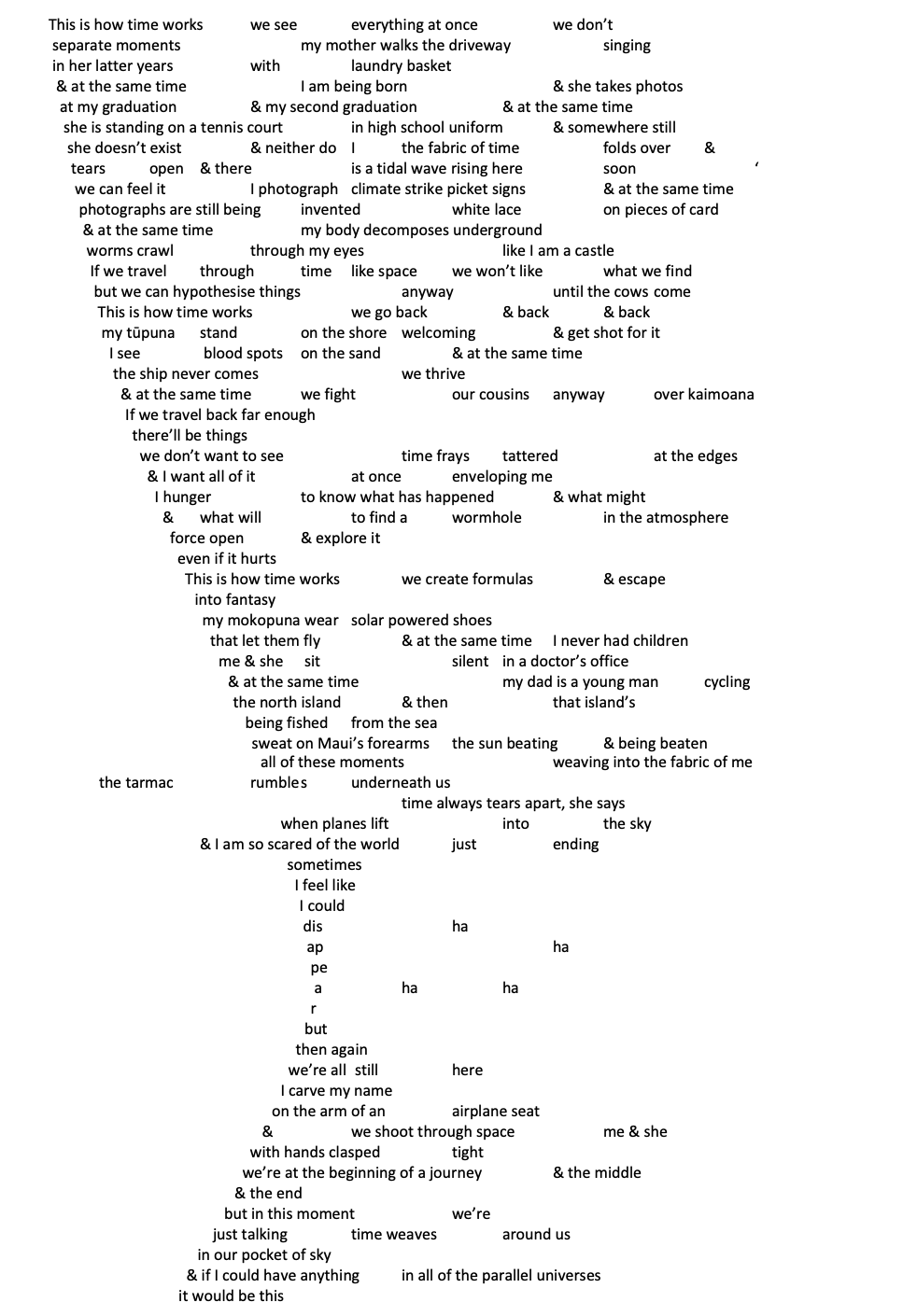
Sinead Overbye’s ‘Wormhole’ is another big, wide-ranging poem – I love Sinead’s writing in this form (see also her ‘The River’, ‘Hinemoana’ and more). She always uses her experimentations with the layout of her poem to structure and guide the reader to something deeply felt – she’s another very open-hearted writer. This was originally part of an exquisite corpse experiment for the Digital Writers Festival in Australia where it was paired with music from Ruby Solly (as well as video and coding from two Australian artists, Veronica Charmont and Ruby Quail), and I highly recommend reading it with Ruby’s accompaniment.
Chris Tse and Louise Wallace are both two of my favourite poets and favourite people, so I picked favourites by them that I think read well next to one another. ‘Spanner–A Toast’ and ‘Why we need a reunion’ are both quiet, reflective poems that still hit me hard, years after first reading them. I remember Bill Manhire once described one of Louise’s poems as being like a pebble dropped in the centre of a lake – at first it might seem small, but the ripples keep spreading further and further in your mind after you’ve read it. I think both of these poems do that.
Tayi Tibble’s ‘Karakia 4 a Humble Skux’ is the most recent poem I’ve read that stopped me in my tracks, so it’s the last poem here. It comes towards the end of her new book, Rangikura, and after all of the turbulence in that collection is an incredible moment of calm and transformation – Tayi is always shifting and surprising me as a reader, and she does it again here.
The poems
The Fall
for Meg
I had been painting the blue sky a brighter blue. I had been higher than I thought possible. When I fell, the sun wheeled spokes of light about my head
I make no excuses for my fall – anyone that aims at such heights must take the necessary precautions. He must take care to lean his ladder against a fixed object, preferably a star.
O love, knowing your constancy, how did I fail to lean it against your heart?
Alistair Te Ariki Campbell
from It’s Love, Isn’t It? The Love Poems, Alistair Te Ariki Campbell and Meg Campbell HeadworX, 2008
schön
my girl watered her cacti until they drowned my girl filled my house with flowers until the house coughed and fell down
my girl ties yellow ribbons to my hair with her cold hands and calls me beautiful in swooping german and my girl laughs
when my girl laughs she cuts my life in two and two again where she kisses me there is love fizzing from my cheeks to the car windows
and we walk into the supermarket at midnight when the lilies have gone quiet and hold hands past the eggs and milk and cut-price easter bunnies
when my girl wakes up she looks at me close and still smiles my girl nearest to me in the world plucks her eyebrows and frowns and proves her face
my girl and I, here we are, refusing to decide what to feed each other in the crumbed kitchen with the lights off
my girl and I spill our egg yolks on wednesday’s astrology forget that we are paper boats pushed out to sea by wistful hands
my girl forgets with me the drycleaning ticket my girl forgets with me the breakfast cost
my girl becomes a calendar and I curl up inside her my girl becomes a tongue twister and I curl up inside her
my girl lets the spring in through her hands she puts her hands over my ears and I remember how it feels
it is nice and nice and nice
Sophie van Waardenberg
from Mimicry 4, 2018
Hey girls
Hey girls could we dance in the glister of a winter night could we hum along to the hazy beat of jazz? We could be neon
we could be starlets eyeliner like slits in our skin holding that little 20s powder compact in the shape of a gun (with a matching bullet-shaped lipstick).
God, girls I’d love to glow as green as radium glassware, discarded in the night like a ghost’s banquet, all the dead dames and dandies
sipping toxic wine, listening to the click of the Geiger counter getting louder louder louder, girls, there are graves that still hum with radiation, that you
can’t stand too close to or your cells will go haywire split, swirl, divide oh girls I’d paint my lips fluorescent green just to poison for 24,000 years longer.
Hey ladies if the jazz gets too much then how about we listen to the slow descent into tragedy that Chopin always reminds me of like the blood
crusted onto a stale knife with lapis, emerald, ruby on the hilt. We could waltz far too close at the ball cause a scandal come home with
our petticoats swapped around and smelling like each other, so much so that the swallows would change their paths, mix up their routes confused
with the exchange of souls and lace, and love. My girls, I could be the humble gardener with crooked teeth and dirt down my nails you could be the fair dame
who never accepts marriage proposals and spends all her time planting violets to coat in coarse sugar make the bitter petals sweet. Girls, we could dance
in the dry-throated-heart-thumping mess of waiting backstage before a show, listen to the crowd shout louder than the glaring stars. We could wear huge
plastic earrings, so heavy they can only be worn once a year. Girls, let’s tie the ends of our button-down blouses and make them into crop-tops wear sunglasses on
our heads, but never let them blind us to our brightness. Hey hey hey girls if flowers bloom on my grave then I hope they have disco lights on their stamens
so people never forget the sweat-slicked thumpthumpthump of my past; the statues of the Greeks were once painted and were hideously gaudy, but we forget that things were not always
just bronze, marble, and plaster. We forget the click from the gravestones, growing louder every day. Ticktickticktick tick, the ground is growing heavy from the weight of such
blistering souls it carries. Tickticktickticktick, girls, before it’s too late let us paint ourselves with the brightest pigment and burn our kisses into history books ‒ xoxoxo.
Cadence Chung
from Poetry New Zealand Yearbook, Massey University Press, 2021. The poem was the winner of the 2021 Poetry New Zealand Yearbook Student Competition, Year 12 division.
MH370
A whole ass plane disappeared five years ago and we still Take the bins out and get Thai takeaway
Turn on the news and they’re talking about the print on the royal baby’s bib and I feel like dragging a really large wine glass into somewhere crowded and politely drowning in it to force the point that an ENTIRE plane disappeared OUT OF THE SKY and it isn’t the first thing the Prime News guy opens with like
“Kia ora good evening, I’m Eric Young, an entire fucking plane disappeared 1825 days ago, and this is prime news”
I am no expert in planes or in flight or in anything I am silly and stupid and stuck on this, unattractively, like a mad child
but: an airplane, gone, vanished that flushed, roaring engine 227 passengers, 10 flight attendants, 2 pilots and a snack cart
And the world continues, which I guess is what it does But I want to place a formal compliant to whoever is in charge of this kind of thing that cornflakes shouldn’t go on special when a plane is missing, or at the very least milk should also go on special at the same time
A plane leaves and we look for it and when we don’t find it, we go on. We let the world get away with being this big. Worse- we know it’s this big and we don’t spend all our time afraid. That is the point. Sorry it took so long to say so. Something should not be so large and unforgiving
Caroline Shepherd
from Mimicry 5, 2019
Children are the Orgasm of the World
This morning on the bus there was a woman carrying a bag with inspirational sayings and positive affirmations which I was reading because I’m a fan of inspirational sayings and positive affirmations. I also like clothing that gives you advice. What’s better than the glittered baseball cap of a stranger telling you what to strive for? It’s like living in a world of endless therapists. The inspirational bag of the woman on the bus said a bunch of stuff like ‘live in the moment’ and ‘remember to breathe,’ but it also said ‘children are the orgasm of the world.’ Are children the orgasm of the world like orgasms are the orgasms of sex? Are children the orgasm of anything? Children are the orgasm of the world like hovercraft are the orgasm of the future or silence is the orgasm of the telephone or shit is the orgasm of the lasagne. You could even say sheep are the orgasm of lonely pastures, which are the orgasm of modern farming practices which are the orgasm of the industrial revolution. And then I thought why not? I like comparing stuff to other stuff too. Like sometimes when we’re having sex and you look like a helicopter in a low budget movie, disappearing behind a cloud to explode. Or an athlete winning a prestigious international sporting tournament at the exact same moment he discovers his wife has just been kidnapped. For the most part, orgasms are the orgasms of the world. Like slam dunking a glass basketball. Or executing a perfect dive into a swimming pool full of oh my god. Or travelling into the past to forgive yourself and creating a time paradox so beautiful it forces all of human history to reboot, stranding you naked on some distant and rocky outcrop, looking up at the sunset from a world so new looking up hasn’t even been invented yet.
Hera Lindsay Bird
from Hera Lindsay Bird, Victoria University Press, 2016
Birth control
We begin with the viral video of the anaconda in New England giving birth to her exact genetic copies because she’s never even seen a male snake in all her eight years behind glass.
The headlines are calling it a virgin birth.
I watched the video this morning— now everywhere I turn, a Madonna, a snake. Oh, Rome, how you worship your silk-hipped mothers!
You heap your offerings of smoke and ash, your hard heels of bread. This church is just another Santa Maria with an old woman in a shawl and a takeaway coffee cup shaking outside.
*
At the Vatican yesterday, I wondered if he-who-sees-everything could see the small t-shaped thing inside me. I walked through the metal detectors and bag-check and had the surreal thought that the Pope might sweep down to deny me entry like Jesus in The Last Judgment.
When I first had it inserted, I bled for a month and ruined all the underwear I owned, even though I rinsed them in cold water first the way my mother taught me. Every day I’d think it’d stopped, but it kept coming— Mary’s stigmata, Eve’s—relentless like the blood after birth— uterus closing like a fist with nails cutting into the palm.
In the Vatican there is so much art, so much wealth, but what I notice is the absence of Madonnas. Every wall in Rome is frescoed with Marys except here, the holy centre.
*
At home, my daughter, who has grown so tall so quickly it looks like someone has grabbed her at either end and pulled, starts taking the pill to manage her bleeding.
Six months ago she was innocent as grass. Seems like every initiation into womanhood is an initiation into pain. Into seeing the other women busying around us, bruising hips on the corners of tables, gasping in the bathroom as their stitches tear—
trying to hold back the knowledge of it, doing their best always, always rubbing honey into the wound, almond butter into the cracks in their hands, delivering us into the knowledge of blood.
*
In this church the colours are fairy floss and hayfever and bubble-gum flavoured milk but Byzantine.
The gold is so bright that we glow a bit, even though we joked about burning up as we walked in. If god made gold, it was definitely for this—to dazzle us into a submissive kind of belief.
But, later, all these churches later, what I remember is the fresco of the one woman with her arms held wide trying to call her companions to order, like Bitches, please, and that poor woman on her left with a toddler and a baby on her lap each clamouring for a breast.
Another woman seems to be resting a sandalled foot casually on the decapitated head of a man. Her robe drapes a bit in the blood, but she’s too deep in conversation to notice that. On the far side of the group the woman in blue has her arm raised to receive a raven while she whispers in her friend’s ear.
This is the pastel chaos of womanhood. And behind them all in black, a neat semicircle of men.
*
What’s helpful is to know what the line ‘Blessed be the fruit’ actually means. It’s what the serpent said to Eve just before she bit—what Eve said to Adam juice dripping down her chin.
*
In Rome, outside every church are four or five armed soldiers and a jeep, spilling ash from their cigarettes between the cobblestones, watching. Kitset boys in camouflage and blood-red berets.
I sit on the steps of the fountain and google the church— the first church in Rome dedicated to Mary, it holds the head of the virgin martyr Saint Apollonia. But before that it was a pagan temple dedicated to Carmenta — goddess of childbirth, prophecy and technical innovation. Inventor of the Latin alphabet.
And the old woman, begging outside? One of the soldiers calls her Maria and hands her a bomboloni wrapped in a paper napkin.
*
The light around the broken temple of the virgins is orange and thick. If the flame went out, the women were blamed for being unchaste. Whoever the culprit— she was buried alive with just enough apricots and milk
to make the death a low-angled wasting. What would her heart do, while her face was pulling back into its bones? She would cry, and you would too, for spending your life a servant to fire, and never knowing how it felt to burn.
*
Parthenogenesis is the ancient word for a virgin birth— not magic, but a well-documented biological process in many plants and animals. Typically, what has happened
is that if men can’t explain a thing, they call it witchcraft and destroy it. There is a hymn for everything here and this is the hymn for days made narrow through lack of sleep. This is the hymn for the good-bad gift of knowing.
Hannah Mettner
from Sweet Mammalian 7, 2020
Wormhole
Sinead Overbye
from Scum, July 2020
Spanner—A toast
To be the sun. To be locked in the care of glass. To show, then offer. To know that love is the most dangerous sting yet to still give up an arm. To wake from machines and know your hope will never be yours alone. To take to those machines as an unexpected spanner. To fill a touch with a complete backstory. To leave sugar at my door to keep you close. To crave
but not seek. To know the future and avoid it. To accept that after silk comes rain from dark, honest clouds. To lose a smile at a storied game of chance. To let the morning sweep away the last nine months. To wrong no other even when the line’s gone dead. To family and friendship. To starts, to ends, to towers we go.
Chris Tse
from He’s So MASC, Auckland University Press, 2018
Why we need a reunion
Something about long driveways, wizened trees sprawling overhead, the stew and the yeasty bread. Country comes from the stereo. I like it, I admit – but only in this house.
At the lunch table it’s the same old stories – comforting like the meal. What will you do? My family’s favourite question. I try to think of a new answer, one they might not mind.
Nana broke science. She overpowered our genes – wrestled them to the floor. Let’s forget about who got the coffee table she made from shells. But who did? Let’s forget that.
I could have used a funny uncle growing up. Call me ‘Boss’, he said, and we did, but never saw him much. Other than that, I can’t mention names – everything is touchy still. We won’t be here forever you know, the gorse will eat the hills.
Louise Wallace
from Since June, Victoria University Press, 2009
A Karakia 4 a Humble Skux
I take a bath in my body of water I take a bath in my body of water
I know I am the daughter of rangi papa tangaroa I know I am the daughter of rangi papa tangaroa
& every yung god who fucked it up before me. & every yung god who fucked it up before me.
Every day I breach the surface cleanly Every day I breach the surface cleanly
& step out dripping so hard & step out dripping so hard
ya better call a plumber. ya better call a plumber.
God I’m a flex. God I’m a flex.
I’m God’s best sex. I’m God’s best sex.
I am made in the image of God. I am made in the image of God.
I am made in the image of my mother. I am made in the image of my mother.
I am made in the image of I am made in the image of
my mountain my river my whenua
my mountain my river my whenua
Yeah I’m as fresh as my oldest tipuna. Yeah I’m as fresh as my oldest tipuna.
Even when I’m lowkey I’m loud. Even when I’m lowkey I’m loud.
Lil, but a million years old. Lil, but a million years old.
I’ve been germinating like a seed I’ve been germinating like a seed
been on my vibe like an atom been on my vibe like an atom
& I am wilder than anything & I am wilder than anything
my ancestors could have imagined. my ancestors could have imagined.
So release the parts of me that call for change So release the parts of me that call for change
but the energy is stale. but the energy is stale.
I’m switching it all up I’m switching it all up
fishing stars into the sea fishing stars into the sea
and painting the skyful of whales. and painting the skyful of whales.
Keep it humble, keep it skux. Keep it humble, keep it skux.
Keep it pushing, keep it cute. Keep it pushing, keep it cute.
I be in the marae doing the dishes I be in the marae doing the dishes
cos there’s mahi to do. cos there’s mahi to do.
Creator and Creation. Creator and Creation.
I am made of the same I am made of the same
star matter as legends. star matter as legends.
Āmene. Āmene.
Lesh go. Lesh go.
Tayi Tibble
from Rangikura, Victoria University Press, 2021
Francis Cooke is a Wellington author and co-editor (with Louise Wallace and the editorial committee of Tate Fountain, Claudia Jardine and Sinead Overbye) of Starling journal.
Hera Lindsay Bird was a poet from Wellington. She hasn’t written a poem in a long time, and no longer lives in Wellington.
Alistair Te Ariki Campbell (1925 – 2009) was born in Rarotonga and lived in Aotearoa from the age of eight. During his writing career of sixty years, he published 20 poetry collections along with novels, plays and an autobiography. His many honours and awards included a NZ Book Award for Poetry (1982), an Honorary DLitt from Victoria University of Wellington (1999), the Prime Minister’s Award for Literary Achievement (2005). He was made an Officer of NZ Order of Merit (2005).
Cadence Chung is a poet and student at Wellington High School. She has been writing poetry since she was at primary school, and draws inspiration from classic literature, Tumblr text posts, and roaming antique stores.
Hannah Mettner (she/her) is a Wellington writer who still calls Tairāwhiti home. Her first collection of poetry, Fully Clothed and So Forgetful, was published by Victoria University Press in 2017, and won the Jessie Mackay Award for best first book of poetry at the 2018 Ockham New Zealand Book Awards. She is one of the founding editors of the online journal Sweet Mammalian, with Sugar Magnolia Wilson and Morgan Bach.
Sinead Overbye (Ngāti Porou, Te Aitanga-a-Māhaki, Rongowhakaata) is a poet and fiction writer living in Wellington. In 2018 she completed her MA in creative writing at the IIML. She founded and co-edits Stasis Journal. Her work can be found in The Pantograph Punch, Tupuranga Journal, Turbine | Kapohau, Starling, and other places.
Caroline Shepherd is (still) a Victoria University student whose work has appeared in the Spinoff, Starling, and Stasis, along with some other places that do not start with S. She is based in Wellington and likes mint slices, actually.
Tayi Tibble (Te Whānau ā Apanui/Ngāti Porou) was born in 1995 and lives in Wellington. In 2017 she completed a Masters in Creative Writing from the International Institute of Modern Letters, Victoria University of Wellington, where she was the recipient of the Adam Foundation Prize. Her first book, Poūkahangatus (VUP, 2018), won the Jessie Mackay Best First Book of Poetry Award. Her second collection, Rangikura, was published in 2021.
Chris Tse is the author of two poetry collections published by Auckland University Press – How to be Dead in a Year of Snakes (winner of Best First Book of Poetry at the 2016 Ockham New Zealand Book Awards) and HE’S SO MASC – and is co-editor of the Out Here: An Anthology of Takatāpui and LGBTQIA+ Writers From Aotearoa (AUP, 2021).
Sophie van Waardenberg is a poet from Tāmaki Makaurau and a current MFA candidate at Syracuse University, where she serves as an Editor-in-Chief of Salt Hill Journal. Her first chapbook-length collection, does a potato have a heart?, was published in Auckland University Press’s New Poets 5 (2019).
Louise Wallace is the author of three collections of poetry published by Victoria University Press, most recently Bad Things. She is the founder and editor of Starling and is currently working on a PhD in Creative Writing at the University of Otago. She spent the level 4 lockdown at home with her partner and young son on the Otago Peninsula.
Poetry Shelf Spring Season
Tara Black picks poems Victor Rodger picks poems Peter Ireland picks poems Emma Espiner picks poems Claire Mabey picks poems Sally Blundell picks poems
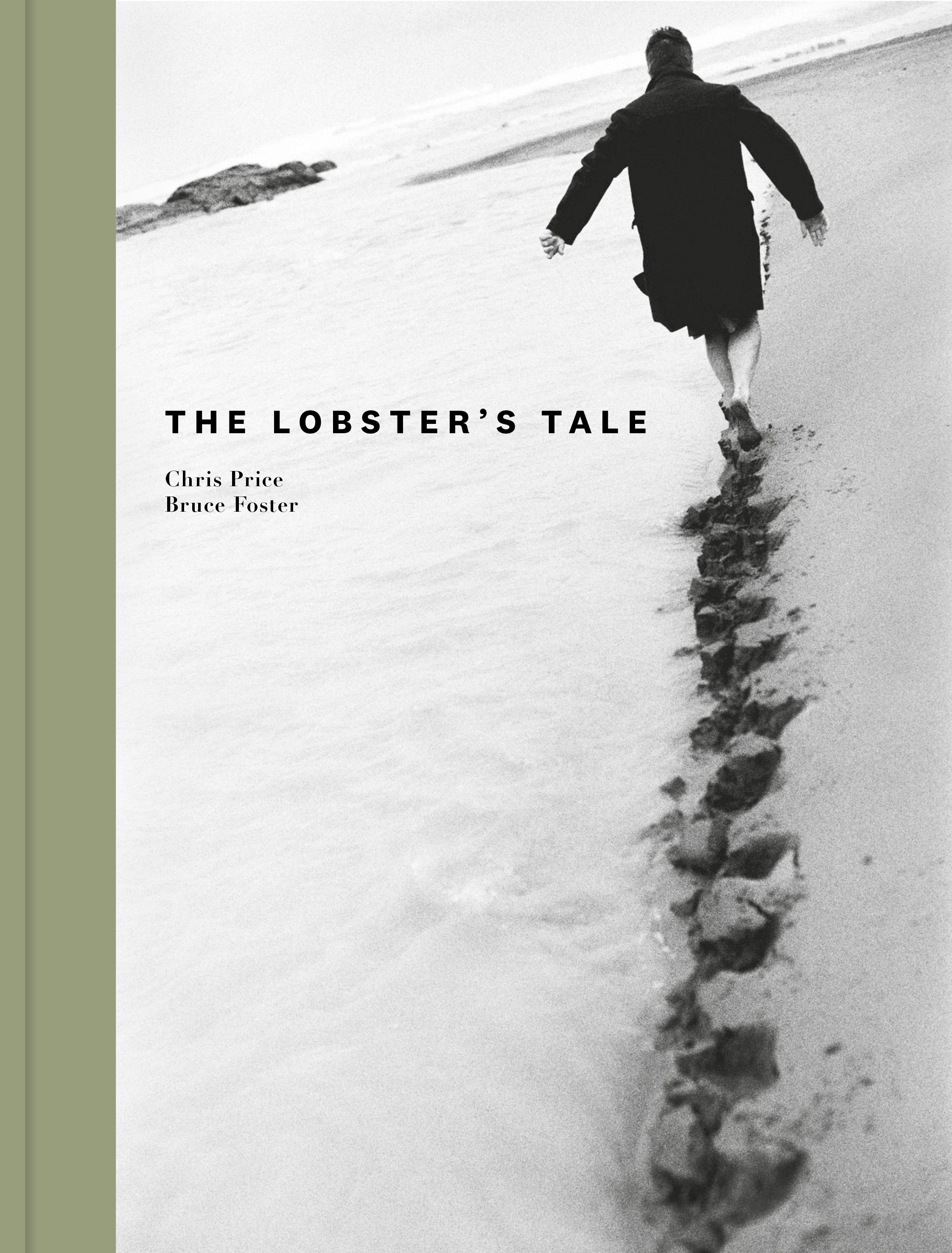
The Lobster’s Tale, Chris Price and Bruce Foster, Massey University Press, 2021
Lloyd Jones’ Kōrero series invites a collaboration between ‘two different kinds of artist intelligence’ on a specific topic. The first two books were a triumph of image, text and design: Lloyd Jones and Euan Macleod (High Wire); Paula Morris and Haru Sameshima (Shining Land). The third book The Lobster’s Tale brings together photographer Bruce Foster and writer Chris Price. A sentence threads along the bottom of the page, there are Bruce’s photographs and there is Chris’s text. The photographs track sky water land, imprints of existence. The paragraphs draw upon multiple voices that also navigate questions of being. The final and fascinating leg of the journey is the conversation that emanates from photographs, text and sentence thread.
The sentence thread running along the bottom of the pages, is described by Chris as a paragraph, a ribbon. A paragraph ribbon that is a poetic and fascinating accretion. An at-times borrowed thread that draws upon the words of Ursula LeGuin and William Beebe. As you turn the page, the paper rustle breaks into the stream of reading, a tiny rupture, visually and aurally. Which is how I read the book as a whole. Ideas arrive and I pause. The thread is an itinerary, full of pit stops and bridges and, as with any voyage, I can only hold it in pieces. I grasp the damaged earth, weather, diverse terrain, the air we breathe, definable time, indefinable time.
I travel with the paragraphs next, and each paragraph, reminiscent of poetry, expands in generous frames of white space. The writing is both intricate and plain. Complex issues of ‘being’ come to the foreground. ‘Being’ becomes notated existence, whether lobster or human, whether voyage or longing, repleteness or hunger, plunder or plenitude. Suicide is a linking echo. Albert Camus, Tupaia, Jonathan Franzan, Ursula Le Guin, David Foster Wallace, among others, make appearances. Yes, lobster is a starting point, from which reading and research radiate. Fascinating lobster facts and anecdotes reside alongside philosophical nuggets. I am attracted to these nuggets gleaming in the oceanic dark, like landmarks on my voyage into the unknown. The writing is both of and beyond the lobster. The writing is a means of becoming. ‘A profound thought,’ says Camus, ‘is in a constant state of becoming’.
The photographs register as loading bays for contemplation: secret-holders, blurred, still, even stiller, shimmering, creased and folded, abstract, political, sequences of trails, debris, impacts, light, land, water. The photograph is a means of breathing in the light. Facing our fragile future. The sequence itself offers its own haunting itinerary, a voyage that is more about the getting there than the destination. I join the other spectators, my back to the lens, gazing spellbound at the horizon, the infinite pull of water.
And then I pivot, and view the sentence thread and the paragraphs also as creased and folded, as shimmering talk, as sequences of trails and debris.
To read The Lobster Tale in the time of Covid is to refresh the voyage. It becomes imperative, in the face of difficulty and uncertainty, to acknowledge that everything is intensely personal, elusive and far away. Writing reviews is tough. I need voyage. I need anchors. And I need books, so lovingly crafted as this one has been, books that matter. I look forward to the next collaboration/conversation in the Kōrero series.
Chris Price reads an extract ‘below-the-waterline’ text from The Lobster’s Tale
Chris Price is the author of three poetry collections and the hybrid ‘biographical dictionary’ Brief Lives. She has also collaborated with NZ physicists (in Are Angels Ok?), and with German poets (in the bilingual anthology Transit of Venus | Venustransit). Chris convenes the MA Workshop in Poetry and Creative Nonfiction at the International Institute of Modern Letters.
Bruce Foster’s current photographs consider the impacts on nature of political decisions and corporate actions. Recent touring exhibitions that include his work are: the ‘Kermadec Project: Lines Across the Ocean’, an initiative articulating the issues facing one of the few pristine ocean sites left on the planet; ‘Wai, the Water Project’, an exploration of the cultural, conceptual and imaginative aspects of waterways and the existential threats they face; and ‘Toitū Te Whenua – The Land Will Always Remain’.
The photographs in this book were made between 1996 and 2020. For more information
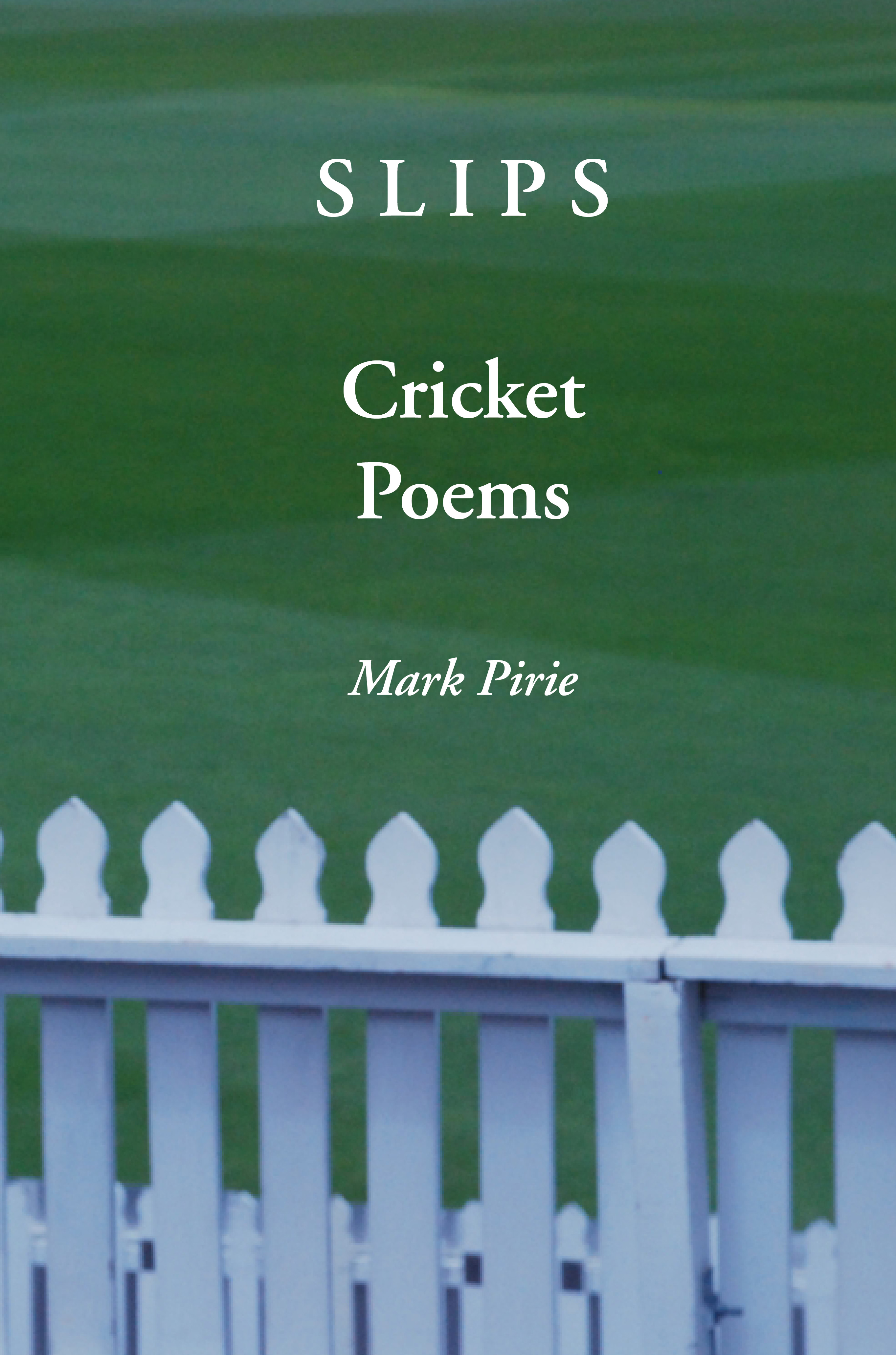
When I was a child, my father held his transistor to his ear to listen to the cricket, and somehow I caught the cricket bug. Decades later I got to see Vivian Richards hit the ball oh so elegantly across the grounds at Lords. I was raised on test matches, and my love for them has never faded, but now I find different delights in the game’s shorter forms. Like Mark Pirie, I stream cricket whenever I get the chance, especially when the Black Caps or the White Ferns are playing. So yes I am currently watching the ICC Men’s T20 World Cup. I am going to review Slips once a copy reaches my letter box, but yesterday I listened to the seven cricket poems Mark recorded to celebrate his new book. I got goosebumps. I love the way a poem can embrace a subject but cast light upon multiple things, experiences, memories. I found these poems so very special on so many levels. Take a listen.
Mark Pirie reads 7 poems
The Streaming Room
Park Song
Dreams
The Pavillion:
Bradman, in Wellington
Joe
Martin Crowe
Mark Pirie (b.1974) is an internationally published New Zealand poet, editor, publisher and archivist for PANZA (Poetry Archive of NZ Aotearoa). In 2016, his selected poems, Rock & Roll, was published by Bareknuckle Books, Australia (available from the publisher). Other books include a biography, Tom Lawn, Mystery Forward (ESAW, 2018), an artbook Folk Punk (2020) and Gallery (poetry) published by Salt, England, 2003. He is a former founder/editor of JAAM, 1995-2005, publisher for HeadworX 1998-, and currently edits broadsheet: new new zealand poetry, 2008-. Website
Bill Manhire founded the creative writing programme at Victoria University of Wellington, which a little over 20 years ago became the International Institute of Modern Letters. His most recent book Wow is published by Victoria University Press in New Zealand and Carcanet in the UK.
These are poems chosen in lockdown. Perhaps it shows. They are rooted in one place, with an eye on a flickering, shifting other. Ruth France, who died in 1968, finds herself between ‘headlands we did not know were headlands’ – France mastered the art of dislocation, her experience never quite fitted the map. Bernadette Hall’s twist in the tale, her superb tripwire, gives the land the upper hand, puts us in our place. Simone Kaho’s Blues holds the dream of music success just beyond the horizon of island time and an alcohol-fuelled bender. Rhian Gallagher is in that other place, of foreign sounds and welcome anonymity. Selina Tusitala Marsh’s perfunctory dismissal of ‘Jimmy’ Cook from his step on the podium of our history; Richard Langston’s gentle last rites for a roadkill seabird; the charged adolescent hopes in Airini Beautrais’ The Library – from our masked up, emptied spaces, these are Apirana Taylor’s reasons for writing: the richness of the land given to the poor.
Sally Blundell
The Poems
Near Hurunui
It is surprising, not far from home, to discover An unknown, a shy bay where the water is very blue.
Where the road comes in through the bush Casually, and arrives with no rush
But just comes there, beside the beach. Where the headlands we did not know were headlands reach
Blue-shadowed into the the blue sea, stealing Each from the other as an old remembered song
Of Greek islands lost, a long time ago. There is a a feeling here of sleep, too
Many completed times we did not have part in, And a strangeness as of other gods than our own
Walking among these hills. It is good in some ways To come at evening back over the high ranges
Towards our own land, to leave such shadows behind us, And feel tired, as though we have been a long way.
Ruth France
from No Traveller Returns: The selected poems of Ruth France, ed. Robert McLean, Cold Hub Press, 2020
The River Whau
for Linda
she tells me how her big desire is to capture the River Whau
every day she sends me another photo
here is the river in gold dust here is the river in ice here is the river in mist as it twists the sweet daily bread of language
who can explain the mystery of desire?
now, we’ve both been captured by the River Whau
Bernadette Hall
from The Ponies (Victoria University Press, 2007).
Poem note: The Whau estuary is in Kelston. Auckland. The quotation is from Janet Frame’s poem, ‘I Write Surrounded by Poets’, from The Goose Bath (Random House, 2006)
Blues
Andy Blues, man, soul man let’s jam to the view Do you want a cup of tea brother? How did we get home last night? Nah – good call good call. Things have moved on man it’s another day. I’d give you that cat if it was mine I swear sister. Nah I’m Sāmoan, mainly Sāmoan. My woman – she saved me I like to think of her as an angel I haven’t seen her all weekend she doesn’t like to see me when I am on a bender. Don’t you know who I am? I’m Andy Blues I’m gonna make it big in the UK and come back and buy this street. Yeah that’s what I said on Police Ten 7 haha cos they said You’ve got to turn it down sir but here drink this sis you gotta hydrate all the time on the island. That’s it have a big long drink.
Simone Kaho
from Lucky Punch, Anahera Press, 2016
Abroad
I
Your own voice comes back at you accentuating the rise as if scaling a staircase of sound, and everything here goes the other way round. Everything you say is in question.
II
For the first time in your life you feel free of your story, walking street after street in a city that is layered with history. You are alone; you are in a zone of millions. Anonymity shines down on you from a sky so unclear after years you will still not know its true colour.
III
The islands shimmer against damp red brick, flaunting their best appearances: wild mountains & rivers & sea. A tape in your head plays the earliest memories. That girl, you mother says, where she has gone?
Rhian Gallagher
from Shift, Auckland University Press, 2011
Breaking Up With Captain Cook on Our 250th Anniversary
Dear Jimmy,
It’s not you, it’s me.
Well, maybe it is you.
We’ve both changed.
When I first met you you were my change.
Well, your ride the Endeavour was anyway on my 50-cent coin.
Your handsome face was plastered everywhere.
On money on stamps on all my world maps.
You were so Christian you were second to Jesus and both of you came to save us.
But I’ve changed.
We need to see other people other perspectives other world views.
We’ve grown apart.
I need space.
We’re just at different points in our lives —
compass points
that is.
I need to find myself and I can’t do that with you hanging around all the time.
Posters, book covers, tea cozies every year, every anniversary.
You’re a legend.
I don’t know the real you (your wife did burn all your personal papers but that’s beside the point.)
I don’t think you’ve ever really seen me.
You’re too wrapped up in discovery.
I’m sorry but there just isn’t room in my life for the two of you right now:
you and your drama your possessive colonising Empire.
We’re worlds apart.
I just don’t want to be in a thing right now.
Besides, my friends don’t like you.
And I can’t break up with my them so …
Selina Tusitala Marsh
from Ko Aotearoa Tātou: We Are New Zealand An Anthology, eds Michelle Elvy, Paula Morris & James Norcliffe, Otago University Press, 2020
Seabird
I have not forgotten that seabird, the one I saw with its wings stretched across the hard road.
One eye open, one closed. I wanted to walk past,
but the road is no place for a burial – I picked it up by the wings
took it to the water & floated it out to sea,
which was of no use to the bird. It had ceased. I like to think someone
was coaching me in the small, never futile art, of gentleness.
Richard Langston
from Five O’Clock Shadows, The Cuba Press, 2020
The library
The library is full of people looking for love. At the sound of footsteps approaching, a boy turns around with a meaningful glance, and casually slips a pencil behind his ear. Girls pause on the landings, clutching armfuls of books to their breasts. Sometimes, you feel sorry for these people. You wish this wasn’t happening. All you want is a book, and all the shelves are filled with eyes of longing.
Airini Beautrais
from Secret Heart, Victoria University Press, 2006
To write
to write of the mountains to write of the rivers to write of the lakes to write of the seas to write of the land to write for the poor that is the dream
Apirana Taylor
from Ko Aotearoa Tātou: We Are New Zealand An Anthology, eds Michelle Elvy, Paula Morris & James Norcliffe, Otago University Press, 2020
Sally Blundell is a freelance journalist and writer in Ōtautahi Christchurch. She holds a PhD from the University of Canterbury. She was books and culture editor for the NZ Listener and a judge (fiction) in the 2018 Ockham New Zealand Book Awards. She was awarded MPA journalist of the year in 2020 and was runner up as reviewer of the year in this year’s Voyager Media Awards.
Airini Beautrais lives in Whanganui and is the author of four poetry collections and a collection of short fiction. Her most recent poetry collection is Flow: Whanganui River Poems (VUP 2017). Bug Week and Other Stories recently won the Ockham NZ Book Fiction Award 2021.
Ruth France (1913–68) published two novels: The Race (1958), which won the New Zealand Literary Fund’s Award for Achievement, and Ice Cold River (1961); and two volumes of poetry: Unwilling Pilgrim (1955) and The Halting Place (1961), under the pseudonym Paul Henderson. Poems from a third collection, which remained in manuscript at the time of her death, are published as No Traveller Returns: The Selected poems of Ruth France (Cold Hub Press, 2020).
Rhian Gallagher’s first poetry collection Salt Water Creek (Enitharmon Press, 2003) was shortlisted for the Forward Prize for First Collection. In 2008 she received the Janet Frame Literary Trust Award. Her second poetry collection Shift, (Auckland University Press 2011, Enitharmon Press, UK, 2012) won the 2012 New Zealand Post Book Award for Poetry. A collaborative work, Freda: Freda Du Faur, Southern Alps, 1909-1913, was produced with printer Sarah M. Smith and printmaker Lynn Taylor in 2016 (Otakou Press). Rhian was the Robert Burns Fellow in 2018. Her most recent poetry collection Far-Flung was published by Auckland University Press in 2020.
Bernadette Halllives in the Hurunui, North Canterbury. She retired from high-school teaching in 2005 in order to embrace a writing life. Fancy Dancing is her eleventh collection of poetry (VUP, 2020). In 2015 she was awarded the Prime Minister’s Award for literary achievement in poetry and in 2017 she was made a Member of the New Zealand Order of Merit for services to literature in Aotearoa New Zealand.
Richard Langston is a poet, television director, and writer. Five O’Clock Shadows is his sixth book of poems. His previous books are Things Lay in Pieces (2012), The Trouble Lamp (2009), The Newspaper Poems (2007), Henry, Come See the Blue (2005), and Boy (2003). He also writes about NZ music and posts interviews with musicians on the Phantom Billstickers website.
Simone Kaho is a digital strategist, author, performance poet and director. Her debut poetry collection Lucky Punch was published in 2016. She has a master’s degree in poetry from Victoria University’s International Institute of Modern Letters (IIML). She’s the Director of the E-Tangata web series ‘Conversations’ and a journalist for Tagata Pasifika. In 2021 Simone was awarded the Emerging Pasifika Writer residency at the IIML.
Selina Tusitala Marsh (ONZM, FRSNZ) is the former New Zealand Poet Laureate and has performed poetry for primary schoolers and presidents (Obama), queers and Queens (HRH Elizabeth II). She has published three critically acclaimed collections of poetry, Fast Talking PI (2009), Dark Sparring (2013), Tightrope (2017) and an award-winning graphic memoir, Mophead (Auckland University Press, 2019) followed by Mophead TU (2020), dubbed as ‘colonialism 101 for kids’.
Apirana Taylor, Ngati Porou, Te Whanau a Apanui, Ngati Ruanui, Te Ati Awa, is a nationally and internationally published poet, playwright, short story writer, novelist, actor, painter and musician. He has been Writer in Residence at Canterbury and Massey Universities. He frequently tours nationally and internationally visiting schools, tertiary institutions and prisons reading his poetry, storytelling and taking creative writing workshops. He has written six collections of poetry, a book of plays, three collections of short stories, and two novels. His work has been included in many national and international anthologies.
Poetry Shelf Spring Season
Tara Black picks poems Victor Rodger picks poems Peter Ireland picks poems Emma Espiner picks poems Claire Mabey picks poems
As the Taliban surged back into Kabul and the international correspondents looked more exhausted with every broadcast but not as exhausted as the refugees
I thought of my young second cousin Matthew, one of the four hundred and fifty-seven flown back from Afghanistan in sealed coffins to Wootten Bassett and then, in Matthew’s case,
to York for his military funeral in the Minster, after which the gun-carriage paraded him on a tour of the packed streets before beginning its sedate procession
to the cemetery while we, the mourners, plus vanloads of soldiery sped off ahead at a pace Matthew would surely have preferred, with sirens and flashing lights, to get there first;
all of which might have been designed to persuade his parents that being blown up by a bomb at twenty-three was a worthy destiny – an opinion they are perhaps revising.
Fleur Adcock
Fleur Adcock, born in Auckland in 1934, is a highly acclaimed New Zealand poet, editor and translator who resides in Britain. She has published many collections of poems, most recently Glass Wings (2013), The Land Ballot (2014), Hoard (2017) and The Mermaid’s Purse (2021). Her awards include the 1961 Festival of Wellington Poetry Award, the Jessie Mackay Prize in 1968 and 1972, the Buckland Award in 1968 and 1979, the New Zealand National Book Award in 1984, an OBE in 1986, the Queen’s Gold Medal for Poetry in 2006, and a CNZM for services to literature in 2008. In 2019 she was the recipient of a Prime Minister’s Award for Literary Achievement.
Sargeson Prize 2021 winners focus on relationships and families
A story about the harm patriarchal communities can do is the overall winner of this year’s Sargeson Prize.
The University of Waikato sponsors the short story competition and announced the winners at the annual Frank Sargeson Memorial Lecture, which was streamed online on Wednesday night due to Covid-19 lockdown restrictions.
Lara Markstein’s story ‘Good Men’was the Open Division winner selected from 847 entries, and Shima Jack won the Secondary Schools Division with ‘Muscle Memory’, selected from 139 entries.
Markstein’s story is about the harshness of growing up in conservative, patriarchal communities.
Chief judge Patricia Grace says this story opens out, stage by stage, to form a picture of the main protagonist as part of an extended family, embracing three generations, in a particular time and place.
“Not an easy task within the confines of a short piece of writing,” says Grace, who is regarded as one of New Zealand’s best fiction writers. “Through action, reaction, interaction and vivid dialogue, characters and their circumstances are revealed.”
Markstein, from Picton, says she’d been thinking about this story after a family member revealed that their cousin wasn’t allowed to learn French.
“I find the idea of closing off knowledge to children heartbreaking, and often thought of this distant relation, until I felt compelled to write about it.
“So the story came relatively easily, by which I mean, it percolated unwritten for several years, and then I wrote (and rewrote) for several weeks.”
Markstein was born in South Africa, raised in Aotearoa, with a longer than intended interlude in the United States, where she graduated from Harvard University with a BA in English and received her MFA in Creative Writing from Warren Wilson College. Her work has appeared in a variety of literary journals and she’s currently completing an epistolary novel, titled Little Wonder.
She takes away $6000 for her prize-winning story, plus a publication fee, making the Sargeson Prize New Zealand’s richest short-story competition.
Second place and $1000 went to ‘The Duwende’ by Mikee Sto Domingo from Wellington and third place went to another Wellingtonian, Jordan Hamel, for his story ‘Unexpected item in the bagging area’.
Secondary Schools Division winner Shima Jack is a Year 12 student at Dunedin’s Logan Park High School. Her winning story ‘Muscle Memory’ explores the intricacies of relationships and the quiet permanence of childhood memories.
Grace says of all the stories in the student section, Jack’s stood out as the one most clearly defined in regards to the short story genre.
“But it stood out in other ways too,” says Grace. “Sharply drawn images bring the reader into the story. From this beginning, it progresses via the thought processes of the narrator and through words spoken … We learn of a grievance, and of a relationship somewhat on edge at this moment in time. Writing is spare, and appropriate to the mood it sets up.”
Jack says she wrote it in one intense period while listening to the song ‘Papillon’ by Johannes Motschmann, months after the idea first came to her in the form of the line ‘the slow blush of blood to skin’.
“That line sat in the Notes app on my phone for a while!” she says.
Jack has already published poetry and is the founder and editor of a writing anthology for her school where students can anonymously submit their writing to be featured in each edition.
“Towards the future, I’m focused on being more open-minded as a reader and writer and exploring different writing styles. Another ambition of mine is to start a youth writers’ group in my home city.”
Alongside $500 prize money, Jack wins a one-week summer writing residency at the University of Waikato, including accommodation, meals and mentoring.
Now in its third year, the Sargeson Prize was established in 2019 by novelist Catherine Chidgey, Senior Lecturer in Creative Writing at the University.
She says she was impressed with the extremely high quality of entries this year.
“There were enough fantastic stories to fill several anthologies and it was tough for the panel to narrow them down. Of particular note was the skill and range seen in the secondary schools entries.”
This year’s winning stories will be published on ReadingRoom, Steve Braunias’ literary section of Newsroom.
He will publish ‘Good Men’ on 16 October, ‘Muscle Memory’ on 23 October, ‘The Duwende’ on 6 November and ‘Unexpected item in the bagging area’ on 13 November.
Results
Open Division:
First: ‘Good Men’ by Lara Markstein, Picton
Second: ‘The Duwende’ by Mikee Sto Domingo, Wellington
Third: ‘Unexpected item in the bagging area’ by Jordan Hamel, Wellington
Highly Commended:
‘Close Your Eyes, Girls’ by Caoimhe McKeogh, Wellington
‘Inside the Ribcage’ by Marama Salsano, Hamilton
‘Precipitation’ by Harley Hern, Puhoi
‘Honeymoon in a Town Called Fog’ by Pip Robertson, Wellington
‘Mam’s Tables’ by Kirsty Gunn, Scotland
Secondary Schools Division:
First: ‘Muscle Memory’ by Shima Jack, Logan Park High School, Dunedin
Second: ‘What Makes a Forest’ by Jade Wilson, Kaiapoi High School
Third: ‘Ghosts’ by Stella Weston, Rotorua Lakes High School
Highly Commended:
‘Blood Orange Season/The Girl Without a Heart’ by Zia Rogers, Feilding High School
‘Flowers from 1970’ by Ryan Davidson, Wairarapa College
‘Prelude’ by Ana Faville, Palmerston North Girls’ High School
‘Second Sight’ by Gemma Bennion, Hutt Valley High School
‘Ghosts’ by Andrew Crotty, Takapuna Grammar School
‘roll the bones’ by Cadence Chung, Wellington High School
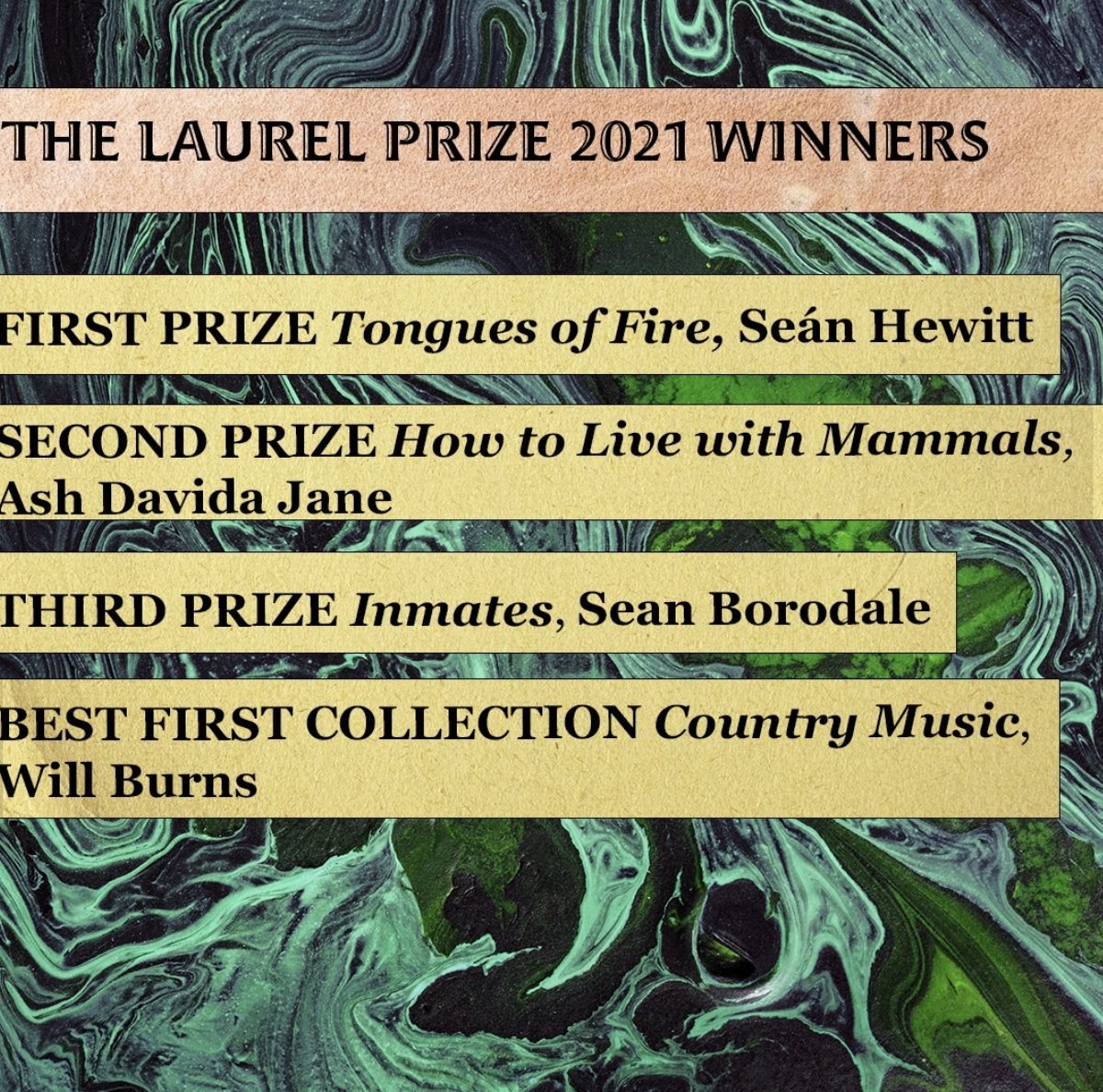
The Laurel Prize is an award for the best collection of environmental, ecopoetry or nature poetry. The Prize will further the discourse around climate crisis, environmental and ecological topics and aims to reach new audiences with environmental messages.
Simon Armitage donates his Laureate’s Honorarium of £5,000 each year to support the project.
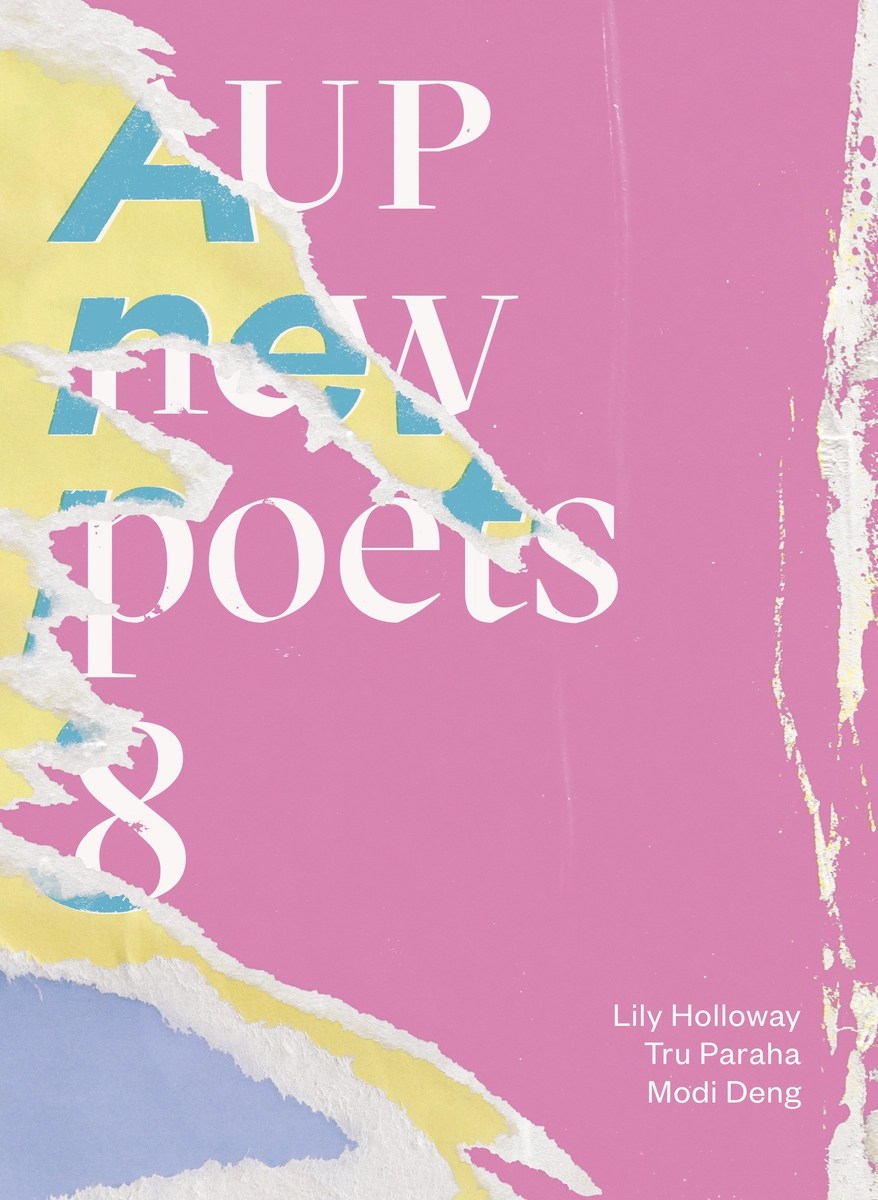
AUP New Poets 8: Lily Holloway, Tru Paraha, Modi Deng, Auckland University Press, 2021
Review extract:
Editor Anna Jackson has selected three distinctive poets for AUP New Poets 8 and has placed them in the perfect tonal order.
The title of Lily Holloway’s suite, a child in the alcove, reminds me of poetry’s alcove-like features. Poems can be miniature shelters, places of refuge, an interplay of dark and light, secret, mysterious, challenging, bulging with nooks and crannies. Reading the work is to read across myriad directions, to peer into captivating cubbyholes and, as Jackson writes in her terrific foreword, to read distance and depth.
Holloway is an award-winning writer and postgraduate student who has been published in numerous journals. I have long admired her poetry: her aural and linguistic deftness, the sweet measure of surprise, the variegated forms, the connecting undercurrents, the honey, the bitterness. Her poems run on the rewarding premise that poems don’t need the full explanation, that tactile detail and deft juxtapositions can unmask love, desire, razor edges, self-exposure. Pocket narratives are equally sublime.
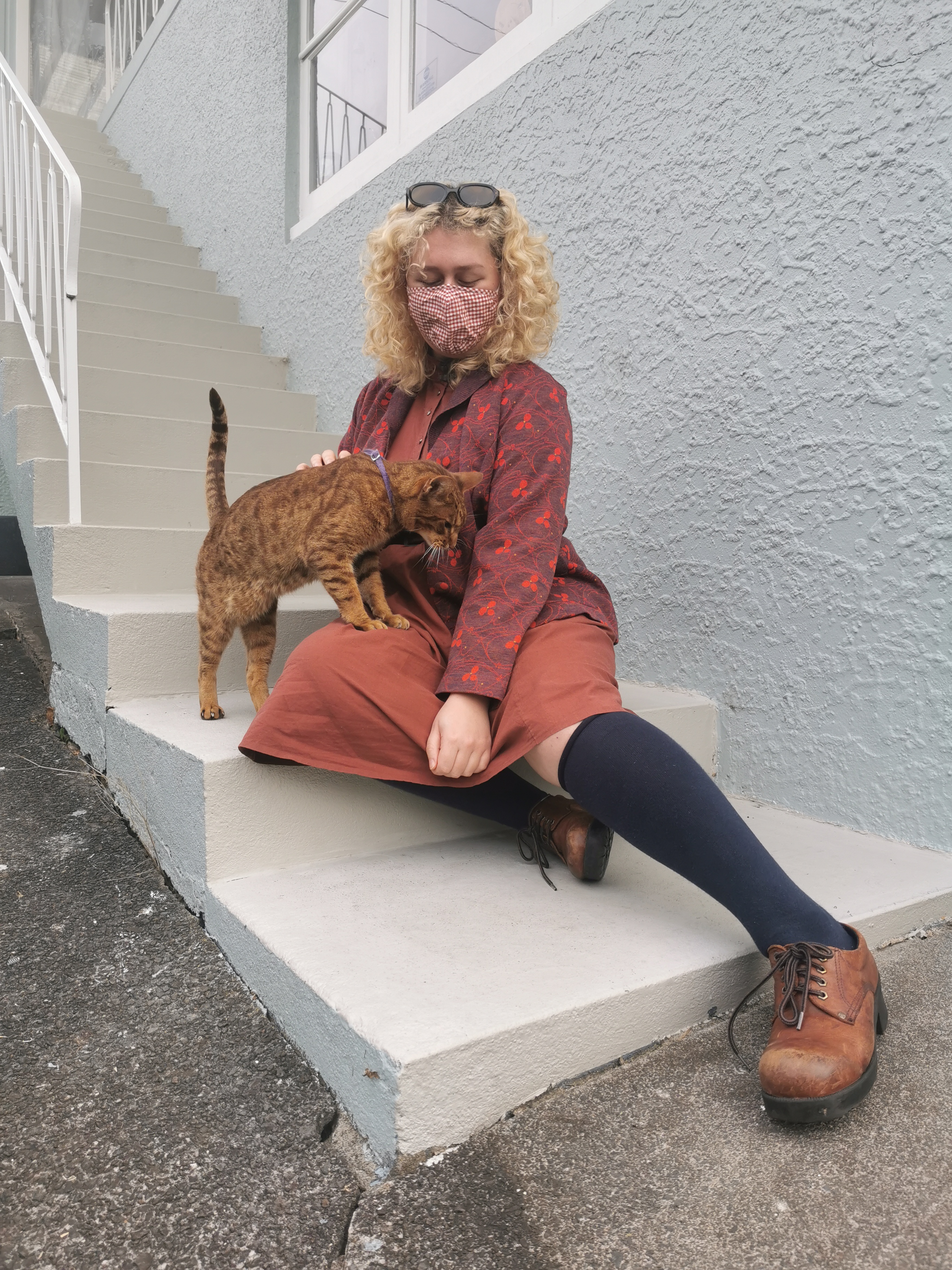
Lily Holloway(born in 1998, she / they) is a queer writer and postgraduate English student. While she mostly writes poetry, she has also tried her hand at non-fiction, fiction and playwriting. You can find her work in places like Starling, Midway Journal, Scum, The Pantograph Punch and The Spinoff amongst various other literary nooks and crannies. In 2020 she was honoured to receive the Shimon Weinroth Prize in Poetry, the Kendrick Smithyman Scholarship in Poetry and second place in the Charles Brasch Young Writers’ Essay Competition. In her spare time she enjoys op-shopping, letter writing, visiting small towns and collecting vintage Teletubbies paraphernalia. She is passionate about survivor advocacy and taking up space. You can find a list of her writing at lilyholloway.co.nz.
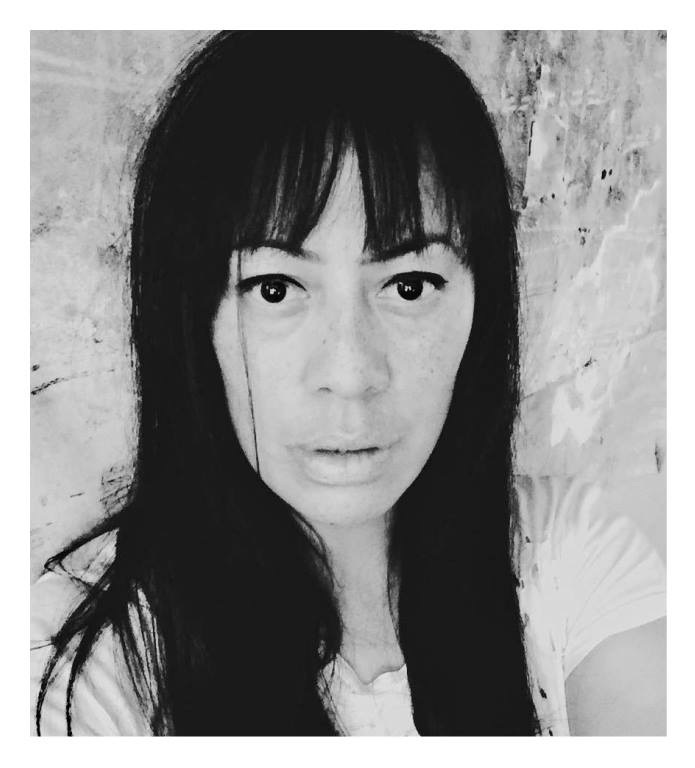
Tru Paraha resides in Tāmaki Makaurau in the suburb of Tukituki Muka (aka Herne Bay). She works as a choreographer and director, having enjoyed an extensive career in experimental dance, theatre and audio-visual arts. She is currently in the final year of a postdoctoral research fellowship in the English and Drama department at the University of Auckland. Moving between choreography, philosophy and creative writing, Tru produces live performances, artists’ pages and poems drawing on materials from deep space. She is a member of the International Dark-Sky Association and advocate for the preservation of the night sky as a world cultural heritage.
Modi Deng is a pianist based in London, currently pursuing postgraduate performance studies on a scholarship at the Royal Academy of Music. Her Chinese name 默笛 means ‘silent flute’, which her father drew from a poem by Tagore. Performances with her ensemble, the Korimako Trio, have taken her throughout the UK and her concerts have been broadcast on BBC Radio 3 and RNZ Concert. After growing up in Dunedin, she went on to complete a Master of Music with First Class Honours on a Marsden research scholarship, while completing a Bachelor of English at the University of Auckland. Modi cares deeply about literature (diaspora and poetry), music, psychology and her family.


 NZ Poetry Shelf