
Ben Brown’s The Kindling and the Blaze is poetry from the heart
1 Reply
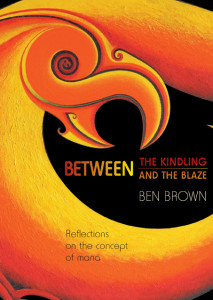
Ben Brown Between the Kindling and the Blaze (Anahera Press, 2013)
Ben Brown (Ngāti Paoa, Ngāti Mahuata) is an award-winning writer, performer and children’s author currently living in Lyttelton. His debut poetry collection, Between the Kindling and the Blaze, was completed during his residency at the Michel King Writers’ Centre in Devonport. He has previously released a CD of poetry entitled Dogtown (2010).
With scant collections by Māori writers making an appearance in New Zealand’s poetry scene, this book is an important arrival. Ben declares from the outset that these poems are ‘reflections on the concept of mana.’ A preface story introduces humans (a man) to the vastness and the smallness of the world: mountain, rock, grain of sand, tree. It speaks of how a human can furnish a shelter from sand, rock and wood, and how it can be built with both love and dignity. In this way, a family shelter becomes ‘a place of mana.’
The book, fittingly, is dedicated to whānau.
And so the poems, also a shelter for friends, family, whānau, are miniature edifices crafted with dignity and love. These poems become vessels for the poet’s loving kōrero. Mana is there between the kindling and the blaze, between an idea and and an experience. Mana is in the wisdom of the grandfather, but it is in a host of surprising things. Through this poetic contemplation, you are taken from moko to hui, from the ‘concrete cold of a city’ to Presidential dreamings, from James K Baxter to Hone Tuwhare. The poems become reattached to the world–to values and to customs.
Ben centres a lot of the poems on the page (Western poets have a habit of hugging the left-hand margin). It becomes a different way of reading with the billowing, silent beats on either side of the poems. It accentuates the music of the shortened lines that swell and contract like the belly of a vessel (that place for kōrero that comes from the heart, but that holds itself open to politics).
Listening to a selection of the poems on the CD, heightens the music and the sense of contemplation. I particularly loved ‘Taniwha’ (a subtle evocation of the force that ‘is there for all to see’), the lyrical delights of ‘The heron is God,’ the cheeky warm tribute to Hone Tuwhare in ‘Chur bro,’ the twists and turns of ‘I am the Māori Jesus’ as it jams with the Baxter original. Like Hone, Ben mixes up his language, mixes up the voices, the tone of the lines.
The book, like a good LP, demands to be replayed.
Anahera Press page
New Zealand Book Council page
Storylines page
Random House page
Interview with NZ Children’s Authors, Christchurch Public Library
Richard von Sturmer’s new collection is aglow
Book of Equanimity Verses Richard von Sturmer (Puriri Press, 2013)
Richard von Strumer‘s latest poetry collection is an utter treat. Inspired by Wang Wei’s Zen text, The Book of Equanimities (100 koans), Richard has assembled his own set of miniatures. He has used the tanka form but added a few lines to expand upon each moment. And this new collection is indeed a celebration of moments – billowing, shimmering, luminous moments in time and place. Through the act of writing, Richard stops still and opens his senses to the world and its splendid detail, and in that loving attentiveness reproduces astonishing movement.
In the introduction, Richard cites translator Yoel Hoffman’s observation that a tanka poet observes nature and in that observation observes himself (the tanka is thus a two-way mirror). It is an interesting entry point to Richard’s poems. The pleasure of reading this collection is the pleasure of contemplation, but it is not as one might expect, solely a regard of the sublime. Instead you navigate fablesque and pocket narrative, alongside the ordinary profound. Everyday detail sparks and reverberates. The poetic moment might be a transcendental landscape, but it might also be a trembling morsel of anecdote.
The physical details are glorious: a field of violets, kings, strong fingers, Jean Cocteau, weeds, an iron raincoat, the muddy waves, fishhooks, spades and shovels. Yet what elevates these miniature poems is the movement within the poem itself. There is always a shift — a tremor, a sense of humour, a wry wit, a cartwheel or tumble, an oxymoron, a doubling, a subtle difference. In the midst of the rolling of the blinds and the ebbing tide, there is a paddock ‘nothing to add/ nothing to take away.’ Alongside ‘salmon swimming upstream’ we read ‘somehow we’ve drifted away/ from our original home.’ Or to read of the ‘cough’ alongside the ‘toast popping.’ Or the person ‘who drinks/ excessive amounts of water/ is denied access/ to the swimming pool.’ Or ‘I divide my time/ between High Street/ and the Tang Dysnasty.’
This delightful book is a book of sweet harmonies, unexpected, enthralling. Like Dinah Hawken and Bernadette Hall, Richard’s poetry is aglow with wisdom, empathy and a love of poetry. I urge you to add this book to your shelves.
Richard von Sturmer is a poet with four previous publications.
New Zealand Book Council page
Richard’s Auckland Zen centre website
NZEPC page
Puriri Press page
An interview on YouTube
Dunedin reading Poetry invite

Here’s a special bonus for all of us in need of some live poetry:
Riemke Ensing will be reading at the Port Chalmers Public Library, 6.00pm on Thursday 27 February. No need to book, just turn up!
Riemke Ensing is an Auckland poet, born in Holland, and in her work ‘has distinctively synthesised European and New Zealand influences’ – NZ Book Council
She has had several volumes of poetry published. Among her recent achievements are first prize in the NZSA Kevin Ireland Poetry Competition 2012, and also in 2012 she received the Lauris Edmond Memorial Award for poetry.
Call for submissions for JAAM
Call for submissions – JAAM 32: Shorelines
Submissions are now open for issue 32 of JAAM literary journal.

Sue Wootton
For this issue we are shifting south, and are delighted that Dunedinite Sue Wootton is our guest editor for our 2014 issue. Sue is probably best known as a poet – she has published three collections of poetry, most recently By Birdlight (Steele Roberts, 2011), and has won awards for her poems. But she’s also an experienced prose writer. Her ebook of three short stories, The Happiest Music on Earth, was published in 2012 and her children’s book, Cloudcatcher, came out in 2010. Sue has twice been a runner up in the BNZ Katherine Mansfield short story awards, has been a finalist in the Sunday Star Times and Royal Society of New Zealand Manhire Prize short story competitions, and has won the Aoraki Literary Festival short story prize.
The theme for JAAM 32 is ‘shorelines’, and Sue welcomes submissions that consider this theme from any angle, loosely, or not at all.
JAAM publishes poetry, fiction, creative non-fiction, essays, photography and other artwork. Please don’t send simultaneous submissions, more than six poems or more than three prose submissions.
JAAM prefers emailed submissions. Send to jaammagazine@yahoo.co.nz, using ‘JAAM submission’ (or similar) in your subject line, so we know it’s not spam. Include your submission(s) in the body of your email. If you have particular formatting, you can also include your submissions in an attachment (.doc, .rtf, .pdf or any image file type is ok for images).
If you don’t have email, you can post submissions to:
JAAM
PO Box 25239
Wellington 6146
New Zealand
Make sure you include a stamped self-addressed envelope for reply.
The deadline for submissions is 31 March 2014, and JAAM 32 will be published in or around September 2014.
C A L L F O R S U B M I S S I O N S for Ika
C A L L F O R S U B M I S S I O N S
Ika wants to swim with you
Ika 2 is emitting a high-frequency call for submissions to its second issue. The deadline is 1 May 2014.
Ika is the literary and arts journal of Manukau Institute of Technology Faculty of Creative Arts. Ika publishes poetry, fiction, creative non-fiction, visual art and photography, from Aotearoa, the wider Pacific and beyond. Ika’s contributors include writers and artists who are fully submerged and those who are putting their flipper in the water for the first time.
Submissions can be emailed to ikajournal@gmail.com
Electronic documents are preferred, but printouts together with a self-addressed envelope may be mailed to: Ika Journal, Faculty of Creative Arts, Manukau Institute of Technology, Private Bag 9400, South Auckland Mail Centre 224, New Zealand
There is a submission limit of eight poems, eight images, or 7,000 words of prose. Inquiries are welcome.
Editors: Anne Kennedy and Robert Sullivan
More details on Sarah Broom Poetry Prize
Sarah Broom Poetry Prize 2014
The winner will be announced at the Auckland Writers and Readers Festival in Auckland on Saturday May 17.
The prize for 2014 will be $12,000.
Entries close March 14th.
Launch of page : stone : leaf by Dinah Hawken and John Edgar
page : stone : leaf
poems by Dinah Hawken
drawings by John Edgar
The publication of this, the last book from The Holloway Press, will be celebrated at the Gus Fisher Gallery, 74 Shortland Street, Auckland, at 5.30pm, Wednesday March 5, 2014.
Dinah Hawken and John Edgar will both be present to speak, read and to sign copies of the book. Some stone pieces by John Edgar will also be on display.
This is a last opportunity to acquire copies of this beautiful book (50 copies only) at the pre-publication discount of 20%, $280. For further details about the book see the attached file.
All welcome.
NEW HOLLOWAY PRESS TITLE
poems by Dinah Hawken
drawings by John Edgar
Twenty-one new poems by distinguished poet Dinah Hawken together with eight drawings from stone rubbings in crayons and pencils by leading sculptor John Edgar. Poet and artist have worked closely together for several years to produce this profound and moving book.
Dinah Hawken writes: For many years I have been instinctively attracted to the word ‘stone’ and equally attracted to stone and stones. So it has been fulfilling to work with John on this crafted book. It amazes me that a thing as dense, plain, and as taken-for-granted as a stone can give rise to so many human ideas and associations. In that respect a stone is far from inanimate. It is a catalyst, like a page. The poems in page : stone : leaf carry some of my associations with stone, along with a very short history of the page and its inseparable links with leaf and stone.
John Edgar writes: As a sculptor I have always been fascinated by written language, especially ancient symbols and inscriptions on stone, clay and paper. I have studied stele and standing stones, grave stones, church floors and temple walls, and more recently modern digital code. After much thought on my drawings for this project, I returned to the language known as ogham; an ancient text of celtic origin which was inscribed in simple lines on stone or wood.
page : stone : leaf is designed and letterpress printed by Tara McLeod on a Littlejohn cylinder press. The type is 12pt Helvetica linotype set by Longley Printing Co. Ltd. Images printed by GTO printers. Binding is by Design Bind Ltd. The paper is 290gsm Tiepolo, mould made in Italy. Hardbound, 21 x 22 cms. 42 pages.55 copies. Price until 10 March 2014, $280; from March 11, 2014, $350.
Wonderful! Gregory O’Brien’s Citizen of Santiago with photographs by Bruce Foster
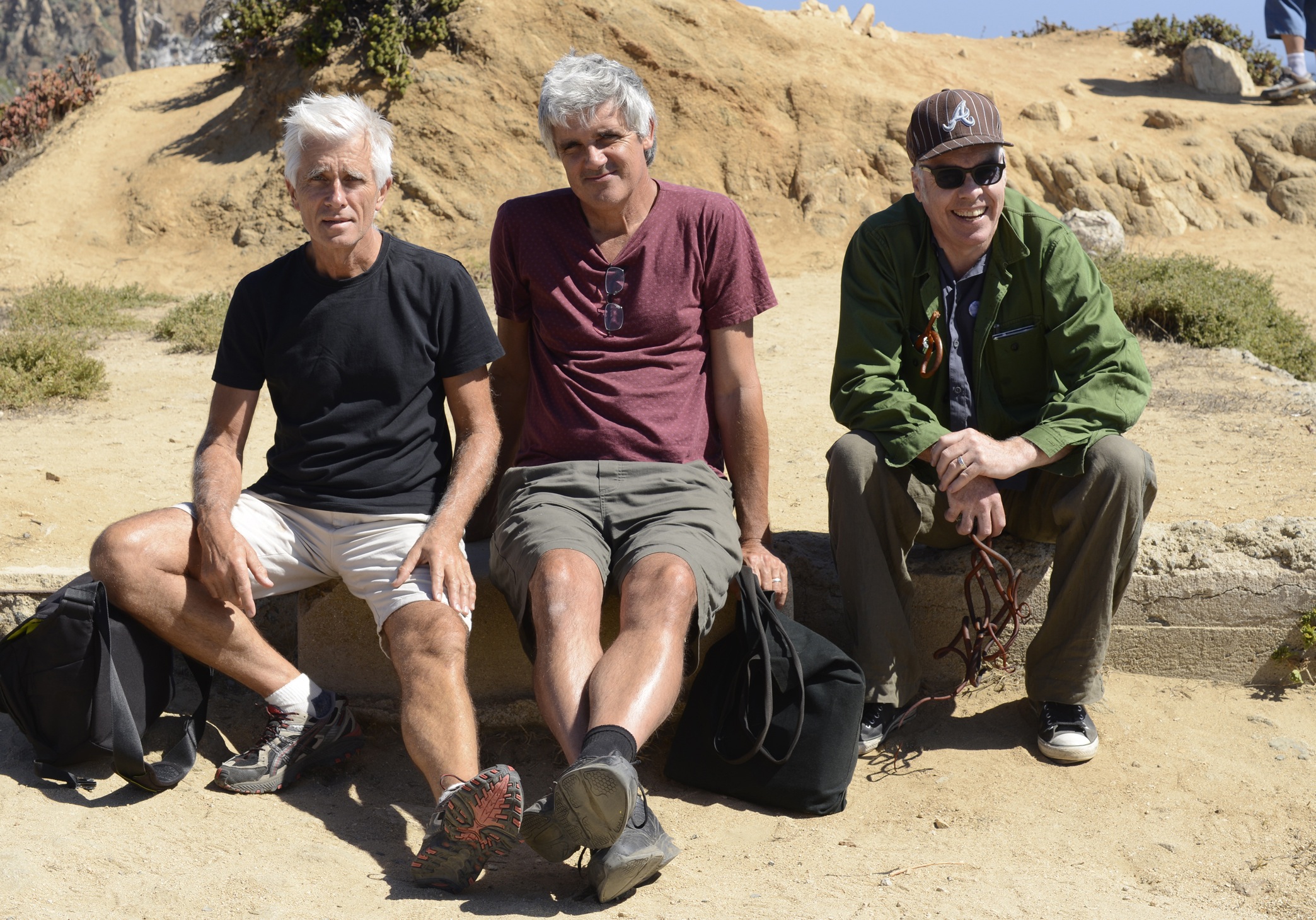
Photo: Bruce Foster, Gregory O’Brien and John Reynolds at Quintay, a short distance from Santiago on the Chilean coast, March 2013
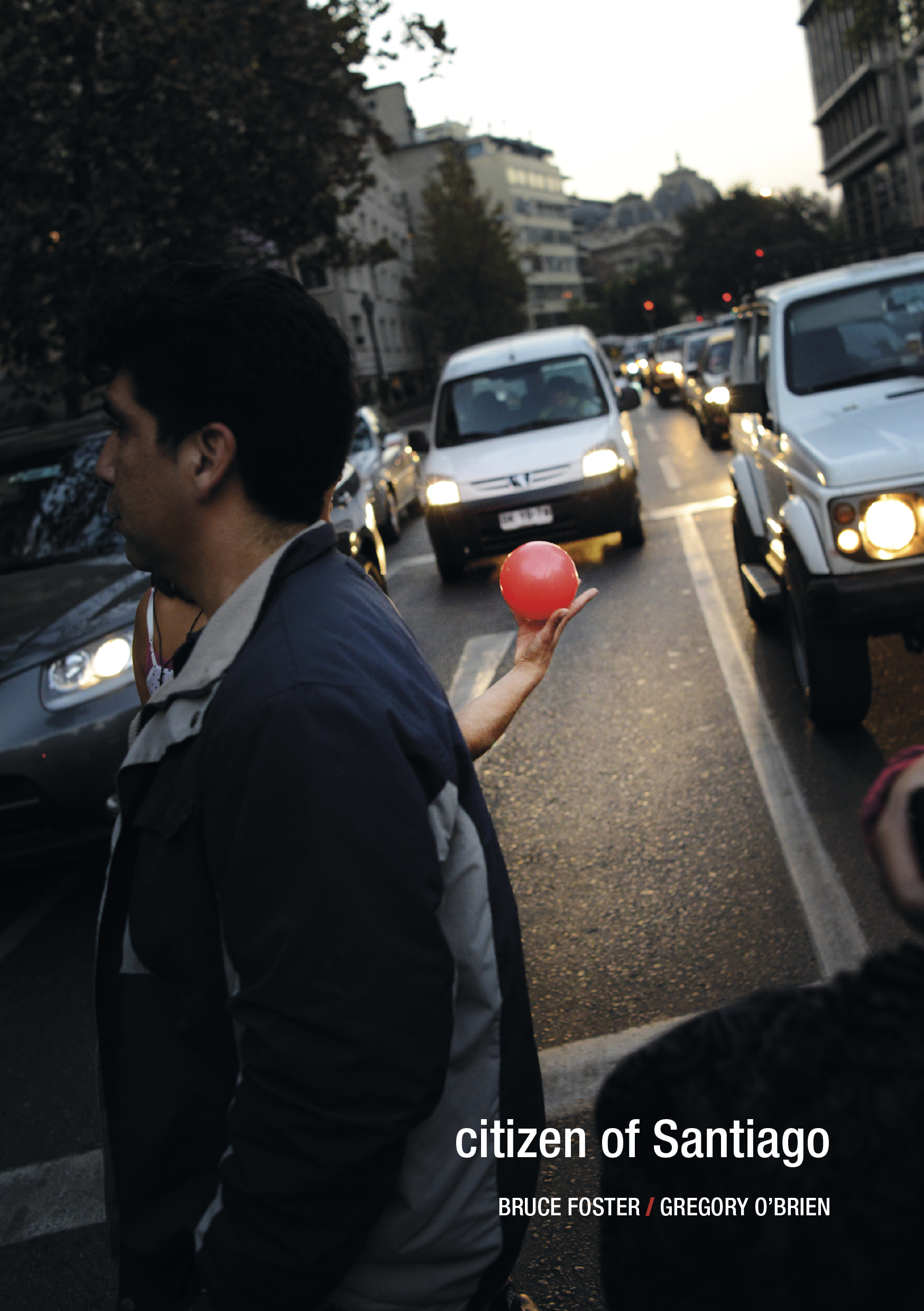
Citizen of Santiago poems by Gregory O’Brien, photographs by Bruce Foster (Wellington: Trapeze, 2013)
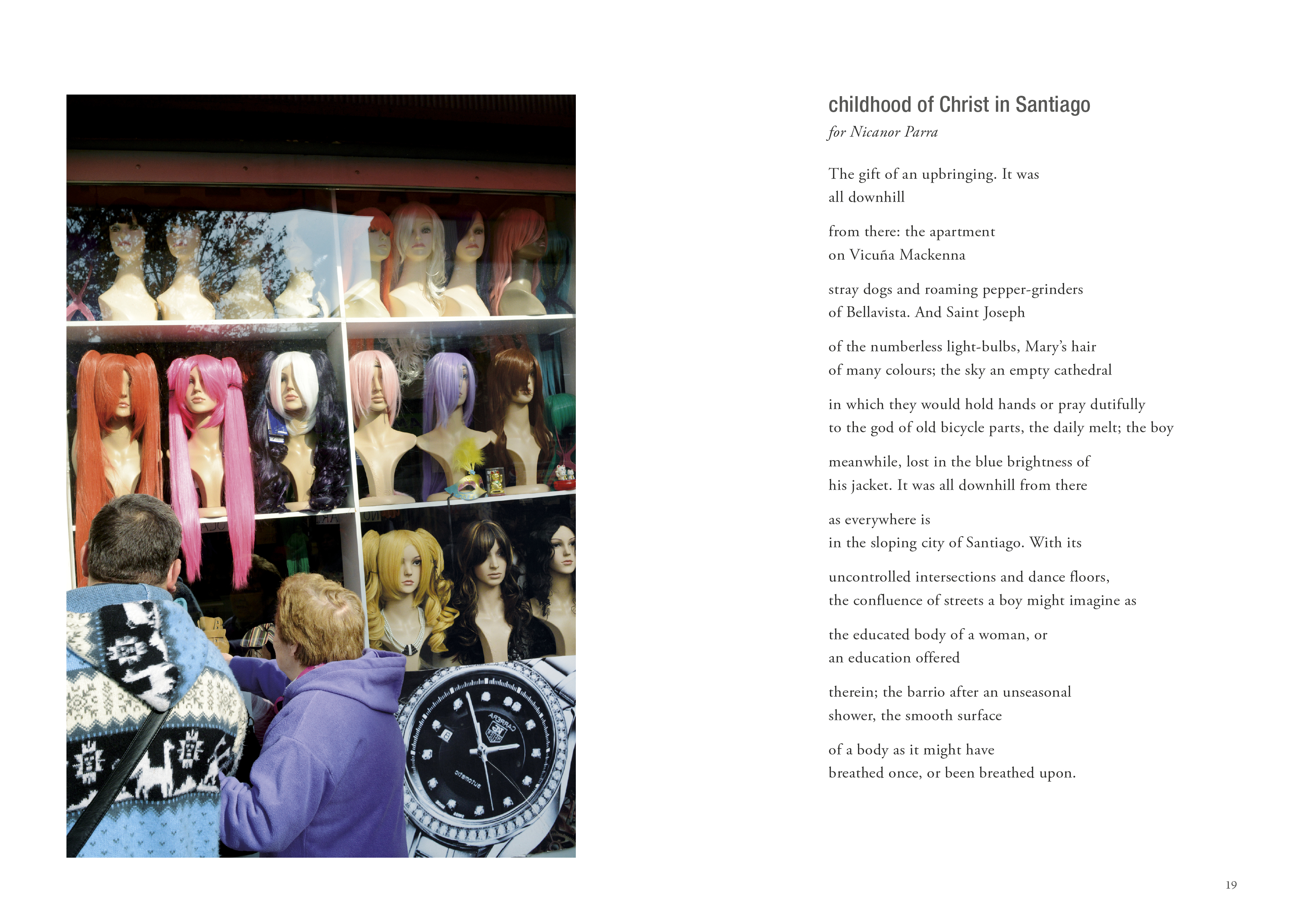
As participants in the travelling exhibition, ‘Kermadec — Art Across the Pacific,’ Gregory O’Brien and Bruce Foster stayed in an apartment in Santiago de Chile between March and May in 2013 while the show was on. Both men went exploring the city, one with camera and one with pad and pen. The urban navigation resulted in Citizen of Santiago — a delightful collection of poems and photographs.
I have always been a fan of Gregory’s poetry and have often wondered what it is that draws me to it. Partly, I think, the uniqueness of voice; the quirky mind that accumulates detail as the poet inhabits the world, and then the way that detail prompts little tracks of thought that surprise and tumble and turn.
The opening poem, ‘sombrereria,’ goes way beyond the tourist snapshot. The poet takes hold of an object that catches his attention, ‘the hat,’ and then burrows in deeper (trademark O’Brien). This poem is modulated by place (we get details that might attract the tourist eye), but to me the poem goes beyond a specific location (the hat nourishes imagination and intellect, and acts as a pivot of meditation). Lines ring out splendidly: ‘A hat goes a long way/ to making up its mind’ ‘A hat is also an ear/ listening in on/ the head’s business.’
The afterword mentions the story that the Architect Cristian Valdes told of the origins of the Valdes Chair (in a nutshell, father and son were playing tennis, and then the broken tennis racquet was transformed into a chair). It also describes how Cristian’s exhibit at the Kermedes show (two free-standing, gib-board structures) might be a prototype for a summer house that could be folded away to one wall in the off season. Gregory’s poem replays the story told, but also acts as a metaphor for the way a poem can be unfolded and refolded. This gets to the heart of what I love about Gregory’s poetry: the way his poems fold in on themselves, delicately, wittily, not just at the level of syntax but also at the level of thought and the layering of music). His lines are flipping what you see or think or feel back in on itself (like philosophical or poetic peelings — you hold the potato peeler).
Bruce Foster’s photograph’s also sidestep the expected tourist snapshot. As with the poems, there is repetition, echoes, images folding back into themselves, (easels, legs walking). The photographs place human activity centre stage; a city is more than bricks and mortar, it is a psychological state of mind, communities of people. Strangenesses. Points of empathy. Universal registers (father and son laughing in Bruce’s photo). Accumulating narratives.
In one poem, I read: ‘It was all down hill from here/ as everything is/ in the sloping city of Santiagio.’ In one photo, there is a man half hidden by a slanted tree — the tree denies us access to his face (really we only ever get a partial view on any page), but the detail within the frame is electric. The bright pink, plastic crates match the man’s trousers; you leapfrog from the hole in the tree to the diamonds in the crates to squares in the windows. In both poem and photograph, the detail is fertile ground for visual, aural and semantic pleasure.
The book, through both image and line, sets you upon the slopes of reading and viewing, and then sends you skating and skimming and stalling in this foreign place. It is a poetic treat.
The Kermadec show- Artists in the South Pacific here
Kermadec Gregory O’Brien page
Kermadec Bruce Foster page
Gregory O’Brien Beauties of the Octagonal Pool AUP
Gregory O’Brien NZ Book Council page
Entries now open for the Sarah Broom Poetry Prize — established poets welcome to enter
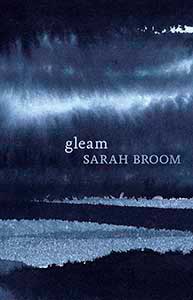
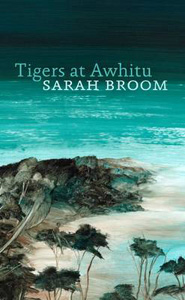
Entries are now open for the inaugural Sarah Broom Poetry Prize. Poets (both emerging and established) are invited to send in 6 to 8 poems (of which at least 5 must be unpublished).
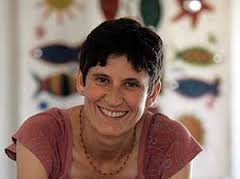
The Sarah Broom Poetry Prize is inspired by the spirit of imagination, freedom and determination that marked Sarah’s life and work. The prize aims to provide recognition for a New Zealand poet and a financial contribution to support their work.
The prize will be awarded annually, based on 6-8 unpublished poems, to encourage and support the recipient in the completion of a full manuscript of original poetry.
Entries for the Sarah Broom Poetry Prize open on 3 February 2014 and close 14 March 2014 and the inaugural Sarah Broom Poetry Prize will be announced at the Auckland Writers & Readers Festival in May 2014.
Shortlisted poets will be invited to read their poetry at a specific poetry event at the Festival.
Fundraising for the Poetry Prize is now underway and will determine the final amount awarded to the recipient. If you would like to contribute to the fund please make a donation with your credit card or internet banking via PayPal.
If you would like more information about donating please emailtrustfund@sarahbroom.co.nz
Details on how to enter here
 NZ Poetry Shelf